
A leading China factory specializing in Wireless Tour Guide Systems, Church Audio Guides, and Translation Headphones with premium OEM/ODM solutions.

Tel:+86 18922879583

Email:tiger.wang@richitek.com

RC8860 and RC2501: What a September Intake Does to a June Figure

On the twelfth of June the international office filled in one line of an order form for the autumn orientation programme: a hundred and twenty six receivers, three transmitter types, one delivery date. The number came from the admission list as it stood that morning. Nobody at the desk thought of it as a forecast. It was written as a count, with no column beside it for when the students would actually arrive, and no column for who would be allowed to change it later. The form was signed, filed and forgotten for eleven weeks.

In the first week of September the same form was pulled out three times in four days, and each time somebody asked whether the hundred and twenty six pieces were enough. The answer was different on each occasion, while the number on the paper never moved. That is the awkward part of buying for an intake: the goods are ordered against a headcount, but they are used against a timetable. A figure can be perfectly honest in June and still be the wrong unit of measurement by the time the first coach reaches the campus gate.

The Figure Written in June

The June form had four columns: model, quantity, unit price and a requested delivery week. It did not have a column for the version of the admission list the quantity came from, nor for the office that owned that version. The international office held one list, the language centre held another arranged by placement result, and the residence team held a third arranged by move-in date. All three were correct. They simply counted different things, and the form gave no way to say which one had been used.

This is worth stating plainly, because the usual conclusion is that the buyer estimated badly. The estimate was reasonable. Offers were still being accepted, visa appointments had not been booked, and the language placement test would not be sat until the students were on site. A June sheet can only carry a projected intake. What it can also carry, at almost no cost, is a note saying that the figure belongs to a named list dated the twelfth of June, and that a revised quantity has to be written against a new list rather than amended in place on the old one.

Line on the June formWhat it meant in JuneWhat the September desk needed
Quantity: 126 receiversOffers accepted by 12 JuneA named list per sitting; a peak count for the busiest sitting
One delivery weekWhen the cartons could arriveThree arrival dates; a return minute between the first two
Three model rowsThree catalogue itemsWhich sitting each row was bought to serve
Signature blockBudget approvalWho may write a revised quantity, and on which dated list

The table above is not asking for four more numbers. It is asking for four more owners. Once a line has an owner, a question about whether the kit is enough becomes a question about a specific sitting on a specific morning, rather than an argument about a total that nobody can reconstruct. The distinction matters most when the same equipment is expected to serve more than one group in the same week, which is exactly what happened at the end of August.

Why Arrival Comes in Sittings

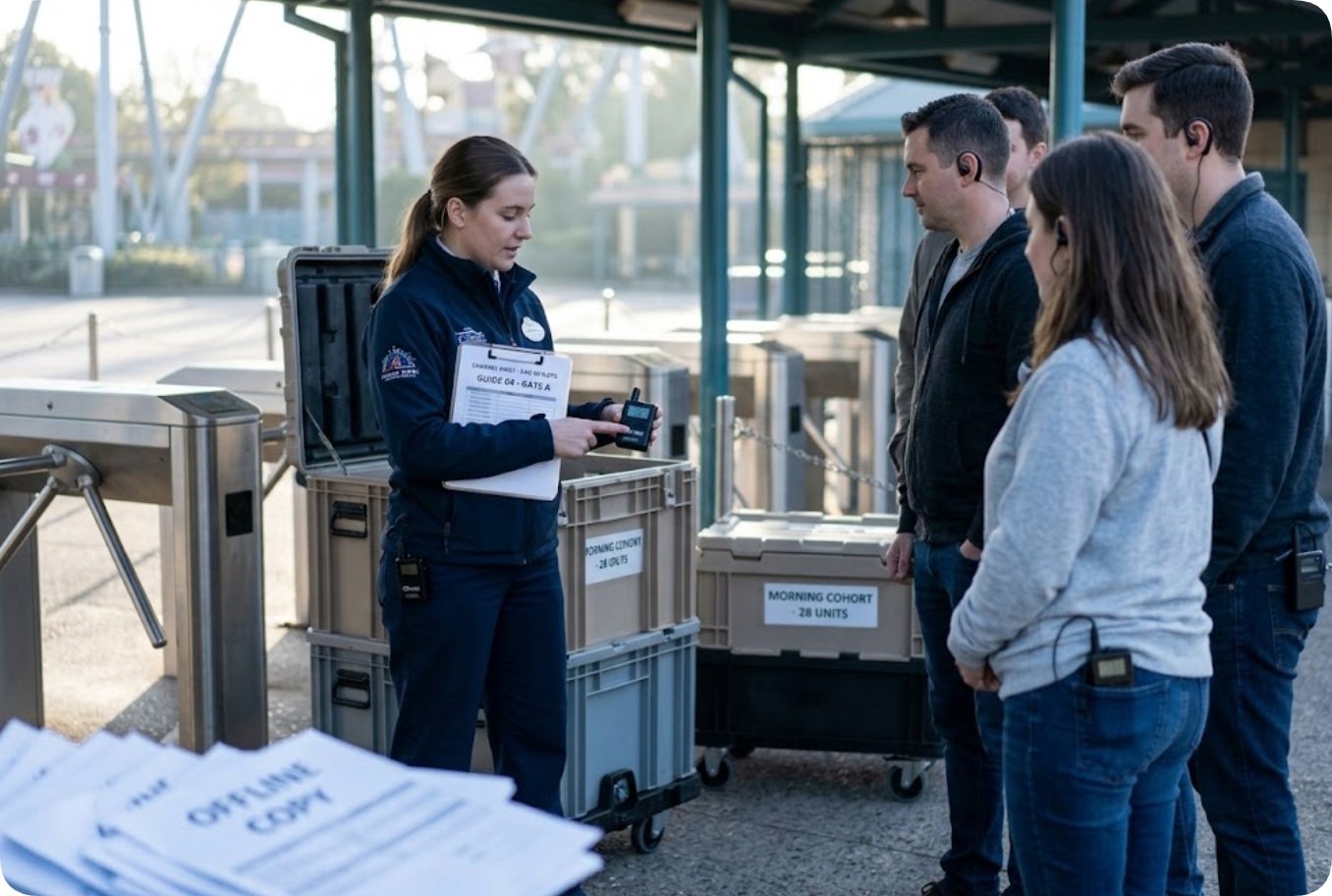
The cohort did not arrive as a single body. Three dates were printed on the welcome pack: the twenty eighth of August, the fourth of September and the eleventh of September. The split was not a preference. Visa appointment slots were issued in batches, and the language placement test was only run on the Monday after each arrival date, so a student who landed on a Thursday could not join a Tuesday walking group. The residence team used the same three dates for key handover. By the time the equipment was unpacked, the programme was already three programmes.

A common mistake is to divide the June figure by three and call the result a batch size. The busiest of the three sittings brought forty seven students into the same library forecourt at once, with two smaller groups crossing the quad at the same hour. The second sitting was smaller, and the third smaller again. So the peak was not a third of the total; it was the only number that decided how many receivers had to be ready before nine in the morning. The other two sittings were constrained by something quite different, which was whether the first sitting had given its units back in time.

Where the Peak Sitting Outruns the Provisional List

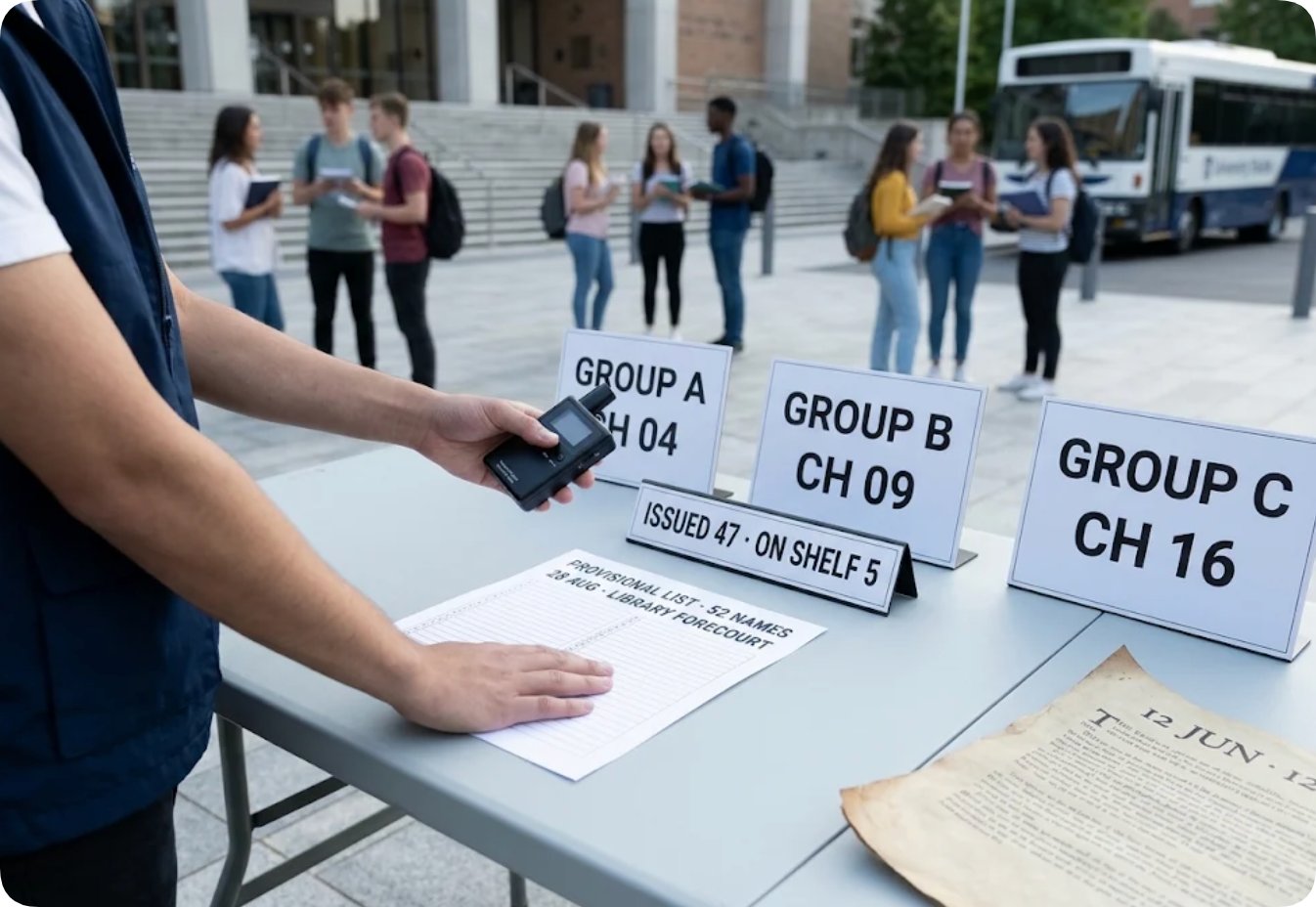
The largest group was assigned the RC2406, whose published row gives the 2403-2483 MHz band and eighty channels. That mattered on the forecourt because three walking groups were leaving within ten minutes of each other, and the student guides had been told to keep their commentary on separate channels rather than ask the groups to wait for one another. Eighty channels is a planning allowance for simultaneous groups, not a measure of how far a voice carries; the published distance for this model is one to two hundred metres, the same as the other two in this comparison.
RC2406-international_student_orientation

The provisional list attached to that sitting had fifty two names. Forty seven collected a receiver. Five did not, for reasons that had nothing to do with the equipment: two had a later flight, one had been moved to the third sitting after a placement result, and two never came to the desk at all. None of this could be read from the June form, because the June form counted offers rather than arrivals. What the desk needed on the morning was a named list with a line for each issued unit, and a place to record the five that stayed on the shelf.

Between Return and Reissue

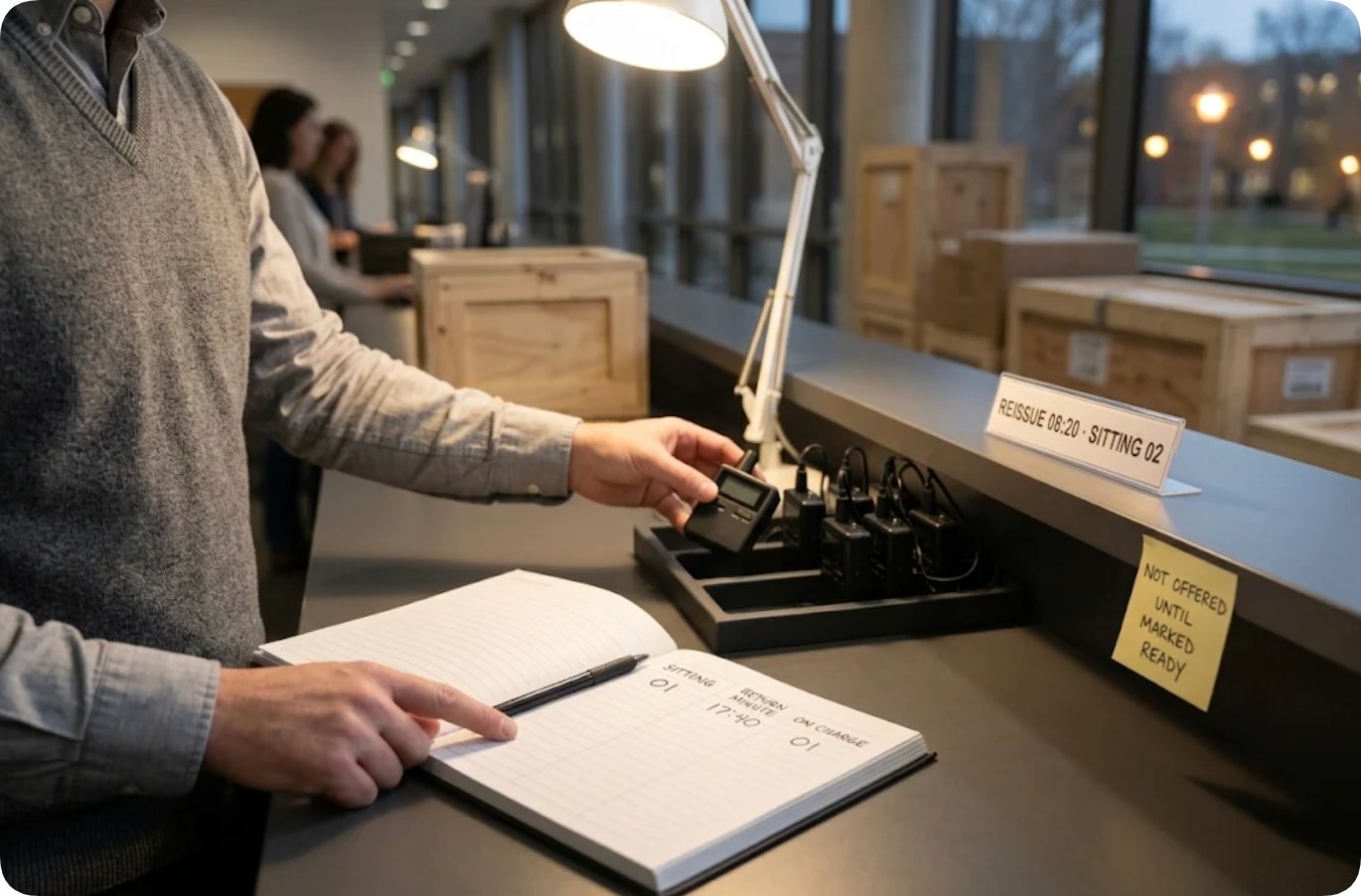
The tightest interval in the whole programme was not a walking session. It was the fourteen hours and forty minutes between the first sitting handing its receivers back at seventeen forty and the second sitting collecting them at eight twenty the next morning. The RC2501 was bought for that gap. Its published figures give fifteen hours on the transmitter, thirty five hours or more on the receiver, forty seven grams for each unit, and a Type-C charging port, while the other two models in this comparison take a DC port and quote twenty hours on the receiver.
RC2501-international_student_orientation

Nobody on the desk timed a full charge that night, and the published pages do not give a charging duration, so it would be wrong to claim one. What the pages do give is a run time, and a run time is enough to plan a turnaround: a receiver that has been used for a two hour campus walk is not starting from empty when it comes back. The overnight question was therefore not how many hours the charger needed, but how many units could be marked ready to issue by eight twenty. That is a status on a sheet, not a number on the June order form.

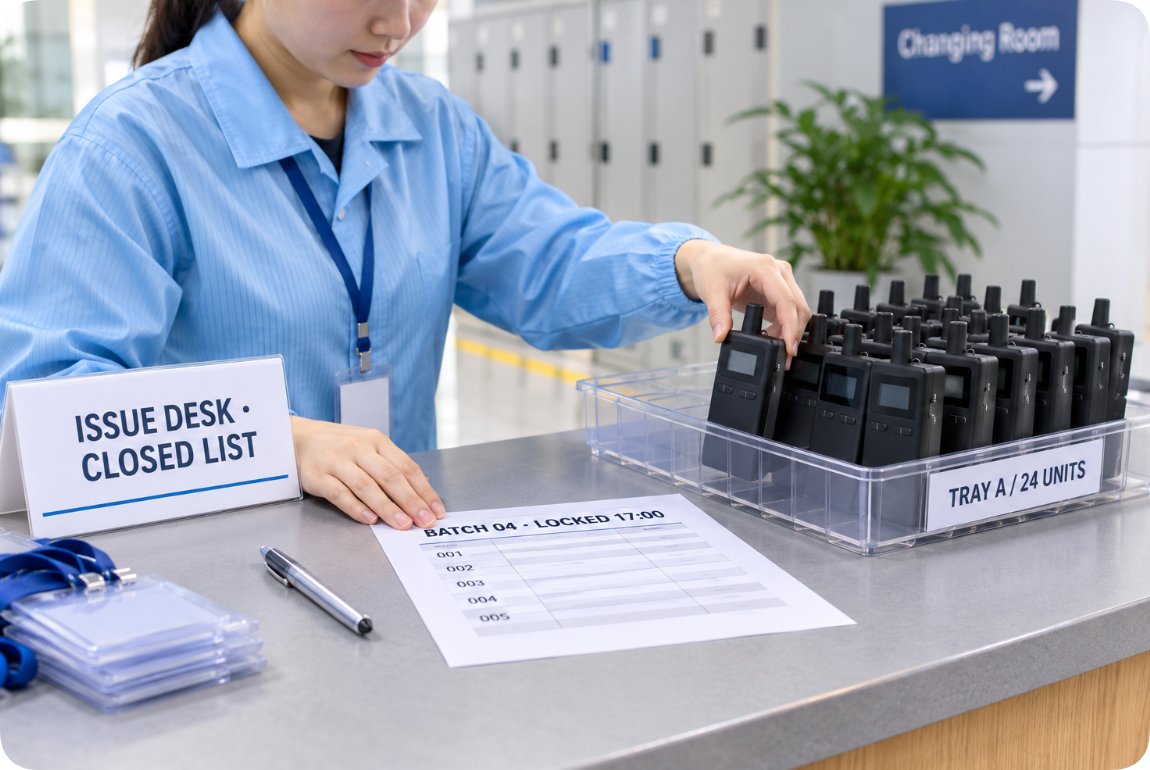
A short handover book settled it. Each returning unit got a line with the sitting number, the return minute and a tick for whether it had been placed on charge. Units that had not been placed on charge were simply not offered to the next sitting, even if they were physically in the cupboard. The second sitting was smaller than the first, so this was never a shortage; it was a decision to let the record, rather than the pile of plastic on the table, decide what could be issued. The following week the same book made the third sitting trivial to plan.

What the Unclaimed Units Were Doing

Nine units were still unclaimed at the end of the first week. In the language of a purchase order those are spare units, which sounds like an overbuy. In the language of the welcome desk they were three different things: five never collected from the first sitting, two held for students whose visa appointment had been moved, and two kept aside for a guide who arrived with a late placement result. None of them was lost, and none of them had been returned to a supplier. They were waiting for a name to be written against them.

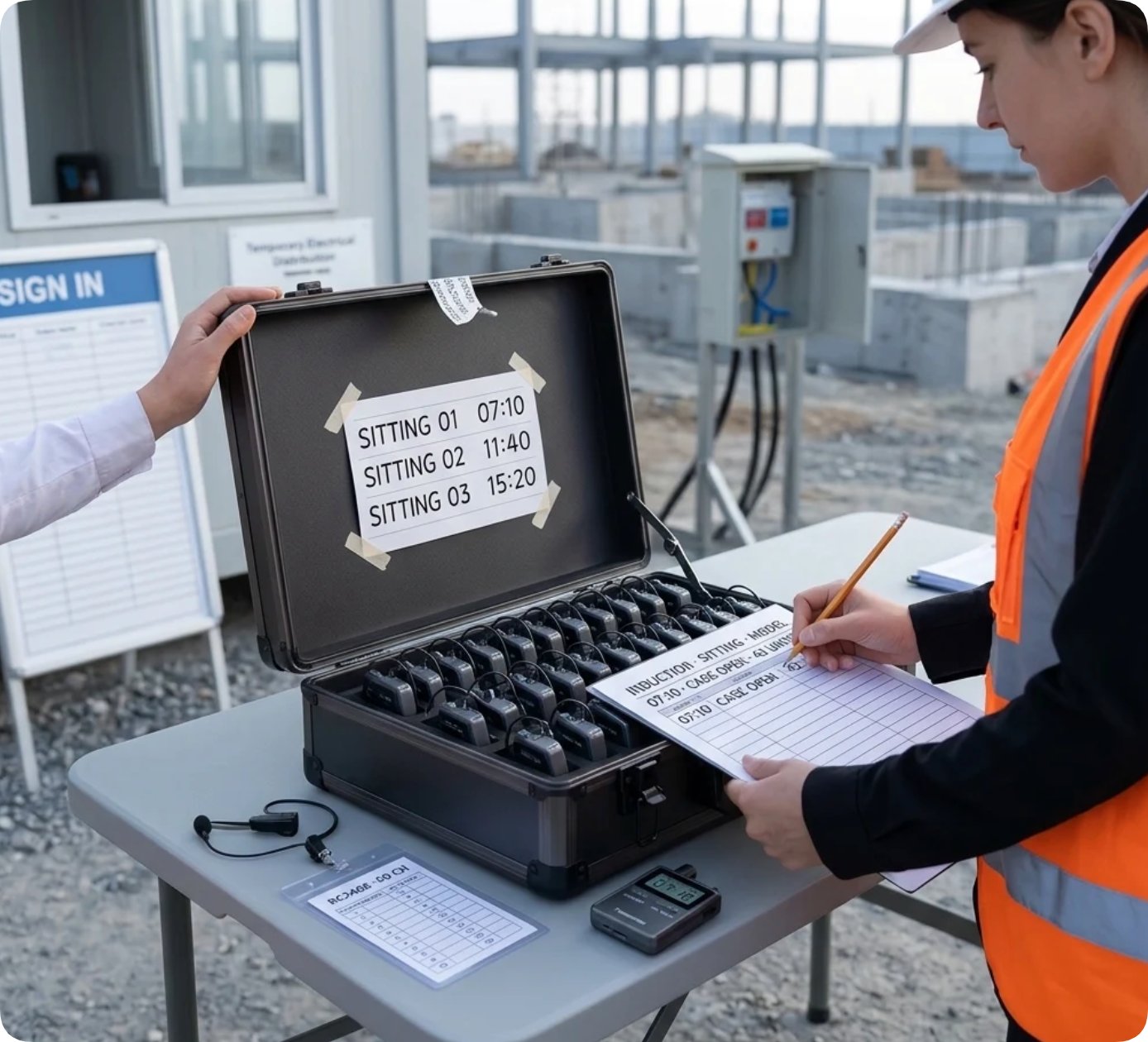
The third sitting used the RC8860, and its published row is the one that looks least like the others: 860-870 MHz, twenty channels, a ten hour transmitter, a twenty hour receiver, fifty nine grams at the transmitter and fifty grams at the receiver, with a DC port. The UHF band is the reason it sat in a separate row of the handover book. Groups using the 2.4G models and this one were not sharing a channel plan, so the student guides did not have to coordinate their start times. Twenty channels was ample for the two small groups that sitting actually ran.

RC8860-international_student_orientation

By the eleventh of September all nine units had been issued at least once. That is a dull outcome, and it is the point. The interesting procurement question was never whether the June quantity had been too generous. It was whether the desk could say, on any given morning, which dated list a unit belonged to and which sitting would use it next. A hundred and twenty six unchanged on a form cannot answer that; a handover book with a sitting number on each line can.

Where Band and Charging Port Enter the Batch Plan

It is tempting to read three published rows as a ranking and conclude that one model is the best buy. The orientation programme did not use them that way. Band, channel count, run time and charging port were constraints attached to particular sittings: the largest group needed room for simultaneous channels in the 2.4G band, the overnight turnaround needed a long receiver run time and a connector the desk already had leads for, and the small final group needed a separate band so that its guides could start without waiting for the others. No model won; each was matched to a moment in the timetable.

ModelPublished row used by the deskWhich sitting it served
RC24062403-2483 MHz; 80 channels; 10 h transmitter; 20 h receiver; 59 g and 50 g; DC PortThe peak sitting; three walking groups leaving together
RC25012403-2483 MHz; 50 channels; 15 h transmitter; 35+ h receiver; 47 g and 47 g; Type-CThe overnight turnaround into the second sitting
RC8860860-870 MHz; 20 channels; 10 h transmitter; 20 h receiver; 59 g and 50 g; DC PortThe small third sitting on a separate band

One published dimension is deliberately absent from that table. The frequency response ranges are not written to a single convention across the three pages: the RC2406 gives separate transmitter and receiver ranges, while the RC8860 and the RC2501 each give one range for the pair. Putting those three values side by side would imply a comparison that the pages do not support, so the column has been left out and no value has been inferred. The other dimensions above come from the same maintained comparison table and use the same wording for all three models. Buyers who need the full line, including colours and control mode, can read the published model pages rather than rely on a summary written for a different purpose.

What the Intake Form Should Carry Next

The following June form does not need a more accurate total. It needs three extra columns. The first is a sitting label, so that a quantity can be split against arrival dates instead of being written once. The second is a return minute for each sitting, which is what actually decides whether the next one can be issued from the same pool. The third is a place for unclaimed units, so that a name can be added later without editing a signed line. All three are text fields; none of them requires a new specification or a longer quotation.

Those columns also make the revision trail visible. If the admission list moves from a hundred and twenty six to a hundred and eighteen in the first week of August, the change belongs against a dated list, with the office that made it, rather than as a pencilled correction to a number that four other documents already quote. Programmes that run several intakes a year can reuse the same sheet and compare one sitting with the next, which is a far more useful record than a single annual total. The wider deployment notes describe how other venues split a fleet across a calendar; this is simply the version that fits a welcome week.

The form from June was not wrong, and the equipment was not short. What was missing was a way to say what the number was counting at nine in the morning on the twenty eighth of August. Once the sitting label, the return minute and a line for unissued units are on the sheet, the total can stay as it was and still answer the question the desk kept asking. A related discussion of how a roster changes under crowd pressure appears in an earlier account of a festival equipment roster, where the same distinction between a named list and a projected one turns up in a very different setting.
Frequently Asked Questions

1. Was ordering against the June admission list a mistake?

No. On the twelfth of June there was no better figure available: offers were still being accepted and visa appointments had not been booked. The mistake was that the form gave no way to say which dated list the hundred and twenty six belonged to. When the count moved to a hundred and twenty one and then a hundred and eighteen in August, there was nowhere to write the new number except over the old one. A single extra column naming the list and the office that owns it would have made all three figures readable without altering the signed total.

2. Is fourteen hours enough to turn the kit around between two sittings?

The programme never measured a full charging cycle, and the published pages do not state a charging duration, so no claim about that is made here. What the pages do publish is run time: fifteen hours on the RC2501 transmitter and thirty five hours or more on its receiver, against ten and twenty hours on the RC2406 and the RC8860. After a two hour campus walk a returned unit is not empty. The desk used that fact to mark units ready to issue by eight twenty, and simply held back any unit that had not been placed on charge.

3. Should the nine unclaimed units have been returned to the supplier?

No, and by the eleventh of September every one of them had been issued. Five were never collected from the first sitting, two were held for students whose visa appointment moved, and two waited for a guide with a late placement result. Returning them would have created a shortage in the third sitting and a second delivery to reconcile. The useful change is to the form: a line for unissued units with a sitting number, so that a name can be added later without editing a signed quantity.

4. Can all three models be used in one sitting?

They can, but the channel plan has to be written before the groups start. The RC8860 works in the 860-870 MHz band with twenty channels, while the RC2406 and the RC2501 both use 2403-2483 MHz with eighty and fifty channels respectively. In this programme the UHF row served the small third sitting, which let those guides begin without coordinating a start time with the 2.4G groups. On the peak morning, three groups left within ten minutes of each other on separate channels of the same band.
2026-11-09 10:44
ꄘ click: 31

Get the spec sheet, MOQ and a factory-direct quote

Tell us the venue, the group size and how many languages you need. An engineer at our Shenzhen factory replies within one business day with the matching model, a written quote, lead time and the CE / RoHS / ISO 9001 documents.

Talk to an engineer WhatsApp +86 189 2287 9583

Prefer email? tiger.wang@richitek.com  |  OEM / ODM, custom tooling and neutral packaging available  |  send the enquiry through our contact page

Shenzhen Rich Age Electronics Co., Ltd. (Richitek) - manufacturing wireless tour guide systems, church translation headsets and museum audio guide equipment since 2007.

RC8860 and RC2501: What a September Intake Does to a June Figure

time: 2026年11月09日 click:31

On the twelfth of June the international office filled in one line of an order form for the autumn orientation programme: a hundred and twenty six receivers, three transmitter types, one delivery date. The number came from the admission list as it stood that morning. Nobody at the desk thought of it as a forecast. It was written as a count, with no column beside it for when the students would actually arrive, and no column for who would be allowed to change it later. The form was signed, filed and forgotten for eleven weeks.

In the first week of September the same form was pulled out three times in four days, and each time somebody asked whether the hundred and twenty six pieces were enough. The answer was different on each occasion, while the number on the paper never moved. That is the awkward part of buying for an intake: the goods are ordered against a headcount, but they are used against a timetable. A figure can be perfectly honest in June and still be the wrong unit of measurement by the time the first coach reaches the campus gate.

The Figure Written in June

The June form had four columns: model, quantity, unit price and a requested delivery week. It did not have a column for the version of the admission list the quantity came from, nor for the office that owned that version. The international office held one list, the language centre held another arranged by placement result, and the residence team held a third arranged by move-in date. All three were correct. They simply counted different things, and the form gave no way to say which one had been used.

This is worth stating plainly, because the usual conclusion is that the buyer estimated badly. The estimate was reasonable. Offers were still being accepted, visa appointments had not been booked, and the language placement test would not be sat until the students were on site. A June sheet can only carry a projected intake. What it can also carry, at almost no cost, is a note saying that the figure belongs to a named list dated the twelfth of June, and that a revised quantity has to be written against a new list rather than amended in place on the old one.

Line on the June formWhat it meant in JuneWhat the September desk needed
Quantity: 126 receiversOffers accepted by 12 JuneA named list per sitting; a peak count for the busiest sitting
One delivery weekWhen the cartons could arriveThree arrival dates; a return minute between the first two
Three model rowsThree catalogue itemsWhich sitting each row was bought to serve
Signature blockBudget approvalWho may write a revised quantity, and on which dated list

The table above is not asking for four more numbers. It is asking for four more owners. Once a line has an owner, a question about whether the kit is enough becomes a question about a specific sitting on a specific morning, rather than an argument about a total that nobody can reconstruct. The distinction matters most when the same equipment is expected to serve more than one group in the same week, which is exactly what happened at the end of August.

Why Arrival Comes in Sittings

The cohort did not arrive as a single body. Three dates were printed on the welcome pack: the twenty eighth of August, the fourth of September and the eleventh of September. The split was not a preference. Visa appointment slots were issued in batches, and the language placement test was only run on the Monday after each arrival date, so a student who landed on a Thursday could not join a Tuesday walking group. The residence team used the same three dates for key handover. By the time the equipment was unpacked, the programme was already three programmes.

A common mistake is to divide the June figure by three and call the result a batch size. The busiest of the three sittings brought forty seven students into the same library forecourt at once, with two smaller groups crossing the quad at the same hour. The second sitting was smaller, and the third smaller again. So the peak was not a third of the total; it was the only number that decided how many receivers had to be ready before nine in the morning. The other two sittings were constrained by something quite different, which was whether the first sitting had given its units back in time.

Where the Peak Sitting Outruns the Provisional List

The largest group was assigned the RC2406, whose published row gives the 2403-2483 MHz band and eighty channels. That mattered on the forecourt because three walking groups were leaving within ten minutes of each other, and the student guides had been told to keep their commentary on separate channels rather than ask the groups to wait for one another. Eighty channels is a planning allowance for simultaneous groups, not a measure of how far a voice carries; the published distance for this model is one to two hundred metres, the same as the other two in this comparison.

RC2406-international_student_orientation

The provisional list attached to that sitting had fifty two names. Forty seven collected a receiver. Five did not, for reasons that had nothing to do with the equipment: two had a later flight, one had been moved to the third sitting after a placement result, and two never came to the desk at all. None of this could be read from the June form, because the June form counted offers rather than arrivals. What the desk needed on the morning was a named list with a line for each issued unit, and a place to record the five that stayed on the shelf.

Between Return and Reissue

The tightest interval in the whole programme was not a walking session. It was the fourteen hours and forty minutes between the first sitting handing its receivers back at seventeen forty and the second sitting collecting them at eight twenty the next morning. The RC2501 was bought for that gap. Its published figures give fifteen hours on the transmitter, thirty five hours or more on the receiver, forty seven grams for each unit, and a Type-C charging port, while the other two models in this comparison take a DC port and quote twenty hours on the receiver.

RC2501-international_student_orientation

Nobody on the desk timed a full charge that night, and the published pages do not give a charging duration, so it would be wrong to claim one. What the pages do give is a run time, and a run time is enough to plan a turnaround: a receiver that has been used for a two hour campus walk is not starting from empty when it comes back. The overnight question was therefore not how many hours the charger needed, but how many units could be marked ready to issue by eight twenty. That is a status on a sheet, not a number on the June order form.

A short handover book settled it. Each returning unit got a line with the sitting number, the return minute and a tick for whether it had been placed on charge. Units that had not been placed on charge were simply not offered to the next sitting, even if they were physically in the cupboard. The second sitting was smaller than the first, so this was never a shortage; it was a decision to let the record, rather than the pile of plastic on the table, decide what could be issued. The following week the same book made the third sitting trivial to plan.

What the Unclaimed Units Were Doing

Nine units were still unclaimed at the end of the first week. In the language of a purchase order those are spare units, which sounds like an overbuy. In the language of the welcome desk they were three different things: five never collected from the first sitting, two held for students whose visa appointment had been moved, and two kept aside for a guide who arrived with a late placement result. None of them was lost, and none of them had been returned to a supplier. They were waiting for a name to be written against them.

The third sitting used the RC8860, and its published row is the one that looks least like the others: 860-870 MHz, twenty channels, a ten hour transmitter, a twenty hour receiver, fifty nine grams at the transmitter and fifty grams at the receiver, with a DC port. The UHF band is the reason it sat in a separate row of the handover book. Groups using the 2.4G models and this one were not sharing a channel plan, so the student guides did not have to coordinate their start times. Twenty channels was ample for the two small groups that sitting actually ran.

RC8860-international_student_orientation

By the eleventh of September all nine units had been issued at least once. That is a dull outcome, and it is the point. The interesting procurement question was never whether the June quantity had been too generous. It was whether the desk could say, on any given morning, which dated list a unit belonged to and which sitting would use it next. A hundred and twenty six unchanged on a form cannot answer that; a handover book with a sitting number on each line can.

Where Band and Charging Port Enter the Batch Plan

It is tempting to read three published rows as a ranking and conclude that one model is the best buy. The orientation programme did not use them that way. Band, channel count, run time and charging port were constraints attached to particular sittings: the largest group needed room for simultaneous channels in the 2.4G band, the overnight turnaround needed a long receiver run time and a connector the desk already had leads for, and the small final group needed a separate band so that its guides could start without waiting for the others. No model won; each was matched to a moment in the timetable.

ModelPublished row used by the deskWhich sitting it served
RC24062403-2483 MHz; 80 channels; 10 h transmitter; 20 h receiver; 59 g and 50 g; DC PortThe peak sitting; three walking groups leaving together
RC25012403-2483 MHz; 50 channels; 15 h transmitter; 35+ h receiver; 47 g and 47 g; Type-CThe overnight turnaround into the second sitting
RC8860860-870 MHz; 20 channels; 10 h transmitter; 20 h receiver; 59 g and 50 g; DC PortThe small third sitting on a separate band

One published dimension is deliberately absent from that table. The frequency response ranges are not written to a single convention across the three pages: the RC2406 gives separate transmitter and receiver ranges, while the RC8860 and the RC2501 each give one range for the pair. Putting those three values side by side would imply a comparison that the pages do not support, so the column has been left out and no value has been inferred. The other dimensions above come from the same maintained comparison table and use the same wording for all three models. Buyers who need the full line, including colours and control mode, can read the published model pages rather than rely on a summary written for a different purpose.

What the Intake Form Should Carry Next

The following June form does not need a more accurate total. It needs three extra columns. The first is a sitting label, so that a quantity can be split against arrival dates instead of being written once. The second is a return minute for each sitting, which is what actually decides whether the next one can be issued from the same pool. The third is a place for unclaimed units, so that a name can be added later without editing a signed line. All three are text fields; none of them requires a new specification or a longer quotation.

Those columns also make the revision trail visible. If the admission list moves from a hundred and twenty six to a hundred and eighteen in the first week of August, the change belongs against a dated list, with the office that made it, rather than as a pencilled correction to a number that four other documents already quote. Programmes that run several intakes a year can reuse the same sheet and compare one sitting with the next, which is a far more useful record than a single annual total. The wider deployment notes describe how other venues split a fleet across a calendar; this is simply the version that fits a welcome week.

The form from June was not wrong, and the equipment was not short. What was missing was a way to say what the number was counting at nine in the morning on the twenty eighth of August. Once the sitting label, the return minute and a line for unissued units are on the sheet, the total can stay as it was and still answer the question the desk kept asking. A related discussion of how a roster changes under crowd pressure appears in an earlier account of a festival equipment roster, where the same distinction between a named list and a projected one turns up in a very different setting.
Frequently Asked Questions

1. Was ordering against the June admission list a mistake?

No. On the twelfth of June there was no better figure available: offers were still being accepted and visa appointments had not been booked. The mistake was that the form gave no way to say which dated list the hundred and twenty six belonged to. When the count moved to a hundred and twenty one and then a hundred and eighteen in August, there was nowhere to write the new number except over the old one. A single extra column naming the list and the office that owns it would have made all three figures readable without altering the signed total.

2. Is fourteen hours enough to turn the kit around between two sittings?

The programme never measured a full charging cycle, and the published pages do not state a charging duration, so no claim about that is made here. What the pages do publish is run time: fifteen hours on the RC2501 transmitter and thirty five hours or more on its receiver, against ten and twenty hours on the RC2406 and the RC8860. After a two hour campus walk a returned unit is not empty. The desk used that fact to mark units ready to issue by eight twenty, and simply held back any unit that had not been placed on charge.

3. Should the nine unclaimed units have been returned to the supplier?

No, and by the eleventh of September every one of them had been issued. Five were never collected from the first sitting, two were held for students whose visa appointment moved, and two waited for a guide with a late placement result. Returning them would have created a shortage in the third sitting and a second delivery to reconcile. The useful change is to the form: a line for unissued units with a sitting number, so that a name can be added later without editing a signed quantity.

4. Can all three models be used in one sitting?

They can, but the channel plan has to be written before the groups start. The RC8860 works in the 860-870 MHz band with twenty channels, while the RC2406 and the RC2501 both use 2403-2483 MHz with eighty and fifty channels respectively. In this programme the UHF row served the small third sitting, which let those guides begin without coordinating a start time with the 2.4G groups. On the peak morning, three groups left within ten minutes of each other on separate channels of the same band.

Get the spec sheet, MOQ and a factory-direct quote

Tell us the venue, the group size and how many languages you need. An engineer at our Shenzhen factory replies within one business day with the matching model, a written quote, lead time and the CE / RoHS / ISO 9001 documents.

Talk to an engineer WhatsApp +86 189 2287 9583

Prefer email? tiger.wang@richitek.com  |  OEM / ODM, custom tooling and neutral packaging available  |  send the enquiry through our contact page

Shenzhen Rich Age Electronics Co., Ltd. (Richitek) - manufacturing wireless tour guide systems, church translation headsets and museum audio guide equipment since 2007.

×

Contact us

email:
name:
subject:
content: