
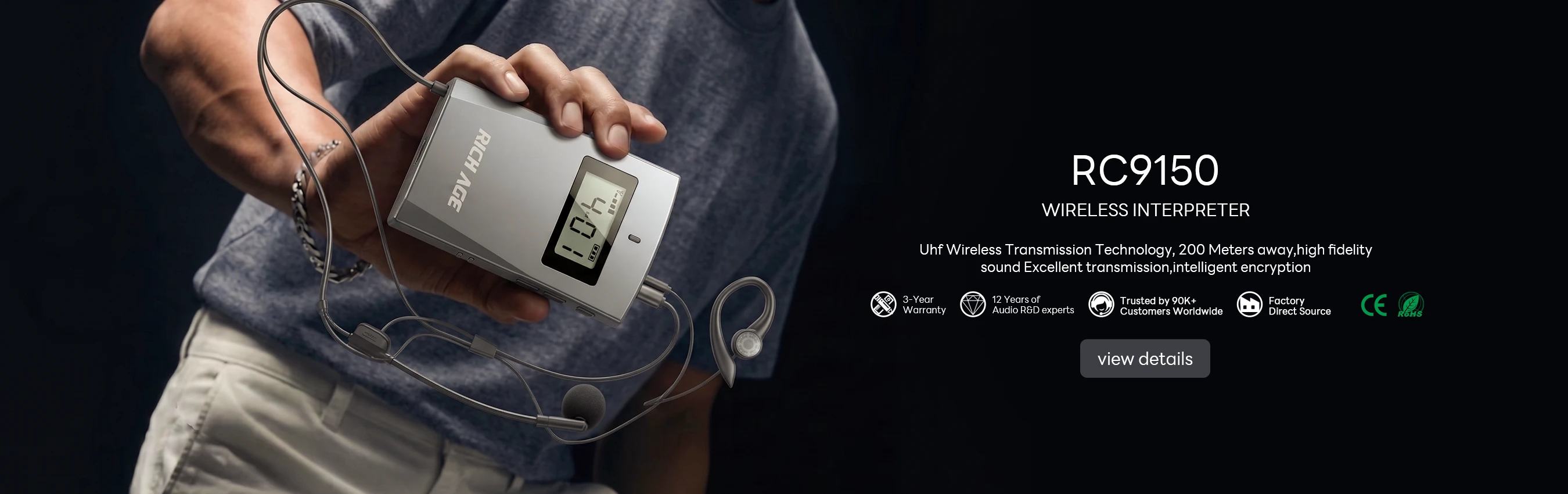
An open class day puts a school's audio budget under more pressure than any parents' evening or staff briefing. One lead teacher narrates through a 40-minute demonstration lesson, thirty to forty-five students listen through receivers, and a row of visiting teachers or parents at the back expects the same clarity as the front row. Purchase committees rarely fail these projects on audio quality; they fail them on the spreadsheet, because nobody costed the deployment per classroom before the demo day. This article walks through that math with three very different machines: the RC2401 standard 2.4G set, the 80-channel RC2408, and the newly listed R3101 earhook receiver that weighs 21.8 g. All three ship from the same factory floor, yet they land on three completely different lines of a school purchase order.
💡 Why an Open Class Day Needs Three Different Machines
A demonstration lesson is not a museum tour stretched across a campus. The room is small, the audience sits still, and the interference risk comes from the classroom next door running its own lesson at the same hour, not from a crowd moving between exhibits. That is why a single-model purchase often looks efficient on paper and then underperforms in the second week of term. The standard set handles the everyday lesson. The hardened set absorbs the floor where six classrooms transmit at once. The featherweight earhook exists for the youngest listeners, who pull off headset bands within minutes and hand them back tangled.
Costing all three through one per-classroom lens exposes something the datasheets never state side by side: the cheapest receiver per unit is not the cheapest receiver per term. A set that survives 20 hours per charge on the receiver side deletes one charging routine per week from a teacher's schedule. A set with more channels deletes the fifteen minutes of re-pairing that happens when two classes power on simultaneously. Our education audio guide system page groups the school-grade options, but the budget decision still comes down to what each machine saves a coordinator per week, and that is where the three models split.
🎓 The Per-Classroom Math That Decides the Budget
Start from the room, not the catalog. A typical open class runs one transmitter for the lead teacher, one spare transmitter charged and ready, and one receiver per listener plus roughly ten percent spares. For a 45-student demonstration room that is about 50 receivers, and schools that rotate visiting groups across a full morning usually double that pool across two classrooms. Every receiver in that pool must return to a charging routine before the next session, so the real cost driver is not the sticker price of channel 1 in the catalog; it is how many staff-minutes each unit consumes between lessons across a 40-week term.
Run the same 50-receiver pool against three charging behaviors and the gap widens fast. Receivers rated at 20 hours per charge finish a two-session morning with charge to spare, so a single overnight tray cycle covers them. Receivers rated at 15 hours finish the second session near the floor, which pushes schools toward midday top-ups or a larger spare pool. Both behaviors are defensible; what breaks budgets is buying the 15-hour unit at the 20-hour unit's pool size and then discovering the shortfall during the third demo day of the term. Coordinators who cost this per classroom, rather than per device, stop over-ordering spares by a wide margin. A useful reference point is our earlier breakdown of matching a system to a university open day at RC2468 to RC2500 for a University Open Day, which applies the same room-first arithmetic.
✅ The Standard 50-Channel Set for Daily Lessons
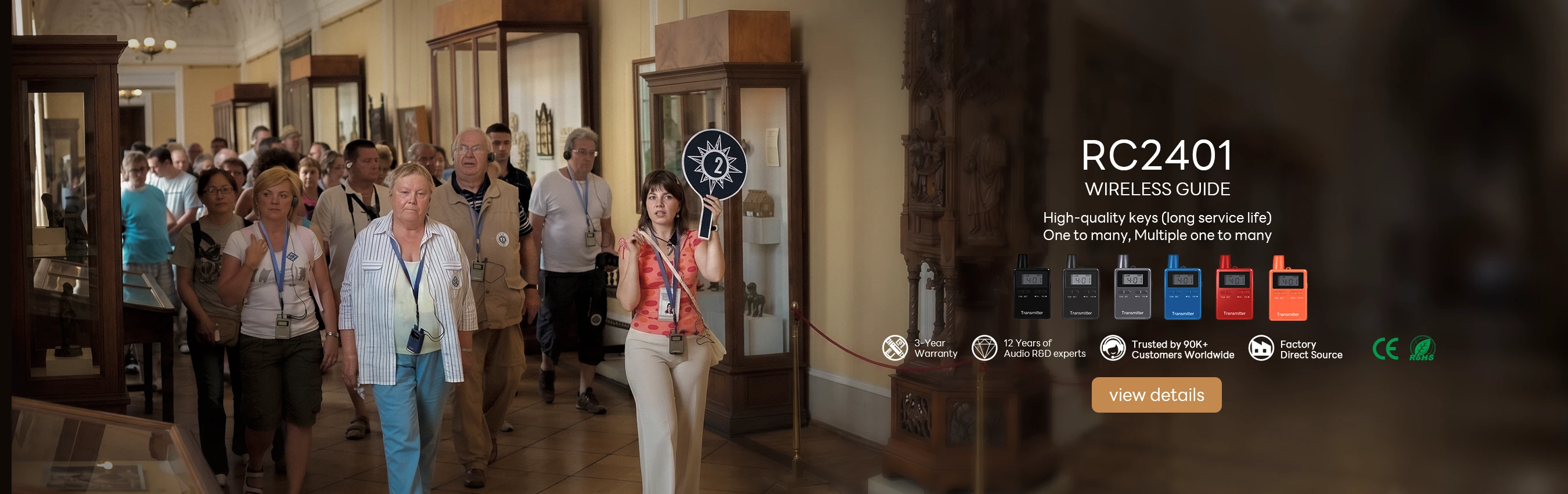
The RC2401 is the baseline 2.4G set that most schools start with, and its numbers explain why. It transmits on 2403-2483 MHz with 50 selectable channels at 10 mW, reaches 1 to 200 meters depending on the room layout, and runs 10 hours per charge on the transmitter against 20 hours on the receiver. The transmitter carries a 3.7 V 1500 mAh cell and weighs 59 g; the receiver carries 1000 mAh and weighs 50 g. Both units charge through a DC port, and the frequency response is rated at 50 Hz to 200 kHz on transmit with 50 Hz to 12 kHz on receive. For a single classroom running one lesson per slot, 50 channels is comfortable headroom: even a school-wide timetable rarely stacks more than a dozen simultaneous groups.
The per-classroom case for the standard set is predictability. At 20 receiver-hours per charge, a two-session morning never touches the reserve, and the overnight tray covers the whole pool. Teachers power it on, select a channel during setup, and the PLL control loop holds the link for the rest of the lesson. Where the standard set strains is not the single room but the shared floor: when a school books several demonstration rooms back to back for a review week, 50 channels still suffice on paper, but coordination between classes starts to depend on one person maintaining the allocation sheet. That labor line is exactly what the next model removes.

The 80-Channel Set for Crowded Teaching Floors
The RC2408 keeps the same radio envelope and battery profile as the standard set, and changes one number that matters on a busy floor: 80 channels instead of 50. Its factory positioning is explicit, with the hardened variant built for interference resistance and stable performance where several groups transmit at once. The rest of the sheet matches the baseline exactly, 2403-2483 MHz, 10 mW output, 1 to 200 meters, 10 transmitter-hours against 20 receiver-hours, a 59 g transmitter and a 50 g receiver, the same DC port and the same 50 Hz to 12 kHz receive response. Nothing about the daily experience changes for one isolated classroom; the difference appears when the timetable stacks.
On a floor where a review week puts four to six lessons in parallel, the wider channel bank does two concrete things. First, each class keeps a dedicated channel all week, so nobody re-pairs mid-term when a neighboring room powers on. Second, the coordinator stops auditing the allocation sheet, because the bank has enough room that two classes can drift one channel apart without collisions. Schools that run back-to-back parent days or district teaching competitions tend to standardize on this variant after one crowded event, and the premium over the standard set is routinely smaller than the staff time it returns. The trade is symmetry: battery life, weight and charging all stay at the baseline, so the saving is purely organizational rather than electrical.

A 21.8 Gram Receiver for Younger Listeners
The R3101 is the newest addition to the lineup, and it attacks the problem the two sets above leave open: younger students who will not keep a handset on for a full lesson. The receiver weighs 21.8 g in an integrated earhook form factor, with the transmitter at 100 g, and the whole family operates license-free on the 2.4 G ISM band from 2400 to 2483.5 MHz. Channel capacity jumps to 999 independent channels with zero crosstalk across rooms, range is rated up to 100 meters line of sight, and the battery split is unusual for the category, about 20 hours on the transmitter from a 3000 mAh cell against roughly 15 hours on the receiver with 30 hours of standby from 310 mAh. Both units charge over a modern Type-C port at DC 5.0 V.
The per-classroom arithmetic shifts in two places. Charging moves from DC barrels to Type-C, and the accessory lineup includes 10-slot and 30-slot charging cases, so a 45-receiver pool recharges in two tray cycles instead of a drawer of cables. The lighter receiver also changes the loss-and-damage line: units that stay on young ears get handed back less often, and the 2-year factory warranty with OEM and ODM logo customization makes replacement pools cheaper to plan. Compliance is documented as CE, EMC, LVD, RED and RoHS, and the housing measures 60 by 27.3 by 14.5 mm, small enough for a grade-school pocket. For open class days that mix grade levels, this is the machine that stops the "it hurts behind my ear" withdrawals by the second session.

Specs Side by Side
The table below consolidates the numbers that drive the per-classroom budget. All RC2401 and RC2408 values come from the September 2026 authoritative comparison sheet maintained for procurement writing; all R3101 values come from its product page, since the model was newly listed in November 2026 and has not yet entered that sheet. Where a value is not published for any model, the row is omitted rather than estimated.
| Specification | RC2401 | RC2408 | R3101 |
|---|---|---|---|
| Channels | 50 | 80 | 999 |
| Battery life (TX / RX) | 10 h / 20 h | 10 h / 20 h | ~20 h / ~15 h (30 h standby) |
| Battery capacity (TX / RX) | 1500 mAh / 1000 mAh | 1500 mAh / 1000 mAh | 3000 mAh / 310 mAh |
| Weight (TX / RX) | 59 g / 50 g | 59 g / 50 g | 100 g / 21.8 g |
| Charging port | DC Port | DC Port | Type-C (DC 5.0 V) |
| Range | 1-200 m | 1-200 m | Up to 100 m line-of-sight |
Two rows repay a second look. The weight line is the only one where the new earhook inverts the usual pattern: at 21.8 g the receiver is less than half the 50 g of either 2.4G set, while its transmitter runs heavier at 100 g to feed the longer 20-hour transmit day. The charging line is the other inversion, because the DC ports of the older sets give way to a single Type-C standard that most school IT pools already stock cables for.
Where Each Set Pays Back Fastest
Match the machine to the room and the payback writes itself. The standard 50-channel set pays back in schools that run one demonstration classroom at a time, where its 20 receiver-hours erase charging labor and its baseline price anchors the whole program. The 80-channel set pays back wherever the timetable stacks, because the wider bank converts coordination labor into a one-time setup sheet that survives a full review week without re-pairing. The 21.8 g earhook pays back in younger classrooms, where fit problems, mid-lesson hand-backs and damage replacements quietly consume the savings that a cheaper per-unit price promised on paper.
For committees that want one sentence to take into the meeting: buy the standard set per classroom, step up to 80 channels only when your timetable proves it needs them, and put the earhook on every roster that includes grade-school listeners. Every machine discussed here is listed under the full tour guide system catalog, alongside the factory's wider work on solutions for guided venues of every type, so a mixed purchase across classrooms can ship in one consolidation instead of three.