Auto Show Guide Systems: Ten Days on the Show Floor
An international motor show runs for about ten days, and during that window a single hall can hold dozens of exhibitor stands, each running its own presentations, often in two or three languages at once. Visitors walk the show floor for hours, and the hardware a brand puts on its stand has to survive the whole run without a service desk full of spare batteries. This comparison puts three conference and exhibition audio solutions from Richitek against two very different alternatives: the OKAYO TK-501 WaveTALK transmitter and the self-guided platform from Beijing Dongfang Songbai.
The buying question at an auto show is not a single spec. It is three constraints stacked on top of each other: the radio spectrum inside the hall is crowded, visitors wear the receivers from the morning press walk until the evening dealer sessions, and every unit has to be reset, recharged and re-paired between daily runs. The three Richitek models below cover that spread in different ways.
1. RC2468: The 18-Gram Answer to All-Day Wear
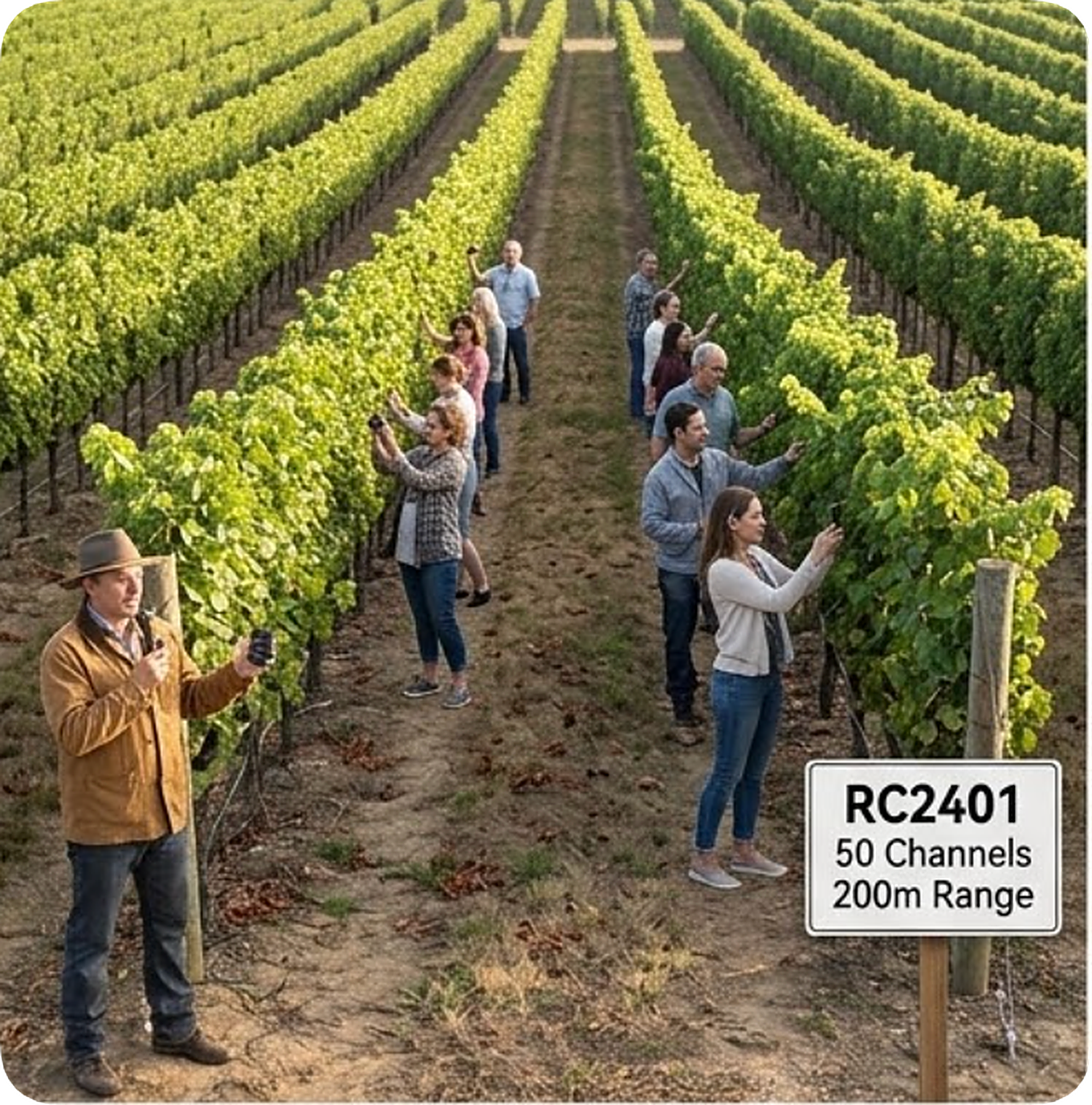
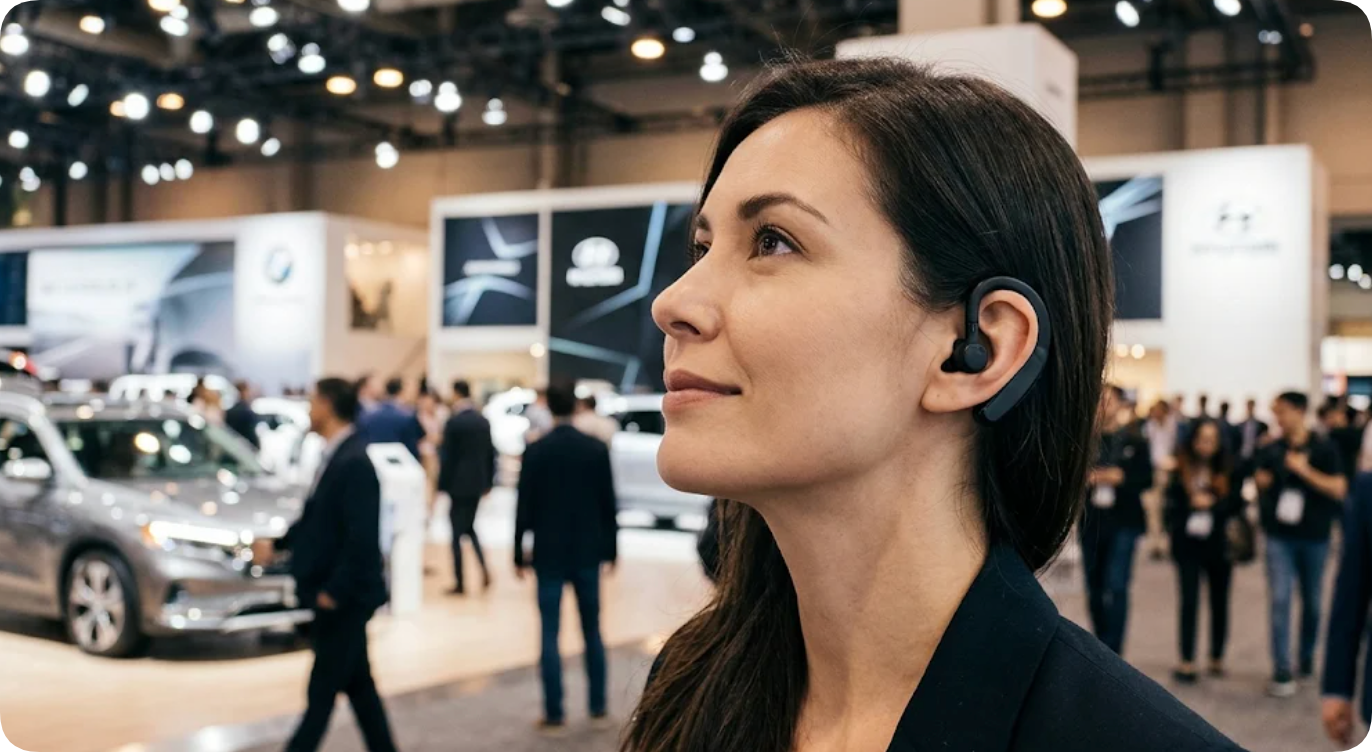
Visitors judge a receiver within the first hour, long before anyone mentions specifications. The RC2468 receiver is an 18-gram ear-hook unit, and that figure matters because a show day can stretch past ten hours of wear. Its battery is a 3.7V 300mAh cell rated for roughly 8 hours, so a full exhibition day usually means a lunch-break recharge rather than a nightly one. Charging runs over Micro USB at 5V/1A, which is the one port in this trio that differs from the other two, so a rental fleet needs its own cable bin. The transmitter side carries a 3.7V 1500mAh battery for about 10 hours of talk time at 10mW across 2403-2483 MHz, with 50 channels selected through a PLL synthesizer and a range of 1-200m. For a stand running two morning groups and two afternoon groups, fifty channels is comfortable headroom.
2. RC2500: One Sync Command Between Morning and Afternoon Runs
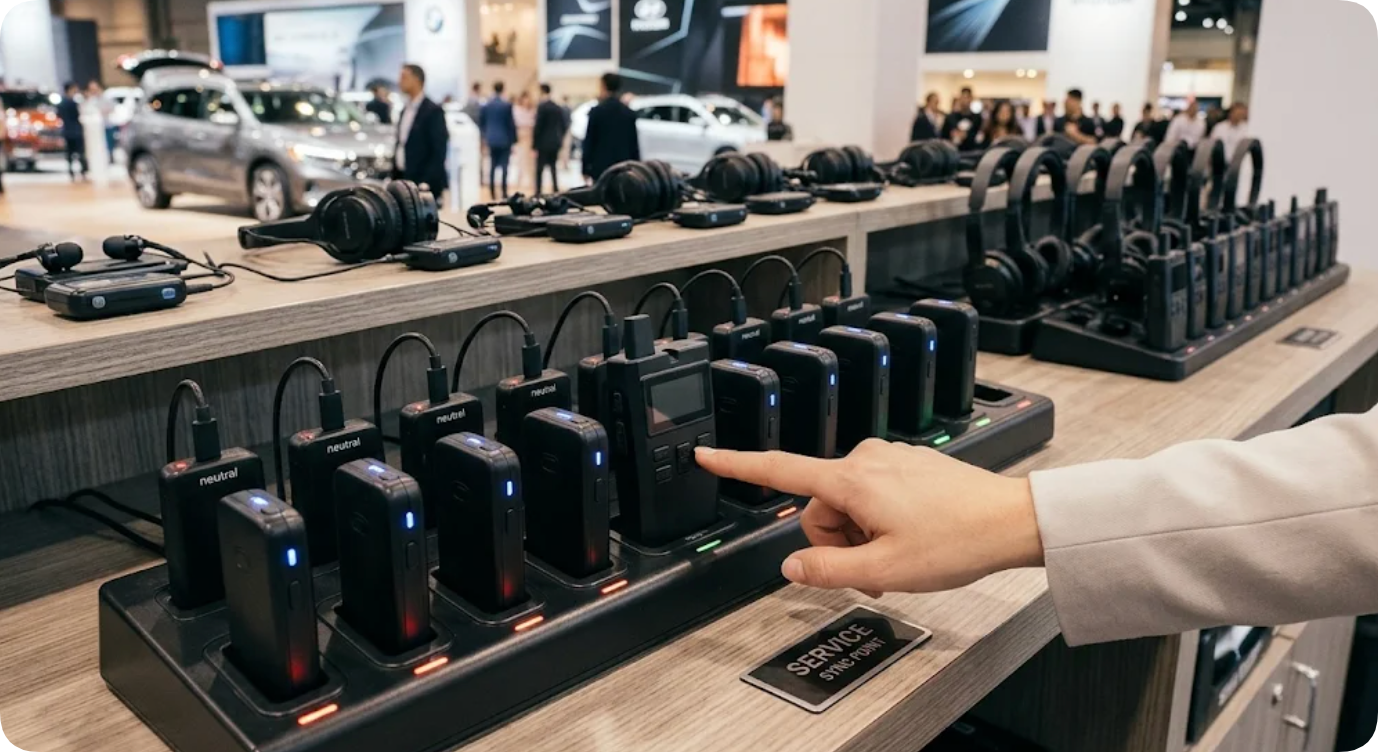
Between daily runs the floor team has minutes, not hours, to reset forty receivers. The RC2500 turns that reset into a single action: one-touch sync, one-touch mute and one-touch power-off, which is why rental operators keep picking it for multi-session venues. It transmits at 10mW on the same 2.4GHz band with 50 channels, and its transmitter is a 104g unit built around a 3.7V 1800mAh cell rated at 15 hours. Receivers hold 1800mAh cells as well, with a standby figure above 35 hours, so a fleet charged on the evening of day one still has margin on the morning of day two. Both halves charge over Type-C, and the transmitter's audio band spans 50Hz-8kHz, wide enough for music cues that car stands like to layer under a presenter's voice.
3. RC2501: Two Voices, One 47-Gram Unit
Luxury-brand stands rarely run a single narrator. A product specialist describes the drivetrain while an interpreter repeats it in the buyer's language, and the RC2501 is built for exactly that pairing. It accepts an optional head-worn or lavalier microphone, publishes a microphone sensitivity of about -38dBm, and pushes 13mW of output on the same 2.4GHz band with 50 channels. The whole transmitter weighs 47 grams, so a presenter clipped into it for a three-hour showcase barely notices it, and the audio band reaches 20Hz-200kHz on the transmit side. Its 3.7V 1500mAh cell lasts about 15 hours, receivers hold 1000mAh cells with the same 35-plus-hour standby figure, and both halves charge over Type-C alongside the RC2500, which keeps the charging cart down to one cable type.
Alternative Market Approaches
OKAYO TK-501 WaveTALK
The OKAYO TK-501 WaveTALK operates across 500-900 MHz, sidestepping 2.4GHz congestion but introducing regional spectrum licensing constraints for global tour teams. It features a 55g transmitter with a impressive 30-hour battery life and 100m range. However, unassigned channel counts and missing receiver specs require vendor clarification prior to large deployments.
Beijing Dongfang Songbai
Leaning on QR-code and NFC triggers at individual vehicle exhibits, this platform eliminates docent staffing and gathers visitor dwell-time analytics. However, without live voice guidance, it sacrifices the structured sales narrative that drives immediate test-drive bookings.

Specification Comparison Matrix
All Richitek figures below come directly from verified manufacturer datasheets. Unpublished third-party values are marked accordingly.
| Dimension | RC2468 | RC2500 | RC2501 | OKAYO TK-501 | Dongfang Songbai |
|---|---|---|---|---|---|
| Band | 2403-2483 MHz | 2403-2483 MHz | 2403-2483 MHz | 500-900 MHz | Not published |
| Channels | 50 | 50 | 50 | Not published | Not published |
| Working Range | 1-200m | 1-200m | 1-200m | 100m | Not published |
| Transmitter Weight | 59g | 104g | 47g | 55g | Not published |
| Receiver Weight | 18g (Ear-hook) | 104g | 47g | Not published | Not published |
| TX Battery Life | 10h | 15h | 15h | ~30h | Not published |
| RX Battery Life | ~8h | 35+h standby | 35+h standby | Not published | Not published |
| Output Power | 10mW | 10mW | 13mW | Not published | Not published |
| Charging Interface | Micro USB 5V/1A | Type-C | Type-C | USB-C | Not published |
Key Logistics & Engineering Considerations
Charging Logistics Across Multi-Day Shows
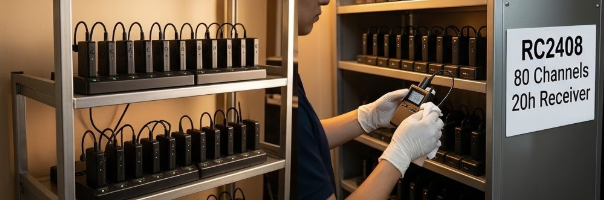
A ten-day show turns charging into a daily operations problem. The RC2500 and RC2501 share Type-C interfaces, enabling a single charging cart configuration across fleets. With 35+ hour receiver standby, overnight charging ensures complete coverage. The RC2468's 8-hour battery cycle requires a midday rotation strategy, but the RC2500's one-touch reset feature drastically shortens setup turnarounds between continuous presentation runs.
Spectrum Management in Dense RF Halls
Auto show halls feature congested 2.4GHz environments due to visitor Wi-Fi, Bluetooth setups, and LED controllers. Richitek's 50-channel PLL synthesizer allows isolated booth operation, though venue-wide channel allocation plans are recommended. While OKAYO avoids 2.4GHz via UHF bands, international licensing adds operational friction. Dongfang Songbai bypasses RF planning entirely through NFC/QR triggers.
Which Venue Plan Takes Which System
The decision sorts cleanly by stand format. A brand running guided loops, bilingual presenters and test-drive sign-ups gets the most from the radio trio: the RC2468 for all-day visitor comfort at 18 grams, the RC2500 for fleets that reset between sessions with a single command, and the RC2501 when two voices share one transmitter. A stand built around free roaming and dwell-time analytics fits the Dongfang Songbai scan model better than any RF fleet. A touring team crossing borders season after season should price the OKAYO TK-501's licensing overhead against its 30-hour transmitter endurance before committing. For a deeper cut across the lineup, the wireless tour guide system range and the comparison hub keep every published head-to-head in one place.
Frequently Asked Questions
1. How do 2.4GHz wireless guide systems handle crowded exhibition hall interference?
Systems like the Richitek RC2500 and RC2501 utilize 50 selectable channels and Phase-Locked Loop (PLL) frequency synthesis to maintain tight channel separation. Coordinating channel assignments across adjacent stands before event opening prevents frequency overlap with venue Wi-Fi and Bluetooth networks.
2. What is the advantage of ultra-lightweight ear-hook receivers for multi-hour events?
Receivers like the 18-gram Richitek RC2468 minimize ear fatigue during extended tradeshow visits. By eliminating heavy bodypack housings and dangling wires, visitors can comfortably wear the unit throughout full-day press walkthroughs and VIP booth tours.
3. How does a one-touch channel sync feature speed up fleet management between sessions?
One-touch channel synchronization allows staff to instantly match dozens of receivers to the presenter's transmitter frequency in seconds. This eliminates manual per-device tuning, allowing rapid turnarounds between sequential group presentations.
4. What is the difference between active radio guide systems and QR/NFC scan solutions?
Active radio systems deliver live, presenter-led narration to a group in real time, making them ideal for structured tours and VIP unveilings. QR/NFC trigger platforms allow visitors to pull pre-recorded content individually on their smartphones, offering free-roaming flexibility and visitor dwell analytics without live staff narration.