
A leading China factory specializing in Wireless Tour Guide Systems, Church Audio Guides, and Translation Headphones with premium OEM/ODM solutions.

Tel:+86 18922879583

Email:tiger.wang@richitek.com

A Ski Slope Tests a Tour System Harder Than Any Gallery

A winter resort sells a feeling of effortless glide, but behind the scenes a guide has to hold a group together across gondola queues, icy plazas, and windy ridges where the next turn hides the last person in line. The silence of snow is deceptive. An open slope is one of the most demanding radio environments a tour system will ever meet, and a kit that works in a warm conference room can fall apart the moment the group steps onto the snow.

We built a three-unit field kit for alpine and Nordic resorts and ran it against two common rental systems that buyers often shortlist for the same job. A mountain is unlike a city walk or a museum hall in one blunt way: there is no ceiling and no wall to help the signal, and there is weather that punishes weak gear. If you are planning outdoor tour audio for a mountain setting, the numbers below explain why band choice, battery shape, and receiver weight matter more on snow than almost anywhere else.

📡 What the Mountain Does to a Radio

Three forces work against you at a ski resort. The first is distance with nothing to stop it. A lift line can stretch a group across two hundred meters of open piste, and a ridge has no walls to bounce a signal back, so range figures measured indoors shrink fast. The second is the crowd's own spectrum. Thousands of guest phones, smartwatches, and wireless headphones all fight for 2.4 GHz, the exact band most tour systems share, and a resort's own Wi-Fi mesh only adds to the noise. The third is the cold, which quietly shortens battery life and makes a heavy receiver feel heavier after a full day on the snow; lithium cells lose a visible slice of capacity below freezing, so a unit that promises eight hours at room temperature may deliver closer to five on a minus-ten morning. A fourth, easy to forget, is the metal cage of a gondola: the moment a guide and a guest ride up in separate cabins, a steel box sits between them and the link has to punch through it. Any system that ignores these pressures will look fine on paper and fail on the mountain.

A UHF Anchor That Ignores the Crowd's Phones

Our RC085 is the only unit in this kit that never touches 2.4 GHz. It transmits on 470-510 MHz UHF, a band where guest phones and wearables simply do not operate, so the congestion problem is removed before it starts. On an open slope that single choice buys real reach: the RC085 holds a clean signal up to about 200 meters in line of sight, which is exactly what a guide needs when the group spreads out between a chairlift exit and the next meeting point. We have stood at the top of a fixed-grip lift with the transmitter and watched the receiver stay locked to a guest still crossing the base plaza, a gap no 2.4 GHz unit held that day. It runs 12 hours on the transmitter and 20 on the receiver per charge, charges over a plain USB cable, and carries multi-channel group operation so two guides can run separate groups on separate frequencies without cross-talk. That USB charging matters more than it sounds in a mountain hut, where a proprietary dock is one broken part away from a dead fleet and a laptop or power bank keeps every unit alive. The trade is audio bandwidth, capped near the speaking range rather than full music fidelity, which is the honest limit to name up front.
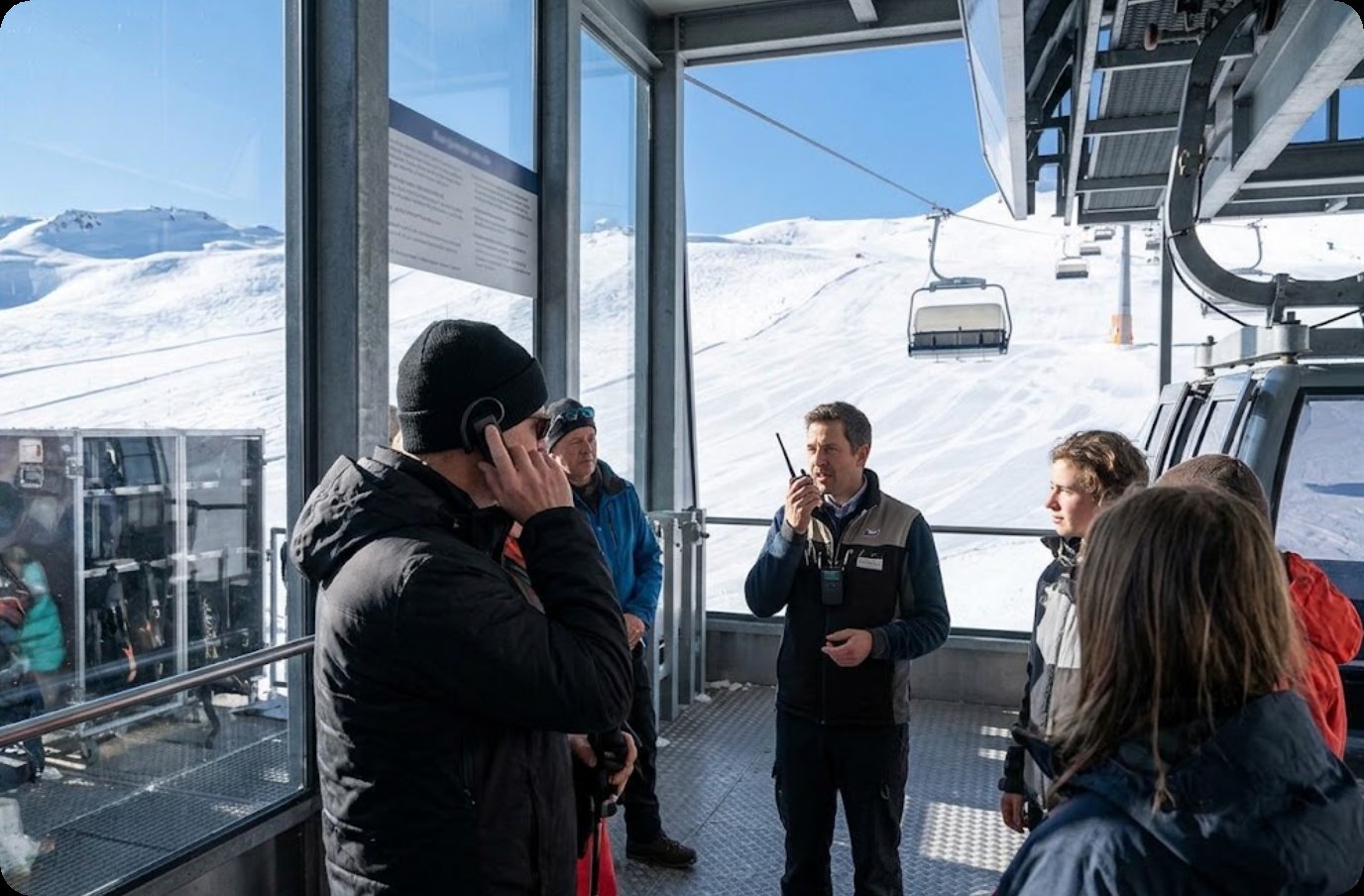
RC085-ski_resort_uhf

Eighty Channels for a Busy Winter Day

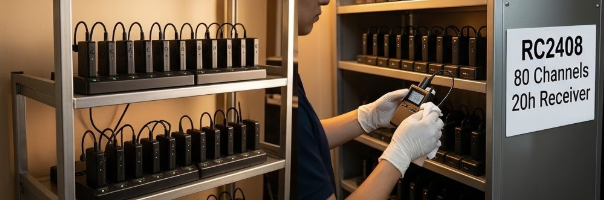
Where a resort is already built around 2.4 GHz Wi-Fi and the IT team has filled the band, our RC2408 stays on the familiar frequency but brings 80 independent channels instead of the usual few. On a peak-season day with a dozen simultaneous tours, that headroom is the difference between finding a clean slice of spectrum and fighting every access point for it. A rental desk can assign tour A to channel 12, tour B to channel 47, and tour C to channel 73, and none of them bleed into the others even when the three groups queue at the same gondola. The receiver lasts 20 hours and the transmitter 10, the weights are 59 grams on the transmitter and 50 on the receiver, and it powers through a DC port. It will not escape 2.4 GHz interference the way the RC085's UHF band does, and we name that limit plainly, but as a high-density workhorse it keeps a rotating cast of guides and guests connected through a long, busy day.
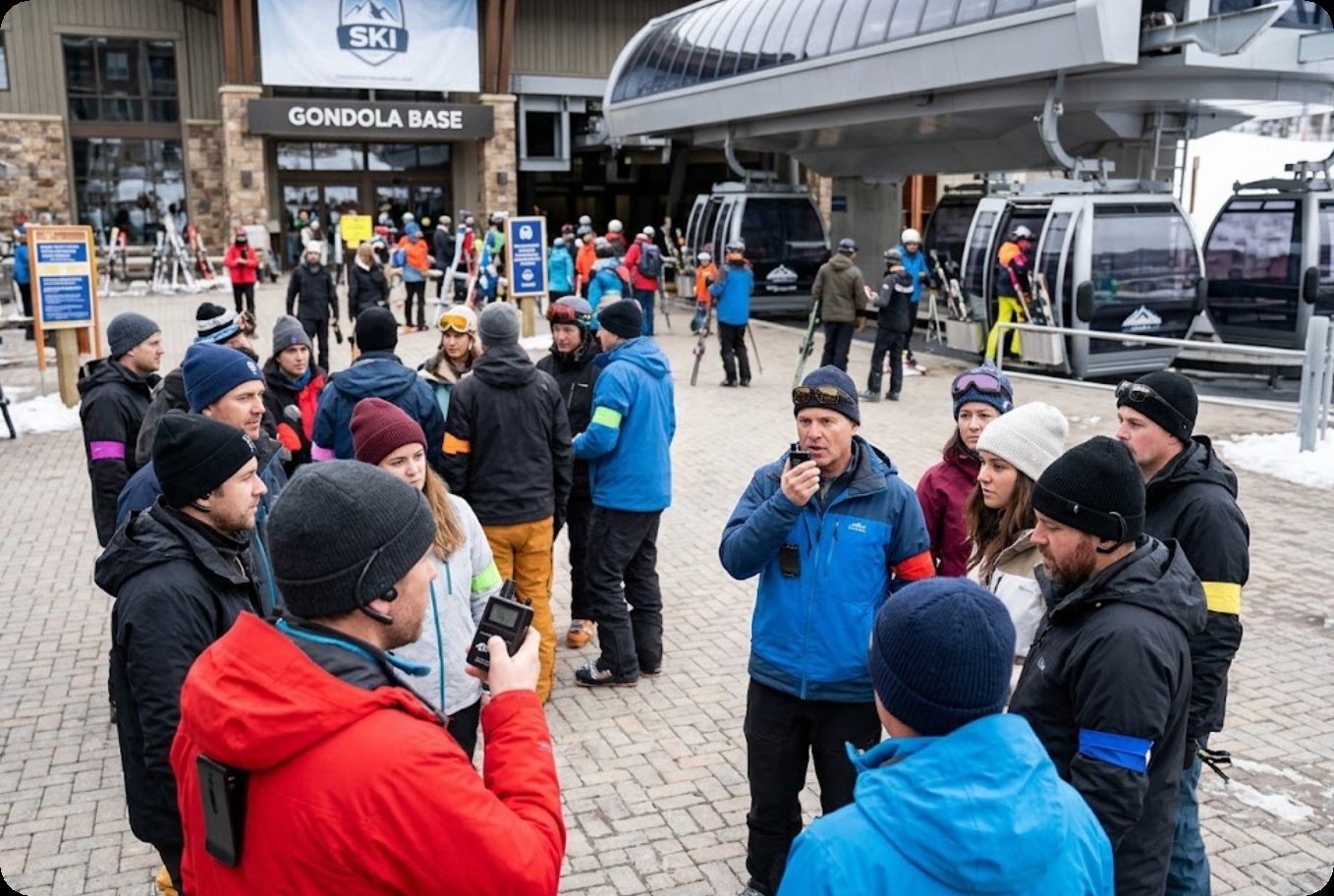
RC2408-ski_resort_channels

🎯 An 18-Gram Receiver for a Guide on Skis

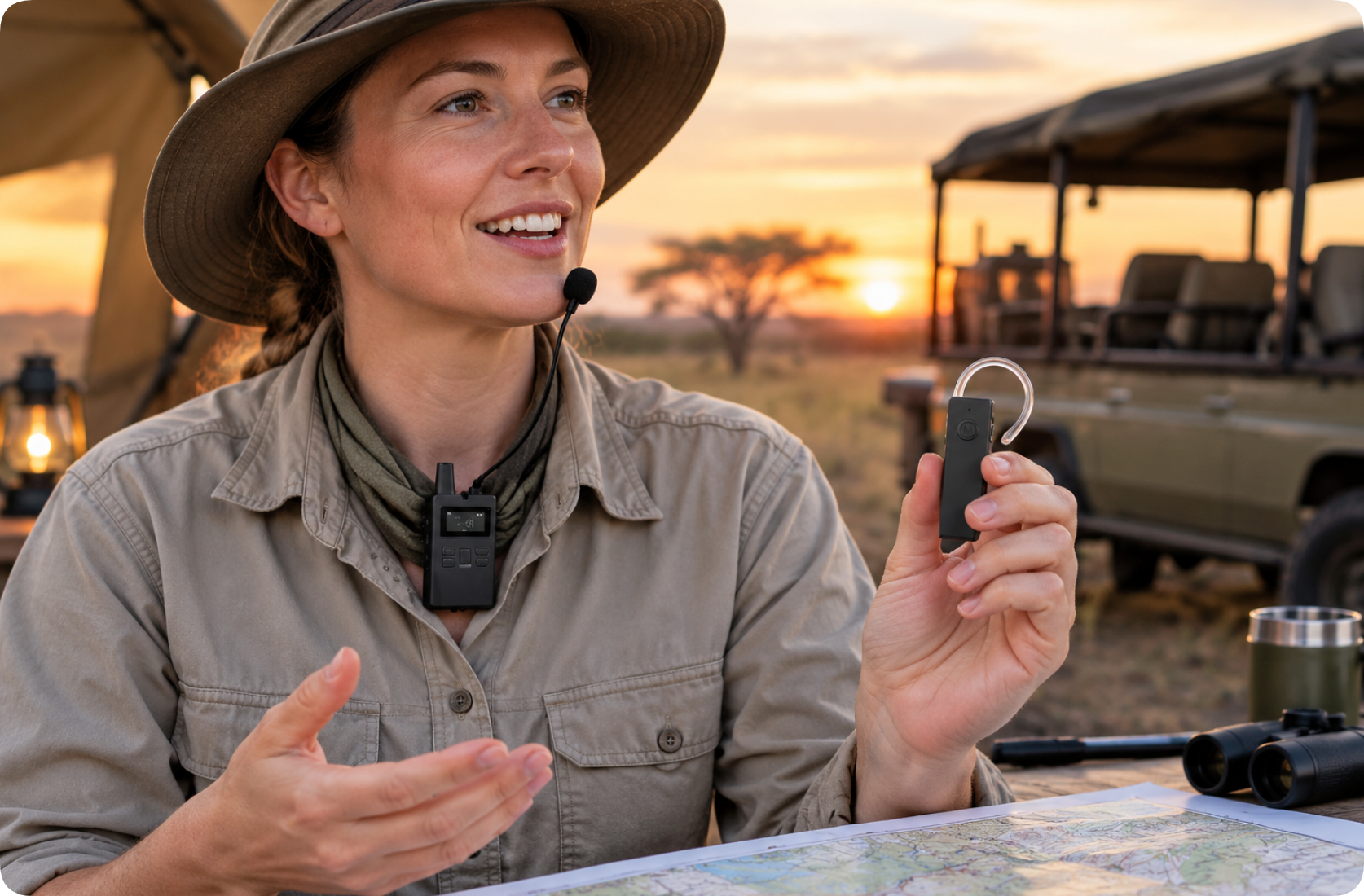
The third piece is about the person wearing it. Our RC2468 puts the weight where it counts: the receiver is just 18 grams, light enough to forget in an ear for a full morning on the snow. It runs on 2.4 GHz with 50 PLL-synthesized channels, reaches one to two hundred meters in open terrain, and runs about 12 hours on the transmitter and 10 on the receiver. In a children's ski school, where a four-year-old wears the unit for a single forty-minute lesson and then hands it back dripping, that featherweight receiver is the feature instructors notice first and parents complain about least. It carries an IP44 rating against snow and moisture, which matters the moment a unit is dropped in slush and has to be dried and reissued before the next class.
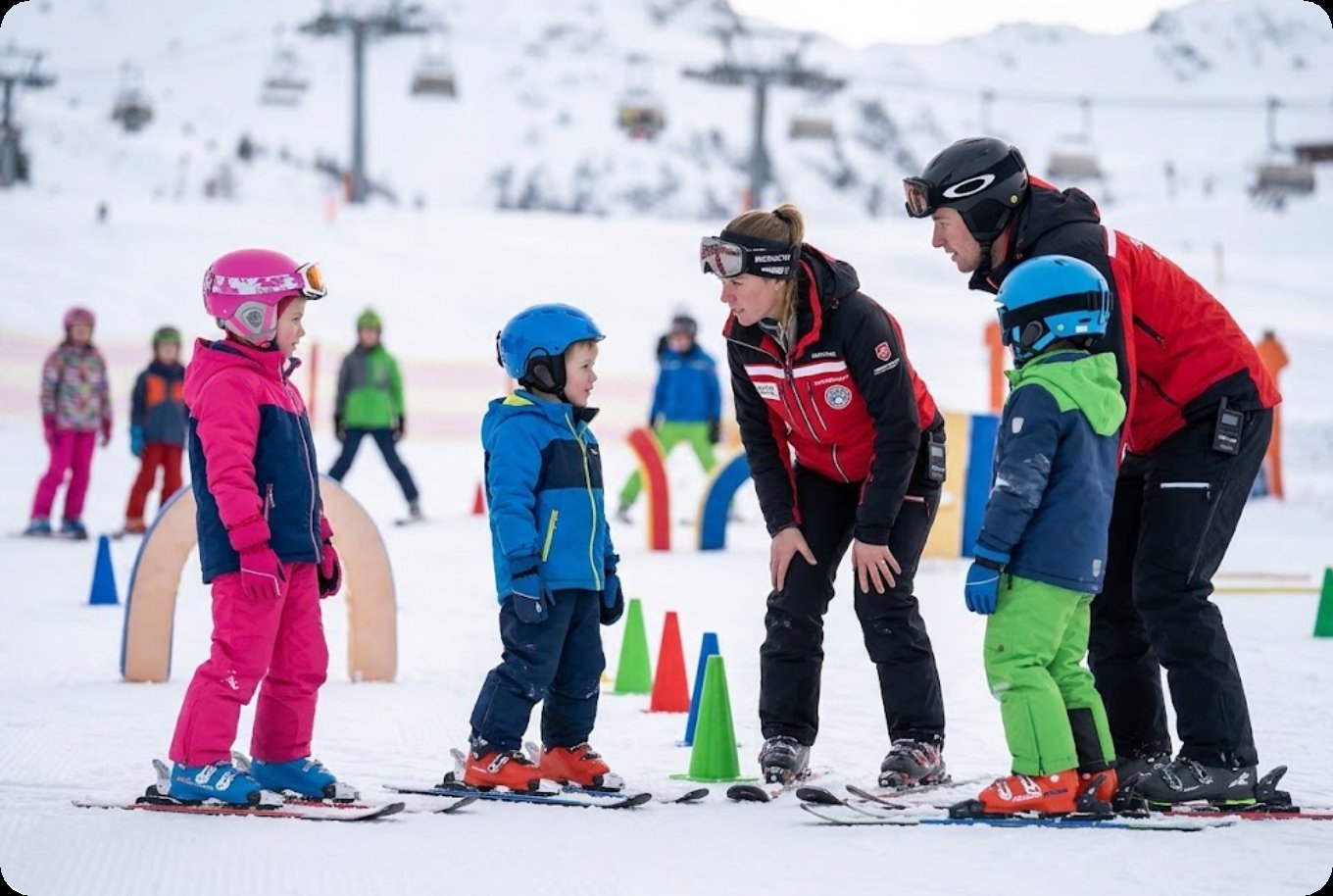
RC2468-ski_resort_light

How the Three Compare With Two Common Rentals

The table below sets our three units next to two rental systems buyers frequently compare them with, so the trade-offs are visible at a glance. Where a competitor does not publish a figure, we write Not published rather than guess, because a number we invent would only surface the first time a buyer checks the box.

SystemBandChannelsOpen rangeBatteryReceiver weightProtection
RC085UHF 470-510 MHzMulti-group~200 m12 h TX / 20 h RX~60 gIP42
RC24082.4 GHz80Up to 200 m10 h TX / 20 h RX50 gIP42
RC24682.4 GHz501-200 m12 h TX / 10 h RX18 gIP44
OKAYO WT-500UHF 794-806 / 819-823 MHz8070-100 m12-15 h42 gNot published
Retekess TT1092.4 GHz50180 m18-20 h51 gNot published

Where the Rental Options Fit Best

Neither rental is a bad choice, and each has a role. The OKAYO WT-500 is also UHF, so it escapes the 2.4 GHz crowd and runs 12 to 15 hours on a single charge, but its open range of 70 to 100 meters is roughly half of what the RC085 holds on a slope, and at 42 grams the receiver is more than twice the weight of the RC2468. The Retekess TT109 matches the RC2468 on channel count and beats it on paper for battery, yet its receiver sits at 51 grams and its 180-meter range still falls short of the RC085's UHF reach. For a small, slow group on a beginner slope they are perfectly serviceable, and a budget-minded desk can stock them without complaint. On a windy ridge with a spread-out group, or a peak day when ten tours share one mountain, they are the units that run out of road first, and that is the honest line we draw.

Building the Kit for a Full Ski Season

A practical resort kit pairs the RC085 as the long-range anchor, the RC2408 as the high-density workhorse for peak days, and the RC2468 as the featherweight option for short guided runs. All three live in the same wireless tour guide lineup, share charging habits that survive a cold equipment room, and let a rental desk mix and match by group size. Spare receivers stay in the warming hut, transmitters go on lanyards, and a guide can swap a dead unit for a charged one between morning and afternoon runs without breaking the tour. Overnight, the units charge in the same rack regardless of band, so the morning count is never a scramble, and a single spare pool covers every model a desk hands out.

The Takeaway

A ski resort is not a museum, and the system that wins there is the one built for distance, density, and weight at once. Our three-unit kit covers the open slope with UHF, the busy day with eighty channels, and the moving guide with an 18-gram receiver, and it does so without asking guests to fight their own phones for spectrum. If your season swings from quiet weekdays to sold-out weekends, the mix of one long-range anchor, one high-density workhorse, and one featherweight unit is the cheapest way to stay ready for both. See the full side-by-side comparison guides for other scenarios, or talk to us about a trial kit sized to your mountain.


2026-11-04 16:26
ꄘ click: 52

Get the spec sheet, MOQ and a factory-direct quote

Tell us the venue, the group size and how many languages you need. An engineer at our Shenzhen factory replies within one business day with the matching model, a written quote, lead time and the CE / RoHS / ISO 9001 documents.

Talk to an engineer WhatsApp +86 189 2287 9583

Prefer email? tiger.wang@richitek.com  |  OEM / ODM, custom tooling and neutral packaging available  |  send the enquiry through our contact page

Shenzhen Rich Age Electronics Co., Ltd. (Richitek) - manufacturing wireless tour guide systems, church translation headsets and museum audio guide equipment since 2007.

no data
Home > VS

A Ski Slope Tests a Tour System Harder Than Any Gallery

time: 2026年11月04日 click:52

A winter resort sells a feeling of effortless glide, but behind the scenes a guide has to hold a group together across gondola queues, icy plazas, and windy ridges where the next turn hides the last person in line. The silence of snow is deceptive. An open slope is one of the most demanding radio environments a tour system will ever meet, and a kit that works in a warm conference room can fall apart the moment the group steps onto the snow.

We built a three-unit field kit for alpine and Nordic resorts and ran it against two common rental systems that buyers often shortlist for the same job. A mountain is unlike a city walk or a museum hall in one blunt way: there is no ceiling and no wall to help the signal, and there is weather that punishes weak gear. If you are planning outdoor tour audio for a mountain setting, the numbers below explain why band choice, battery shape, and receiver weight matter more on snow than almost anywhere else.

📡 What the Mountain Does to a Radio

Three forces work against you at a ski resort. The first is distance with nothing to stop it. A lift line can stretch a group across two hundred meters of open piste, and a ridge has no walls to bounce a signal back, so range figures measured indoors shrink fast. The second is the crowd's own spectrum. Thousands of guest phones, smartwatches, and wireless headphones all fight for 2.4 GHz, the exact band most tour systems share, and a resort's own Wi-Fi mesh only adds to the noise. The third is the cold, which quietly shortens battery life and makes a heavy receiver feel heavier after a full day on the snow; lithium cells lose a visible slice of capacity below freezing, so a unit that promises eight hours at room temperature may deliver closer to five on a minus-ten morning. A fourth, easy to forget, is the metal cage of a gondola: the moment a guide and a guest ride up in separate cabins, a steel box sits between them and the link has to punch through it. Any system that ignores these pressures will look fine on paper and fail on the mountain.

A UHF Anchor That Ignores the Crowd's Phones

Our RC085 is the only unit in this kit that never touches 2.4 GHz. It transmits on 470-510 MHz UHF, a band where guest phones and wearables simply do not operate, so the congestion problem is removed before it starts. On an open slope that single choice buys real reach: the RC085 holds a clean signal up to about 200 meters in line of sight, which is exactly what a guide needs when the group spreads out between a chairlift exit and the next meeting point. We have stood at the top of a fixed-grip lift with the transmitter and watched the receiver stay locked to a guest still crossing the base plaza, a gap no 2.4 GHz unit held that day. It runs 12 hours on the transmitter and 20 on the receiver per charge, charges over a plain USB cable, and carries multi-channel group operation so two guides can run separate groups on separate frequencies without cross-talk. That USB charging matters more than it sounds in a mountain hut, where a proprietary dock is one broken part away from a dead fleet and a laptop or power bank keeps every unit alive. The trade is audio bandwidth, capped near the speaking range rather than full music fidelity, which is the honest limit to name up front.

RC085-ski_resort_uhf

Eighty Channels for a Busy Winter Day

Where a resort is already built around 2.4 GHz Wi-Fi and the IT team has filled the band, our RC2408 stays on the familiar frequency but brings 80 independent channels instead of the usual few. On a peak-season day with a dozen simultaneous tours, that headroom is the difference between finding a clean slice of spectrum and fighting every access point for it. A rental desk can assign tour A to channel 12, tour B to channel 47, and tour C to channel 73, and none of them bleed into the others even when the three groups queue at the same gondola. The receiver lasts 20 hours and the transmitter 10, the weights are 59 grams on the transmitter and 50 on the receiver, and it powers through a DC port. It will not escape 2.4 GHz interference the way the RC085's UHF band does, and we name that limit plainly, but as a high-density workhorse it keeps a rotating cast of guides and guests connected through a long, busy day.

RC2408-ski_resort_channels

🎯 An 18-Gram Receiver for a Guide on Skis

The third piece is about the person wearing it. Our RC2468 puts the weight where it counts: the receiver is just 18 grams, light enough to forget in an ear for a full morning on the snow. It runs on 2.4 GHz with 50 PLL-synthesized channels, reaches one to two hundred meters in open terrain, and runs about 12 hours on the transmitter and 10 on the receiver. In a children's ski school, where a four-year-old wears the unit for a single forty-minute lesson and then hands it back dripping, that featherweight receiver is the feature instructors notice first and parents complain about least. It carries an IP44 rating against snow and moisture, which matters the moment a unit is dropped in slush and has to be dried and reissued before the next class.

RC2468-ski_resort_light

How the Three Compare With Two Common Rentals

The table below sets our three units next to two rental systems buyers frequently compare them with, so the trade-offs are visible at a glance. Where a competitor does not publish a figure, we write Not published rather than guess, because a number we invent would only surface the first time a buyer checks the box.

SystemBandChannelsOpen rangeBatteryReceiver weightProtection
RC085UHF 470-510 MHzMulti-group~200 m12 h TX / 20 h RX~60 gIP42
RC24082.4 GHz80Up to 200 m10 h TX / 20 h RX50 gIP42
RC24682.4 GHz501-200 m12 h TX / 10 h RX18 gIP44
OKAYO WT-500UHF 794-806 / 819-823 MHz8070-100 m12-15 h42 gNot published
Retekess TT1092.4 GHz50180 m18-20 h51 gNot published

Where the Rental Options Fit Best

Neither rental is a bad choice, and each has a role. The OKAYO WT-500 is also UHF, so it escapes the 2.4 GHz crowd and runs 12 to 15 hours on a single charge, but its open range of 70 to 100 meters is roughly half of what the RC085 holds on a slope, and at 42 grams the receiver is more than twice the weight of the RC2468. The Retekess TT109 matches the RC2468 on channel count and beats it on paper for battery, yet its receiver sits at 51 grams and its 180-meter range still falls short of the RC085's UHF reach. For a small, slow group on a beginner slope they are perfectly serviceable, and a budget-minded desk can stock them without complaint. On a windy ridge with a spread-out group, or a peak day when ten tours share one mountain, they are the units that run out of road first, and that is the honest line we draw.

Building the Kit for a Full Ski Season

A practical resort kit pairs the RC085 as the long-range anchor, the RC2408 as the high-density workhorse for peak days, and the RC2468 as the featherweight option for short guided runs. All three live in the same wireless tour guide lineup, share charging habits that survive a cold equipment room, and let a rental desk mix and match by group size. Spare receivers stay in the warming hut, transmitters go on lanyards, and a guide can swap a dead unit for a charged one between morning and afternoon runs without breaking the tour. Overnight, the units charge in the same rack regardless of band, so the morning count is never a scramble, and a single spare pool covers every model a desk hands out.

The Takeaway

A ski resort is not a museum, and the system that wins there is the one built for distance, density, and weight at once. Our three-unit kit covers the open slope with UHF, the busy day with eighty channels, and the moving guide with an 18-gram receiver, and it does so without asking guests to fight their own phones for spectrum. If your season swings from quiet weekdays to sold-out weekends, the mix of one long-range anchor, one high-density workhorse, and one featherweight unit is the cheapest way to stay ready for both. See the full side-by-side comparison guides for other scenarios, or talk to us about a trial kit sized to your mountain.
Get the spec sheet, MOQ and a factory-direct quote

Tell us the venue, the group size and how many languages you need. An engineer at our Shenzhen factory replies within one business day with the matching model, a written quote, lead time and the CE / RoHS / ISO 9001 documents.

Talk to an engineer WhatsApp +86 189 2287 9583

Prefer email? tiger.wang@richitek.com  |  OEM / ODM, custom tooling and neutral packaging available  |  send the enquiry through our contact page

Shenzhen Rich Age Electronics Co., Ltd. (Richitek) - manufacturing wireless tour guide systems, church translation headsets and museum audio guide equipment since 2007.

no data
×

Contact us

email:
name:
subject:
content: