
Heritage sites have a sound problem that no other venue shares. In a monastery cloister or a temple hall, the guide cannot raise their voice — a docent who projects over stonework built for silence is a docent who gets complained about. So the narration has to arrive at each visitor's ear directly, at conversational volume, whether that visitor is three steps away or across a courtyard. International visitors add a second layer: groups split by language, each needing the same story in their own tongue. Faced with this, a surprising number of operators reach for consumer translation hardware — a shelf of pocket translators or a crate of AI translation earbuds — on the theory that if the gadget can translate a conversation, it can serve a group. Two of the best-known names in that category, Timekettle and Pocketalk, make genuinely impressive devices. But a two-way conversation tool and a one-to-many narration system are different machines, and the difference shows up the moment a timed entry slot begins.
What Two-Way Conversation Devices Actually Do
Timekettle's WT2 Edge earbuds are remarkable at their designed job. They deliver bidirectional simultaneous interpretation across 43 languages and 96 accents online, with 13 offline language pairs, and hand a translated sentence to the other listener in as little as half a second. Each bud weighs under six grams, the case extends three hours of interpreting to twelve, and the app exports a full transcript afterwards. For two people sitting across a table, it is close to magic. Now put it in a cloister. The architecture assumes a dialogue: one bud per speaker, turn-taking enforced by the mode you choose. A guided visit is a monologue to thirty people — there is no second bud to pair with, no turn to take, and the phone running the app belongs to whichever guide remembered to charge it. Offline support covers only a handful of language pairs, and stone buildings are exactly where mobile data goes to die. Pocketalk's Plus unit takes the other approach: a 3.5-inch touchscreen with 82 languages, a two-year LTE data plan across 130 countries, and a 100dB speaker. That speaker is the entire distribution system. Twenty-five visitors cannot crowd around one hand-held device and hear a whispered narration over it, and the operators holding it in rotation will spend the visit passing hardware instead of listening. PCMag's review praises it as a conversation tool and notes plainly what it is not: it has no IP rating and requires internet for every translation, because the engines live in the cloud.
The Acoustics No Gadget Specs Mention
Stone interiors punish both categories of consumer hardware in ways that never appear on a spec sheet. Reverberation time in a vaulted nave stretches past two seconds, so every loudspeaker — including the Pocketalk's 3W unit and any phone playing an app's output — smears its own voice into mud before it reaches the back of a group. Whispering galleries and pointed arches funnel sound unpredictably: the visitors at the corners hear a delayed ghost of the narration, while translation earbuds fight a different battle, because their beamforming microphones were tuned for a quiet office, not for shuffling feet, other groups' guides, and the low roar of a crowd moving through a doorway. A dedicated transmitter and a sealed earpiece sidestep all of it: the audio path from lavalier mic to eardrum never touches the room's acoustics, which is why visitors can stand six metres apart and hear identical, intimate delivery. Site managers notice the flip side too — receivers keep each group silent, so three tours can share one hall without the rising spiral of competing loudspeakers that plagues unmanaged multilingual visits.
Whisper Delivery for Sacred Silence
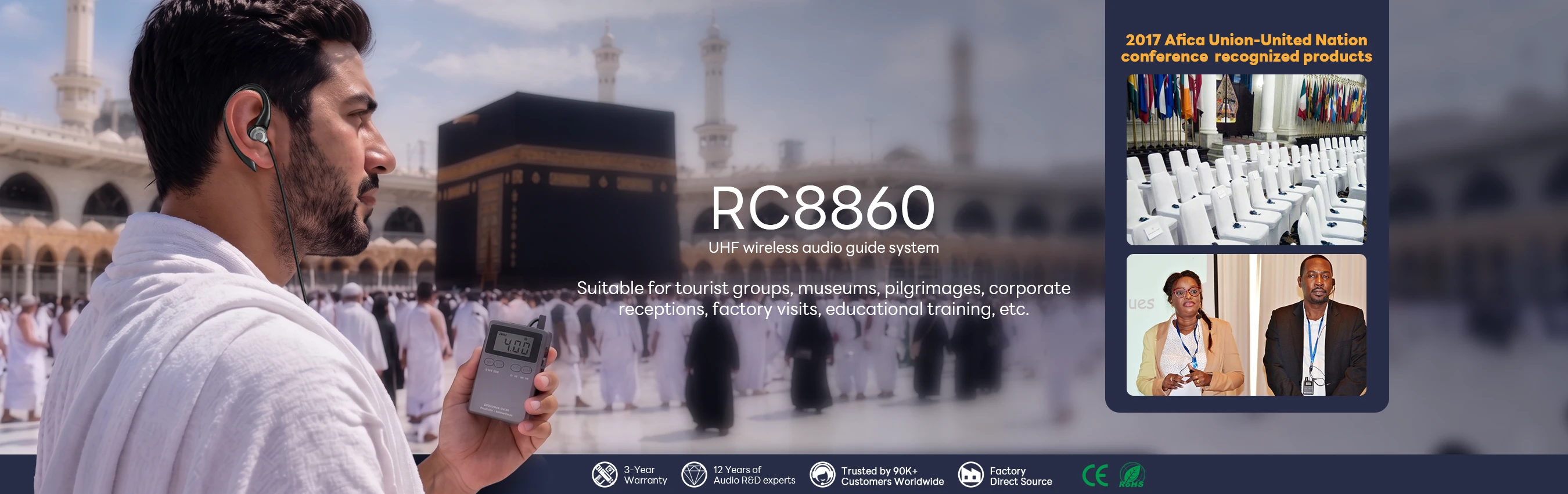
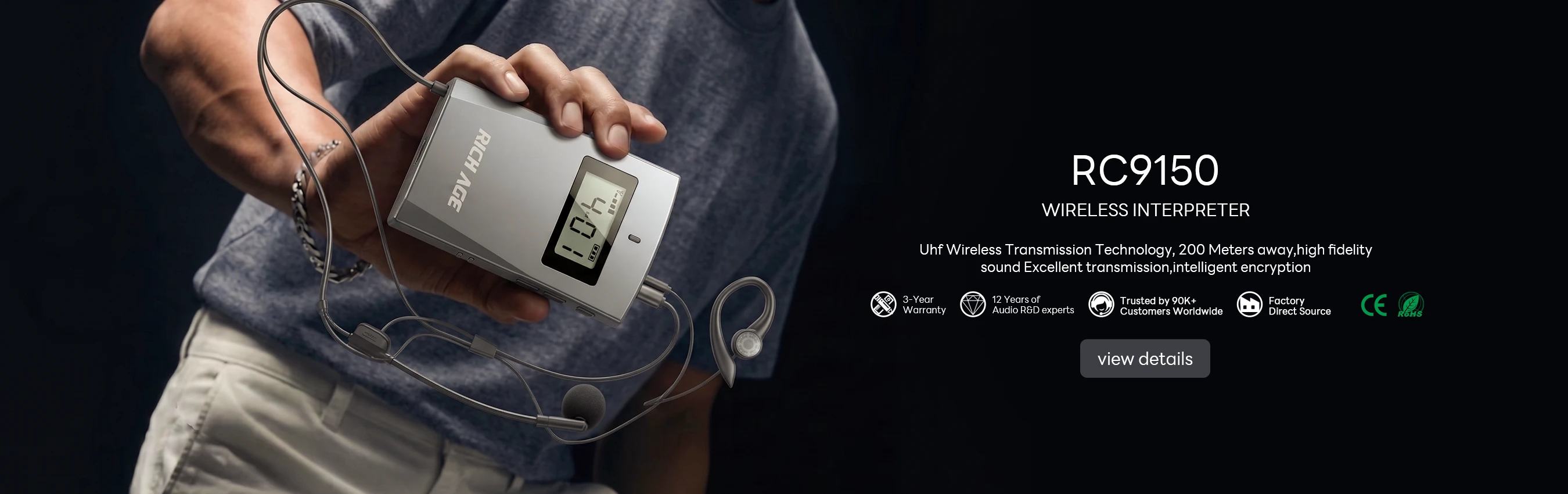
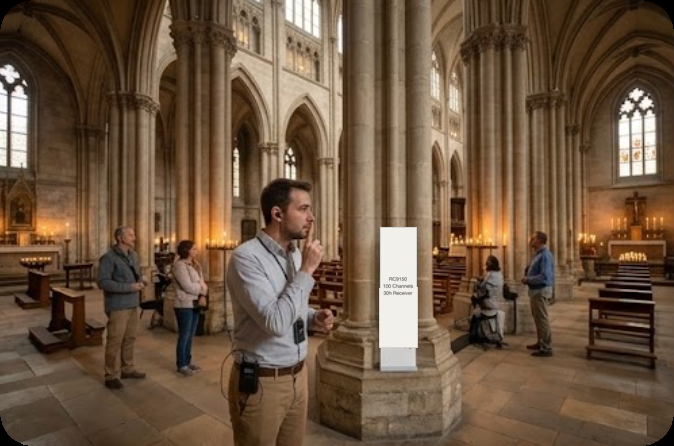
The correct architecture inverts the gadget's: the guide speaks once, quietly, into a transmitter, and every visitor hears that whisper directly in an earpiece. The Richitek RC9150 is built for exactly this duty at scale — 100 independent channels that let multiple groups share a single hall without crosstalk, and battery endurance that resets expectations: over 30 hours of receiver operation and 15 hours on the transmitter, enough to cover a multi-day pilgrimage without a charging cart. Transmission rides the 2403-2483MHz 2.4GHz ISM band, licence-free worldwide, with encrypted, high-fidelity audio that keeps a guide's hushed delivery intact across reverb-heavy stone interiors. In a prayer hall where a raised voice is a violation, that is not a nice-to-have; it is the difference between being welcomed back and being shown the door. The same encrypted whisper fills in for what a pass-around speaker cannot do at all: narrate while visitors are looking up at a fresco, not down at a screen.
Eighty Channels for Every Language Group
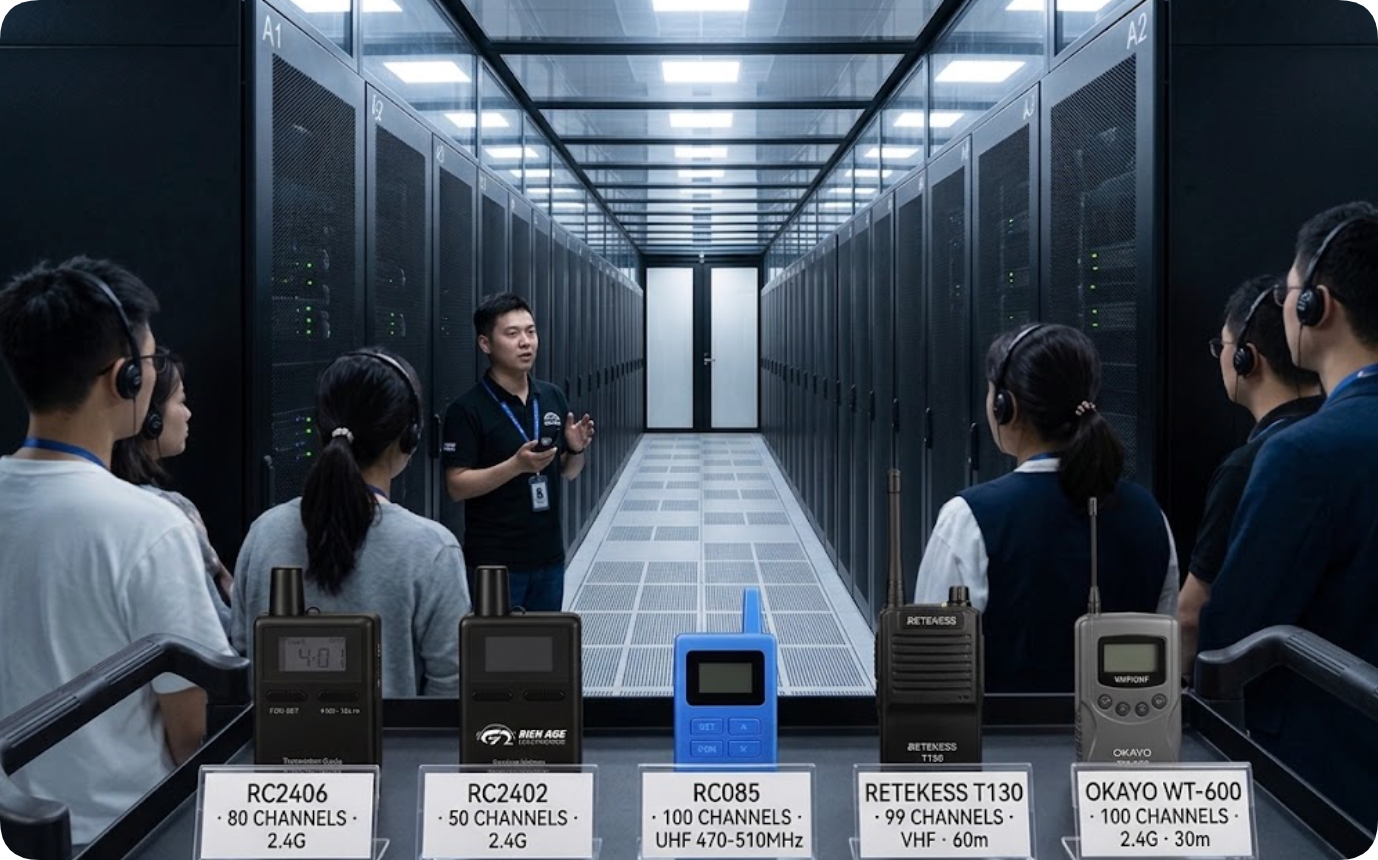
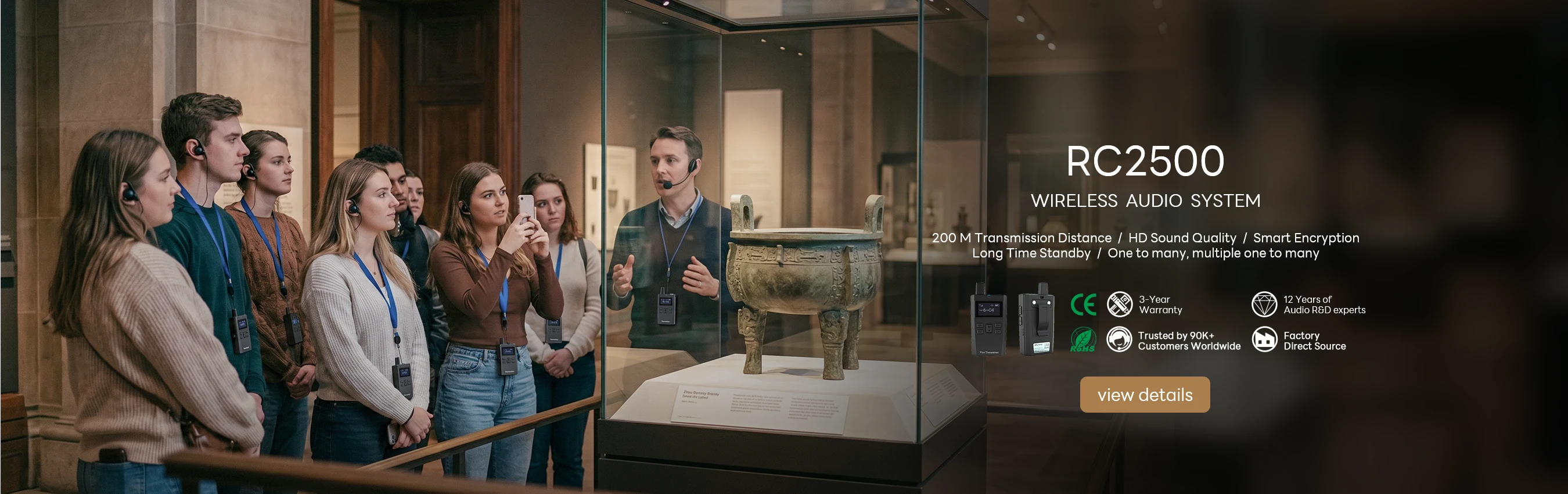
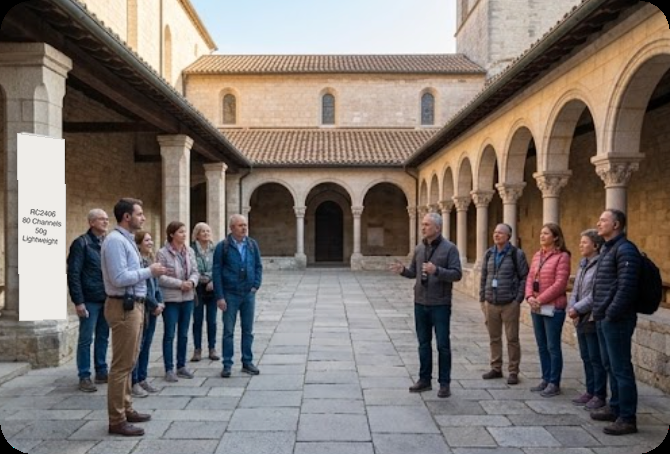
Multilingual heritage sites rarely run one group at a time. A Saturday morning might stack a Mandarin group, a Spanish group and a French group into the same halls on staggered starts, and each needs its own narration path. The Richitek RC2406 handles this with 80 interference-free channels — each group isolated on its own frequency, no audio overlap even in dense traffic — and stretches 200 metres of range, so the guide can lead from the front while stragglers linger at an altar screen. The whole unit is featherweight: a 50-gram transmitter and a 50-gram receiver, comfortable across a full day of wear, backed by a 1500mAh battery rated for continuous long events. It runs on 2.4GHz and is licence-free globally, which matters for operators who move between countries and cannot babysit regional frequency approvals. One-click pairing turns the morning's kit-up from a technical chore into a task a volunteer can run. For sites that also host school cohorts and corporate receptions, the same hardware flexes across all of them without reconfiguration — the same reason it slots naturally into education audio guide deployments.
Range and Weather for Courtyard Circuits
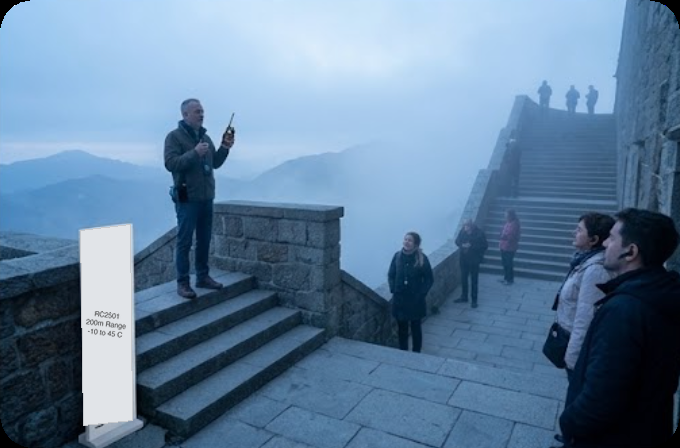
Temple complexes are not climate-controlled boxes. Visitors move between incense courtyards, shaded corridors and open terraces, and morning ceremonies start before the day warms up. The Richitek RC2501 is engineered around that reality: 200 metres of transmission range in open areas, with a signal that stays steady while visitors spread across halls, terraces and gardens, and an operating window of -10°C to 45°C that covers frost-weathered mountain monasteries and summer courtyard heat alike. The mainboard is covered by warranty — with only the wear items a guide would expect, headset, microphone and battery, excluded — which is a honest, durable-service design for hardware that gets handled by thousands of visitors a year. A guide can narrate continuously while walking a full circuit without ever asking the group to bunch up, and the transmission does not care whether the wall between them is carved sandstone or open air.
There is also the question of who operates the equipment. At most heritage sites the morning kit-up is run by a volunteer or a rotating docent, not an audio technician, and hardware that demands pairing rituals gets misconfigured by the second week. One-click pairing and a transmitter that powers on into its assigned channel make the RC2501's startup a thirty-second routine: count the receivers out of the case, hand them out at the gate, count them back at the end. The same logic governs survivability — devices passed through a thousand hands a month need bodies that shrug off being set down on stone benches, and a warranty that covers the mainboard while excluding only the three genuine wear items keeps the total cost of ownership predictable across seasons.
🔋 Battery Arithmetic for a Pilgrimage Day
Count the hours honestly. A Pocketalk Plus manages 330 minutes of continuous translation — about five and a half hours — before its 1,550mAh battery quits, and it is useless while charging. A set of WT2 Edge buds delivers three hours per charge, twelve with the case, and each of thirty visitors would need their own set to hear a shared narration, which converts a $280 gadget into a four-figure per-group purchase. The RC9150's receivers run beyond 30 hours, covering a three-day festival on one charge, and the RC2406's 1,500mAh cell spans the longest single-day programme. Charging logistics shrink accordingly: one multi-bay case overnight instead of a wall of adapters, and the kit-room routine — wipe, rack, charge, count — closes each day the same predictable way it does for museum audio guide fleets.
Running Language Groups Without a Human Relay
Translation gadgets cannot carry a second language through a building at all: a Pocketalk translates whatever is said into it, turn by turn. Heritage operators solve multilingual tours differently — a bilingual guide or interpreter narrates into a second transmitter on a separate channel, and the Spanish-language receivers hear the live relay in real time, in sync with the same walk. That is how simultaneous interpretation systems work at conferences, and the channel plan transfers directly to a cloister: RC9150's 100 channels host an interpreter relay, a Mandarin group and a French group simultaneously, each isolated, each hearing their own guide. No app, no cloud engine, no subscription, and no dependence on whatever the site's Wi-Fi is doing that morning — a resilience that cloud-translated audio, by definition, cannot promise.
Broadcast Wins Where Dialogue Ends
None of this says the gadgets are bad. A Pocketalk Plus belongs in a site office for ad-hoc visitor questions, and a set of WT2 Edge buds is a superb tool for a curator's one-on-one meeting with an overseas counterpart. But the moment a timed group gathers at the gate, the job stops being conversation and becomes broadcast — one whispered voice carried clearly to every ear across stone, courtyards and crowds, in as many languages as the site sells tickets for. Gear the job for the job: the RC9150 in the prayer hall, the RC2406 across parallel language groups, the RC2501 on the long courtyard circuit, and the narration arrives the way the architecture intended — quietly, and everywhere at once.