A leading China factory specializing in Wireless Tour Guide Systems, Church Audio Guides, and Translation Headphones with premium OEM/ODM solutions.

Tel:+86 18922879583

Email:tiger.wang@richitek.com

Why Creator Microphones Fail in Winery Tours (And What Works Instead)

The first time I watched a winery try to solve its tour problem, the marketing manager unboxed two tiny clip-on transmitters and a matchbox-sized receiver — the same kit their videographer uses for harvest-reel footage — and announced that guests would now hear the guide through their phones. Six months later the kit lives in a drawer. It was never broken; it was simply built to carry a voice to a camera's recording input, not to forty pairs of ears spread across a barrel cellar. Creator-grade wireless microphones are the most seductively wrong purchase in hospitality audio, and a wine estate is precisely the place where the wrongness shows.

Where the Earmuff Idea Comes From

The logic is understandable. A vlogging kit is small, fashionable, costs less than a round of tasting fees for the whole group, and the unboxing experience feels premium. So estates buy one, film one test video, and then discover that the architecture of the product — one or two transmitters feeding a single recorder-mounted receiver — has nothing to offer a paying group of visitors.

Rode Wireless GO II: A Recorder Wearing a Microphone's Clothes

To be clear about what the Wireless GO II is: a dual-channel 2.4 GHz recording tool with 128-bit encryption, 200 meters of line-of-sight range, transmitters weighing about 30 grams, and roughly 7 hours of battery life. Outstanding numbers — for their purpose. Its receiver outputs to a camera's 3.5 mm input or a phone's USB-C port; there is no headphone listening stage for an audience, because an audience was never the customer. A tour group of eighteen people would need eighteen receiver units, and Rode does not make them. The 7-hour battery is respectable, but it powers a recorder, not a listening service, and the two-transmitter ceiling means a second guide cannot join without a second receiver chain.

Comica BoomX-D D2: Fifty Meters and a Hard Stop

The BoomX-D D2 doubles down on the same architecture with smaller numbers. Digital 2.4 GHz transmission across 2400-2483.5 MHz, yes — but the maximum operating range is 50 meters line of sight, the 300 mAh batteries last about 5 hours, and the specification sheet caps the setup at two systems per venue. A barrel cellar with stone arches eats line-of-sight for breakfast; by the second turn in the tunnel the fifty meters is forty, then thirty. And the two-system ceiling means that when the German group and the Japanese group overlap on a Saturday afternoon — a scheduling event that happens every Saturday — one of them waits. Five hours of battery also lands awkwardly against a harvest-season day that runs from the 9 AM vineyard walk to the 5 PM barrel tasting.

A Wine Estate Is Three Different Acoustic Buildings

What makes wineries genuinely hard, and creator microphones genuinely useless here, is that a single visit crosses three acoustically hostile spaces in ninety minutes. The vineyard rows are open air but wide: the guide walks ten paces ahead, wind moves through the canopy, and two hundred meters of separation happens without anyone noticing. The fermentation hall is stainless steel and poured concrete — every word ricochets, and the tank-monitoring Wi-Fi and Bluetooth probes hanging off the equipment fill the 2.4 GHz band with traffic. The barrel cellar underground is stone, arched, damp at a steady cellar temperature, and every wall is a low-frequency absorber that thins a voice to a mumble within one vault. Equipment that cannot cross all three environments — open range, RF congestion, and masonry penetration — becomes shelf decoration by October.

RC2401: Reach That Survives the Second Vault

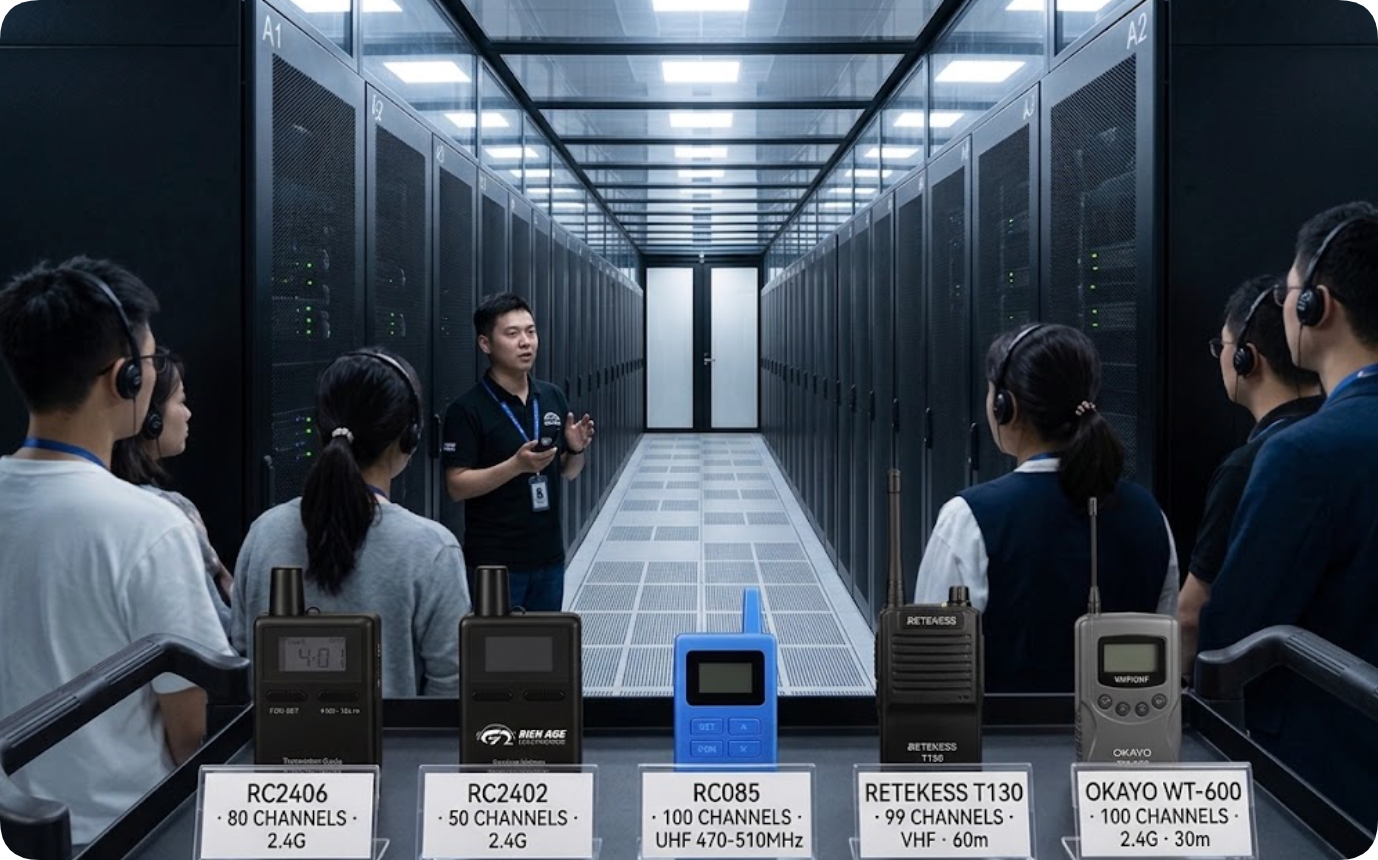
The RC2401 50-channel system starts where the creator kits stop. Its effective open-area range reaches 200 meters, and it powers through concrete walls and machinery-dense spaces that stall weaker 2.4G devices — which is the exact profile of a walk from the crush pad, through the fermentation hall, and down into the cellar. Fifty independent channels held by PLL synthesis mean the German tour, the Japanese tour, and the sommelier-led collectors' walk operate side by side without a whisper of crosstalk, and a single transmitter feeds an unlimited number of receivers, so a VIP group of eight and a coach group of forty use the same fleet logic. The transmitter runs 10-plus hours; the receivers hold 20, which is a full harvest-weekend on one overnight charge. For the estate that runs a shop, a tasting room, and a morning cooperage visit from one storeroom, single-transmitter scalability is also an inventory argument: one charger rack, one SKU of receiver, no per-group kit differentiation to maintain.
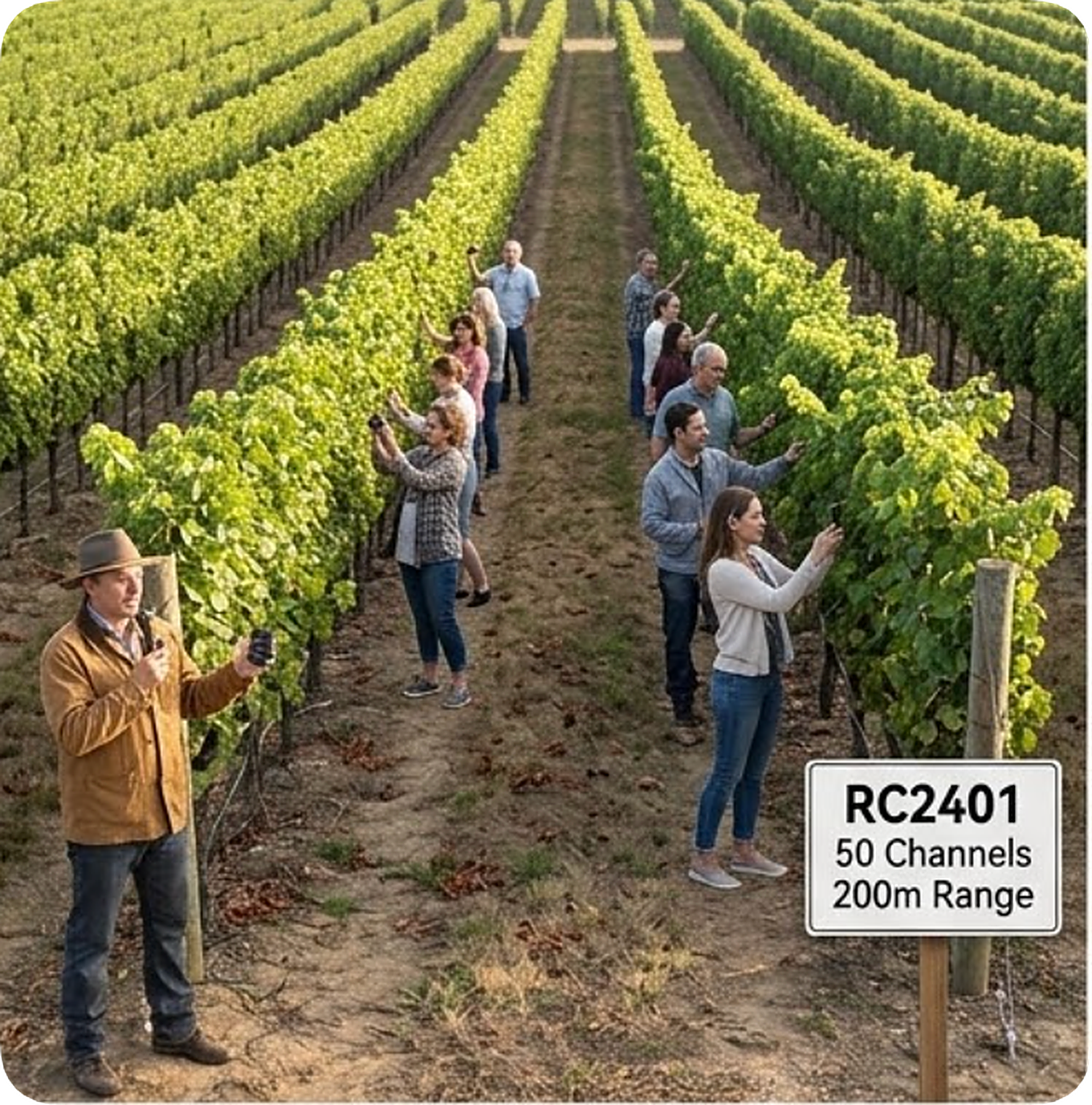
RC2401 winery_vineyard_rows_200m

RC2402: Light Enough for a Tasting Glass in the Other Hand

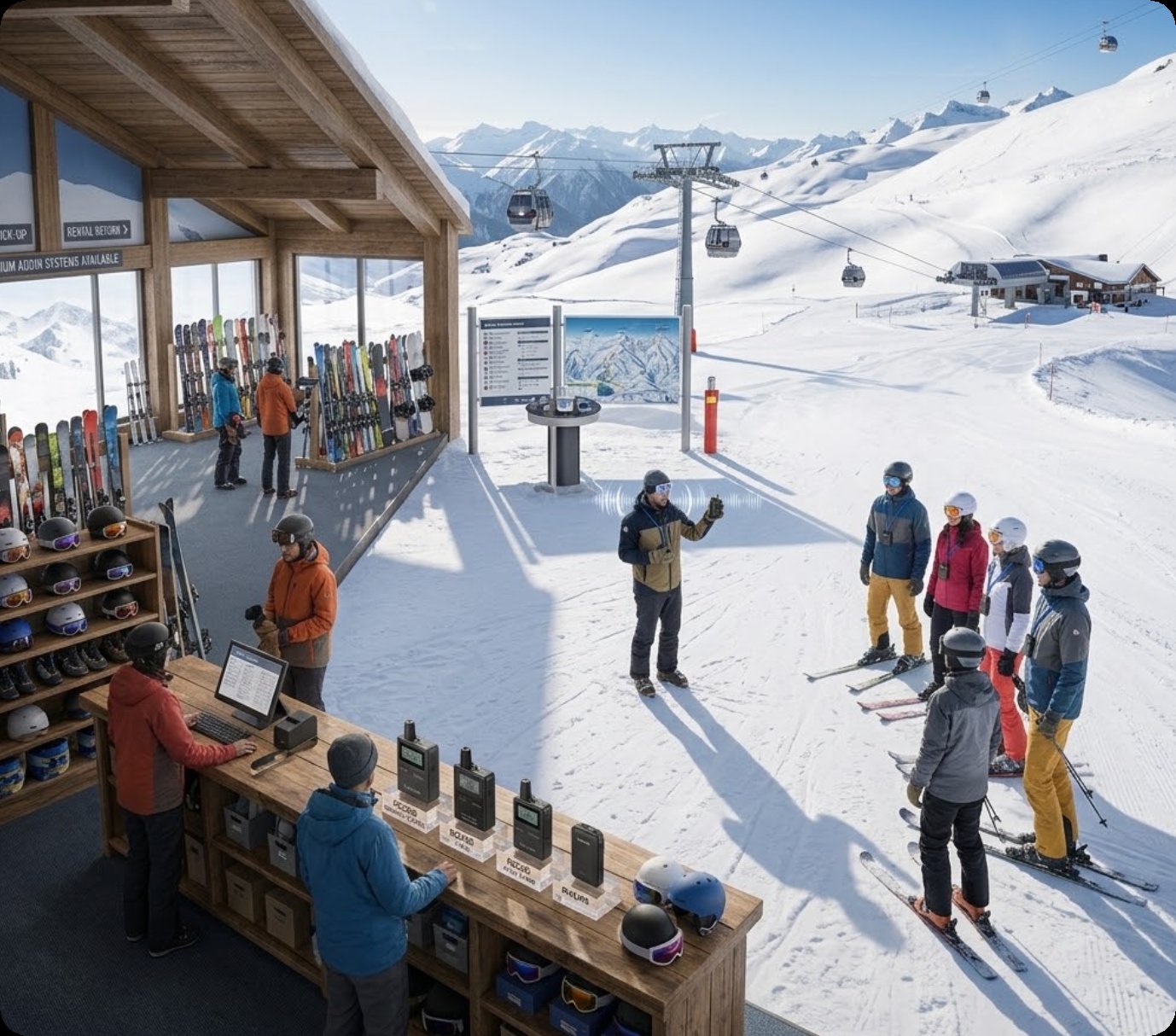
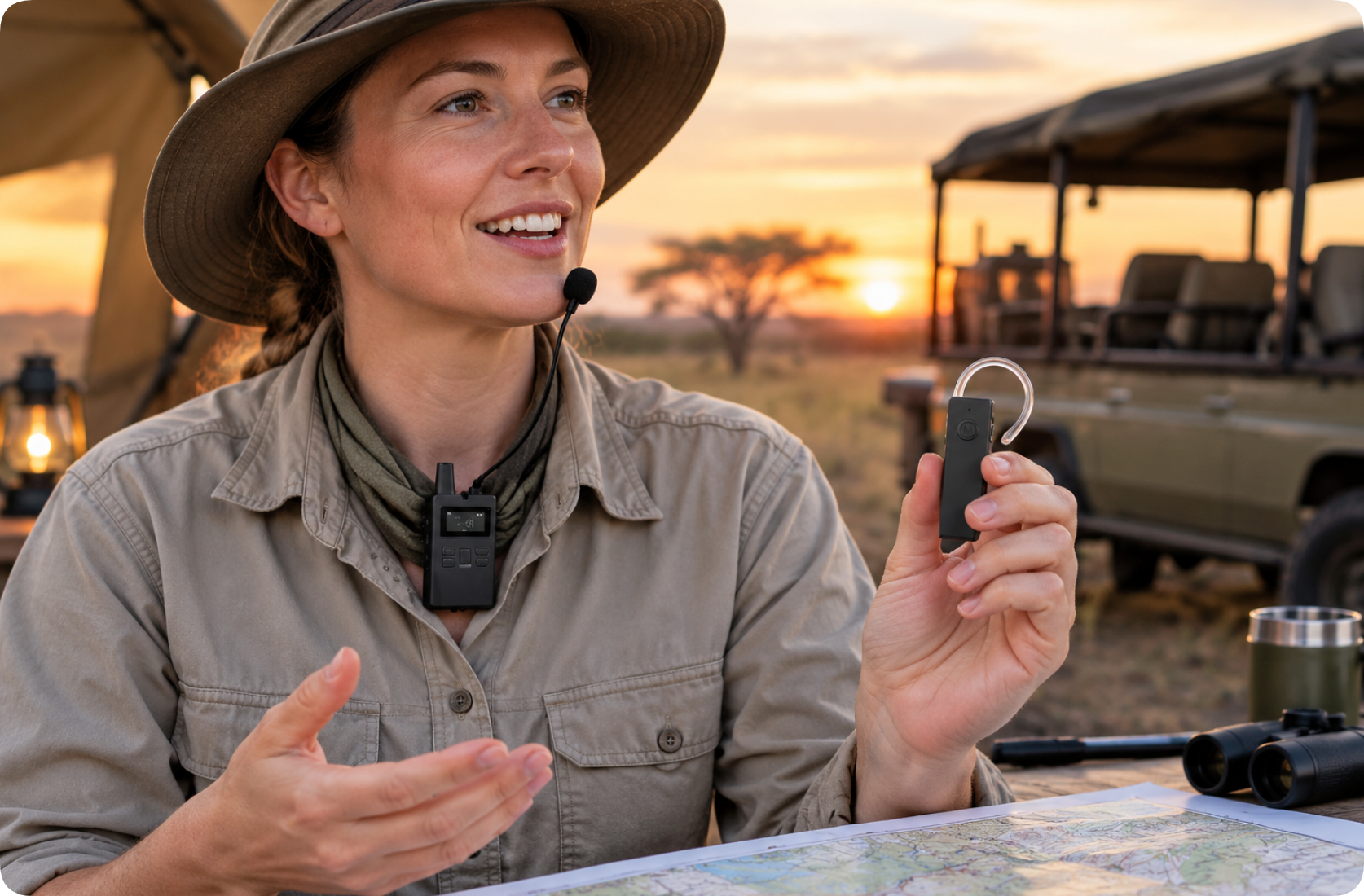
The RC2402 ear-hang system is the guest-comfort unit. Visitors hold a glass in one hand and a spit bucket conversation in the other; a fatigue-free, lightweight earpiece disappears into the experience instead of competing with it. It shares the license-free 2.4 GHz band — legal across borders without registration, which matters for estates running tours in the EU, North America, and Asia with one fleet — and the one-click sync means a seasonal guide is trained in ninety seconds. Receivers deliver 20 hours on a charge and the transmitter 10, and the 200-meter range covers the full vineyard-to-cellar arc of a standard visit.
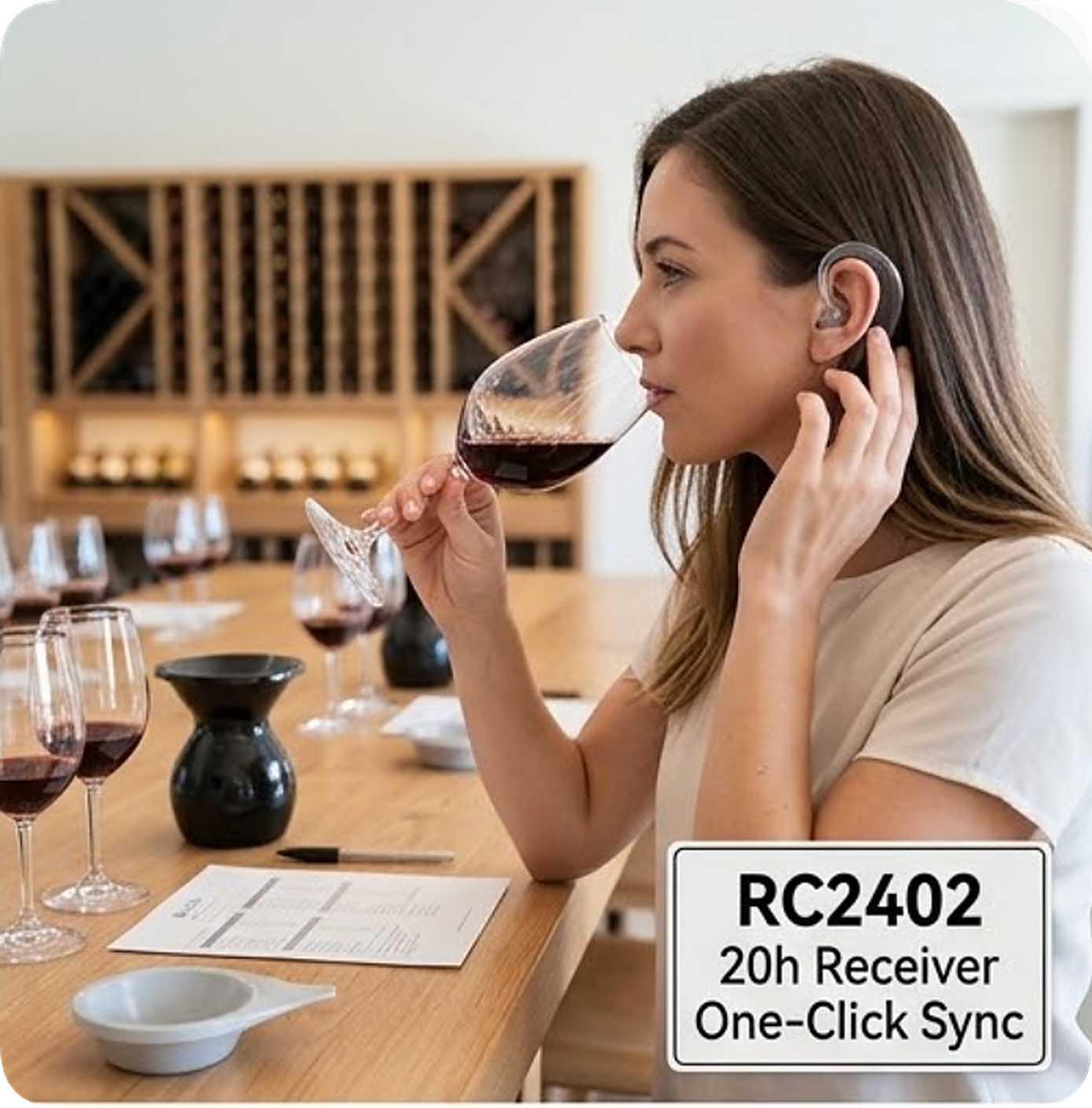
RC2402 winery_tasting_glass_earpiece

RC085: The UHF Unit That Lets the Room Answer Back

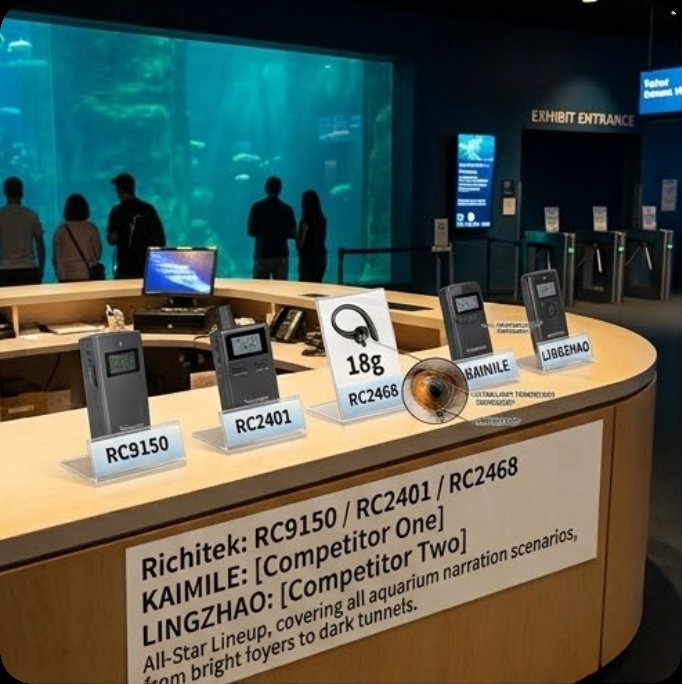
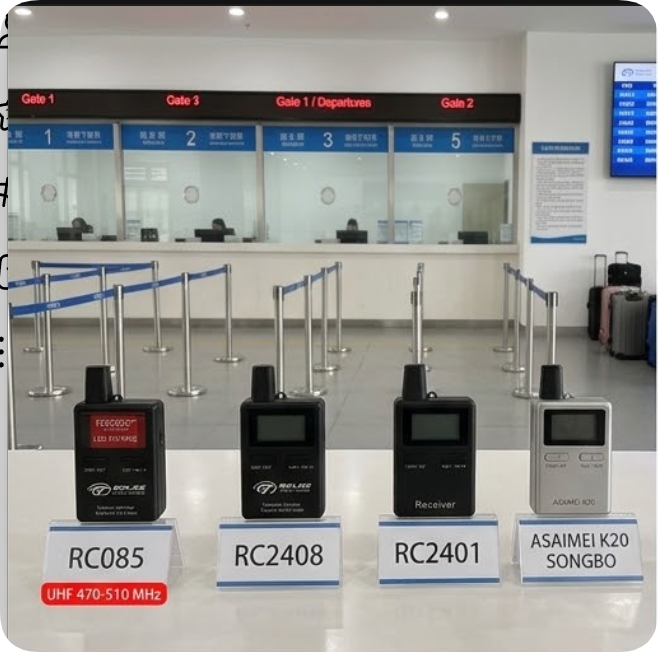
Wine education is a conversation, and the RC085 is the only unit in the fleet built for that. It works the UHF band — steering clear of the fermentation hall's 2.4 GHz congestion from tank probes and guest phones — and offers two working modes: F1, a one-way broadcast from one transmitter to unlimited receivers for the formal cellar walkthrough, and F2, a two-way mode where guests' receiver units carry a microphone and the host takes questions from anywhere in the barrel room. During a vertical tasting, that reverses the dynamic: instead of guests shouting across the vault, a question arrives privately in the host's earpiece. An LCD display shows battery, channel, and signal status at a glance, multiple groups run on separate channels, and range extends up to 200 meters depending on conditions. The physics is unglamorous but decisive: longer UHF wavelengths diffract around oak racks and stone piers more gracefully than the shorter 2.4 GHz waves that creator microphones share with every phone in the room, which is why the cellar walkthrough does not stutter exactly where the Instagram footage does.
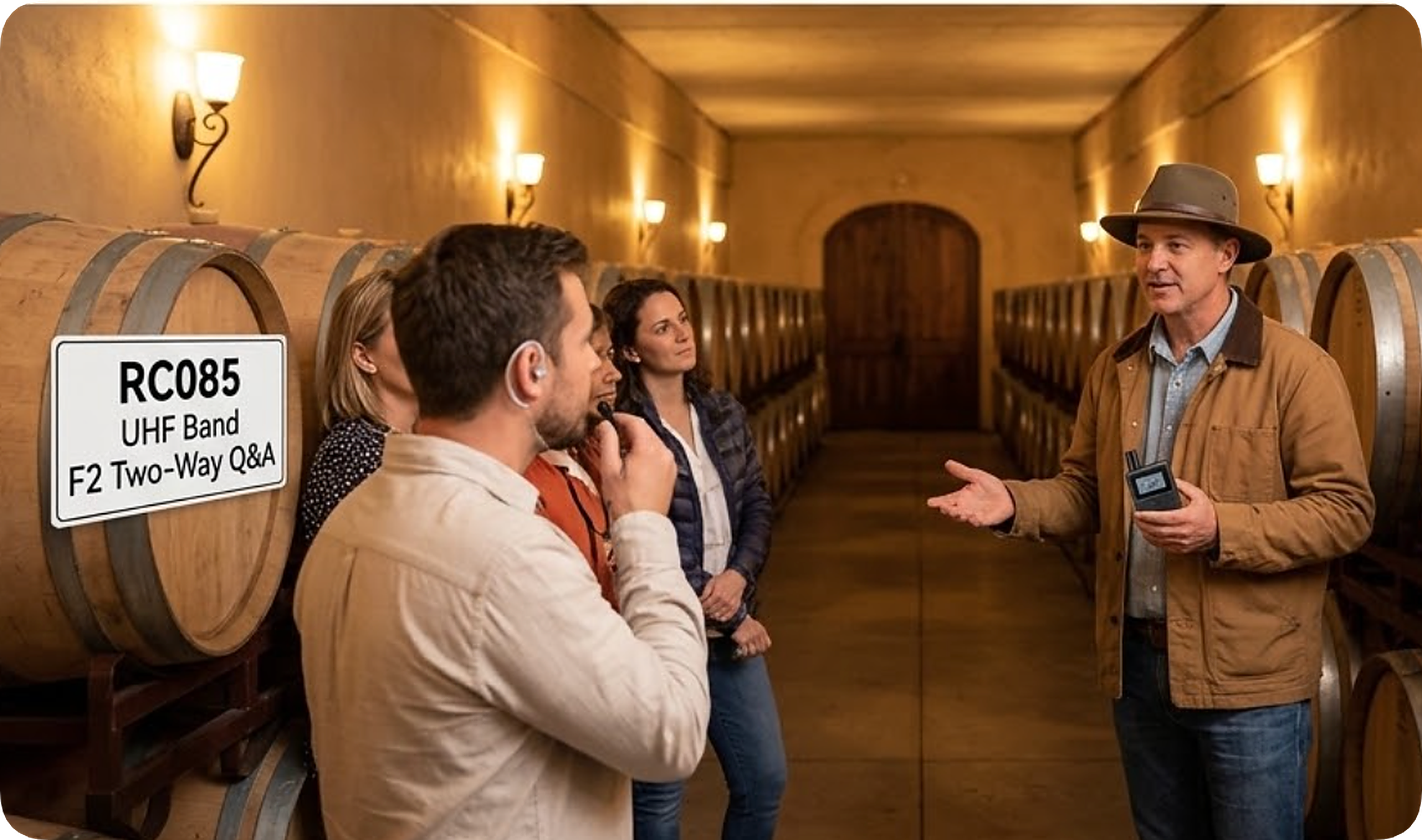
RC085 winery_barrel_room_qanda

The Numbers Behind the Pour

Dimension Rode Wireless GO II Comica BoomX-D D2 Richitek line
Designed output Camera / phone recording Camera / phone recording Visitor earpieces, one-way or two-way
Range 200 m line of sight 50 m line of sight 200 m open area, wall-penetrating
Channels 2 (dual record) 2, max 2 systems per venue 50 per unit, multi-group
Runtime ~7 h ~5 h 10 h TX / 20 h RX
Audience capacity Recorder only Recorder only Unlimited receivers per transmitter
Interactivity None None RC085 F2 two-way Q&A
Branding Stock Stock OEM shells, packaging, channel config

What the Creator Kits Still Do Well

Fairness first: keep the Wireless GO II and the BoomX-D exactly where they belong — on the videographer. They are superb at putting the winemaker's voice onto harvest footage, social reels, and the tasting-room promo loop, and the onboard recording with 128-bit encryption is genuinely excellent at that job. The mistake was never buying them; it was asking them to serve visitors.  The onboard recorders, with more than 40 hours of internal memory per transmitter, mean the winemaker interview is safe even if a receiver walks out of range mid-take. A camera needs one clean channel of record. A tour needs fifty clean channels of listening. No amount of clever gain staging turns the first product into the second.

Questions Before the First Tasting

Can two tours run at once without bleed?

Yes — that is the core of the channel architecture. Fifty PLL-locked channels per unit mean overlapping language groups and a separate press walkthrough share the same estate without audible crosstalk, which the two-system ceiling on consumer kits makes impossible.

Does the stone cellar kill the signal?

The 2.4 GHz units are specified to power through walls and machinery-dense spaces, and the UHF RC085 bends around stone architecture even more readily. Cellar vaults that reduce a creator microphone to thirty working meters leave the fleet audible at the back of the third vault.

What happens when guests want to ask questions?

Switch the RC085 into F2 mode. Guest receivers carry a microphone and the host hears questions directly in the earpiece — a genuine upgrade for vertical tastings and trade visits, not a workaround.

How long does setup take for a seasonal guide?

Under two minutes. Pick a channel, press sync, hand out receivers — the one-click pairing needs no app, no account, and no training session, which is why a new harvest intern can run the morning group on day one.

Can the estate put its own name on the units?

Yes. OEM customization covers device shells, packaging, channel configuration, and even battery specification — the estate's mark on the fleet the way it is on the label.

Outfitting the Estate Properly

A wine visit is choreography: rows, steel, stone, and a glass that never leaves the guest's hand. The audio has to thread all four without a button press, a phone app, or a dead battery at the fourth pour. That is a broadcast system's job with a sommelier's manners — which is exactly what the Richitek line was built for, and the same logic behind our simultaneous interpretation deployments. Send us the estate's route, group sizes, and language calendar, and we will return a fleet plan that fits on one page — with room for your label on every shell, the way our OEM program has done for estates and venues worldwide.

2026年10月28日 15:49
ꄘ click: 12

Get the spec sheet, MOQ and a factory-direct quote

Tell us the venue, the group size and how many languages you need. An engineer at our Shenzhen factory replies within one business day with the matching model, a written quote, lead time and the CE / RoHS / ISO 9001 documents.

Talk to an engineer WhatsApp +86 189 2287 9583

Prefer email? tiger.wang@richitek.com  |  OEM / ODM, custom tooling and neutral packaging available  |  send the enquiry through our contact page

Shenzhen Rich Age Electronics Co., Ltd. (Richitek) - manufacturing wireless tour guide systems, church translation headsets and museum audio guide equipment since 2007.

no data
Home > VS

Why Creator Microphones Fail in Winery Tours (And What Works Instead)

time: 2026年10月28日 click:12

The first time I watched a winery try to solve its tour problem, the marketing manager unboxed two tiny clip-on transmitters and a matchbox-sized receiver — the same kit their videographer uses for harvest-reel footage — and announced that guests would now hear the guide through their phones. Six months later the kit lives in a drawer. It was never broken; it was simply built to carry a voice to a camera's recording input, not to forty pairs of ears spread across a barrel cellar. Creator-grade wireless microphones are the most seductively wrong purchase in hospitality audio, and a wine estate is precisely the place where the wrongness shows.

Where the Earmuff Idea Comes From

The logic is understandable. A vlogging kit is small, fashionable, costs less than a round of tasting fees for the whole group, and the unboxing experience feels premium. So estates buy one, film one test video, and then discover that the architecture of the product — one or two transmitters feeding a single recorder-mounted receiver — has nothing to offer a paying group of visitors.

Rode Wireless GO II: A Recorder Wearing a Microphone's Clothes

To be clear about what the Wireless GO II is: a dual-channel 2.4 GHz recording tool with 128-bit encryption, 200 meters of line-of-sight range, transmitters weighing about 30 grams, and roughly 7 hours of battery life. Outstanding numbers — for their purpose. Its receiver outputs to a camera's 3.5 mm input or a phone's USB-C port; there is no headphone listening stage for an audience, because an audience was never the customer. A tour group of eighteen people would need eighteen receiver units, and Rode does not make them. The 7-hour battery is respectable, but it powers a recorder, not a listening service, and the two-transmitter ceiling means a second guide cannot join without a second receiver chain.

Comica BoomX-D D2: Fifty Meters and a Hard Stop

The BoomX-D D2 doubles down on the same architecture with smaller numbers. Digital 2.4 GHz transmission across 2400-2483.5 MHz, yes — but the maximum operating range is 50 meters line of sight, the 300 mAh batteries last about 5 hours, and the specification sheet caps the setup at two systems per venue. A barrel cellar with stone arches eats line-of-sight for breakfast; by the second turn in the tunnel the fifty meters is forty, then thirty. And the two-system ceiling means that when the German group and the Japanese group overlap on a Saturday afternoon — a scheduling event that happens every Saturday — one of them waits. Five hours of battery also lands awkwardly against a harvest-season day that runs from the 9 AM vineyard walk to the 5 PM barrel tasting.

A Wine Estate Is Three Different Acoustic Buildings

What makes wineries genuinely hard, and creator microphones genuinely useless here, is that a single visit crosses three acoustically hostile spaces in ninety minutes. The vineyard rows are open air but wide: the guide walks ten paces ahead, wind moves through the canopy, and two hundred meters of separation happens without anyone noticing. The fermentation hall is stainless steel and poured concrete — every word ricochets, and the tank-monitoring Wi-Fi and Bluetooth probes hanging off the equipment fill the 2.4 GHz band with traffic. The barrel cellar underground is stone, arched, damp at a steady cellar temperature, and every wall is a low-frequency absorber that thins a voice to a mumble within one vault. Equipment that cannot cross all three environments — open range, RF congestion, and masonry penetration — becomes shelf decoration by October.

RC2401: Reach That Survives the Second Vault

The RC2401 50-channel system starts where the creator kits stop. Its effective open-area range reaches 200 meters, and it powers through concrete walls and machinery-dense spaces that stall weaker 2.4G devices — which is the exact profile of a walk from the crush pad, through the fermentation hall, and down into the cellar. Fifty independent channels held by PLL synthesis mean the German tour, the Japanese tour, and the sommelier-led collectors' walk operate side by side without a whisper of crosstalk, and a single transmitter feeds an unlimited number of receivers, so a VIP group of eight and a coach group of forty use the same fleet logic. The transmitter runs 10-plus hours; the receivers hold 20, which is a full harvest-weekend on one overnight charge. For the estate that runs a shop, a tasting room, and a morning cooperage visit from one storeroom, single-transmitter scalability is also an inventory argument: one charger rack, one SKU of receiver, no per-group kit differentiation to maintain.

RC2401 winery_vineyard_rows_200m

RC2402: Light Enough for a Tasting Glass in the Other Hand

The RC2402 ear-hang system is the guest-comfort unit. Visitors hold a glass in one hand and a spit bucket conversation in the other; a fatigue-free, lightweight earpiece disappears into the experience instead of competing with it. It shares the license-free 2.4 GHz band — legal across borders without registration, which matters for estates running tours in the EU, North America, and Asia with one fleet — and the one-click sync means a seasonal guide is trained in ninety seconds. Receivers deliver 20 hours on a charge and the transmitter 10, and the 200-meter range covers the full vineyard-to-cellar arc of a standard visit.

RC2402 winery_tasting_glass_earpiece

RC085: The UHF Unit That Lets the Room Answer Back

Wine education is a conversation, and the RC085 is the only unit in the fleet built for that. It works the UHF band — steering clear of the fermentation hall's 2.4 GHz congestion from tank probes and guest phones — and offers two working modes: F1, a one-way broadcast from one transmitter to unlimited receivers for the formal cellar walkthrough, and F2, a two-way mode where guests' receiver units carry a microphone and the host takes questions from anywhere in the barrel room. During a vertical tasting, that reverses the dynamic: instead of guests shouting across the vault, a question arrives privately in the host's earpiece. An LCD display shows battery, channel, and signal status at a glance, multiple groups run on separate channels, and range extends up to 200 meters depending on conditions. The physics is unglamorous but decisive: longer UHF wavelengths diffract around oak racks and stone piers more gracefully than the shorter 2.4 GHz waves that creator microphones share with every phone in the room, which is why the cellar walkthrough does not stutter exactly where the Instagram footage does.

RC085 winery_barrel_room_qanda

The Numbers Behind the Pour

Dimension Rode Wireless GO II Comica BoomX-D D2 Richitek line
Designed output Camera / phone recording Camera / phone recording Visitor earpieces, one-way or two-way
Range 200 m line of sight 50 m line of sight 200 m open area, wall-penetrating
Channels 2 (dual record) 2, max 2 systems per venue 50 per unit, multi-group
Runtime ~7 h ~5 h 10 h TX / 20 h RX
Audience capacity Recorder only Recorder only Unlimited receivers per transmitter
Interactivity None None RC085 F2 two-way Q&A
Branding Stock Stock OEM shells, packaging, channel config

What the Creator Kits Still Do Well

Fairness first: keep the Wireless GO II and the BoomX-D exactly where they belong — on the videographer. They are superb at putting the winemaker's voice onto harvest footage, social reels, and the tasting-room promo loop, and the onboard recording with 128-bit encryption is genuinely excellent at that job. The mistake was never buying them; it was asking them to serve visitors.  The onboard recorders, with more than 40 hours of internal memory per transmitter, mean the winemaker interview is safe even if a receiver walks out of range mid-take. A camera needs one clean channel of record. A tour needs fifty clean channels of listening. No amount of clever gain staging turns the first product into the second.

Questions Before the First Tasting

Can two tours run at once without bleed?

Yes — that is the core of the channel architecture. Fifty PLL-locked channels per unit mean overlapping language groups and a separate press walkthrough share the same estate without audible crosstalk, which the two-system ceiling on consumer kits makes impossible.

Does the stone cellar kill the signal?

The 2.4 GHz units are specified to power through walls and machinery-dense spaces, and the UHF RC085 bends around stone architecture even more readily. Cellar vaults that reduce a creator microphone to thirty working meters leave the fleet audible at the back of the third vault.

What happens when guests want to ask questions?

Switch the RC085 into F2 mode. Guest receivers carry a microphone and the host hears questions directly in the earpiece — a genuine upgrade for vertical tastings and trade visits, not a workaround.

How long does setup take for a seasonal guide?

Under two minutes. Pick a channel, press sync, hand out receivers — the one-click pairing needs no app, no account, and no training session, which is why a new harvest intern can run the morning group on day one.

Can the estate put its own name on the units?

Yes. OEM customization covers device shells, packaging, channel configuration, and even battery specification — the estate's mark on the fleet the way it is on the label.

Outfitting the Estate Properly

A wine visit is choreography: rows, steel, stone, and a glass that never leaves the guest's hand. The audio has to thread all four without a button press, a phone app, or a dead battery at the fourth pour. That is a broadcast system's job with a sommelier's manners — which is exactly what the Richitek line was built for, and the same logic behind our simultaneous interpretation deployments. Send us the estate's route, group sizes, and language calendar, and we will return a fleet plan that fits on one page — with room for your label on every shell, the way our OEM program has done for estates and venues worldwide.
Get the spec sheet, MOQ and a factory-direct quote

Tell us the venue, the group size and how many languages you need. An engineer at our Shenzhen factory replies within one business day with the matching model, a written quote, lead time and the CE / RoHS / ISO 9001 documents.

Talk to an engineer WhatsApp +86 189 2287 9583

Prefer email? tiger.wang@richitek.com  |  OEM / ODM, custom tooling and neutral packaging available  |  send the enquiry through our contact page

Shenzhen Rich Age Electronics Co., Ltd. (Richitek) - manufacturing wireless tour guide systems, church translation headsets and museum audio guide equipment since 2007.

no data
×

Contact us

email:
name:
subject:
content: