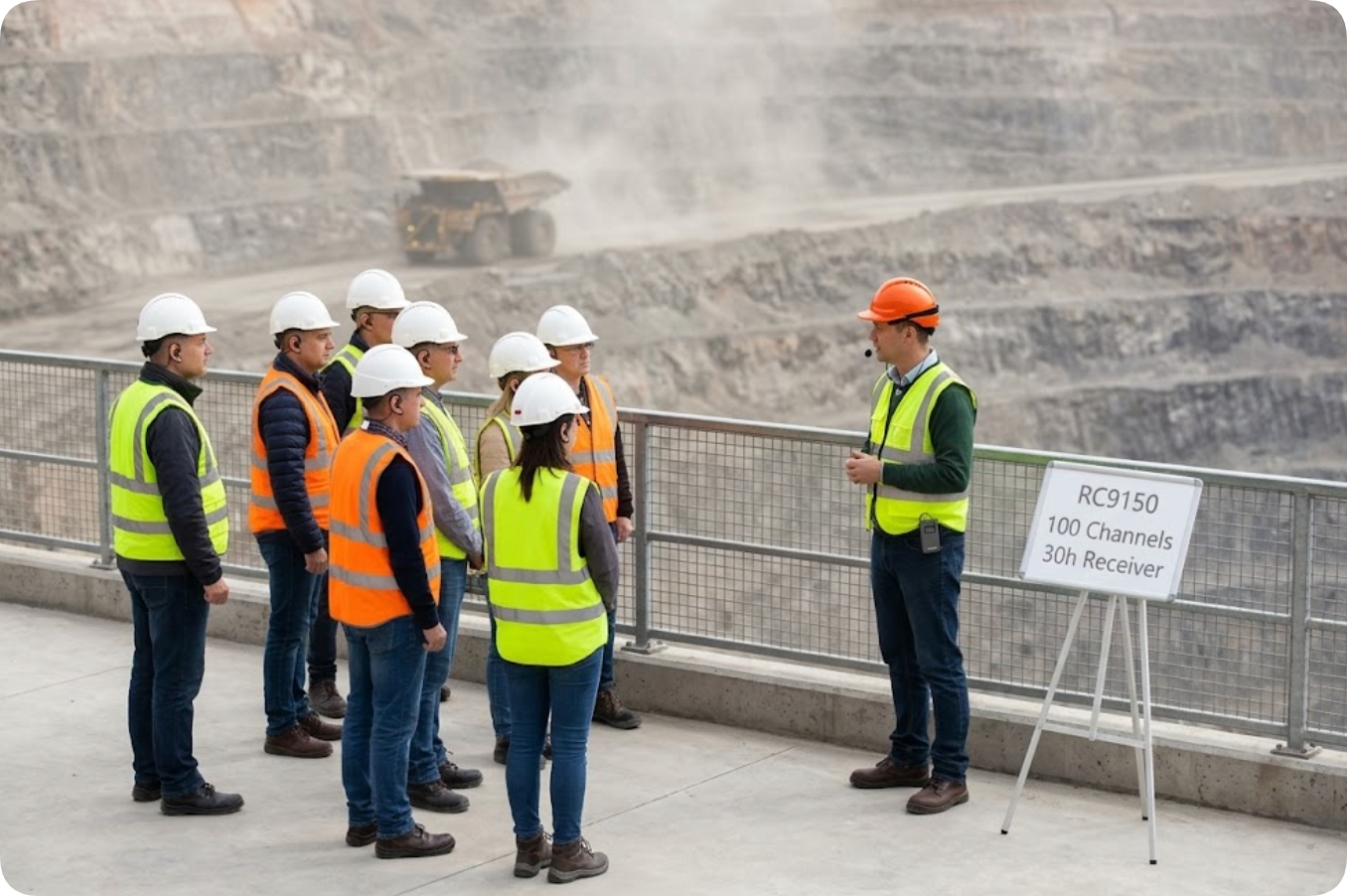
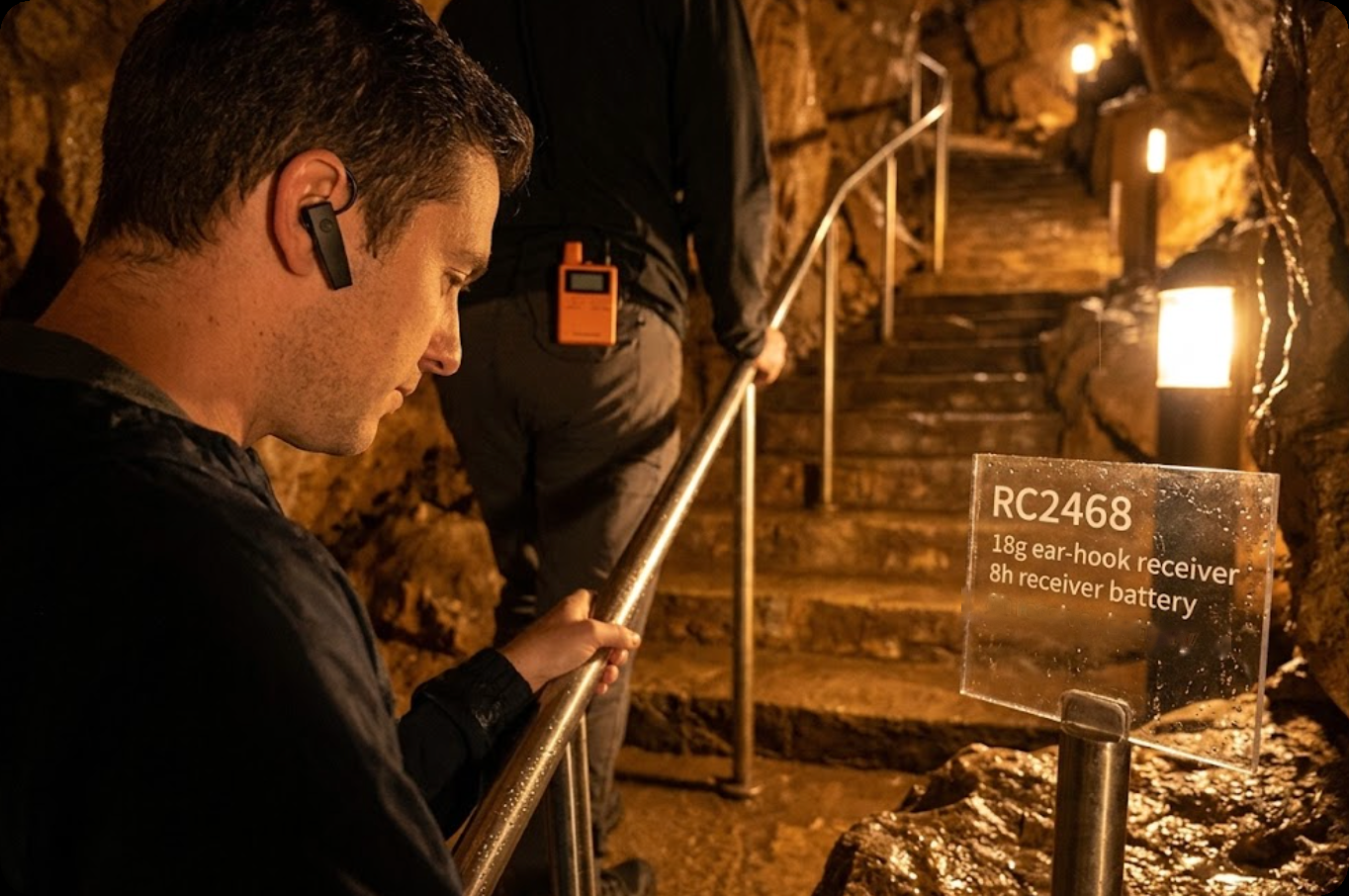
A factory tour is the hardest room a guide will ever work. The machinery never stops, the walls are steel, and the group keeps wandering toward the next machine. The words have to reach every ear through all of that, and the unit in the guide's hand has to keep transmitting for a full shift without a recharge break. We put three of our own tour-guide systems on a real production floor alongside two established names to see which one actually survives the noise, the distance, and the clock.
The short version: a plant is not a museum. The radio bands that work beautifully in a quiet gallery can fall apart between a row of variable-frequency drives, and a system rated for a ninety-minute walk can die before the third group of the day. That is why the choice of band, channel count, and battery shape matters more here than anywhere else. Factory tours demand a different audio plan than a city walk does, and the numbers below show exactly why.
The Plant Writes the Real Specifications
Before comparing units, name the enemies. A working factory floods the air with 2.4 GHz traffic: Wi-Fi on every access point, Bluetooth on every handheld scanner, and dozens of PLC radios talking to sensors on the line. A second enemy is the building itself. Sheet steel and rebar eat radio energy, so a range figure measured in an open hall shrinks the moment you step inside. The third enemy is time. A guide may run six groups across a nine-hour day, with the transmitter left powered between groups so the next tour starts instantly.
Any system that ignores those three pressures will look fine on a spec sheet and fail on the floor. So we measured our three candidates against the band they use, the channels they can jump to, and the battery they carry, then set them next to two competitors that buyers often shortlist for the same job.
A UHF Band That Steps Off the 2.4 GHz Crowd
Our RC085 is the only unit in this comparison that refuses to live on 2.4 GHz at all. It transmits on 470-510 MHz UHF, a band that the plant's Wi-Fi, Bluetooth, and PLC radios simply do not occupy. That single choice removes most of the congestion problem before it starts, which is why we reach for it first in electrical rooms and near variable-frequency drives where 2.4 GHz gear drops out.
It carries 100 channels on that band, the highest count in our lineup, so even if two tours run in adjacent buildings you can park them on separate frequencies with room to spare. The transmitter runs 12 hours and the receiver 20 hours on a single charge, both lighter than you would expect at 65 g and 60 g, and it charges over a plain USB cable. The trade is audio bandwidth: its response tops out around 12 kHz, perfectly clear for a speaking voice but not a music system.
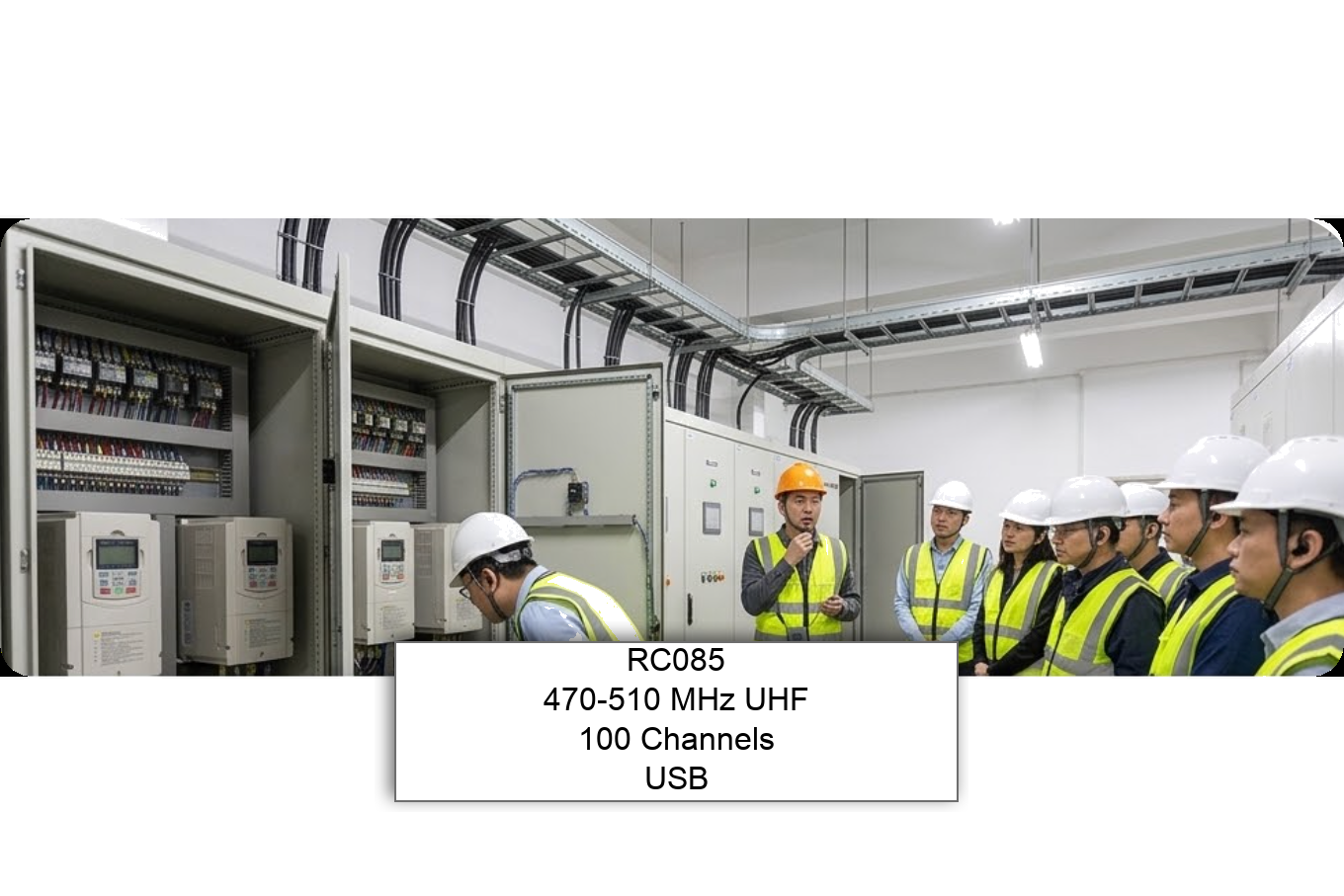
Eighty Channels of Headroom Inside 2.4 GHz
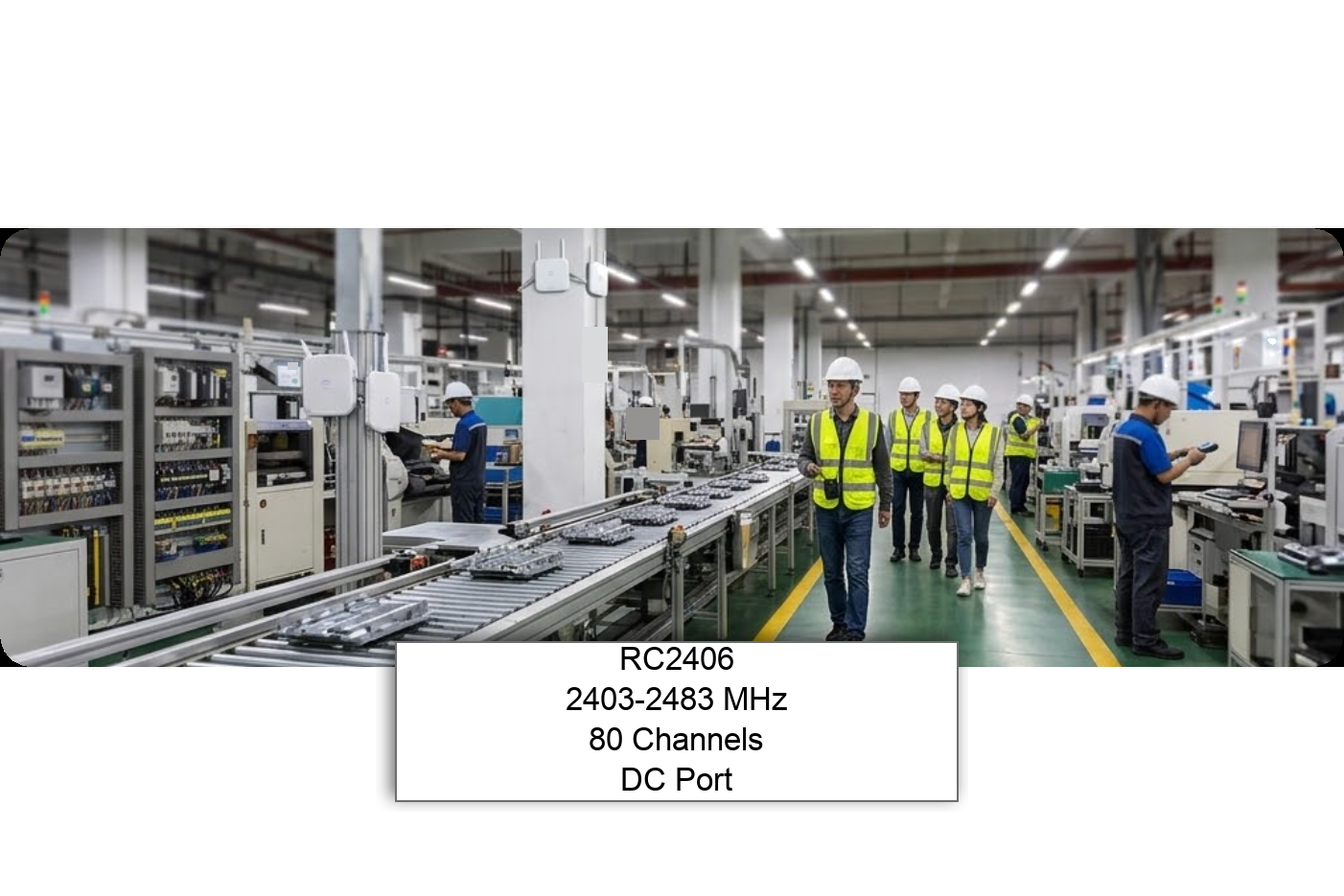
Where the floor is already committed to 2.4 GHz infrastructure, our RC2406 stays on the familiar band but brings 80 channels instead of the usual fifty. In a plant that is the difference between finding a quiet slice of spectrum and fighting every access point for it. We use it when the customer's IT team has already filled 2.4 GHz and we need to thread a tour signal through the gaps.
The receiver lasts 20 hours and the transmitter 10, weights are 59 g and 50 g, and it powers through a DC Port connector. Against a 2.4 GHz world it is the pragmatic pick: same band as everything else, but enough channels to dodge the crowded ones. It will not escape 2.4 GHz interference the way the RC085's UHF band does, and that is the honest limit to name up front.
The Flagship That Holds the Whole Shift
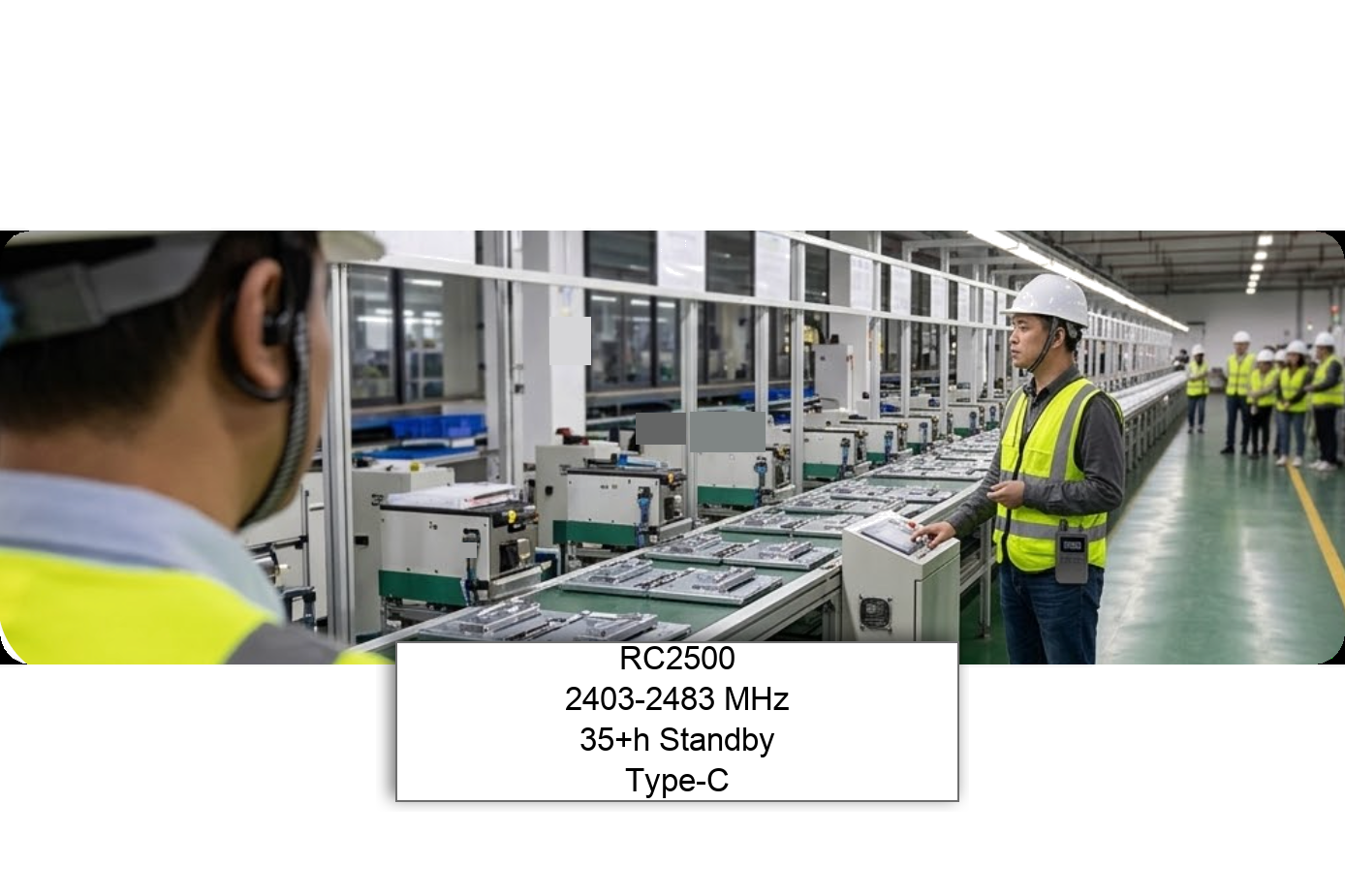
Our RC2500 is the heavyweight of the three, and we mean that literally at 104 g for both transmitter and receiver. What you buy with that mass is endurance: a 35-plus-hour receiver standby and a 15-hour transmitter runtime, plus one-key sync, mute, and shutdown that let a guide reset a whole group of receivers without a laptop. On a nine-hour day with the unit left powered between tours, that standby buffer is the reason it never dies mid-shift.
It charges over Type-C, the only one of our three to do so, and it sits on the 2.4 GHz band with 50 channels. We deploy it as the anchor unit for the longest, most demanding routes, where a lighter system would need a midday battery swap. The cost is weight and a 50-channel count that is the lowest of our trio, so it pairs naturally with the RC085 or RC2406 handling the noisier corners.
Two Established Names on the Same Route
Buyers rarely choose in a vacuum, so we set our three against Listen Technologies and Sennheiser, two brands that show up constantly in tour-guide shortlists. The Listen LT-700 and LT-800 family broadcasts on 72 MHz or 216 MHz analog RF with 57 selectable channels and an 80 dB signal-to-noise ratio that genuinely sounds clean. But its range is rated at only 45.7 m (150 ft), and in the United States it is FCC-approved for assistive listening use, which shapes where and how you may deploy it.
Sennheiser's Tourguide 2020-D is a digital 863-865 MHz system with just 6 channels in tour mode. The audio is excellent and the build is rugged, but six parallel channels is a real constraint when three tour groups want to run in the same hall, and its transmitter runs about 8 hours with a 160 g body. Both are credible products; neither offers the band separation of our UHF unit or the channel headroom of our 2.4 GHz eighty-channel model.
⚖️ Splitting the Route Between Three Units
The practical plan on a factory floor is not one unit for everyone but three units for three problems. We hand the RC085 to the guide leading groups through the electrical and drive sections, where its UHF band simply ignores the 2.4 GHz noise. We put the RC2406 on routes that stay inside a 2.4 GHz-saturated area but need to hop off a congested sub-band. The RC2500 becomes the anchor for the longest full-day route, where its 35-hour standby removes any worry about a mid-shift recharge.
Against Listen and Sennheiser on the same site, coexistence is straightforward because everyone lives on a different band: 470-510 MHz, 2.4 GHz, 72-216 MHz, and 863-865 MHz do not step on each other. The limit is parallel groups per band, and that is where our 100- and 80-channel units pull ahead of Sennheiser's six. A site running four simultaneous tours should count those channels before signing anything.
🎯 What the Guide Carries After the Last Group Leaves
None of this matters if the gear is miserable to live with. The RC085 and RC2406 both accept an optional headset or lapel microphone and weigh under 65 g, so a guide forgets them by the second tour. The RC2500 is heavier but earns its place through one-key group sync that saves ten minutes of setup before every group. Charging splits three ways across our trio: USB, DC Port, and Type-C, so a site needs three cable types rather than one, and that is the small operational tax for the range of options.
Listen and Sennheiser each standardize on their own charging case, cleaner logistically but locked to one ecosystem. For a plant that already runs mixed equipment, our spread of bands and connectors is the feature, not the bug, because it lets one team cover a noisy floor, a saturated floor, and a full-day route without swapping brands mid-tour.
Frequently Asked Questions
Q: How far does the RC085 actually reach inside a steel building?
Its rated range is 1-200 m line of sight, but the honest factory figure is closer to 45 m through a sheet-metal wall and open sight lines of 150 m on a clear assembly floor. The 470-510 MHz UHF band holds that distance where a 2.4 GHz unit drops to a third of it near variable-frequency drives, which is the whole reason we spec it for electrical rooms.
Q: Why does channel count matter more on a factory tour than a museum?
A plant is already saturated with 2.4 GHz Wi-Fi, Bluetooth scanners, and PLC radios, so a system with only a handful of channels will keep landing on a busy sub-band. Our RC2406's 80 channels and the RC085's 100 let us move each tour to a quiet frequency, which on a noisy floor is the difference between a clean voice and a dropping one.
Q: Will the RC2500 really last a full nine-hour shift?
The transmitter runs 15 hours and the receiver holds 35-plus hours of standby, so a guide who leaves it powered between groups covers a 9-hour day with idle time left over. We have run it from open to close without a recharge, and the one-key sync means the next group's receivers are ready in seconds rather than minutes.
Q: Can our systems run on the same floor as Listen or Sennheiser units?
Yes, because the bands do not overlap: our UHF at 470-510 MHz, our 2.4 GHz pair, Listen at 72-216 MHz, and Sennheiser at 863-865 MHz coexist without fighting. The thing to count is parallel groups per band, since Sennheiser's six channels cap you at six simultaneous tours there while our 80- and 100-channel units allow far more.
Choosing a factory-tour radio is less about the loudest spec and more about the band, the channels, and the battery shape fitting the building in front of you. Explore the full tour-guide range to match a unit to your floor, or tell us the machines you run and we will spec the route for you.
| Specification | RC085 | RC2406 | RC2500 | Listen LT-700 / 800 | Sennheiser 2020-D |
|---|---|---|---|---|---|
| Frequency band | 470-510 MHz UHF | 2403-2483 MHz | 2403-2483 MHz | 72 / 216 MHz | 863-865 MHz |
| Channels | 100 | 80 | 50 | 57 | 6 |
| Transmitter battery life | 12 h | 10 h | 15 h | AA / NiMH | 8 h |
| Receiver battery life | 20 h | 20 h | 35+ h | AA / NiMH | 8-16 h |
| Transmission range | 1-200 m | 1-200 m | 1-200 m | 45.7 m (150 ft) | 45.7 m (150 ft) |
| Receiver weight | 60 g | 50 g | 104 g | stethoset ~73 g | 78 g |
| Charging | USB | DC Port | Type-C | drop-in / wall | charging case |