

A shore excursion kit is bought once and then carried into a different country almost every morning. The receivers that worked beside Tuesday's quay are unpacked again on Wednesday under a different set of radio rules, and the guide has perhaps forty minutes between the first boat and the waiting coach to make them work. What looks like a single equipment decision on a purchase order is really three decisions about where the signal is allowed to sit, how many groups can share a strip of concrete, and who signs for the charging case when the ship sails again.
That is why this comparison is organised around a frequency table rather than a feature list. We place three Richitek models beside two regional alternatives and ask a narrow question: which rows of a specification change when the vessel moves, which rows stay fixed from one sailing to the next, and who on board is expected to check them. City Sightseeing Tour Audio Solutions covers the wider planning side of city visits; here we stay with the hardware, the published figures and the paperwork that follows the equipment down the gangway.
No manufacturer publishes a single number that settles all three stops. A useful figure is one your local agent can confirm in writing before the season starts. A useful device is one whose charging routine, channel assignment and handover habit survive a week of repeated moves without a spare engineer travelling with it. The sections below separate those two kinds of certainty, because a buyer who confuses them tends to purchase for the wrong port.
RC2402: Fifty Channels for the First Boat Ashore
The RC2402 Two Way Wireless Tour Guide System is the plain 2.4G option in this group, operating from 2403 to 2483 MHz with fifty channels and a stated working range of 1 to 200 metres at 10 mW. Its transmitter runs for ten hours from a 3.7V 1500mAh cell and weighs 59 g; the receiver lasts twenty hours from a 1000mAh cell at 50 g. Both ends use PLL synthesis and a DC charging port. For a programme that sends one group down a pier, into a coach and back again before lunch, those numbers describe a full day without a midday recharge.
The advantage on a mixed itinerary is not the range figure but the band itself. A 2.4 GHz licence-exempt unit can be issued at the first port without waiting for a local frequency assignment, so the same sealed case can travel through several countries with the channel plan unchanged. The fifty-channel pool is modest beside an eighty-channel model, yet it is ample for one guide and one group, or for two groups kept on separate channel blocks by a written rota. Programmes that run a single language per departure often prefer this simplicity: the crew learns one setup, the checklist has one line, and a relief guide can be handed a charged transmitter without an explanation of regional variants.
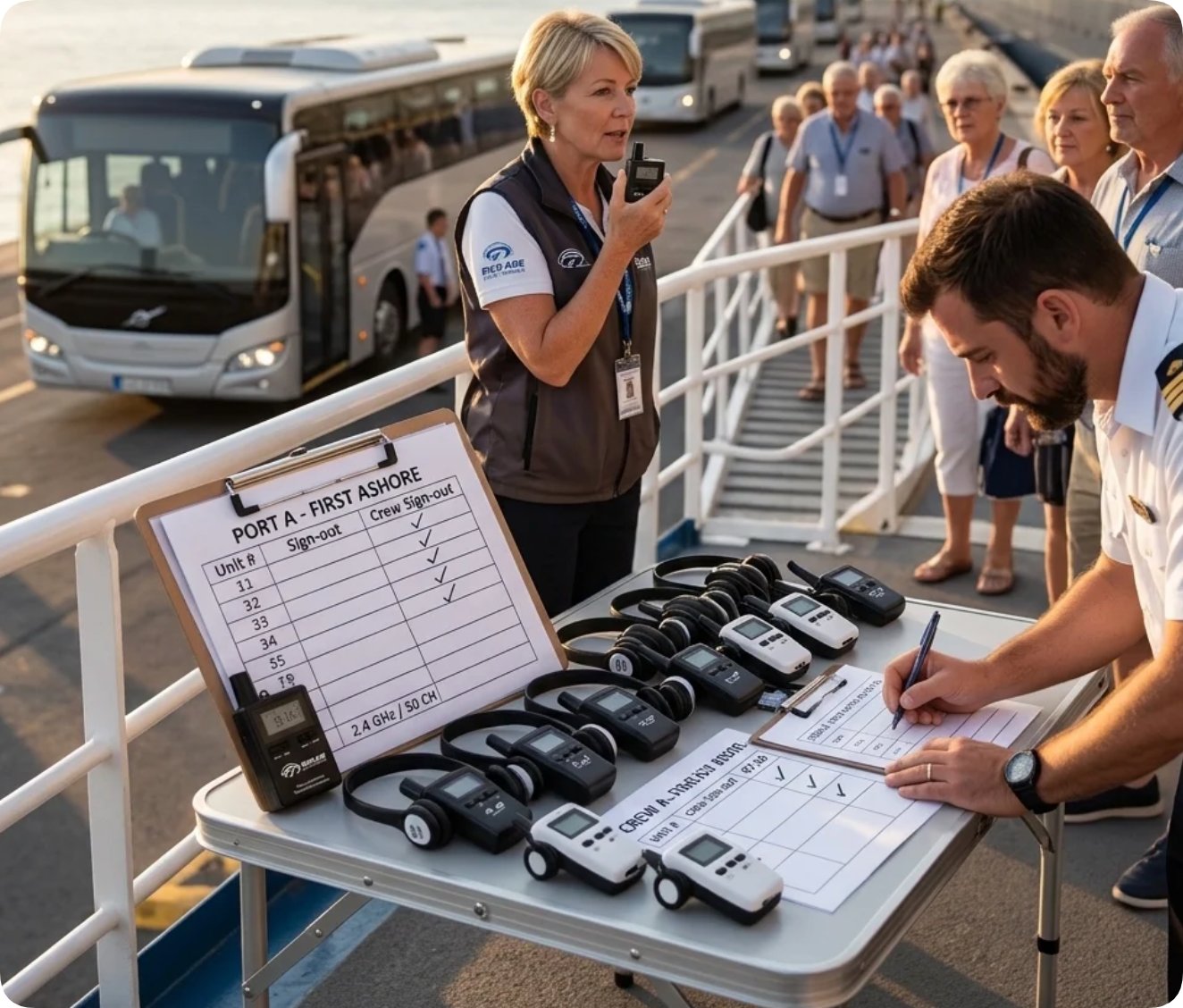
Where it asks for discipline is at the point where two groups share a quay. Fifty channels are a finite pool, and a neighbouring operator using similar equipment will not consult your rota. The practical answer is to assign non-adjacent blocks before the season rather than at the coach door, and to keep a short record of which block each group used. That record costs nothing and becomes the evidence you need when an interference complaint arrives three sailings later.
RC2408: Two Groups on One Quay Without Crossing Over
The RC2408 Long Range Wireless Audio Guide shares the same 2403-2483 MHz band, 1-200 m working range, 10 mW output, transmitter and receiver batteries, weights and DC charging port as the RC2402. The difference that matters is the channel count: eighty instead of fifty, with the model positioned around interference resistance. On paper it is a small change. On a busy call it decides whether a second language group can be launched while the first is still within earshot.
Consider a morning where the ship discharges two excursions within fifteen minutes: a market walk and a cathedral visit, each with its own guide, each returning to the same meeting point. With the larger channel pool the two guides can be given distant blocks and left alone; with a smaller pool someone has to police the spacing. The RC2408 is therefore the model we would allocate to the port with the heaviest simultaneous departures rather than spreading it evenly across the itinerary. Hardware does not have to be identical at every stop to be simple to operate, provided the case labels say which port each set belongs to.
Its twenty-hour receiver rating also absorbs a late return. Shore programmes rarely end exactly on schedule, and a receiver that still has charge after a delayed coach removes one small source of friction at the gangway. The transmitter's ten-hour rating is shorter, so the overnight routine should prioritise the guide units. That is a rota issue rather than a specification weakness, and it belongs in the handover note described later in this comparison.

RC085: The UHF Option When a Local Allocation Decides
The RC085 Portable Tour Guide System Wholesale is the outlier in this set. It works between 470 and 510 MHz with a hundred channels, an output of 8 to 10 mW and a stated sensitivity of approx. -102dBm. Its transmitter runs twelve hours from a 1200mAh cell at 65 g, its receiver twenty hours from a 1000mAh cell at 60 g, and it charges over USB rather than a DC port. Those are genuinely different numbers, not a restatement of the 2.4G row.
A UHF unit earns its place when the local allocation, the physical surroundings or both make the lower band the better engineering choice. It also adds a compliance step: 470-510 MHz is not administered identically everywhere, and a shore programme that intends to use this model at several ports needs written confirmation of the permitted segment at each one before the case is sealed. We would not describe that as a drawback. It is simply a different row of the frequency table, owned by the agent rather than by the guide, and it should be settled weeks before the first sailing rather than on the morning of arrival.
The hundred-channel pool is the largest here, which helps when a single departure is split into several language streams. USB charging is also convenient on a vessel where spare cables and power banks are already stocked for other equipment. Set against that, the crew now manages two charging habits across the fleet, and the case needs a divider so a DC-only unit is not packed with the wrong lead. Programmes that can accept those two small routines gain a flexible third option for the port where 2.4 GHz is crowded or locally constrained.
Linkx TG-200: A Regional Band Sheet and a 22-Millisecond Figure
Linkx TG-200 and TG-201 are documented as GFSK digital UHF units covering 500-952 MHz, with the usable segments varying by region. The published operating figures are 100 m indoors and 150 m outdoors, a 22 ms latency, twenty hours on the transmitter, twenty-nine hours on the receiver, and 48 g for the unit quoted. That is a solid, specific set of claims, and the phrase that deserves a buyer's attention is the one about regional segments: the product is supplied against a local band sheet rather than against one global frequency.
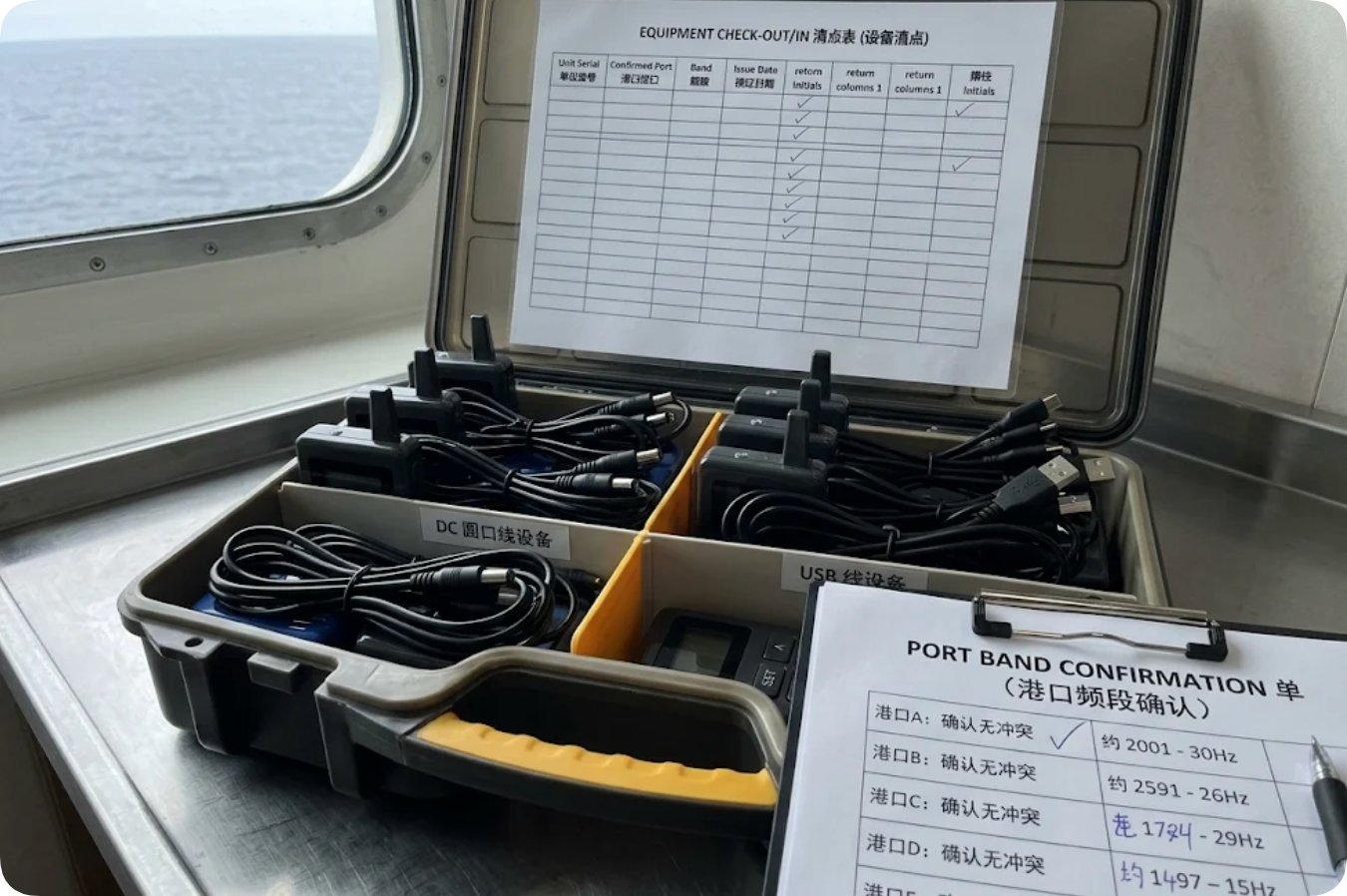
For a shore programme this is less exotic than it sounds. Many regional suppliers work exactly this way, configuring equipment to the allocation in force where it will be used, and the arrangement has an advantage: somebody local has already checked the rules. The trade-off is that a fleet assembled port by port is harder to move. A receiver configured for one country may not be the receiver you want to issue at the next, and the channel plan has to be rebuilt with each addition. The 22 ms latency and the long receiver rating are attractive for simultaneous speech, but they do not remove the need to keep a written record of which band sheet each batch was built against.
Our recommendation for buyers comparing this route is procedural. Ask for the segment in writing, ask which channels inside it are available to a second guide, and ask what happens if the itinerary changes after the equipment has shipped. None of those questions is a criticism of the hardware. They are the same questions a 2.4 GHz buyer should ask about channel crowding, phrased for a product whose band is defined locally. A supplier who answers all three clearly has usually done this before.
Kaimile KML: Two Bands and One Charging Case on the Same Shelf
The Kaimile KML series is documented in two band forms: 2.4 GHz on the KML-980 and KML-880 models, and 740-790 MHz on some KML-880T variants. Published coverage is given as 0-150 m or 0-300 m depending on configuration, alongside a charging and sanitising storage case and noise-cancelling headsets. Those details come from a product-family description rather than a single model datasheet, so we treat the range as a family-level figure and do not attach it to one specific unit in the table below.
The two-band availability is interesting for a mixed itinerary because it lets a buyer standardise on one supplier while still holding a UHF option for a port that needs it. The storage case is the more practical detail. Shore equipment is handled by many people in a short window, is returned damp or dusty, and is often redistributed within hours; a case that combines charging, disinfection and storage answers three separate housekeeping problems with one item. It also gives the crew a visible count: if the case has twenty labelled slots and nineteen are filled at the gangway, the missing unit is noticed before the ship sails rather than at the next port.
What a careful buyer should request is a per-model breakdown. A family that spans two bands will not have one channel plan, one battery routine or one compliance story, and a quote that lists only the family name can hide which variant is actually being supplied. Ask for the exact suffix on the invoice, the band for that suffix, and the number of channels available when two groups run together. The same request applies to any supplier with a broad series, and it costs one email.
Specification Comparison
The table keeps published figures to themselves and marks the rest plainly. A blank here means the source did not publish that field for the model in question, not that the figure is zero. Weights, runtimes and power ratings for the three Richitek units come from the September 2026 specification matrix; competitor rows come from the November 2026 competitor workbook, using only entries graded A or B for source reliability.
| Model | Published band | Channels | Range | Transmitter | Receiver | Charging |
|---|---|---|---|---|---|---|
| RC2402 | 2403-2483 MHz | 50 | 1-200 m | 10 h; 59 g; 1500 mAh | 20 h; 50 g; 1000 mAh | DC port |
| RC2408 | 2403-2483 MHz | 80 | 1-200 m | 10 h; 59 g; 1500 mAh | 20 h; 50 g; 1000 mAh | DC port |
| RC085 | 470-510 MHz | 100 | 1-200 m | 12 h; 65 g; 1200 mAh | 20 h; 60 g; 1000 mAh | USB |
| Linkx TG-200 / TG-201 | 500-952 MHz UHF; segments vary by region | Not published | 100 m indoor; 150 m outdoor | 20 h; 48 g quoted for unit | 29 h | Not published |
| Kaimile KML series | 2.4 GHz; 740-790 MHz on some variants | Not published | 0-150 m or 0-300 m by configuration | Family-level data only | Family-level data only | Charging and sanitising case |
What the Frequency Table Says at Each Stop
A specification table tells you what a device is. A port table tells you what somebody has to do. The four rows below are the ones we would put on the shore programme's operating sheet; they deliberately contain no invented measurements, because the actions are the point. Each row names the row of the specification it touches, so a change of itinerary can be traced to the figure that must be rechecked.
| Operating moment | Question to settle before sailing | Specification row affected | Action by the crew |
|---|---|---|---|
| First call of the season | Is the 2.4 GHz band usable without local filing | Band row; channel and battery rows unchanged | Issue the standard case and record serial numbers |
| A call using UHF equipment | Which segment inside the published UHF band is permitted | Band row and channel plan | Assign those units only after written confirmation |
| Two departures share a quay | How many language streams can run side by side | Channel row | Split the fifty-channel and eighty-channel pools |
| Return on board | Where DC supplies, USB leads and the storage case live | Charging row only | Recharge, clean, count and reseal the case |
Notice that only one of the four rows is about radio regulation. The other three are about records, allocation and housekeeping, and in our experience they cause more missed departures than the regulation row does. A programme that keeps this sheet current can add a port without rewriting the whole equipment policy: the agent answers the second question, the crew checks the fourth, and the remaining rows stay as they were.
Charging and Handover Between Sailings
Two of the three Richitek models here charge over a DC port, while the RC085 uses USB. That small difference becomes a daily routine when a fleet is repacked every night. We suggest a case with a labelled divider, a short list taped inside the lid showing which lead belongs to which model, and a rule that guide units go on charge before receivers because the ten-hour transmitter rating is the tighter of the two. The twenty-hour receiver figures then provide a comfortable margin for a delayed return.
A sanitation and storage case, as offered with the Kaimile family, solves a problem that a specification sheet rarely mentions: equipment shared by several hundred people in a humid climate. Whether the case comes from that supplier or is assembled in-house, the useful features are visible slots, a wipe-clean interior and a lid that closes on a count. A crew member should be able to confirm that every receiver is back without unpacking anything. The same discipline applies to the regional UHF batch, where a unit configured for one port should be visibly tagged so it is not issued at the next one by mistake.
For a wider view of how these devices are built and supplied, the Wireless Tour Guide System Manufacturer Direct catalogue groups the models by band and channel count. Reading it alongside the operating sheet above is more useful than reading it alone: the catalogue answers what can be bought, while the sheet answers what has to be checked.
Which System a Shore Program Should Book
If the itinerary is a single language group per departure across several countries, the fifty-channel 2.4G unit is the least demanding choice and the easiest to hand to a relief guide. If a port regularly launches two groups from the same quay, put the eighty-channel model on that call and keep the written channel blocks with the case. If a local allocation or a crowded 2.4 GHz environment points to UHF, make the hundred-channel unit available after the agent has confirmed the permitted segment, and label it so it stays with that port.
Regional alternatives deserve a fair hearing. A supplier who configures to a local band sheet takes a compliance task off your desk; a family with a charging and sanitising case takes three housekeeping tasks off it. Ask both for the exact model suffix, the band attached to that suffix, and the channel count when two guides work together. Then compare those written answers with the operating sheet, not with a marketing headline.