





A heritage railway represents a unique operational environment where docents, tour groups, and live steam locomotives share a single moving steel structure. Between the shed gate and the return siding, a docent’s voice must cross open-platform crosswinds, cut through riveted steel carriage reverberation, and maintain absolute signal isolation from concurrent tour groups. Combined with coal dust drift, standby boiler steam, and reflective night-shed metal walls, radio systems cease being mere accessories—they function as essential operational infrastructure. The harsh reality of high-vibration rolling stock dictates equipment survival, making RF stability, battery architecture, and ergonomic fit far more critical than raw transmitter output power.
This comparative operational review evaluates three Richitek systems—the RC9150 high-fidelity kit, the 80-channel RC2406, and the 50-channel RC2402—against two industrial baseline references: the DiLuan DL-R322 economy receiver and the Z-Sound independent-channel UHF system. Each platform is tested against real-world heritage railway stresses rather than static showroom benches.
Why Moving Railway Consists Alter Audio Link Dynamics
Unlike fixed museum galleries where guides maintain constant proximity to visitors, a moving train creates dynamic transmission boundaries. The interpreter navigates swaying carriages while handing off narration to a second docent at a crossing loop, while passenger density shifts dynamically as trains decelerate into station halts.
Transmission distances fluctuate continuously from 4 meters inside carriages to 50 meters across open station platforms. Furthermore, docents bracing against rolling motion cannot maintain constant microphone technique. Consequently, the wireless link must process variable audio input levels without introducing clipping or signal dropout.
RC9150: Flagship Footplate Commentary with Full-Spectrum Audio
Delivering clear commentary over jointed rail clatter and locomotive exhaust demands wide frequency response. The RC9150 2.4G High Fidelity Audio Guide operates across a 20Hz–8kHz bandwidth, maintaining sharp consonant articulation against low-frequency wheel rumble that suppresses speech intelligible in narrow-band systems.
Its 100-channel architecture allows maintenance crews, on-board docents, and platform walking tours to operate simultaneously without frequency overlap. The two-way multi-talk capability enables guard-to-guide commentary from opposite ends of the train. With 15-hour transmitter and 35-hour receiver battery runtimes, Type-C charging, and a one-key mass power-off feature, it comfortably covers extended operational days. The 97.5-gram receiver weight reflects its heavy-duty enclosure design.
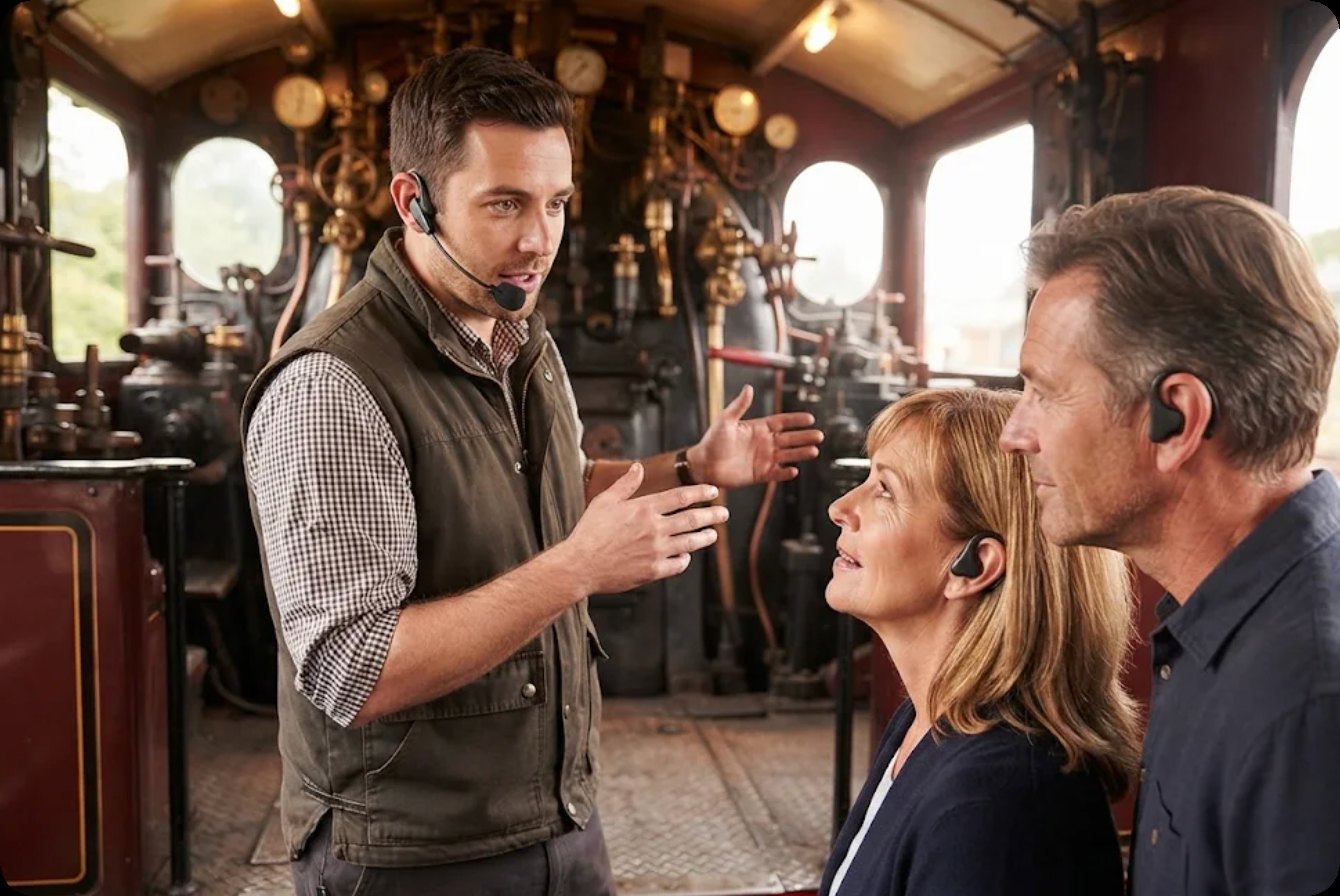
RC2406: 80 Channels Engineered for Multi-Society Special Events
Preserved railways frequently host multiple historical societies operating on shared trackage during gala weekends. The RC2406 80 Channel Tour Guide Transmitter Receiver solves RF congestion with 80 dedicated anti-interference channels within the 2403–2483 MHz ISM band, using Phase-Locked Loop (PLL) synthesis to prevent signal drift between adjacent groups.
Providing 10 hours of transmitter operation and 20 hours of receiver runtime, the 50-gram ear-hook receivers ensure guest comfort across multi-leg journeys. Dedicated DC charging docks located in administrative offices streamline fleet management during high-turnover shift changes.

RC2402: Cost-Effective Baseline Deployment for Daily Operations
For regional branch lines operating standardized timetables, the RC2402 Two Way Wireless Tour Guide System provides a robust 50-channel baseline solution. It shares the 200-meter line-of-sight range, 10h/20h battery performance, and international CE/FCC/RoHS compliance of the enterprise platform at an accessible price point for reserve fleet procurement.
Simplified physical controls eliminate volunteer training overhead, allowing seasonal staff to master device operation in a single briefing session while ensuring redundant hardware availability during peak seasonal charters.
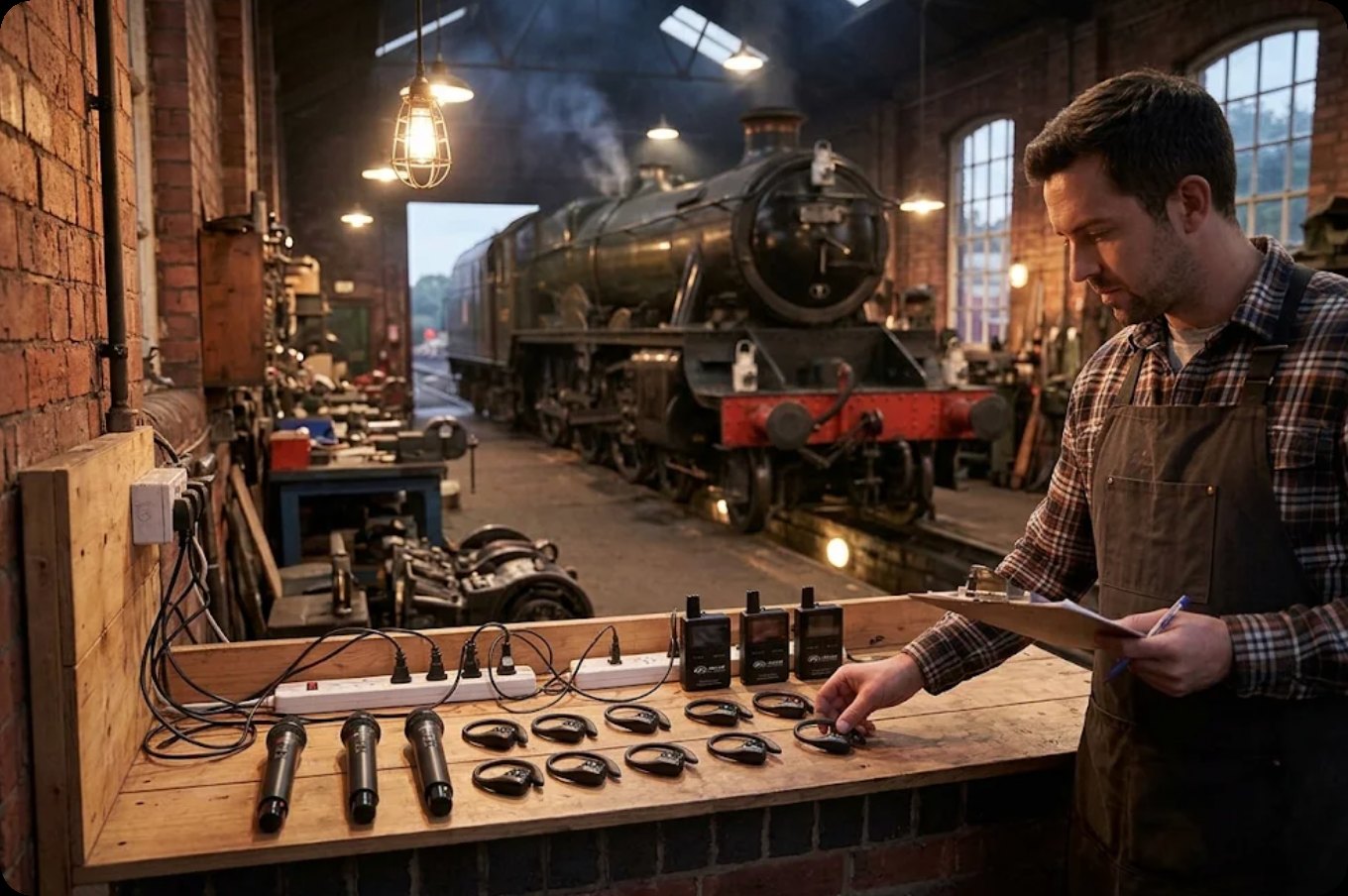
Alternative Benchmark Evaluation: DiLuan DL-R322 & Z-Sound Systems
Evaluating third-party alternatives highlights distinct operational trade-offs:
DiLuan DL-R322: Ultra-lightweight (16g) open-ear receiver offering 25-hour battery life and Type-C charging. Includes an out-of-range alert function, though its 130-meter range limits long-consist coverage.
Z-Sound UHF System: Operates on dedicated UHF frequencies, bypassing 2.4GHz Wi-Fi congestion near urban rail terminals. Requires licensed frequency management and regional distributor support.
Technical Specification Benchmark Matrix
The table below details verified technical parameters across all five evaluated systems:
| System Model | Frequency Band | Channel Capacity | Transmission Range | Battery Life (TX/RX) | RX Weight |
|---|---|---|---|---|---|
| Richitek RC9150 | 2.4GHz ISM (2403–2483 MHz) | 100 Channels | 200 Meters | 15h / 35h+ | 97.5g |
| Richitek RC2406 | 2.4GHz ISM (2403–2483 MHz) | 80 Anti-Interference | 200 Meters | 10h / 20h | 50g |
| Richitek RC2402 | 2.4GHz ISM (2403–2483 MHz) | 50 Channels | 200 Meters | 10h / 20h | 50g |
| DiLuan DL-R322 | 2.4GHz Digital | Unspecified | 130 Meters | 25h+ / 25h+ | 16g |
| Z-Sound System | Independent UHF | Single/Multi Channel | 200 Meters (Claimed) | Unspecified | 18g |
Review complete product documentation via our Wireless Tour Guide System Manufacturer Direct catalog. For outdoor city walking tours connecting with rail depots, consult our City Sightseeing Tour Audio Solutions guidelines. Access technical comparisons across all market options via the Tour Guide System Comparison & Buyer Guide resource center.
Frequently Asked Questions (FAQ)
1. Does operating the Richitek RC9150 require an official radio license?
No. The RC9150 operates strictly within the globally license-free 2.4GHz ISM frequency band (2403–2483 MHz). Heritage railway operators deploy this system across public excursions without regulatory filings or spectrum licensing fees.
2. How does the RC9150 maintain continuous battery operation during multi-day railway galas?
The RC9150 transmitter delivers 15 continuous operating hours, while ear-hook receivers provide over 35 hours per single charge. This capacity guarantees uninterrupted operation across multi-day events without mid-shift charging.
3. Can the RC2406 isolate multiple tour groups operating simultaneously on the same platform?
Yes. Featuring 80 discrete anti-interference channels backed by Phase-Locked Loop (PLL) synthesis, the RC2406 eliminates cross-talk, ensuring crystal-clear audio separation for up to 80 concurrent groups.
4. Are third-party receivers cross-compatible with Richitek transmitters?
No. Richitek systems utilize proprietary digital encryption protocols to guarantee signal integrity. Receivers must pair directly with native Richitek transmitters to operate.