Archives do not buy hardware the way museums do. A museum sells tickets and can amortise anything against footfall; an archive usually has a reading room, a volunteer roster, a grant that covers capital but not staffing, and a director who has to write one sentence per line item explaining why it earns its shelf space. A county archive we have worked with for two funding cycles put its visiting-day programme through exactly this discipline last year, and the result was not a single device choice but three — each justified by a different kind of arithmetic. The shortlisted kit looks mismatched on paper: a pre-recorded 2.8-inch audio guide, a hundred-channel RC9150 live system, and a kit of Silent Disco headphones borrowed from a very different industry. This article follows each budget line the way the archive's own justification memo did: what it costs, what replaces it if unbought, and when the numbers close. Nothing here is theoretical — every figure traces to a specification sheet or to the archive's own first-year log.
🎯 Reading Room Rules Decide the Hardware First
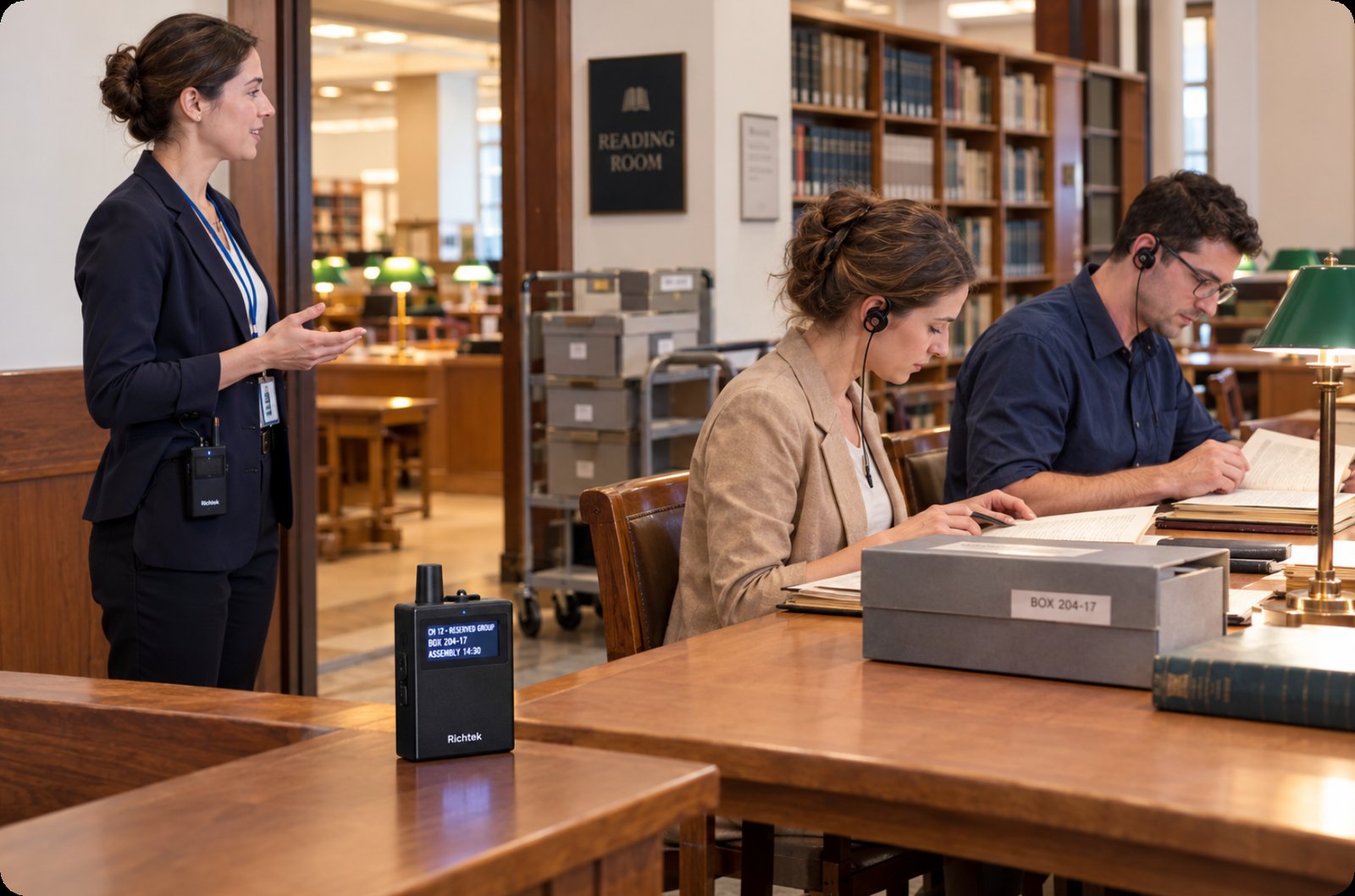
The constraint that shapes everything is silence. A reading room cannot contain a speaking guide, so every visiting-day format the archive runs — the monthly behind-the-scenes walkthrough, the school group on a local-history module, the donor evening — already depends on equipment. Before the rebuild, the archive rented a live system per event from a regional AV house, at a rate that quietly became the largest line in the programme: four events a term, delivery fees both ways, and a device set that arrived charged by someone else's standard. The rebuild's first decision was to stop renting and to split the need, because the archive's three formats do not actually want the same machine.
The walkthrough needs recorded content, played at the visitor's own pace, in more languages than the volunteer roster can speak. The school module needs a live voice that can address a whole class while the room stays quiet. The donor evening needs neither — it needs atmosphere, several simultaneous audio tracks in one room, and a way to end the evening without a rack of returned equipment. Three formats, three devices, three separate justifications. The general landscape of equipment built for hushed heritage spaces is visible in our museum audio guide equipment range, and the archive's memo starts there before narrowing to the three lines below.
Where the Pre-Recorded Player Pays for Itself
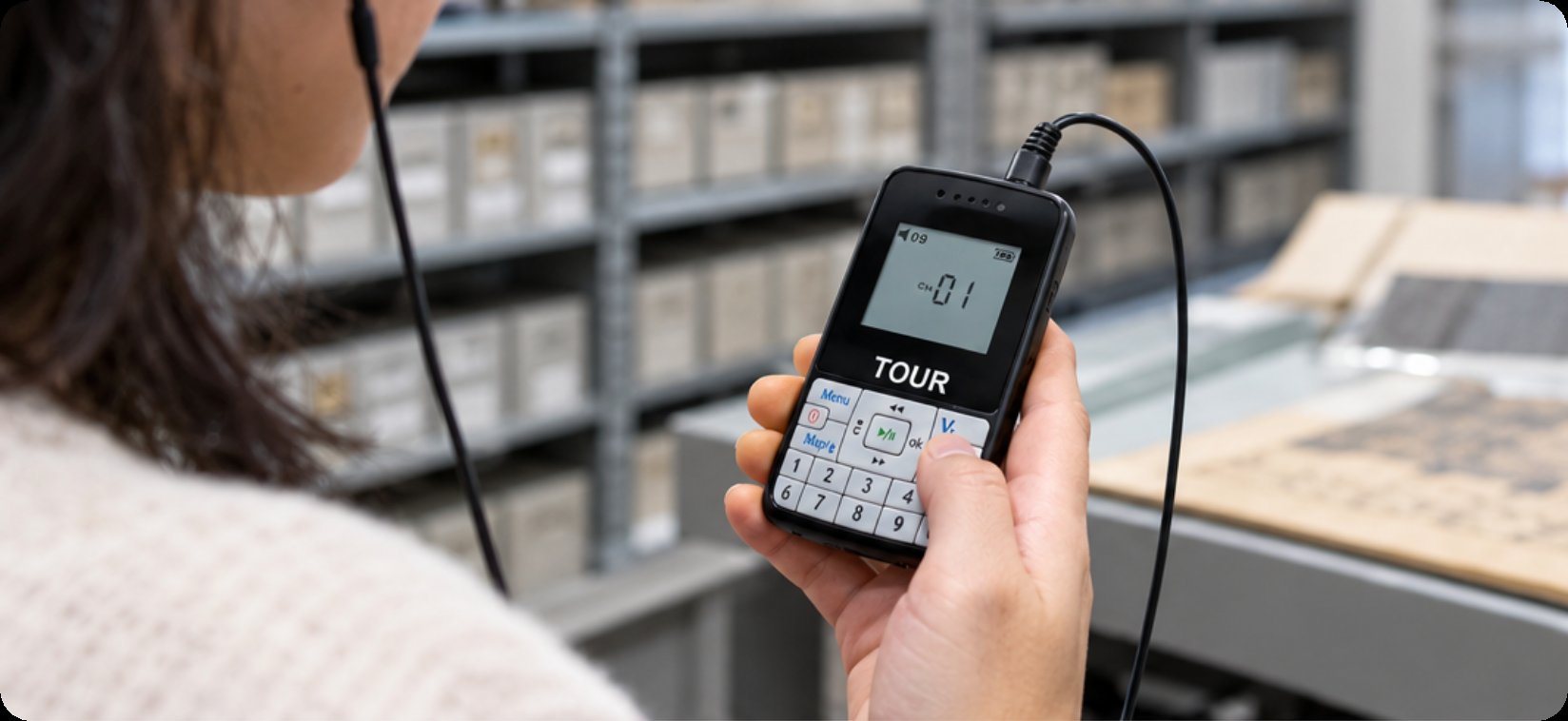
The first budget line is the 2.8-inch semi-auto digital audio guide, and its arithmetic is about content, not hardware. The unit plays pre-loaded material through number-input selection: a visitor keys a stop number and the track plays, semi-automatically. The specification that decided the memo was the storage pairing — sixteen languages and 9,999 file slots on 2GB — with eighteen hours of battery life on a single charge. For an archive, the languages matter less than the file count: the manuscript story, the map case, the seal press and the conservation bench each get a track, and the volunteer who records the narration in October can re-record the two tracks that mention the closed stacks in spring, at no cost beyond an afternoon.
The unbought alternative is a paid guide per walkthrough, and the memo prices it bluntly: a local historian's fee for one guided walkthrough roughly equals the cost of one additional player. After the first year, the archive ran thirty-one walkthrough days on twenty-four units, and the players' only ongoing costs were charging time and one re-recorded narration block. The eighteen-hour battery meant the charging trolley ran overnight and the units never appeared on the visiting-day checklist — a small operational point that the memo credited with more volunteer goodwill than any training session. Payback closed inside the first funding year, and the line now reads as maintenance rather than investment.
Live Commentary and the Multi-Group Headroom
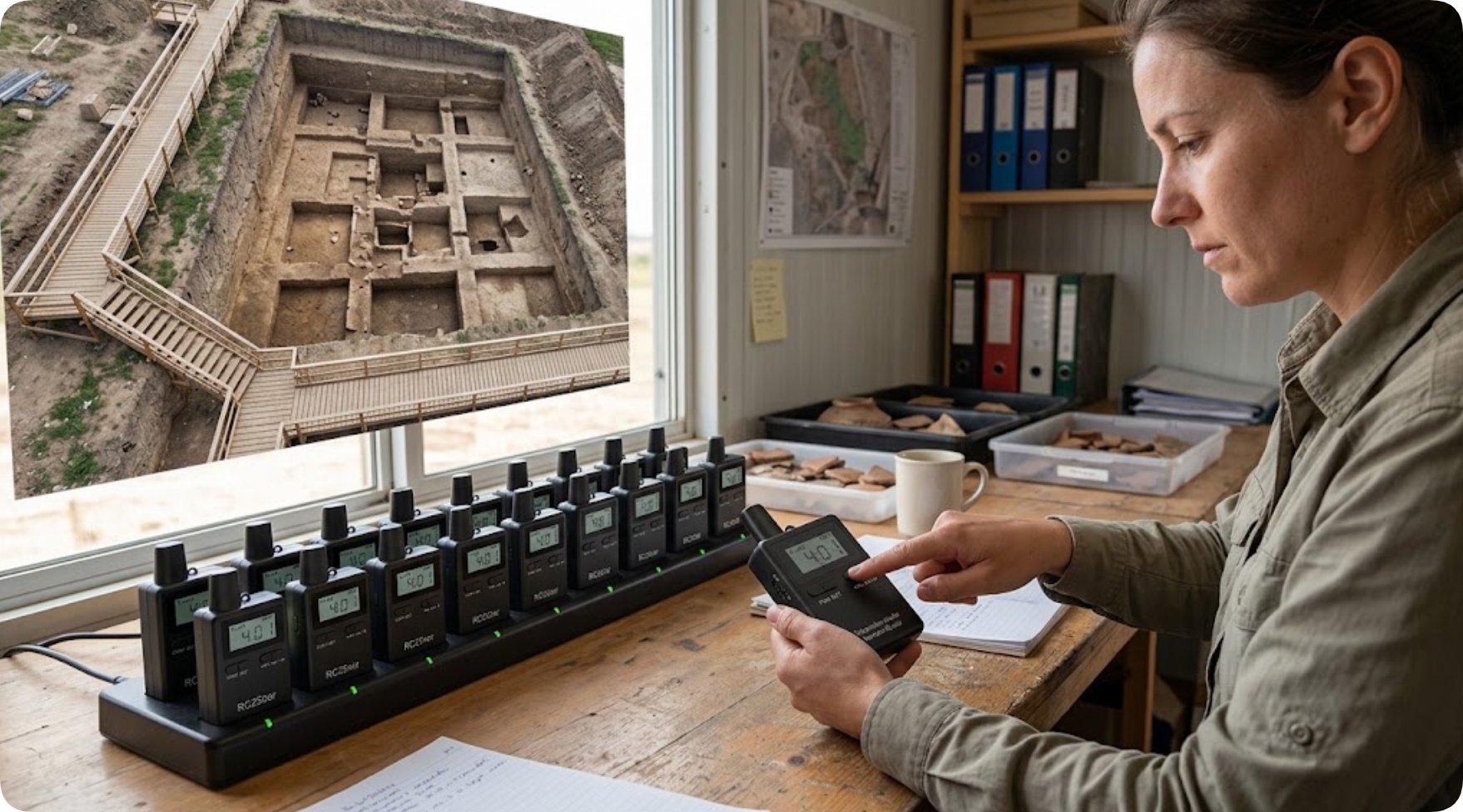
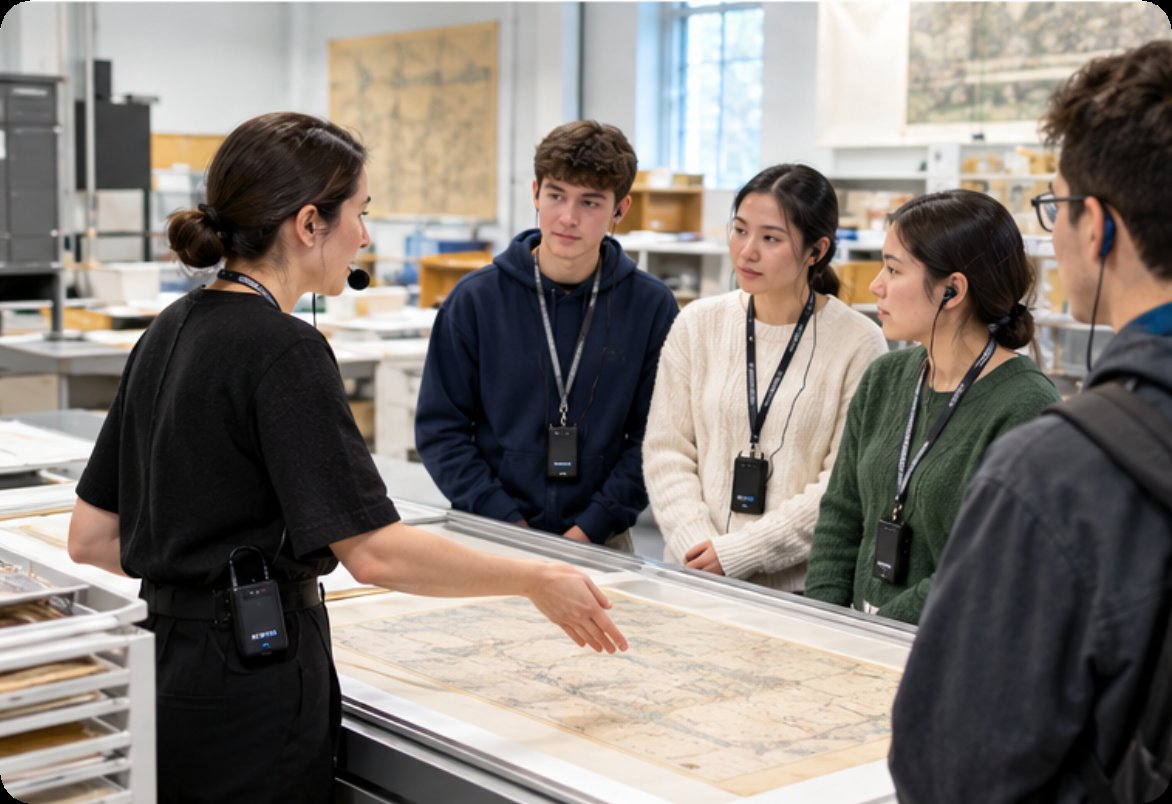
The second line is the RC9150, and its justification is about time and crowding rather than content. The school module runs forty-one pupils and two teachers through the conservation bench and the map room while another class works the reading room; two groups, one voice each, zero leakage between them. The RC9150 runs on the 2.4G band across 2403–2483MHz with a hundred interference-free channels and a two-hundred-meter working range, which is the specification that lets the archive run two school groups in the same building without a channel conversation between the volunteer leads. The memo's phrasing is worth repeating: the channels are not for today's two groups, they are for the day the library next door runs its own event.
The unbought alternative is scheduling. Without a live system, the archive would run school modules one class at a time, which doubles the staff hours per pupil or halves the programme's reach — and staffing is the one cost the grant does not cover. The transmitter's working day also outlasts the module: a full charge covers the morning session and the afternoon debrief, and the receivers come back to the charging case before the building closes. What the memo actually bought, in its own words, was calendar space — the ability to say yes to two classes on the same morning without hiring anyone. Against a rental rate that had grown for three consecutive terms, the line closed payback in the second term of use.
Weekend Income From a Kit the Weekday Visits Use
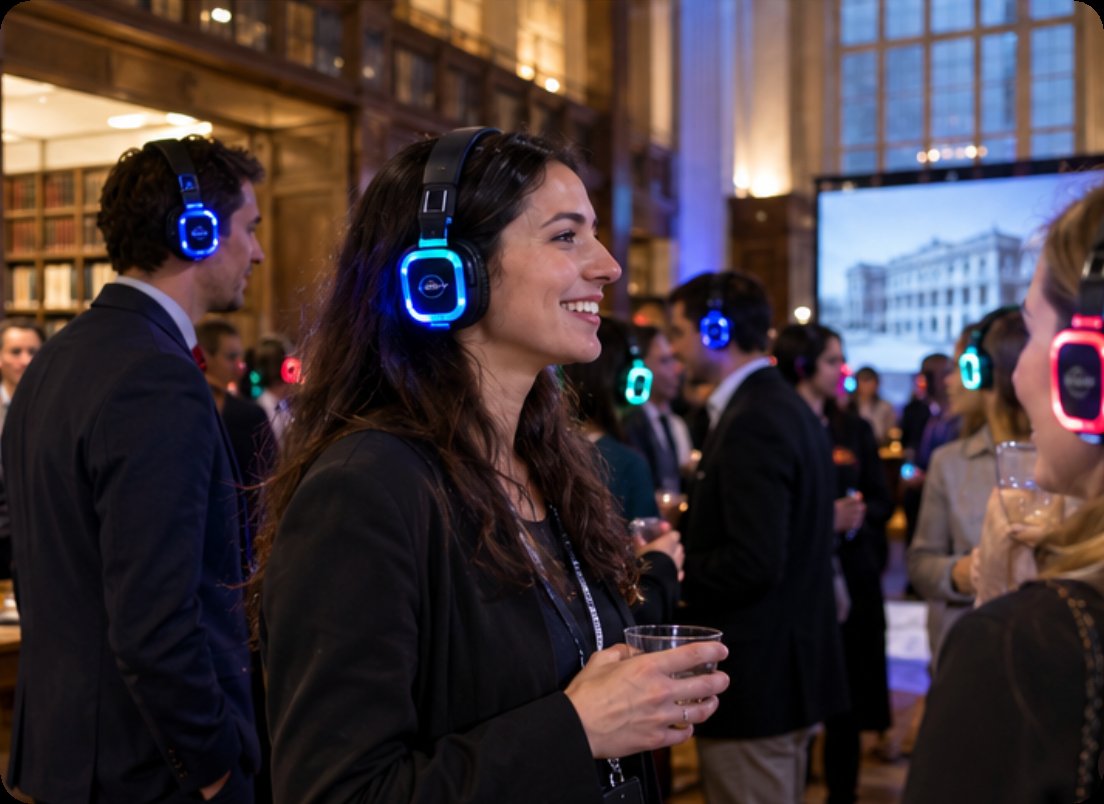
The third line is the one the funding committee smiled at: a Silent Disco wireless headphone system, bought for the donor evening and hired out on the weekends the archive building sits half-empty. The kit's specifications read like a party product because it is one — ten independent UHF channels on 863/925MHz, five-colour LED indicators on each earcup so a wearer can see which channel they are on, 40mm drivers with a frequency response of 30–20000Hz, SNR above 75dB and distortion under 1%, ten hours of operation with a three-hour charge, and a metal-cased transmitter whose high-power mode reaches beyond 500 meters. The archive's donor evening uses three channels: the archivist's spoken commentary, a period music bed, and a children's track, all simultaneous in one room, with each guest switching by changing a channel that the earcup's LED colour makes obvious across the room.
The justification, though, is the weekend. A community arts collective now hires the kit for silent-film screenings in the reading room's annex at a rate that covers the archive's own annual PAT testing and battery upkeep, and the archive's memo books that income against the device line rather than against general revenue — which is the accounting trick that made all three lines pass. The unbought alternative was no donor evening at all; the room's acoustics never supported amplified speech after the neighbours' complaint in the previous year. Payback for this line closed first, inside eleven months, and it is the only one of the three the treasurer describes as an earner.
The Numbers Side by Side
The memo's summary table compresses all three justifications onto one page, and it is reproduced here because its structure travels better than its figures:
| Budget line | Device | What it replaces | Key specification | Payback logic |
|---|---|---|---|---|
| Recorded content | 2.8-inch semi-auto audio guide | Paid guide per walkthrough | 16 languages, 9,999 files, 18 h battery | Content made once, replayed for years |
| Live capacity | RC9150 wireless system | One-class-at-a-time scheduling | 2.4G, 100 channels, 200 m range | Buys calendar space without staff hours |
| Room-friendly events | Silent Disco headphone kit | No evening events at all | 10 UHF channels, LED channel colours, 10 h | Weekend hire covers its own upkeep |
Read vertically, the table says what a mixed fleet is actually for: no single device carries all three formats, and forcing one to would have broken the programme at its thinnest point — the school module, which is the only format with a hard timetable. Read horizontally, it gives any director a template: name the format, name the unbought alternative, and let the specification settle the argument. The full hardware families behind all three lines sit in one place at our wireless tour guide systems, which matters when the time comes to standardise chargers and cases across a growing fleet.
🔮 What Transfers to the Next grant Application
Three habits from this memo transfer to any archive or small heritage site writing its own case. Split the visiting programme by format before looking at any hardware, because the formats — and not the devices — are what the funder is being asked to pay for. Price the unbought alternative honestly; every line in this memo closes against a real cost the archive was already carrying, from guide fees to scheduling constraints to a cancelled events calendar. Book any secondary income against the device that earns it, because a line that pays its own upkeep is a line a committee can approve without discussion. And keep the justification memo alive after purchase — the archive updates its table each term with actual usage, which is now the first exhibit attached to every renewal. Sites planning a similar mixed programme will find the room-by-room considerations set out in our museum and heritage solutions overview. The archive's own closing sentence is the honest summary: no device in the memo was bought to be impressive, and that is exactly why all three survived the committee.