

Every Hajj season, the same question arrives with the quotation request: which kit actually holds up when the crowd is at its densest? Brochures list frequencies and channel counts, but a procurement officer who has stood in the Jamarat crowd knows that numbers on a datasheet behave differently against tens of thousands of phones, radios and rental transceivers in one plaza. So before this season's orders were confirmed, three systems went out for a structured test day: the RC2468 as the ultra-light 2.4G candidate, the RC085 as the UHF alternative, and the RC2408 as the high-channel-count 2.4G workhorse. This article records what each checkpoint measured, what the specification tables predicted, and where the field disagreed with the paper. For the kit configurations built around these results, see the dedicated Hajj and Umrah tour guide system page.
📡 Why Crowded Pilgrimage Grounds Stress a Radio First
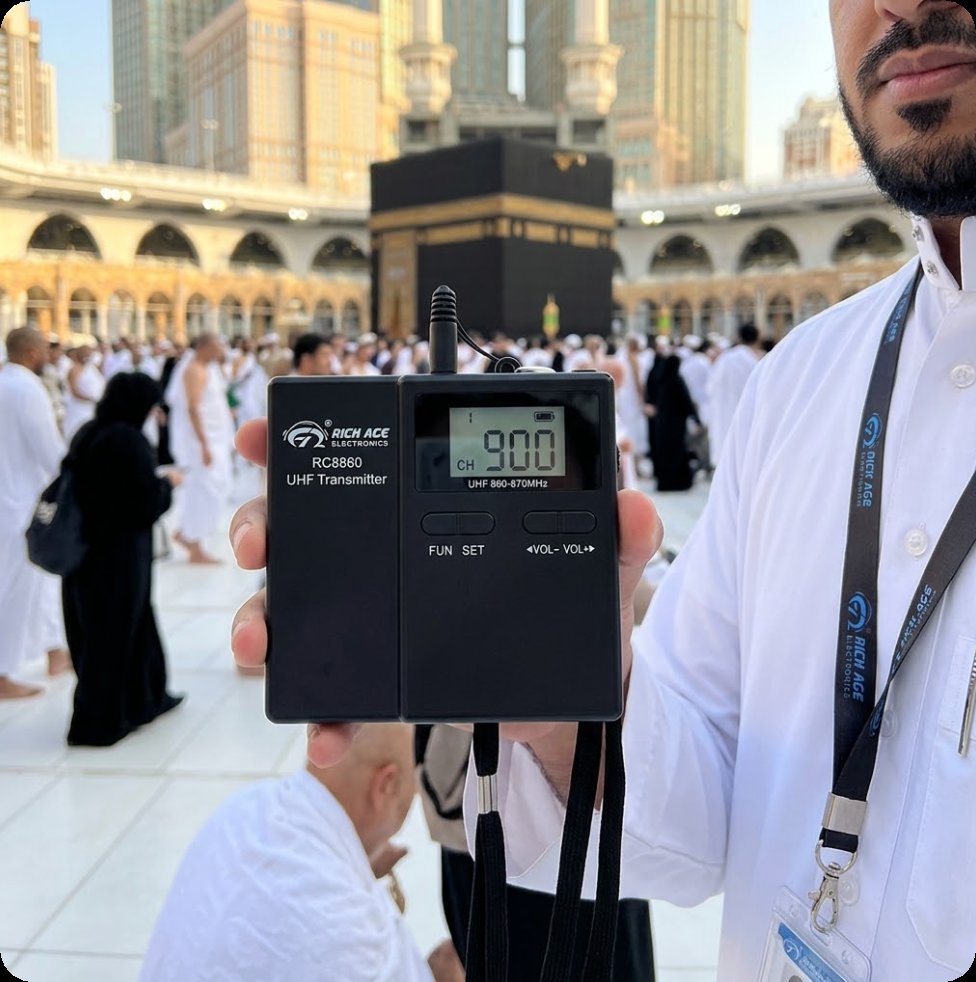
A museum corridor is a quiet room with one transmitter in it. The plaza around the Grand Mosque is the opposite: dense human bodies that absorb signal, thousands of simultaneous 2.4GHz emitters from phones and hotspot devices, and rental two-way radios stacked on adjacent frequencies. Under those conditions, the first failure mode is not range but occupancy: a receiver with too few channels can find every usable slot taken and lock onto interference instead of its guide. That is why the test day started with channel behaviour rather than sound quality, because a system that cannot hold a clean channel in the crowd never gets to demonstrate how it sounds. It is also why the three candidates were chosen deliberately: they represent three different answers to the same congestion problem.
The Channel Count Trial: 50, 80 and 100 Under One Roof
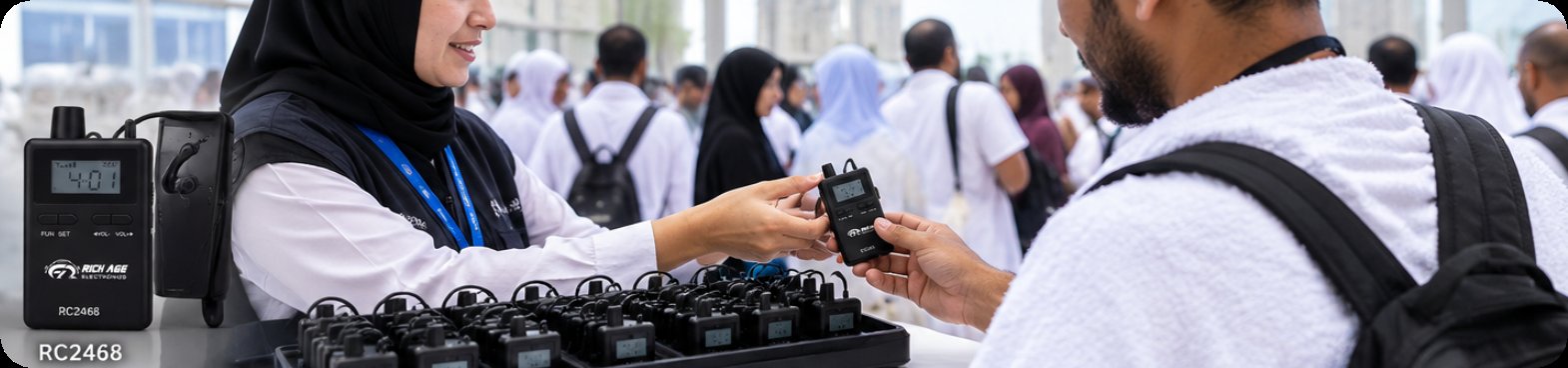
The specification sheet gives each candidate a different ceiling: 50 channels on the RC2468, 80 on the RC2408, and 100 on the RC085. In practice, channel count is fleet arithmetic. A large Hajj group running several guides in the same hotel corridor needs each team on its own channel, plus headroom to move when another operator appears on an adjacent slot. With 50 channels, a coordinator plans assignments carefully and re-checks after every move. With 80, the RC2408's anti-interference design gets room to hop without coordination overhead. With 100 on the RC085, the test coordinator simply stopped counting, which is exactly the point: at the densest site on the itinerary, the UHF unit never needed a fallback plan. Teams that want the full specification for the lightest candidate can review the RC2468 ultra-light system alongside its channel behaviour described here.
Band Separation: What UHF Did While 2.4G Was Loud
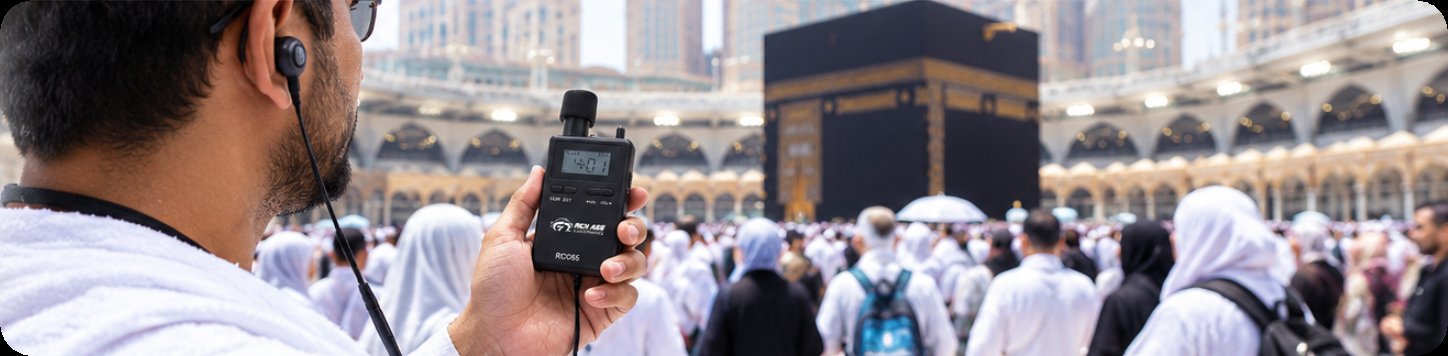
The RC085 runs on 470-510 MHz, a band the crowd's phones simply do not use, and that single fact shaped the whole test day. While the two 2.4G systems shared spectrum with every phone and hotspot in the plaza, the UHF receiver sat in quieter territory, and its 100-channel bank stayed clean through the tightest crowd of the day. The 2.4G candidates responded the way their designs intend: the RC2408 leaned on its 80 channels and anti-interference logic to relocate when a slot degraded, and the RC2468, with 50 channels, needed the most active coordination of the three. None of this makes UHF universally better; 470-510 MHz availability varies by country, and the RC085's own specification warns that special scenarios need confirmation before shipment. But on the specific ground where this test ran, the band difference was the clearest single result. Full UHF specifications are published on the RC085 digital tour guide system page.
Weight on the Ear: 18 Grams Against a Full Circuit
Reception hardware gets judged differently after hour three of a walking day. The RC2468's receiver weighs 18 grams in an ear-hook design, and that was the single most commented-on property among test wearers; pilgrims forgot they were wearing it, which matters when a device is worn from before dawn until the evening return. The RC2408 receiver, at 50 grams, sits in the familiar neck-strap class and drew no complaints about weight but more about warmth against the collar in the afternoon. The RC085 receiver, at 60 grams with an optional headband or clip microphone for the transmitter side, was described as solid but noticeable over a long circuit. Weight does not affect a single radio parameter on the datasheet, yet it decided which units testers reached for on the second morning, and any coordinator who has handled end-of-day returns knows that comfort drives whether equipment comes back intact.
🔋 Battery Logs From Before Dawn to After Dark
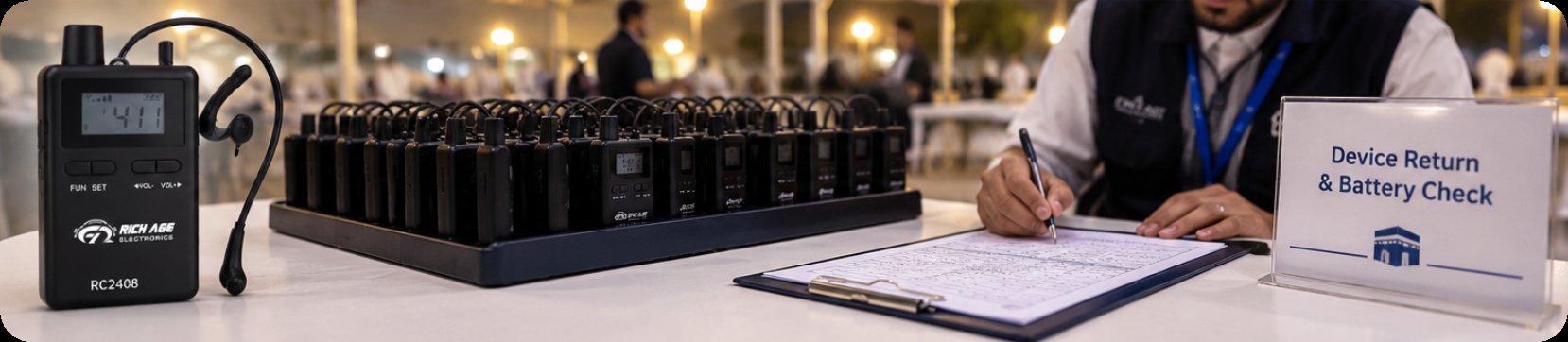
The test day ran from the pre-dawn departure to the evening return, roughly matching the longest realistic duty cycle a Hajj group asks of its kit. The RC085 transmitter, rated for 12 hours on a 3.7V 1200mAh pack, finished with margin; its receivers, rated at 20 hours on 1000mAh, were never the constraint. The RC2408 transmitters held their 10-hour rating on the 1500mAh pack, which covers the day but leaves less slack for a delayed schedule, while its 20-hour receivers finished comfortably. The RC2468 told a split story: the transmitter matched its 10-hour rating, but its 8-hour approximate receiver rating meant the support team swapped a portion of ear-hooks at the midday rest stop, a logistics step the other two kits did not require. None of the three failed the day; the difference is how much spare-battery planning each one imposes on the coordinator, and that planning cost belongs in the procurement decision next to the purchase price.
Charging logistics quietly amplified the battery differences during the same day. The RC2468 charges its ear-hook receivers over Micro USB at 5V/1A, which meant a standard multi-port charger on the hotel bus handled a full tray without any custom hardware. The RC085 receivers charge through a USB port and the RC2408 receivers through a DC port, so each kit needs its own charging caddy labelled and packed per case, and a coordinator who mixes kits on one truck quickly learns to keep the three caddy types visually distinct. None of this appears in a radio test, yet on a season with twenty departures a week, the charging step is where kits get lost, mixed or returned incomplete. Buyers adding either kit to an existing fleet should budget for the caddy and the label set on day one rather than improvising them after the first departure.
The Numbers Side by Side
| Test checkpoint | RC2468 | RC2408 | RC085 |
|---|---|---|---|
| Band | 2.4G (2403-2483 MHz) | 2.4G (2403-2483 MHz) | UHF (470-510 MHz) |
| Channels | 50 | 80, anti-interference | 100 |
| Receiver weight | 18 g, ear-hook | 50 g | 60 g |
| Transmitter endurance | 10 h | 10 h | 12 h |
| Receiver endurance | approx. 8 h | 20 h | 20 h |
| Crowd behaviour | Needs active channel coordination | Hops within 80 slots | Never needed a fallback |
| Mid-day intervention | Partial receiver swaps | None | None |
Read as a set, the table explains why the three kits will probably ship together rather than one replacing the others. The RC2468 wins the comfort row outright and keeps per-unit cost low for the largest wearer groups; the RC2408 is the balanced default for teams that stay on 2.4G and want interference headroom without changing charging habits; the RC085 buys channel certainty in the worst crowds at the cost of the heaviest receiver and a country-by-country band check. Coordinators comparing the RC2408 against its stablemates can cross-check the published specification on the RC2408 wireless tour guide system page before locking quantities.
From Trial Results to This Season's Order Split
The practical conclusion is an allocation rule rather than a winner. Routes that pass through the densest zones get the RC085 kits, with the band check done per destination before the quotation is signed. Hotel-based teaching sessions and inter-site transfers, where congestion is moderate and wearing time is long, get the RC2468 for its ear-hook comfort, with a receiver swap planned at the midday break. The RC2408 takes the general-purpose share, covering most of the season with fewer special arrangements than either extreme. Teams building their own allocation should treat the datasheet rows above as the starting frame and keep one habit from the test day: log transmitter and receiver hours per route segment, because next season's quoting will be easier with this season's actuals in hand. Broader deployment patterns drawn from past seasons are collected under the solutions library, and the full product range behind these kits, including the charging and accessory options that each allocation implies, sits under the tour guide system catalogue.