A leading China factory specializing in Wireless Tour Guide Systems, Church Audio Guides, and Translation Headphones with premium OEM/ODM solutions.

Tel:+86 18922879583

Email:tiger.wang@richitek.com

RC2401, RC2501 and a Silent Disco Kit: Cross-Brand Decisions a Zoo Botanical Garden Faces

Animal parks shop across brands more than any other venue type. A zoo or botanical garden runs guided school groups at ten in the morning, keeper-led feeding talks at noon, and an evening fundraiser with music by eight, and no single product family was designed with all three in mind. So procurement teams end up comparing Richitek receivers against OKAYO and Sennheiser units, weighing DECT intercom systems against 2.4G tour kits, and deciding whether a silent disco layer belongs in the same budget line. This article walks through those decisions using three representative builds: the RC2401 as the value-oriented 2.4G baseline, the RC2501 as the long-endurance professional option, and a silent disco headphone kit for after-hours events. The competitor figures quoted here come from published comparison pages on this site, and where a rival does not publish a figure, that gap is stated rather than guessed. For the venue-side deployment context behind these choices, see the city tour and park solutions page.

Zoo-keeper-talk-with-receivers-group

📡 What Animal Park Grounds Demand From Radio

Zoos and botanical gardens share three physical traits that shape every radio decision. First, the route is long and outdoors, so the 1-200 metre transmission envelope that all three featured systems publish matters less than how the signal behaves around metal railings, glasshouses and concrete night-houses. Second, the crowd is mixed: visitors carry phones, and on busy days several paid tours, school classes and private groups run in parallel, which puts channel count ahead of almost any other datasheet row. Third, the operator team is usually small and part-time, so whatever system is chosen has to be chargeable, paired and stored by people who did not design it. Those three traits explain why the comparison below keeps returning to channels, band choice and charging logistics rather than exotic audio features, and why a cross-brand evaluation is genuinely necessary rather than a marketing exercise.

The Licensing Question: 2.4G Against 863-865 MHz

The most consequential brand difference is invisible on the product photo: the frequency band. The RC2401 operates on 2403-2483 MHz in the 2.4G ISM band, which is licence-free in the overwhelming majority of destinations. By contrast, the OKAYO WT-300 G2 uses 863-865 MHz with 80 channels, and the Sennheiser 2020 guide sits in the same 863-865 MHz territory with just 6 channels; 863-865 MHz availability and licence conditions differ by region, which is why touring operators treat that band as a per-country check. A city zoo that never crosses borders can live with either band, but a botanical garden that hosts international conferences, or a zoo with sister-park exchanges, tends to standardise on licence-free 2.4G to keep one fleet legal everywhere. Where a competitor's transmission distance or battery life is simply not published, buyers should treat that as a question to put to the dealer rather than a number to assume. The RC2401's own channel bank of 50 covers the parallel-group arithmetic of a mid-size park, and its full build is specified on the RC2401 wireless audio guide system page.

Guide-with-RC2501-transmitter-at-aviary

Endurance Across Brands: Who Finishes the Day

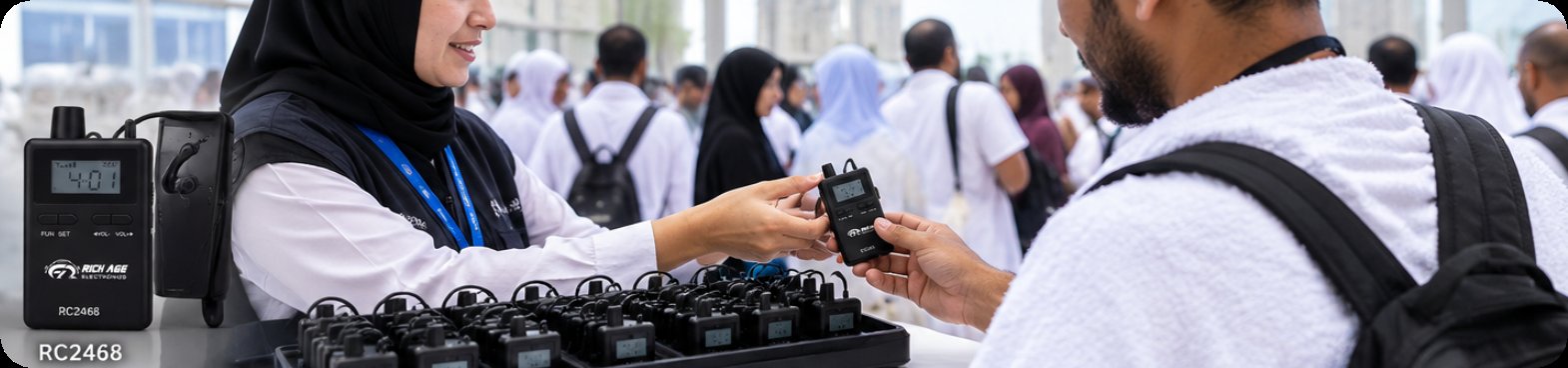
Battery figures are where cross-brand comparisons get honest, because they decide whether the volunteer coordinator spends the afternoon swapping packs. The RC2501 runs 15 hours on its transmitter and 35-plus hours on its receiver, charged over Type-C, which in practice means a morning charge covers a double shift plus the evening event without a mid-day intervention. The ListenTALK system from Listen Tech, built on 1.9 GHz DECT with 30 groups, publishes 8 hours for both transmitter and receiver and lists its range as 150 metres indoors or 300 metres outdoors, at a typical price position of 400 to 600 US dollars per unit; the OKAYO WT-500 manages 12 to 15 hours on AA batteries with a 70-100 metre range and a 42-gram transmitter body. AA batteries remove charging hardware from the budget but add a consumables line that a busy park burns through weekly. None of these figures makes one brand objectively better; they define different staffing models, and the right question is which model your volunteer rota can actually sustain. The RC2501's headset and lapel microphone options matter for keeper talks held next to noisy enclosures, and its build is detailed on the RC2501 wireless tour guide system page.

After Dark: Where the Silent Disco Layer Earns Its Place

Evening fundraisers, member nights and seasonal light festivals have become a revenue pillar for botanical gardens, and they need a different kind of kit. A silent disco headphone kit runs on its own UHF band with 10 channels and colour-coded LED rings that let guests self-sort between a DJ channel, a keeper commentary channel and a children's story channel, with the transmitter reaching beyond 500 metres across open garden ground. No traditional tour-guide brand covers this use case well, because the requirement is not interpretation but simultaneous programming, and that is exactly why the cross-brand shortlist for a zoo usually ends with one tour-guide line and one headphone line rather than a single vendor. Sharing the same charging case discipline as the daytime fleet keeps the evening kit from becoming the thing that goes missing, and the hardware is specified on the silent disco headphone system page.
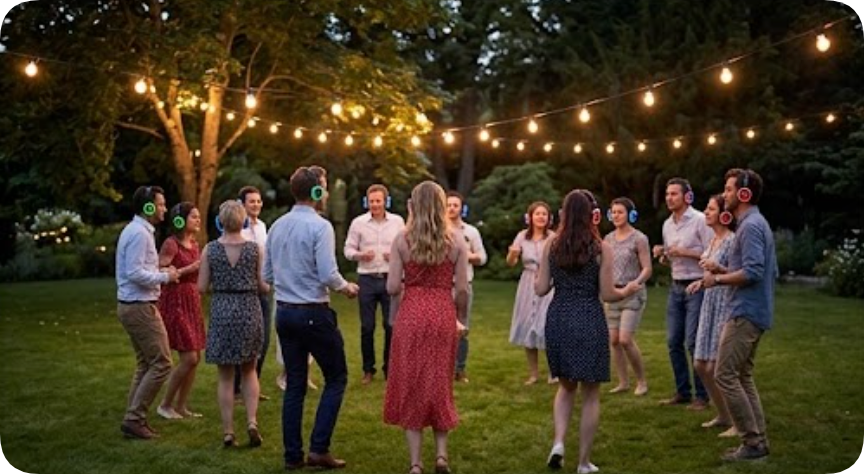
Silent-disco-headphones-at-evening-garden-event

The Cross-Brand Table

DimensionRC2401RC2501OKAYO WT-300 G2ListenTALKSilent Disco kit
Band2403-2483 MHz2403-2483 MHz863-865 MHz1.9 GHz DECTUHF 863/925 MHz
Channels50508030 groups10
TX / RX endurance10 h / 20 h15 h / 35+ hNot published8 h / 8 h10 h / 10 h
Licence positionLicence-free 2.4GLicence-free 2.4GRegion-dependentDECT bandRegion-dependent
ChargingDC portType-CNot publishedUSBCase charging
Best fit in a parkSchool groups, day toursKeeper talks, long shiftsSingle-country fleetsTwo-way staff commsEvening events

Read across the rows, the table reframes the buying question. A park is not choosing one winner; it is assigning each row of its operating calendar to the system whose band, endurance and charging model fit. Where a competitor cell reads "not published", the honest next step is a dealer question, not an assumption, and buyers who want the manufacturer's own answer sheets can find them collected under the solutions library.

Service, Spares and the Fleet Ownership Question

Cross-brand comparisons rarely discuss what happens in year three, yet a zoo fleet lives for five to eight seasons. Accessories decide more of that story than radios do: earpieces, neck straps, charging caddies and microphone replacements wear out on a scale that the electronics never reach. A multi-brand fleet therefore multiplies the spare-parts inventory, because a 2.4G receiver earpiece will not be interchangeable with a DECT unit's, and a mixed charging drawer becomes the most common failure point reported by venue coordinators. Standardising on one primary tour-guide brand for the daytime fleet, with the silent disco layer as the only second system, keeps the parts shelf short and the training one-page. Parks evaluating the full catalogue behind that kind of consolidation can browse the tour guide system range before fixing the mix.

⚡ Running the Comparison on Your Own Ground

The final step is a trial protocol that respects the venue's rhythm rather than a vendor's demo script. Borrow or rent the shortlisted kits for one full weekend: Saturday daytime with school groups on the tour-guide line, and an evening member event on the headphone line. Score four things: whether every group kept a clean channel at the eleven-o'clock crowd peak, whether any unit needed a battery intervention before closing, whether the volunteer team could set up and pack down without engineering help, and whether visitors volunteered any comment about the audio. Those four scores, collected on your own paths and among your own animals and glasshouses, will settle the cross-brand argument faster than any datasheet, because the datasheet rows that looked decisive on paper rarely match the row that fails on the ground.
Frequently Asked Questions

1. Can 2.4G tour systems and an 863-865 MHz fleet operate in the same park without interference?

Yes in practice, because the bands do not overlap. The realistic coordination issue is not radio interference but channel discipline among your own guides, so the fleet plan should assign channel blocks per brand during the trial weekend and keep the assignment sheet laminated at the dispatch desk.

2. Is the OKAYO WT-300 G2 a bad choice because its endurance figures are not published?

No. Unpublished figures are a procurement question, not a verdict. Many venues run that system successfully in single-country deployments; the point of the comparison is that you should ask the dealer for the numbers and the licence position for your specific region before committing, rather than treating silence in a datasheet as a favourable value.

3. Why add a silent disco kit instead of a second tour-guide line for events?

Because the evening use case is simultaneous programming, not interpretation. Guests switch between music, commentary and children's channels themselves, which a traditional guide-and-receiver pair does not do. Trying to run an event on tour-guide hardware usually ends with the guide narrating over a playlist, which satisfies neither purpose.

4. How large should the trial fleet be before a park commits to a brand?

Enough to stress the real arithmetic: at minimum one transmitter per likely concurrent group plus the receivers those groups would carry, on the busiest public day of the month. A two-unit desk demo cannot reproduce the channel congestion or the charging logistics that decide cross-brand outcomes in a living collection.


2026年10月19日 11:59
ꄘ click: 12
no data

RC2401, RC2501 and a Silent Disco Kit: Cross-Brand Decisions a Zoo Botanical Garden Faces

time: 2026年10月19日 click:12

Animal parks shop across brands more than any other venue type. A zoo or botanical garden runs guided school groups at ten in the morning, keeper-led feeding talks at noon, and an evening fundraiser with music by eight, and no single product family was designed with all three in mind. So procurement teams end up comparing Richitek receivers against OKAYO and Sennheiser units, weighing DECT intercom systems against 2.4G tour kits, and deciding whether a silent disco layer belongs in the same budget line. This article walks through those decisions using three representative builds: the RC2401 as the value-oriented 2.4G baseline, the RC2501 as the long-endurance professional option, and a silent disco headphone kit for after-hours events. The competitor figures quoted here come from published comparison pages on this site, and where a rival does not publish a figure, that gap is stated rather than guessed. For the venue-side deployment context behind these choices, see the city tour and park solutions page.

Zoo-keeper-talk-with-receivers-group

📡 What Animal Park Grounds Demand From Radio

Zoos and botanical gardens share three physical traits that shape every radio decision. First, the route is long and outdoors, so the 1-200 metre transmission envelope that all three featured systems publish matters less than how the signal behaves around metal railings, glasshouses and concrete night-houses. Second, the crowd is mixed: visitors carry phones, and on busy days several paid tours, school classes and private groups run in parallel, which puts channel count ahead of almost any other datasheet row. Third, the operator team is usually small and part-time, so whatever system is chosen has to be chargeable, paired and stored by people who did not design it. Those three traits explain why the comparison below keeps returning to channels, band choice and charging logistics rather than exotic audio features, and why a cross-brand evaluation is genuinely necessary rather than a marketing exercise.

The Licensing Question: 2.4G Against 863-865 MHz

The most consequential brand difference is invisible on the product photo: the frequency band. The RC2401 operates on 2403-2483 MHz in the 2.4G ISM band, which is licence-free in the overwhelming majority of destinations. By contrast, the OKAYO WT-300 G2 uses 863-865 MHz with 80 channels, and the Sennheiser 2020 guide sits in the same 863-865 MHz territory with just 6 channels; 863-865 MHz availability and licence conditions differ by region, which is why touring operators treat that band as a per-country check. A city zoo that never crosses borders can live with either band, but a botanical garden that hosts international conferences, or a zoo with sister-park exchanges, tends to standardise on licence-free 2.4G to keep one fleet legal everywhere. Where a competitor's transmission distance or battery life is simply not published, buyers should treat that as a question to put to the dealer rather than a number to assume. The RC2401's own channel bank of 50 covers the parallel-group arithmetic of a mid-size park, and its full build is specified on the RC2401 wireless audio guide system page.

Guide-with-RC2501-transmitter-at-aviary

Endurance Across Brands: Who Finishes the Day

Battery figures are where cross-brand comparisons get honest, because they decide whether the volunteer coordinator spends the afternoon swapping packs. The RC2501 runs 15 hours on its transmitter and 35-plus hours on its receiver, charged over Type-C, which in practice means a morning charge covers a double shift plus the evening event without a mid-day intervention. The ListenTALK system from Listen Tech, built on 1.9 GHz DECT with 30 groups, publishes 8 hours for both transmitter and receiver and lists its range as 150 metres indoors or 300 metres outdoors, at a typical price position of 400 to 600 US dollars per unit; the OKAYO WT-500 manages 12 to 15 hours on AA batteries with a 70-100 metre range and a 42-gram transmitter body. AA batteries remove charging hardware from the budget but add a consumables line that a busy park burns through weekly. None of these figures makes one brand objectively better; they define different staffing models, and the right question is which model your volunteer rota can actually sustain. The RC2501's headset and lapel microphone options matter for keeper talks held next to noisy enclosures, and its build is detailed on the RC2501 wireless tour guide system page.

After Dark: Where the Silent Disco Layer Earns Its Place

Evening fundraisers, member nights and seasonal light festivals have become a revenue pillar for botanical gardens, and they need a different kind of kit. A silent disco headphone kit runs on its own UHF band with 10 channels and colour-coded LED rings that let guests self-sort between a DJ channel, a keeper commentary channel and a children's story channel, with the transmitter reaching beyond 500 metres across open garden ground. No traditional tour-guide brand covers this use case well, because the requirement is not interpretation but simultaneous programming, and that is exactly why the cross-brand shortlist for a zoo usually ends with one tour-guide line and one headphone line rather than a single vendor. Sharing the same charging case discipline as the daytime fleet keeps the evening kit from becoming the thing that goes missing, and the hardware is specified on the silent disco headphone system page.

Silent-disco-headphones-at-evening-garden-event

The Cross-Brand Table

DimensionRC2401RC2501OKAYO WT-300 G2ListenTALKSilent Disco kit
Band2403-2483 MHz2403-2483 MHz863-865 MHz1.9 GHz DECTUHF 863/925 MHz
Channels50508030 groups10
TX / RX endurance10 h / 20 h15 h / 35+ hNot published8 h / 8 h10 h / 10 h
Licence positionLicence-free 2.4GLicence-free 2.4GRegion-dependentDECT bandRegion-dependent
ChargingDC portType-CNot publishedUSBCase charging
Best fit in a parkSchool groups, day toursKeeper talks, long shiftsSingle-country fleetsTwo-way staff commsEvening events

Read across the rows, the table reframes the buying question. A park is not choosing one winner; it is assigning each row of its operating calendar to the system whose band, endurance and charging model fit. Where a competitor cell reads "not published", the honest next step is a dealer question, not an assumption, and buyers who want the manufacturer's own answer sheets can find them collected under the solutions library.

Service, Spares and the Fleet Ownership Question

Cross-brand comparisons rarely discuss what happens in year three, yet a zoo fleet lives for five to eight seasons. Accessories decide more of that story than radios do: earpieces, neck straps, charging caddies and microphone replacements wear out on a scale that the electronics never reach. A multi-brand fleet therefore multiplies the spare-parts inventory, because a 2.4G receiver earpiece will not be interchangeable with a DECT unit's, and a mixed charging drawer becomes the most common failure point reported by venue coordinators. Standardising on one primary tour-guide brand for the daytime fleet, with the silent disco layer as the only second system, keeps the parts shelf short and the training one-page. Parks evaluating the full catalogue behind that kind of consolidation can browse the tour guide system range before fixing the mix.

⚡ Running the Comparison on Your Own Ground

The final step is a trial protocol that respects the venue's rhythm rather than a vendor's demo script. Borrow or rent the shortlisted kits for one full weekend: Saturday daytime with school groups on the tour-guide line, and an evening member event on the headphone line. Score four things: whether every group kept a clean channel at the eleven-o'clock crowd peak, whether any unit needed a battery intervention before closing, whether the volunteer team could set up and pack down without engineering help, and whether visitors volunteered any comment about the audio. Those four scores, collected on your own paths and among your own animals and glasshouses, will settle the cross-brand argument faster than any datasheet, because the datasheet rows that looked decisive on paper rarely match the row that fails on the ground.

Frequently Asked Questions

1. Can 2.4G tour systems and an 863-865 MHz fleet operate in the same park without interference?

Yes in practice, because the bands do not overlap. The realistic coordination issue is not radio interference but channel discipline among your own guides, so the fleet plan should assign channel blocks per brand during the trial weekend and keep the assignment sheet laminated at the dispatch desk.

2. Is the OKAYO WT-300 G2 a bad choice because its endurance figures are not published?

No. Unpublished figures are a procurement question, not a verdict. Many venues run that system successfully in single-country deployments; the point of the comparison is that you should ask the dealer for the numbers and the licence position for your specific region before committing, rather than treating silence in a datasheet as a favourable value.

3. Why add a silent disco kit instead of a second tour-guide line for events?

Because the evening use case is simultaneous programming, not interpretation. Guests switch between music, commentary and children's channels themselves, which a traditional guide-and-receiver pair does not do. Trying to run an event on tour-guide hardware usually ends with the guide narrating over a playlist, which satisfies neither purpose.

4. How large should the trial fleet be before a park commits to a brand?

Enough to stress the real arithmetic: at minimum one transmitter per likely concurrent group plus the receivers those groups would carry, on the busiest public day of the month. A two-unit desk demo cannot reproduce the channel congestion or the charging logistics that decide cross-brand outcomes in a living collection.


no data
×

Contact us

email:
name:
subject:
content: