A leading China factory specializing in Wireless Tour Guide Systems, Church Audio Guides, and Translation Headphones with premium OEM/ODM solutions.

Tel:+86 18922879583

Email:tiger.wang@richitek.com

RC2468 to RC2500: Matching a 2.4G Tour Guide System to a University Open Day

An admissions office that runs a spring open day is really running three tours at once. Prospective students want the labs, parents want the residence halls and the fee conversation, and international families want everything translated on the move. On one Saturday in March, a mid-sized university we spoke with scheduled sixty families per wave, split them across three routes, and repeated the whole cycle twice before lunch. Every group had a different guide, every guide had a different voice, and the only way sixty families heard anything was through a borrowed fleet of wireless receivers that had grown, model by model, over three admission cycles. That fleet is the subject here: RC2468, RC2406 and RC2500, three 2.4G units that turn out to answer three very different questions about the same event.

Three Waves, Sixty Families, a Single Morning

The logistics of an open day punish any system that assumes one guide and one group. Wave one departs the welcome marquee at 9:20, wave two at 10:40, wave three at 12:00, and each wave branches into an engineering route, a library route and a residence route. Nine guides are speaking simultaneously within a campus area of a few hundred metres. Families drift between groups when a teenager decides chemistry looks boring, which means a receiver handed to a parent at the marquee may spend its afternoon with a different route entirely. The admissions team does not need a fleet of identical professional equipment; it needs hardware that survives hand-me-down use, untrained volunteer guides and a charging deadline of roughly ninety minutes between waves. Those three pressures — comfort, interference and turnaround — map almost perfectly onto the three models in this comparison, which is why the university ended up running them side by side instead of replacing one generation with the next. Institutions planning similar events can see how this segment is positioned on our education wireless audio solutions page.

💡 Why Campus Interference Reshapes Receiver Choice

A campus on an open day is one of the most hostile 2.4G environments short of a trade show. Every one of those sixty families carries at least two phones, the university runs eduroam and a guest SSID on the same band, the sports centre streams its Saturday fixture, and the café's payment terminals add their own chatter. All three units here transmit in the 2403–2483 MHz band at 10 mW with PLL frequency control and a working radius of 1–200 metres, so the raw physics are identical. What differs is how many clean channels each model can find when the band fills up. The entry point offers fifty channels, the mid-generation unit offers eighty, and in the field test that gap was not theoretical: on the engineering route, which passes within forty metres of the data centre's rooftop antennas, the fifty-channel fleet needed two frequency changes before lunch, while the eighty-channel fleet kept its original assignment all day. A guide who has to stop a group of teenagers and re-pair receivers loses the room; that alone justified dedicating the newer units to the routes with the worst spectrum.

The 18-Gram Ear-Hook Parents Forget They Are Wearing

Open-day audiences are not museum audiences. Half the receivers go to teenagers who will fiddle with anything on their head, and the other half go to parents who will pocket a bulky unit and forget to turn it on. The RC2468 was bought for exactly this problem. Its receiver weighs 18 grams in an ear-hook format, light enough that the admissions team reported almost no "is this on?" questions from families, because the device disappears the way a hearing aid does. The transmitter side is a conventional 59-gram handheld with a 10-hour battery, fifty channels and a multi-colour shell that let each route own a colour. The honest trade-off sits in the receiver battery: at roughly 8 hours per charge from a 300 mAh cell, it covers a full open day but not a full open day plus an alumni event the same evening, and it recharges over Micro USB at 5V/1A, which means the slowest top-up of the three fleets. For a morning-and-afternoon programme without evening use, the maths still works. Full details of this model are on the RC2468 ultra-light 2.4G tour guide system page.
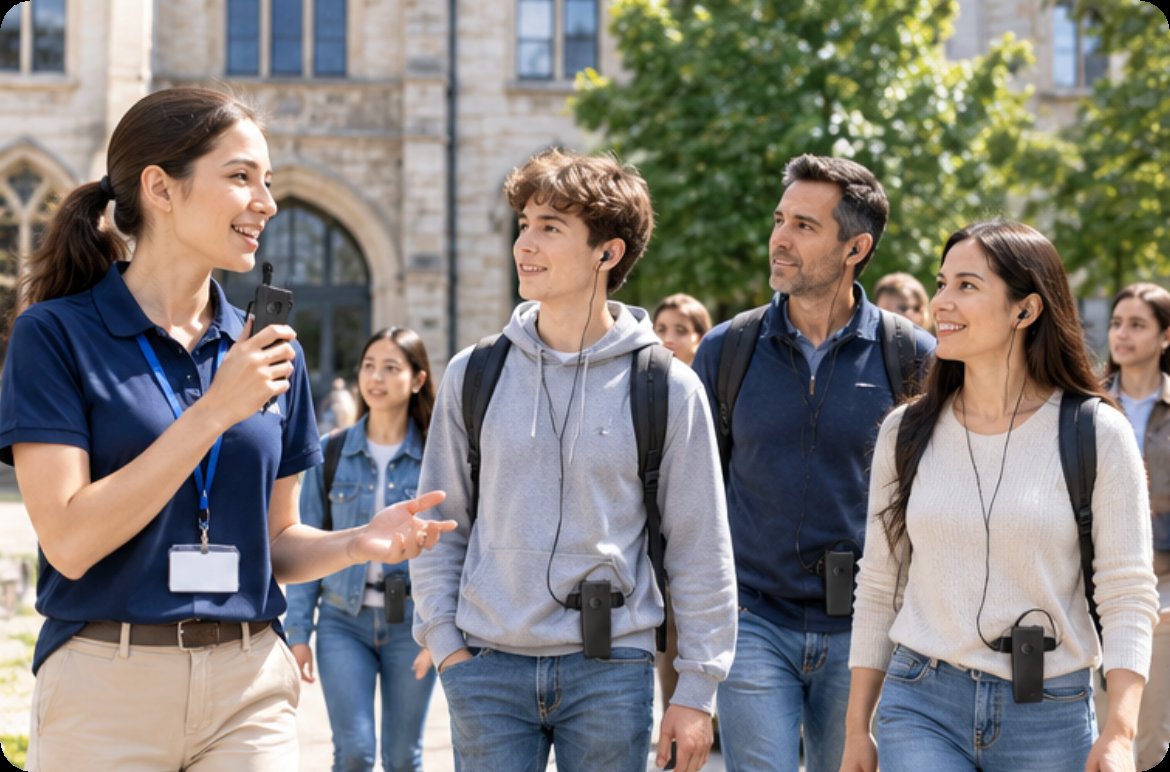
rc2468-ear-hook-receiver-open-day-desk

📡 Eighty Channels Against a Signal-Crowded Campus Core

The RC2406 is the unit the university quietly standardized on after the first open day of the season. On paper the step from fifty to eighty channels looks like headroom nobody needs; on a campus it is the difference between assigning frequencies once in the morning and re-managing them at every building handover. The receiver steps up to a 50-gram belt-pack format with a 20-hour battery fed by a 1000 mAh cell — nearly triple the endurance of the 18-gram unit, which matters when families collect a receiver at 9:00 and return it after the afternoon Q&A. Transmitter endurance stays at 10 hours from the same 1500 mAh class of cell as the entry model, and the 59-gram transmitter keeps the one-hand weight that student ambassadors prefer. Charging runs over a DC port, which the fleet manager dislikes slightly less than Micro USB only because the cradle cables never get borrowed for phones. The multi-colour shells continued the route-colour convention. Specifications and configuration options for this unit are listed on the RC2406 80-channel 2.4G tour guide system product page.
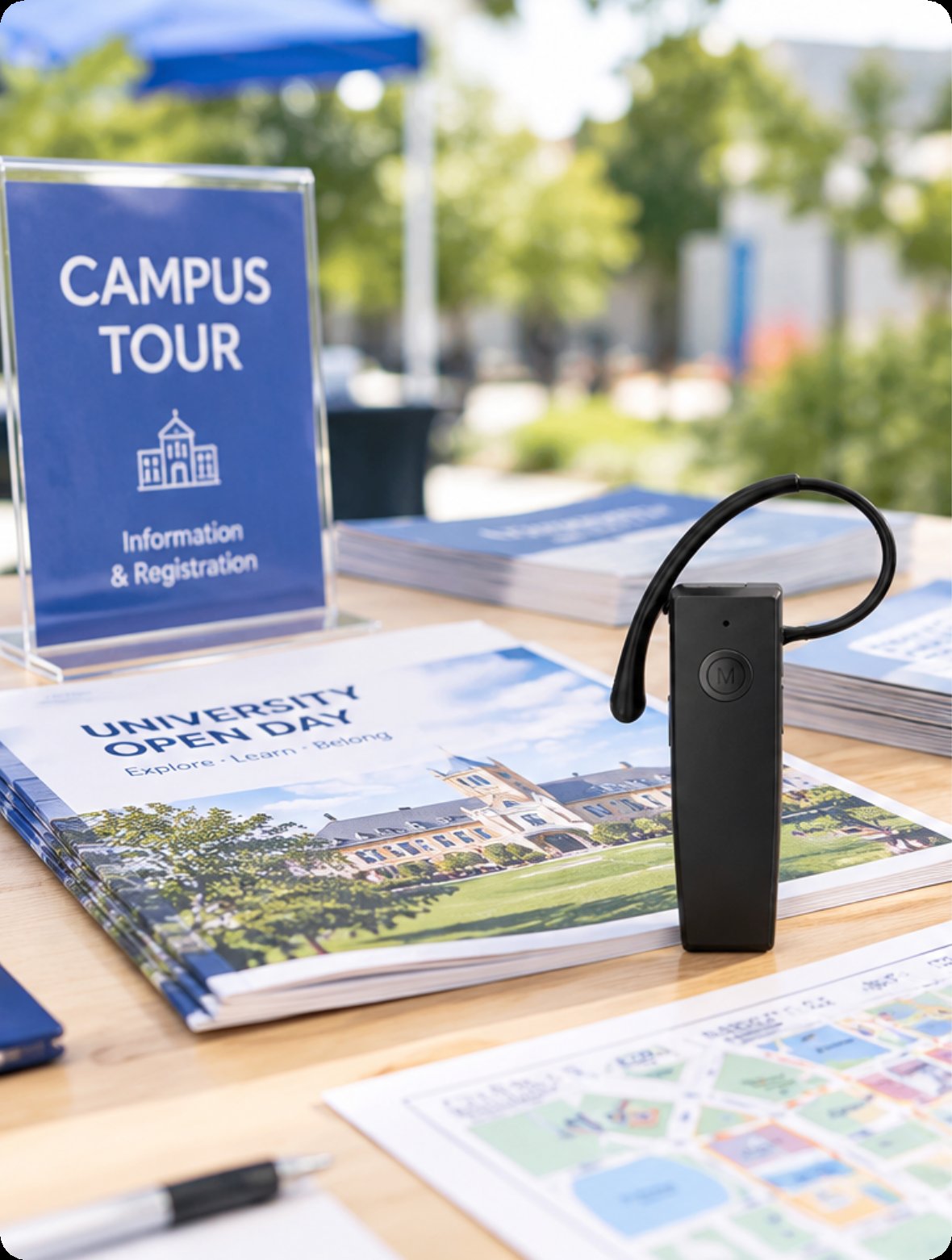
rc2406-campus-tour-group-receivers

One-Key Sync Meets a 15-Hour Transmission Shift

The RC2500 entered the fleet for the least glamorous reason: staff turnover. Between the morning and afternoon waves the university rotates in volunteer guides — professors, alumni, the dean — and every rotation previously meant re-pairing transmitters to receivers one by one. The flagship's one-key sync, one-key mute and one-key power-off turned a fifteen-minute ritual into about two minutes, because a single press on the transmitter pulls the whole group of receivers onto the same frequency. The hardware is heavier and built like it: transmitter and receiver both weigh 104 grams, the transmitter runs 15 hours on a 1800 mAh cell, and the receiver carries the same 1800 mAh capacity with a 35-hour-plus standby figure that lets the fleet sit charged from Friday's prep through Sunday's second event day. Charging moves to Type-C, so the same cable stock as the admissions office laptops tops the units up. The receiver frequency response is rated at 50 Hz–8 kHz, a touch more restrained than the two lighter units, and the shells come in black only — the route-colour trick ends here, which is why the flagship is reserved for the main marquee presentation rather than the colour-coded routes. The RC2500 wireless tour guide system page carries the complete configuration.
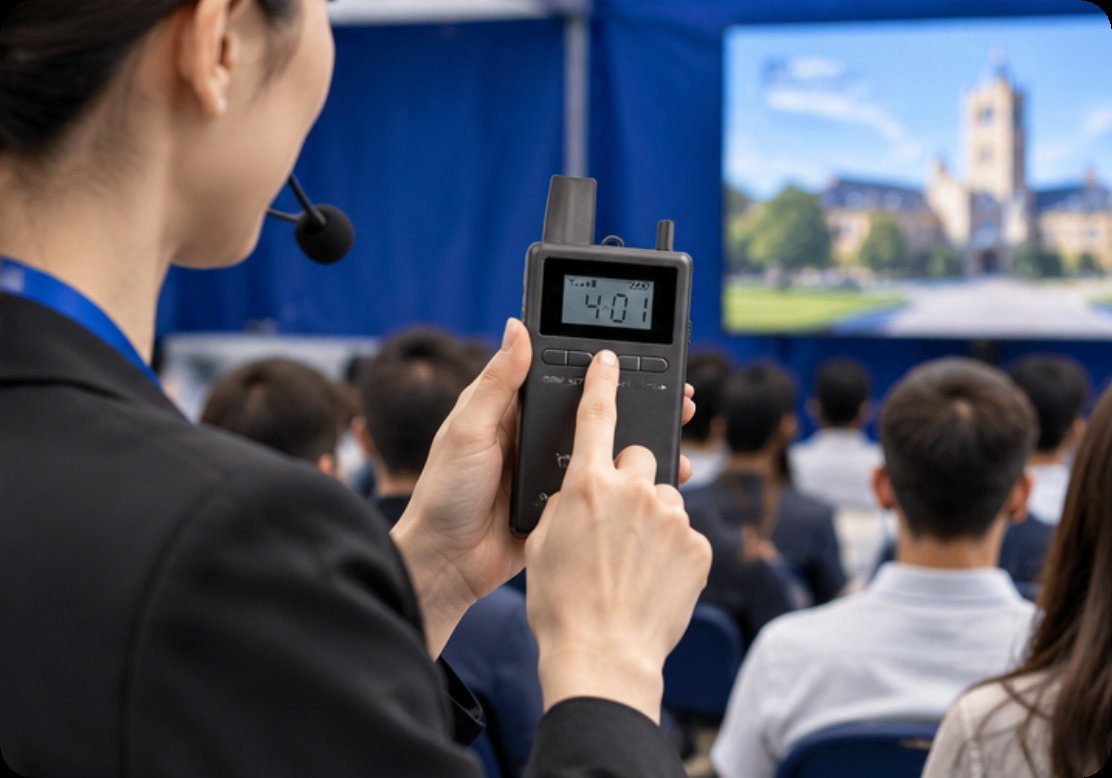
rc2500-one-key-sync-transmitter-demo

Side-by-Side Specifications Across the Three Units

The table below condenses the three fleets into the figures the admissions team actually quotes when another university asks for advice. Every value comes from the current specification sheet, with transmitter and receiver weights listed separately because the difference is the whole point of the entry model.

Comparison DimensionRC2468RC2406RC2500
Core frequency band2403–2483 MHz (2.4G)2403–2483 MHz (2.4G)2403–2483 MHz (2.4G)
Number of channels508050
Transmission distance1–200 m1–200 m1–200 m
Output power10 mW10 mW10 mW
Transmitter battery life10 h10 h15 h
Receiver battery life8 h approx.20 h35+ h
Transmitter battery3.7V 1500 mAh3.7V 1500 mAh3.7V 1800 mAh
Receiver battery3.7V 300 mAh3.7V 1000 mAh3.7V 1800 mAh
Transmitter weight59 g59 g104 g
Receiver weight18 g ear-hook50 g104 g
Frequency responseTX 50 Hz–200 kHz / RX 50 Hz–12 kHzTX 50 Hz–200 kHz / RX 50 Hz–12 kHz50 Hz–8 kHz
Control modePLLPLLPLL
Charging portMicro USB (5V/1A)DC portType-C
Signature designUltra-light 18 g ear-hook receiver80 channels for interference-heavy venuesOne-key sync / mute / power-off; 35+ h standby
Colour optionsMulti-colour TX / black RXMulti-colourBlack

Read as a whole, the table describes an evolution rather than a ranking: comfort peaked first, then interference resilience, then fleet control. A buyer who replicates the university's mixed fleet gets all three peaks at their respective price points instead of paying flagship money for capabilities a walking route never uses. The full hardware range behind this comparison is browsable on the wireless tour guide system catalogue.

⚖️ Charging Logistics Between Morning and Afternoon Sessions

Ninety minutes between waves is the real battery test, and the three fleets answer it differently. The 18-gram ear-hook receivers drain fastest and recharge slowest over Micro USB at 5V/1A, so the team keeps twelve spares on the charging trolley and swaps them at the marquee rather than waiting. The 50-gram belt-packs, with 20-hour endurance, genuinely do not need a midday charge; the trolley visit is precautionary. The flagship pair, with its 35-hour-plus receiver endurance and Type-C input, treats the ninety-minute window as irrelevant — the fleet manager's only rule is that transmitters go back on cable the moment the afternoon session ends, because a 15-hour transmission day is generous but not infinite. The university's written handover sheet now assigns each model a different trolley row, colour-coded to match the routes, and the volunteer briefing takes four minutes. Teams weighing a first purchase against a similar event calendar can explore our solutions for venue-sized planning notes, or skip straight to the answers below.

Frequently Asked Questions

1. How many tour groups can run at the same time before channels run out?

On the fifty-channel entry fleet, nine simultaneous guides used barely a fifth of the channel bank; the constraint was never the raw count but coordination, because two routes were assigned adjacent frequencies and suffered when a guide's transmitter drifted near the data-centre antennas. The eighty-channel model exists to absorb exactly that planning error, giving the frequency map enough slack that a route can hold its assignment all day without re-pairing.

2. Does dense campus Wi-Fi knock a 2.4G system out?

It compresses it rather than killing it. All three models share the 2403–2483 MHz band with eduroam, guest networks and payment terminals, and all three use PLL control to hold a clean channel once found. In practice the fifty-channel units needed two reassignments on the most saturated route, while the eighty-channel unit rode out the same spectrum without a change — so the answer is to buy channels in proportion to how busy the venue's air is.

3. Which receiver suits families with small children?

The 18-gram ear-hook receiver was designed for exactly this audience: at 18 grams it stays put on a child's ear without a lanyard and causes no fiddling, while the 50-gram belt-pack suits teenagers and adults who prefer a clipped unit with far longer battery life. The 104-gram flagship receiver is best treated as a marquee-seat device rather than something a ten-year-old wears for two hours of walking.

4. Can one charge cover a full open day?

For transmitters, yes across the board: ten hours on the two lighter units and fifteen on the flagship cover a morning-plus-afternoon programme with margin. For receivers the entry model's roughly eight hours finish close to the line, the mid-generation unit's twenty hours and the flagship's thirty-five-plus finish comfortably. The practical habit is topping everything at the ninety-minute break anyway, using Type-C on the flagship and the slower ports on the rest.


2026年10月20日 09:38
ꄘ click: 21

RC2468 to RC2500: Matching a 2.4G Tour Guide System to a University Open Day

time: 2026年10月20日 click:21

An admissions office that runs a spring open day is really running three tours at once. Prospective students want the labs, parents want the residence halls and the fee conversation, and international families want everything translated on the move. On one Saturday in March, a mid-sized university we spoke with scheduled sixty families per wave, split them across three routes, and repeated the whole cycle twice before lunch. Every group had a different guide, every guide had a different voice, and the only way sixty families heard anything was through a borrowed fleet of wireless receivers that had grown, model by model, over three admission cycles. That fleet is the subject here: RC2468, RC2406 and RC2500, three 2.4G units that turn out to answer three very different questions about the same event.

Three Waves, Sixty Families, a Single Morning

The logistics of an open day punish any system that assumes one guide and one group. Wave one departs the welcome marquee at 9:20, wave two at 10:40, wave three at 12:00, and each wave branches into an engineering route, a library route and a residence route. Nine guides are speaking simultaneously within a campus area of a few hundred metres. Families drift between groups when a teenager decides chemistry looks boring, which means a receiver handed to a parent at the marquee may spend its afternoon with a different route entirely. The admissions team does not need a fleet of identical professional equipment; it needs hardware that survives hand-me-down use, untrained volunteer guides and a charging deadline of roughly ninety minutes between waves. Those three pressures — comfort, interference and turnaround — map almost perfectly onto the three models in this comparison, which is why the university ended up running them side by side instead of replacing one generation with the next. Institutions planning similar events can see how this segment is positioned on our education wireless audio solutions page.

💡 Why Campus Interference Reshapes Receiver Choice

A campus on an open day is one of the most hostile 2.4G environments short of a trade show. Every one of those sixty families carries at least two phones, the university runs eduroam and a guest SSID on the same band, the sports centre streams its Saturday fixture, and the café's payment terminals add their own chatter. All three units here transmit in the 2403–2483 MHz band at 10 mW with PLL frequency control and a working radius of 1–200 metres, so the raw physics are identical. What differs is how many clean channels each model can find when the band fills up. The entry point offers fifty channels, the mid-generation unit offers eighty, and in the field test that gap was not theoretical: on the engineering route, which passes within forty metres of the data centre's rooftop antennas, the fifty-channel fleet needed two frequency changes before lunch, while the eighty-channel fleet kept its original assignment all day. A guide who has to stop a group of teenagers and re-pair receivers loses the room; that alone justified dedicating the newer units to the routes with the worst spectrum.

The 18-Gram Ear-Hook Parents Forget They Are Wearing

Open-day audiences are not museum audiences. Half the receivers go to teenagers who will fiddle with anything on their head, and the other half go to parents who will pocket a bulky unit and forget to turn it on. The RC2468 was bought for exactly this problem. Its receiver weighs 18 grams in an ear-hook format, light enough that the admissions team reported almost no "is this on?" questions from families, because the device disappears the way a hearing aid does. The transmitter side is a conventional 59-gram handheld with a 10-hour battery, fifty channels and a multi-colour shell that let each route own a colour. The honest trade-off sits in the receiver battery: at roughly 8 hours per charge from a 300 mAh cell, it covers a full open day but not a full open day plus an alumni event the same evening, and it recharges over Micro USB at 5V/1A, which means the slowest top-up of the three fleets. For a morning-and-afternoon programme without evening use, the maths still works. Full details of this model are on the RC2468 ultra-light 2.4G tour guide system page.

rc2468-ear-hook-receiver-open-day-desk

📡 Eighty Channels Against a Signal-Crowded Campus Core

The RC2406 is the unit the university quietly standardized on after the first open day of the season. On paper the step from fifty to eighty channels looks like headroom nobody needs; on a campus it is the difference between assigning frequencies once in the morning and re-managing them at every building handover. The receiver steps up to a 50-gram belt-pack format with a 20-hour battery fed by a 1000 mAh cell — nearly triple the endurance of the 18-gram unit, which matters when families collect a receiver at 9:00 and return it after the afternoon Q&A. Transmitter endurance stays at 10 hours from the same 1500 mAh class of cell as the entry model, and the 59-gram transmitter keeps the one-hand weight that student ambassadors prefer. Charging runs over a DC port, which the fleet manager dislikes slightly less than Micro USB only because the cradle cables never get borrowed for phones. The multi-colour shells continued the route-colour convention. Specifications and configuration options for this unit are listed on the RC2406 80-channel 2.4G tour guide system product page.

rc2406-campus-tour-group-receivers

One-Key Sync Meets a 15-Hour Transmission Shift

The RC2500 entered the fleet for the least glamorous reason: staff turnover. Between the morning and afternoon waves the university rotates in volunteer guides — professors, alumni, the dean — and every rotation previously meant re-pairing transmitters to receivers one by one. The flagship's one-key sync, one-key mute and one-key power-off turned a fifteen-minute ritual into about two minutes, because a single press on the transmitter pulls the whole group of receivers onto the same frequency. The hardware is heavier and built like it: transmitter and receiver both weigh 104 grams, the transmitter runs 15 hours on a 1800 mAh cell, and the receiver carries the same 1800 mAh capacity with a 35-hour-plus standby figure that lets the fleet sit charged from Friday's prep through Sunday's second event day. Charging moves to Type-C, so the same cable stock as the admissions office laptops tops the units up. The receiver frequency response is rated at 50 Hz–8 kHz, a touch more restrained than the two lighter units, and the shells come in black only — the route-colour trick ends here, which is why the flagship is reserved for the main marquee presentation rather than the colour-coded routes. The RC2500 wireless tour guide system page carries the complete configuration.

rc2500-one-key-sync-transmitter-demo

Side-by-Side Specifications Across the Three Units

The table below condenses the three fleets into the figures the admissions team actually quotes when another university asks for advice. Every value comes from the current specification sheet, with transmitter and receiver weights listed separately because the difference is the whole point of the entry model.

Comparison DimensionRC2468RC2406RC2500
Core frequency band2403–2483 MHz (2.4G)2403–2483 MHz (2.4G)2403–2483 MHz (2.4G)
Number of channels508050
Transmission distance1–200 m1–200 m1–200 m
Output power10 mW10 mW10 mW
Transmitter battery life10 h10 h15 h
Receiver battery life8 h approx.20 h35+ h
Transmitter battery3.7V 1500 mAh3.7V 1500 mAh3.7V 1800 mAh
Receiver battery3.7V 300 mAh3.7V 1000 mAh3.7V 1800 mAh
Transmitter weight59 g59 g104 g
Receiver weight18 g ear-hook50 g104 g
Frequency responseTX 50 Hz–200 kHz / RX 50 Hz–12 kHzTX 50 Hz–200 kHz / RX 50 Hz–12 kHz50 Hz–8 kHz
Control modePLLPLLPLL
Charging portMicro USB (5V/1A)DC portType-C
Signature designUltra-light 18 g ear-hook receiver80 channels for interference-heavy venuesOne-key sync / mute / power-off; 35+ h standby
Colour optionsMulti-colour TX / black RXMulti-colourBlack

Read as a whole, the table describes an evolution rather than a ranking: comfort peaked first, then interference resilience, then fleet control. A buyer who replicates the university's mixed fleet gets all three peaks at their respective price points instead of paying flagship money for capabilities a walking route never uses. The full hardware range behind this comparison is browsable on the wireless tour guide system catalogue.

⚖️ Charging Logistics Between Morning and Afternoon Sessions

Ninety minutes between waves is the real battery test, and the three fleets answer it differently. The 18-gram ear-hook receivers drain fastest and recharge slowest over Micro USB at 5V/1A, so the team keeps twelve spares on the charging trolley and swaps them at the marquee rather than waiting. The 50-gram belt-packs, with 20-hour endurance, genuinely do not need a midday charge; the trolley visit is precautionary. The flagship pair, with its 35-hour-plus receiver endurance and Type-C input, treats the ninety-minute window as irrelevant — the fleet manager's only rule is that transmitters go back on cable the moment the afternoon session ends, because a 15-hour transmission day is generous but not infinite. The university's written handover sheet now assigns each model a different trolley row, colour-coded to match the routes, and the volunteer briefing takes four minutes. Teams weighing a first purchase against a similar event calendar can explore our solutions for venue-sized planning notes, or skip straight to the answers below.
Frequently Asked Questions

1. How many tour groups can run at the same time before channels run out?

On the fifty-channel entry fleet, nine simultaneous guides used barely a fifth of the channel bank; the constraint was never the raw count but coordination, because two routes were assigned adjacent frequencies and suffered when a guide's transmitter drifted near the data-centre antennas. The eighty-channel model exists to absorb exactly that planning error, giving the frequency map enough slack that a route can hold its assignment all day without re-pairing.

2. Does dense campus Wi-Fi knock a 2.4G system out?

It compresses it rather than killing it. All three models share the 2403–2483 MHz band with eduroam, guest networks and payment terminals, and all three use PLL control to hold a clean channel once found. In practice the fifty-channel units needed two reassignments on the most saturated route, while the eighty-channel unit rode out the same spectrum without a change — so the answer is to buy channels in proportion to how busy the venue's air is.

3. Which receiver suits families with small children?

The 18-gram ear-hook receiver was designed for exactly this audience: at 18 grams it stays put on a child's ear without a lanyard and causes no fiddling, while the 50-gram belt-pack suits teenagers and adults who prefer a clipped unit with far longer battery life. The 104-gram flagship receiver is best treated as a marquee-seat device rather than something a ten-year-old wears for two hours of walking.

4. Can one charge cover a full open day?

For transmitters, yes across the board: ten hours on the two lighter units and fifteen on the flagship cover a morning-plus-afternoon programme with margin. For receivers the entry model's roughly eight hours finish close to the line, the mid-generation unit's twenty hours and the flagship's thirty-five-plus finish comfortably. The practical habit is topping everything at the ninety-minute break anyway, using Type-C on the flagship and the slower ports on the rest.


×

Contact us

email:
name:
subject:
content: