A leading China factory specializing in Wireless Tour Guide Systems, Church Audio Guides, and Translation Headphones with premium OEM/ODM solutions.

Tel:+86 18922879583

Email:tiger.wang@richitek.com

Seasonal Planning for Church Services: RC2402, RC2501 and Silent Disco Headphones

Twice a year, a church that runs smoothly on an ordinary Sunday gets hit with a crowd it cannot seat, a bilingual visitor group it cannot brief, and a volunteer team that has never touched the audio rack before. Easter and Christmas turn an ordinary sanctuary into a temporary venue: overflow seating in the hall next door, a kids' room that suddenly has forty children in it, and a lobby where latecomers watch on a screen because every pew is full. Sound systems built for the regular congregation rarely stretch that far, and hiring interpreters without a wireless audio plan usually means asking fifty people to share one loudspeaker.

This guide treats the two big calendar surges as a planning problem rather than an equipment problem. The kit discussed here pairs two 2.4 GHz transceivers from the same product family with a multi-channel headphone system: the RC2402 Wireless Tour Guide System for standard simultaneous translation, the RC2501 Wireless Tour Guide System for the clergy side of the chain, and the Silent Disco Wireless Headphone System as the overflow and quiet-room layer. All three come from one supplier, which matters in December when a dead receiver cannot wait three weeks for a warranty return. The full wireless lineup behind these units is listed on the manufacturer's tour guide hub, and scenario notes for this vertical sit under the church audio solutions page.

Nothing in this article assumes a budget figure, because quotes vary by region and season. What the spec sheets do fix are the operational numbers: channel counts, battery hours, charging ports and rated range. Those four numbers decide whether a holiday service starts on time or dissolves into a lobby full of people waving receivers.

What the Easter and Christmas Surges Actually Stress

A regular Sunday service runs one translation channel at most, and the operator is often the same volunteer every week. The calendar surges break three assumptions at once. Attendance can double or triple, which pushes families into overflow rooms where the sermon has to arrive by audio instead of line of sight. Visitors arrive without their own headphones, so every earpiece in the building gets handed out, wiped, and reissued within ninety minutes. And the volunteers operating the gear change from week to week: the person who ran the transmitter flawlessly in November may be traveling for the holidays, leaving a newcomer with the rack on the biggest morning of the year.

The stress is not volume, it is allocation. How many independent audio streams does the building need at 10:30 on Easter morning? A typical mid-size church needs the translated sermon in the main hall, a second language stream in a side chapel, a feed into the kids' room, and a low-distraction feed in the quiet room for families with sensory-sensitive children. Four streams, four rooms, one operator. That is an allocation problem, and it maps directly onto channel counts and battery hours rather than onto speaker wattage.

There is also a rehearsal problem. Gear that sits in a cabinet for eleven months gets switched on twice a year. Batteries that were "fine" in October may have self-discharged to a token level by Christmas Eve. Planning the surge means planning the charge cycle, not just the purchase.

A Three-Device Kit for the Two Big Days

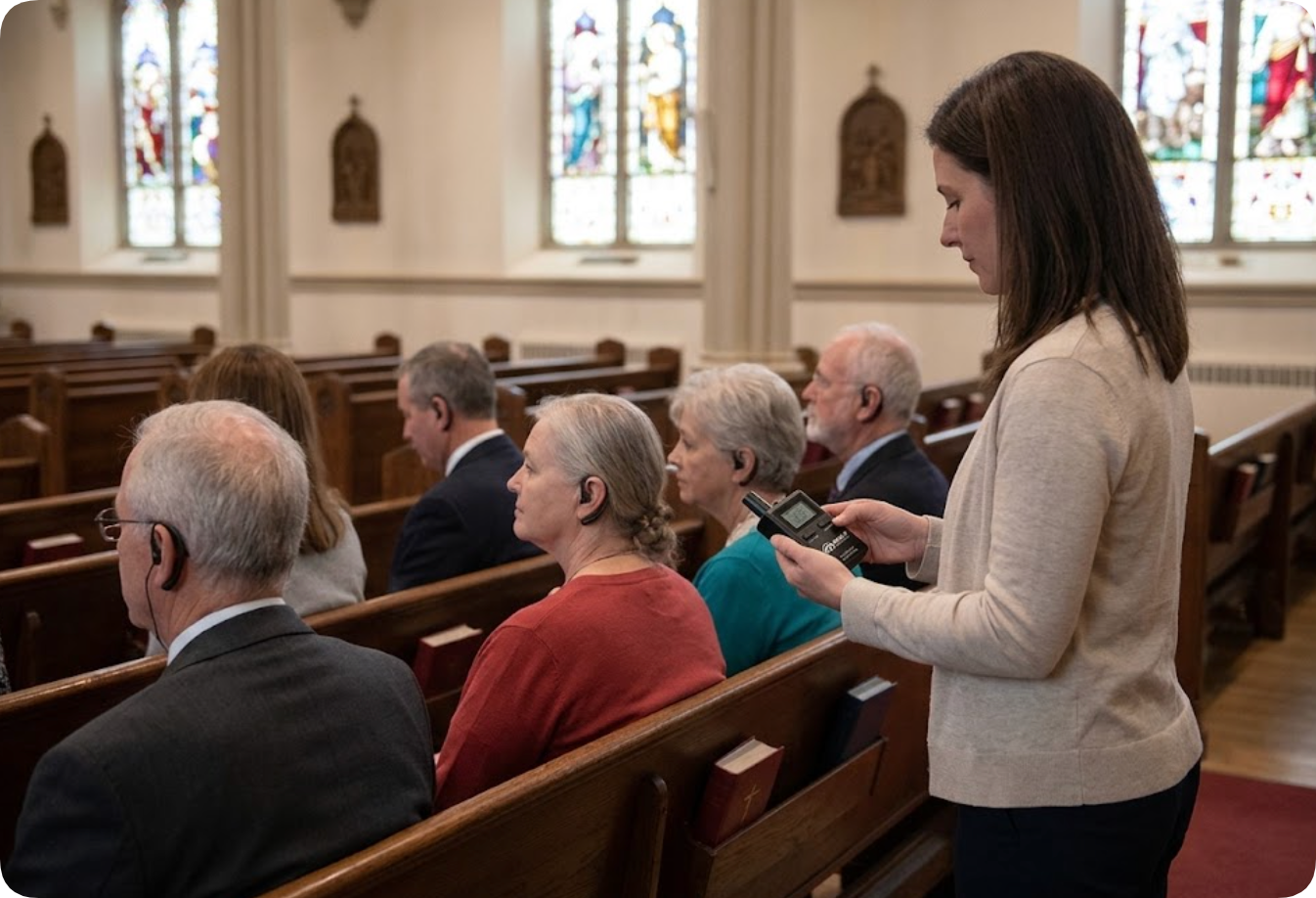
The division of labor in this kit follows the shape of the morning. The RC2402 is the standard 2.4 GHz workhorse: a basic version built around 50 channels, with the transmitter rated at 10 hours and each receiver at 20 hours on their 3.7 V packs. In the surge plan it carries the main translation stream in the sanctuary, where fifty congregants or so share receivers handed out at the door. Its DC-port charging is unglamorous but predictable, and the multi-color transmitter-and-receiver options help volunteers color-code which crate goes to which room.
rc2402-church-translation-kit

The RC2501 sits at the front of the chain rather than in the pews. It runs on the same 2.4 GHz band with 50 channels, but the September-corrected spec sheet rates the transmitter at 15 hours and the receivers at 35-plus hours, both at 47 g, with a Type-C charging port and a 13 mW output. The headband and lavalier microphone options matter for clergy: a lectern-bound dynamic microphone assumes the speaker stands still, and Christmas pageants are anything but stationary. A lavalier on the celebrant keeps the translation chain fed while both hands are occupied with a censer, a book, or a toddler drafted into the nativity scene at the last minute.
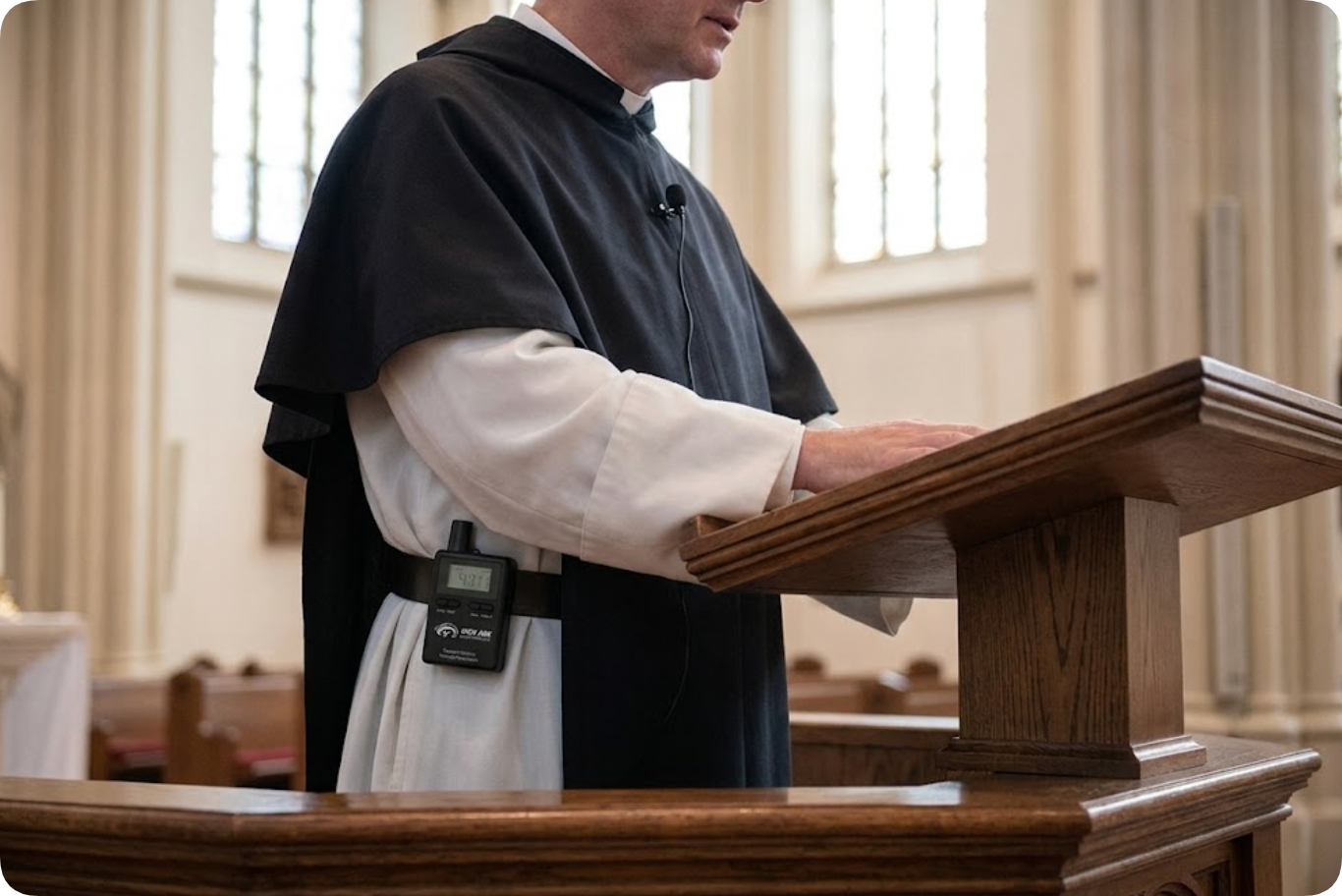
rc2501-clergy-lavalier-transmitter

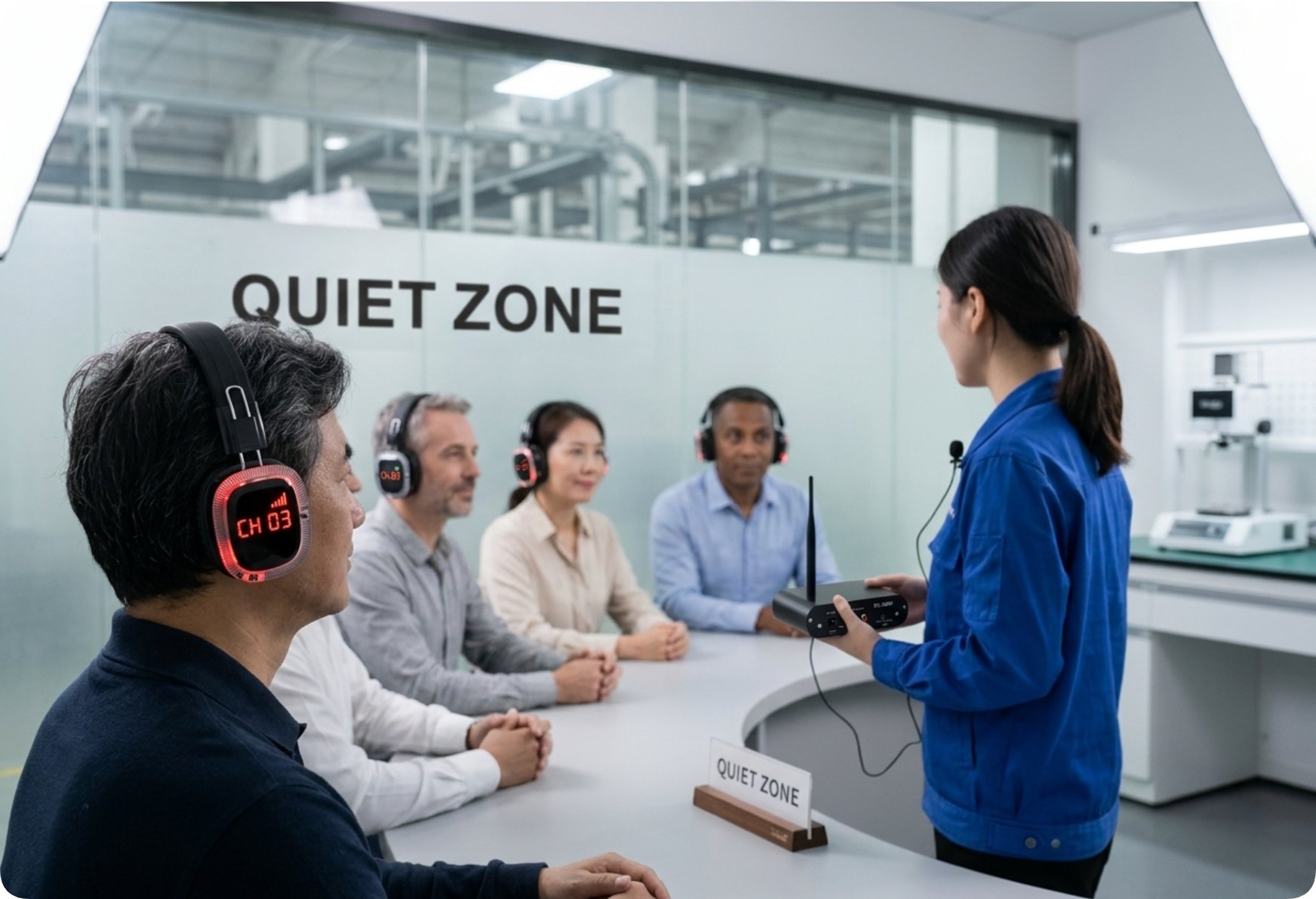
The Silent Disco Wireless Headphone System covers the rooms where the main chain does not reach. Its RC-409 headphones pair with the RC-50RF transmitter as a 10-channel FM stereo system, with five LED colors (red, green, blue, purple, yellow) marking which channel each cup is tuned to. The 40 mm Mylar drivers are rated at SNR above 75 dB with distortion under 1 percent, the built-in 500 mAh battery runs 10 hours per 3-hour Micro USB charge, and the foldable cups pack into a crate between services. Ten independent audio streams is more than any single morning needs, which is exactly the point: the silent layer absorbs whatever overflow shape the crowd takes.
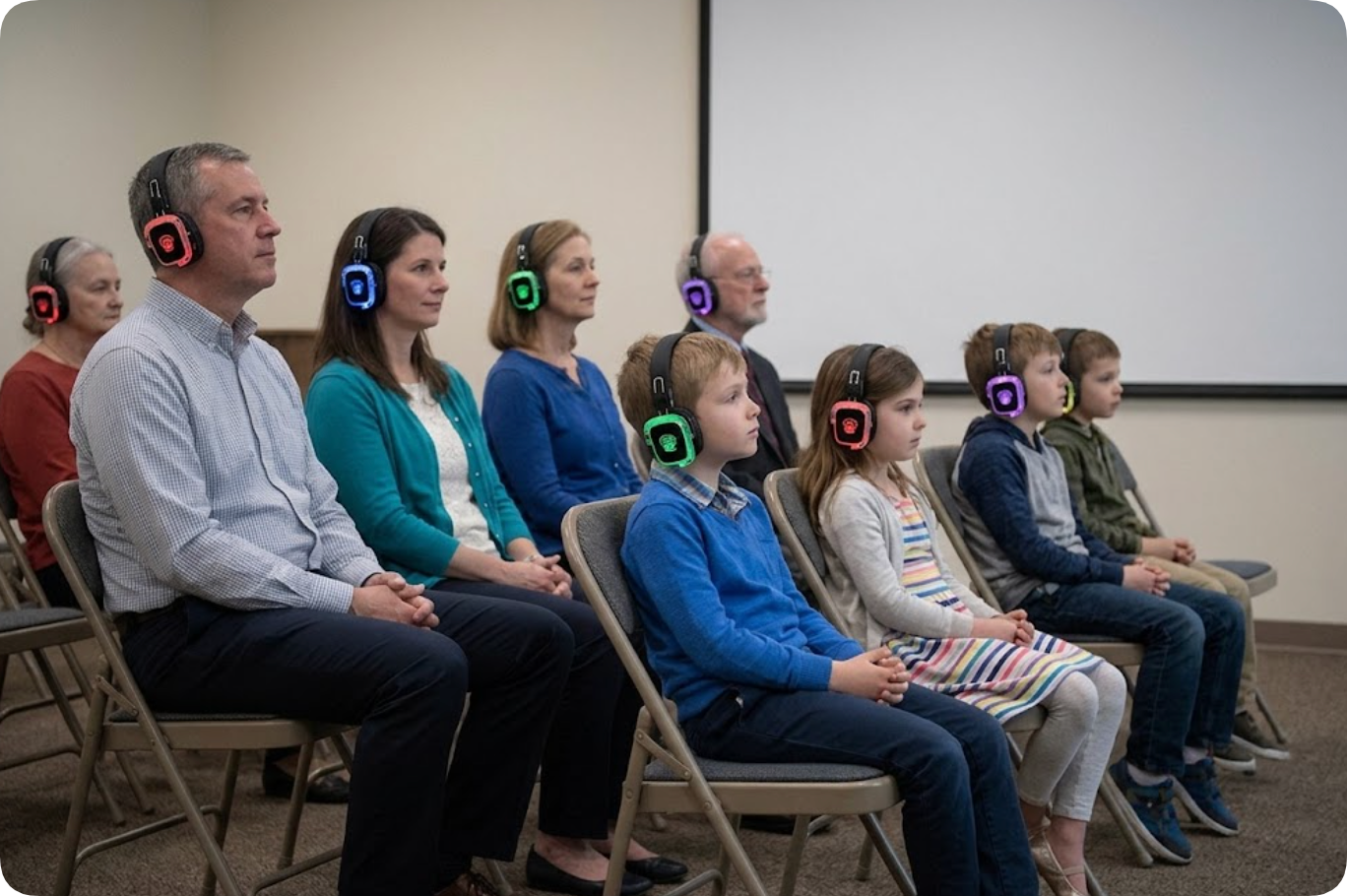
silent-disco-headphones-church-overflow

🎯 Specs That Decide the Surge Fit

Three numbers do most of the deciding. The first is channel headroom: 50 channels on each 2.4 GHz unit means the translation stream never fights the kids' stream for a frequency, and the headphone system's 10 channels make it a self-contained island for the overflow rooms. The second is battery asymmetry: the RC2501's 35-plus-hour receiver rating means a receiver charged on Thursday still has margin on Sunday evening, while the RC2402's 20-hour receiver rating comfortably covers a double-service morning even if it was charged the night before. The third is charging logistics: one crate of DC-port units, one Type-C cable for the clergy unit, and one Micro USB bank for forty headphone cups is three charging routines, and the countdown below treats them as three line items.

Weight deserves a sentence even though it never makes a brochure. At 59 g and 50 g for the RC2402 transmitter and receiver, and a uniform 47 g for both RC2501 units, neither system fatigues an elderly usher who spends ninety minutes collecting earpieces at the door. The headphone cups are bulkier but fold flat, which is what actually determines how many fit in the storage crate under the sound desk.

🔋 Head-to-Head: Channel, Range, Battery and Charging

The table below compares only the fields all three devices publish. Where a value depends on mode, both figures are shown rather than averaged into a single misleading number.

DimensionRC2402 (TX / RX)RC2501 (TX / RX)Silent Disco (RC-409 + RC-50RF)
Channels505010 (FM stereo)
Rated transmission range1-200 m1-200 mup to 200 m in low-power mode; over 500 m in high-power mode
Battery life10 h TX / 20 h RX15 h TX / 35+ h RX10 h per headphone
Charging portDC PortType-CMicro USB (3 h full charge)
Frequency controlPLLPLLdual PLL
Standout hardwarebasic 2.4 GHz standard version; multi-color options for color-coding crates47 g units; headband/lavalier mic options; 13 mW outputfive-color LED channel indicators; foldable 40 mm driver cups

Two omissions are deliberate. Output power is not compared because the headphone system does not publish a milliwatt figure, and per-unit weight stops at the transceivers because the headphone cups list no mass on their product page. Where a column would require inference, it stays out; the numbers above are quoted exactly as the manufacturer publishes them.

Volunteer-Friendly Operation on Holiday Mornings

The least glamorous requirement is that a stranger can run the kit after one rehearsal. PLL frequency control on both 2.4 GHz units means the operator picks a channel and the link stays locked; there is no drift to chase mid-sermon. The RC2402's color options let the team standardize, for example, gray transmitters in the sanctuary crate and a distinct receiver color per language, so a late substitute volunteer can match hardware to room without reading a manual. The RC2501's lavalier option removes the one skill that actually takes practice, which is holding a microphone steady while reading from a book.

The headphone system's contribution to operability is the LED ring. When forty children in the kids' room each hold a cup, the five-color indicator tells an eighteen-year-old volunteer at a glance whether the cup is on the story channel or the music channel, without any display to squint at. Independent volume control on each cup also ends the tallest-child-gets-the-loudest-cup negotiation, because each listener sets their own level.

For the overflow hall, the low-power and high-power range modes map onto room size directly: low-power mode reaches up to 200 m, which is beyond any indoor room-to-room run, while high-power mode beyond 500 m covers a campus with a separate building. A church should default to the lowest power setting that covers the route, both for battery margin and to keep the signal inside its own walls.

The Quiet Room and Kids Room Playbook

The quiet room is the newest expectation in this vertical. Families with sensory-sensitive children increasingly attend the big services, and the standard accommodation is a room with the same sermon at low audio intensity. The headphone layer handles this without touching the main chain: the RC-50RF transmitter takes the sermon feed, and cups tuned to a dedicated channel deliver it at whatever volume each family chooses. Because the system carries 10 independent streams, the same transmitter can simultaneously feed the kids' room with a different program, and the LED colors keep the two populations from trading cups.

Foldability is the operational detail that decides whether this survives contact with a real storage cupboard. Forty foldable cups in two stacked crates take the same footprint as one box of hymnals. The 3-hour charge on a 500 mAh pack means a Monday-night top-up covers a weekend with two services, and the Micro USB standard means the charge bank is the same one half the congregation already owns cables for.

A Four-Week Countdown Template

Four weeks out, switch everything on and run a full-chain test: one RC2402 transmitter to its receivers in the sanctuary, one RC2501 chain with the lavalier fitted, one RC-50RF feed to forty cups in the overflow hall. Note every unit that fails or shows a weak pack. Two weeks out, charge every pack to full and log the date; a 3.7 V pack that reads full two weeks out is a known quantity on the day. One week out, rehearse with the actual volunteers who will run the racks, including the substitution drill of handing the transmitter to someone who has never held one. The final week is for consumables: hygiene wipes for the earpieces, spare batteries confirmed in their charger, and the crate labels that match the room names on the service sheet.

On the morning itself, the operator's checklist is four lines long: transmitters on and channel-locked, receivers distributed by crate color, headphone cups on the two overflow channels, and the charge bank plugged in at the sound desk for anything that comes back mid-service. None of that requires reading a manual, which is the entire test a surge plan has to pass. The solutions library keeps additional scenario playbooks for other venue types, so a kit sized for these two mornings also carries over to weddings, funerals, and heritage open days.

Treated this way, the two calendar peaks stop being an annual emergency. The gear is sized on published numbers, the rooms are mapped to channels, the volunteers rehearse on the actual hardware, and the only thing left to chance is the length of the sermon.


Frequently Asked Questions

1. How many listeners can the three systems cover at one service?

The channel counts, not a listener cap, are what the spec sheets publish: 50 channels on each 2.4 GHz unit and 10 on the headphone system. In practice the limit is how many receivers and cups the church owns, so the purchase question is headcount per room, and the channel question is how many rooms need independent streams.

2. Can one volunteer run all three systems at the same time?

That is the design assumption. Both transceivers lock channels via PLL and need no per-listener adjustment, and the headphone cups carry per-cup volume control plus a five-color LED that shows the tuned channel. A single operator can start three feeds and spend the service handling distribution instead of troubleshooting.

3. What happens if a receiver runs flat mid-service?

Swap, do not charge. A spare receiver from the crate takes ten seconds; a charging receiver takes hours. The RC2402 and RC2501 receivers are rated at 20 and 35-plus hours respectively, so a pack charged the night before should not run flat, but the swap plan removes the variable entirely. The headphone cups charge fully in 3 hours on Micro USB, which fits between services.

4. Do the three systems interfere with each other or with the church's existing wireless microphones?

The two 2.4 GHz units share the 2403-2483 MHz band with 50 channels each, and the headphone system runs its own 10 FM stereo channels, so streams are separated by channel assignment rather than by luck. During the four-week rehearsal, run everything on simultaneously and confirm no audible pairing; any conflict is fixed by moving a channel number once, before the building is full.


2026-11-03 11:16
ꄘ click: 21

Get the spec sheet, MOQ and a factory-direct quote

Tell us the venue, the group size and how many languages you need. An engineer at our Shenzhen factory replies within one business day with the matching model, a written quote, lead time and the CE / RoHS / ISO 9001 documents.

Talk to an engineer WhatsApp +86 189 2287 9583

Prefer email? tiger.wang@richitek.com  |  OEM / ODM, custom tooling and neutral packaging available  |  send the enquiry through our contact page

Shenzhen Rich Age Electronics Co., Ltd. (Richitek) - manufacturing wireless tour guide systems, church translation headsets and museum audio guide equipment since 2007.

no data

Seasonal Planning for Church Services: RC2402, RC2501 and Silent Disco Headphones

time: 2026年11月03日 click:21

Twice a year, a church that runs smoothly on an ordinary Sunday gets hit with a crowd it cannot seat, a bilingual visitor group it cannot brief, and a volunteer team that has never touched the audio rack before. Easter and Christmas turn an ordinary sanctuary into a temporary venue: overflow seating in the hall next door, a kids' room that suddenly has forty children in it, and a lobby where latecomers watch on a screen because every pew is full. Sound systems built for the regular congregation rarely stretch that far, and hiring interpreters without a wireless audio plan usually means asking fifty people to share one loudspeaker.

This guide treats the two big calendar surges as a planning problem rather than an equipment problem. The kit discussed here pairs two 2.4 GHz transceivers from the same product family with a multi-channel headphone system: the RC2402 Wireless Tour Guide System for standard simultaneous translation, the RC2501 Wireless Tour Guide System for the clergy side of the chain, and the Silent Disco Wireless Headphone System as the overflow and quiet-room layer. All three come from one supplier, which matters in December when a dead receiver cannot wait three weeks for a warranty return. The full wireless lineup behind these units is listed on the manufacturer's tour guide hub, and scenario notes for this vertical sit under the church audio solutions page.

Nothing in this article assumes a budget figure, because quotes vary by region and season. What the spec sheets do fix are the operational numbers: channel counts, battery hours, charging ports and rated range. Those four numbers decide whether a holiday service starts on time or dissolves into a lobby full of people waving receivers.

What the Easter and Christmas Surges Actually Stress

A regular Sunday service runs one translation channel at most, and the operator is often the same volunteer every week. The calendar surges break three assumptions at once. Attendance can double or triple, which pushes families into overflow rooms where the sermon has to arrive by audio instead of line of sight. Visitors arrive without their own headphones, so every earpiece in the building gets handed out, wiped, and reissued within ninety minutes. And the volunteers operating the gear change from week to week: the person who ran the transmitter flawlessly in November may be traveling for the holidays, leaving a newcomer with the rack on the biggest morning of the year.

The stress is not volume, it is allocation. How many independent audio streams does the building need at 10:30 on Easter morning? A typical mid-size church needs the translated sermon in the main hall, a second language stream in a side chapel, a feed into the kids' room, and a low-distraction feed in the quiet room for families with sensory-sensitive children. Four streams, four rooms, one operator. That is an allocation problem, and it maps directly onto channel counts and battery hours rather than onto speaker wattage.

There is also a rehearsal problem. Gear that sits in a cabinet for eleven months gets switched on twice a year. Batteries that were "fine" in October may have self-discharged to a token level by Christmas Eve. Planning the surge means planning the charge cycle, not just the purchase.

A Three-Device Kit for the Two Big Days

The division of labor in this kit follows the shape of the morning. The RC2402 is the standard 2.4 GHz workhorse: a basic version built around 50 channels, with the transmitter rated at 10 hours and each receiver at 20 hours on their 3.7 V packs. In the surge plan it carries the main translation stream in the sanctuary, where fifty congregants or so share receivers handed out at the door. Its DC-port charging is unglamorous but predictable, and the multi-color transmitter-and-receiver options help volunteers color-code which crate goes to which room.

rc2402-church-translation-kit

The RC2501 sits at the front of the chain rather than in the pews. It runs on the same 2.4 GHz band with 50 channels, but the September-corrected spec sheet rates the transmitter at 15 hours and the receivers at 35-plus hours, both at 47 g, with a Type-C charging port and a 13 mW output. The headband and lavalier microphone options matter for clergy: a lectern-bound dynamic microphone assumes the speaker stands still, and Christmas pageants are anything but stationary. A lavalier on the celebrant keeps the translation chain fed while both hands are occupied with a censer, a book, or a toddler drafted into the nativity scene at the last minute.

rc2501-clergy-lavalier-transmitter

The Silent Disco Wireless Headphone System covers the rooms where the main chain does not reach. Its RC-409 headphones pair with the RC-50RF transmitter as a 10-channel FM stereo system, with five LED colors (red, green, blue, purple, yellow) marking which channel each cup is tuned to. The 40 mm Mylar drivers are rated at SNR above 75 dB with distortion under 1 percent, the built-in 500 mAh battery runs 10 hours per 3-hour Micro USB charge, and the foldable cups pack into a crate between services. Ten independent audio streams is more than any single morning needs, which is exactly the point: the silent layer absorbs whatever overflow shape the crowd takes.

silent-disco-headphones-church-overflow

🎯 Specs That Decide the Surge Fit

Three numbers do most of the deciding. The first is channel headroom: 50 channels on each 2.4 GHz unit means the translation stream never fights the kids' stream for a frequency, and the headphone system's 10 channels make it a self-contained island for the overflow rooms. The second is battery asymmetry: the RC2501's 35-plus-hour receiver rating means a receiver charged on Thursday still has margin on Sunday evening, while the RC2402's 20-hour receiver rating comfortably covers a double-service morning even if it was charged the night before. The third is charging logistics: one crate of DC-port units, one Type-C cable for the clergy unit, and one Micro USB bank for forty headphone cups is three charging routines, and the countdown below treats them as three line items.

Weight deserves a sentence even though it never makes a brochure. At 59 g and 50 g for the RC2402 transmitter and receiver, and a uniform 47 g for both RC2501 units, neither system fatigues an elderly usher who spends ninety minutes collecting earpieces at the door. The headphone cups are bulkier but fold flat, which is what actually determines how many fit in the storage crate under the sound desk.

🔋 Head-to-Head: Channel, Range, Battery and Charging

The table below compares only the fields all three devices publish. Where a value depends on mode, both figures are shown rather than averaged into a single misleading number.

DimensionRC2402 (TX / RX)RC2501 (TX / RX)Silent Disco (RC-409 + RC-50RF)
Channels505010 (FM stereo)
Rated transmission range1-200 m1-200 mup to 200 m in low-power mode; over 500 m in high-power mode
Battery life10 h TX / 20 h RX15 h TX / 35+ h RX10 h per headphone
Charging portDC PortType-CMicro USB (3 h full charge)
Frequency controlPLLPLLdual PLL
Standout hardwarebasic 2.4 GHz standard version; multi-color options for color-coding crates47 g units; headband/lavalier mic options; 13 mW outputfive-color LED channel indicators; foldable 40 mm driver cups

Two omissions are deliberate. Output power is not compared because the headphone system does not publish a milliwatt figure, and per-unit weight stops at the transceivers because the headphone cups list no mass on their product page. Where a column would require inference, it stays out; the numbers above are quoted exactly as the manufacturer publishes them.

Volunteer-Friendly Operation on Holiday Mornings

The least glamorous requirement is that a stranger can run the kit after one rehearsal. PLL frequency control on both 2.4 GHz units means the operator picks a channel and the link stays locked; there is no drift to chase mid-sermon. The RC2402's color options let the team standardize, for example, gray transmitters in the sanctuary crate and a distinct receiver color per language, so a late substitute volunteer can match hardware to room without reading a manual. The RC2501's lavalier option removes the one skill that actually takes practice, which is holding a microphone steady while reading from a book.

The headphone system's contribution to operability is the LED ring. When forty children in the kids' room each hold a cup, the five-color indicator tells an eighteen-year-old volunteer at a glance whether the cup is on the story channel or the music channel, without any display to squint at. Independent volume control on each cup also ends the tallest-child-gets-the-loudest-cup negotiation, because each listener sets their own level.

For the overflow hall, the low-power and high-power range modes map onto room size directly: low-power mode reaches up to 200 m, which is beyond any indoor room-to-room run, while high-power mode beyond 500 m covers a campus with a separate building. A church should default to the lowest power setting that covers the route, both for battery margin and to keep the signal inside its own walls.

The Quiet Room and Kids Room Playbook

The quiet room is the newest expectation in this vertical. Families with sensory-sensitive children increasingly attend the big services, and the standard accommodation is a room with the same sermon at low audio intensity. The headphone layer handles this without touching the main chain: the RC-50RF transmitter takes the sermon feed, and cups tuned to a dedicated channel deliver it at whatever volume each family chooses. Because the system carries 10 independent streams, the same transmitter can simultaneously feed the kids' room with a different program, and the LED colors keep the two populations from trading cups.

Foldability is the operational detail that decides whether this survives contact with a real storage cupboard. Forty foldable cups in two stacked crates take the same footprint as one box of hymnals. The 3-hour charge on a 500 mAh pack means a Monday-night top-up covers a weekend with two services, and the Micro USB standard means the charge bank is the same one half the congregation already owns cables for.

A Four-Week Countdown Template

Four weeks out, switch everything on and run a full-chain test: one RC2402 transmitter to its receivers in the sanctuary, one RC2501 chain with the lavalier fitted, one RC-50RF feed to forty cups in the overflow hall. Note every unit that fails or shows a weak pack. Two weeks out, charge every pack to full and log the date; a 3.7 V pack that reads full two weeks out is a known quantity on the day. One week out, rehearse with the actual volunteers who will run the racks, including the substitution drill of handing the transmitter to someone who has never held one. The final week is for consumables: hygiene wipes for the earpieces, spare batteries confirmed in their charger, and the crate labels that match the room names on the service sheet.

On the morning itself, the operator's checklist is four lines long: transmitters on and channel-locked, receivers distributed by crate color, headphone cups on the two overflow channels, and the charge bank plugged in at the sound desk for anything that comes back mid-service. None of that requires reading a manual, which is the entire test a surge plan has to pass. The solutions library keeps additional scenario playbooks for other venue types, so a kit sized for these two mornings also carries over to weddings, funerals, and heritage open days.

Treated this way, the two calendar peaks stop being an annual emergency. The gear is sized on published numbers, the rooms are mapped to channels, the volunteers rehearse on the actual hardware, and the only thing left to chance is the length of the sermon.
Frequently Asked Questions

1. How many listeners can the three systems cover at one service?

The channel counts, not a listener cap, are what the spec sheets publish: 50 channels on each 2.4 GHz unit and 10 on the headphone system. In practice the limit is how many receivers and cups the church owns, so the purchase question is headcount per room, and the channel question is how many rooms need independent streams.

2. Can one volunteer run all three systems at the same time?

That is the design assumption. Both transceivers lock channels via PLL and need no per-listener adjustment, and the headphone cups carry per-cup volume control plus a five-color LED that shows the tuned channel. A single operator can start three feeds and spend the service handling distribution instead of troubleshooting.

3. What happens if a receiver runs flat mid-service?

Swap, do not charge. A spare receiver from the crate takes ten seconds; a charging receiver takes hours. The RC2402 and RC2501 receivers are rated at 20 and 35-plus hours respectively, so a pack charged the night before should not run flat, but the swap plan removes the variable entirely. The headphone cups charge fully in 3 hours on Micro USB, which fits between services.

4. Do the three systems interfere with each other or with the church's existing wireless microphones?

The two 2.4 GHz units share the 2403-2483 MHz band with 50 channels each, and the headphone system runs its own 10 FM stereo channels, so streams are separated by channel assignment rather than by luck. During the four-week rehearsal, run everything on simultaneously and confirm no audible pairing; any conflict is fixed by moving a channel number once, before the building is full.


Get the spec sheet, MOQ and a factory-direct quote

Tell us the venue, the group size and how many languages you need. An engineer at our Shenzhen factory replies within one business day with the matching model, a written quote, lead time and the CE / RoHS / ISO 9001 documents.

Talk to an engineer WhatsApp +86 189 2287 9583

Prefer email? tiger.wang@richitek.com  |  OEM / ODM, custom tooling and neutral packaging available  |  send the enquiry through our contact page

Shenzhen Rich Age Electronics Co., Ltd. (Richitek) - manufacturing wireless tour guide systems, church translation headsets and museum audio guide equipment since 2007.

no data
×

Contact us

email:
name:
subject:
content: