A leading China factory specializing in Wireless Tour Guide Systems, Church Audio Guides, and Translation Headphones with premium OEM/ODM solutions.

Tel:+86 18922879583

Email:tiger.wang@richitek.com

RC2468 and RC085: Reading the Number Before the Repair

At 07:10 on a Tuesday, the gatehouse of a construction site handed out forty-two receivers to a subcontractor's induction group. The names were split across three sittings of fourteen, with six minutes allowed for the walk from the gate to the steel floor, and the third sitting was booked for 15:20. By mid-afternoon the job sheet carried nine entries under a single line: no sound after lunch. Every one of them was written up as a faulty receiver, and every one of them was sent back to the site office in the same plastic tray. Nobody had opened the case to look at a label, and nobody had asked which model those nine people had been carrying.

Nine of those sets were RC2468 units. The published receiver window for that model is eight hours approximately, on a 300 mAh cell. From 07:10 to 15:20 is eight hours and ten minutes. The figure had already answered the complaint before anyone reached for a spare. This is the part of Industrial Plant Tour Noise Cancelling Headsets planning that almost never gets written into a site induction: on a working site, the difference between a broken unit and an expected end point is a number that was printed months before the first group arrived. Read that number first, and most afternoon reports stop being repair jobs.

Seven Ten, and a Sealed Case

The metal case sat on a folding table beside the sign-in board, still sealed from the night before. A laminated card inside the lid listed three channel slots, and a pencil line underneath recorded the time the case was opened. The gatehouse clerk wrote the sitting number against each name, not the model, because the model was not part of the form. That single omission is why the afternoon reports all looked identical: nine people, nine silent receivers, one assumed cause. Nothing in the tray distinguished a unit that had reached the end of its published window from a unit that had stopped working at nine in the morning.

The site itself added two more variables that never reached the form. A concrete pump was parked roughly sixty metres from the steel floor, and a temporary wireless access point had been fixed to the site distribution board near the walking route. Both were in place before the first sitting. A report that says only "no sound" cannot separate a receiver that ran out of charge from a transmitter that was competing with a nearby access point, or from a group that had been given a channel already in use by the sitting ahead of it. The sheet recorded an effect; it did not record a boundary.

So the first question on a plant tour is not which part failed. It is whether the reported effect sits inside a figure that was already published for that model. If it does, the correct action is a timetable change, a channel reassignment or a charging rotation, none of which requires the unit to leave the site. If it does not, the report becomes a genuine fault and deserves a bench check. Keeping those two categories apart saves a site team from doing repair work on hardware that behaved exactly as its specification said it would.

Where the Eight Hours End on a Tuesday

The RC2468 is the lightest receiver in the group: eighteen grams, an ear-hook form, a 300 mAh cell and an eight-hour approximate receiver window against a ten-hour transmitter window. It carries fifty channels on the 2.4 GHz band and charges over USB. Those figures are not estimates made up at the gate; they are the published values for this model, and they are the same values a site planner would use to decide how many sittings one case can serve. The RC2468 Lightweight Tour Guide Headsets Bulk page describes a sensible choice for a short walking route where every listener carries the unit for a single sitting and hands it back before noon. It is a poor choice for a case that is sealed at seven in the morning and reopened after three sittings.
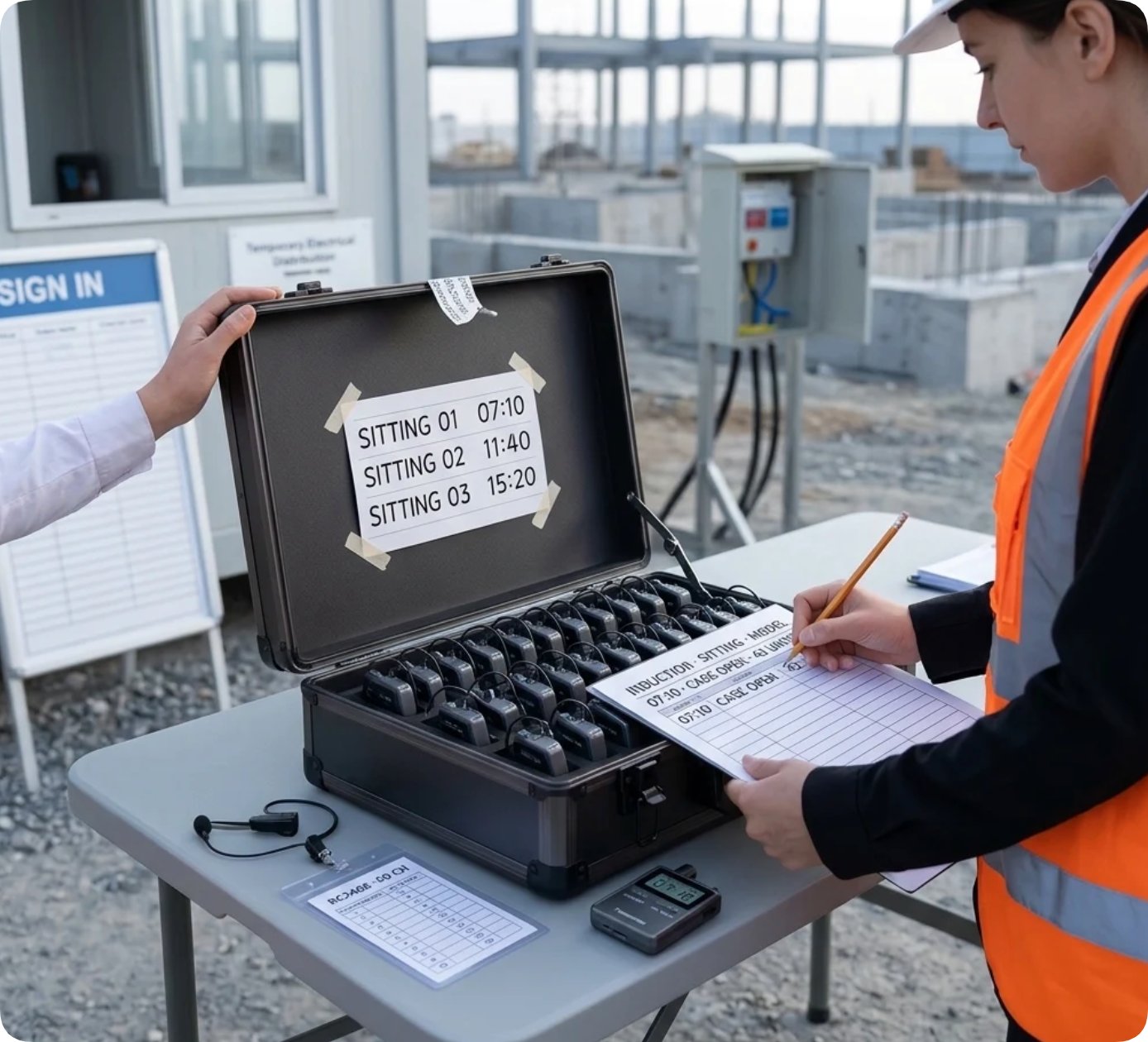
RC2468-construction_site

Work the arithmetic in the order the day actually ran. The case opened at 07:10. The first sitting finished its walk at 07:40 and returned its units by 08:05. The second sitting ran from 11:40 to 12:15. The third was called at 15:20. If the nine RC2468 receivers stayed out from the first hand-out, they had been powered for eight hours and ten minutes when the third group picked them up. The eight-hour approximate window had closed ten minutes earlier. A silent ear-hook at that moment is an expected end point, not a repair. Charge those nine units at midday, or issue a fresh set for the third sitting, and the report disappears without a single component being replaced.

ModelPublished receiver windowPublished bandChannelsCharging portWhat a late-afternoon report usually means
RC24688h approx. on 300 mAh2403-2483 MHz50USBThe window closed; plan a midday charge
RC915035+h on 1800 mAh2403-2483 MHz100Type-CKeep looking; this window is still open
RC08520h on 1000 mAh470-510 MHz100USBKeep looking; this window is still open

The table is deliberately narrow. Weight, colour, warranty and audio response are all published for these models, but none of them decides whether an afternoon silence is a fault. One column does the work: the receiver window. A report that falls inside it should be answered by the schedule; a report that falls outside it should be answered by the bench. Mixing the two is what fills a site office tray with healthy hardware.

A Steel Floor and a Different Band

The RC9150 2.4G High Fidelity Audio Guide takes the opposite side of that arithmetic. Its receiver window is published at thirty-five hours or more on an 1800 mAh cell, matched by a fifteen-hour transmitter window, one hundred channels on 2403-2483 MHz and a Type-C port. A receiver from this model that goes quiet at 15:20 on the same day it was issued cannot be explained by its battery figure. Something else happened: a channel shared with the sitting before it, an access point fixed to the distribution board, or a transmitter left in the wrong mode at the start of the walk. Treating that report as a low battery would send a healthy unit back to the office and leave the real cause in place for the next sitting.

RC9150-construction_site

The RC085 Portable Tour Guide System Wholesale page adds a third shape to the same case. It works on 470-510 MHz rather than 2.4 GHz, publishes one hundred channels, and lists a twenty-hour receiver window against a twelve-hour transmitter window on a USB port. Its product page makes a qualitative point about steel structures and dense radio environments: the lower band is chosen for penetration where machinery and framing are in the way. That is a useful sentence for a site with a steel floor, but it is not a licence to ignore the channel plan. One hundred channels is a pool to allocate, not a guarantee that two sittings will never occupy the same one.
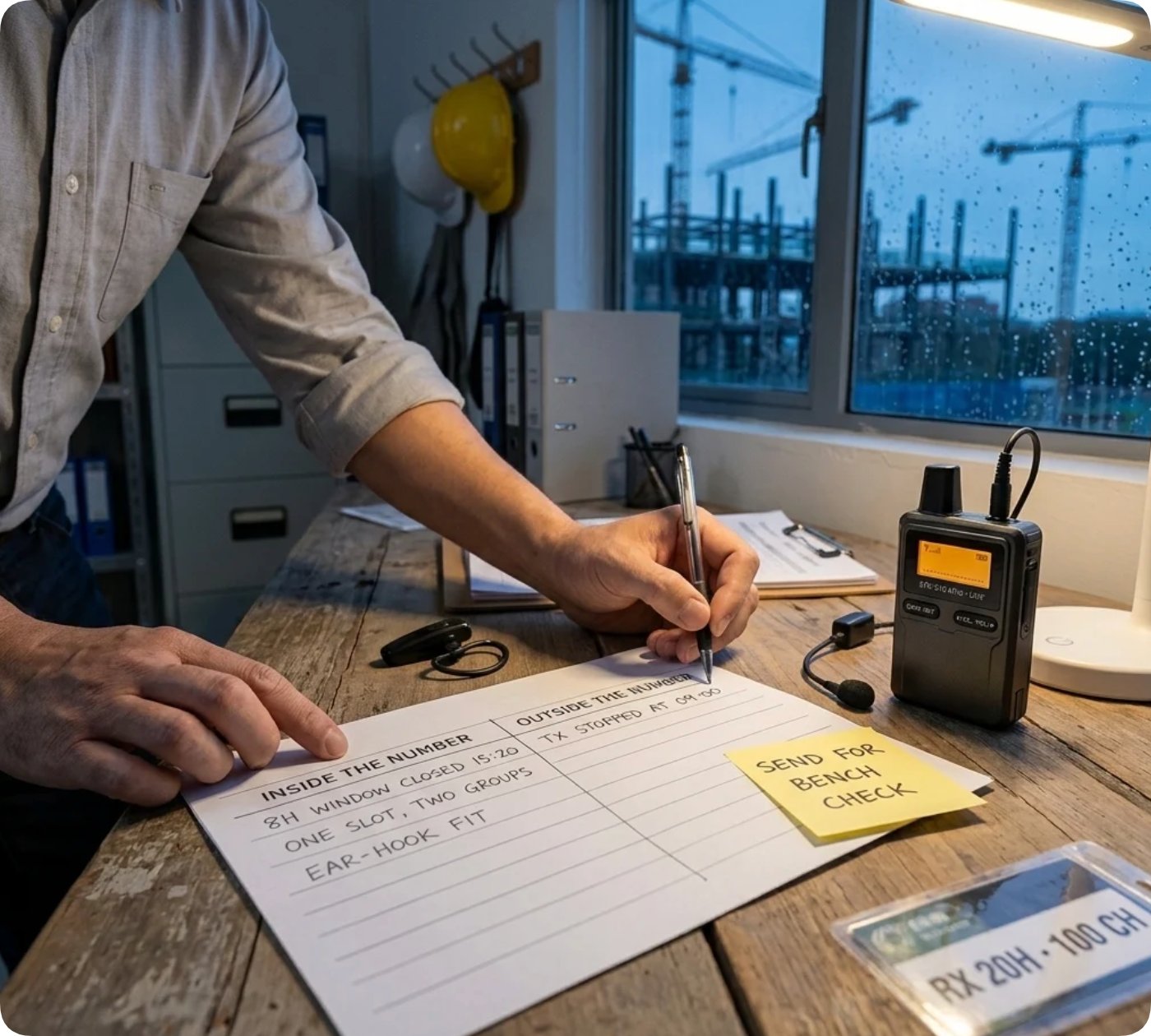
RC085-construction_site

Put the three models side by side on the same walking route and the published figures stop being a specification exercise. Two of them will still be inside their receiver window at 15:20; one will not. Two of them share a 2.4 GHz band that has to compete with a temporary access point; one sits elsewhere. Two of them can be charged through a USB lead from the site office drawer; one takes Type-C. Every one of those differences changes what a "no sound" report means, and none of them is visible on a job sheet that records only a sitting number and a name.

Silence From One Side of the Group

Some afternoon reports are neither a closed window nor a crowded band. A listener says the sound stopped on one side, or that it came back after the group turned a corner, or that it never arrived even though the person beside them heard every word. On a site with hard hats and ear protection, an eighteen-gram ear-hook can simply be sitting away from the ear. An RC085 page lists an auto sleep and wake-up behaviour and F1 and F2 communication modes; a unit that has gone to sleep, or one that was set to the wrong mode before the walk, produces a quiet receiver that will test perfectly on a bench an hour later.

The useful distinction here is reproducibility. If the effect follows one listener, it travels with the receiver or with how it is worn. If it follows one place on the route, it belongs to the path and the structure around it. If it follows one sitting, it belongs to the channel allocation or to the state the case was in when that sitting was issued. None of those three requires a spare unit to be opened immediately. Each can be checked by moving one listener, repeating one corner, or reading one line of the channel card before the next group arrives.

This is also where the word "fault" does the most damage. A quiet unit that is still working is not a broken unit; it is a working unit being asked about in the wrong terms. Site teams that write down the boundary instead of the verdict end up with fewer returns, because they stop sending back hardware whose only problem was the moment somebody chose to listen to it.

Printed Figures Are Not Site Readings

A published figure is a boundary, not a measurement of what happened at 15:20. The distinction matters because the same site will produce both kinds of number, and a job sheet that mixes them cannot be audited later. The table below keeps them apart: the middle two columns hold values that were printed before the day began; the outer columns hold what a crew member can actually observe at the time. Nothing in it asks anyone to guess a battery percentage or invent a signal strength reading.

What the crew writesFigure to read firstAlready explained by the figureStill unexplained; treat as a fault
No sound after 15:208h approx. receiver windowCase issued at 07:10; window closed before the third sittingThe same unit silent at 09:00 on its first sitting
Another group on our channel50 or 100 published channelsTwo sittings allocated one slot on the laminated cardCrossed audio that stays after a channel change
Quiet on one ear18g ear-hook receiver formFit under a hard hat or an auto sleep intervalSilent on both ears from the first minute
Transmitter stopped at midday15h, 12h or 10h transmitter windowNothing; every transmitter figure is still openSend the unit back and note the sitting

Read the third column and nine afternoon reports from this site become a scheduling note. Read the fourth column and one or two reports become repair jobs with a clear history attached. That is the whole point of writing the boundary down: it lets the site office sort a tray of returned hardware in a minute instead of guessing from a pile of identical complaints. The Wireless Tour Guide System Manufacturer Direct range has models with very different windows, and the sorting rule has to follow the model actually issued, not the one somebody remembers from the last project.

Beyond What the Number Can Explain

Not every site looks like a gatehouse with three sittings. On a shipyard repair deck, the working day is split by tide and by the availability of a confined space permit, so a case may be issued at 06:00 and not reopened until 16:00; a receiver with an eight-hour approximate window is the wrong tool for that shift regardless of how well it is charged. In a substation compound, the walk is short but the metalwork is dense, and the useful figure is the published band and channel pool rather than the battery window. In an exhibition hall during build-up, fifteen crews may be on the same floor at once, so the channel card matters more than any single unit's endurance. On a heritage city route, the case is opened once and closed once, and the receiver window barely enters the conversation.

What carries across all four is the order of the questions. First, which published figure is the report touching; second, is the observed effect inside it; third, what can the crew change before the next sitting. A shipyard answers with a charging rotation. A substation answers with a band decision made before the visit. An exhibition build-up answers with a channel allocation written on the card. A city route answers with a single spare in the case. None of them starts by declaring a unit broken, and none of them needs a workshop to reach a decision.

There is a hard edge to this. A transmitter with a published fifteen-hour window that stops after two hours is a fault. A receiver with a published thirty-five-hour window that is flat the next morning is a fault. Audio that stays crossed after the channel has been changed is a fault. These are the reports that belong outside the number, and they should be pulled from the case, labelled with the sitting and sent for a bench check with the channel card still attached. Being disciplined about the boundary makes these few reports easier to see, not harder. Broader Wireless Audio Guide Application Solutions can then be planned around a real failure rate instead of an afternoon's worth of expected endings.

The Line Nobody Fills In Until Noon

The job sheet at this gatehouse had a column for names, a column for sitting number and a column for the time a unit was returned. It had no column for the time the case was opened, and none for the receiver window of the model issued. Add those two lines and the nine afternoon reports would have been predictable at 07:10. The clerk would have seen that fourteen RC2468 units were being committed to a third sitting eight hours and ten minutes after hand-out, and would have swapped in a set from the RC9150 tray before the group left the gate. No repair, no tray of healthy hardware, no second visit from the supplier.

The same two lines also settle an argument that otherwise runs on impression. When a foreman says the equipment is unreliable and the supplier says it was used past its published window, the form decides it. That record lists the model, the hand-out minute and the window that applied, all before anyone has a reason to be defensive about a complaint. The RC9150, RC085 and the 2.8-Inch Guide article made a similar point about descriptions: the person reporting an effect is rarely the person who can name the device that produced it. Here the missing witness is not a person but a figure, and it belongs on the sheet from the start.

None of this requires new hardware. It requires reading the number before calling the repair, and writing two extra lines on a form that already exists. The nine receivers from that Tuesday were tested at the site office and all nine worked. What had failed was the sheet, and no spare unit in the case would have fixed it.
Frequently Asked Questions

1. Can an eight-hour receiver cover three sittings in one day?

Not on the timetable described here. The case opened at 07:10, the second sitting started at 11:40 and the third was called at 15:20, which is eight hours and ten minutes after hand-out. Two sittings fit inside an eight-hour approximate window with room to spare; the third does not. Charge that set at midday or issue a model with a twenty-hour or thirty-five-hour receiver window for the late group.

2. Do one hundred channels mean two sittings cannot hear each other?

Only if somebody allocates the channels. Both the RC9150 and the RC085 publish one hundred channels, while the RC2468 publishes fifty, but a laminated card with three slots still has to be filled in before the case leaves the gatehouse. Two groups placed on one slot will hear each other, and moving one group to a free slot fixes it without opening a unit. Crossed audio that survives a channel change is a different report and belongs on the bench.

3. Why does this article quote a different receiver figure from the one on a product page?

Product pages and the specification sheet used across a fleet are not always updated on the same day, and a site team that mixes the two will compare one model against two different numbers. Pick one published source, use it for all three models in the same table, and do not fill a gap by borrowing a figure from the neighbouring model. Where a field is published in two incompatible ways, leave it out of the comparison rather than choosing the convenient one.

4. Which reports should still be treated as a genuine fault?

Three stand out on this site. A transmitter with a published fifteen-hour window that stops after two hours; a receiver with a published thirty-five-hour window that is flat the following morning; and crossed audio that remains after the channel has been changed. Each falls outside what the published figure can explain. Pull the unit, label it with the sitting and the channel, and keep the case card with it when it goes for a bench check.


2026-11-09 13:37
ꄘ click: 21

Get the spec sheet, MOQ and a factory-direct quote

Tell us the venue, the group size and how many languages you need. An engineer at our Shenzhen factory replies within one business day with the matching model, a written quote, lead time and the CE / RoHS / ISO 9001 documents.

Talk to an engineer WhatsApp +86 189 2287 9583

Prefer email? tiger.wang@richitek.com  |  OEM / ODM, custom tooling and neutral packaging available  |  send the enquiry through our contact page

Shenzhen Rich Age Electronics Co., Ltd. (Richitek) - manufacturing wireless tour guide systems, church translation headsets and museum audio guide equipment since 2007.

no data

RC2468 and RC085: Reading the Number Before the Repair

time: 2026年11月09日 click:21

At 07:10 on a Tuesday, the gatehouse of a construction site handed out forty-two receivers to a subcontractor's induction group. The names were split across three sittings of fourteen, with six minutes allowed for the walk from the gate to the steel floor, and the third sitting was booked for 15:20. By mid-afternoon the job sheet carried nine entries under a single line: no sound after lunch. Every one of them was written up as a faulty receiver, and every one of them was sent back to the site office in the same plastic tray. Nobody had opened the case to look at a label, and nobody had asked which model those nine people had been carrying.

Nine of those sets were RC2468 units. The published receiver window for that model is eight hours approximately, on a 300 mAh cell. From 07:10 to 15:20 is eight hours and ten minutes. The figure had already answered the complaint before anyone reached for a spare. This is the part of Industrial Plant Tour Noise Cancelling Headsets planning that almost never gets written into a site induction: on a working site, the difference between a broken unit and an expected end point is a number that was printed months before the first group arrived. Read that number first, and most afternoon reports stop being repair jobs.

Seven Ten, and a Sealed Case

The metal case sat on a folding table beside the sign-in board, still sealed from the night before. A laminated card inside the lid listed three channel slots, and a pencil line underneath recorded the time the case was opened. The gatehouse clerk wrote the sitting number against each name, not the model, because the model was not part of the form. That single omission is why the afternoon reports all looked identical: nine people, nine silent receivers, one assumed cause. Nothing in the tray distinguished a unit that had reached the end of its published window from a unit that had stopped working at nine in the morning.

The site itself added two more variables that never reached the form. A concrete pump was parked roughly sixty metres from the steel floor, and a temporary wireless access point had been fixed to the site distribution board near the walking route. Both were in place before the first sitting. A report that says only "no sound" cannot separate a receiver that ran out of charge from a transmitter that was competing with a nearby access point, or from a group that had been given a channel already in use by the sitting ahead of it. The sheet recorded an effect; it did not record a boundary.

So the first question on a plant tour is not which part failed. It is whether the reported effect sits inside a figure that was already published for that model. If it does, the correct action is a timetable change, a channel reassignment or a charging rotation, none of which requires the unit to leave the site. If it does not, the report becomes a genuine fault and deserves a bench check. Keeping those two categories apart saves a site team from doing repair work on hardware that behaved exactly as its specification said it would.

Where the Eight Hours End on a Tuesday

The RC2468 is the lightest receiver in the group: eighteen grams, an ear-hook form, a 300 mAh cell and an eight-hour approximate receiver window against a ten-hour transmitter window. It carries fifty channels on the 2.4 GHz band and charges over USB. Those figures are not estimates made up at the gate; they are the published values for this model, and they are the same values a site planner would use to decide how many sittings one case can serve. The RC2468 Lightweight Tour Guide Headsets Bulk page describes a sensible choice for a short walking route where every listener carries the unit for a single sitting and hands it back before noon. It is a poor choice for a case that is sealed at seven in the morning and reopened after three sittings.

RC2468-construction_site

Work the arithmetic in the order the day actually ran. The case opened at 07:10. The first sitting finished its walk at 07:40 and returned its units by 08:05. The second sitting ran from 11:40 to 12:15. The third was called at 15:20. If the nine RC2468 receivers stayed out from the first hand-out, they had been powered for eight hours and ten minutes when the third group picked them up. The eight-hour approximate window had closed ten minutes earlier. A silent ear-hook at that moment is an expected end point, not a repair. Charge those nine units at midday, or issue a fresh set for the third sitting, and the report disappears without a single component being replaced.

ModelPublished receiver windowPublished bandChannelsCharging portWhat a late-afternoon report usually means
RC24688h approx. on 300 mAh2403-2483 MHz50USBThe window closed; plan a midday charge
RC915035+h on 1800 mAh2403-2483 MHz100Type-CKeep looking; this window is still open
RC08520h on 1000 mAh470-510 MHz100USBKeep looking; this window is still open

The table is deliberately narrow. Weight, colour, warranty and audio response are all published for these models, but none of them decides whether an afternoon silence is a fault. One column does the work: the receiver window. A report that falls inside it should be answered by the schedule; a report that falls outside it should be answered by the bench. Mixing the two is what fills a site office tray with healthy hardware.

A Steel Floor and a Different Band

The RC9150 2.4G High Fidelity Audio Guide takes the opposite side of that arithmetic. Its receiver window is published at thirty-five hours or more on an 1800 mAh cell, matched by a fifteen-hour transmitter window, one hundred channels on 2403-2483 MHz and a Type-C port. A receiver from this model that goes quiet at 15:20 on the same day it was issued cannot be explained by its battery figure. Something else happened: a channel shared with the sitting before it, an access point fixed to the distribution board, or a transmitter left in the wrong mode at the start of the walk. Treating that report as a low battery would send a healthy unit back to the office and leave the real cause in place for the next sitting.

RC9150-construction_site

The RC085 Portable Tour Guide System Wholesale page adds a third shape to the same case. It works on 470-510 MHz rather than 2.4 GHz, publishes one hundred channels, and lists a twenty-hour receiver window against a twelve-hour transmitter window on a USB port. Its product page makes a qualitative point about steel structures and dense radio environments: the lower band is chosen for penetration where machinery and framing are in the way. That is a useful sentence for a site with a steel floor, but it is not a licence to ignore the channel plan. One hundred channels is a pool to allocate, not a guarantee that two sittings will never occupy the same one.

RC085-construction_site

Put the three models side by side on the same walking route and the published figures stop being a specification exercise. Two of them will still be inside their receiver window at 15:20; one will not. Two of them share a 2.4 GHz band that has to compete with a temporary access point; one sits elsewhere. Two of them can be charged through a USB lead from the site office drawer; one takes Type-C. Every one of those differences changes what a "no sound" report means, and none of them is visible on a job sheet that records only a sitting number and a name.

Silence From One Side of the Group

Some afternoon reports are neither a closed window nor a crowded band. A listener says the sound stopped on one side, or that it came back after the group turned a corner, or that it never arrived even though the person beside them heard every word. On a site with hard hats and ear protection, an eighteen-gram ear-hook can simply be sitting away from the ear. An RC085 page lists an auto sleep and wake-up behaviour and F1 and F2 communication modes; a unit that has gone to sleep, or one that was set to the wrong mode before the walk, produces a quiet receiver that will test perfectly on a bench an hour later.

The useful distinction here is reproducibility. If the effect follows one listener, it travels with the receiver or with how it is worn. If it follows one place on the route, it belongs to the path and the structure around it. If it follows one sitting, it belongs to the channel allocation or to the state the case was in when that sitting was issued. None of those three requires a spare unit to be opened immediately. Each can be checked by moving one listener, repeating one corner, or reading one line of the channel card before the next group arrives.

This is also where the word "fault" does the most damage. A quiet unit that is still working is not a broken unit; it is a working unit being asked about in the wrong terms. Site teams that write down the boundary instead of the verdict end up with fewer returns, because they stop sending back hardware whose only problem was the moment somebody chose to listen to it.

Printed Figures Are Not Site Readings

A published figure is a boundary, not a measurement of what happened at 15:20. The distinction matters because the same site will produce both kinds of number, and a job sheet that mixes them cannot be audited later. The table below keeps them apart: the middle two columns hold values that were printed before the day began; the outer columns hold what a crew member can actually observe at the time. Nothing in it asks anyone to guess a battery percentage or invent a signal strength reading.

What the crew writesFigure to read firstAlready explained by the figureStill unexplained; treat as a fault
No sound after 15:208h approx. receiver windowCase issued at 07:10; window closed before the third sittingThe same unit silent at 09:00 on its first sitting
Another group on our channel50 or 100 published channelsTwo sittings allocated one slot on the laminated cardCrossed audio that stays after a channel change
Quiet on one ear18g ear-hook receiver formFit under a hard hat or an auto sleep intervalSilent on both ears from the first minute
Transmitter stopped at midday15h, 12h or 10h transmitter windowNothing; every transmitter figure is still openSend the unit back and note the sitting

Read the third column and nine afternoon reports from this site become a scheduling note. Read the fourth column and one or two reports become repair jobs with a clear history attached. That is the whole point of writing the boundary down: it lets the site office sort a tray of returned hardware in a minute instead of guessing from a pile of identical complaints. The Wireless Tour Guide System Manufacturer Direct range has models with very different windows, and the sorting rule has to follow the model actually issued, not the one somebody remembers from the last project.

Beyond What the Number Can Explain

Not every site looks like a gatehouse with three sittings. On a shipyard repair deck, the working day is split by tide and by the availability of a confined space permit, so a case may be issued at 06:00 and not reopened until 16:00; a receiver with an eight-hour approximate window is the wrong tool for that shift regardless of how well it is charged. In a substation compound, the walk is short but the metalwork is dense, and the useful figure is the published band and channel pool rather than the battery window. In an exhibition hall during build-up, fifteen crews may be on the same floor at once, so the channel card matters more than any single unit's endurance. On a heritage city route, the case is opened once and closed once, and the receiver window barely enters the conversation.

What carries across all four is the order of the questions. First, which published figure is the report touching; second, is the observed effect inside it; third, what can the crew change before the next sitting. A shipyard answers with a charging rotation. A substation answers with a band decision made before the visit. An exhibition build-up answers with a channel allocation written on the card. A city route answers with a single spare in the case. None of them starts by declaring a unit broken, and none of them needs a workshop to reach a decision.

There is a hard edge to this. A transmitter with a published fifteen-hour window that stops after two hours is a fault. A receiver with a published thirty-five-hour window that is flat the next morning is a fault. Audio that stays crossed after the channel has been changed is a fault. These are the reports that belong outside the number, and they should be pulled from the case, labelled with the sitting and sent for a bench check with the channel card still attached. Being disciplined about the boundary makes these few reports easier to see, not harder. Broader Wireless Audio Guide Application Solutions can then be planned around a real failure rate instead of an afternoon's worth of expected endings.

The Line Nobody Fills In Until Noon

The job sheet at this gatehouse had a column for names, a column for sitting number and a column for the time a unit was returned. It had no column for the time the case was opened, and none for the receiver window of the model issued. Add those two lines and the nine afternoon reports would have been predictable at 07:10. The clerk would have seen that fourteen RC2468 units were being committed to a third sitting eight hours and ten minutes after hand-out, and would have swapped in a set from the RC9150 tray before the group left the gate. No repair, no tray of healthy hardware, no second visit from the supplier.

The same two lines also settle an argument that otherwise runs on impression. When a foreman says the equipment is unreliable and the supplier says it was used past its published window, the form decides it. That record lists the model, the hand-out minute and the window that applied, all before anyone has a reason to be defensive about a complaint. The RC9150, RC085 and the 2.8-Inch Guide article made a similar point about descriptions: the person reporting an effect is rarely the person who can name the device that produced it. Here the missing witness is not a person but a figure, and it belongs on the sheet from the start.

None of this requires new hardware. It requires reading the number before calling the repair, and writing two extra lines on a form that already exists. The nine receivers from that Tuesday were tested at the site office and all nine worked. What had failed was the sheet, and no spare unit in the case would have fixed it.
Frequently Asked Questions

1. Can an eight-hour receiver cover three sittings in one day?

Not on the timetable described here. The case opened at 07:10, the second sitting started at 11:40 and the third was called at 15:20, which is eight hours and ten minutes after hand-out. Two sittings fit inside an eight-hour approximate window with room to spare; the third does not. Charge that set at midday or issue a model with a twenty-hour or thirty-five-hour receiver window for the late group.

2. Do one hundred channels mean two sittings cannot hear each other?

Only if somebody allocates the channels. Both the RC9150 and the RC085 publish one hundred channels, while the RC2468 publishes fifty, but a laminated card with three slots still has to be filled in before the case leaves the gatehouse. Two groups placed on one slot will hear each other, and moving one group to a free slot fixes it without opening a unit. Crossed audio that survives a channel change is a different report and belongs on the bench.

3. Why does this article quote a different receiver figure from the one on a product page?

Product pages and the specification sheet used across a fleet are not always updated on the same day, and a site team that mixes the two will compare one model against two different numbers. Pick one published source, use it for all three models in the same table, and do not fill a gap by borrowing a figure from the neighbouring model. Where a field is published in two incompatible ways, leave it out of the comparison rather than choosing the convenient one.

4. Which reports should still be treated as a genuine fault?

Three stand out on this site. A transmitter with a published fifteen-hour window that stops after two hours; a receiver with a published thirty-five-hour window that is flat the following morning; and crossed audio that remains after the channel has been changed. Each falls outside what the published figure can explain. Pull the unit, label it with the sitting and the channel, and keep the case card with it when it goes for a bench check.


Get the spec sheet, MOQ and a factory-direct quote

Tell us the venue, the group size and how many languages you need. An engineer at our Shenzhen factory replies within one business day with the matching model, a written quote, lead time and the CE / RoHS / ISO 9001 documents.

Talk to an engineer WhatsApp +86 189 2287 9583

Prefer email? tiger.wang@richitek.com  |  OEM / ODM, custom tooling and neutral packaging available  |  send the enquiry through our contact page

Shenzhen Rich Age Electronics Co., Ltd. (Richitek) - manufacturing wireless tour guide systems, church translation headsets and museum audio guide equipment since 2007.

no data
×

Contact us

email:
name:
subject:
content: