

A historic house museum typically initiates a wireless tour guide system procurement with a fixed room layout. Floor plans clearly define the grand hall, main staircase, study, and tight historic quarters where visitor capacity is strictly limited. However, architectural drawings do not show the exact commentary a docent will deliver in each room—or who holds sign-off authority for those words. While hardware selection can be finalized in an afternoon, script approval and editorial compliance often stall seasonal visitor programming for weeks. Managing this editorial workflow determines whether tour hardware is authorized for operational deployment.
When configuring a system for a venue operating four daily time slots (22 visitors per session) with temporary exhibitions rotating every 11 weeks, equipment requirements—such as three transmitters and 60 receivers—are straightforward. However, compliance standards demand more than hardware specs: institutions answering to conservation trusts, artifact lenders, or academic advisory boards require a traceable record of spoken commentary delivered in every room. Our Museum Self Guided Audio Tour Solutions page details acoustic spatial planning. For hardware restrictions in heritage spaces, refer to Three Vetoes a Historic House Puts on Tour Audio. This guide focuses on editorial governance and content authorization protocols.
Why Heritage Sites Prioritize script Compliance Over Hardware Specs
Spoken tour commentary is subject to strict multi-stakeholder review. Curators flag historical date inaccuracies; room owners or trust boards object to sensitive personal histories being discussed in public galleries; loaning institutions insist that wall captions match spoken commentary identically. These stakeholders rarely audit radio channel spacing—they demand to inspect the signed, dated master script and confirm that docents are reading from the authorized version. Compliance relies on presenting verified documentation for any past tour session.
This regulatory reality dictates equipment deployment. Technical datasheets certify radio frequencies, not historical narrative accuracy. When temporary exhibitions change every 11 weeks, version control procedures must handle complete text rewrites without relying on docent memory or informal briefs. Establishing clear versioning protocols prevents operational delays caused by pending editorial sign-offs.
Managing script Revisions on Live RF Transmission Systems
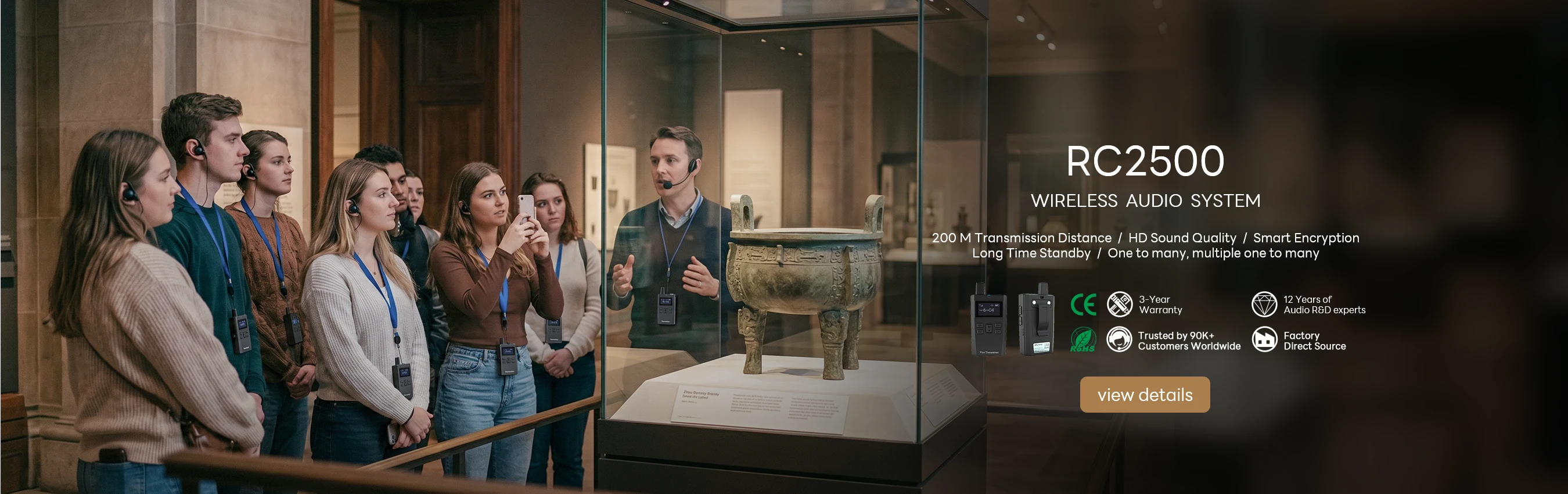
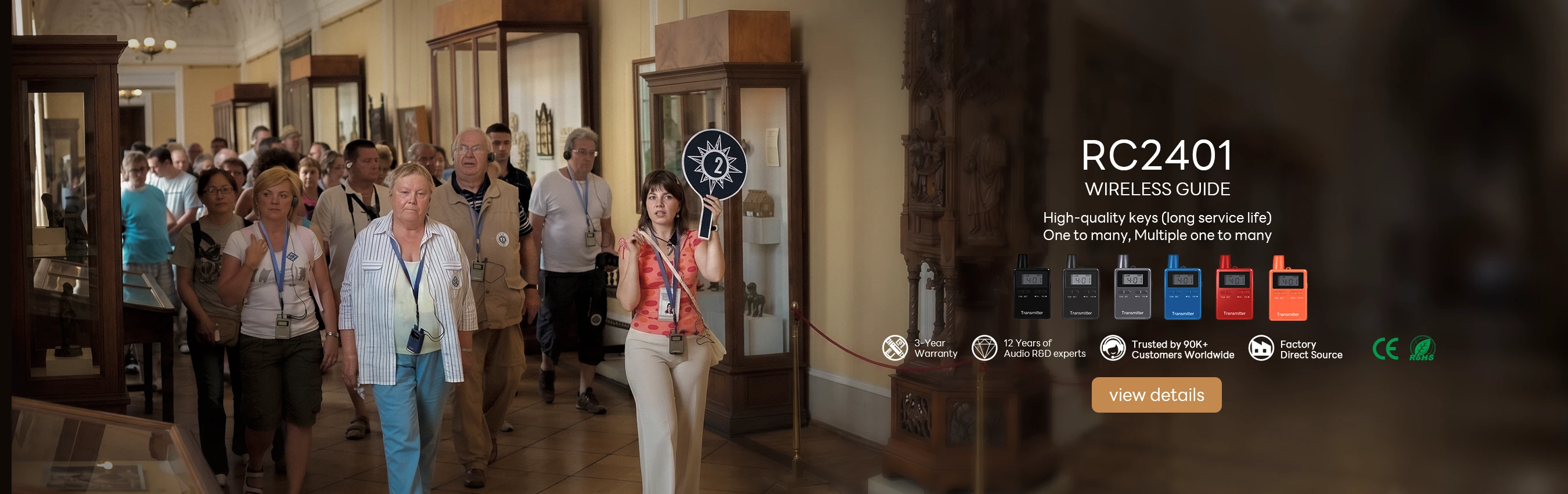
The RICH AGE RC2401 Wireless Audio System Factory operates as a live transmission setup: the guide speaks into a microphone, the group receives crystal-clear audio, and no static audio files are stored locally on the receiver units. Operating on the 2403–2483 MHz ISM band with 50 Phase-Locked Loop (PLL) channels, it provides 10 hours of transmitter battery life and 20 hours of receiver runtime. Lightweight components (59g transmitter, 50g receiver) easily support full-day operations within a single charge cycle.
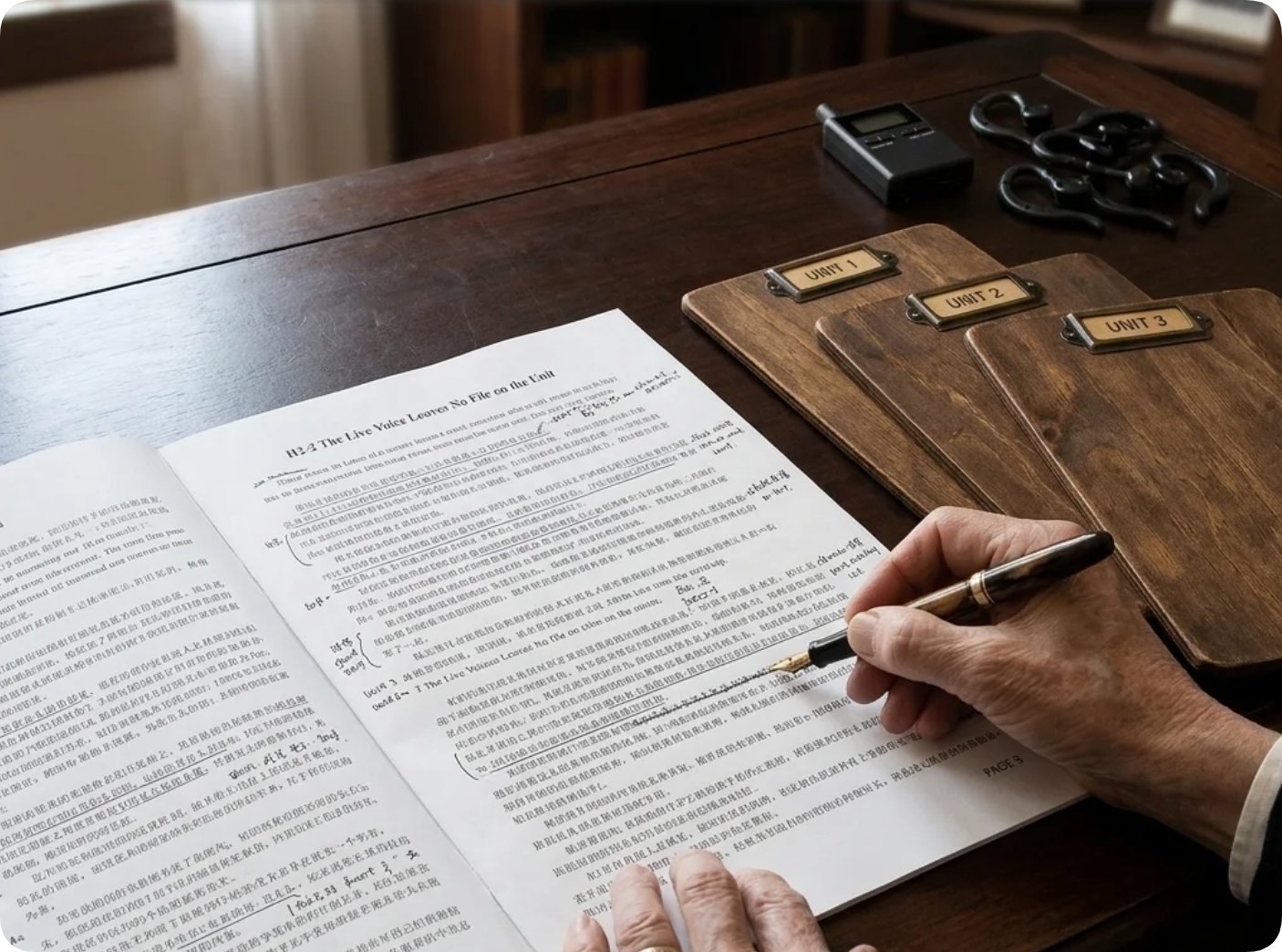
Because commentary relies on live speech guided by written scripts rather than pre-recorded firmware files, mid-day script updates require updating physical reference sheets rather than reflashing hardware. Maintaining a master script log with numbered print copies assigned to docents ensures instant compliance. If a trustee requests a text redaction mid-morning, updating the active docent cue sheets instantly aligns the next tour session without requiring hardware recalls or device re-indexing. Hardware CE and RoHS certifications cover RF compliance, while internal logging protocols maintain narrative compliance.
Multi-Channel Operations and Simultaneous Group Segregation
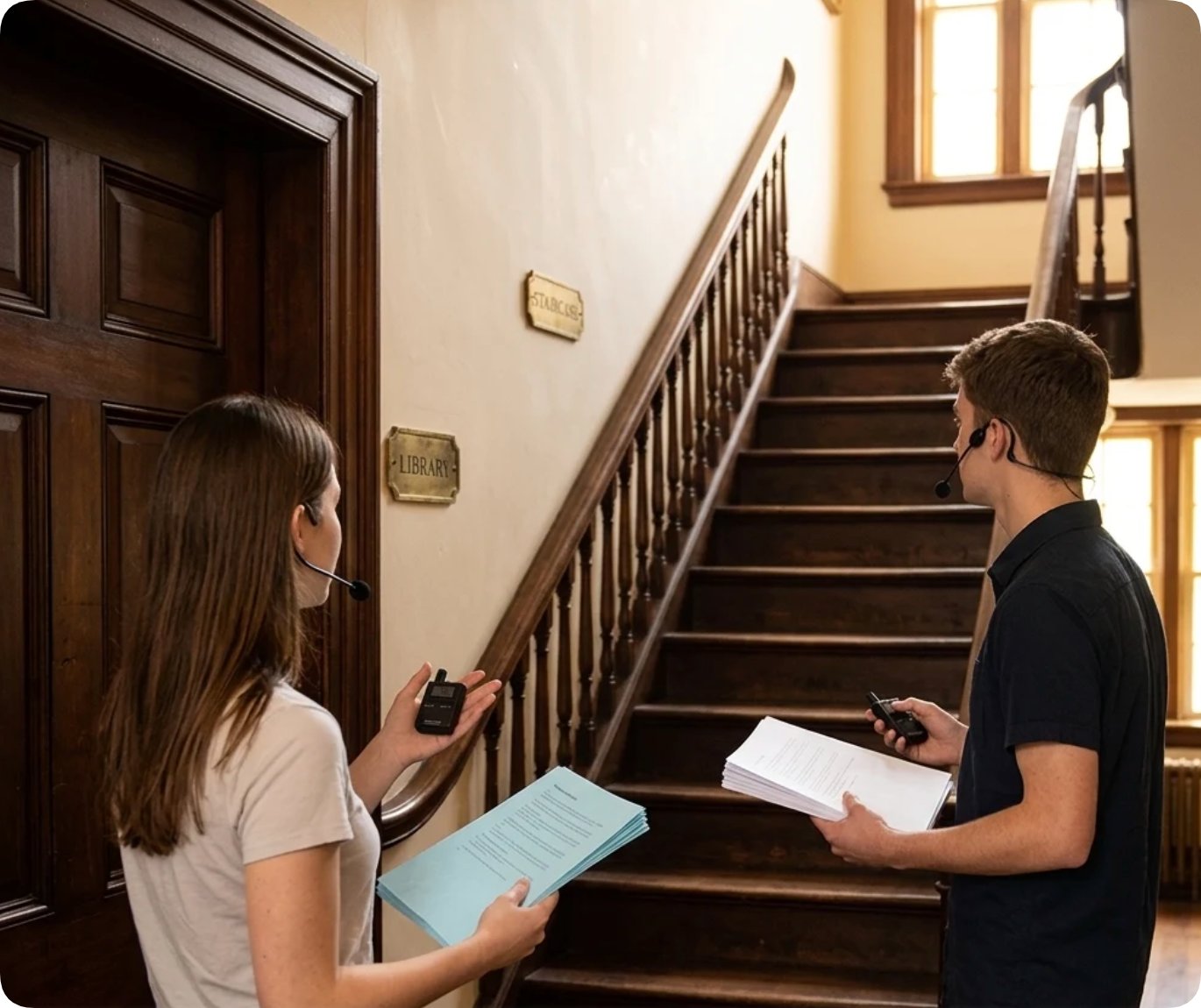
During peak operational windows, multiple tour groups—such as educational field trips and general public visitors—traverse adjacent galleries simultaneously. The RC2406 80 Channel Tour Guide Transmitter Receiver expands capacity to 80 selectable channels, preventing cross-channel interference between simultaneous groups. It shares key performance benchmarks with the RC2401, including 10mW RF power output, 1–200m line-of-sight range, extended battery performance, and standardized DC charging infrastructure.
Running parallel tours requires managing targeted script variations. For instance, student groups may utilize an abbreviated narrative, while adult tours receive an unabridged historical commentary. Utilizing color-coded cue sheets matched to assigned RF channels prevents docents from accidentally reading the wrong script variation. Maintaining clear compliance files for each model's certifications (such as RoHS and CE declarations) satisfies institutional safety and radio frequency audits.
Maintaining Revision Archives for Fixed Tour Routes
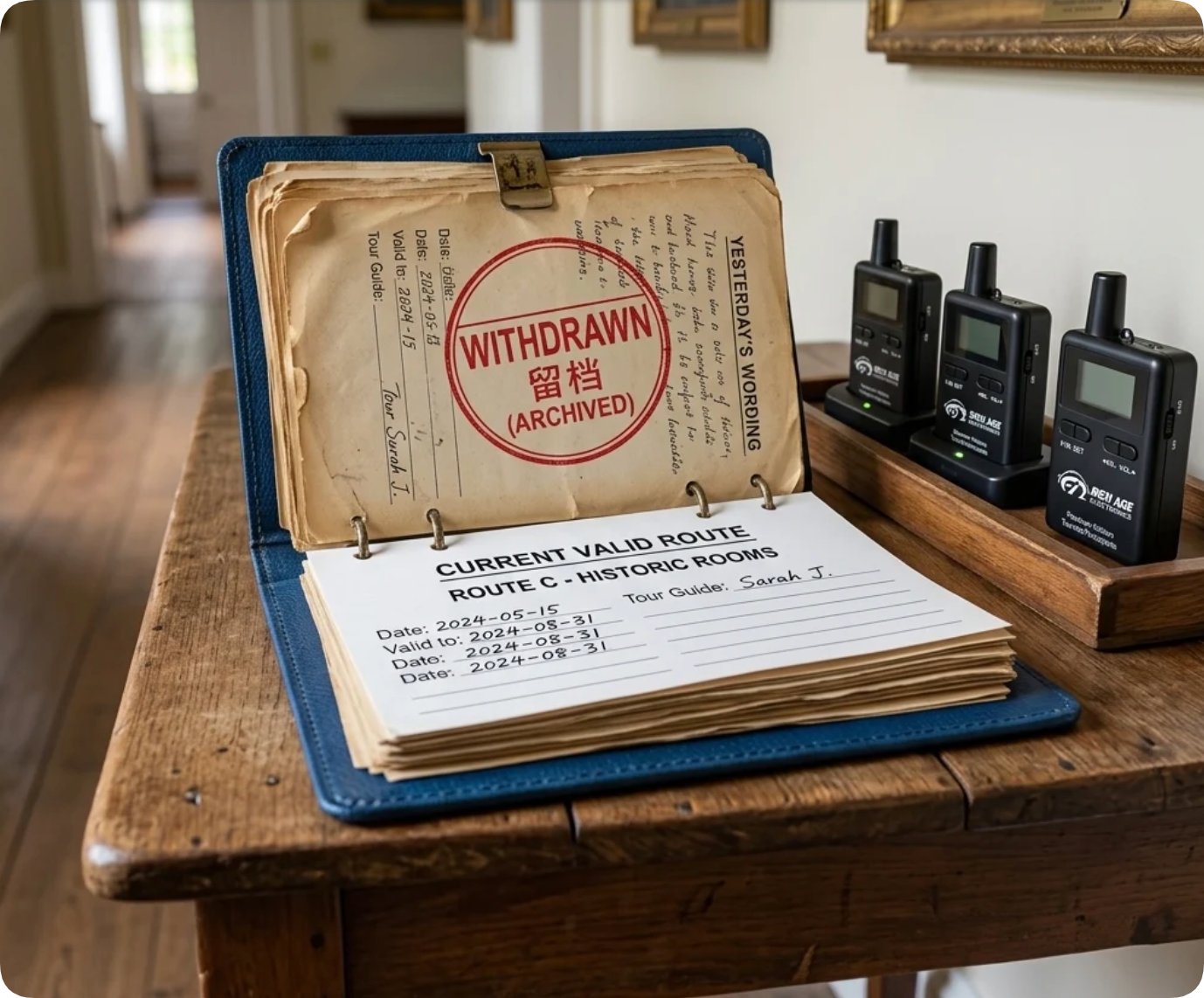
For permanent exhibition galleries and fixed heritage routes, the RC2408 Long Range Wireless Audio Guide delivers high-fidelity, interference-resistant 2.4GHz transmission across 80 channels. Over an operational season, permanent route scripts undergo multiple revisions due to room closures, artifact rotations, or updated research. Archiving dated script revisions prevents docents from relying on outdated commentary memory.
Enforcing daily checkout logs ensures docents carry the latest approved script edition. When revisions occur, legacy print copies are archived in the compliance record with withdrawal timestamps rather than discarded. If a visitor inquiry or audit arises months later, management can verify the exact script text authorized for that specific date and session.
Technical Specification Comparison: RC2401 vs. RC2406 vs. RC2408
Comparing technical specifications across the 2.4GHz series demonstrates uniform core performance, allowing venues to maintain a single technical compliance file across their entire hardware fleet:
| Technical Parameter | Shared Performance Specifications |
|---|---|
| Selectable RF Channels | RC2401: 50 Channels | RC2406 & RC2408: 80 Channels |
| Operating Frequency Band | 2403–2483 MHz (Global License-Free ISM Band) |
| RF Output Power & Operating Range | 10 mW Output Power; 1–200 Meters Coverage Range |
| Battery Operating Runtime | Transmitter: 10 Hours | Receiver: 20 Hours continuous use |
| Battery Cell Capacity | Transmitter: 3.7V 1500 mAh | Receiver: 3.7V 1000 mAh Lithium-ion |
| Physical Weight | Transmitter: 59g | Receiver: 50g |
| Audio Frequency Response | Transmitter: 50 Hz–200 kHz | Receiver: 50 Hz–12 kHz |
| Oscillator Control & Charging Interface | PLL Synthesized Control; Dedicated DC Charging Port |
Because hardware specs remain uniform across model variants, technical approval documentation can be consolidated into a master file. If future operational expansions require UHF systems, explore our full catalog via Wireless Tour Guide System Manufacturer Direct options.
Four-Stage Governance Workflow for Tour Content Approval
To prevent script disputes, museum management should implement a four-stage approval workflow assigning clear responsibilities across departments:
| Workflow Stage | Approval Sign-Off Authority | Compliance Record Deliverables | Hardware Operational Status |
|---|---|---|---|
| 1. script Drafting | Curatorial Team & Lead Researcher | Dated draft text with verified historical source citations | Hardware remains in storage |
| 2. Spatial Clearance | Historic House Manager | Approved room commentary boundary map; sensitive terms removed | RF channel allocations configured |
| 3. Tour Session Dispatch | Visitor Operations Lead | Docent log matching script edition number, session time, and RF channel | Receivers issued to tour group |
| 4. script Archiving | Duty Docent & Museum Curator | Superseded script pages stamped, archived, and logged with reason for edit | Hardware continues normal operation |
Logging script edition numbers alongside docent assignments and assigned RF channels creates a complete operational trail. For details on tailoring deployment to specialized venues, review our Wireless Audio Guide Application Solutions directory.
Updating Tour Content Without System Downtime
Updating tour narratives for rotating exhibitions does not require hardware downtime or firmware re-flashing. Because live tour systems transmit real-time speech, content revisions are managed through documentation controls. Updating physical docent script folders aligns guided tours instantly without disrupting hardware charging schedules or channel setups.
Establishing a rule that docents may not introduce unapproved narrative changes in galleries protects both staff and institutional reputation. When visitors ask unscripted questions, docents address them informally while keeping official cue sheets intact until formal curatorial review. This maintains narrative consistency across all daily tour sittings.