





Key Takeaways for Exam Center Operations
The Challenge: Delivering synchronized, identical exam instructions across multiple rooms without wording drift or timing delays.
RC085 Solution: Best for thick building partitions (470–510 MHz UHF) and back-and-forth chief invigilator communication (F2 mode).
RC2500 Solution: Ideal for all-day testing marathons with industry-leading 35+ hour receiver battery endurance (2.4 GHz).
Compliance & Appeals: Eliminating human speech variation protects exam integrity and provides verifiable audit logs.
Most test centers evaluate a Wireless Education Audio Guide Systems Supplier when seeking to centralize real-time room announcements.
The Operational Problem: Human Drift in Exam Instructions
In standardized testing, absolute compliance is non-negotiable. Every candidate must receive identical instructions down to the exact second. However, when 14 separate invigilators read from paper scripts across two floors, wording drift is almost inevitable. Corridor noise, minor improvisations, and slight variations in reading speed create inconsistencies that leave exam centers vulnerable to candidate appeals.
Adding floor deputies and paper checklists only adds administrative overhead without solving simultaneity. For a historical perspective on transitioning away from localized room speakers, read our analysis on the move away from single hall loudspeakers. The sections below examine how dedicated wireless audio broadcast architectures resolve instruction variance across modern exam facilities.
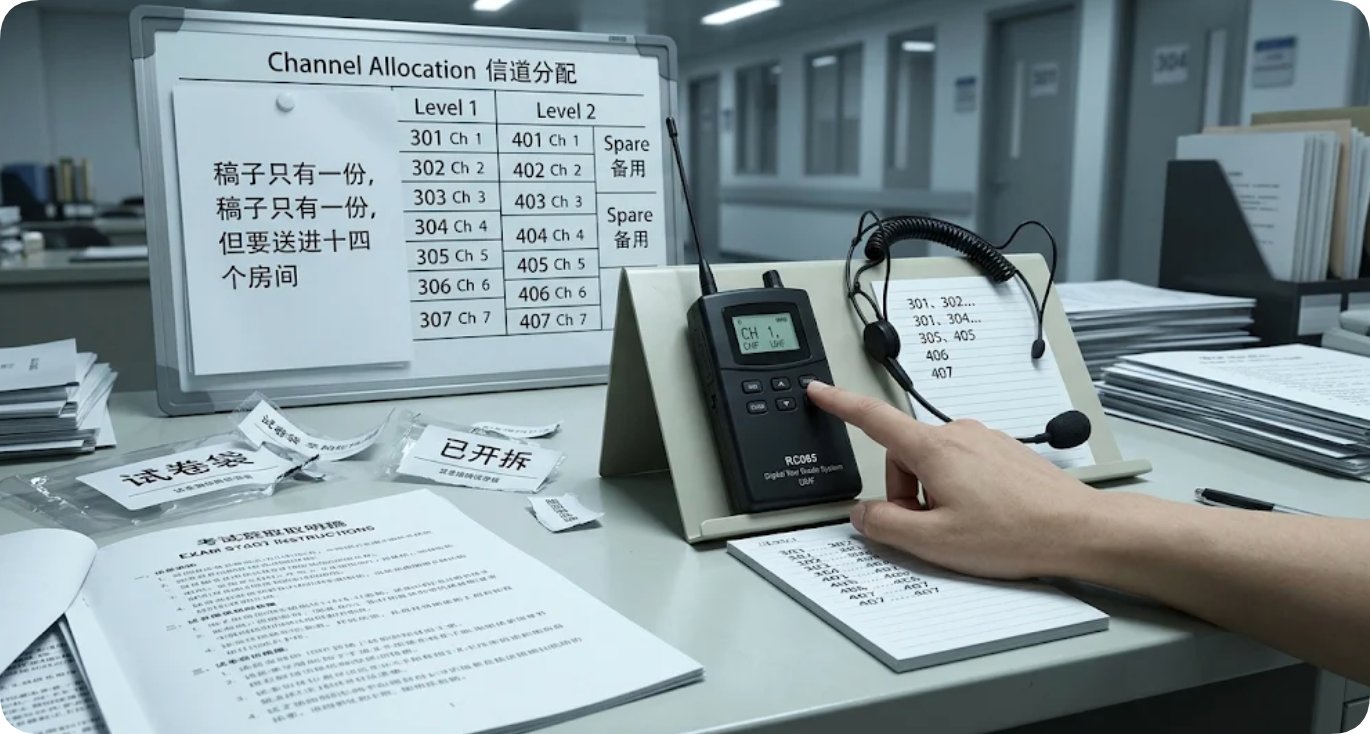
Solution 1: Live Centralized Voice Broadcast via RC085 (UHF)
The primary technical approach replaces decentralized invigilator reading with a single live transmission originating from the main exam control room. By routing one authorized voice to every candidate receiver simultaneously, verbal variance is eliminated instantly.
For venues with concrete walls, heavy doorframes, or high local Wi-Fi interference, a sub-GHz system is recommended. The RC085 Portable Tour Guide System Wholesale operates in the 470–510 MHz UHF band, making it optimal for heavy structural penetration.
RC085 Key Operational Specs
Frequency Band: 470–510 MHz (100 Selectable Channels)
Battery Life: 12 hours (Transmitter) / 20 hours (Receiver)
Weight & Power: Lightweight design (TX 65g / RX 60g) with 8–10mW RF output
Dual-Mode Communication: Supports F1 (one-way broadcast) and F2 (two-way intercom)
The F2 mode allows a secondary invigilator or floor supervisor to query the main exam office directly without disturbing candidates or handing off handheld mics.
Solution 2: Multi-Session Endurance & One-Key Sync via RC2500 (2.4 GHz)
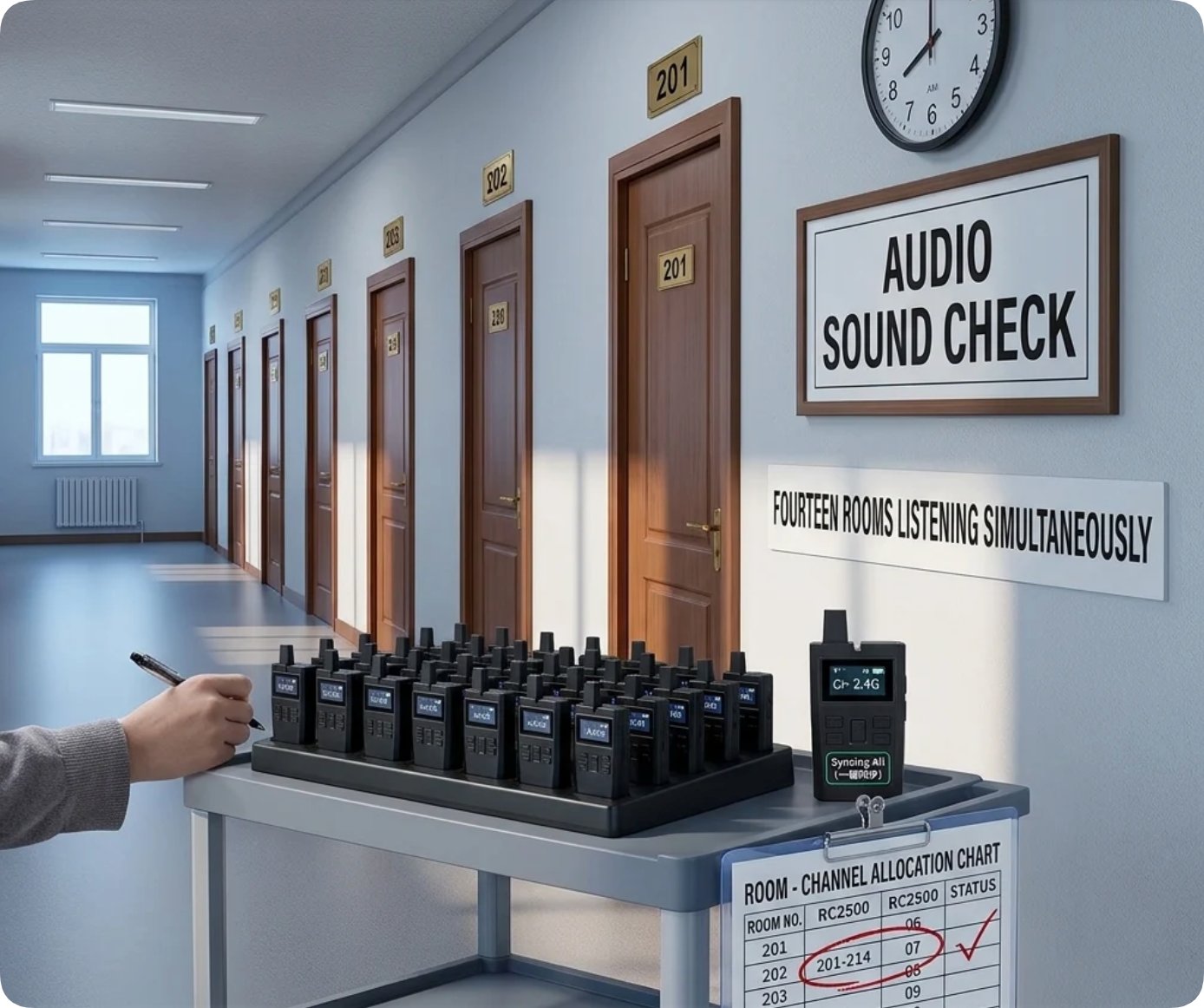
When test schedules run back-to-back across morning, afternoon, and evening sessions, battery longevity becomes the primary operational bottleneck. The RC2500 Digital Tour Guide System Price provides an extended battery architecture designed specifically for high-density testing facilities.
Operating on the global 2.4 GHz band (2403–2483 MHz), the RC2500 delivers over 35 hours of continuous receiver runtime on a single charge. It also features one-key frequency synchronization, allowing chief invigilators to lock all room receivers to the designated channel in seconds—preventing channel mismatch errors across large staff teams.
Solution 3: Mastered Audio Playback for Language Listening Tests
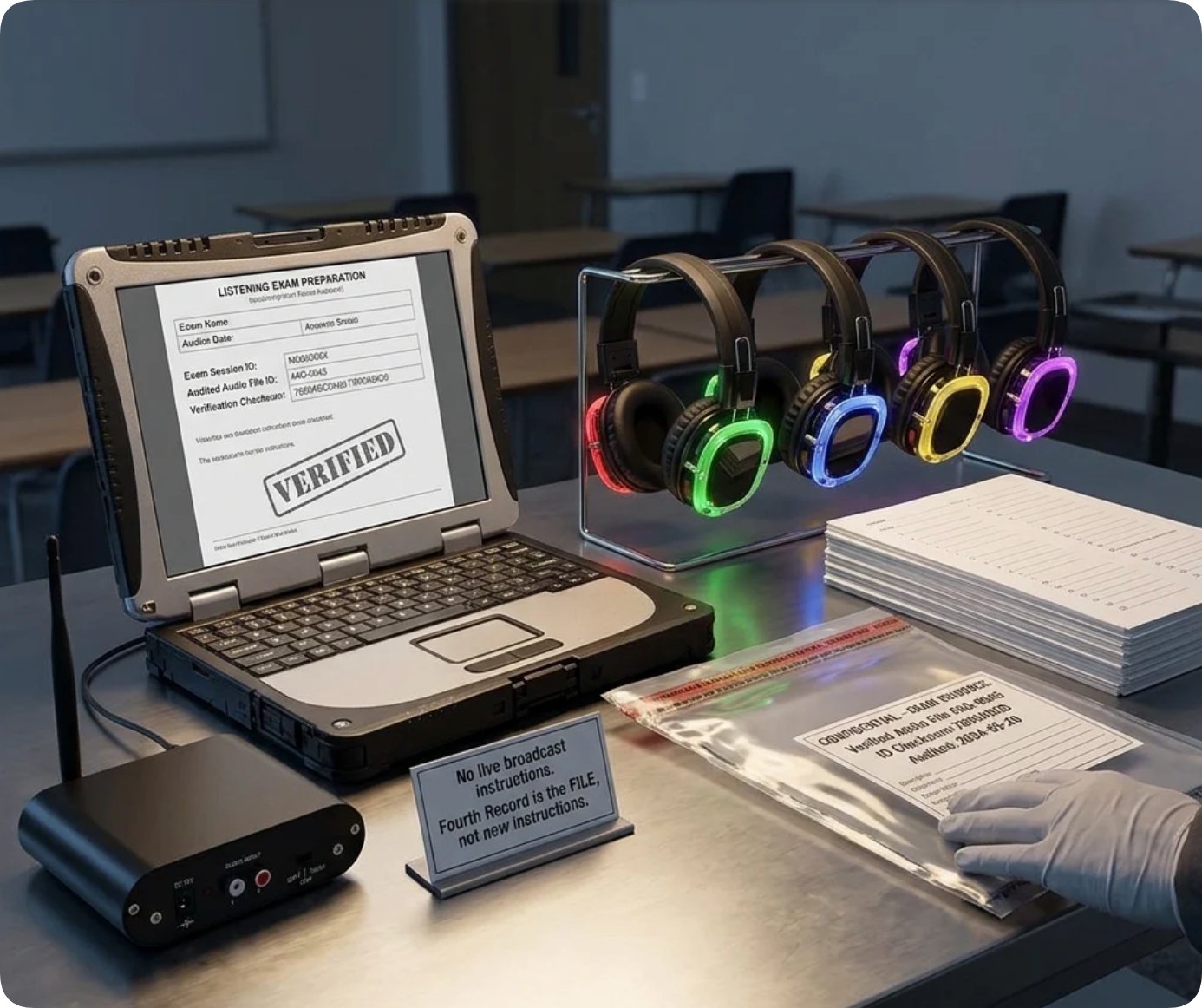
For standardized language examinations, even live centralized reading carries risks of human vocal fatigue or inflection variations. In these environments, pre-recorded audio files streamed via high-fidelity headphones eliminate human delivery factors entirely.
The Silent Disco Wireless Audio Headphone System offers multi-channel RF stereo transmission (863–925 MHz) with integrated 5-color LED indicators on the earcups. These visual indicators allow invigilators to verify from across the room that every candidate is tuned to the correct audio track without verbal interruption.
Workflow Comparison & Risk Audit Matrix
Choosing the right audio transmission architecture directly impacts compliance logging and appeal verification. The table below outlines how each method manages wording control and post-exam auditing.
| Delivery Method | Candidate Experience | Variable Control | Post-Exam Audit Capability |
|---|---|---|---|
| Manual script Reading | Varies by invigilator tone & speed | High risk (Any invigilator can alter phrasing) | script copy only (No proof of exact delivery) |
| Central Live Broadcast | Synchronized voice in every room | Medium risk (Limited to chief operator) | Channel assignment logs & transmitter logs |
| Pre-Recorded Audio File | Identical digital master playback | Zero delivery risk (Locked file) | File checksum, playback log & timestamp |
| Technical Fallback Mode | Invigilator fallback reading | Managed via printed deviation protocol | Signed incident report & fallback script |
Hardware Specifications: RC2500 vs. RC085
Below is the technical matrix derived directly from test center verification datasheets. For customized tenders or bulk procurement, consult the Wireless Tour Guide System Manufacturer Direct.
| Technical Parameter | RC2500 (2.4 GHz) | RC085 (UHF) |
|---|---|---|
| Frequency Range | 2403–2483 MHz | 470–510 MHz |
| Channel Capacity | 50 Channels | 100 Channels |
| Operating Distance | 100–200 Meters | Up to 200m (Open Line-of-Sight) |
| RF Output Power | 10mW | 8–10mW |
| Endurance (TX / RX) | 15 Hours / 35+ Hours | 12 Hours / 20 Hours |
| Battery Configuration | 3.7V 1800mAh (TX & RX) | 3.7V 1200mAh (TX) / 1000mAh (RX) |
| Unit Weight | 104g / 104g | 65g / 60g |
| Frequency Response | 50Hz–8kHz | 50Hz–12kHz |
| Charging Interface | USB Type-C | Standard USB |
For broader institutional setups spanning multi-building campuses, review our overview of Wireless Audio Guide Application Solutions.
Frequently Asked Questions
1. Why avoid using single loudspeakers in each exam room?
Loudspeakers do not ensure simultaneous delivery across rooms and suffer from uneven volume distribution—making audio loud at the front while muffled at the back. Personal wireless receivers guarantee equal audio clarity at every desk.
2. Are pre-recorded instructions always preferred over live transmission?
Pre-recorded files eliminate vocal drift but require early sign-off. If last-minute timing or schedule adjustments occur 10 minutes prior to exam start, a live central transmitter allows immediate authorized reading without file distribution delays.
3. How many channels should a standard test center plan for?
Most 14-room setups operate efficiently with 16 to 20 assigned channels (one per room, plus backup floor channels). Hardware capacity (50–100 channels) provides ample buffer against external frequency interference.
4. What documentation is required for exam compliance audit logs?
An audit-proof compliance package should include: the master audio checksum/approved script, channel-to-room assignment sheet, operator sign-in log, rehearsal protocol, and signed deviation reports if technical fallbacks were triggered.