.webp)
RC2406, RC8860 and RC085: The Migration Away From the Hall Loudspeaker
For most of the history of standardized listening papers, the audio came from one place: a loudspeaker mounted at the front of the hall, aimed at a few hundred candidates, with the invigilator's only job being to press play at the right second. That arrangement is now being dismantled room by room. Test centres that once wired one amplifier into one hall are moving to one receiver per candidate, and the change is not cosmetic — it redraws who hears what, how many sittings a day a centre can run, and which radio band a centre should buy into. This article follows that migration using three published systems as reference points: RC2406 at 2.4 GHz with 80 channels, RC8860 at 860–870 MHz with 20 channels, and RC085 at 470–510 MHz with 100 channels. Every number quoted below comes from the published specification tables; where a figure is not published, the text says so instead of guessing.
🎯 Why Seat Position Used to Decide the Listening Score
A loudspeaker at the front of a hall does not deliver the same sound pressure to every seat. The candidate in the front row sits a few metres from the driver; the candidate in the last row sits thirty metres back and one floor of reverberation away. Sound level falls with distance, walls and furniture absorb high frequencies first, and air conditioning adds a low background noise floor that the rear rows hear just as clearly as the recording. Two candidates answering the same listening paper therefore never had the same acoustic experience — the score partly measured where the candidate was told to sit.
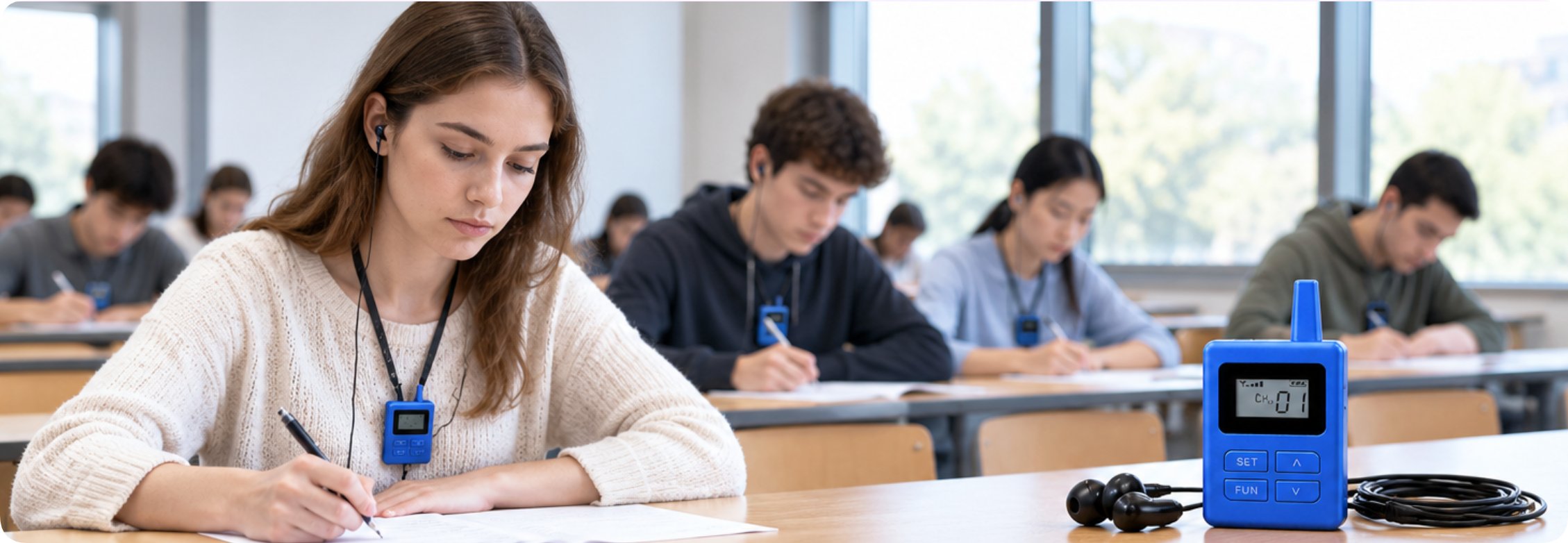
Replacing the hall loudspeaker with an individual receiver collapses that variance. Each candidate receives the signal through a personal earphone coupled directly to the ear, so the level is set once for the room and delivered identically at seat 1 and seat 200. The published output power on all three reference units is small — 10 mW on RC2406 and RC8860, 8–10 mW on RC085 — and that figure describes drive into an earphone, not coverage of a hall, which is exactly the point: the delivery problem moves from acoustics to radio. What the specifications do not publish is perceived loudness or earphone comfort, and those remain things a centre can only confirm with its own headphones on its own candidates before the first real sitting.
Split Sittings Ended One Schedule for Everyone
The second force behind the migration is administrative. Modern test centres rarely run a single mass sitting; they run several smaller sittings across a day, sometimes in different rooms, because candidates arrive in waves and invigilation ratios are fixed. A hall loudspeaker hard-wires the audio to one room and one timetable: every sitting that needs the recording must happen where the speaker is, when the speaker is free. A centre that wants to run a listening paper in three rooms at once has no way to do it with one amplifier bolted to one wall.
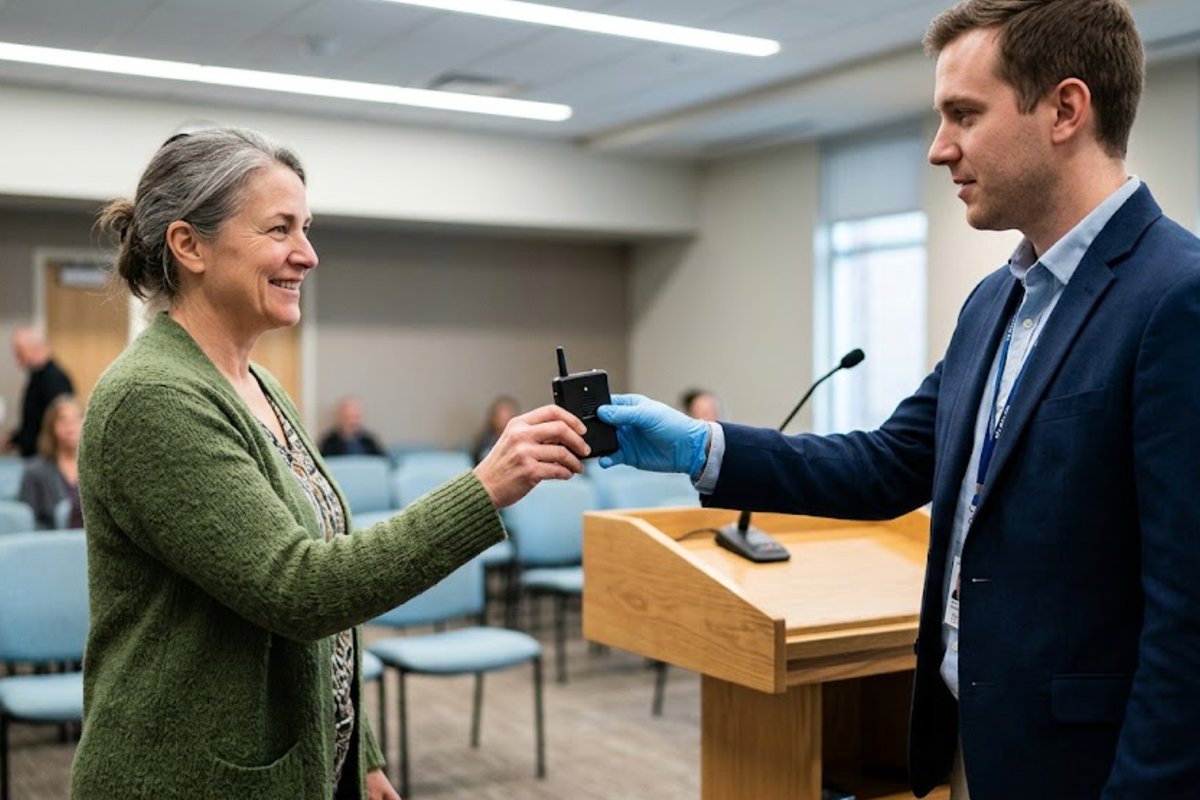
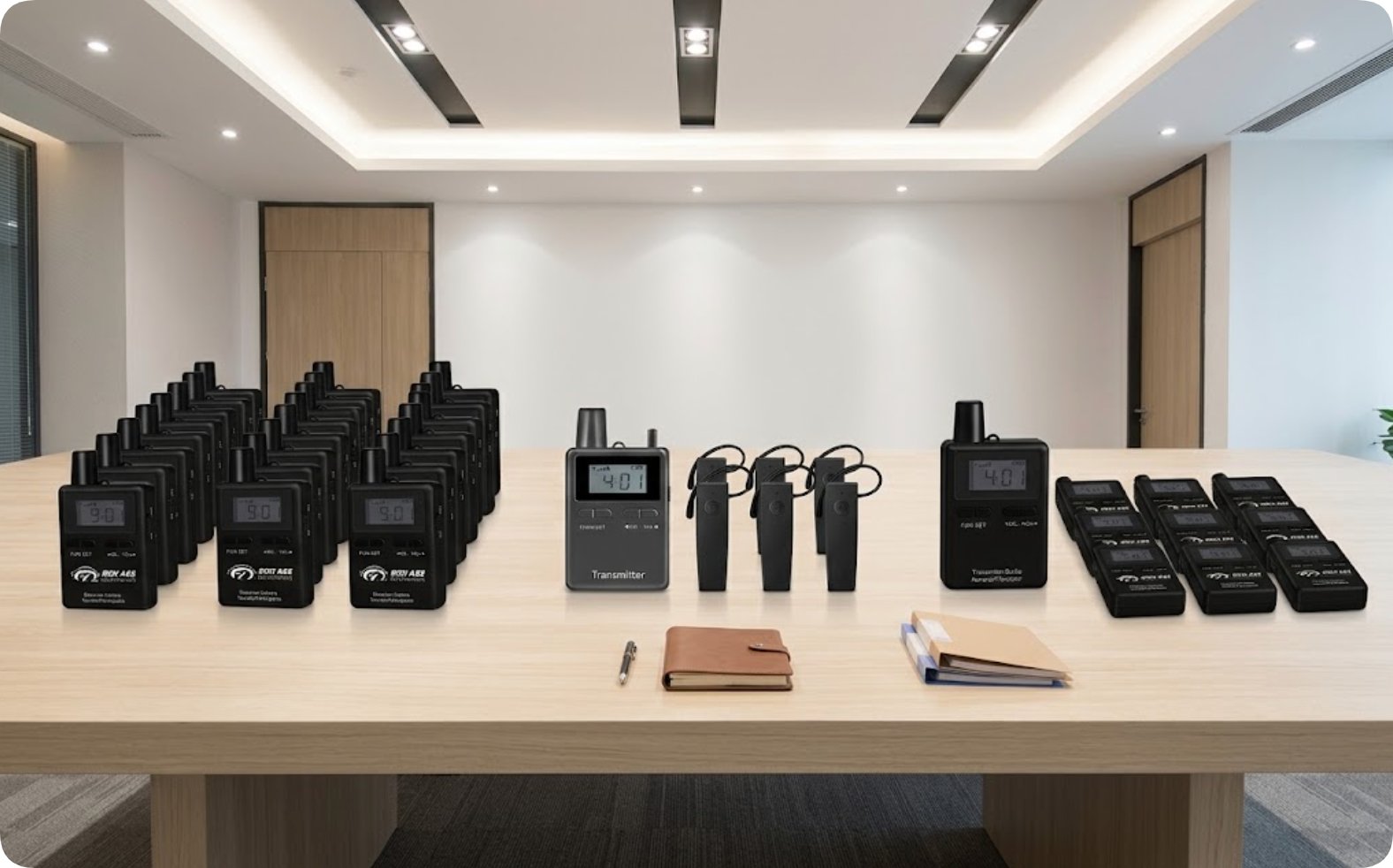
Individual receivers invert the constraint. The transmitter sits with the invigilator, and the candidates' units go wherever the seating plan says — a main hall in the morning, two classrooms in the afternoon. The published battery figures decide how many sittings a day this supports: the transmitter on RC2406 and RC8860 is rated at 10 hours and on RC085 at 12 hours, while every receiver is rated at 20 hours. A full day of split sittings fits inside those numbers without a midday recharge, and a centre that charges overnight starts each day with the whole fleet full. What the tables do not state is charging time, so a centre running back-to-back sittings should measure a top-up cycle on site rather than assume one.
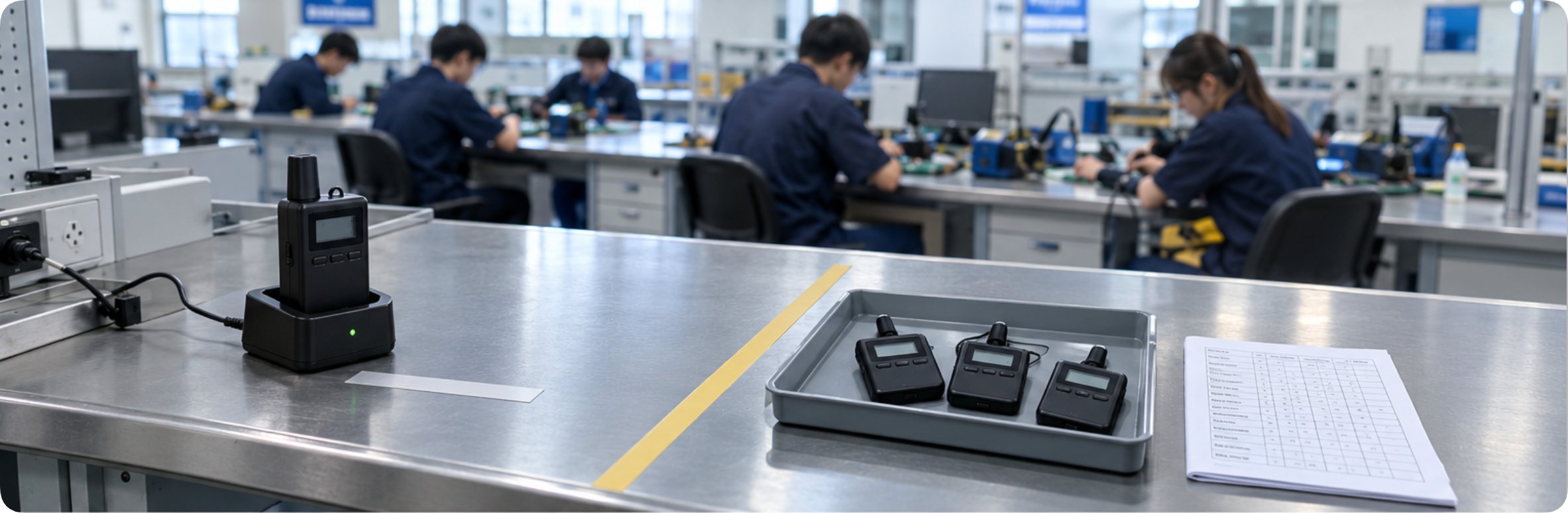
The workflow detail that decides whether split sittings actually work is collection. A hall loudspeaker has one thing to switch off; a fleet of two hundred receivers has two hundred things to count back in. The published receiver weight — 50 g on RC2406 and RC8860, 60 g on RC085 — is small enough that candidates carry their unit to a collection tray on the way out, and the invigilator counts trays rather than units. Centres that skip the tray step discover the real cost of the migration at the next sitting, when the short fleet forces a seating-plan rewrite twenty minutes before doors. The specification tables publish weights and battery ratings but nothing about handling procedure, because handling is where each centre writes its own operating standard — and the centres that run the smoothest split schedules are the ones that treat collection as part of the sitting, not an afterthought after it.
Three Bands, Three Ways to Fill a Wing of Testing Rooms
The migration also forces a radio decision that a hall loudspeaker never had to make. One speaker used one wire; thirty receivers share one radio band, and the band determines what else the signal has to tolerate. School and university buildings are hostile radio environments: campus Wi-Fi lives at 2.4 GHz, and the same spectrum is shared by tablets, laptops and access points in the next classroom. RC2406 operates at 2403–2483 MHz — inside that congested band — and its published answer is channel count: 80 channels of anti-interference headroom, letting a centre pick a quiet slot rather than share one.
The two UHF units sit outside the Wi-Fi band entirely. RC8860 transmits at 860–870 MHz, a single UHF allocation, and leans on signal stability rather than spectrum space; its 20 channels are the smallest pool of the three, which is workable for one hall and tight for a wing. RC085 operates at 470–510 MHz with 100 channels, the widest pool in the comparison, plus a published receiver sensitivity of approximately −102 dBm — a figure measured under stated conditions, so it should not be arithmetic-compared against sensitivity numbers quoted under different test conditions. A centre choosing between the bands is really choosing what its building will do to the signal: if the wing is saturated with Wi-Fi, UHF sidesteps the congestion; if the route between rooms crosses other licensed users, the wider channel pool matters more.
What 80 Channels and 100 Channels Buy a Test Centre
Channel count reads like a spec-sheet ornament until a centre runs parallel sittings. Two rooms on the same channel and the same band receive each other; the candidates in room B hear fragments of room A's recording. Channels are how a centre keeps parallel rooms separate without running wires between them. RC085's 100 channels mean a large centre can assign every concurrent room its own channel and still keep spares; RC2406's 80 channels cover the same need for all but the largest operations; RC8860's 20 channels support a handful of concurrent rooms, which matches its role as a stable single-band unit for a centre that runs one or two sittings at a time.
Channel discipline also survives turnover between sittings. When room one empties and room two fills, the invigilator switches the transmitter and the fleet to the next channel — a routine that works only if the fleet's channel count exceeds the centre's peak concurrency with margin. A centre that runs three concurrent rooms has margin on all three units; a centre that grows to ten rooms in an exam season should be shopping in the 80-and-above tier, and the published tables make that threshold visible before purchase rather than after the first clashed sitting.
The practical version of channel discipline is a written map, not a good memory. A centre that runs a wing of rooms assigns channel one to the first room, channel two to the second, and so on, and tapes that map inside the transmitter case, because the person running the afternoon sitting is often not the person who ran the morning one. PLL control mode — published on all three units — is what makes the map reliable: the channel is synthesized, not tuned by a drifting dial, so room four lands on the same frequency at every sitting of the season. A centre inheriting someone else's fleet without the map spends its first sitting rediscovering which rooms clash, which is a preventable way to lose an hour of a booked schedule.
🔋 Battery Math That Has to Survive a Full Sitting Day
The migration moves the power budget from the wall to the fleet, so the published battery tables become operational planning. Transmitters: 10 hours on RC2406 and RC8860, 12 hours on RC085. Receivers: 20 hours on all three, from a 3.7 V 1000 mAh pack. A listening paper is short — minutes of audio inside a longer sitting — so the constraint is not the length of one paper but the accumulation of a day: setup checks in the morning, several sittings, teardown and the occasional re-run for a late candidate. Twenty receiver-hours covers that comfortably from a morning charge.
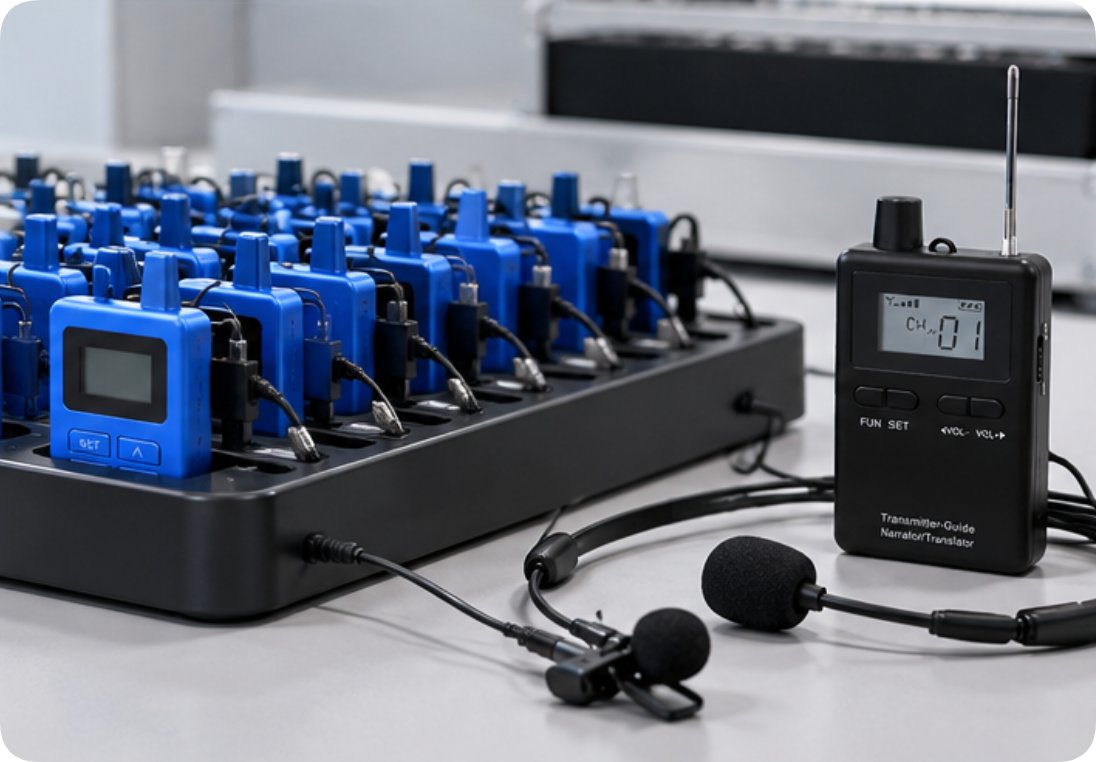
Charging infrastructure differs in one published detail worth noticing: RC2406 and RC8860 charge over a DC port, while RC085 charges over USB. A centre that already runs USB chargers for other equipment can share that stock with an RC085 fleet; a centre standardising on DC cradles keeps its existing habit with the other two. Weight matters at collection time, when the invigilator counts units back in: receivers weigh 50 g on RC2406 and RC8860 and 60 g on RC085, with transmitters at 59 g and 65 g respectively — light enough that a tray of fifty units is carried, not wheeled. None of the three tables publishes a charging-cradle slot count, so fleet charging logistics have to be confirmed with the supplier per order.
Accommodation Is Now Part of the Listening Paper
The quietest driver of the migration is fairness policy. Testing bodies increasingly treat hearing-related accommodation as a standard requirement rather than an exception, and an accommodation candidate is exactly the person a hall loudspeaker serves worst: a shared speaker cannot be turned up for one candidate without changing the paper for everyone. An individual receiver gives the candidate a private level, and centres that adopt per-candidate units for accommodation reasons usually find the same fleet serves the whole room.
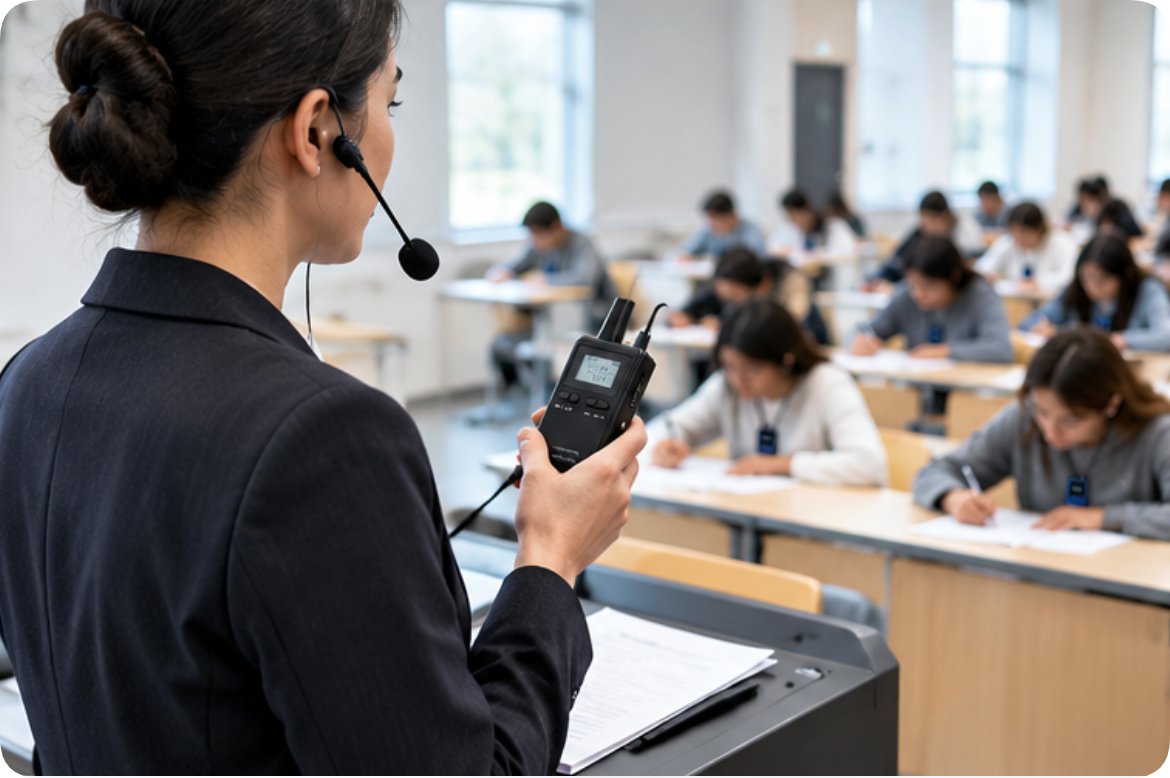
One published option matters here. RC085 lists an optional headset or lavalier professional microphone on the transmitter side, which changes who can speak through the system — a proctor reading instructions live, or a listening drill narrated by a teacher, works without a separate PA. The other two units publish no such microphone option, which does not make them unsuitable for pre-recorded playback but does mean a centre planning live spoken instruction should weight that line in the comparison. As always with optional accessories, availability and compatibility should be confirmed for the specific order, because the specification table marks the option without stating its procurement details.
The Figures Behind the Three Systems
| What the centre decides | RC2406 | RC8860 | RC085 |
|---|---|---|---|
| Band | 2403–2483 MHz (2.4 G) | 860–870 MHz (UHF) | 470–510 MHz (UHF) |
| Channels | 80 | 20 | 100 |
| Output power | 10 mW | 10 mW | 8–10 mW |
| Range | 1–200 m | 1–200 m | 1–200 m |
| Transmitter battery | 10 h (3.7 V 1500 mAh) | 10 h (3.7 V 1500 mAh) | 12 h (3.7 V 1200 mAh) |
| Receiver battery | 20 h (3.7 V 1000 mAh) | 20 h (3.7 V 1000 mAh) | 20 h (3.7 V 1000 mAh) |
| Frequency response | TX 50 Hz–200 kHz / RX 50 Hz–12 kHz | 50 Hz–12 kHz | 50 Hz–12 kHz |
| Weights (TX / RX) | 59 g / 50 g | 59 g / 50 g | 65 g / 60 g |
| Charging port | DC | DC | USB |
| Microphone options | Not published | Not published | Optional headset / lavalier |
Three rows deserve a note. First, the published frequency-response figures are not stated under identical test conditions across models, so the row compares what each maker published, not a laboratory-standard measurement. Second, RC2406's transmitter response reaching 200 kHz is a published figure for the transmitter path and says little about what the earphone reproduces; the receiver-side 50 Hz–12 kHz figure is the one a listening paper actually exercises. Third, the units share a control mode (PLL) and a 1–200 m range figure, which is why the real differentiators for a test centre reduce to band, channels, charging port and the microphone option — not range.
For a centre reading this as a buying problem rather than a trend piece: the migration ends when every candidate holds a unit, and the choice among the three is a choice about the building. A Wi-Fi-saturated campus with several concurrent rooms points at the wide-channel UHF option; a single-hall centre that wants band isolation from campus Wi-Fi at the lowest channel count prices the 860–870 MHz unit. The full education-side range, including these three and their siblings, is laid out on the education audio guide page, and the wider wireless tour guide system catalogue shows where the exam-room fleet sits relative to the touring lines.