





City marathons operate on two metrics that rarely scale together. Registration totals dictate how many runners cross the starting line on race morning, whereas course master plans dictate how many physical stations—start arches, wave gates, hydration posts, timing mats, and expo information counters—require hardware deployment. A field of 12,000 entrants might move through 62 operational service points, while a smaller 6,000-runner race spread across remote loops might require 90. Race-day communication budgets depend primarily on the number of deployed points rather than participant headcount. While consumables scale per runner, hardware infrastructure remains fixed per location. This technical breakdown evaluates course deployment models using published performance data for the RC2406 80 Channel Tour Guide Transmitter Receiver alongside standardized race-day communication kits. For comparable fixed-point audio architecture applied to fleet and foot operations, refer to our City Sightseeing Tour Audio Solutions.
Where a Marathon Audio Budget Actually Begins
Procurement requests often begin with an incorrect baseline. Organising committees frequently supply total field size—entry caps, wave counts, and expected finishers—as if every piece of audio equipment were allocated per athlete. In reality, runners carry no audio hardware; communication systems serve event operations staff, marshals, and visiting spectators.
Suppliers require the course layout: the number of start waves, medical stations, fuel posts, marshaled intersections, and expo customer service desks. A 15,000-runner race on a compact 21 km circuit often requires less audio hardware than a 6,000-runner point-to-point course with long remote stretches. Audio procurement planning should begin 6 to 9 months prior to race day with a marked-up course map—aligning channel plans with confirmed city road closures, wave release schedules, and custom hardware enclosure requirements before volunteer deployment guides are printed.
📡 Start Arch Communications: Prioritizing Channel Capacity Over Receiver Counts
The start arch presents the highest RF density on a race course. Adjacent wave gates release runners sequentially while lead vehicles, medical personnel, and security teams communicate simultaneously within tight geographical radii. Resolving multi-group cross-talk requires precise RF channel separation rather than additional hardware units.
The RC2406 features 80 selectable channels with PLL anti-interference technology across the 2403–2483 MHz (2.4 GHz) spectrum, delivering up to 200 meters of transmission range at 10 mW output. Transmitters operate up to 10 hours on a 1500 mAh battery, while receivers reach 20 hours on a 1000 mAh cell, with unit weights of 59g and 50g respectively. For a start-area crew of 40 staff managing 8 wave gates, hardware allocation is governed strictly by gate roster sizes—remaining constant whether the field holds 8,000 or 15,000 runners. The system supports full-duplex talkback with a transmitter audio response of 50 Hz–200 kHz and 50 Hz–12 kHz on the receiving end.

Kilometer Posts: Standardized Hardware Kits for Modular Deployment
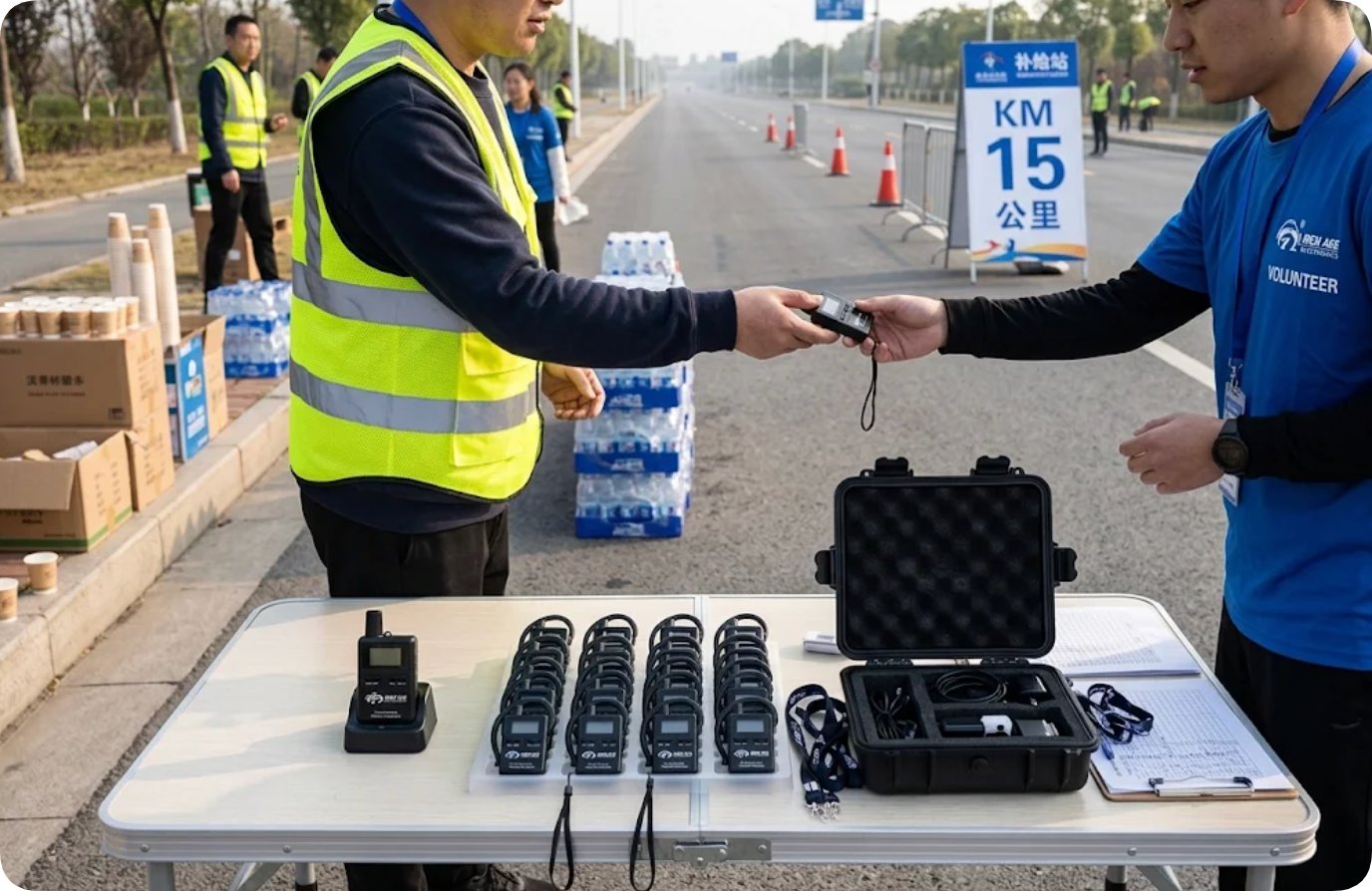
Beyond the start arch, the course divides into modular service stations. Each fuel point, medical tent, and key intersection uses a standard crew package: one main speaker paired with multiple monitoring receivers. Hardware demand is driven by total course station counts rather than participant numbers.
The RC2402 system serves as the core standard version for these remote locations. Operating on the 2.4 GHz band (2403–2483 MHz) with 50 selectable channels and 10 mW output, it shares the same battery life parameters (10h TX / 20h RX) and lightweight form factor (59g TX / 50g RX) as the RC2406. While the start arch requires 80 channels to manage dense multi-group RF overlap, mid-course posts share spectrum only with adjacent stations, making 50 channels more than sufficient. As detailed on the RC2402 Two Way Wireless Tour Guide System page, one-click channel synchronization allows uniform kit staging across all stations. Late route changes adding a new station incur a predictable, step-level hardware cost. Explore broader device specifications on our Wireless Tour Guide System Manufacturer Direct page.
🎪 Expo Service Desks: Automated Multi-Language Audio Devices
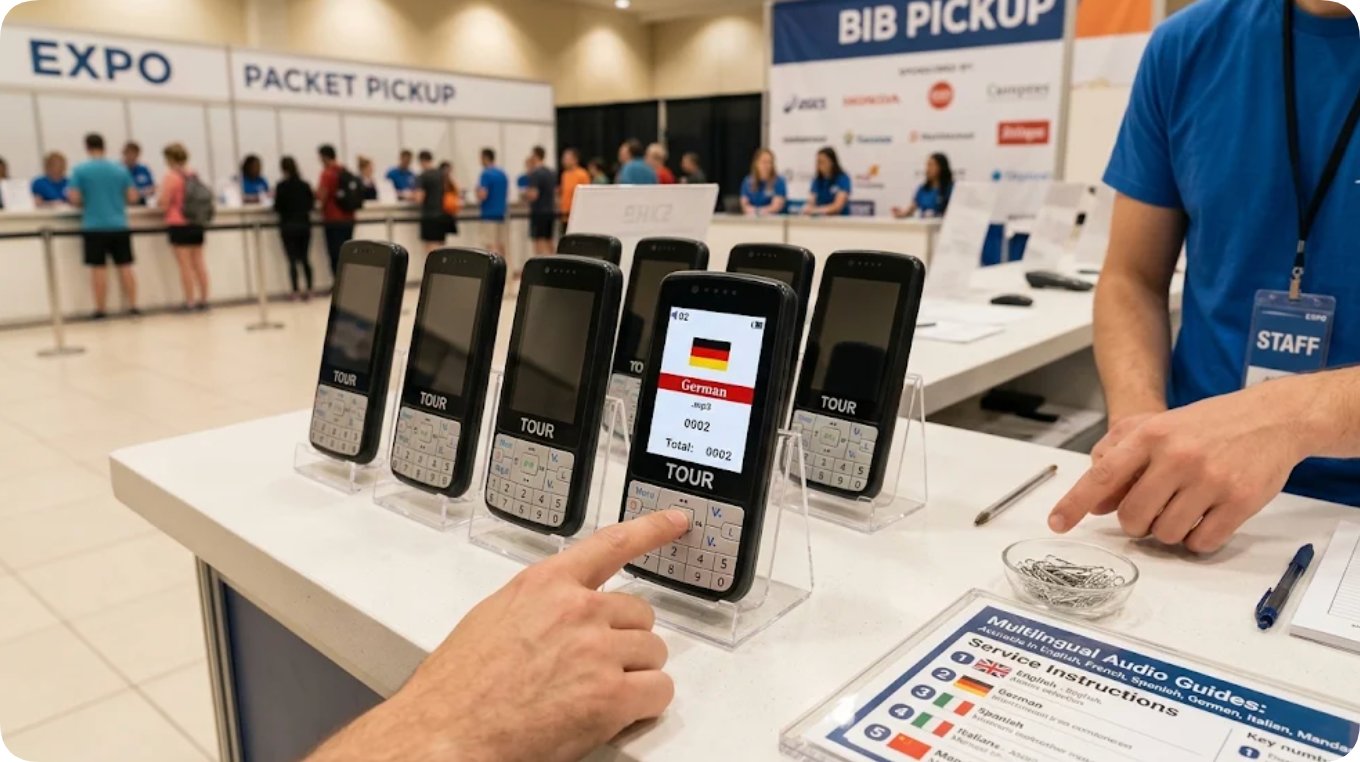
The race expo hall where participants collect bibs and registration packets represents the primary location with high-density public traffic. However, equipment costs at the expo remain counter-driven rather than visitor-driven.
International marathons utilize self-service audio stations instead of multi-lingual support staff. The 2.8-inch semi-automatic digital audio guide features a 0–9 numeric keypad for instant track selection, supporting up to 16 languages and 9,999 audio files across 2 GB of internal storage. Featuring an 18-hour continuous playback battery recharged via Micro USB, each unit includes individual earphones and undergoes factory testing to maintain a defect rate below 1%. As shown on the 2.8 Inch Display Automatic Museum Audio Guide page, hardware inventory scales directly with the number of operational information counters rather than total registered runners.
Multi-Event Hardware Lifecycle & Amortization
Marathon equipment procurement differs from single-event rentals because hardware is amortized across multiple annual races or multi-city series. Extended battery operational windows (10-hour TX / 20-hour RX) eliminate mid-race battery swaps across multi-day setups. Charging interfaces (DC ports on radio units and Micro USB on audio guide devices) allow standard local cable sourcing.
Lightweight design parameters (59g and 50g) streamline post-to-post transport logistics during dawn setup. Consumable items—such as replacement earphone foam pads and sanitary covers—scale with runner volume, whereas core radio hardware represents a one-time capital expenditure deployed across seasons. Modular storage cases containing pre-configured station kits simplify warehouse inventory audits between events.
Cost Sensitivity Analysis: Runner Volume vs. Course Expansion
To evaluate budget elasticity, consider doubling participant registration while holding the course layout constant: start-arch channel allocations and mid-course crew kit requirements remain unchanged, while expo player counts increase marginally based on counter throughput. Conversely, extending course distance adds physical stations, directly increasing hardware kit allocations.
| Budget Line Item | Scales with Runner Volume? | Scales with Course Points? | Equipment Involved |
|---|---|---|---|
| Start-Arch RF Plan | No — Fixed by gate roster | Yes — Additional gates require group separation | RC2406 Fleet at Start Arch |
| Mid-Course Crew Kits | No — Post staffing is fixed | Yes — One kit per added course post | RC2402 Station Kits |
| Expo Audio Guides | Indirectly — Via queue throughput | Yes — Allocated per desk counter | 2.8" Keypad Audio Players |
| Charging Infrastructure | No | Yes — Charging ports follow post counts | DC Ports & Micro USB Charging Cables |
| Consumables & Spares | Yes — Wear scales with visitor volume | Minor — Scaled per station crew | Earphones, Foam Covers, Backup Units |
💰 Equipment Specifications Comparison
The operational attributes below outline hardware selection criteria based on official manufacturer specifications:
| Model | Interaction & Range Specifications | Battery Life | Charging Interface |
|---|---|---|---|
| RC2406 | Live 2-way guiding, 80 channels, 2403–2483 MHz, up to 200m range | TX 10h / RX 20h | DC Port |
| RC2402 | Live 2-way guiding, 50 channels, 1-click frequency synchronization | TX 10h / RX 20h | DC Port |
| 2.8" Keypad Guide | 0–9 keypad playback, 16 languages, 9,999 audio files, 2 GB storage | 18h continuous | Micro USB |
Understanding operational distinctions ensures accurate hardware planning. Radio transceivers support core event staff where counts depend on course layout, whereas automated keypad audio guides serve visiting runners and spectators. For institutional applications utilizing similar multi-room audio coordination models, review our technical guide on How Many Mouths an Exam Instruction Needs. Custom enclosure colors and logo branding options are available across all product lines via our Wireless Audio Guide System OEM ODM Factory portal.
Frequently Asked Questions
1. Do marathon runners carry audio equipment during the race?
No. Standard marathon deployments supply audio transceivers exclusively to event staff, marshals, and medical crews at fixed stations, alongside self-service audio guides for expo visitors. Hardware requirements scale with physical course points rather than registered runner counts.
2. Why does the start arch require 80 channels while remote posts use 50 channels?
The start arch operates under dense RF conditions where multiple wave-gate leads, medical teams, and lead vehicles transmit within close proximity. The RC2406's 80-channel capability prevents cross-talk. Mid-course stations share spectrum only with adjacent posts, making the RC2402's 50-channel capacity ideal.
3. Can expo audio guide devices be re-deployed for post-race events?
Yes. Featuring an 18-hour battery life and 2 GB storage (supporting 9,999 files across 16 languages), the 2.8-inch keypad audio guide can be reloaded with post-race festival or event tour content via Micro USB data transfer.
4. How do late course additions affect the audio budget?
Adding a remote course station requires adding a discrete RC2402 kit, charging allocation, and spare accessories for that specific location. Base start-arch channel allocations and expo audio guide quantities remain completely unaffected.