


Most visitor communication plans for active mines and oilfields assume site geography remains static from initial survey to final operations. In heavy industry, that assumption fails immediately. Benches extend deeper into hillsides, drilling camps are dismantled and re-established valleys away, and previous visitor briefing rooms are frequently converted into spare parts depots. Equipment survival through these relocations depends entirely on original mounting architectures. Items hard-bolted to permanent structural walls often face abandonment when structures change, whereas mobile assets tied to modular power supplies, transit vehicles, or shift rosters transition smoothly. Treating permanent fixtures and relocatable assets as a single deployment checklist is why subsequent site launches frequently encounter stranded charging cradles and obsolete frequency channel maps.
For field engineers and safety supervisors, the critical evaluation is not how to mount equipment, but which deployment components retain operational viability following an address change. A charging station wired to a single temporary 230V outlet has a short operational lifecycle, whereas standardized briefing compliance signage endures indefinitely provided room allocations remain unchanged. This operational dichotomy extends directly to the wireless transceivers themselves, where published frequency bands, channel density, battery capacities, and charging interfaces dictate reconfiguration overhead. While plant noise mitigation and PPE integration are managed via Industrial Plant Tour Noise Cancelling Headsets, this analysis focuses exclusively on infrastructure adaptation when heavy industrial sites are temporary and mobile.
Why Industrial Site Deployments Feature Dual Lifecycles
Hardware deployment items possess extended lifecycles when justified by permanent structural rooms, regulatory standards, or standardized asset tracking protocols that outlast active excavation zones. Conversely, items tied to fluctuating power sources, dynamic group sizing, or signal propagation distances face rapid obsolescence. Numbered receiver racks bolted beside permanent plant gates belong to the permanent category, while charging docks tethered to provisional mess-hall outlets belong to the transient tier.
Three core engineering questions resolve this deployment split prior to drilling or bolting: Does the asset rely on temporary mains power vulnerable to layout shifts? Does it encode simultaneous group capacities subject to workforce scaling? Does it maintain reliable link margins within the published 1–200m transmission range as transmitter coordinates shift? Affirmative answers categorize items as relocatable, requiring modular transport cases rather than permanent structural mounts.
Permanent Infrastructure: Assets Retained on Original Pads
The permanent component of a heavy industry visitor setup is intentionally streamlined. It typically comprises safety induction briefing wall cards, standardized receiver inventory numbering conventions, fixed return tray stations, and formal sign-off logging procedures. These elements align with physical rooms and safety protocols rather than shifting geographical coordinates.
For stable indoor briefing environments, the RICH AGE RC2401 Wireless Audio System Factory unit provides a reliable 2.4 GHz benchmark. Specifications detail operation across the 2403–2483 MHz spectrum with 50 selectable channels, 10-hour transmitter runtimes, 20-hour receiver runtimes, and 3.7V batteries (1500 mAh TX / 1000 mAh RX). Weighing 59g (TX) and 50g (RX) with DC port charging, it integrates smoothly into standardized charging racks.
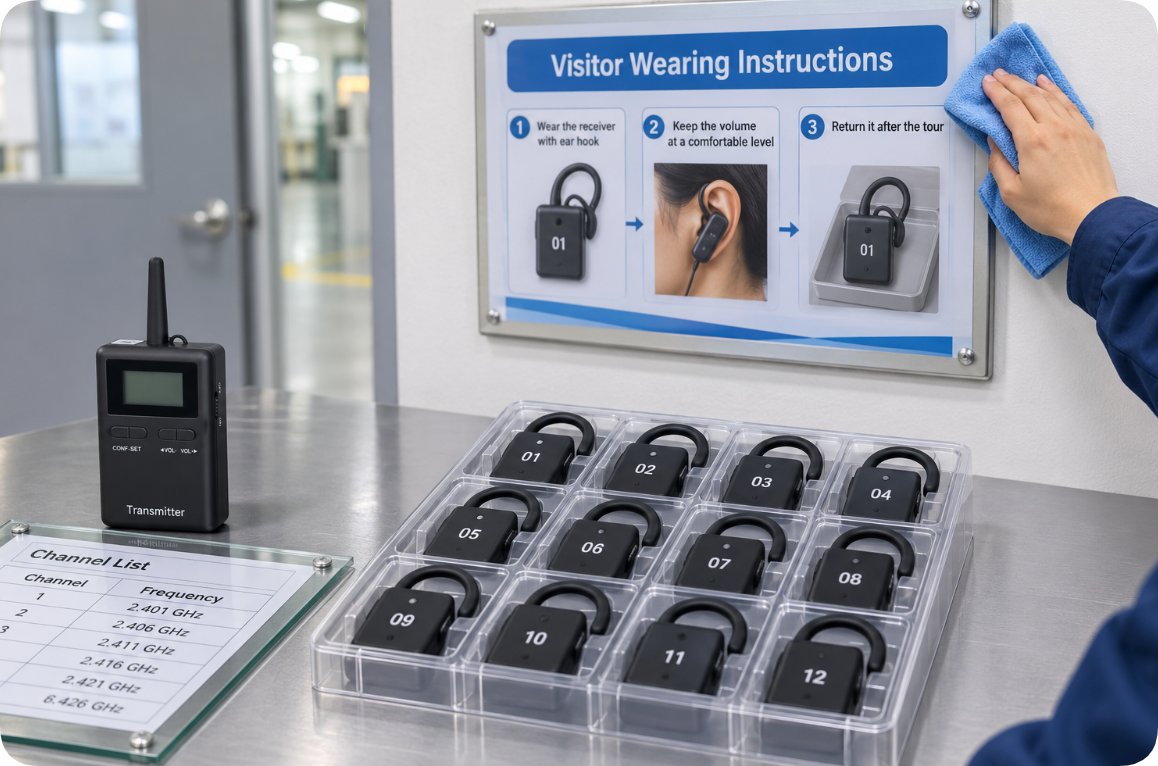
The rationale for selecting such units for permanent zones is structural stability. Induction facilities maintain dedicated enclosures, controlled lighting, and consistent seating capacities. Transmitters remain secured on administrative shelves, receiver bins rest beside egress doors, and core hardware configurations require zero alteration across operational cycles.
Modular Power: Charging Infrastructure Governed by Utility Grid Availability
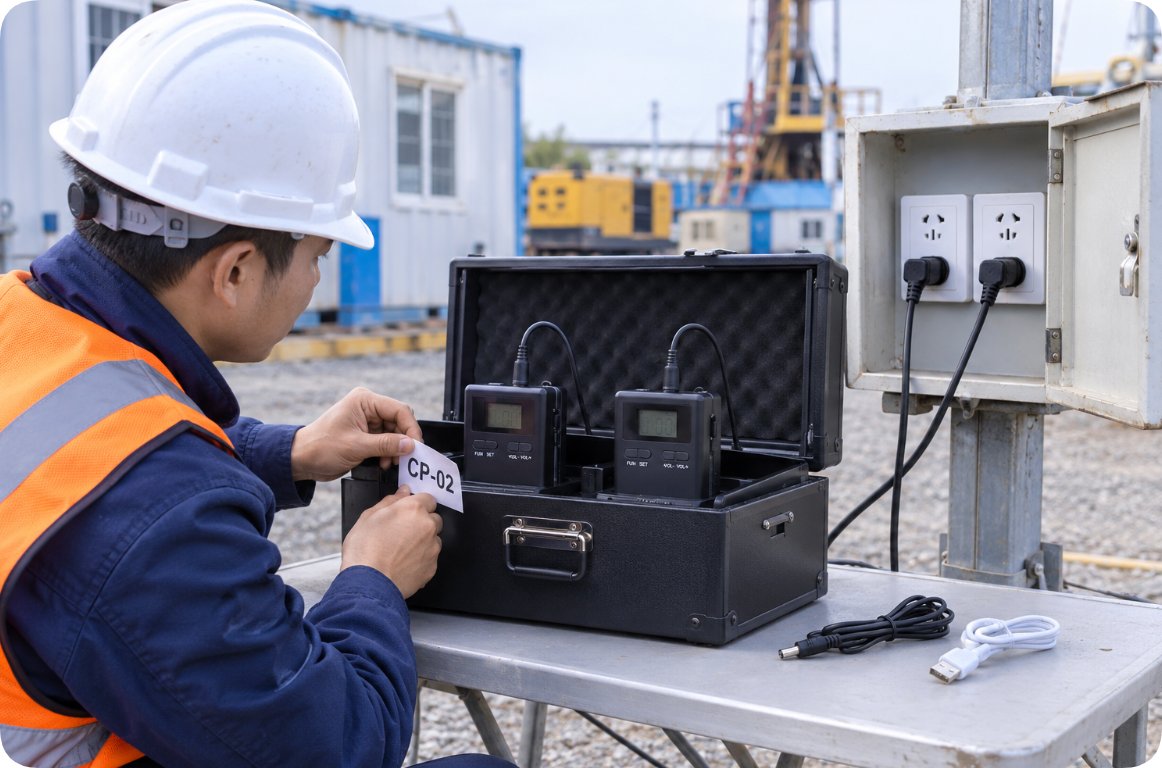
Transitional deployment assets are dictated by power availability. In exploratory drilling camps, electrical feeds fluctuate across generator hookups and modular trailer wiring. Labeling charging bays strictly by permanent room identifiers causes operational failure upon relocation when cabinets arrive but matching grid receptacles do not.
The RC8860 Wireless Teaching Microphone System operates within the 860–870 MHz UHF band, offering superior signal penetration through heavy steel infrastructure and concrete barriers common in industrial terrain. Featuring 20 selectable channels, 10h/20h battery runtimes, DC port charging, and a balanced 50Hz–12kHz frequency response, its 20-channel limit enforces disciplined group allocation during complex multi-party site tours.
Frequency Management: Channel Architecture for Dynamic Camps
Frequency coordination sheets must be engineered as dynamic templates containing open parameter fields rather than rigid static assignments. Specifying concurrent group thresholds, channel grouping rules, and role-based unit allocations allows rapid reconfiguration within minutes of site occupation.
The RC085 Portable Tour Guide System Wholesale unit addresses expanded channel demands via its 470–510 MHz UHF band spanning 100 selectable channels. Delivering 12-hour transmitter runtimes, dual F1/F2 working modes, and flexible microphone configurations, its broad channel capacity accommodates unexpected influxes of safety inspectors and VIP delegations. Explore comprehensive hardware specifications via our Wireless Tour Guide System Manufacturer Direct catalog.

Site Architecture Comparison: Re-Siting Workloads Across Four Industrial Environments
Operational burdens vary significantly across industrial terrain types:
Open-Pit Benches: Characterized by lack of walls and minimal power outlets. Transmitters are mobile, and the 1–200m transmission range acts as a strict boundary requiring strategic relay positioning as excavation faces advance.
Drilling Camps: Highly mobile modular units where power availability and connector compatibility (DC Port vs. USB) dictate logistics.
Processing Plants: Permanent structural installations where fixed equipment bolted once endures for years, requiring only annual channel audits.
Visitor Transit Buses: Mobile distribution hubs requiring robust handover protocols and strict battery runtime matching.
Technical Specification & Asset Classification Matrices
The matrices below contrast core RF parameters and deployment classifications across the three industrial transceiver models:
| Published Parameter | RC8860 | RC085 | RC2401 |
|---|---|---|---|
| Frequency Band | 860–870 MHz UHF | 470–510 MHz UHF | 2403–2483 MHz 2.4G |
| Selectable Channels | 20 Channels | 100 Channels | 50 Channels |
| Transmission Range | Up to 200m | Up to 200m | Up to 200m |
| Runtime (TX / RX) | 10h / 20h | 12h / 20h | 10h / 20h |
| Charging Interface | DC Port | USB Port | DC Port |
For broader multi-site deployment methodologies, consult our Wireless Audio Guide Application Solutions. Furthermore, rigorous content governance preceding site tours is detailed in our operational review on Who Approves a Sentence Before a Visitor Hears It.
Frequently Asked Questions (FAQ)
1. How much of a mine visit installation must be rebuilt when a work area relocates?
Only infrastructure tied directly to power availability, group scaling, or distance limits requires re-engineering. This typically includes charging stations, channel allocation sheets, and transmitter positioning. Static assets like induction room safety boards and receiver numbering rules remain valid as long as facility functions are preserved.
2. Can RC8860, RC085, and RC2401 units share a centralized charging cabinet after relocation?
They can share physical shelf space, but require distinct charging cables. The RC8860 and RC2401 utilize DC port connections, whereas the RC085 employs a USB interface. Verifying cable inventories during camp reconstruction prevents uncharged equipment on operational mornings.
3. Why do lower-channel units like the 20-channel RC8860 require stricter administrative planning?
Limited channel pools require precise pre-planning against known tour rosters, preventing cross-talk when multiple guide groups operate simultaneously. High-channel alternatives like the 100-channel RC085 absorb unexpected VIP or inspection delegations dynamically without manual reallocation.
4. What operational parameters determine battery replacement cycles during site moves?
Battery replacement intervals are governed by daily shift durations rather than camp relocation frequency. Transmitters rated for 10 to 12 hours require structured midday swapping or backup cells during extended mining shifts, whereas 20-hour receivers comfortably span full operational windows.