
A leading China factory specializing in Wireless Tour Guide Systems, Church Audio Guides, and Translation Headphones with premium OEM/ODM solutions.

Tel:+86 18922879583

Email:tiger.wang@richitek.com

Richitek RC085, RC8860 and RC2406 vs Acoustiguide and Tourtalk for Quiet Gallery Tours

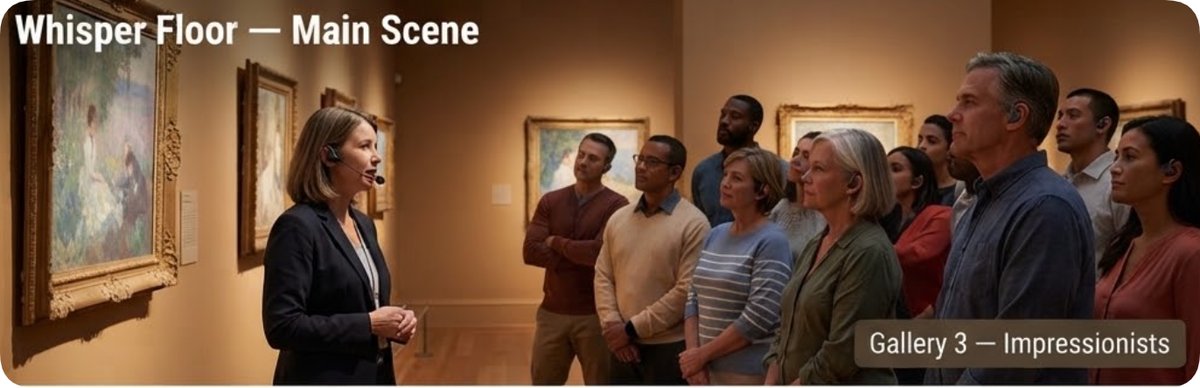
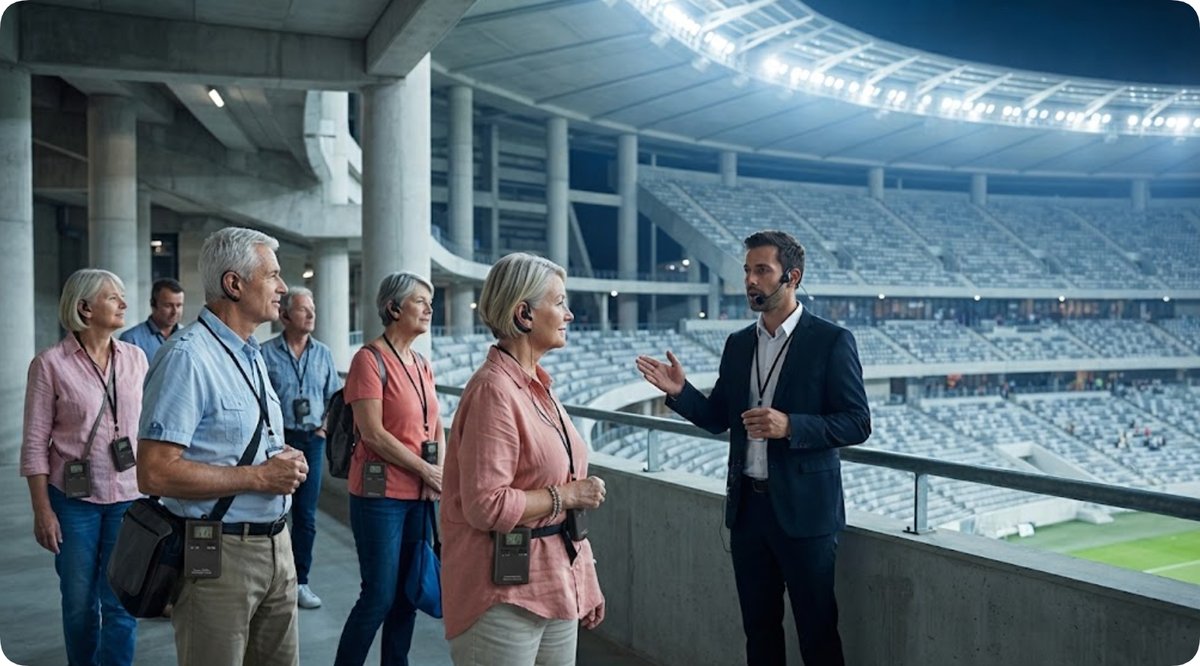
A gallery floor is the quietest room in the hospitality business. Visitors drop their voices to a whisper between paintings, docents speak at conversation level at best, and the acoustics punish anything louder — bare walls, hard floors and long sightlines bounce every syllable back. In that environment the equipment question is not how far a transmitter can throw a signal but how quietly a system can carry one voice to fifteen people standing three metres apart without a single raised syllable. This comparison sets three Richitek units against two very different rivals: the RC085, the RC8860 wideband unit and the RC2406, against the Acoustiguide Opus player — the best-known name in recorded museum commentary — and the Tourtalk TT 40, a British live-tour system that competes directly on price. For the wider museum context, the museum audio guide equipment overview covers how these categories fit cultural venues.
richitek gallery_quiet vs acoustiguide tourtalk 1

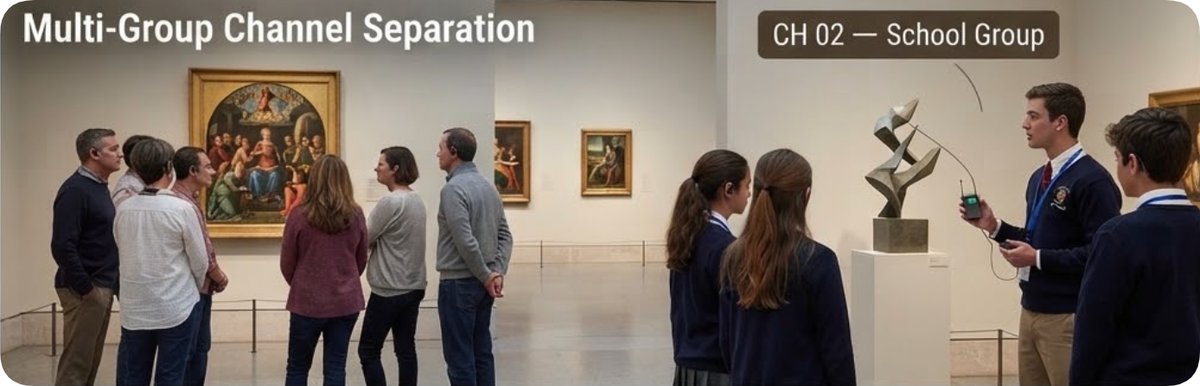
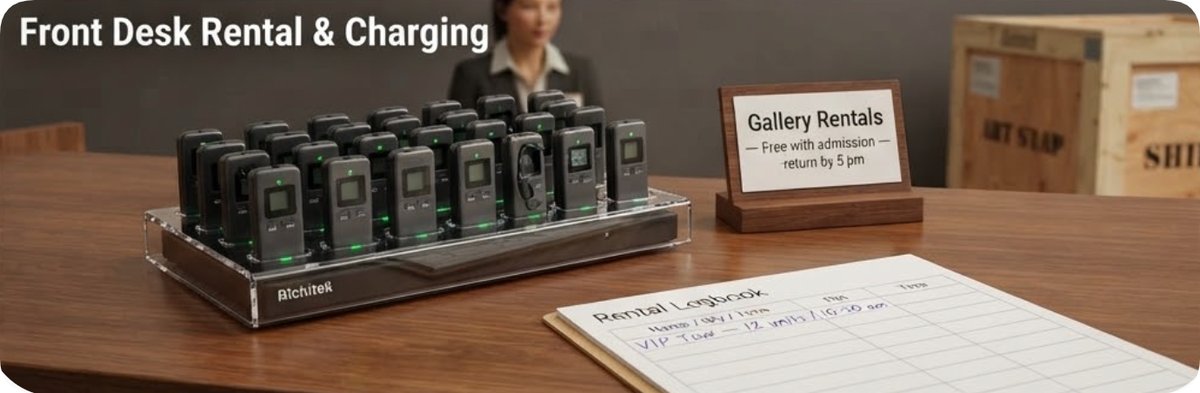
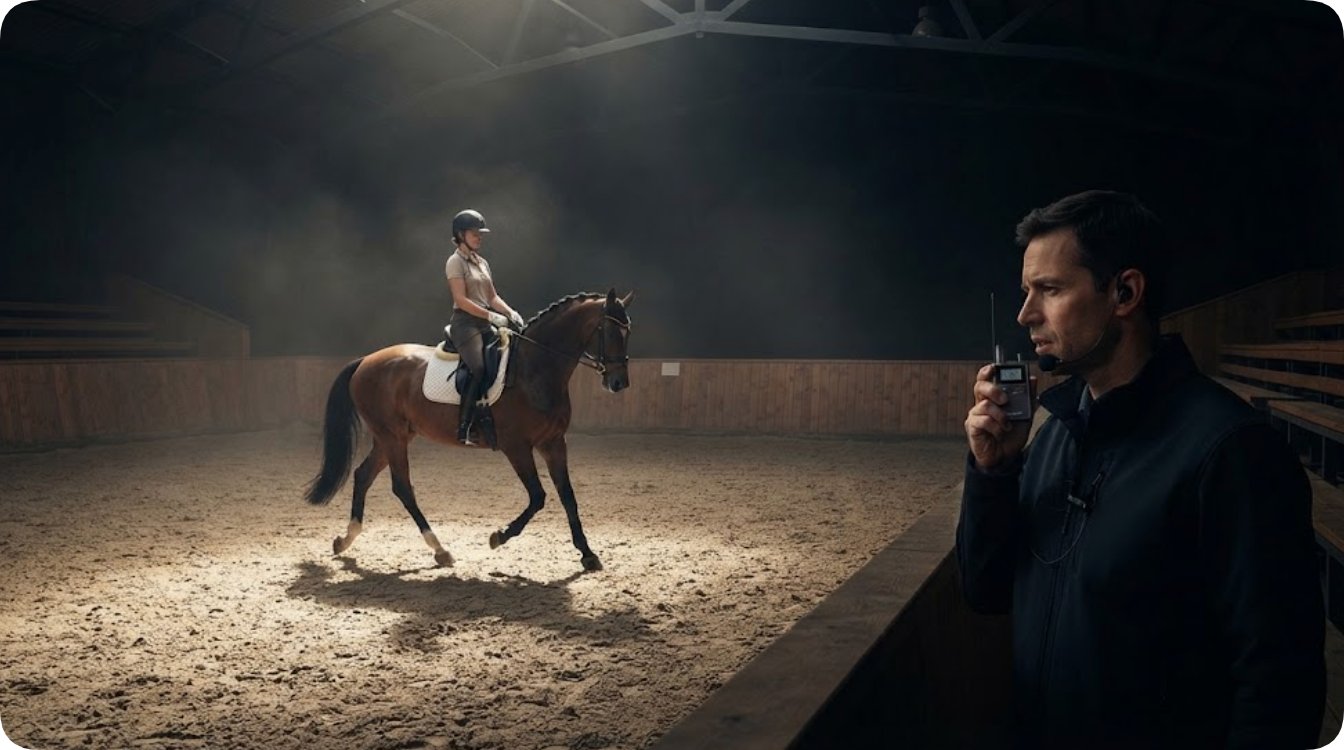
Start with the room, because the room dictates the spec. Three docent tours sharing one floor at the same hour need channel separation, not just channel count. A Wednesday school group needs its own frequency well away from the VIP walkthrough that started ten minutes earlier. And the front desk rents units to walk-in visitors who have never worn a tour device before, so whatever goes over the counter has to survive being put on backwards, dropped on a bench and handed back at closing with the battery status unknown. Every claim below comes from the manufacturers' own published specifications, checked against their official pages and dealer documentation in October 2026.
richitek gallery_quiet vs acoustiguide tourtalk 2

DimensionRC085RC8860RC2406Tourtalk TT 40Acoustiguide Opus
ModeLive, one-wayLive, one-wayLive, one-wayLive, one-wayRecorded playback
BandUHF 470-510 MHzUHF 860-870 MHz2.4 GHz ISMUHF 863-865 MHz (EU)Preloaded content
Channels10020 PLL80 multi-line40500+ h tours
RangeIndoor floor200 m open area1-200 m120 m line of sightPosition-triggered
Receiver weight60 g50 g50 g75 g with AA160 g handheld
BatteryUSB rechargeableTx 10 h / Rx 20 hTx 10 h / Rx 20 h1×AA, 10 h / 15 hFull day + rack

Channel Separation on a Shared Floor

The RC085 is the channel-count argument for gallery work. Its hundred UHF channels across 470-510 MHz let a museum campus run a curator's talk, a school programme and a members' preview through the same galleries at the same hour without a coordination meeting — and unlike a crowded 2.4 GHz band, a dedicated UHF slot does not fight the visitors' own phones for airspace. The receiver weighs sixty grams, light enough that a visitor forgets they are wearing it, and it charges over plain USB, so the front desk can top units up from the same drawer of cables it already owns. For the guide, Richitek offers headband and lapel microphone options; the lapel is the gallery choice, sitting close enough to catch a lowered voice while the docent keeps both hands free for pointing at brushwork. One practical caution applies: 470-510 MHz is a regional band, so a touring exhibition crossing borders should confirm local licensing before it packs its crates.

Wideband Audio for Artwork Commentary

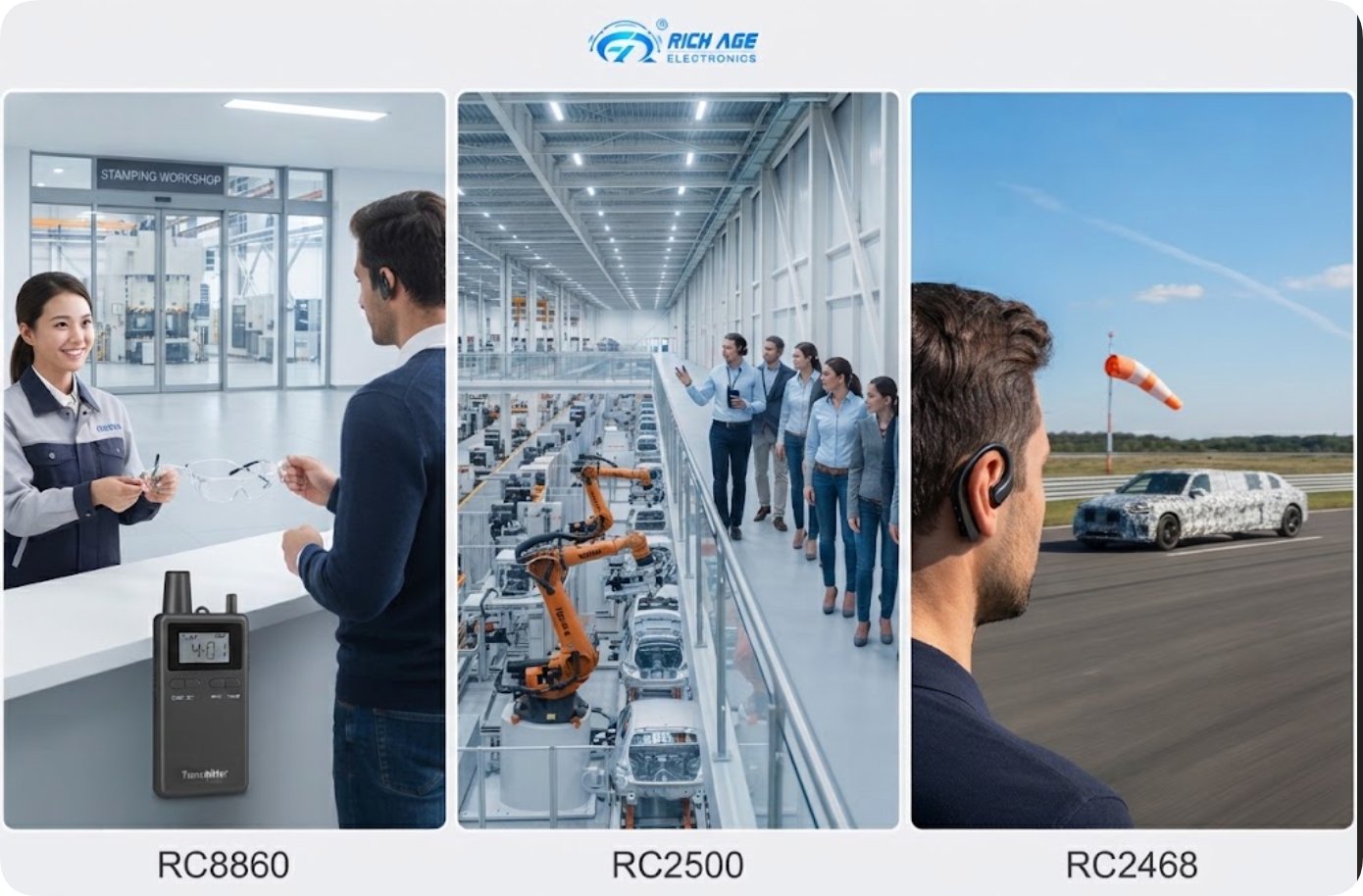
Some gallery moments deserve better than adequate sound. When a docent pauses a group in front of a canvas and walks them through what the artist was doing with the third movement, the commentary is part of the interpretation — and thin, compressed audio flattens it. The RC8860 transmits on UHF 860-870 MHz with a wideband audio path, twenty PLL-locked channels and a two-hundred-metre open-area range that carries across mezzanine levels without re-pairing. Its transmitter runs ten hours and the receiver twenty, so a day of back-to-back tours ends with charge to spare, and both units carry an IPX4 rating that shrugs off the cleaning crew's sprays between closing and the next morning's first booking.

🔋 An All-Day Schedule Without a Battery Meeting

Galleries run longer than tours. School programmes start at ten, the lunchtime highlights tour goes out at noon, an evening private view stretches past eight, and the same fleet works all of it. The RC2406 is built around that arithmetic: an eighty-channel multi-line plan on 2.4 GHz, ten hours of transmitter life and twenty hours per receiver, on a one-to-two-hundred-metre range that flexes from a single intimate room to a full building. Its DC-port charging suits an overnight tray routine — dock the fleet at close, pull it charged at open — and the fifty-gram receiver keeps the walk-in rental experience unremarkable in the best sense: visitors remember the exhibition, not the hardware. Running the RC2406's multi-line plan alongside the RC085's hundred UHF channels, a venue can also layer languages: one frequency for the local-language docent, another for the Mandarin school group, a third for the audio-described tour for visually impaired visitors.

🗺️ The Recorded-Tour Alternative: Acoustiguide Opus

Acoustiguide belongs in this comparison with an honest framing: the Opus is not a live system at all. It is a handheld player loaded with professionally produced commentary — over five hundred hours of multilingual audio on the platform, a colour touchscreen on the Opus Touch variant, infrared and radio positioning triggers that fire the right track as a visitor approaches an exhibit, and a dual-listening design with a fold-out speaker that works as a wand or a headset player. Its modular charging racks hold twenty-five players with no fragile connectors to align, the hardware is tested against disability regulations with induction-loop compatibility, and the company sells a content-production service alongside the device. For institutions that want every visitor to hear the same polished narrative in twelve languages without staffing a single docent, that model is genuinely strong, and its accessibility credentials are the best in this table. What it cannot do is answer a question. A visitor puzzling over why the artist chose that blue gets silence, or at best a pre-recorded guess at what they might ask — and at one hundred and sixty grams it is a device visitors hold, not one they wear and forget.

The Closest Live Rival: Tourtalk TT 40

Tourtalk's TT 40 competes on the same ground as the Richitek trio: a presenter speaks, listeners hear. Its forty licence-free channels on 863-865 MHz, ten-milliwatt power and hundred-and-twenty-metre range cover a mid-size gallery honestly, and the specification sheet is refreshingly complete — a transmitter with an integrated microphone plus lapel and aux-in inputs, a mute switch, and receivers whose LCD shows channel, group lock and battery status. The lock stops guests from wandering into another tour's audio, and a receiver that hears no transmitter for twenty minutes switches itself off to save the battery, a quietly thoughtful touch for a rental fleet. Its economics are real: one AA battery per unit, ten to fifteen hours, means a gallery can keep spares ready with no charging infrastructure at all. At seventy-five grams with the battery installed it is not heavy, though it rides a lanyard or belt clip rather than disappearing the way a sixty-gram ear-hook unit does. The honest gaps against the Richitek units are channel headroom — forty against one hundred and eighty across the pair — and the single-region 863-865 MHz band, which ties the hardware to European licensing.
richitek gallery_quiet vs acoustiguide tourtalk 3

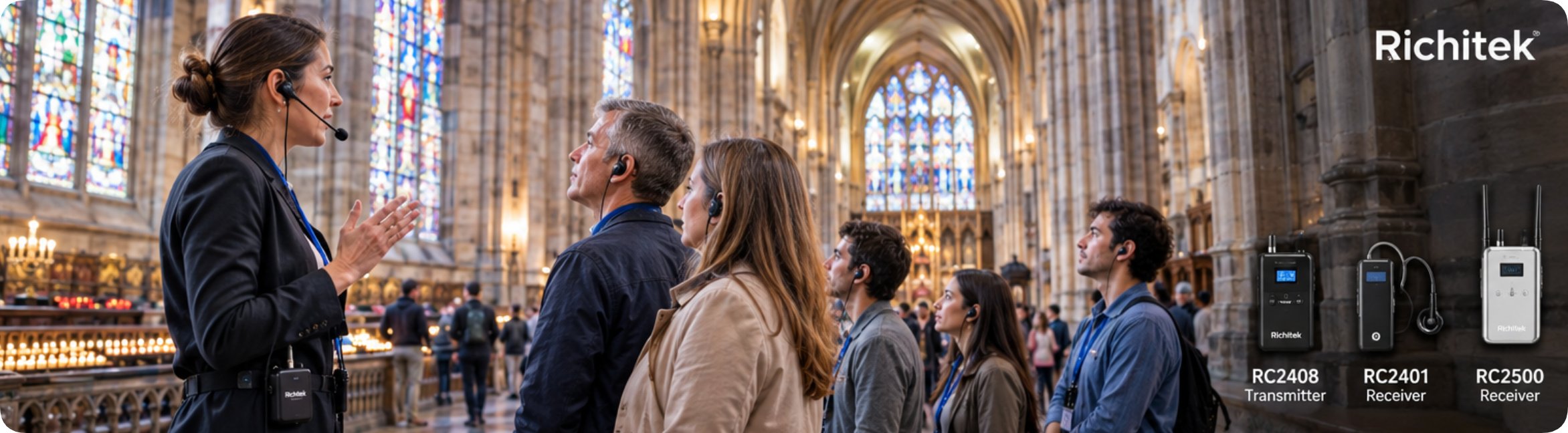
So the decision is really between three models of running a quiet floor. Buy the Acoustiguide Opus when the priority is a fixed, polished, multilingual narrative delivered to unstaffed crowds, and budget for the content production that makes it sing. Buy the Tourtalk TT 40 when budget rules and the programme fits inside forty channels on one European continent. Choose the Richitek combination when the calendar is the constraint — a hundred channels of separation on busy days, wideband audio for the moments that deserve it, and a fleet that goes from school group to private view without a battery meeting in between. Browse the full wireless tour guide systems lineup for accessory options, or read more cross-brand matchups in the comparison archive.

2026年10月06日 12:22
ꄘ click: 12
no data
Home > VS

Richitek RC085, RC8860 and RC2406 vs Acoustiguide and Tourtalk for Quiet Gallery Tours

time: 2026年10月06日 click:12

A gallery floor is the quietest room in the hospitality business. Visitors drop their voices to a whisper between paintings, docents speak at conversation level at best, and the acoustics punish anything louder — bare walls, hard floors and long sightlines bounce every syllable back. In that environment the equipment question is not how far a transmitter can throw a signal but how quietly a system can carry one voice to fifteen people standing three metres apart without a single raised syllable. This comparison sets three Richitek units against two very different rivals: the RC085, the RC8860 wideband unit and the RC2406, against the Acoustiguide Opus player — the best-known name in recorded museum commentary — and the Tourtalk TT 40, a British live-tour system that competes directly on price. For the wider museum context, the museum audio guide equipment overview covers how these categories fit cultural venues.

richitek gallery_quiet vs acoustiguide tourtalk 1

Start with the room, because the room dictates the spec. Three docent tours sharing one floor at the same hour need channel separation, not just channel count. A Wednesday school group needs its own frequency well away from the VIP walkthrough that started ten minutes earlier. And the front desk rents units to walk-in visitors who have never worn a tour device before, so whatever goes over the counter has to survive being put on backwards, dropped on a bench and handed back at closing with the battery status unknown. Every claim below comes from the manufacturers' own published specifications, checked against their official pages and dealer documentation in October 2026.

richitek gallery_quiet vs acoustiguide tourtalk 2

DimensionRC085RC8860RC2406Tourtalk TT 40Acoustiguide Opus
ModeLive, one-wayLive, one-wayLive, one-wayLive, one-wayRecorded playback
BandUHF 470-510 MHzUHF 860-870 MHz2.4 GHz ISMUHF 863-865 MHz (EU)Preloaded content
Channels10020 PLL80 multi-line40500+ h tours
RangeIndoor floor200 m open area1-200 m120 m line of sightPosition-triggered
Receiver weight60 g50 g50 g75 g with AA160 g handheld
BatteryUSB rechargeableTx 10 h / Rx 20 hTx 10 h / Rx 20 h1×AA, 10 h / 15 hFull day + rack

Channel Separation on a Shared Floor

The RC085 is the channel-count argument for gallery work. Its hundred UHF channels across 470-510 MHz let a museum campus run a curator's talk, a school programme and a members' preview through the same galleries at the same hour without a coordination meeting — and unlike a crowded 2.4 GHz band, a dedicated UHF slot does not fight the visitors' own phones for airspace. The receiver weighs sixty grams, light enough that a visitor forgets they are wearing it, and it charges over plain USB, so the front desk can top units up from the same drawer of cables it already owns. For the guide, Richitek offers headband and lapel microphone options; the lapel is the gallery choice, sitting close enough to catch a lowered voice while the docent keeps both hands free for pointing at brushwork. One practical caution applies: 470-510 MHz is a regional band, so a touring exhibition crossing borders should confirm local licensing before it packs its crates.

Wideband Audio for Artwork Commentary

Some gallery moments deserve better than adequate sound. When a docent pauses a group in front of a canvas and walks them through what the artist was doing with the third movement, the commentary is part of the interpretation — and thin, compressed audio flattens it. The RC8860 transmits on UHF 860-870 MHz with a wideband audio path, twenty PLL-locked channels and a two-hundred-metre open-area range that carries across mezzanine levels without re-pairing. Its transmitter runs ten hours and the receiver twenty, so a day of back-to-back tours ends with charge to spare, and both units carry an IPX4 rating that shrugs off the cleaning crew's sprays between closing and the next morning's first booking.

🔋 An All-Day Schedule Without a Battery Meeting

Galleries run longer than tours. School programmes start at ten, the lunchtime highlights tour goes out at noon, an evening private view stretches past eight, and the same fleet works all of it. The RC2406 is built around that arithmetic: an eighty-channel multi-line plan on 2.4 GHz, ten hours of transmitter life and twenty hours per receiver, on a one-to-two-hundred-metre range that flexes from a single intimate room to a full building. Its DC-port charging suits an overnight tray routine — dock the fleet at close, pull it charged at open — and the fifty-gram receiver keeps the walk-in rental experience unremarkable in the best sense: visitors remember the exhibition, not the hardware. Running the RC2406's multi-line plan alongside the RC085's hundred UHF channels, a venue can also layer languages: one frequency for the local-language docent, another for the Mandarin school group, a third for the audio-described tour for visually impaired visitors.

🗺️ The Recorded-Tour Alternative: Acoustiguide Opus

Acoustiguide belongs in this comparison with an honest framing: the Opus is not a live system at all. It is a handheld player loaded with professionally produced commentary — over five hundred hours of multilingual audio on the platform, a colour touchscreen on the Opus Touch variant, infrared and radio positioning triggers that fire the right track as a visitor approaches an exhibit, and a dual-listening design with a fold-out speaker that works as a wand or a headset player. Its modular charging racks hold twenty-five players with no fragile connectors to align, the hardware is tested against disability regulations with induction-loop compatibility, and the company sells a content-production service alongside the device. For institutions that want every visitor to hear the same polished narrative in twelve languages without staffing a single docent, that model is genuinely strong, and its accessibility credentials are the best in this table. What it cannot do is answer a question. A visitor puzzling over why the artist chose that blue gets silence, or at best a pre-recorded guess at what they might ask — and at one hundred and sixty grams it is a device visitors hold, not one they wear and forget.

The Closest Live Rival: Tourtalk TT 40

Tourtalk's TT 40 competes on the same ground as the Richitek trio: a presenter speaks, listeners hear. Its forty licence-free channels on 863-865 MHz, ten-milliwatt power and hundred-and-twenty-metre range cover a mid-size gallery honestly, and the specification sheet is refreshingly complete — a transmitter with an integrated microphone plus lapel and aux-in inputs, a mute switch, and receivers whose LCD shows channel, group lock and battery status. The lock stops guests from wandering into another tour's audio, and a receiver that hears no transmitter for twenty minutes switches itself off to save the battery, a quietly thoughtful touch for a rental fleet. Its economics are real: one AA battery per unit, ten to fifteen hours, means a gallery can keep spares ready with no charging infrastructure at all. At seventy-five grams with the battery installed it is not heavy, though it rides a lanyard or belt clip rather than disappearing the way a sixty-gram ear-hook unit does. The honest gaps against the Richitek units are channel headroom — forty against one hundred and eighty across the pair — and the single-region 863-865 MHz band, which ties the hardware to European licensing.

richitek gallery_quiet vs acoustiguide tourtalk 3

So the decision is really between three models of running a quiet floor. Buy the Acoustiguide Opus when the priority is a fixed, polished, multilingual narrative delivered to unstaffed crowds, and budget for the content production that makes it sing. Buy the Tourtalk TT 40 when budget rules and the programme fits inside forty channels on one European continent. Choose the Richitek combination when the calendar is the constraint — a hundred channels of separation on busy days, wideband audio for the moments that deserve it, and a fleet that goes from school group to private view without a battery meeting in between. Browse the full wireless tour guide systems lineup for accessory options, or read more cross-brand matchups in the comparison archive.



no data
×

Contact us

email:
name:
subject:
content: