
A leading China factory specializing in Wireless Tour Guide Systems, Church Audio Guides, and Translation Headphones with premium OEM/ODM solutions.

Tel:+86 18922879583

Email:tiger.wang@richitek.com

Richitek RC085, RC8860 and RC2401 vs Sennheiser and Listen Technologies for Multilingual Museum Tours

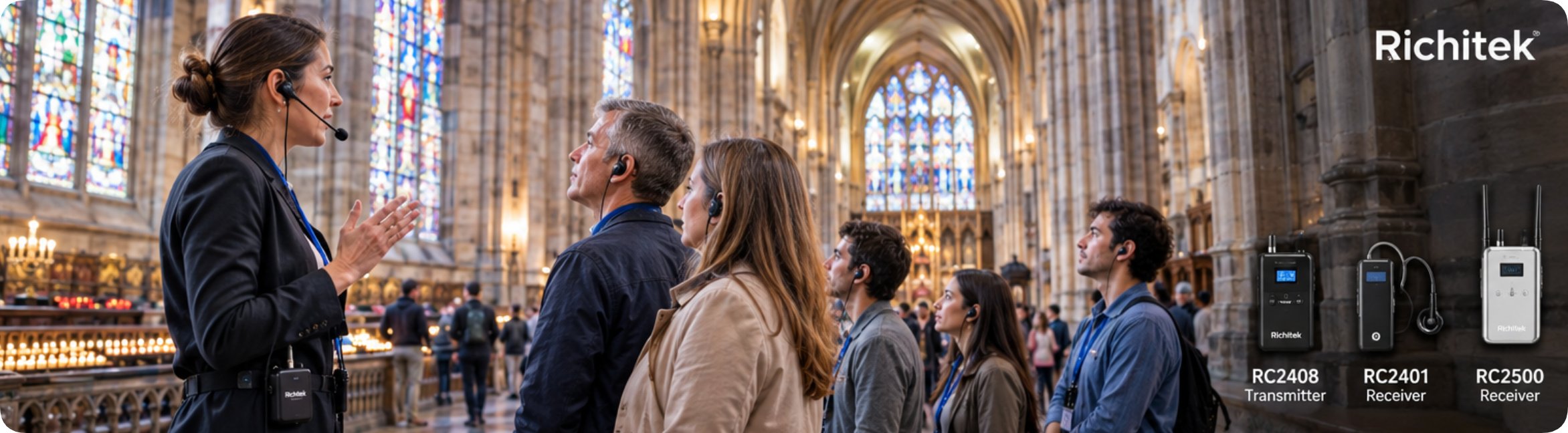
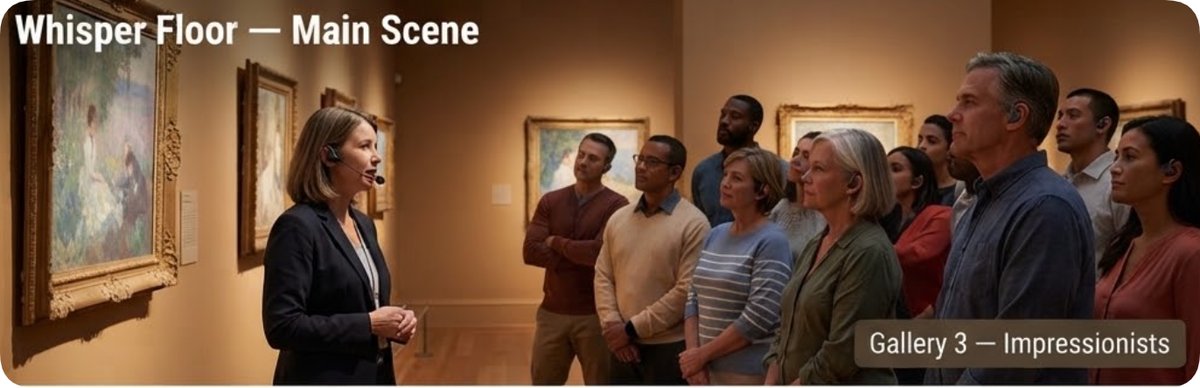
A busy museum does not run one tour. It runs a carousel of languages: the Spanish group at ten, the Mandarin group at eleven, a French school programme squeezed in before lunch, and a walk-in couple at the front desk asking whether there is anything in English. Each rotation needs its own clear frequency, its own set of receivers, and a rental counter that re-arms borrowed units between waves without an IT ticket. That operational shape — language turnover plus a walk-in rental fleet — is what this comparison tests, lining up the RC085, the RC8860 and the RC2401 against two of the oldest names in the trade: Sennheiser's Tourguide 2020, a German legacy flagship still humming in galleries worldwide, and Listen Technologies' iDSP line, the American digital platform built around its home-market band plan. Both rivals earned their reputations; the question is how each one survives a Tuesday language carousel.
richitek museum_multilingual vs sennheiser listen 1

ItemRC085RC8860RC2401Sennheiser TG 2020Listen iDSP
BandUHF 470-510 MHzUHF 860-870 MHz wideband2.4 GHzUHF 863-865 MHz (EU)72 / 216 MHz (US)
Channels10020 PLL5020-classDSP slots
Range, open field200 m class200 m200 m classIndoor classVenue-dependent
Tx / Rx battery10 h / 20 h10 h / 20 h10 h / 20 hTray cycleTray cycle
Receiver weight60 g50 g50 gBelt-packBelt-pack

🏨 The Language Carousel at the Front Desk

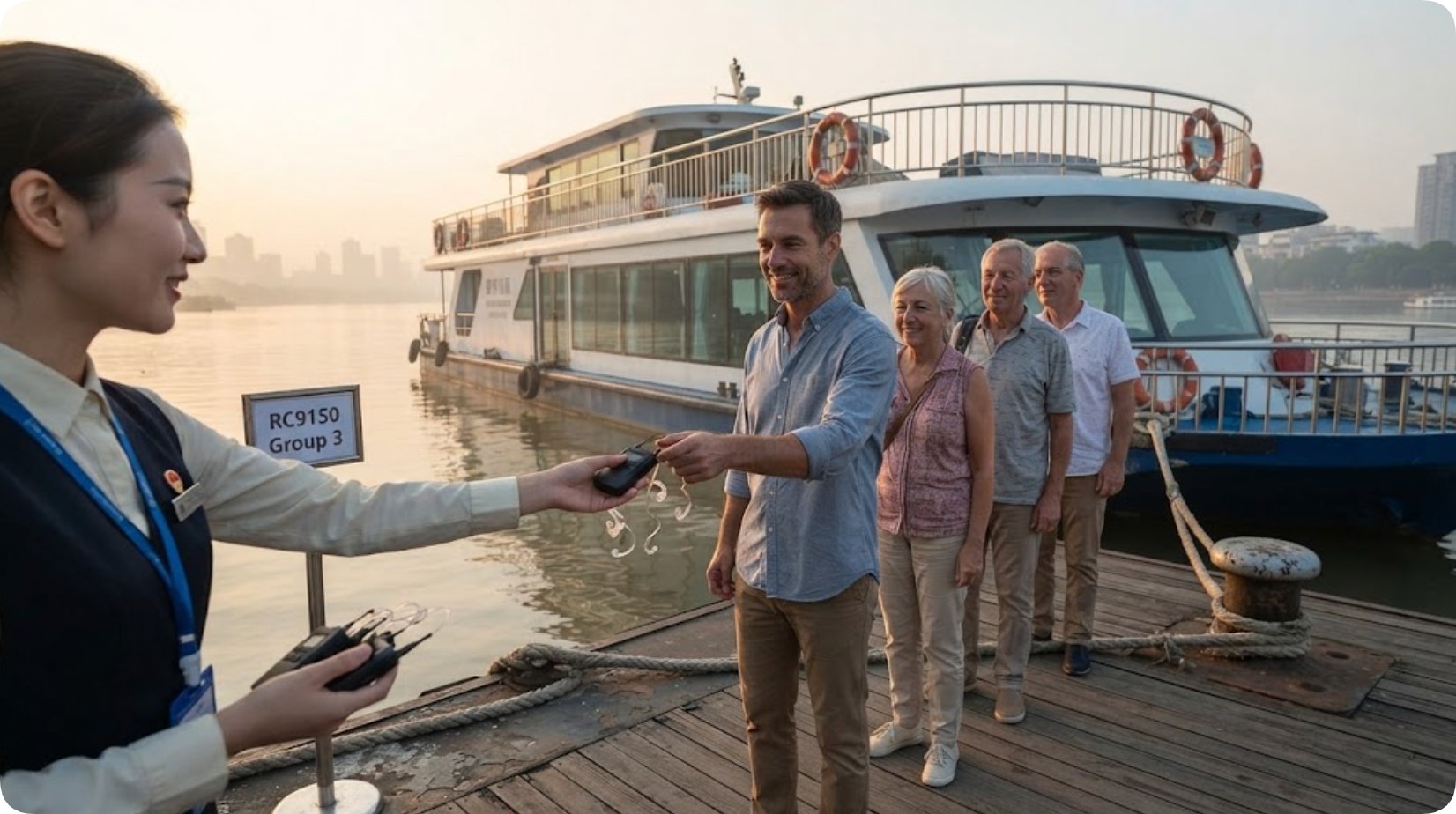
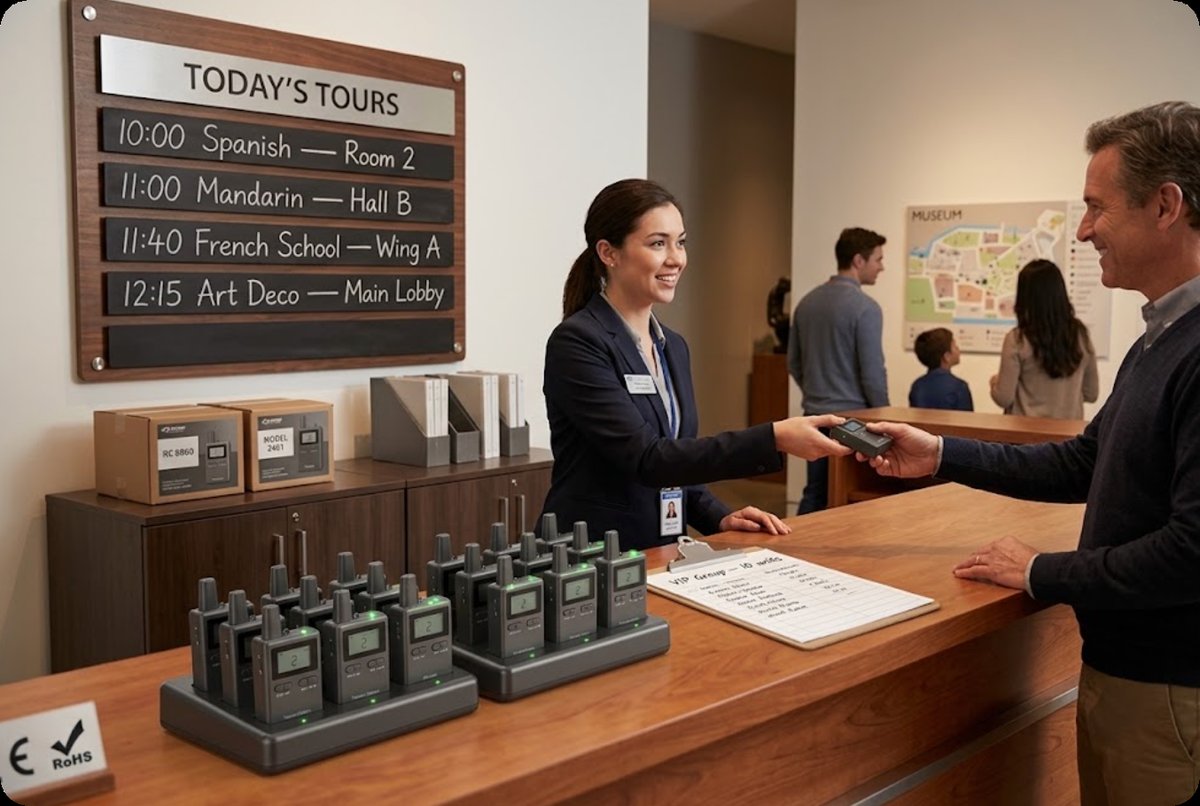
The rental counter is where multilingual programmes quietly succeed or fail. Walk-in visitors have never paired a receiver, the volunteer handing them out has sixty seconds per transaction, and the schedule board behind the desk lists four languages before noon. The operational trick is that none of these rotations needs its own hardware stack — it needs its own frequency, and a fleet that returns charged. Richitek's answer is to let one pool of receivers serve every language of the day: a unit handed to the Spanish group at ten is wiped down, re-charged on the tray and handed to the Mandarin group at eleven with a single channel dial turned. The rivals can run the same carousel, but both lean on infrastructure the venue has to plan around: the Tourguide 2020's charging trays were designed for a fixed daily issue-and-return rhythm, and Listen's iDSP trays are happiest when the fleet stays in one home venue rather than rotating through temporary exhibition halls. For the wider context of how these categories fit cultural venues, the museum audio guide equipment overview breaks the options down by venue size.

One Hundred Channels Before the First Coffee

Channel count sounds like a spec-sheet vanity number until three school groups, a donor preview and a walking lecture share one wing at the same hour. The RC085 carries one hundred UHF channels across 470-510 MHz, and the practical meaning is slack: a museum can assign the Spanish rotation channel twelve, Mandarin on thirty, the French school on fifty-five, and still have half the dial free when a private foundation books a surprise evening visit. Dedicated UHF slots also stay clear of the 2.4 GHz swamp where visitors' phones, earbuds and the café's payment terminals all compete. The RC2401 takes a different route to the same calm: fifty channels on the global 2.4 GHz band, which trades some interference headroom for worldwide licence-free portability — useful when a travelling exhibition takes the fleet across borders. Listen's iDSP answers with clean digital processing but a band plan tied to its home market: the 72 MHz and 216 MHz slots that serve American venues do not exist on European spectrum charts, which is why the company steers overseas buyers toward its Wi-Fi platform instead. Sennheiser's Tourguide 2020 occupies the tidy but narrow 863-865 MHz European slot — legal, quiet, and finite in how many parallel language groups it can host before the dial runs out. For programmes that mix interpretation with live translation days, the simultaneous interpretation system page shows where fixed booths end and portable fleets begin.

Wideband Audio Past the Mezzanine

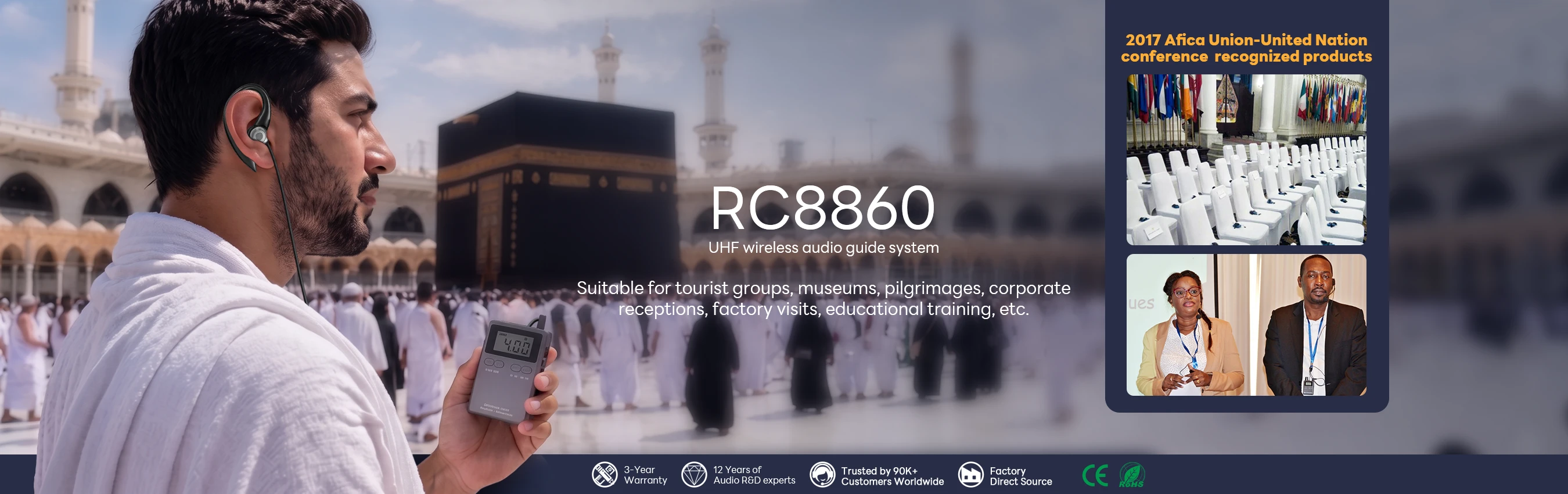
Museum commentary lives or dies on timbre: a whispered description of a Vermeer's glaze collapses when the audio path compresses the life out of it. The RC8860 transmits on UHF 860-870 MHz with a wideband audio path, twenty PLL-locked channels and a two-hundred-metre open-area range that reaches across mezzanine levels without re-pairing, and an IPX4 rating that shrugs off the evening cleaning crew's sprays. Sennheiser's name still carries genuine weight here — the Tourguide 2020 earned its museum decades on audio tuning that made docents sound like radio presenters, and plenty of curators remember it fondly. But the honest ledger has a second column: the platform has been retired from Sennheiser's own catalogue in favour of its newer digital lines, which means replacement receivers, spare parts and firmware support now depend on remaining stock and third-party service rather than the factory's roadmap. A venue buying into the platform today is adopting a legacy, not a future. The RC8860's wideband path chases that same signature clarity on a band that is licence-exempt across Europe, with a current product line standing behind it.

A Fleet That Re-Arms Itself

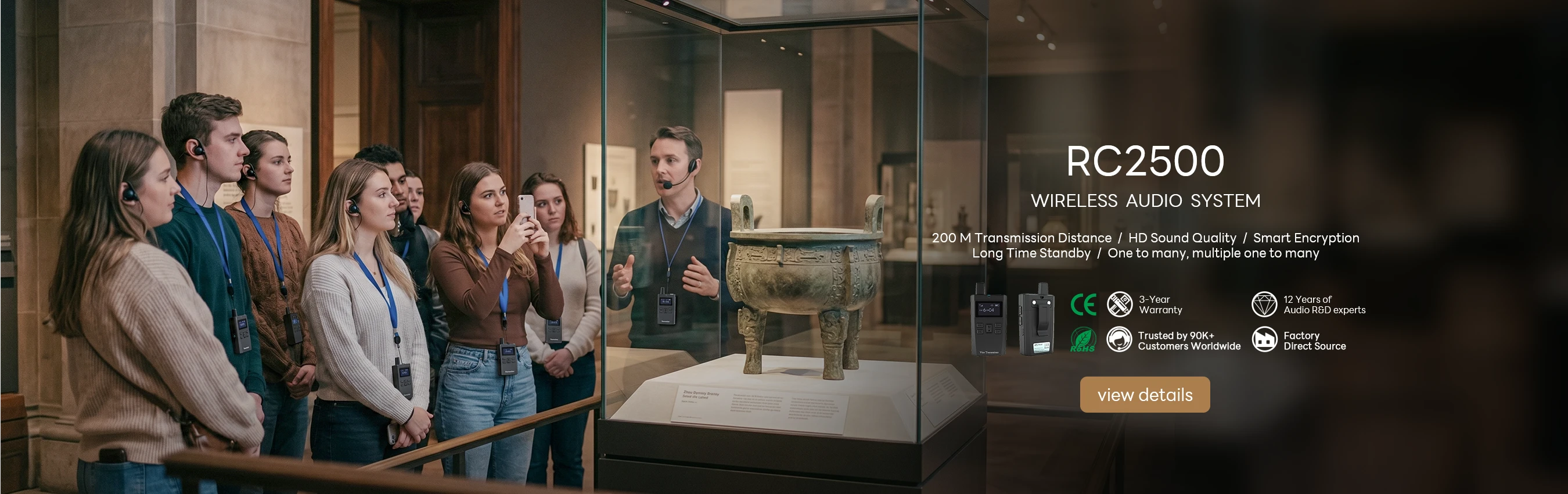
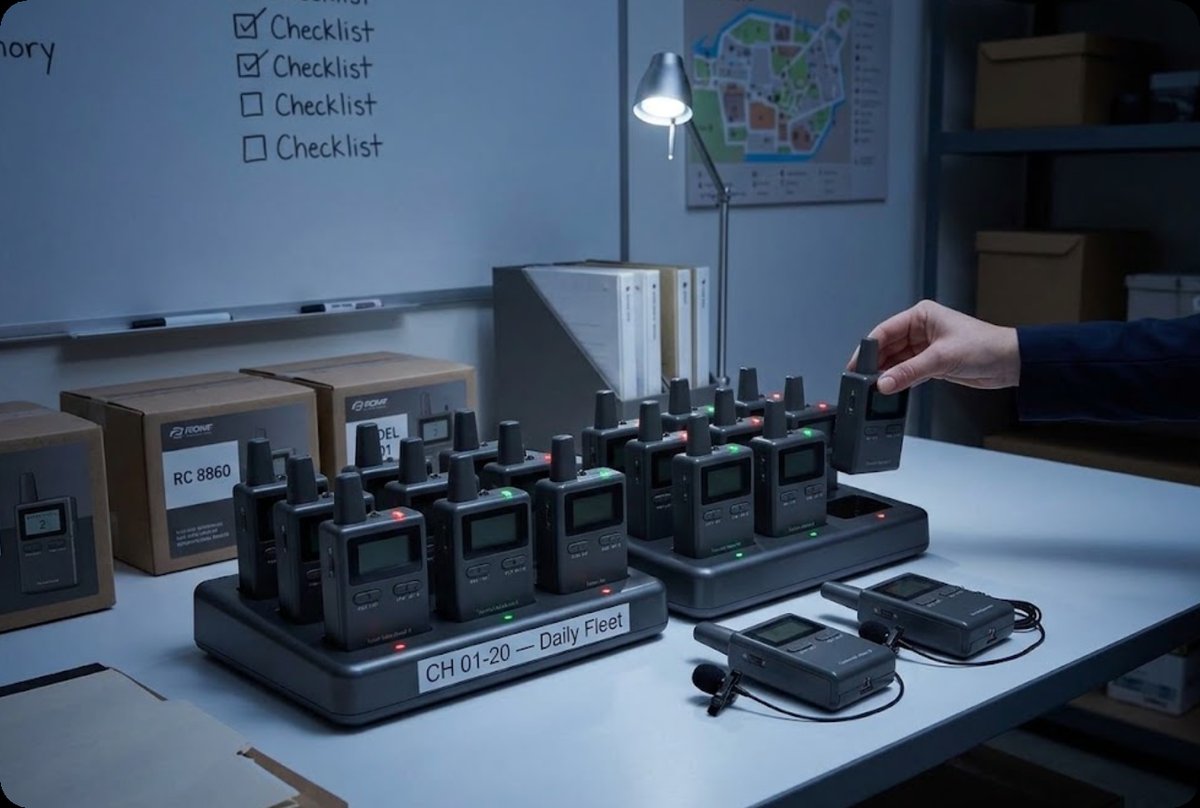
Batteries decide whether the carousel completes its loop. A transmitter that dies at hour eight strands the afternoon docents; receivers that need individual charging cables turn the evening re-arm into a cable hunt. All three Richitek units share the same discipline — ten-hour transmitters, twenty-hour receivers on USB rechargeable cells, topped off in charging trays between waves — and the RC2401 adds a field-repair trick the others lack: its transmitter and receiver units can substitute for each other in a pinch, so a failed transmitter before the eleven-o'clock rotation becomes a channel swap rather than a cancelled programme. Its fifty-gram belt-clip body also clips to a lanyard for visitors who dislike earhooks, and the fifty-channel dial gives volunteers one less decision to make at the counter. Listen's trays match the rhythm for their own fleet, and Sennheiser's legacy trays still work — until one does not, and the replacement conversation circles back to the retired-platform problem.
richitek museum_multilingual vs sennheiser listen 2

The German Legacy and the American Band Plan

Neither rival is a straw man. Sennheiser's Tourguide 2020 is the sound-quality standard that made wireless commentary respectable in cultural venues, and Listen Technologies' iDSP line is a genuinely modern digital platform whose hearing-loop ecosystem makes it a default answer for American venues balancing accessibility obligations. But the carousel exposes different cracks in each: the German line asks a museum to invest in a retired platform, and the American line asks a European or Asian venue to accept a band plan that was never drawn for their spectrum. The Richitek trio answers the carousel where it actually spins — one hundred channels of headroom for colliding language groups, wideband clarity on licence-free UHF, and a fleet that re-arms itself between rotations at a price that lets the rental counter stock spares. When the next language wave lines up at the desk, the comparison archive holds more matchups for every corner of the venue world.

richitek museum_multilingual vs sennheiser listen 3

2026年10月07日 12:51
ꄘ click: 12
no data
Home > VS

Richitek RC085, RC8860 and RC2401 vs Sennheiser and Listen Technologies for Multilingual Museum Tours

time: 2026年10月07日 click:12

A busy museum does not run one tour. It runs a carousel of languages: the Spanish group at ten, the Mandarin group at eleven, a French school programme squeezed in before lunch, and a walk-in couple at the front desk asking whether there is anything in English. Each rotation needs its own clear frequency, its own set of receivers, and a rental counter that re-arms borrowed units between waves without an IT ticket. That operational shape — language turnover plus a walk-in rental fleet — is what this comparison tests, lining up the RC085, the RC8860 and the RC2401 against two of the oldest names in the trade: Sennheiser's Tourguide 2020, a German legacy flagship still humming in galleries worldwide, and Listen Technologies' iDSP line, the American digital platform built around its home-market band plan. Both rivals earned their reputations; the question is how each one survives a Tuesday language carousel.

richitek museum_multilingual vs sennheiser listen 1

ItemRC085RC8860RC2401Sennheiser TG 2020Listen iDSP
BandUHF 470-510 MHzUHF 860-870 MHz wideband2.4 GHzUHF 863-865 MHz (EU)72 / 216 MHz (US)
Channels10020 PLL5020-classDSP slots
Range, open field200 m class200 m200 m classIndoor classVenue-dependent
Tx / Rx battery10 h / 20 h10 h / 20 h10 h / 20 hTray cycleTray cycle
Receiver weight60 g50 g50 gBelt-packBelt-pack

🏨 The Language Carousel at the Front Desk

The rental counter is where multilingual programmes quietly succeed or fail. Walk-in visitors have never paired a receiver, the volunteer handing them out has sixty seconds per transaction, and the schedule board behind the desk lists four languages before noon. The operational trick is that none of these rotations needs its own hardware stack — it needs its own frequency, and a fleet that returns charged. Richitek's answer is to let one pool of receivers serve every language of the day: a unit handed to the Spanish group at ten is wiped down, re-charged on the tray and handed to the Mandarin group at eleven with a single channel dial turned. The rivals can run the same carousel, but both lean on infrastructure the venue has to plan around: the Tourguide 2020's charging trays were designed for a fixed daily issue-and-return rhythm, and Listen's iDSP trays are happiest when the fleet stays in one home venue rather than rotating through temporary exhibition halls. For the wider context of how these categories fit cultural venues, the museum audio guide equipment overview breaks the options down by venue size.

One Hundred Channels Before the First Coffee

Channel count sounds like a spec-sheet vanity number until three school groups, a donor preview and a walking lecture share one wing at the same hour. The RC085 carries one hundred UHF channels across 470-510 MHz, and the practical meaning is slack: a museum can assign the Spanish rotation channel twelve, Mandarin on thirty, the French school on fifty-five, and still have half the dial free when a private foundation books a surprise evening visit. Dedicated UHF slots also stay clear of the 2.4 GHz swamp where visitors' phones, earbuds and the café's payment terminals all compete. The RC2401 takes a different route to the same calm: fifty channels on the global 2.4 GHz band, which trades some interference headroom for worldwide licence-free portability — useful when a travelling exhibition takes the fleet across borders. Listen's iDSP answers with clean digital processing but a band plan tied to its home market: the 72 MHz and 216 MHz slots that serve American venues do not exist on European spectrum charts, which is why the company steers overseas buyers toward its Wi-Fi platform instead. Sennheiser's Tourguide 2020 occupies the tidy but narrow 863-865 MHz European slot — legal, quiet, and finite in how many parallel language groups it can host before the dial runs out. For programmes that mix interpretation with live translation days, the simultaneous interpretation system page shows where fixed booths end and portable fleets begin.

Wideband Audio Past the Mezzanine

Museum commentary lives or dies on timbre: a whispered description of a Vermeer's glaze collapses when the audio path compresses the life out of it. The RC8860 transmits on UHF 860-870 MHz with a wideband audio path, twenty PLL-locked channels and a two-hundred-metre open-area range that reaches across mezzanine levels without re-pairing, and an IPX4 rating that shrugs off the evening cleaning crew's sprays. Sennheiser's name still carries genuine weight here — the Tourguide 2020 earned its museum decades on audio tuning that made docents sound like radio presenters, and plenty of curators remember it fondly. But the honest ledger has a second column: the platform has been retired from Sennheiser's own catalogue in favour of its newer digital lines, which means replacement receivers, spare parts and firmware support now depend on remaining stock and third-party service rather than the factory's roadmap. A venue buying into the platform today is adopting a legacy, not a future. The RC8860's wideband path chases that same signature clarity on a band that is licence-exempt across Europe, with a current product line standing behind it.

A Fleet That Re-Arms Itself

Batteries decide whether the carousel completes its loop. A transmitter that dies at hour eight strands the afternoon docents; receivers that need individual charging cables turn the evening re-arm into a cable hunt. All three Richitek units share the same discipline — ten-hour transmitters, twenty-hour receivers on USB rechargeable cells, topped off in charging trays between waves — and the RC2401 adds a field-repair trick the others lack: its transmitter and receiver units can substitute for each other in a pinch, so a failed transmitter before the eleven-o'clock rotation becomes a channel swap rather than a cancelled programme. Its fifty-gram belt-clip body also clips to a lanyard for visitors who dislike earhooks, and the fifty-channel dial gives volunteers one less decision to make at the counter. Listen's trays match the rhythm for their own fleet, and Sennheiser's legacy trays still work — until one does not, and the replacement conversation circles back to the retired-platform problem.

richitek museum_multilingual vs sennheiser listen 2

The German Legacy and the American Band Plan

Neither rival is a straw man. Sennheiser's Tourguide 2020 is the sound-quality standard that made wireless commentary respectable in cultural venues, and Listen Technologies' iDSP line is a genuinely modern digital platform whose hearing-loop ecosystem makes it a default answer for American venues balancing accessibility obligations. But the carousel exposes different cracks in each: the German line asks a museum to invest in a retired platform, and the American line asks a European or Asian venue to accept a band plan that was never drawn for their spectrum. The Richitek trio answers the carousel where it actually spins — one hundred channels of headroom for colliding language groups, wideband clarity on licence-free UHF, and a fleet that re-arms itself between rotations at a price that lets the rental counter stock spares. When the next language wave lines up at the desk, the comparison archive holds more matchups for every corner of the venue world.

richitek museum_multilingual vs sennheiser listen 3

no data
×

Contact us

email:
name:
subject:
content: