
.webp)
A corporate training department never runs just one room. Monday morning brings an onboarding cohort of thirty into the biggest space in the building, Wednesday splits two product workshops across separate floors, and once a quarter a guest instructor flies in to certify the field team — usually with a microphone request that arrives the night before. The audio kit has to absorb all of it: cohort-scale delivery, stacked breakout rooms, and a fleet that an IT or facilities team can re-deploy between offices without babysitting. This comparison walks that calendar through three Richitek units — the RC9150 flagship, the RC2406 multi-room transmitter and the RC2402 encrypted fleet workhorse — and sets them against two very different outsiders: the premium Williams AV Digi-WAVE 300 platform and the budget EXMAX EX-938 kit. For a wider look at how these categories fit training rooms specifically, the training and teaching wireless audio overview covers the fundamentals.

🔍 The Morning Cohort Problem
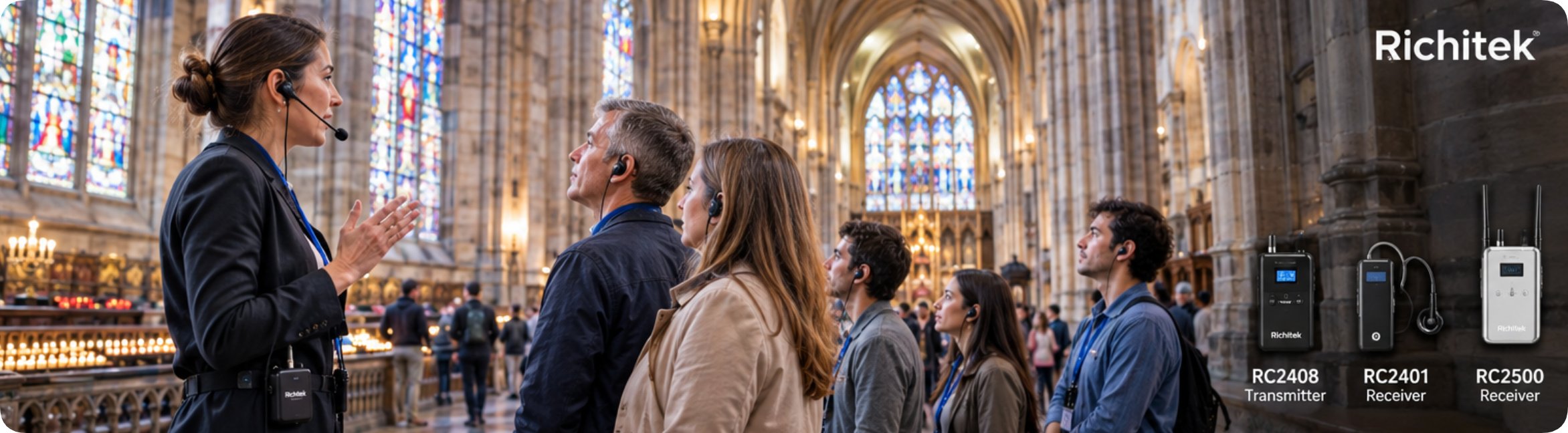
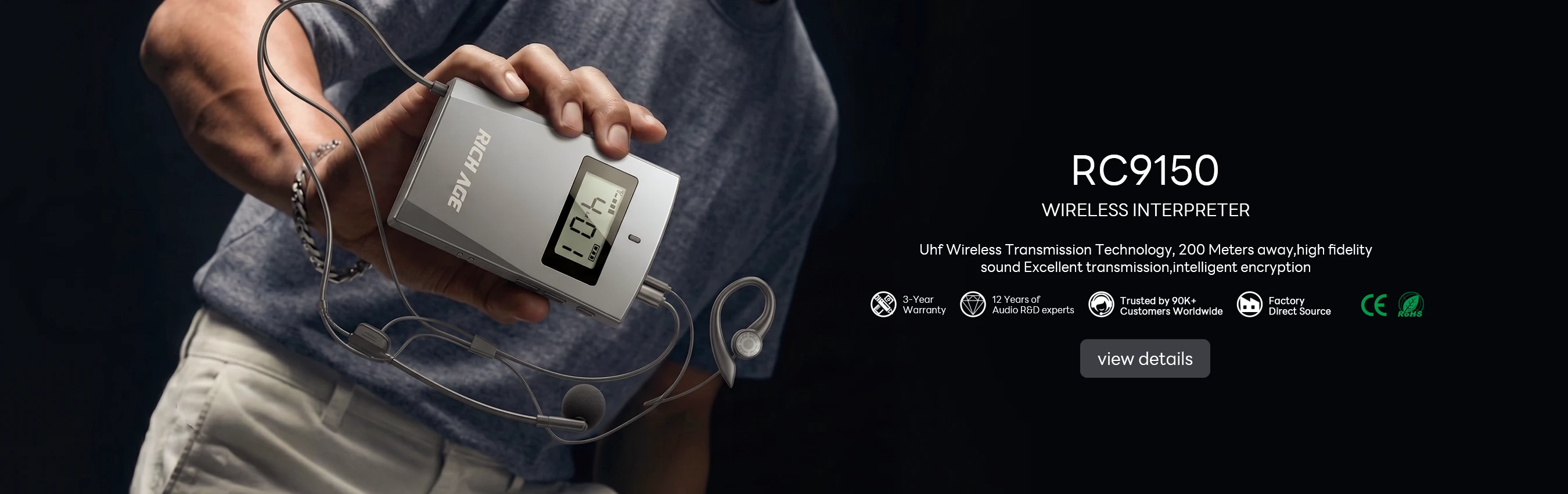
Thirty new hires in one room is a wear problem as much as a range problem. Receivers go on at nine and come off at five, with lunch in between, so anything that hooks inside the ear starts to hurt by mid-afternoon. The RC9150 addresses this two ways: its non-in-ear bud design rests against the ear rather than sealing inside it, and at 97.5 grams the transmitter and receiver share identical, pocketable dimensions rather than loading one side of the body. Battery arithmetic covers the full day without a mid-session swap — fifteen hours of transmitter runtime and thirty-five-plus hours on the receiver side, both charging over Type-C from the same desk bricks the office already owns.
The channel count is where the flagship earns its slot in the rack. One hundred channels on the 2.4 GHz band mean a training department can run the onboarding cohort, the sales enablement session and the compliance refresher in the same building on the same morning without a coordination call — and the kit pairs with the H730T second transmitter, so when the guest instructor lands on Thursday, facilities hands over a second transmitter pre-paired to the same fleet instead of rebuilding the room.
Breakout Floors Without Crosstalk
Splitting thirty people into two afternoon workshops on different floors is where cheaper rigs audibly fall apart. The RC2406 runs an eighty-channel multi-line plan designed exactly for this: each breakout room takes its own line, and the 2.4 GHz transmission keeps the two rooms from stepping on each other even through a concrete intermediate slab. Transmitters hold ten hours on a 1500 mAh cell and receivers twenty on 1000 mAh, so a morning setup survives an afternoon of back-to-back sessions without anyone opening a battery door. At 59 and 50 grams, the units clip onto a trainer's belt and disappear into a lanyard routine that new facilitators learn in about a minute. And because both rooms run on the same license-free 2.4 GHz band, the department never files for frequency clearance when it adds a third workshop next quarter — it just opens another line on the same transmitter fleet.

💰 A Fleet IT Can Re-Deploy
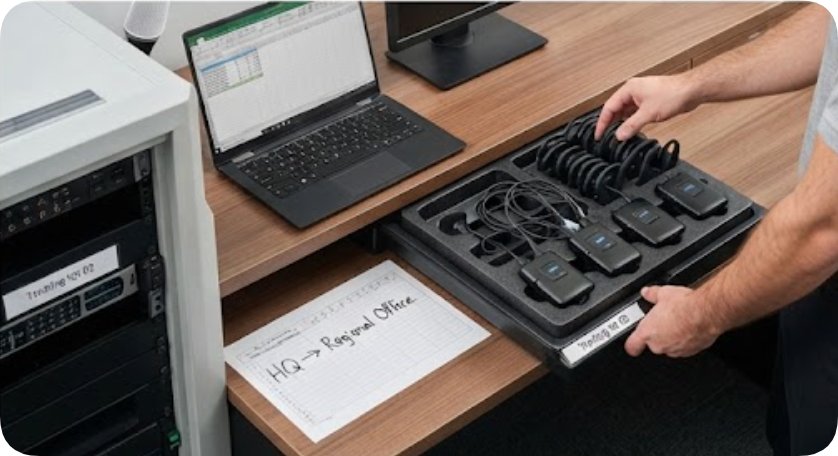
The unglamorous third act of any training kit is logistics. Devices move between the headquarters training suite, the regional office and the occasional hotel ballroom, and every move risks the same failure mode: someone re-pairs forty receivers by hand in a corridor. The RC2402 is built for that hand-off. One-click sync brings a freshly unboxed or freshly moved fleet onto the trainer's channel in seconds, and built-in encryption keeps a product-launch rehearsal from leaking to a competitor's delegate in the next ballroom — a detail that matters more in corporate settings than in tourism. The 200-meter open-area range covers a full floor plate, ten hours of transmitter and twenty of receiver runtime cover the working day, and the lightweight earpiece build keeps the units comfortable through an eight-hour facilitation stint.
| System | Band / Channels | Range | Battery Reality | Wear & Security |
|---|---|---|---|---|
| Richitek RC9150 | 2.4 GHz; 100 ch; 10 mW | Open-area, floor-plate scale | Tx 15 h / Rx 35+ h; Type-C | 97.5 g each; non-in-ear bud; H730T second transmitter |
| Richitek RC2406 | 2.4 GHz; 80 ch multi-line | Multi-room floor plan | Tx 10 h (1500 mAh) / Rx 20 h (1000 mAh) | 59 / 50 g; belt clip |
| Richitek RC2402 | 2.4 GHz; one-click sync | 200 m open area | Tx 10 h / Rx 20 h | Light earpiece; encrypted link |
| Williams AV Digi-WAVE 300 | 2.4 GHz FHSS; 15 interpretation ch; 4 two-way groups | Up to 229 m claimed; 61–91 m per FAQ | DLT 300: 14 h talk / 40 h occasional, Li-Po; DLR 360: 24 h on AAA | 47 g receiver (no batteries); 87-bit encryption; repeater mode |
| EXMAX EX-938 | UHF 433–500 MHz (listing-dependent); 11 ch, 5 groups | 50 m per spec sheet; 150 m per listing | 2×AA: Tx 12–15 h / Rx 15–25 h (listing-dependent) | Tx 66 g / Rx 71 g; aluminum case; MIC + AUX (not simultaneous) |
The Premium Two-Way Contender
The Williams AV Digi-WAVE 300 is the system a facilities director buys when the training room also has to behave like a council chamber. Its DLT 300 transceiver is genuinely full-duplex: up to six people can hold the talk button in intercom mode, four in structured two-way, which makes it superb for role-play exercises, mock negotiations and team-teaching where two facilitators genuinely converse. The build is serious — an 87-bit encrypted link, a repeater mode that stretches coverage, a lithium-polymer pack with smart charging that delivers fourteen hours of talk time or forty hours of occasional use. The honest costs sit in the same paragraph: the platform prices well above one-way tour-guide hardware, the receiver line runs on AAA batteries unless you step up to rechargeable kits, and even Williams' own paperwork drifts on range — the specification sheet claims up to 229 meters while the FAQ conservatively promises 200 feet outdoors and 300 feet indoors. Two-way conferencing is an advantage the one-way Richitek units genuinely do not match; whether a training department needs it is a question about the curriculum, not the radio.
The Budget Shelf and Its Fine Print
The EXMAX EX-938 is the opposite argument: the cheapest credible way to put a transmitter and forty receivers into a training budget. It is an FM-analog UHF unit with eleven channels — enough for five co-located groups — a pair of AA batteries per unit, and a rugged aluminum transport case that survives being thrown into a training van. The fine print is the catch, and it is worth reading twice: the official specification page quotes a 50-meter range on a 433 MHz carrier, while marketplace listings for the same model number claim 150 meters on 500 MHz, and receiver runtime wanders between fifteen and twenty-five hours depending on which listing you believe. None of this makes it a bad purchase; it makes it a purchase where the buyer must test the actual unit in the actual building, because the manufacturer will not commit to one number. The MIC and AUX inputs also refuse to work simultaneously, so a laptop-backed slideshow needs a channel decision, not just a cable.
Where Each System Wins
For a training operation that lives on cohort scale, stacked breakouts and fleet logistics, the Richitek trio covers the calendar end to end: the RC9150 anchors the main room and absorbs guest instructors through its second-transmitter support, the RC2406 splits workshops across floors on its eighty-line plan, and the RC2402 moves encrypted fleets between offices in seconds. Williams AV wins the moment two-way conversation becomes the curriculum, and it charges accordingly. EXMAX wins on price and loses on certainty — workable, provided the buyer tests before scaling. Browse the full wireless tour guide system range to match a fleet to your rooms, or compare more head-to-head matchups in the comparison archive.