A walking tour can stop when the group falls behind. A cycling tour cannot. The guide pedals at the front, the route pulls the queue apart, and within ten minutes the distance between the first rider and the last can stretch past fifty metres of open road. Whatever carries the guide's voice across that gap has to work while everyone is moving, at speed, with wind noise and traffic competing for the same air.
Most cycling operators solve this with one of three tools: a two-way intercom built for motorcyclists, a bone-conduction headset fed by a phone, or a dedicated wireless tour guide system where every rider wears a small receiver. They look similar on a equipment shelf. On the road they behave nothing alike, and the differences show up in exactly the places a ride is hardest: the stretched-out queue, the road noise, and the hour when everyone's battery is already tired.
⚖️ The Road Stretches Between Guide and Group
On foot, a guide can gather a drifting group with a raised hand. On a bike, the same drift becomes a spacing problem. Riders coast on downhills, sprint to catch up after junctions, and hold back on climbs, so the column opens and closes continuously. A guide who stops to wait trades distance for schedule, and a group that spreads over two hundred metres of road has effectively left the range of any loud voice.
This is why cycling tours fail quietly with improvised audio. The guide shouts into the wind, the front four riders hear every word, and riders ten back hear a phrase with the consonants torn off. Nothing announces the failure — the tour simply becomes shorter on information with every kilometre, and by the lunch stop the people at the back have stopped asking questions they know they will not hear the answers to.
A Helmet Speaker Answers a Question Nobody Asked
The first borrowed tool is motorcycle hardware. The Sena Spider ST1 is a well-built piece of kit: Mesh Intercom 3.0, an open-mesh working range of up to 2 km in open terrain (extendable to 8 km with at least six riders at 1.6 km intervals), 6 switchable channels, Bluetooth 5.2, a 60 g main module, and a claimed 20 hours of talk time with a 20-minute fast charge returning 2 hours. For a group of riders who all wear helmets and want to talk to each other, it is an honest product.
A cycling tour group is not that group. The guide talks; the riders mostly listen. The mesh's two-way design buys nothing here and costs plenty: every participant needs a headset mounted inside a helmet, which means every tourist has to wear a helmet on a ride where the local law may not require one, and the operator has to fit, sanitize, and charge a bulky module per guest. The 2 km range is real, but it is range for rider-to-rider conversation — nobody on a food-and-architecture ride asked for a intercom conference at 60 km/h. The hardware is engineered for a job the tour does not have, and the job the tour does have — one clear voice to thirty listeners — is the part the mesh platform never needed to be good at.
Ten Metres of Bluetooth Is Not a Route
The second borrowed tool is consumer audio. The Shokz OpenRun Pro is a genuinely clever headset: 29 g of full titanium, IP55 sweat resistance, Bluetooth 5.1, dual noise-canceling microphones at -38 dB, 10 hours of playback from a 140 mAh cell, magnetic charging with a 5-minute top-up returning 1.5 hours, and an open-ear fit that leaves both ears free to hear traffic. Rental fleets love it because it is light and hygienic to hand out.
Its constraint is printed on the spec sheet: the wireless range is 10 m. The OpenRun Pro is a Bluetooth peripheral, not a radio system. To reach every rider, the guide's phone must stay within ten metres of every tourist, on a route where the queue alone can stretch four times that distance. Operators work around this by playing pre-recorded commentary from an app, but pre-recorded has a cost that compounds over a day: it cannot answer questions, it cannot reroute the commentary when a road is closed, and it cannot tell the group at the back that the guide just spotted something worth stopping for. A tour that cannot react is an audio file with scenery.
One Ear Open on Shared Roads
Shokz deserves credit for one idea cycling tours should keep: the open ear. A rider who cannot hear a car horn or a fellow cyclist calling a turn is a hazard, so nothing that seals both ears belongs on a shared road. The honest comparison is not open-ear versus sealed; it is which open-ear system also carries one live voice across a whole route.
A tour guide receiver does exactly that. The guide wears a transmitter with a microphone; each rider wears a light receiver with a single-sided earpiece, one ear open, both hands on the bars. The guide speaks at conversational volume, the commentary reaches the whole column at once, and the rider's free ear keeps doing its road-safety job. Nobody reaches for a phone, nobody fiddles with pairing, and a rider who stops to photograph a gate hears the guide again the moment they rejoin — no reconnection ritual.
The UHF Case at the Roadside
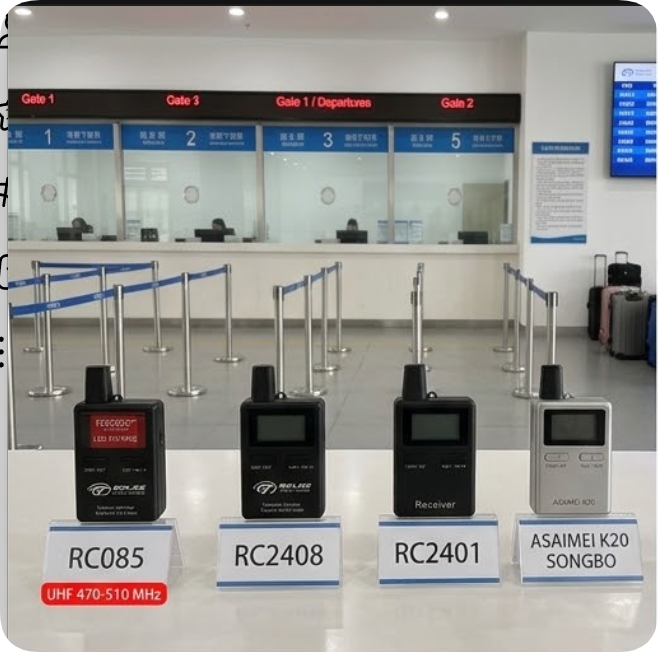
Roadside radio is its own environment, and this is where the RC085 Digital Tour Guide System earns its place on a cycling route. It runs on a UHF band of 470-510 MHz instead of the crowded 2.4 GHz spectrum that bikes share with every phone, e-bike controller, and Bluetooth device in the neighbourhood. With 100 channels and PLL frequency synthesis, an operator can park each group of the day on its own frequency, and a receiver sensitivity of about -102 dBm helps the link hold at the edge of range. The transmitter weighs 65 g with a 3.7V 1200mAh battery rated for 12 hours; the receiver is 60 g with a 3.7V 1000mAh cell rated for 20 hours and charges over USB. Output power is 8-10mW across a working range of 1-200m, and the kit accepts an optional headband or lavalier microphone, which matters when the guide wants a mic that sits still under a helmet strap.
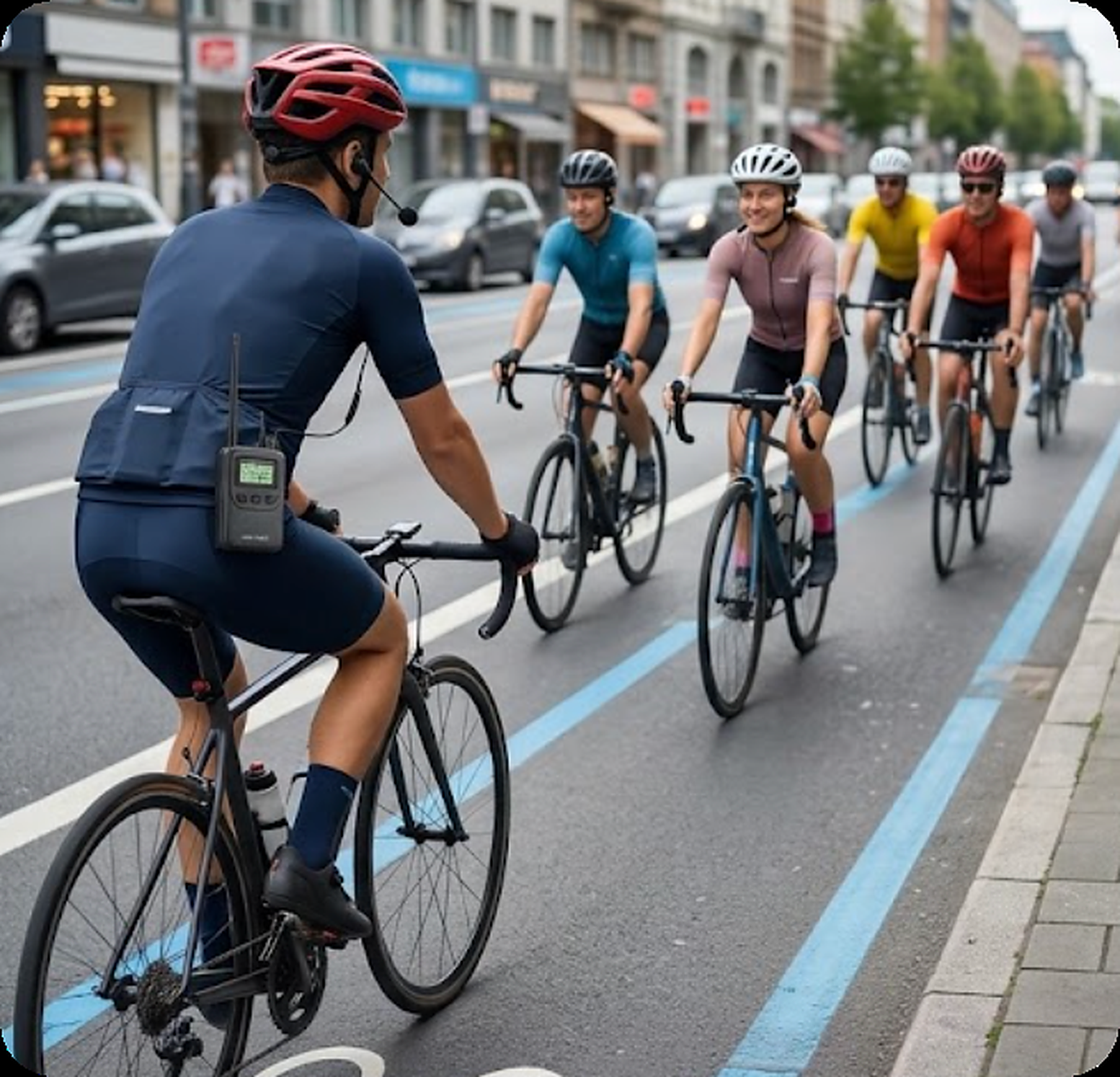
The practical meaning of UHF on a ride is simple: the frequency band is not fighting the riders' own devices. A 2.4 GHz system can work beautifully on a quiet river path and then degrade on a city bike lane packed with connected gadgets. The RC085 sidesteps that fight entirely, which is why it is the unit to hand the guide leading routes through town.
Two 2.4G Kits Split the Fleet
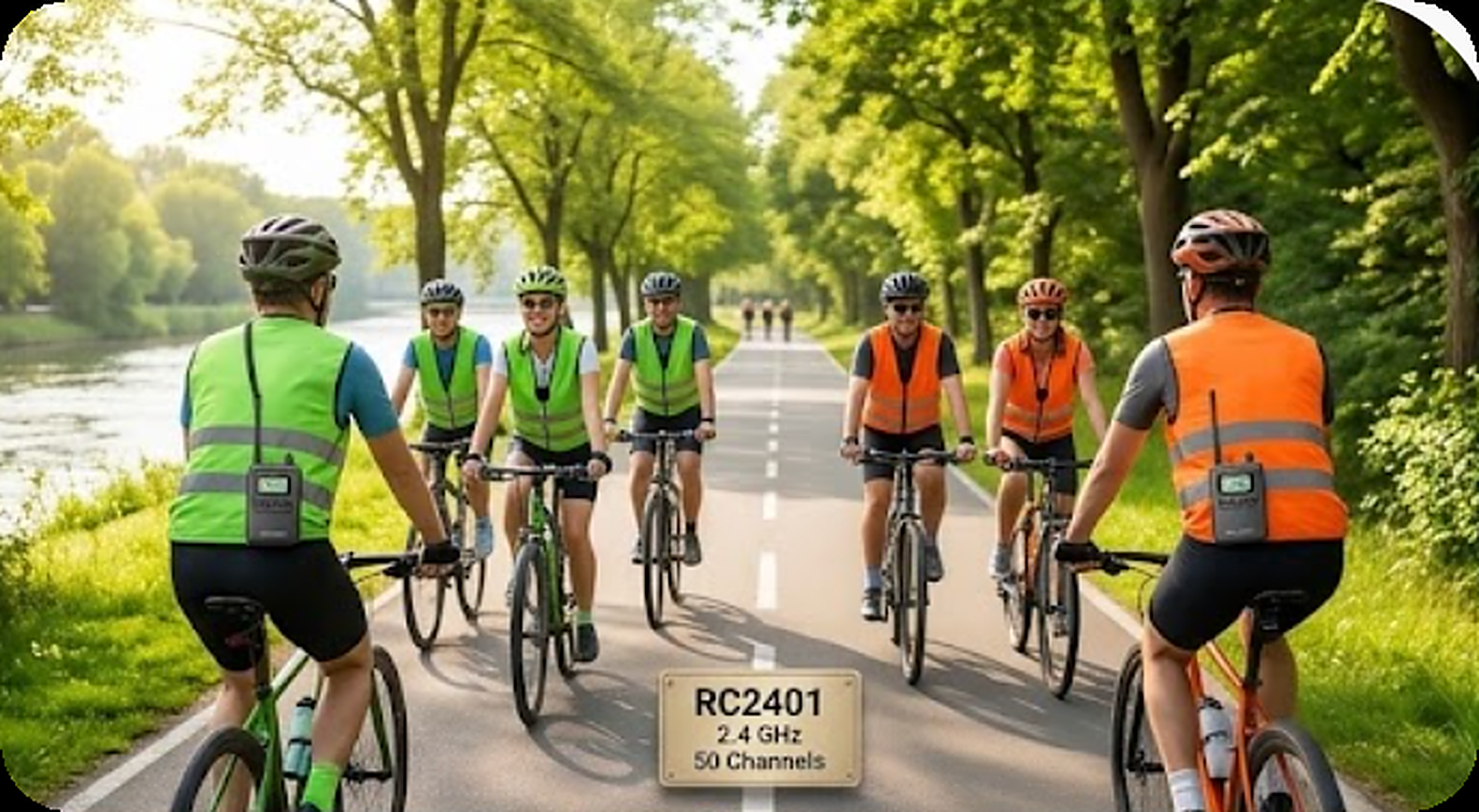
For the quieter routes — park paths, riverside lanes, wine-country roads — the 2.4 GHz kits divide the work cleanly. The RC2401 Wireless Audio Guide System is the fleet workhorse: 50 channels, 10mW output, a 59 g transmitter with a 3.7V 1500mAh battery rated for 10 hours, and a 50 g receiver with a 3.7V 1000mAh cell rated for 20 hours, charging over a DC port. It is the kit an operator buys by the dozens, labels by group colour, and hands out without a training session.
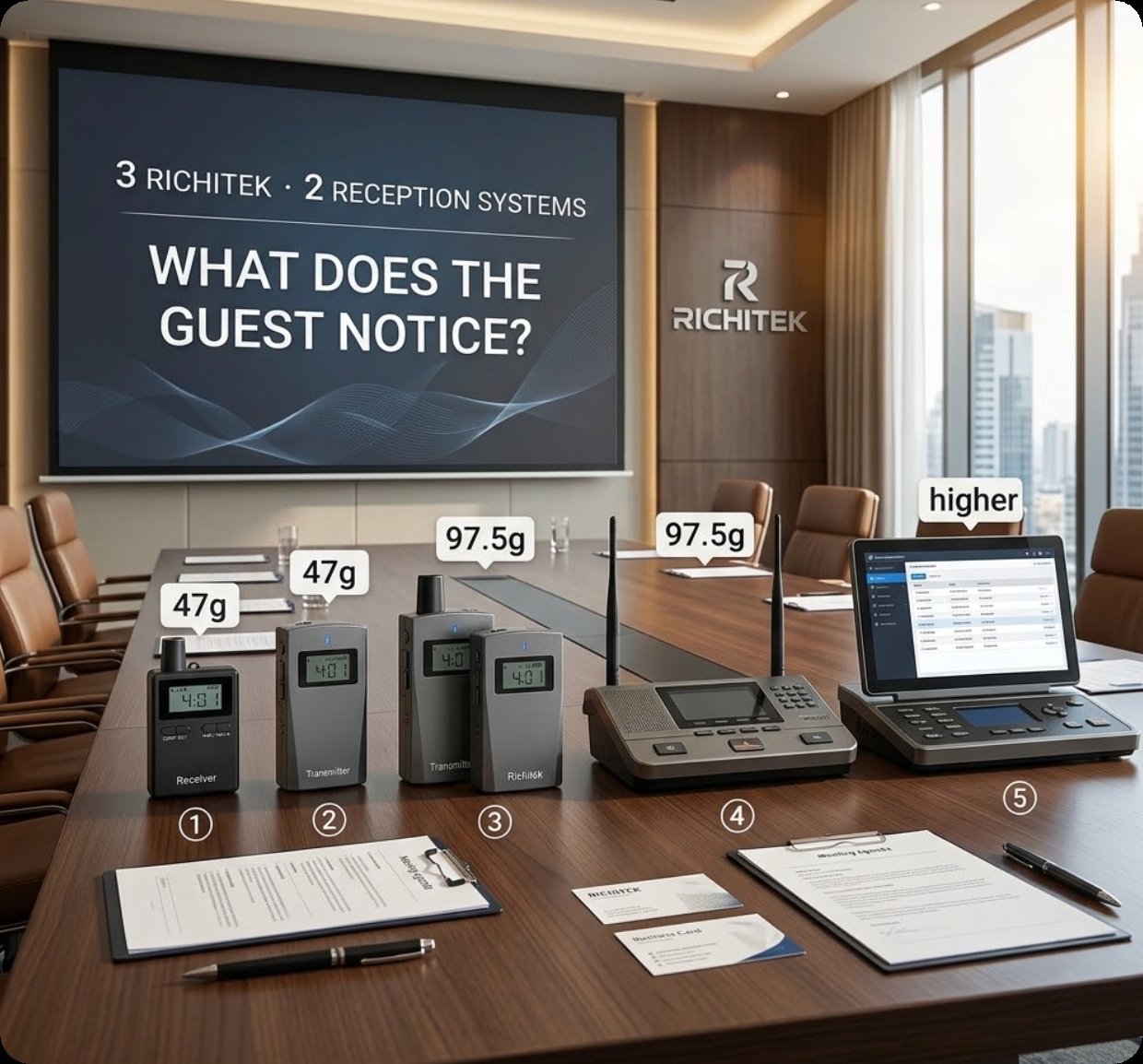
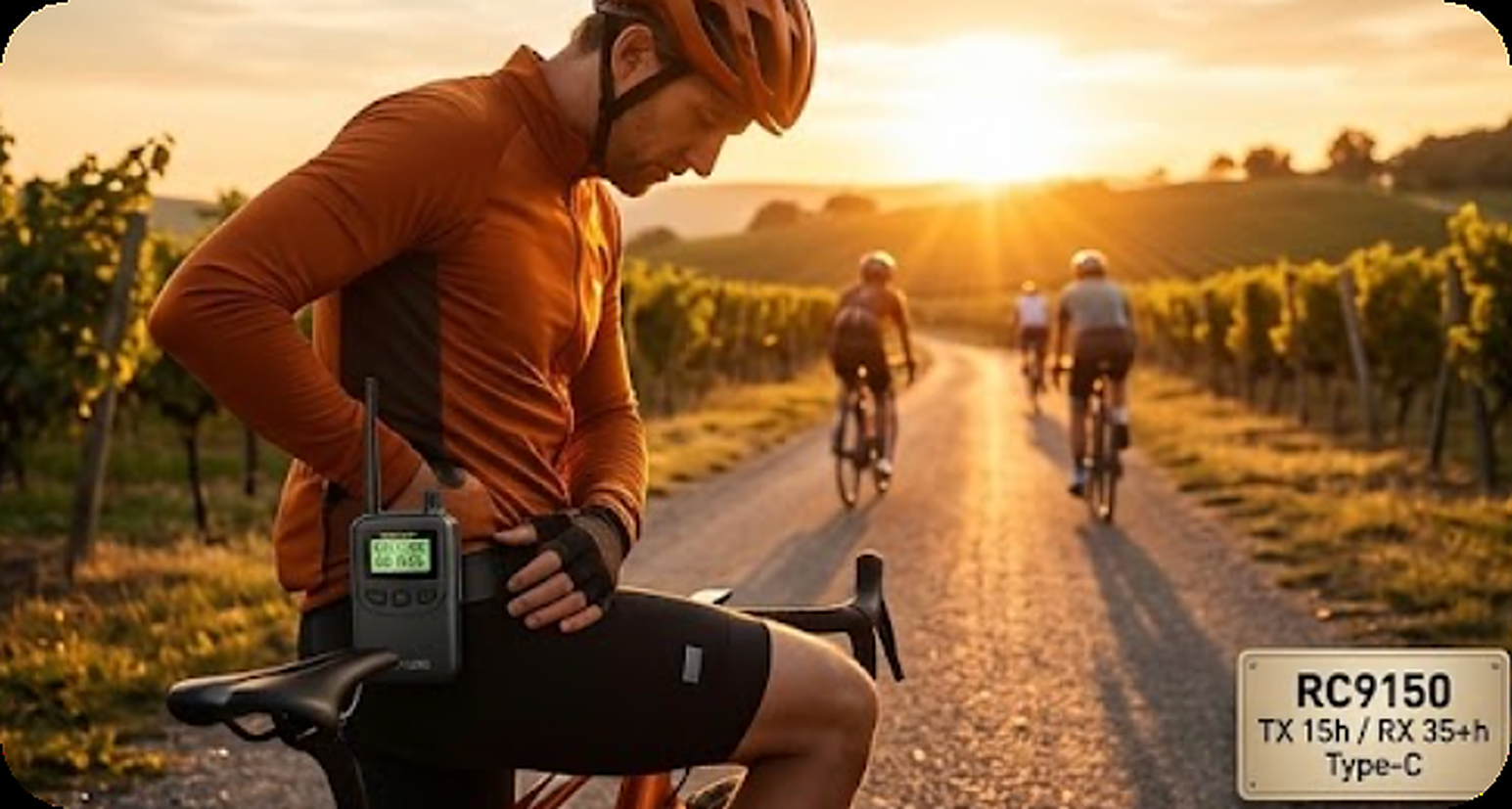
The RC9150 2.4G Wireless Audio Guide System is the long-day unit. Its transmitter carries a 3.7V 1800mAh battery rated for 15 hours and the receiver is rated beyond 35 hours on its own 3.7V 1800mAh cell, with standby figures of 15 hours and 35-plus hours respectively — both units charge over Type-C, and both weigh 97.5 g. On a full-day loop that starts at eight and ends after dinner, the RC9150 is the kit that does not ask to be swapped at lunch. With 100 channels it also anchors the largest single group in the fleet.
The division is by route, not by quality. A town-heavy itinerary leads with the RC085 because the band is quieter; the park and countryside itineraries run RC2401 units at high volume; and the RC9150 covers the marquee full-day rides where battery life is the constraint that actually bites.
What the Three Kits Put on Paper
| Specification | RC9150 | RC2401 | RC085 |
|---|---|---|---|
| Channels | 100 | 50 | 100 |
| Working range | 1-200m | 1-200m | 1-200m |
| Transmitter battery life | 15h | 10h | 12h |
| Receiver battery life | 35+h | 20h | 20h |
| Transmitter weight | 97.5g | 59g | 65g |
| Receiver weight | 97.5g | 50g | 60g |
| Transmitter battery | 3.7V 1800mAh | 3.7V 1500mAh | 3.7V 1200mAh |
| Receiver battery | 3.7V 1800mAh | 3.7V 1000mAh | 3.7V 1000mAh |
| Charging port | Type-C | DC Port | USB |
The frequency band and output power stay out of the table because they tell a story better told in prose: the RC085 broadcasts at 8-10mW in the 470-510 MHz UHF band, while both 2.4G kits run 10mW in 2403-2483 MHz. Every unit shares the same 1-200m working range, which is the number that matters most against the alternatives above — ten times the OpenRun Pro's Bluetooth radius, and a working envelope sized to a real, stretched-out cycling column rather than a rider's helmet.
Where the Sena Headset Still Wins
Fairness requires saying what the borrowed hardware does better. The Sena Spider ST1 offers genuine two-way conversation — a rider at the back can ask a question and the whole mesh hears it, which no one-way tour system allows. Its 2 km open-terrain range dwarfs 200 m. Its 20-hour talk time beats every transmitter here, its 20-minute fast charge is the quickest recovery on this page, and its -10 to 55°C operating window is wider than most tour electronics specify. For guided rides where every guest is an experienced cyclist in a full-face helmet on a mountain-bike descent, the mesh platform is the right tool and no tour kit replaces it.
The OpenRun Pro wins on wearability: 29 g is a fraction of any receiver, the open-ear design is the safest listening posture on a road, and IP55 sweat resistance plus a titanium frame survive daily rental abuse. Where its 10-hour battery and 10 m radio fall short, the failure is architectural — it was never built to be a broadcast receiver — but as a personal audio device it remains excellent.
Matching the Kit to the Pace of the Ride
The three failure modes of cycling-tour audio are distance, noise, and the rental model. Distance kills shouting and Bluetooth; noise kills bare loudspeakers and unmiked speech; the rental model kills hardware that needs a helmet, an app, or a smartphone to work. A dedicated tour guide system survives all three because it was designed for exactly this shape of problem: one transmitter, many light receivers, a range measured in hundreds of metres, and a radio band chosen to match the route.
Operators running rides inside historic city centres should lead with the RC085 and its UHF band; volume fleets on park and riverside routes belong to the RC2401; and the full-day flagships deserve the RC9150's 15-hour transmitter and 35-plus-hour receiver. The city tour wireless audio solutions page collects the same logic for walking groups, and the same three kits carry over with nothing but the earpieces changed. The guide rides ahead. With the right band and the right battery, the voice simply follows.
Frequently Asked Questions
Do receivers work while both the guide and the riders are moving?
Yes — that is the design case. The 1-200m working range is specified for open-air use, and a cycling column moving at 15-20 km/h stays well inside it as long as the guide rides near the front. The link does not care about speed; it cares about distance and obstructions, and an open road has fewer of both than a museum corridor.
How many bikes can one transmitter cover on a climb?
A climb is the hardest moment because the column stretches longest. In practice a guide covers 30-40 riders comfortably when the road is straight; switchbacks and hairpins shorten the effective range because the rock between riders blocks the signal. Guides on mountain routes repeat the key points at the next regroup point rather than fighting the geometry.
What happens when two cycling groups share the same path?
They do not collide. The RC085 has 100 channels and the two 2.4G kits carry 100 and 50 respectively, so a fleet running three concurrent groups assigns each guide a different channel at dispatch. A channel change takes seconds at the transmitter and none at all if receivers were pre-set before the ride.
Do riders need to charge anything during a full-day tour?
No receiver in the three kits needs a midday charge: the RC9150 receiver is rated beyond 35 hours and the RC2401 and RC085 receivers are rated for 20 hours each. Only the guide's transmitter needs attention on the longest itineraries, and the RC9150 transmitter's 15-hour rating covers a dawn-to-dinner loop without a power bank.