
I have lost count of the game drives I have watched fall apart acoustically. A leopard steps out of the thicket, six Land Cruisers converge, and suddenly every guide on the floodplain is shouting over an idling diesel engine while thirty visitors crane their necks and hear none of it. Safari operators eventually buy audio equipment — but the two boxes they usually buy first, a pair of consumer walkie-talkies and a crew intercom set, were engineered for construction sites and film sets, not for a vehicle moving through broken acacia country at dawn. Before spending lodge-budget money, it is worth being honest about how differently a wireless tour guide system behaves out there.
🔍 Two Radios Show Up on Every Safari Vehicle. Both Fail the Same Test.
The equipment pallet that arrives at most safari camps contains two very different communication philosophies, and each one breaks in a distinct way once the vehicle leaves the gate.
Motorola Talkabout T470: Everyone Waits for the Button
The T470 is the default purchase because it is cheap, orange, and promises "up to 56 km" on the box. The fine print matters more: that figure assumes unobstructed line of sight between mountain tops, and independent field testing puts real-world range at one to three miles in suburban or forested terrain — which, on a bush track winding through dense scrub, shrinks further. The deeper problem is protocol, not distance. The T470 is a half-duplex FRS radio: 22 channels and 121 privacy codes on 462-467 MHz, but only one person can transmit at a time, and only while holding the push-to-talk button. A guide narrating a stalk cannot hold a button for four minutes; he speaks in bursts, and every burst ends with silence while he presses again. Guests who try to ask a question press the same button and cut him off mid-sentence. Weatherproofing is IPX4 — splash-resistant, fine for a dry-season dust plume but not a design for the daily bath of red dust a game road produces — and the NiMH pack is 800 mAh good for roughly 12 hours, with a micro-USB charge port that camp solar inverters tolerate but do not love.
Eartec UltraLITE: An Open Line That Seals Both Ears
The UltraLITE is a genuinely impressive piece of engineering, and in film crews it is exactly the right tool. DECT at 1920-1930 MHz, license-free in the US, full-duplex conversation for up to five headsets with one MAIN unit relaying four Remotes, roughly 300 yards of line-of-sight range at 100 mW. Nobody presses anything; the line is always open. On a game drive, that openness becomes the problem. The standard configuration is a double-ear headset weighing about 113 g per unit with a boom microphone — it seals both ears, which is precisely what safari safety rules forbid. Every professional camp briefs the same rule: keep your ears open for the ranger's whistle, for the trumpeting two drainage lines away, for the buffalo in the long grass. A sealed headset and a permanent open microphone also mean the 800 mAh lithium pack lasts five to six hours, while a proper safari day runs a dawn drive, a midday rest, and a dusk drive back to back. And the official operating window is 0 to 40 °C — a 5:30 AM departure on the Ngorongoro rim in June sits below that line before the sun clears the crater wall.
💾 What a Morning Game Drive Demands From Audio
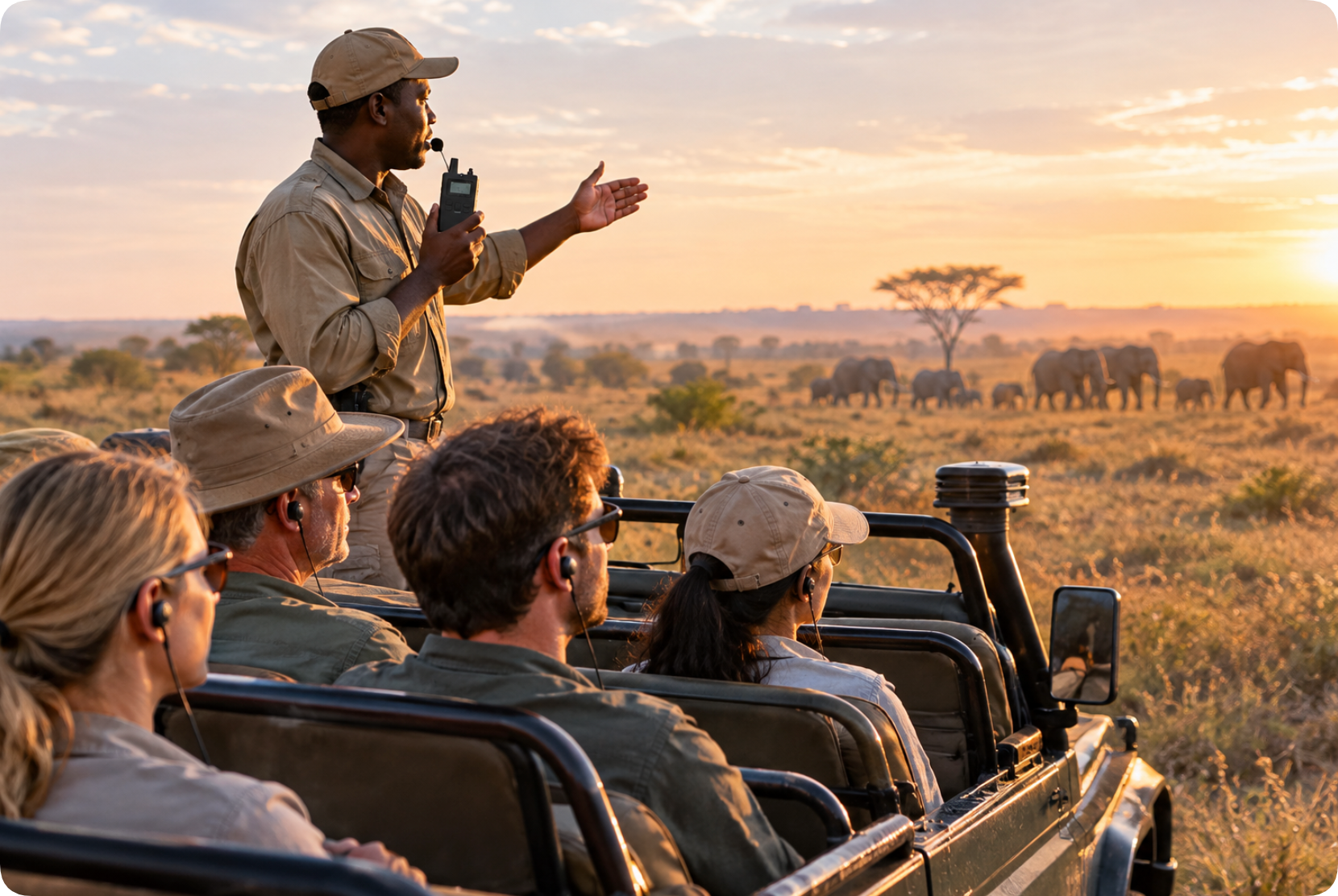
Strip the scenario down and the requirement list is short but unforgiving. The guide must speak continuously, hands free, for two to four hours, while the vehicle moves and the engine contributes broadband noise. Every visitor must hear him without pressing, holding, or pairing anything. Both ears of every guest stay open to the environment — this is a safety requirement, not a comfort preference. Multiple vehicles at the same sighting must not bleed into each other, because five guides narrating the same cheetah on one shared channel is worse than no audio at all. The system must survive dust, cold starts, and a charging infrastructure that may be a single solar array behind the kitchen tent. And because safari operators buy for a fleet that crosses borders — Kenya one week, Tanzania the next, onward to Botswana — the radio hardware should not create a licensing problem at each frontier.
RC8860: UHF Reach Across a Watering Hole
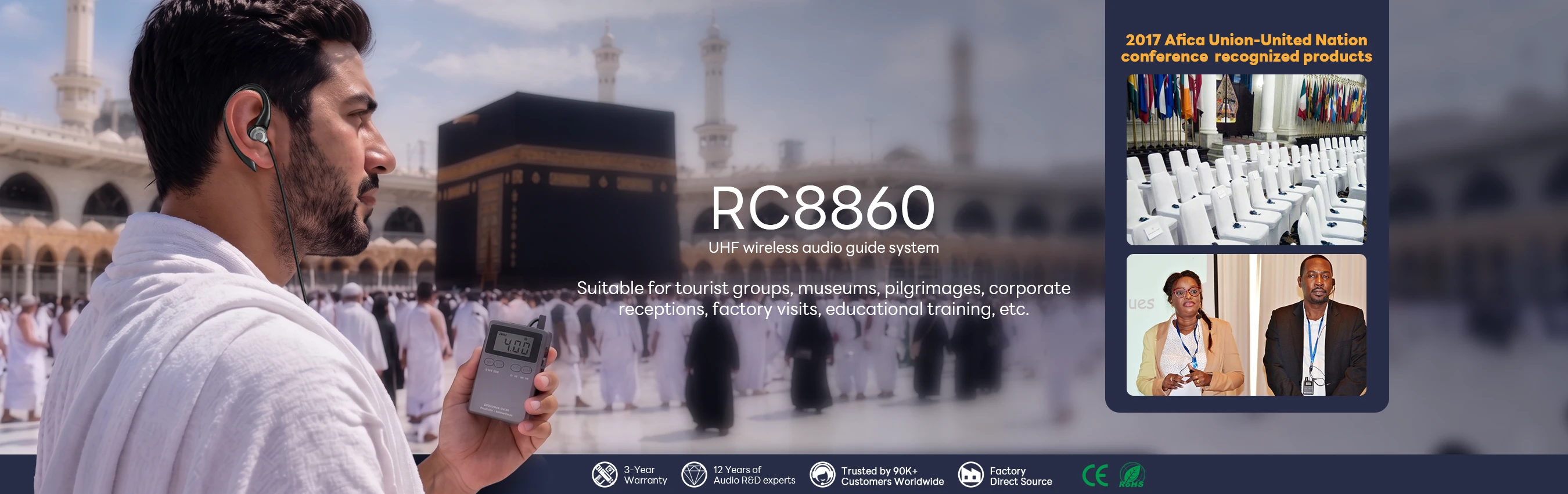
The RC8860 long-range transmitter is the anchor unit for exactly this kind of terrain. It works the 860-870 MHz UHF band, well away from the 2.4 GHz congestion created by camp Wi-Fi and guest phones, and the open-area transmission range reaches 200 meters — enough that visitors can step down and file into a viewing line a full vehicle length from the tracker, and still stay locked to the guide. Twenty channels are held in place by PLL frequency synthesis, so the vehicle from Camp A on channel 7 does not whisper into the earpieces of Camp B on channel 12 at the same river crossing. A DSP noise-cancellation stage in the transmitter chain attacks the constant low-frequency rumble of an idling diesel far more effectively than a consumer walkie-talkie's fixed squelch. The receiver's 1000 mAh battery runs 20 hours; the transmitter's 1500 mAh cell manages 10, and an IPX4 splash rating handles the morning dew and the drinks stop — though, to be precise, IPX4 is a water-ingress rating, and nobody in this industry should confuse it with dust-proofing; the units still ride in a padded case between drives. Guides who have used our headset systems on plant tours will recognize the same engineering logic: continuous narration over machinery noise, rather than bursts of shouted relay.
RC2500: Built for Cold Mornings and Multi-Day Weeks
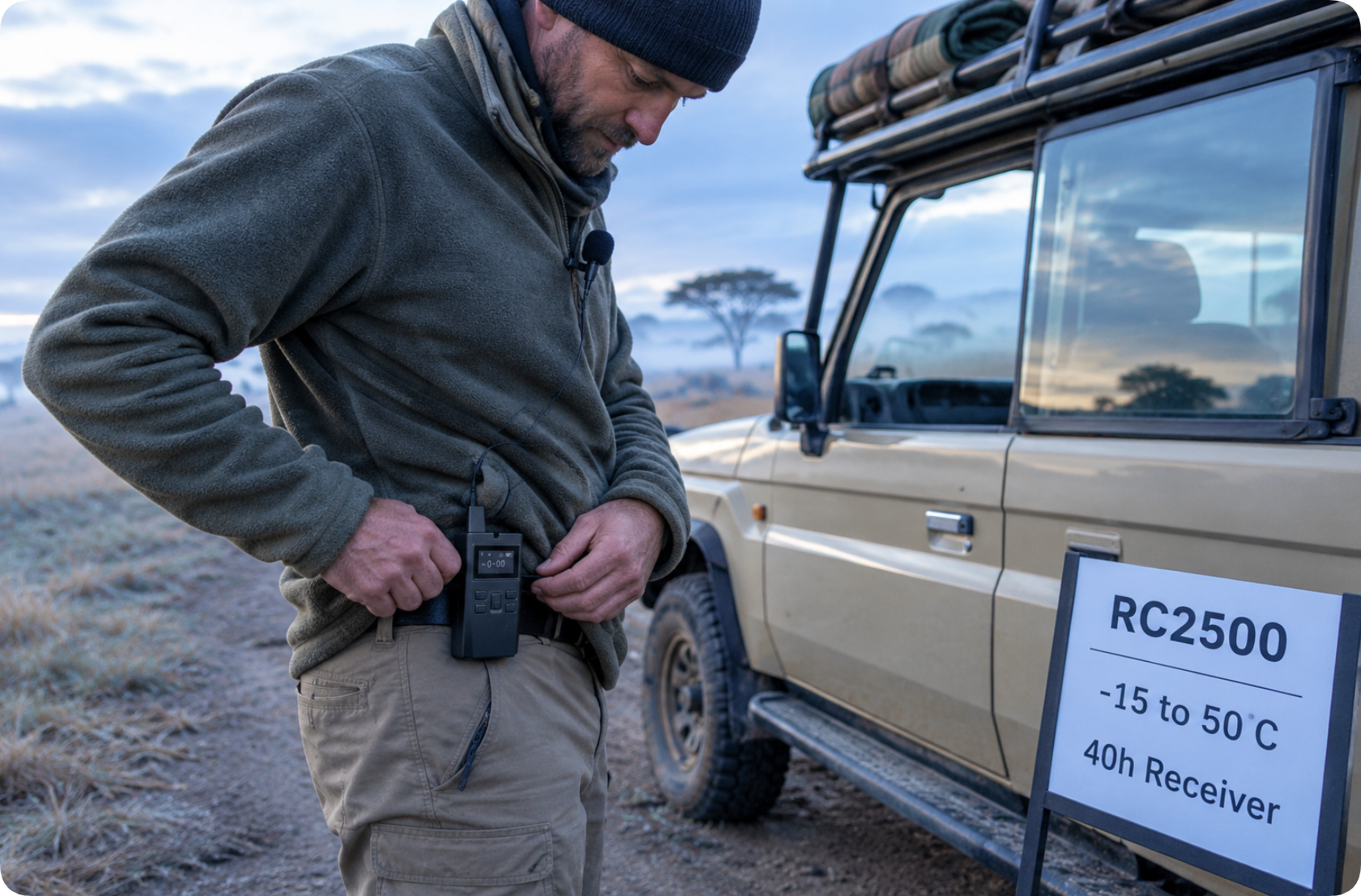
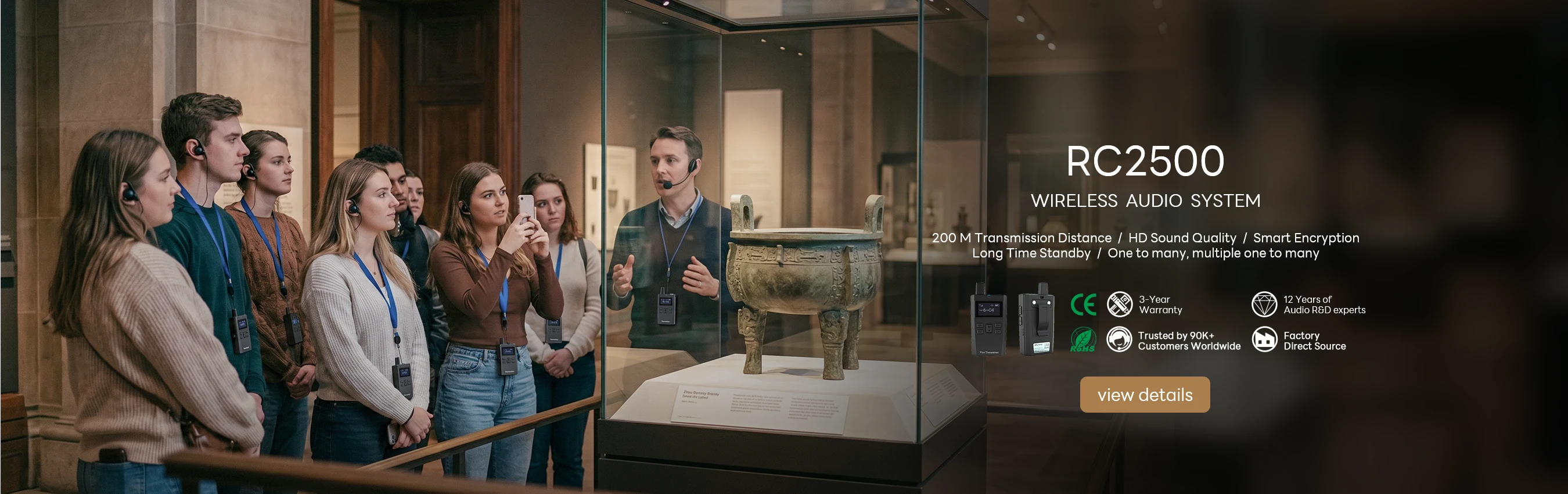
Where the RC8860 covers distance, the RC2500 2.4G high-power system covers endurance and climate. Its operating window spans -15 to 50 °C, which absorbs everything from a frosty Serengeti dawn to a 45 °C October afternoon in the lowveld — a spread neither the T470's spec sheet nor the UltraLITE's 0-40 °C rating is willing to claim. The 20 mW transmission stage pushes the 2.4 GHz signal with enough authority to hold 50 independent channels clean inside one venue, and the receiver battery is the standout figure: 40 hours on a charge, roughly five full working days. For a three-night circuit that means the charging case stays in the storeroom, which matters when the only power is what the solar bank can spare after the lights and the fridges. Audio spans 20 Hz to 20 kHz, so a guide's low register survives the engine note instead of thinning into a telephone-band honk. The same endurance profile has already proven itself in factory tour deployments, where a full shift of walkthroughs used to mean two battery swaps per transmitter.
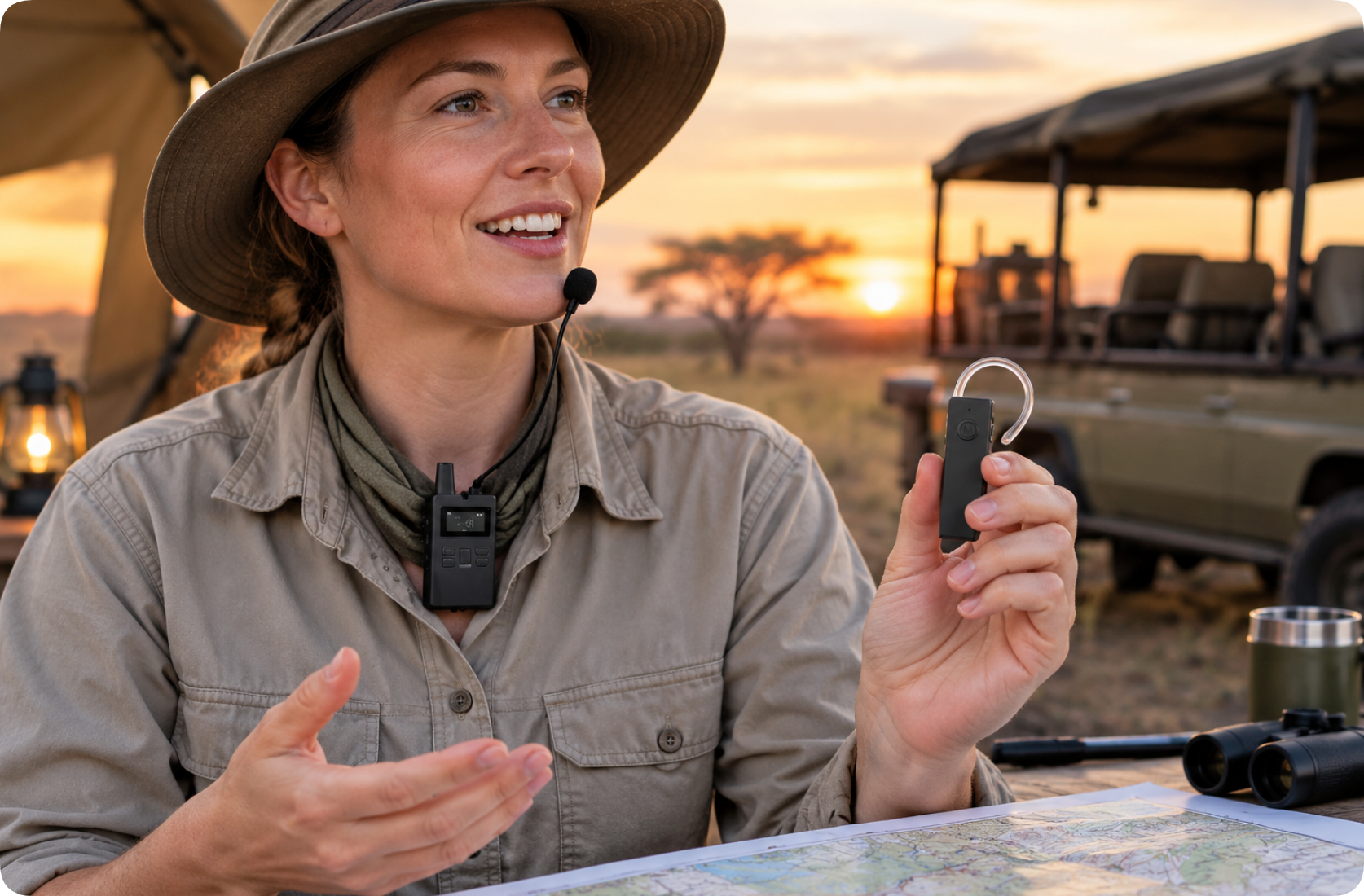
RC2468: Light Enough to Forget, Legal at Every Border
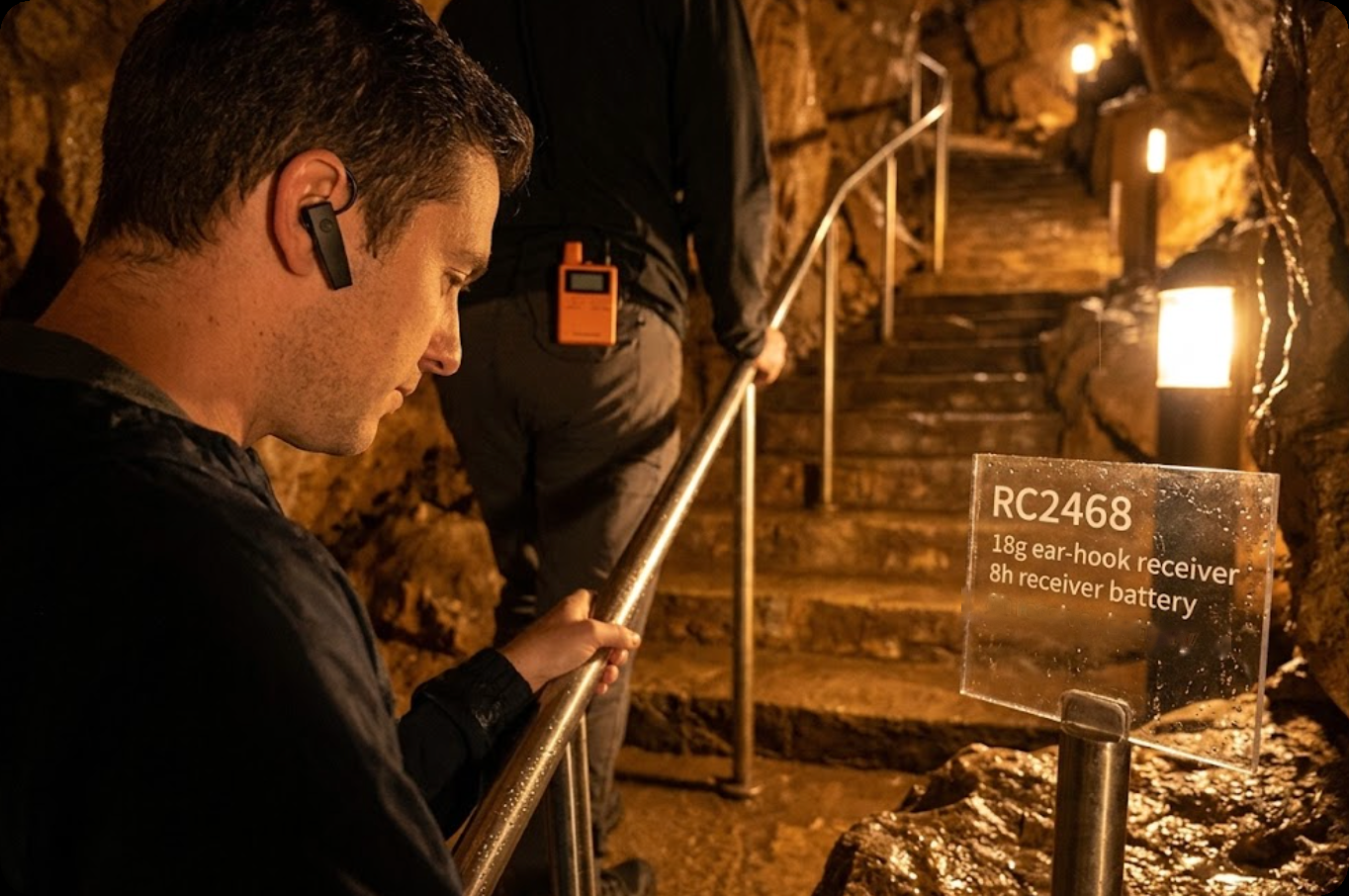
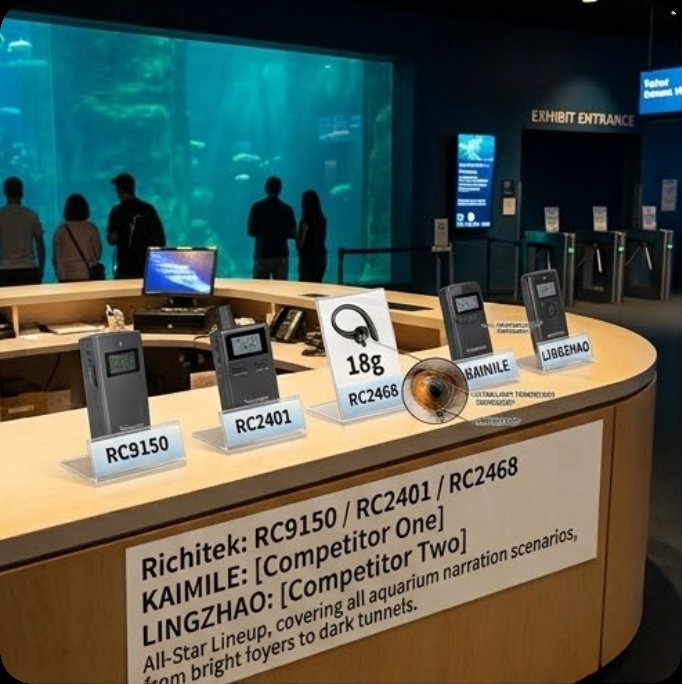
The RC2468 ear-hang transmitter is the unit guides actually fight over. The transmitter weighs 59 g — clipped at the collar, it disappears under a fleece by the second hour — and runs 12 hours on its 1500 mAh cell; the receiver draws 10 hours from a 300 mAh pack and drives a 10 mW output that stays articulate over the shoulder of the seat in front. It operates on 2403-2483 MHz, the license-free 2.4 GHz ISM band, which is the quiet superpower of the line: the same units are legal in virtually every country without paperwork, so a cross-border operator re-badges nothing between Maasai Mara and Chobe. Fifty PLL-stabilized channels let one fleet run language groups in parallel — English on 3, French on 11, German on 22 — and the 200-meter open-area range keeps a walking safari column connected well beyond the tail guide. One honest note for procurement teams: 860-870 MHz UHF rules differ by country, and some administrations treat parts of that band as licensed or lightly regulated, which is precisely why pairing the UHF RC8860 with the ISM-band RC2468 gives a touring fleet both reach and regulatory simplicity.
💾 Side by Side: The Numbers That Decide a Drive
| Dimension | Motorola T470 | Eartec UltraLITE | Richitek line |
|---|---|---|---|
| Talk protocol | Half-duplex, PTT | Full duplex, 5 users | One-way broadcast, guide speaks continuously |
| Guest ears | Speaker only, earpiece optional | Both sealed, 113 g headset | Single earpiece, open ear stays on the bush |
| Real range | 1-3 mi wooded terrain | 300 yd line of sight | 200 m open area, per-unit |
| Channels | 22 + 121 codes | 1 net, privacy code | 20 (RC8860) / 50 (RC2500, RC2468) PLL |
| Runtime | ~12 h NiMH, micro-USB | 5-6 h, swappable Li-Po | 10-40 h by unit, charge-case friendly |
| Temperature | Unspecified | 0 to 40 °C | -15 to 50 °C (RC2500) |
| Licensing | FRS license-free (US) | DECT license-free (US/EU variants) | 2.4 GHz ISM global; UHF region-dependent |
Where Each of the Two Radios Still Belongs
Fairness costs nothing. The UltraLITE remains the better tool for the workshop behind the camp — mechanic to mechanic during a suspension rebuild, where sealing your ears against a grinder is desirable and the five-user ceiling is a feature. The T470 earns its keep at the logistics layer: driver to driver coordinating fuel runs between camps on a fixed channel, where nobody is narrating anything and a pressed button is a perfectly natural gesture. Neither belongs on the guest seat of a game viewer, where the job is continuous, effortless, ambient listening — and where the animal you came for will not pause its approach while a guide fumbles a button or a headset pair re-pairs itself.
Questions Operators Ask Before Outfitting a Fleet
Do guests really keep one ear open the whole drive?
Yes, and every serious camp enforces it. The single-earpiece design of the Richitek receivers exists for this reason: narration flows into one ear while the other tracks the environment, so a ranger's whistle or a warning from the tracker reaches guests instantly.
Can five vehicles share one waterhole without crosstalk?
That is what the PLL-locked channel banks are for. Fifty channels on the RC2500 and RC2468, twenty on the RC8860, each locked by frequency synthesis rather than drifting analog tuning — so simultaneous groups sit side by side without audible bleed.
What happens on the 5:30 AM departure in winter?
The RC2500 is rated from -15 °C, and lithium chemistry in its 1000-1500 mAh packs is specified well below the 0 °C floor that disqualifies many consumer intercoms. Cold starts are a non-event; the receiver simply works while the coffee is still hot.
How does charging work at a solar-only camp?
Receiver runtimes of 20 to 40 hours mean a three-night circuit rarely needs a mid-stay charge. When it does, the multi-bay charge case tops the fleet from one DC feed overnight — a far smaller draw than charging eight walkie-talkie NiMH packs or a crate of DECT headsets.
Choosing Audio for a Fleet That Lives on Dirt Roads
Consumer radios and film-set intercoms each solve a real problem — for someone else. A safari fleet's problem is one voice that must arrive continuous, clean, and unintrusive, from the first hyena call of the morning to the last, with both of every guest's ears left open to the bush that surrounds the vehicle. That is a broadcast job, not a conference call, and it is the job the Richitek line was built around — the same one-way clarity that already serves city tour operators in eleven countries. If you are outfitting vehicles for the coming season, send us your route list, group sizes, and charging situation — the fleet plan usually fits on one page, and it will not include a single push-to-talk button.