
A leading China factory specializing in Wireless Tour Guide Systems, Church Audio Guides, and Translation Headphones with premium OEM/ODM solutions.

Tel:+86 18922879583

Email:tiger.wang@richitek.com

Data Centre Tour Guide Systems: When the Aisle Is Longer Than the Signal

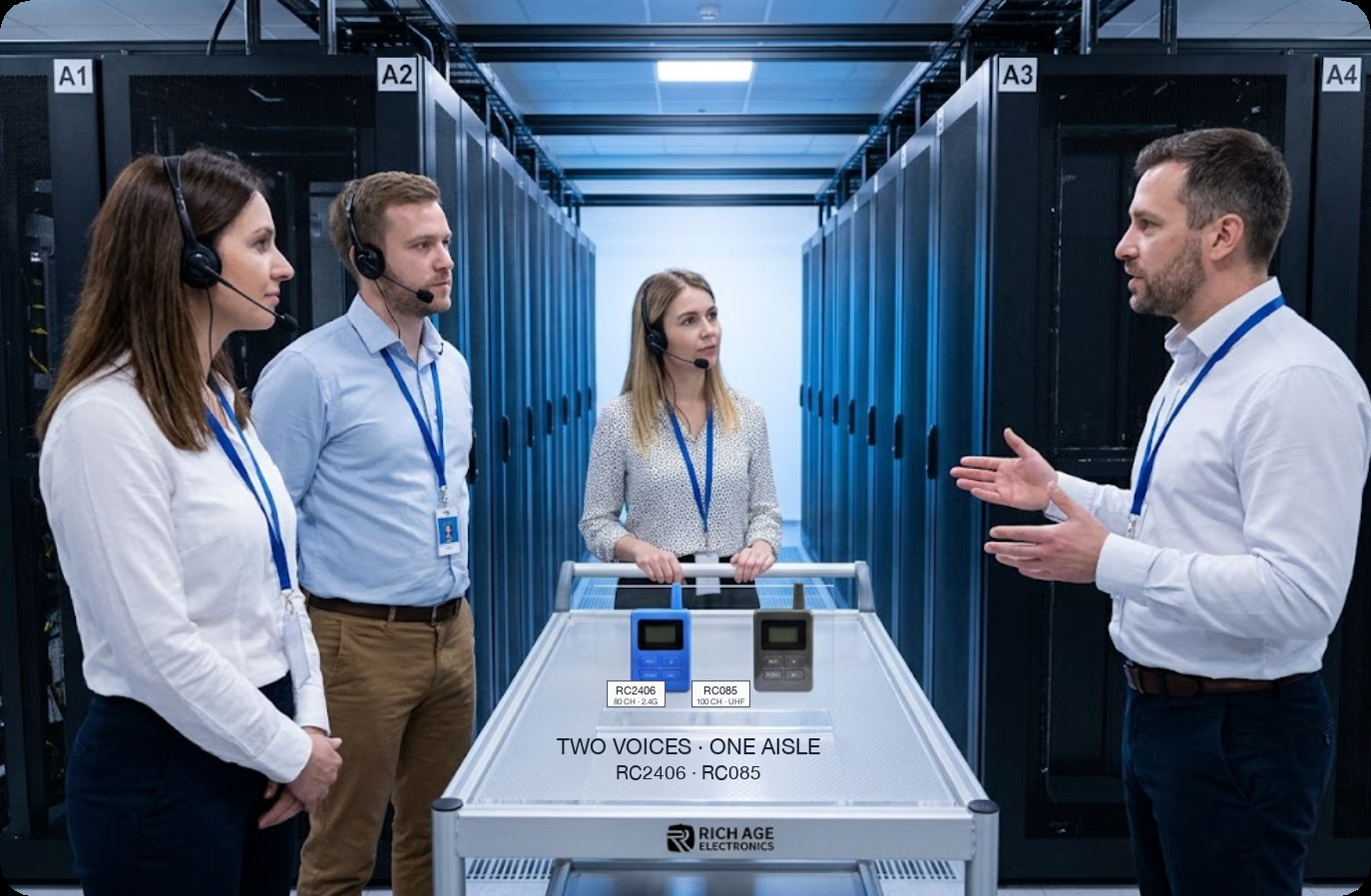
A data centre is the least forgiving room a wireless guide system can be asked to work in, and it is not forgiving for a reason that has nothing to do with acoustics. The cold aisle in a modern facility runs to two hundred metres between the containment walls. The server cabinets on both sides are steel enclosures standing shoulder to shoulder for the entire length of that run, so a radio signal leaving the guide at one end arrives at the far end having been reflected, absorbed and re-reflected by every cabinet it passed. The noise floor from forty rows of cooling fans makes it impossible to talk over, so a guide has to be amplified rather than raised. And visitors are behind a safety line, in a room where nobody is permitted to make noise. These are the constraints that decide which guide system belongs, and they are why the number on the head of the specification sheet is not the one that matters.

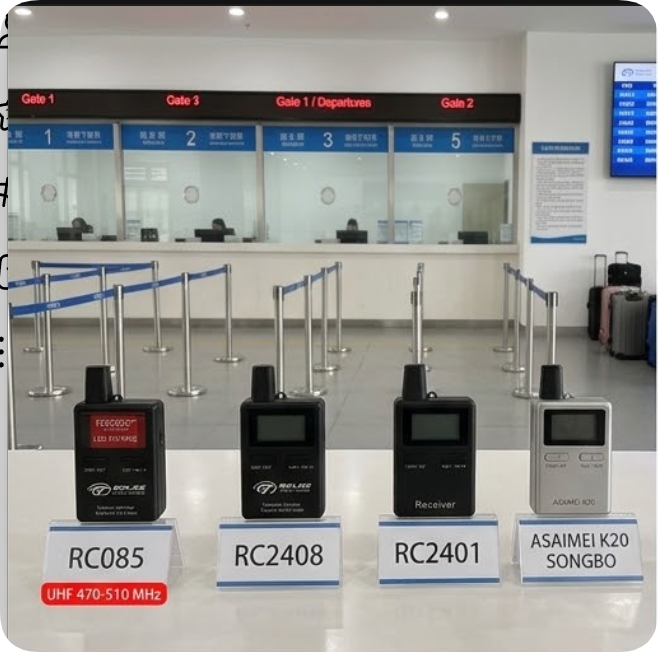
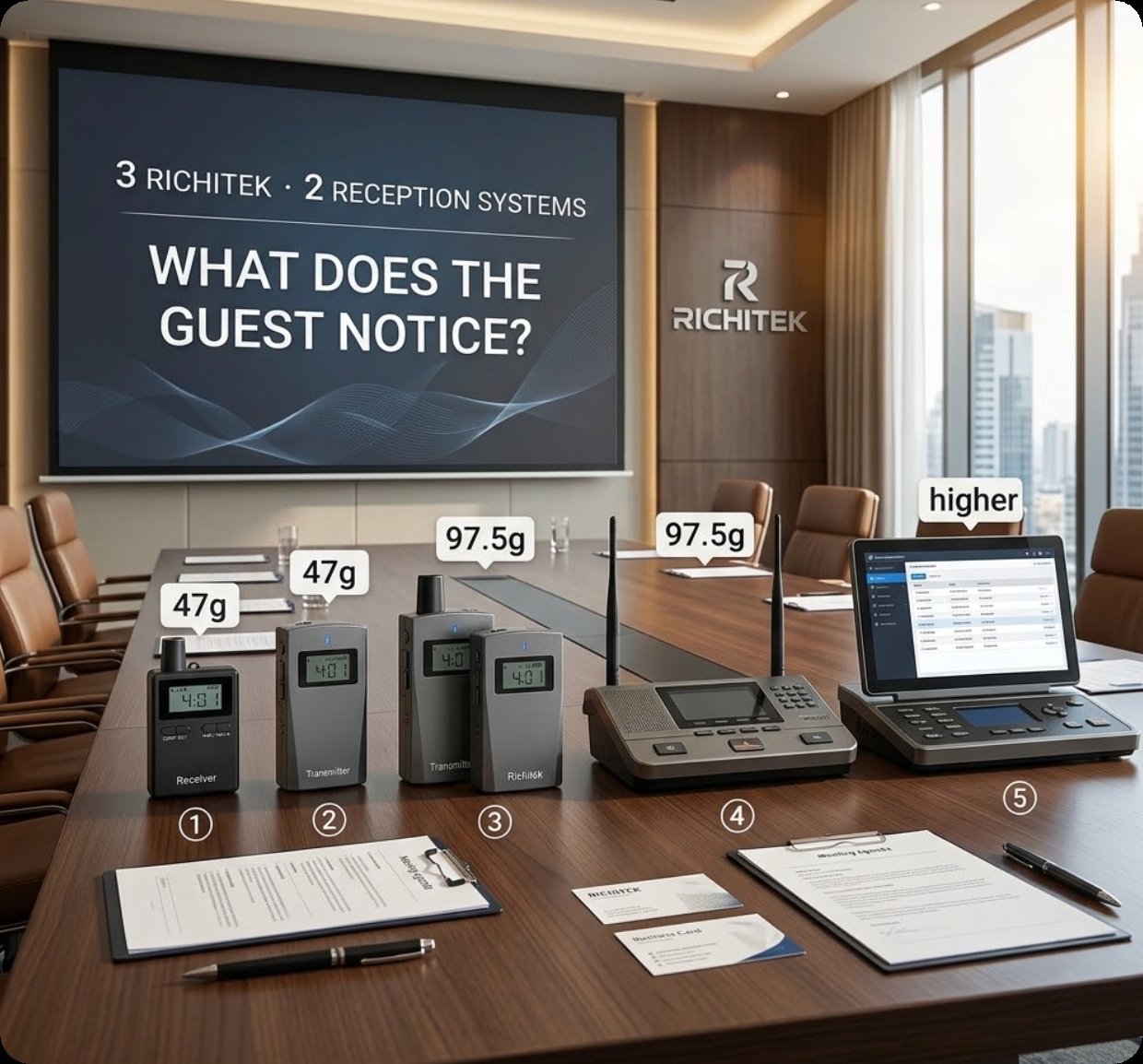
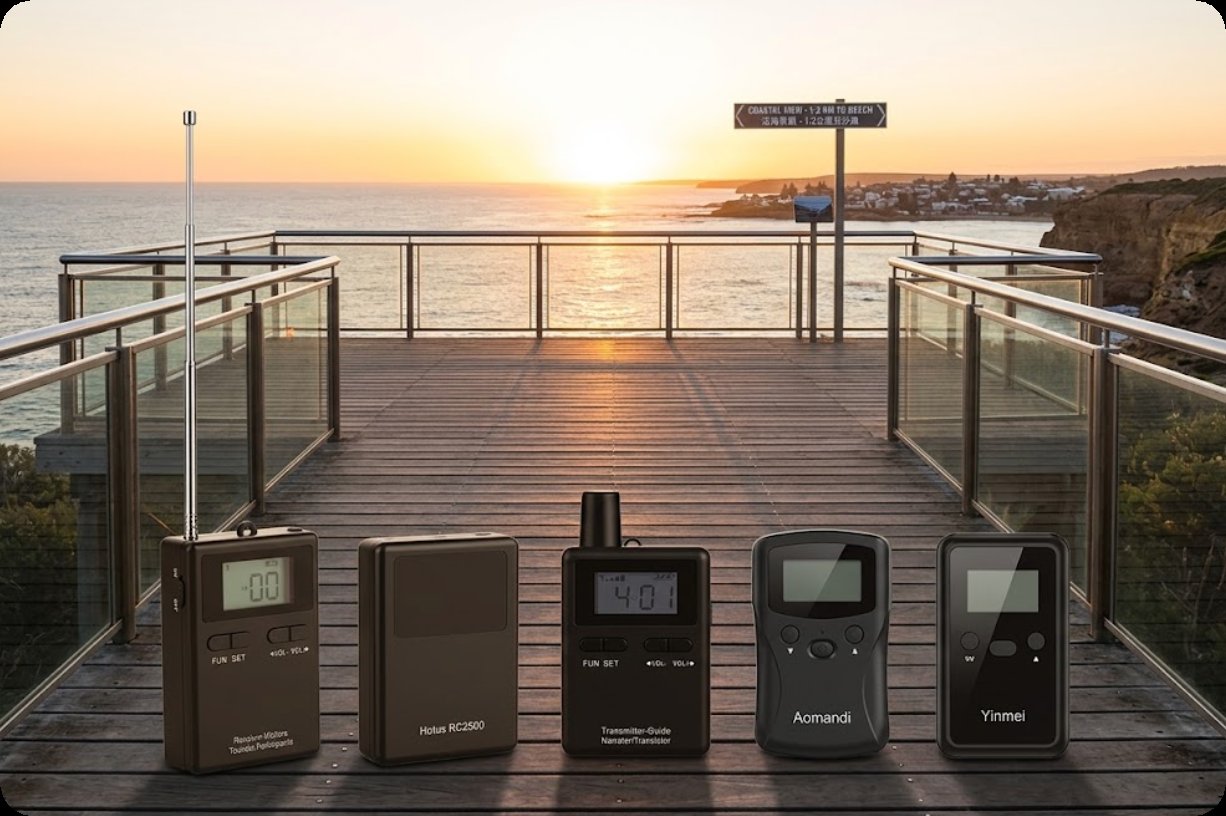
Three Richitek systems are compared here against two enterprise guide systems sold into technical and industrial environments: the RC2406 80-channel 2.4G unit, the RC2402 50-channel 2.4G standard build, and the RC085 UHF unit on the 470-510MHz band. Facing them are the Retekess T130 transmitter with its T131 receiver on 195-230MHz, and the OKAYO WT-600 2.4GHz system, which is a genuinely different piece of engineering with a feature none of the Richitek units offer. The comparison below is organised around the four constraints a data centre actually imposes, because organising it around channel counts would produce a different answer for every tour in the country and none at all for this one.

One boundary should be drawn first. The three Richitek units are published at 1-200 metres as a product-line figure, and the 200-metre end is stated by the manufacturer as open-area performance, with the caveat that actual range depends on environment conditions. Retekess publishes 60 metres for the T130 and T131 pair. OKAYO publishes 30 metres line of sight for the WT-600, with one regional distributor listing the same figure as 20-30 metres. Those are the manufacturers' own numbers, and this article will not adjust them upward. None of the three publishes a figure for penetration through a steel rack cabinet. What can be compared honestly is the frequency plan, the antenna behaviour that follows from it, and the practical consequence for a room built out of metal.
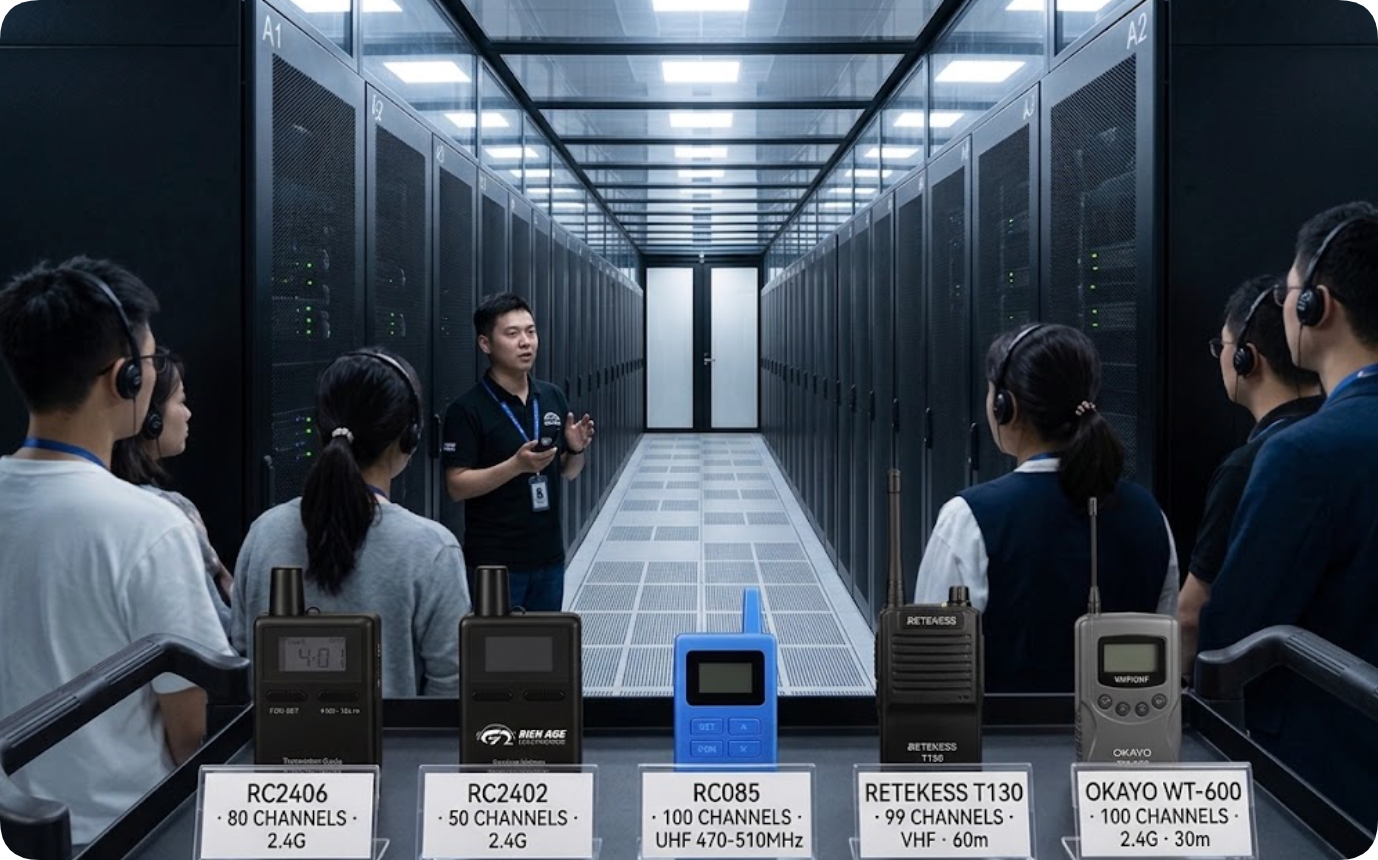
richitek data_center_tour vs retekess okayo 1

The Aisle: Range Is a Room Measurement, Not a Number

The Richitek RC2402 is the baseline in this comparison, and the manufacturer is careful about how it frames the number: up to 200 metres in open area, with the additional statement that it remains stable in large venues, factories and outdoor sites. The transmitter and receiver each carry a 1500mAh lithium battery, giving 10 hours on the transmitter and 20 on the receiver, and both halves weigh 59 grams. Fifty channels, one-touch frequency synchronisation, intelligent encryption against crosstalk, and a full international certification list of CE, EMC, LVD, RED and RoHS. For a tour that stays inside a single row of cabinets it is more than adequate.

The RC2406 exists for the case where the RC2402 is not enough, and the difference between them is almost entirely a question of how many teams are on site and what else in the building is radiating. It carries 80 dedicated channels with PLL anti-interference technology on the same 2403-2483MHz license-free ISM band, with the same 10mW output and the same 200-metre open-area range, plus a noise-cancelling capability that the manufacturer describes as the core hardware for professional guiding. Battery is 1500mAh, receiver weight 50 grams, RoHS compliant, three-year warranty. For a data centre hosting three contractors, a customer walkthrough and a certification audit on the same afternoon, the 80-channel build is what stops language groups hearing each other.

Both of those figures are open-area figures, and an open area is the one thing a cold aisle is not. A two-hundred-metre corridor lined with steel cabinets is a waveguide, not an open field, and a signal travelling down it loses energy to every cabinet it passes close to. This is where the comparison against the two competitors stops being a specification exercise and becomes a planning one. Retekess T130 and T131 publish 60 metres of working distance on 195-230MHz, and OKAYO's WT-600 publishes 30 metres line of sight. Neither number is wrong, and neither is a criticism. They are the numbers a buyer has to divide the aisle length by. A 60-metre system on a 120-metre aisle needs a second unit or a repeater; a 30-metre system needs three or four, and a fixed installation rather than a wearable one, if the tour is to reach the far wall without splitting the group. It is worth being fair to the OKAYO, because the WT-600 has something the Richitek range cannot offer: one of the few systems in this comparison that lets two transmitters speak on the same channel simultaneously. On a data centre tour that has specific value, because a tour is often conducted by two people, a host from the operator and an engineer from the facility, and they take turns rather than talk over each other. The problem is that the same 30-metre range applies to that second channel, so the feature solves the wrong half of the requirement. There is no point in having two voices if the visitors at the far end of the aisle hear neither.

📡 The Steel: Frequency Band Decides What Reaches the Far Rack

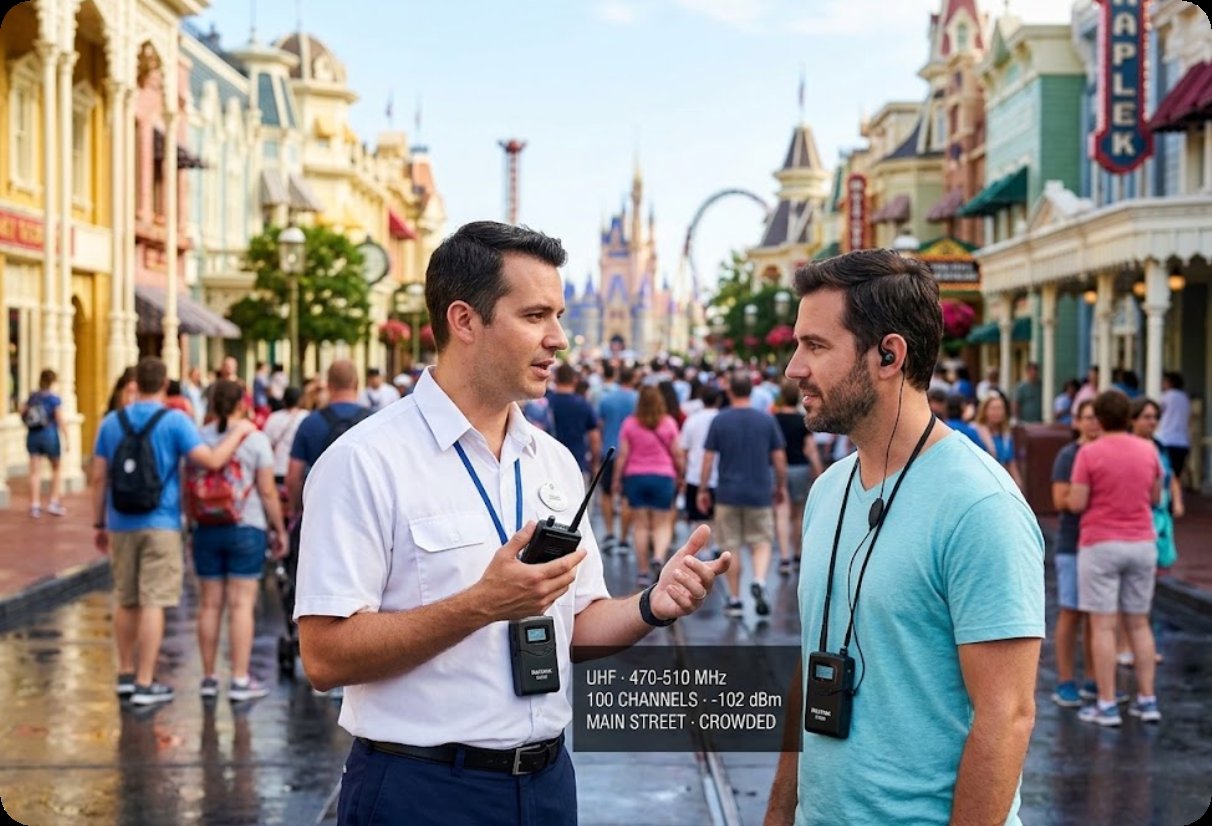
This is where the choice between a 2.4GHz system and a UHF system becomes a decision rather than a preference, and it is the reason the RC085 appears in a comparison of three otherwise 2.4GHz units. The RC085 runs on the 470-510MHz UHF band with GFSK modulation, and the manufacturer's own product copy states that this band provides significantly stronger penetration than 2.4GHz systems, which makes it the right choice for industrial environments with heavy machinery and steel structures. The specification table gives 100 channels for multi-channel group operation, output power of 8-10mW, a receiver standby and power-saving wake-up function, and an LCD that shows real-time battery, channel and signal status. Certification is CE, RED and RoHS, with the same three-year warranty.

Physical reasoning supports the claim. A 2.4GHz signal has a wavelength of a few centimetres in air, and a steel cabinet door is far larger, so the door behaves as a shield with a seam rather than a wall the signal can bend around. A 470MHz signal has a wavelength several times longer, and the same cabinet presents a smaller electrical size relative to it, which is the mechanism behind the improved penetration the manufacturer documents. The RC085 also carries the highest channel count in this comparison at 100, and the highest receiver sensitivity figure in the Richitek range at approximately -102dBm, with the transmitter and receiver at 65 and 60 grams on a 3.7V 1200mAh pack giving 12 hours of transmitter life and 20 hours on the receiver.

Retekess took the opposite approach and put the T130 and T131 on 195-230MHz VHF, lower still and therefore wavelengths of a metre and more. The T130 transmitter publishes a 10mW output, 99 channels, 50Hz-18000Hz frequency response, a 900mAh battery good for 12 hours, and 58 grams; the T131 receiver runs on a 600mAh pack for 18 hours at 45 grams, with a 3.5mm headphone jack that accepts visitor-supplied earphones. The 60-metre working distance is published with a frequency stability of ±0.005% and a modulation deviation of ±75KHz. The engineering is sound and the price point is low, roughly $25-35 for a receiver. For a data centre, the published range is measured in an environment that is not a corridor of steel cabinets, and a buyer planning a two-hundred-metre run is extrapolating beyond the document.

OKAYO's WT-600 is the most thoroughly documented of the three: 100 channels on 2.4GHz with FSK modulation, RF output 10 dBm, a carrier band of 2403.5-2480.5MHz, frequency response 70Hz-7kHz, THD below 1%, receiver sensitivity 85 dBm, SNR 60dB, and a 30-metre line-of-sight range. It runs on a single AA cell, alkaline or Ni-MH, for 10 hours, weighs 70 grams with the battery, and ships with a 2.4GHz channel-sync function across 2-, 5-, 15-, 25- and 50-slot chargers. The same three numbers keep reappearing in this comparison from opposite directions. OKAYO has more channels than the RC2406 and a lower frequency response ceiling; Richitek has three times the published range and a receiver specification that publishes no sensitivity figure at all. In a metal room these are decisive in a specific order.
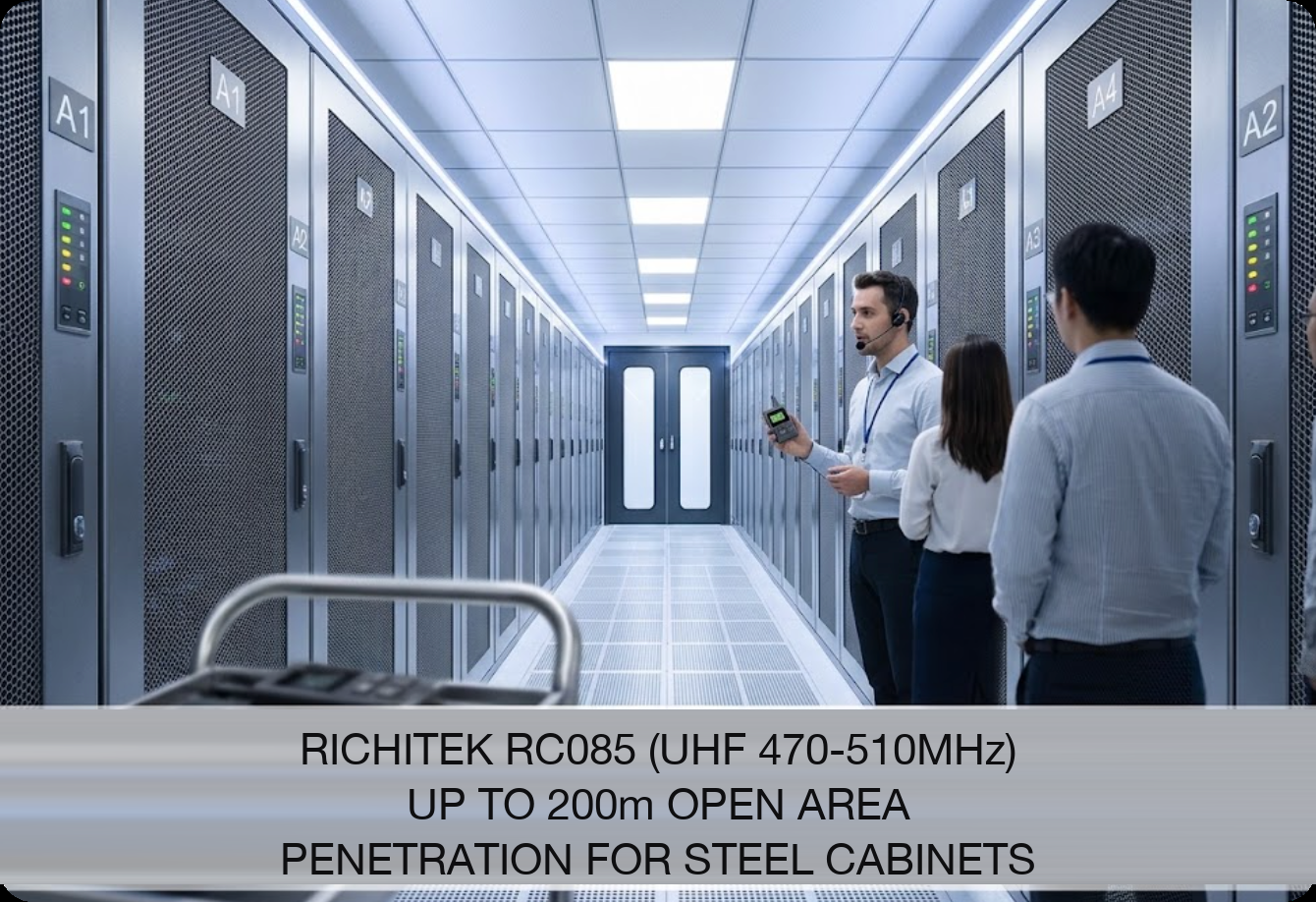
richitek data_center_tour vs retekess okayo 2

🔍 The Noise: A Microphone Problem Disguised as an Audio Problem

Forty rows of cooling fans produce a noise floor that a lapel microphone will pick up and pass straight to every receiver in the group. The problem is not that the guide cannot be heard over it — a headset placed close to the mouth has a far better signal-to-noise ratio than a lapel worn on a lanyard — it is that the guide's own headset will pick up what is behind and beside the microphone, and in a server room that is a lot of broadband mechanical noise. This is the argument for the RC085's and the RC2406's optional professional head-worn or lapel microphone options, and it is also the point on which the three Richitek units publish less than a buyer would want. The RC2501 in the wider Richitek range quotes a sensitivity of approximately -38dBm, materially worse than the -102dBm quoted for the RC085, and a buyer who reads across the range should note that the professional microphone option and the sensitivity figure are not offered together on every model.

The counterweight has to be stated too. The Retekess documentation for the T130 and T131 makes no claim about noise cancellation at all, and describes the set as a PLL system whose advantage is delivering clear sound in noisy environments like factories and tours, a marketing characterisation rather than a published figure. OKAYO publishes no noise-cancelling specification for the WT-600 either; the relevant number is the 70Hz-7kHz frequency response, narrower at the bottom end than the 50Hz-18kHz response the T130 publishes. Whether that matters depends entirely on where the guide puts the microphone, and no datasheet settles that. What a data centre buyer can do is run a ten-minute test in the actual aisle with the actual model.

Two things a buyer will want are not published by anyone here, and it is better to name them. The first is penetration through a steel cabinet, for which there is no figure in the Richitek, Retekess or OKAYO documentation, because a manufacturer would have to publish a test method along with the number and no such standard exists. The UHF argument here is therefore an argument from the physics of wavelength versus cabinet dimension and from Richitek's own statement about penetration, not from a measurement. The second is receiver sensitivity for two of the three Richitek units: the RC085 publishes approximately -102dBm, the RC2406 and RC2402 pages publish no sensitivity number at all, and the wider Richitek range includes the RC2501 at approximately -38dBm. Both competitors are more complete on paper in that respect, the Retekess T130 publishing a full RF specification and the OKAYO WT-600 publishing 85 dBm sensitivity at 60dB signal-to-noise ratio.

None of the three Richitek systems is the right answer for every data centre, and pretending otherwise would not survive a first site visit. The RC2402 is the economical choice for a facility whose tour route stays within sixty metres of the guide, where the published range of both competitors would also have covered the walk. The RC2406 is the choice for a busy building where several groups will be on the floor at once, because 80 channels and a noise-cancelling configuration solve a scheduling problem before they solve a radio problem. The RC085 is the choice for a deep facility with a long run and continuous steel on both sides, because the UHF band and the 100-channel plan are the only configuration in this comparison that addresses both at once.

The Retekess T130 and T131 remain a defensible purchase for a short route, a low budget, or an overseas buyer who needs a widely distributed support network, and at 99 channels and a 60-metre published distance the system is well specified for what it is. The OKAYO WT-600 is the strongest document in this comparison on paper, and its two-transmitters-on-one-channel feature is genuinely useful where a facility engineer and a host both need to speak. Its 30-metre line-of-sight range is what a long cold aisle cannot absorb, and the 30-metre figure is the manufacturer's own, not a competitor's interpretation of it.

Facilities running a data centre tour, a technical audit, a customer walkthrough and a certification visit on the same week can compare the full wireless guide range in the wireless tour guide system lineup, and every other device-versus-device breakdown in this catalogue sits in the device comparison archive.

Buying Against the Route, Not Against the Spec Sheet

Most of the practical difficulty in this purchase comes from the order in which the questions get asked. A facility team tends to start with channel count, because it is the number that appears first in every comparison table, and then discovers that the route runs past the point where the signal survives. The order that works is different. First, measure the route in the aisle rather than on the floor plan, because the containment wall and the first row of cabinets will take more off the usable distance than the drawing suggests. Second, establish which bands are available at that site, because a UHF system at 470-510MHz and a 2.4GHz system are both license-free in most jurisdictions, and that is rarely the deciding factor. Third, count the groups that will be on the floor concurrently, and only then choose a channel count, because a hundred channels on a system that cannot reach the last row is a hundred channels that will not help. Finally, test the microphone in the actual noise, at the actual tour position.

There is a fourth question specific to data centres that is easy to forget: what happens to the equipment at the end of the visit. A tour system that spends its day in a server room is spending it in a place with a stated temperature range, a stated ingress position, and a stated attitude about liquids and dust. The Richitek pages in this comparison publish a three-year mainboard warranty with headset, microphone and battery excluded, and they publish CE, EMC, LVD, RED and RoHS on the RC2402 and RC2406, with CE, RED and RoHS on the RC085. None of the three publishes an ingress rating, and the RC2402 page publishes no operating temperature range at all. For a facility with an unconditioned plant room on the tour route, that is a question to put in writing before the order, and the same question to put to any competitor whose datasheet is silent.

Frequently Asked Questions

Which of these five systems will cover a two-hundred-metre cold aisle?

The Richitek RC2406, RC2402 and RC085 all publish 1-200 metres, with the manufacturer stating that the 200-metre figure is open-area performance and that actual range depends on environment conditions. The Retekess T130 and T131 publish 60 metres, and the OKAYO WT-600 publishes 30 metres line of sight. On the published numbers the Richitek units are the only three of the five able to reach the far end of a full-length aisle, the RC085 strongest in a steel-lined corridor because of its UHF band and 100-channel plan. A site test at the far end of the actual aisle is the only way to confirm the open-area figure.

Can two transmitters be heard at once on the same channel?

Only the OKAYO WT-600 publishes this: two transmitters on the same channel simultaneously, presented by the manufacturer as a breakthrough for the tour and translation market, with channel-sync across 2-, 5-, 15-, 25- and 50-slot chargers. None of the three Richitek units publishes the same feature, and the Richitek approach is the common one in the range, in which a second group runs on a second channel and a listener switches between them. The two-transmitter arrangement has real value in a data centre, where a facility engineer and a tour host alternate and both need to be heard — but the 30-metre line-of-sight range applies to that second channel too.

Do these units need a radio licence, and does that matter across borders?

The Richitek RC2406 and RC2402 both operate on the 2403-2483MHz ISM band, which the manufacturer states is license-free, and the RC085 on 470-510MHz UHF. The OKAYO WT-600 is described by the manufacturer as a license-free solution worldwide in the 2.404-2.472GHz band, and the Retekess T130 and T131 are VHF at 195-230MHz. For a single domestic site the licensing position is rarely deciding. For a group operating tours across several countries, the fact that the 2.4GHz band needs no local licence is why the RC2402 and RC2406 travel without a per-country frequency review, and that is an operational advantage of the band unrelated to radio performance.

What should be tested before ordering for a server hall?

Three things, in this order. First, the far end of the actual aisle with the racks in place, because that is the only measurement that matters and the published figures are not a substitute. Second, the microphone at the tour position, because a lapel and a head-worn set behave very differently against a cooling-fan noise floor and published specifications do not settle it. Third, the charging and collection cycle, because a system used once a week and a system used daily have different requirements and the 64-port Retekess case, the OKAYO 2- to 50-slot charger range and the Richitek three-year mainboard warranty all point at different procurement realities.

🎯 Specification Summary and Selection Matrix

Richitek RC24062403-2483MHz 2.4G ISM, license-free80, PLL anti-interference1-200m, up to 200m open area10mW output; 1500mAh, 10h transmitter and 20h receiver50g receiverNoise-cancelling configuration, RoHS, three-year mainboard warranty
Richitek RC24022403-2483MHz 2.4G ISM, license-free worldwide501-200m, up to 200m open area1500mAh, 10h transmitter and 20h receiver59g both halvesOne-touch frequency sync, intelligent encryption, CE/EMC/LVD/RED/RoHS, three-year mainboard warranty
Richitek RC085470-510MHz UHF, GFSK1001-200m, up to 200m depending on environment8-10mW output; 3.7V 1200mAh, 12h transmitter and 20h receiver65g transmitter and 60g receiverPower-saving wake-up, LCD battery/channel/signal readout, CE/RED/RoHS, three-year mainboard warranty
Retekess T130 and T131195-230MHz VHF9960m10mW output; 900mAh 12h transmitter, 600mAh 18h receiver58g transmitter and 45g receiver50Hz-18000Hz response, stability ±0.005%, modulation deviation ±75KHz, DC 5V mini USB charging, 3.5mm headphone jack
OKAYO WT-6002.4GHz, carrier 2403.5-2480.5MHz10030m line of sight10 dBm RF output; 1x AA Ni-MH or alkaline, 10h70g with batteryFSK modulation, THD under 1%, sensitivity 85 dBm, SNR 60dB, 70Hz-7kHz response, two transmitters on one channel, 2/5/15/25/50-slot chargers
A tour route that stays within sixty metres of the guideRC240250 channels, one-touch sync, 20h receiver life, and a price point that suits a short route where both competitors would also have covered the walk
Several groups on the floor at once and a building where something else is already radiatingRC240680 dedicated channels with PLL anti-interference, plus a noise-cancelling configuration for the fan noise floor
A long cold aisle with continuous steel on both sidesRC085470-510MHz UHF penetrates the cabinet line better than 2.4GHz, with 100 channels and the highest receiver sensitivity in the Richitek range
A short route on a tight budget, or a support network that reaches several countriesRetekess T130 and T13199 channels at roughly $25-35 per receiver, with a published 60m working distance and a full RF specification
A tour where a facility engineer and a host both need to be heardOKAYO WT-600The only system here that runs two transmitters on the same channel, with 100 channels and a complete published specification

richitek data_center_tour vs retekess okayo 3

2026年10月22日 18:38
ꄘ click: 4

Get the spec sheet, MOQ and a factory-direct quote

Tell us the venue, the group size and how many languages you need. An engineer at our Shenzhen factory replies within one business day with the matching model, a written quote, lead time and the CE / RoHS / ISO 9001 documents.

Talk to an engineer WhatsApp +86 189 2287 9583

Prefer email? tiger.wang@richitek.com  |  OEM / ODM, custom tooling and neutral packaging available  |  send the enquiry through our contact page

Shenzhen Rich Age Electronics Co., Ltd. (Richitek) - manufacturing wireless tour guide systems, church translation headsets and museum audio guide equipment since 2007.

no data
Home > VS

Data Centre Tour Guide Systems: When the Aisle Is Longer Than the Signal

time: 2026年10月22日 click:4

A data centre is the least forgiving room a wireless guide system can be asked to work in, and it is not forgiving for a reason that has nothing to do with acoustics. The cold aisle in a modern facility runs to two hundred metres between the containment walls. The server cabinets on both sides are steel enclosures standing shoulder to shoulder for the entire length of that run, so a radio signal leaving the guide at one end arrives at the far end having been reflected, absorbed and re-reflected by every cabinet it passed. The noise floor from forty rows of cooling fans makes it impossible to talk over, so a guide has to be amplified rather than raised. And visitors are behind a safety line, in a room where nobody is permitted to make noise. These are the constraints that decide which guide system belongs, and they are why the number on the head of the specification sheet is not the one that matters.

Three Richitek systems are compared here against two enterprise guide systems sold into technical and industrial environments: the RC2406 80-channel 2.4G unit, the RC2402 50-channel 2.4G standard build, and the RC085 UHF unit on the 470-510MHz band. Facing them are the Retekess T130 transmitter with its T131 receiver on 195-230MHz, and the OKAYO WT-600 2.4GHz system, which is a genuinely different piece of engineering with a feature none of the Richitek units offer. The comparison below is organised around the four constraints a data centre actually imposes, because organising it around channel counts would produce a different answer for every tour in the country and none at all for this one.

One boundary should be drawn first. The three Richitek units are published at 1-200 metres as a product-line figure, and the 200-metre end is stated by the manufacturer as open-area performance, with the caveat that actual range depends on environment conditions. Retekess publishes 60 metres for the T130 and T131 pair. OKAYO publishes 30 metres line of sight for the WT-600, with one regional distributor listing the same figure as 20-30 metres. Those are the manufacturers' own numbers, and this article will not adjust them upward. None of the three publishes a figure for penetration through a steel rack cabinet. What can be compared honestly is the frequency plan, the antenna behaviour that follows from it, and the practical consequence for a room built out of metal.

richitek data_center_tour vs retekess okayo 1

The Aisle: Range Is a Room Measurement, Not a Number

The Richitek RC2402 is the baseline in this comparison, and the manufacturer is careful about how it frames the number: up to 200 metres in open area, with the additional statement that it remains stable in large venues, factories and outdoor sites. The transmitter and receiver each carry a 1500mAh lithium battery, giving 10 hours on the transmitter and 20 on the receiver, and both halves weigh 59 grams. Fifty channels, one-touch frequency synchronisation, intelligent encryption against crosstalk, and a full international certification list of CE, EMC, LVD, RED and RoHS. For a tour that stays inside a single row of cabinets it is more than adequate.

The RC2406 exists for the case where the RC2402 is not enough, and the difference between them is almost entirely a question of how many teams are on site and what else in the building is radiating. It carries 80 dedicated channels with PLL anti-interference technology on the same 2403-2483MHz license-free ISM band, with the same 10mW output and the same 200-metre open-area range, plus a noise-cancelling capability that the manufacturer describes as the core hardware for professional guiding. Battery is 1500mAh, receiver weight 50 grams, RoHS compliant, three-year warranty. For a data centre hosting three contractors, a customer walkthrough and a certification audit on the same afternoon, the 80-channel build is what stops language groups hearing each other.

Both of those figures are open-area figures, and an open area is the one thing a cold aisle is not. A two-hundred-metre corridor lined with steel cabinets is a waveguide, not an open field, and a signal travelling down it loses energy to every cabinet it passes close to. This is where the comparison against the two competitors stops being a specification exercise and becomes a planning one. Retekess T130 and T131 publish 60 metres of working distance on 195-230MHz, and OKAYO's WT-600 publishes 30 metres line of sight. Neither number is wrong, and neither is a criticism. They are the numbers a buyer has to divide the aisle length by. A 60-metre system on a 120-metre aisle needs a second unit or a repeater; a 30-metre system needs three or four, and a fixed installation rather than a wearable one, if the tour is to reach the far wall without splitting the group. It is worth being fair to the OKAYO, because the WT-600 has something the Richitek range cannot offer: one of the few systems in this comparison that lets two transmitters speak on the same channel simultaneously. On a data centre tour that has specific value, because a tour is often conducted by two people, a host from the operator and an engineer from the facility, and they take turns rather than talk over each other. The problem is that the same 30-metre range applies to that second channel, so the feature solves the wrong half of the requirement. There is no point in having two voices if the visitors at the far end of the aisle hear neither.

📡 The Steel: Frequency Band Decides What Reaches the Far Rack

This is where the choice between a 2.4GHz system and a UHF system becomes a decision rather than a preference, and it is the reason the RC085 appears in a comparison of three otherwise 2.4GHz units. The RC085 runs on the 470-510MHz UHF band with GFSK modulation, and the manufacturer's own product copy states that this band provides significantly stronger penetration than 2.4GHz systems, which makes it the right choice for industrial environments with heavy machinery and steel structures. The specification table gives 100 channels for multi-channel group operation, output power of 8-10mW, a receiver standby and power-saving wake-up function, and an LCD that shows real-time battery, channel and signal status. Certification is CE, RED and RoHS, with the same three-year warranty.

Physical reasoning supports the claim. A 2.4GHz signal has a wavelength of a few centimetres in air, and a steel cabinet door is far larger, so the door behaves as a shield with a seam rather than a wall the signal can bend around. A 470MHz signal has a wavelength several times longer, and the same cabinet presents a smaller electrical size relative to it, which is the mechanism behind the improved penetration the manufacturer documents. The RC085 also carries the highest channel count in this comparison at 100, and the highest receiver sensitivity figure in the Richitek range at approximately -102dBm, with the transmitter and receiver at 65 and 60 grams on a 3.7V 1200mAh pack giving 12 hours of transmitter life and 20 hours on the receiver.

Retekess took the opposite approach and put the T130 and T131 on 195-230MHz VHF, lower still and therefore wavelengths of a metre and more. The T130 transmitter publishes a 10mW output, 99 channels, 50Hz-18000Hz frequency response, a 900mAh battery good for 12 hours, and 58 grams; the T131 receiver runs on a 600mAh pack for 18 hours at 45 grams, with a 3.5mm headphone jack that accepts visitor-supplied earphones. The 60-metre working distance is published with a frequency stability of ±0.005% and a modulation deviation of ±75KHz. The engineering is sound and the price point is low, roughly $25-35 for a receiver. For a data centre, the published range is measured in an environment that is not a corridor of steel cabinets, and a buyer planning a two-hundred-metre run is extrapolating beyond the document.

OKAYO's WT-600 is the most thoroughly documented of the three: 100 channels on 2.4GHz with FSK modulation, RF output 10 dBm, a carrier band of 2403.5-2480.5MHz, frequency response 70Hz-7kHz, THD below 1%, receiver sensitivity 85 dBm, SNR 60dB, and a 30-metre line-of-sight range. It runs on a single AA cell, alkaline or Ni-MH, for 10 hours, weighs 70 grams with the battery, and ships with a 2.4GHz channel-sync function across 2-, 5-, 15-, 25- and 50-slot chargers. The same three numbers keep reappearing in this comparison from opposite directions. OKAYO has more channels than the RC2406 and a lower frequency response ceiling; Richitek has three times the published range and a receiver specification that publishes no sensitivity figure at all. In a metal room these are decisive in a specific order.

richitek data_center_tour vs retekess okayo 2

🔍 The Noise: A Microphone Problem Disguised as an Audio Problem

Forty rows of cooling fans produce a noise floor that a lapel microphone will pick up and pass straight to every receiver in the group. The problem is not that the guide cannot be heard over it — a headset placed close to the mouth has a far better signal-to-noise ratio than a lapel worn on a lanyard — it is that the guide's own headset will pick up what is behind and beside the microphone, and in a server room that is a lot of broadband mechanical noise. This is the argument for the RC085's and the RC2406's optional professional head-worn or lapel microphone options, and it is also the point on which the three Richitek units publish less than a buyer would want. The RC2501 in the wider Richitek range quotes a sensitivity of approximately -38dBm, materially worse than the -102dBm quoted for the RC085, and a buyer who reads across the range should note that the professional microphone option and the sensitivity figure are not offered together on every model.

The counterweight has to be stated too. The Retekess documentation for the T130 and T131 makes no claim about noise cancellation at all, and describes the set as a PLL system whose advantage is delivering clear sound in noisy environments like factories and tours, a marketing characterisation rather than a published figure. OKAYO publishes no noise-cancelling specification for the WT-600 either; the relevant number is the 70Hz-7kHz frequency response, narrower at the bottom end than the 50Hz-18kHz response the T130 publishes. Whether that matters depends entirely on where the guide puts the microphone, and no datasheet settles that. What a data centre buyer can do is run a ten-minute test in the actual aisle with the actual model.

Two things a buyer will want are not published by anyone here, and it is better to name them. The first is penetration through a steel cabinet, for which there is no figure in the Richitek, Retekess or OKAYO documentation, because a manufacturer would have to publish a test method along with the number and no such standard exists. The UHF argument here is therefore an argument from the physics of wavelength versus cabinet dimension and from Richitek's own statement about penetration, not from a measurement. The second is receiver sensitivity for two of the three Richitek units: the RC085 publishes approximately -102dBm, the RC2406 and RC2402 pages publish no sensitivity number at all, and the wider Richitek range includes the RC2501 at approximately -38dBm. Both competitors are more complete on paper in that respect, the Retekess T130 publishing a full RF specification and the OKAYO WT-600 publishing 85 dBm sensitivity at 60dB signal-to-noise ratio.

None of the three Richitek systems is the right answer for every data centre, and pretending otherwise would not survive a first site visit. The RC2402 is the economical choice for a facility whose tour route stays within sixty metres of the guide, where the published range of both competitors would also have covered the walk. The RC2406 is the choice for a busy building where several groups will be on the floor at once, because 80 channels and a noise-cancelling configuration solve a scheduling problem before they solve a radio problem. The RC085 is the choice for a deep facility with a long run and continuous steel on both sides, because the UHF band and the 100-channel plan are the only configuration in this comparison that addresses both at once.

The Retekess T130 and T131 remain a defensible purchase for a short route, a low budget, or an overseas buyer who needs a widely distributed support network, and at 99 channels and a 60-metre published distance the system is well specified for what it is. The OKAYO WT-600 is the strongest document in this comparison on paper, and its two-transmitters-on-one-channel feature is genuinely useful where a facility engineer and a host both need to speak. Its 30-metre line-of-sight range is what a long cold aisle cannot absorb, and the 30-metre figure is the manufacturer's own, not a competitor's interpretation of it.

Facilities running a data centre tour, a technical audit, a customer walkthrough and a certification visit on the same week can compare the full wireless guide range in the wireless tour guide system lineup, and every other device-versus-device breakdown in this catalogue sits in the device comparison archive.

Buying Against the Route, Not Against the Spec Sheet

Most of the practical difficulty in this purchase comes from the order in which the questions get asked. A facility team tends to start with channel count, because it is the number that appears first in every comparison table, and then discovers that the route runs past the point where the signal survives. The order that works is different. First, measure the route in the aisle rather than on the floor plan, because the containment wall and the first row of cabinets will take more off the usable distance than the drawing suggests. Second, establish which bands are available at that site, because a UHF system at 470-510MHz and a 2.4GHz system are both license-free in most jurisdictions, and that is rarely the deciding factor. Third, count the groups that will be on the floor concurrently, and only then choose a channel count, because a hundred channels on a system that cannot reach the last row is a hundred channels that will not help. Finally, test the microphone in the actual noise, at the actual tour position.

There is a fourth question specific to data centres that is easy to forget: what happens to the equipment at the end of the visit. A tour system that spends its day in a server room is spending it in a place with a stated temperature range, a stated ingress position, and a stated attitude about liquids and dust. The Richitek pages in this comparison publish a three-year mainboard warranty with headset, microphone and battery excluded, and they publish CE, EMC, LVD, RED and RoHS on the RC2402 and RC2406, with CE, RED and RoHS on the RC085. None of the three publishes an ingress rating, and the RC2402 page publishes no operating temperature range at all. For a facility with an unconditioned plant room on the tour route, that is a question to put in writing before the order, and the same question to put to any competitor whose datasheet is silent.

Frequently Asked Questions

Which of these five systems will cover a two-hundred-metre cold aisle?

The Richitek RC2406, RC2402 and RC085 all publish 1-200 metres, with the manufacturer stating that the 200-metre figure is open-area performance and that actual range depends on environment conditions. The Retekess T130 and T131 publish 60 metres, and the OKAYO WT-600 publishes 30 metres line of sight. On the published numbers the Richitek units are the only three of the five able to reach the far end of a full-length aisle, the RC085 strongest in a steel-lined corridor because of its UHF band and 100-channel plan. A site test at the far end of the actual aisle is the only way to confirm the open-area figure.

Can two transmitters be heard at once on the same channel?

Only the OKAYO WT-600 publishes this: two transmitters on the same channel simultaneously, presented by the manufacturer as a breakthrough for the tour and translation market, with channel-sync across 2-, 5-, 15-, 25- and 50-slot chargers. None of the three Richitek units publishes the same feature, and the Richitek approach is the common one in the range, in which a second group runs on a second channel and a listener switches between them. The two-transmitter arrangement has real value in a data centre, where a facility engineer and a tour host alternate and both need to be heard — but the 30-metre line-of-sight range applies to that second channel too.

Do these units need a radio licence, and does that matter across borders?

The Richitek RC2406 and RC2402 both operate on the 2403-2483MHz ISM band, which the manufacturer states is license-free, and the RC085 on 470-510MHz UHF. The OKAYO WT-600 is described by the manufacturer as a license-free solution worldwide in the 2.404-2.472GHz band, and the Retekess T130 and T131 are VHF at 195-230MHz. For a single domestic site the licensing position is rarely deciding. For a group operating tours across several countries, the fact that the 2.4GHz band needs no local licence is why the RC2402 and RC2406 travel without a per-country frequency review, and that is an operational advantage of the band unrelated to radio performance.

What should be tested before ordering for a server hall?

Three things, in this order. First, the far end of the actual aisle with the racks in place, because that is the only measurement that matters and the published figures are not a substitute. Second, the microphone at the tour position, because a lapel and a head-worn set behave very differently against a cooling-fan noise floor and published specifications do not settle it. Third, the charging and collection cycle, because a system used once a week and a system used daily have different requirements and the 64-port Retekess case, the OKAYO 2- to 50-slot charger range and the Richitek three-year mainboard warranty all point at different procurement realities.

🎯 Specification Summary and Selection Matrix

Richitek RC24062403-2483MHz 2.4G ISM, license-free80, PLL anti-interference1-200m, up to 200m open area10mW output; 1500mAh, 10h transmitter and 20h receiver50g receiverNoise-cancelling configuration, RoHS, three-year mainboard warranty
Richitek RC24022403-2483MHz 2.4G ISM, license-free worldwide501-200m, up to 200m open area1500mAh, 10h transmitter and 20h receiver59g both halvesOne-touch frequency sync, intelligent encryption, CE/EMC/LVD/RED/RoHS, three-year mainboard warranty
Richitek RC085470-510MHz UHF, GFSK1001-200m, up to 200m depending on environment8-10mW output; 3.7V 1200mAh, 12h transmitter and 20h receiver65g transmitter and 60g receiverPower-saving wake-up, LCD battery/channel/signal readout, CE/RED/RoHS, three-year mainboard warranty
Retekess T130 and T131195-230MHz VHF9960m10mW output; 900mAh 12h transmitter, 600mAh 18h receiver58g transmitter and 45g receiver50Hz-18000Hz response, stability ±0.005%, modulation deviation ±75KHz, DC 5V mini USB charging, 3.5mm headphone jack
OKAYO WT-6002.4GHz, carrier 2403.5-2480.5MHz10030m line of sight10 dBm RF output; 1x AA Ni-MH or alkaline, 10h70g with batteryFSK modulation, THD under 1%, sensitivity 85 dBm, SNR 60dB, 70Hz-7kHz response, two transmitters on one channel, 2/5/15/25/50-slot chargers
A tour route that stays within sixty metres of the guideRC240250 channels, one-touch sync, 20h receiver life, and a price point that suits a short route where both competitors would also have covered the walk
Several groups on the floor at once and a building where something else is already radiatingRC240680 dedicated channels with PLL anti-interference, plus a noise-cancelling configuration for the fan noise floor
A long cold aisle with continuous steel on both sidesRC085470-510MHz UHF penetrates the cabinet line better than 2.4GHz, with 100 channels and the highest receiver sensitivity in the Richitek range
A short route on a tight budget, or a support network that reaches several countriesRetekess T130 and T13199 channels at roughly $25-35 per receiver, with a published 60m working distance and a full RF specification
A tour where a facility engineer and a host both need to be heardOKAYO WT-600The only system here that runs two transmitters on the same channel, with 100 channels and a complete published specification

richitek data_center_tour vs retekess okayo 3

Get the spec sheet, MOQ and a factory-direct quote

Tell us the venue, the group size and how many languages you need. An engineer at our Shenzhen factory replies within one business day with the matching model, a written quote, lead time and the CE / RoHS / ISO 9001 documents.

Talk to an engineer WhatsApp +86 189 2287 9583

Prefer email? tiger.wang@richitek.com  |  OEM / ODM, custom tooling and neutral packaging available  |  send the enquiry through our contact page

Shenzhen Rich Age Electronics Co., Ltd. (Richitek) - manufacturing wireless tour guide systems, church translation headsets and museum audio guide equipment since 2007.

no data
×

Contact us

email:
name:
subject:
content: