
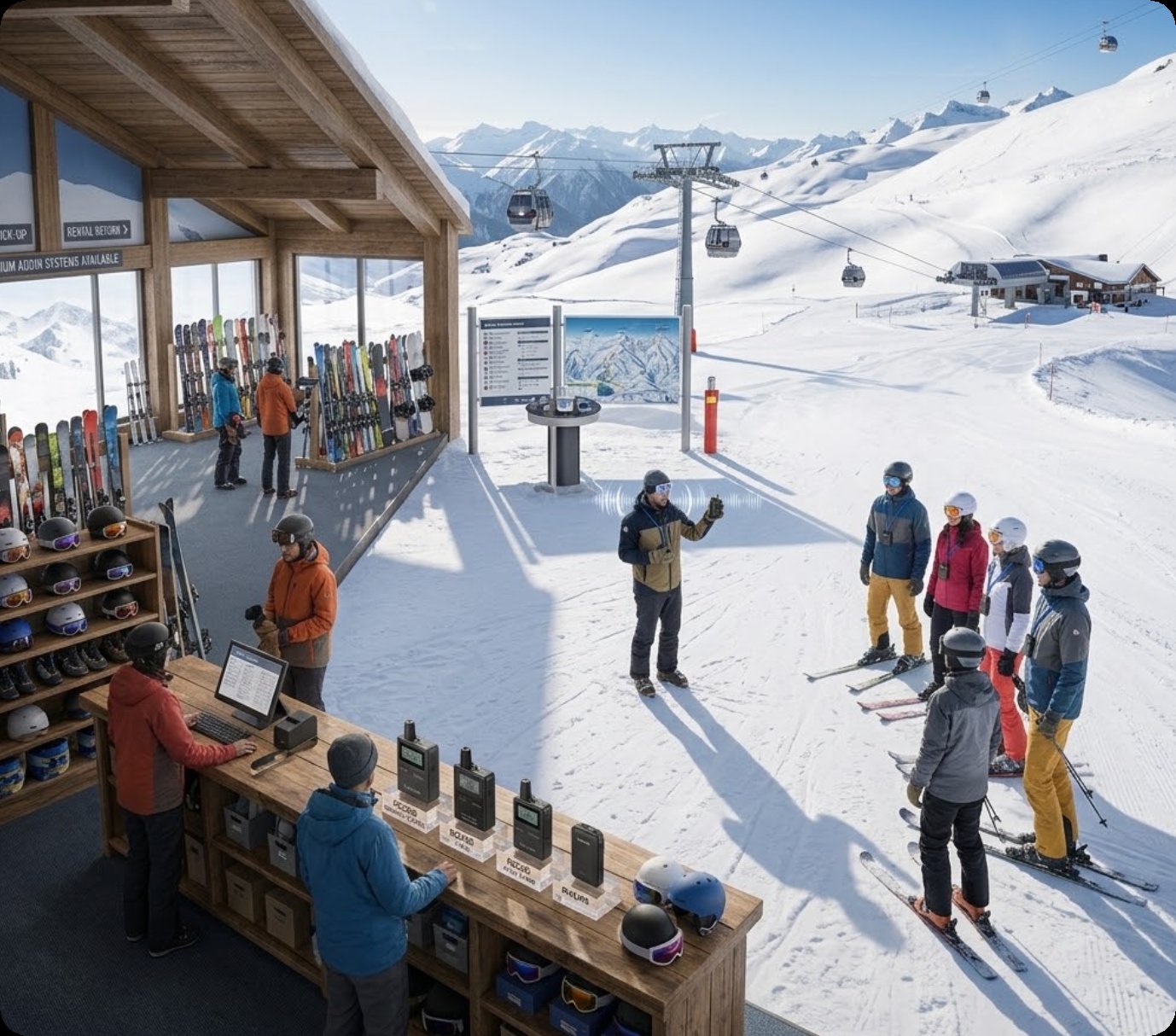
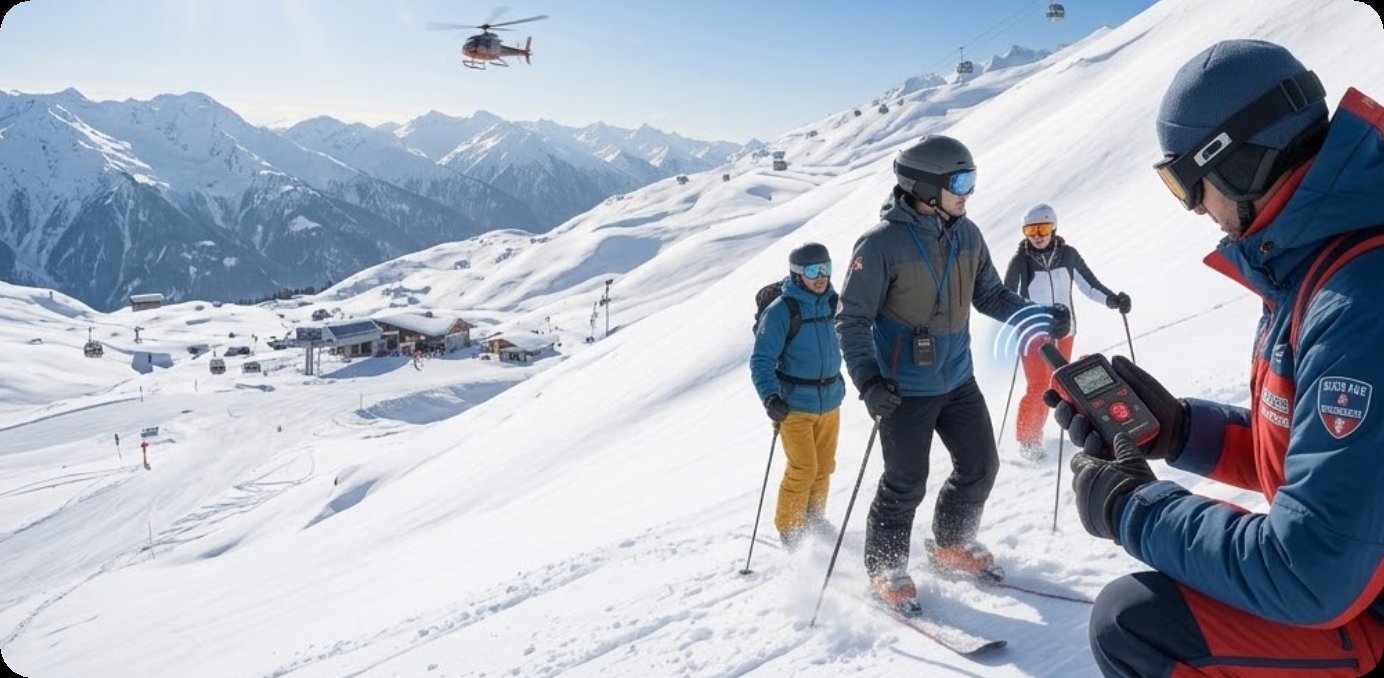
A ski slope is the only guide-system environment where the two halves of the equipment fail for opposite reasons. The transmitter sits against the operator's chest, inside four layers of technical fabric, which keeps a lithium cell warmer than it would be anywhere else in the building — and the receivers go into ears that are exposed to moving air at minus fifteen. One end of the system is being kept warm by the body and the other is being chilled by the wind, and a specification sheet written for a twenty-degree indoor tour says nothing about either condition. The third problem is not electrical at all: on a slope, the guide is wearing gloves, moving downhill, and every control that has to be found and pressed with a fingertip is a control that will be pressed into the wrong thing.
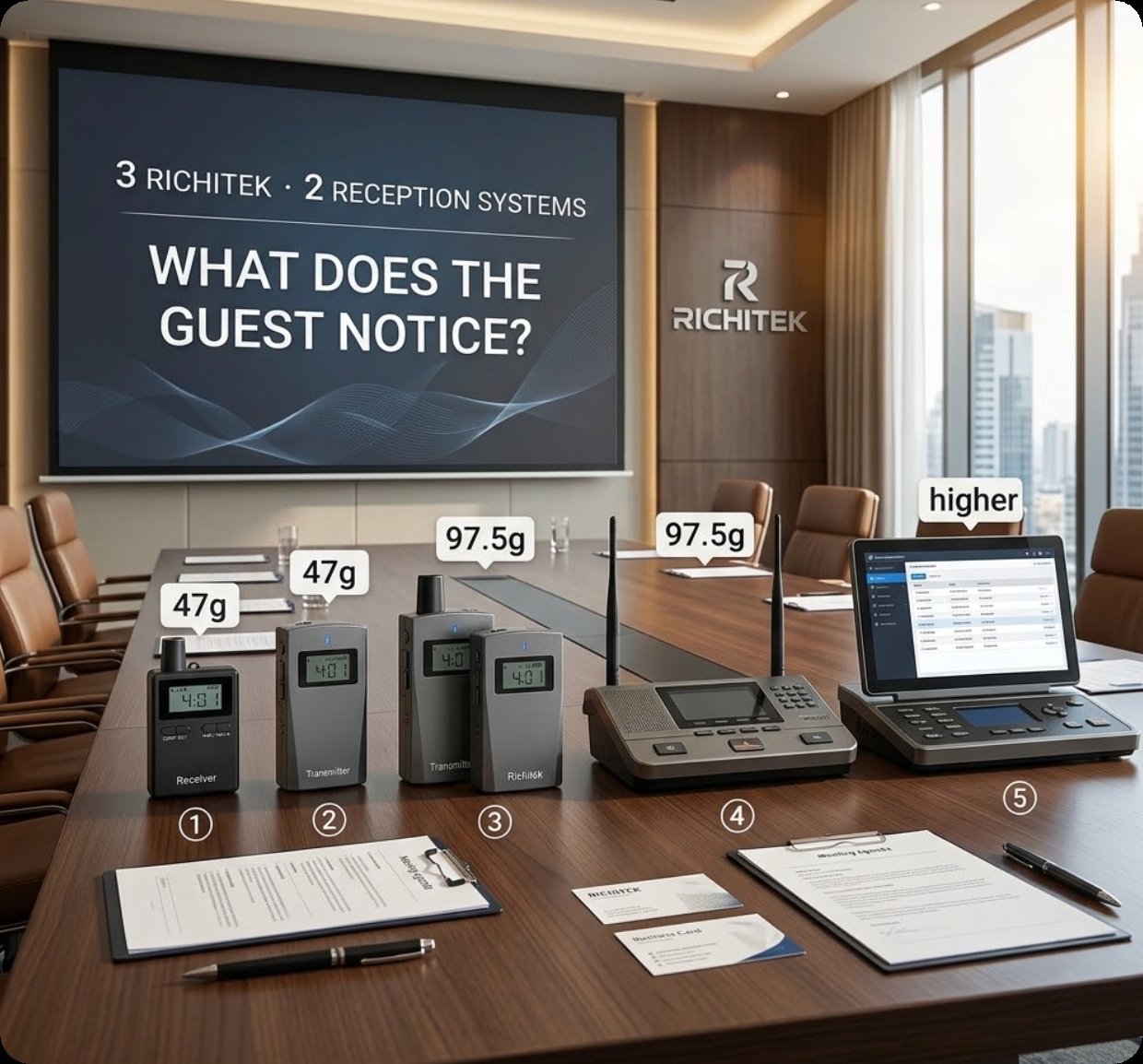
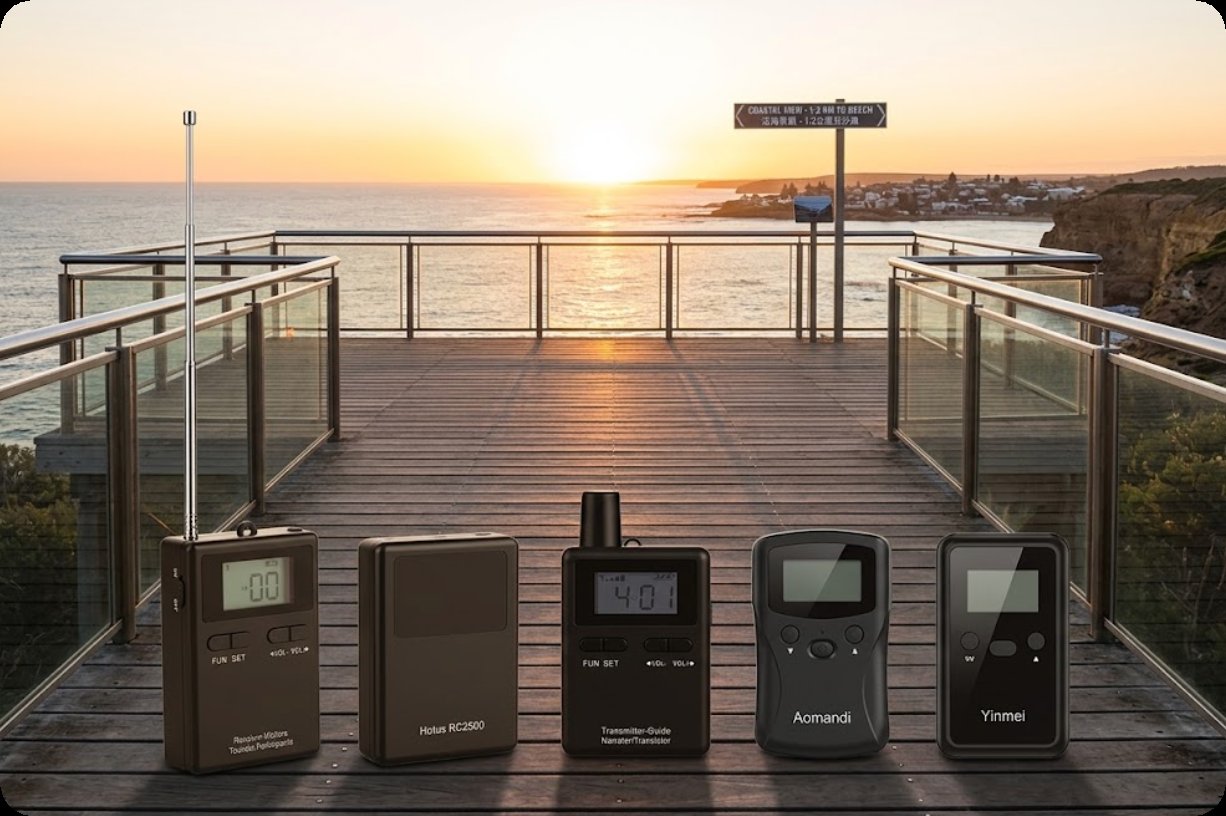
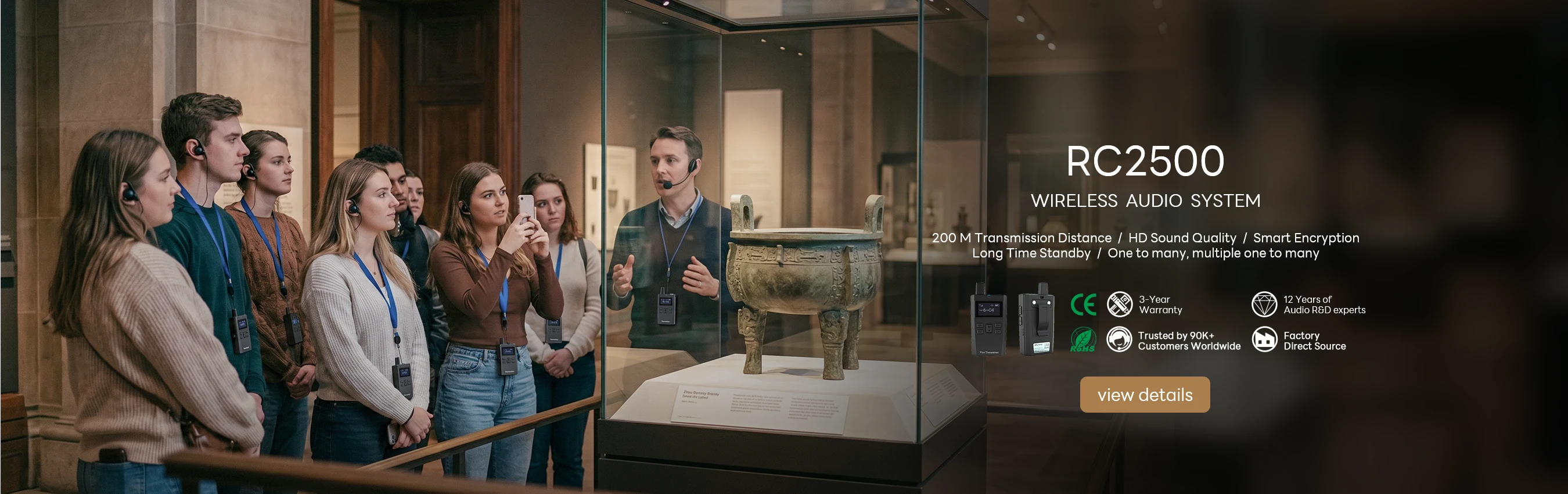
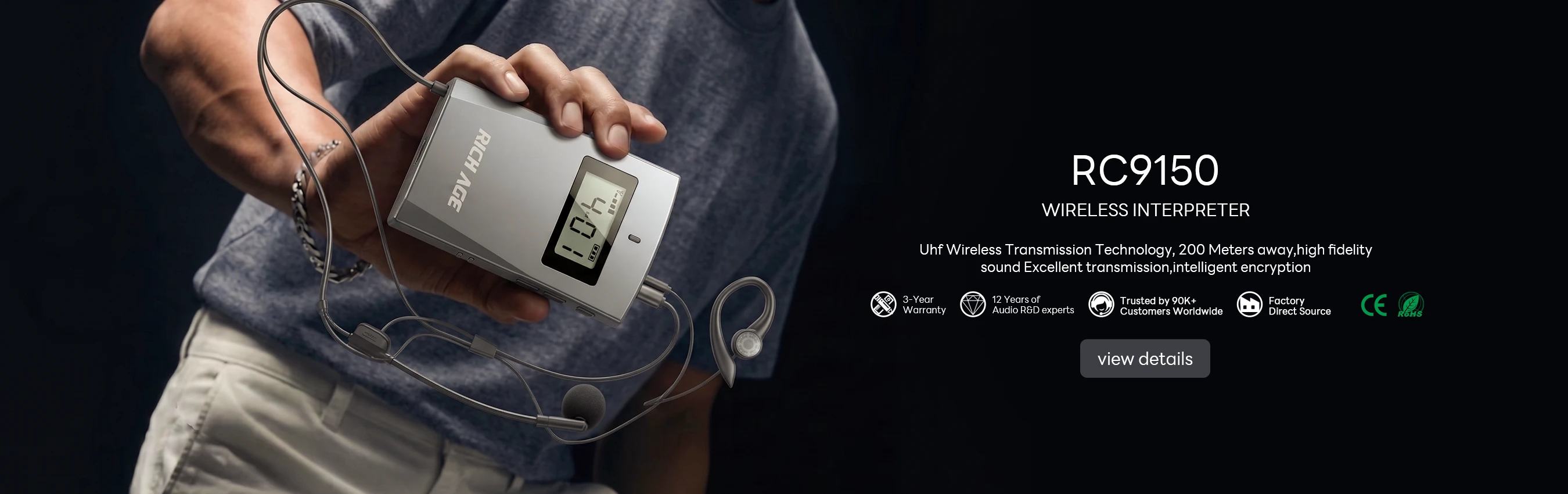
Three Richitek units are compared here against two systems chosen because they attack this environment from different ends. The RC2500 is the flagship at 104 grams on both halves with 1800mAh cells, thirty-five-plus hours of receiver standby, Type-C charging and a documented one-touch synchronise, power-down and mute control — the largest unit here and the one whose weight is hardest to justify on a slope. The RC2406 is the eighty-channel unit at 59 and 50 grams, with multi-colour availability at volume and a transmit audio path reaching 200kHz. The RC2501 is the lightest at 47 grams on both halves and the highest output in the group at 13 milliwatts. Facing them are Philips, whose documented position is deep audio tuning, noise-control technology, a wide physical distribution network and convenient after-sales service, and DiLuan, whose DL-R311 is documented as long-endurance with noise reduction at a listed price of 100 to 150 yuan per unit.
One boundary should be drawn before any comparison is attempted. Neither competitor publishes a channel count, a transmission distance, a battery capacity, a weight, an operating temperature or an ingress rating in the source record available for this comparison, so any figure attached to them here would be invented rather than quoted. What the record does contain is a set of claims that matter — noise control, endurance, distribution and service — and those are worth examining on their own terms rather than being compared against numbers the other side has not published.
🔍 The Cold Is Not One Problem, It Is Two
A lithium cell does not stop working when it gets cold; it stops delivering the capacity it claims on the label. The same cell that gives fifteen hours of transmitter use at twenty degrees will give materially less at minus fifteen, and the shortfall is not a fixed proportion — it grows as the temperature falls. For a guide system that means a day which is fine on the chairlift becomes a problem by the fourth run of the afternoon, and the operator's response is usually to carry spare batteries rather than to plan the schedule around them.
This is why the RC2500's specification is the most interesting of the three in this particular environment, and why its 104 grams does not disqualify it here. It carries a 3.7V 1800mAh cell on each half — transmitter and receiver alike — which is the largest pair of cells in this comparison, and the documented receiver standby is above thirty-five hours. A guide wearing it on a lanyard under a jacket is putting that transmitter cell against the one warm surface available in a mountain environment. The weight that disqualifies it indoors becomes, in this specific case, a thermal advantage, and that inversion is worth stating plainly because the usual instinct is to buy the lightest unit for a cold place.
The same logic cuts against the lightest option. The RC2501 is 47 grams on both halves with a 3.7V 1500mAh transmitter cell and a 3.7V 1000mAh receiver cell, quoted at fifteen hours of transmitter and thirty-five-plus of receiver use, with Type-C charging on both. That receiver cell is the smallest in this comparison, and a receiver carried in an exposed ear at minus fifteen is the worst-placed cell on the whole system. Forty-seven grams is a real advantage in a different environment; in this one the figure that matters is the cell that is already cold before the guest takes it out of the pocket.
Between them sits the RC2406, which carries 3.7V 1500mAh on the transmitter and 3.7V 1000mAh on the receiver, with ten hours of transmitter and twenty of receiver use, DC-port charging and multi-colour availability at volume. Twenty hours is half the RC2500's receiver figure and considerably more than the eight hours quoted for a very light ear-hook receiver in this product family, which makes it the middle answer on battery. Its 80-channel ceiling is the largest here, which is a different kind of answer entirely and is dealt with below.
What none of the three publishes is an operating temperature range, and for a ski resort that is the most useful single line a vendor could add. A cell's behaviour below zero is predictable and unarguable; what matters commercially is whether the vendor will state it, because a resort operator needs to know whether a unit is rated for a minus fifteen morning, a minus twenty-five morning, or only for the lodge.
Gloves Are a Control Interface Decision
On a slope the guide is standing in a lift queue or walking a traverse with gloves on, holding a pole in one hand and a radio in the other. That single fact eliminates a whole class of design decisions and promotes a different class. A volume control that requires finding a small button and pressing it twice is not a control on a slope; a one-touch mute that can be triggered through a glove is a control that works.
This is where the RC2500's documented special design earns its place in a way that none of its other specifications do. The published feature is a one-touch synchronise, power-down and mute control. On a bench that is a convenience; on a slope it is the difference between a guide who can silence a receiver that has picked up a neighbouring group and one who cannot, and the difference matters every time a second group crosses the same part of the mountain.
The RC2501 answers the same problem from the other end with its documented optional head-worn or lapel microphone, which frees the hand that would otherwise be holding a transmitter up to the mouth. A guide who is also holding a pole, adjusting goggles, or steadying a beginner does not have a spare hand, and a lapel option puts the microphone where the voice already is. The published receiver sensitivity on this unit is approximately -38dBm, which is a figure to test on a slope rather than compare on paper — a wind-noise problem presents as a volume problem, and a sensitive receiver does not fix it.
The RC2406 records no microphone option and no sensitivity figure. Its documented advantage is 80-channel interference resistance with high value for money, and on a mountain where two groups share one ridge that is a real advantage, but it is a channel-collision argument rather than a glove argument, and the two problems are solved by different features.
There is a fourth option that this comparison should name because it is what some resorts actually do, which is to issue no receivers at all on the mountain and use recorded commentary over a speaker system, or to run a guided group only inside the lodge where the equipment spends its life. Both avoid the entire battery-and-glove problem and both give up the thing that makes a guide system worth having: an unscripted commentary delivered to a specific group at the specific moment the group arrives at the viewpoint.
🔍 The Wind Is the Actual Transmission Problem
The quoted transmission distance for all three units is one to two hundred metres, and on an open snowfield that figure is generous rather than useful — which is the first sign that the slope is not a coverage problem. A lift queue, a ridge line and a tree run are all short distances with complicated geometry, and what actually decides whether a guest hears the guide is the wind noise arriving at the microphone from a moving body at fifteen kilometres an hour, competing with the acoustic sound of skis on packed snow and a lift drive behind the guide.
That is a signal-to-noise problem, and no amount of channel separation solves it. It is also the one problem in this comparison that a competitor has publicly addressed: the Philips record lists deep audio tuning and noise-control technology alongside a wide physical distribution network and convenient after-sales. Two of those four claims matter on a mountain and two of them are about procurement rather than audio, and that split is itself informative. Deep tuning and noise control address the slope; distribution and service address what happens when a hundred handsets need repair at 2,000 metres in February, which is a real operational cost that a specification table never shows.
The DiLuan DL-R311 is documented more briefly: long endurance and noise reduction, positioned for scenic sites and study tours, at 100 to 150 yuan per unit in the mid tier. That price is worth putting on the page plainly, because it is a different purchase by an order of magnitude. A resort comparing a fleet of several hundred handsets is looking at a replacement cycle that is arithmetic rather than strategy, and the honest observation is that a resort that issues one handset per guest per visit is buying a consumable, not a system.
What neither competitor record contains is a number that would let anyone compare these against the Richitek figures, and this article will not construct one. What can be said is directional: on noise, one competitor has made it a stated feature and the other has made it a stated feature, while none of the three Richtek units documents a noise figure at all. That is a real gap in the Richitek specification, and the honest response is that a resort should treat it as a trial question — a wind-noise test on the actual slope, with the actual guide, at the actual speed.
Against that, the Richitek units hold two figures the competitors do not publish at all. The RC2501 runs at 13 milliwatts, the highest output in this comparison, which does not defeat wind noise but does help with distance and with a group moving through a gully. And the RC2406's 80-channel ceiling is the largest here, which on a resort running several groups across several slopes is the difference between managing the morning and coping with it.
Philips: The Claim That Is About Service
The Philips record is a single entry in the source data, and it is worth handling precisely rather than inflating. The documented characteristics are deep audio tuning, noise-control technology, a wide physical distribution network and convenient after-sales service, positioned at the mid tier with the applications listed as campuses, training bases and internal corporate use, and no price given.
None of those are specification figures, and this comparison will not pretend otherwise. What they describe is a purchasing posture rather than a device: a vendor whose argument is that the audio will sound right and that help will be reachable. On a ski resort the second half is not a throwaway line. A resort two hours from a major city, in February, with a hundred devices, faces a repair problem that a distributor network genuinely addresses and that a factory-direct shipment with a spare-pool strategy genuinely does not.
The first half is harder to evaluate from the record. Deep audio tuning is a claim about how the system sounds in a quiet room with a microphone close to a mouth, which is the opposite of the slope condition. Noise-control technology is the relevant half, and it is stated without a figure — no attenuation in decibels, no frequency range, no test condition. A buyer comparing it against any Richitek unit is comparing a stated intent against an unstated one, and the only honest resolution is a test on the hill.
What the Philips record does not claim is worth noting too. It does not claim a channel count, a distance, a battery figure, a weight or a temperature rating, and it does not position itself for outdoor or mountain use — the listed applications are campuses, training bases and internal corporate settings. A resort is not in that list, and the vendor whose strength is distribution may or may not have a product qualified for a minus fifteen morning.
DiLuan: What a Low Price Buys and What It Does Not
The DiLuan record contains four entries, of which two carry no specification data at all. What is documented is a DL-R311 with long endurance and noise reduction at 100 to 150 yuan per unit, positioned for scenic sites and study tours at the mid tier, and a 2.4GHz series noted for an internationally common band, interference resistance and multi-language synchronisation for scenic sites and museums.
The multi-language point is the one that overlaps with a real ski resort need. International resorts run mixed-nationality groups, and a system that synchronises several languages is solving a problem the three Richitek units in this comparison do not address directly — they are single-channel commentary systems, and a guest on channel 47 hears what the guide says, in one language. Where a resort needs German, Chinese and Japanese on separate channels simultaneously, that is a different category of purchase, and this comparison should say so rather than pretend a channel count solves it.
The price is the rest of the argument. At 100 to 150 yuan per unit, a fleet large enough for a busy resort is an arithmetic decision rather than a capital one, and the consequence of that is predictable: units get dropped in car parks, arrive with dead batteries, and get replaced rather than repaired. A buyer choosing this route is choosing throughput over lifetime, and for a short seasonal operation with a high daily footfall that can be the correct choice.
Where the record cannot support a comparison is on every number that would tell you whether the unit survives a ski season. No temperature range, no ingress rating, no weight, no capacity, no channel count. That absence is itself informative — a product at this price point is not being specified for minus fifteen with a gloved hand — but it means the honest comparison is between a stated price and an unstated qualification, and the resort has to decide which side of that line it sits on.
Choosing by What the Slope Actually Breaks
The table below maps each unit to the constraint it answers rather than to a specification tier, because a ski resort has four distinct problems and each one is solved by a different figure. The battery kept warm against the chest, the receiver sitting in a cold ear, the gloved hand at a control, and the wind arriving at the microphone are four unrelated problems that a single specification number cannot cover.
One practical note belongs with all of these units. The test that matters on a slope is not a specification sheet but a single morning run with the actual guide, the actual speed and the actual wind — and the figure worth watching is not the channel count or the milliwatt rating but how long the receiver keeps working after two hours in a cold car, because that is the moment a guest decides whether the system was worth issuing.
🎯 Specification Summary and Selection Matrix
| Richitek RC2500 | 2403-2483MHz, 50 channels, 10mW, 1-200m | 3.7V 1800mAh both halves; 15h transmitter, 35+h receiver | 104g transmitter, 104g receiver | 50Hz-8kHz | Type-C; black only, customisable at volume | One-touch synchronise, power-down and mute; flagship positioning; PLL |
| Richitek RC2406 | 2403-2483MHz, 80 channels, 10mW, 1-200m | 3.7V 1500mAh transmitter 10h; 3.7V 1000mAh receiver 20h | 59g transmitter, 50g receiver | Transmit 50Hz-200kHz, receive 50Hz-12kHz | DC port; multi-colour at volume | 80-channel interference resistance; high value for money; PLL |
| Richitek RC2501 | 2403-2483MHz, 50 channels, 13mW, 1-200m | 3.7V 1500mAh transmitter 15h; 3.7V 1000mAh receiver 35+h | 47g transmitter, 47g receiver | 20Hz-200kHz | Type-C; grey only, customisable at volume | Optional head-worn or lapel microphone; receiver sensitivity approximately -38dBm; long endurance with a professional microphone |
| Philips system | Not published in the comparison source | Not published | Not published | Deep audio tuning and noise-control technology stated; no figure given | Not published | Wide physical distribution network and convenient after-sales; mid tier; listed for campuses, training bases and internal corporate use; no price stated |
| DiLuan DL-R311 | Not published for this model; a separate 2.4GHz series is documented as internationally common with interference resistance and multi-language synchronisation | Described as long endurance; no capacity published | Not published | Noise reduction stated; no attenuation figure | Not published | 100-150 yuan per unit; mid tier; scenic sites and study tours |
| A full winter day where the transmitter is worn against the chest all day | RC2500 | 1800mAh on both halves with 35+h receiver standby, and the one-touch mute that works through a glove |
| Several groups moving across several slopes at once | RC2406 | Eighty channels with documented interference resistance, multi-colour issue for zone coding, and 50-59g that is manageable for a whole day |
| A guide who needs a free hand on the pole and the maximum available output | RC2501 | Forty-seven grams, 13mW the highest here, and a lapel or head-worn microphone option |
| A resort two hours from a service centre with a hundred devices in February | Philips | A wide physical distribution network and after-sales service is a documented strength, and noise control is stated as a feature |
| A short season with high daily footfall where devices are issued per guest | DiLuan DL-R311 | 100-150 yuan per unit makes the fleet an operating cost rather than a capital one |
A resort that runs guided groups on the mountain should start from the two problems the specification tables do not cover and work backwards: get a wind-noise test done on the actual slope, and ask every vendor to state an operating temperature range in writing. Once those two are answered, the choice narrows quickly — the RC2500 for a full day against the body, the RC2406 when several groups share the mountain, the RC2501 when weight and microphone placement matter most. The Philips system is the one to approach on service and noise rather than on numbers, and the DiLuan is a throughput purchase whose low price is the entire argument.
Resorts running the same guided programme across a mountain and a lakeside property in summer can review the museum audio guide equipment overview for indoor chassis options, and multi-stop industrial itineraries share the same multi-guide constraints covered in the industrial tour headset page. To weigh capacity classes across the whole range before specifying, begin with the tour guide system comparison index.