A leading China factory specializing in Wireless Tour Guide Systems, Church Audio Guides, and Translation Headphones with premium OEM/ODM solutions.

Tel:+86 18922879583

Email:tiger.wang@richitek.com

A Cave Is the Worst Room for a Guide's Voice

Most tour venues are acoustically forgiving. A museum gallery has carpet and fabric, a city square disperses sound into open air, a bus has a roof that keeps your voice contained. A show cave does none of this. Limestone walls are hard, damp and angled in every direction, so every syllable a guide speaks bounces around the chamber for two or three seconds before it dies. Add dripping water, an underground stream, and forty other visitors, and the room itself becomes the loudest thing in it.

That physics is why cave operators end up testing three completely different sound paths. A voice can travel through open air on a loudspeaker, point to point on a professional wireless link, or one-to-many on a dedicated guide system. This article walks each path through the same cave — a typical show cave with a 40-metre main chamber, a staircase of about eighty wet steps, and five groups running in parallel at peak season — and puts the RC2468, RC2408 and RC8860 on the third path.

Loudspeakers Lose to Limestone

The first path is the one most operators already own: a portable voice amplifier clipped to a belt. The AISOMEX K20 is a typical specimen of this breed. It outputs about 3 watts through a small full-range driver, charges over Type-C, pairs with a wireless ear microphone over Bluetooth 5.2, and the vendor claims a full week of use on one charge for the main unit with roughly eight to ten hours on the ear microphone battery. Retail listings put it around 170 to 199 yuan, which is a rounding error next to any professional system.

In a classroom this works, because a classroom absorbs sound. In a limestone chamber the same 3 watts becomes a problem. Every hard surface returns the voice as a delayed copy, and the reverb tail of one sentence smears directly into the first word of the next. Speech intelligibility collapses long before loudness does — the visitors can hear that the guide is talking, but the consonants that carry meaning are buried under their own echoes. Water dripping at one to two second intervals lands in almost the same frequency range as consonants, which makes the masking worse.

There is also a courtesy problem. Air is a broadcast medium with no admission control. Your narration reaches the group behind you in the queue, the group resting at the viewpoint, and anyone standing near the entrance. In a corridor-style cave where groups pass each other on the stairs, two amplified guides produce an interference pattern no visitor paid to hear. The loudspeaker path is cheap, and in a cave it is exactly as cheap as it sounds.

🗺️ Borrowing a Film Crew Kit for a Walking Tour

The second path appears when a tourism operator borrows gear from the video world. The Saramonic UwMic9 is the common choice, and on paper its numbers embarrass most dedicated guide equipment. It is a UHF system working across 514 to 596 MHz with 96 selectable frequency groups, PLL synthesis, under 10 mW of output, a receiver sensitivity of -95 dBm, about 12 ms of latency, and a frequency response of 20 Hz to 18 kHz. Two AA batteries power each unit, and spare AAs are sold at every convenience store on the planet.

The catch is architectural, not electrical. The UwMic9 is a point-to-point system: one transmitter sends to one receiver, and that receiver feeds a camera input or a monitoring headphone. It has no concept of a group. You cannot hand thirty visitors their own receivers and let them all listen to the same transmission, because the system was designed to deliver one clean channel to one recording device. A film crew kit in a cave gives you one perfectly recorded guide and thirty people straining to hear the playback later.

Its carrying weight tells the same story. The transmitter weighs about 211.4 g and the receiver about 218 g without batteries — roughly the mass of an entire four-receiver guide kit in each hand. There is one more procurement detail: 514 to 596 MHz sits in spectrum that many countries allocate to licensed professional audio, so a cave operator importing such a kit needs to check local rules before the first tour, not after.

Eighteen Grams on a Wet Staircase

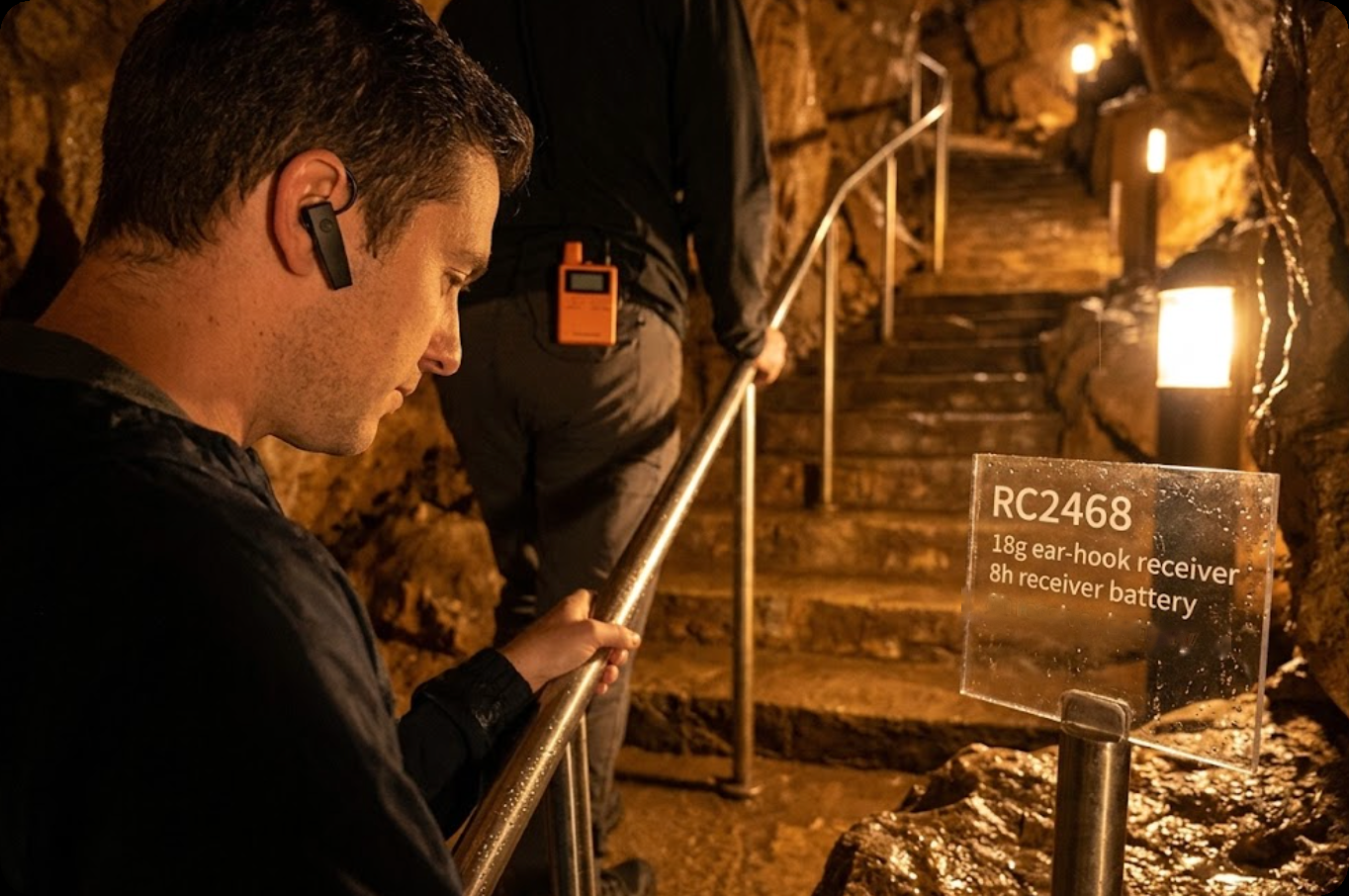
The third path is a dedicated guide system, and the cave version of the decision starts at the ear. On the descent, visitors hold the handrail with one hand and steady themselves with the other; the receiver has to disappear onto the ear and stay there. The RC2468 is built around exactly this constraint. Its receiver weighs 18 g in an ear-hook form — the lightest wearing experience in this entire product family — and carries a 3.7 V 300 mAh cell that delivers roughly 8 hours of reception. The transmitter side weighs 59 g with a 3.7 V 1500 mAh battery running about 10 hours, and the whole kit charges over USB.

That 300 mAh figure is the honest trade on this model. Eight hours covers a morning and an afternoon session, but not both plus an evening lantern tour, so an operator running the device all day builds a midday charging rotation into the schedule. Against a wet staircase, though, the arithmetic favours lightness: an 18 g ear-hook is never taken off, never stuffed in a pocket, and never swung on a lanyard against the rock face while a visitor climbs. The transmitter ships in several colours while receivers stay black, which keeps the visitor-facing side uniform in photos.
QQ_1792744349315_1792746061

Peak Season Means Five Groups in One Cave

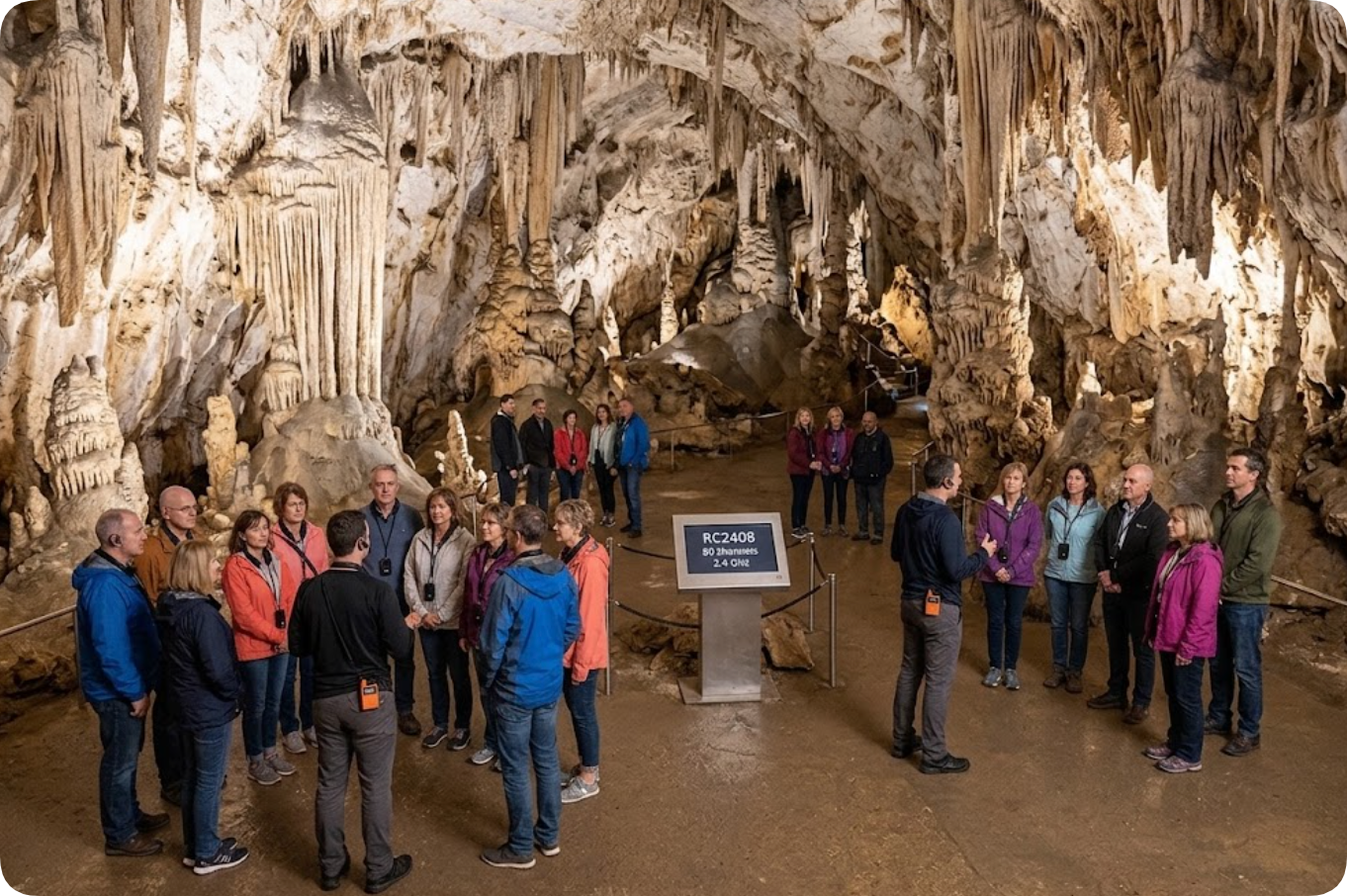
Capacity planning inside a cave is a channel-count problem. A typical show cave in high season runs a group in the entrance gallery, another in the main chamber, a third on the staircase, a fourth at the underground river viewpoint, and a fifth waiting at the exit lounge — all inside the same 40 metres of rock. Every group needs its own channel, plus one or two spare frequencies for the maintenance staff. Under 20 channels that math gets tight fast; with headroom it becomes routine.

The RC2408 is the capacity answer in the current line-up. It provides 80 channels on the 2403-2483 MHz band at 10 mW output with a working range of 1 to 200 m, frequency response of 50 Hz to 12 kHz on reception, a 59 g transmitter paired with 50 g receivers, and DC-port charging for the charging-case workflow. Where the RC2468 wins by disappearing onto the ear, the RC2408 wins by letting the fifth and sixth group join the rotation without anyone re-planning frequencies at the ticket desk.
QQ_1792744358772_1792746064

The UHF Case for Damp Rock

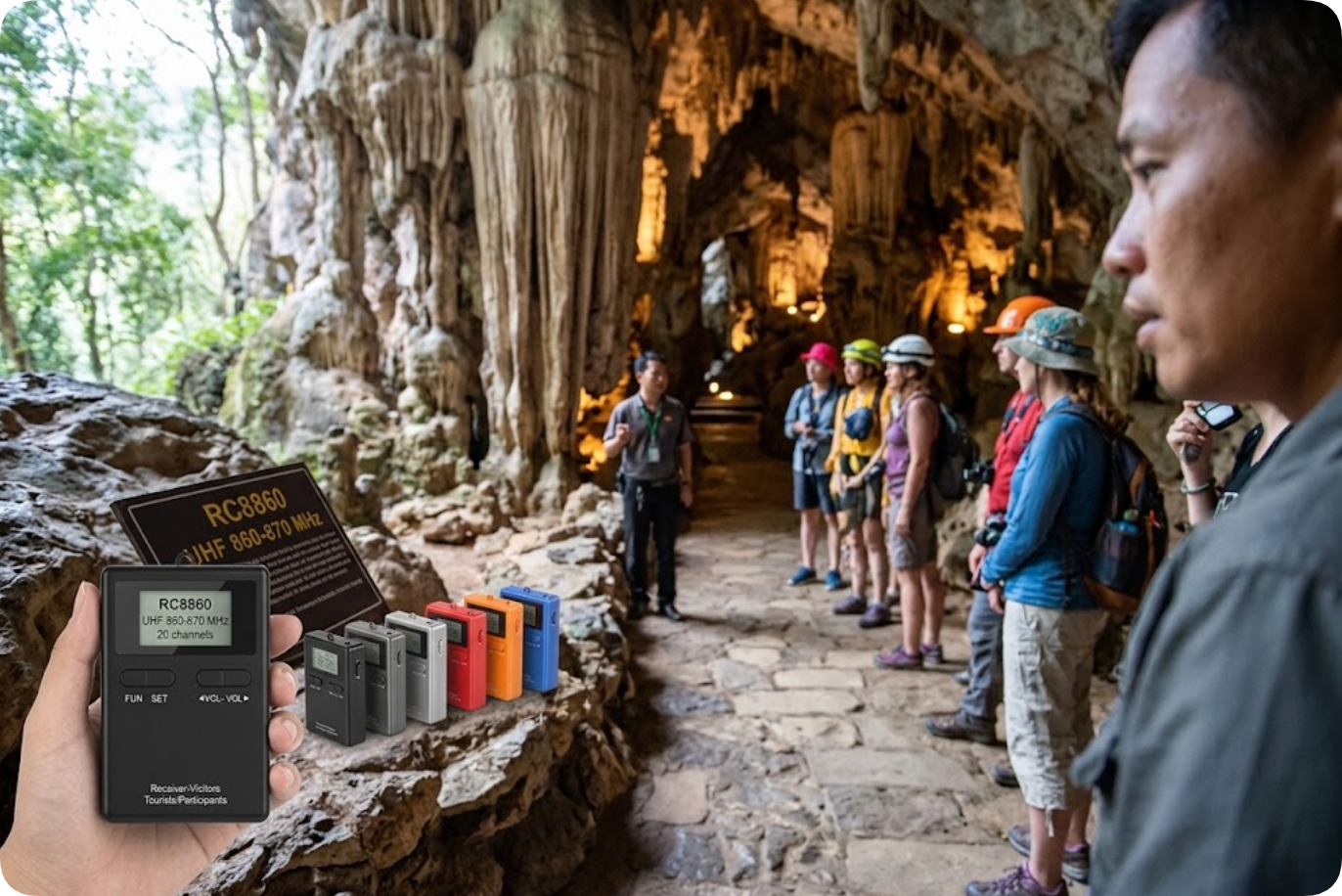
The same product family keeps one UHF model around, and a cave is the environment that justifies it. The RC8860 transmits on 860 to 870 MHz — a licence-free band across most of Europe — at 10 mW with 20 channels, a 59 g transmitter, 50 g receivers, about 10 hours of transmitter runtime and 20 hours on the receiver, charged over a DC port. The band choice matters where the air is wet: the 2.4 GHz band is shared with every visitor's phone hotspot gathered at the cave entrance, while 860 to 870 MHz sits in a quieter neighbourhood of the spectrum.

Twenty channels sounds like a downgrade until you count the deployment. A single-operator cave running two or three concurrent tours uses maybe five channels including spares, and the RC8860's six colours — black, iron grey, silver grey, red, orange and blue — let a two-guide operation colour-code its fleets so receivers return to the right charging slot. This model is the family's argument that band selection, not channel count, is sometimes the procurement question, and it is why the line-up deliberately keeps both answers on the shelf.
QQ_1792744365658_1792746066

What the Three Kits Put on Paper

DimensionRC8860RC2468RC2408
Number of channels205080
Receiver weight50g18g ear-hook50g
Receiver battery life20h8h approx.20h
Receiver battery3.7V 1000mAh3.7V 300mAh3.7V 1000mAh
Charging portDC PortUSBDC Port

Read the table as a set of trade-offs inside one family rather than a ranking. All three transmitters weigh 59 g and share the same transmitter cell and roughly 10 hours of transmitter runtime, so the differences concentrate on the visitor's ear: 18 g against 50 g, 8 hours against 20, and 50 channels against 80 against 20 across two different bands. The RC2468 and RC2408 both live on 2.4 GHz; the RC8860 is the family's UHF outlier.

What the Spec Sheets Leave Out

None of the three Richitek models publishes an IP rating, a humidity rating or a storage-temperature spec, and a show cave runs at 90 percent-plus humidity year-round at around 14 degrees Celsius. That is a genuine gap, not a formality: condensation forms on devices moving between the cool chamber and the warm surface building, and operators should ask the manufacturer for written moisture-handling guidance before committing a fleet. Until such numbers exist, the practical mitigation is operational — dry the kits in the charging case before storage and inspect ear-hooks weekly for mineral deposits from the drip zones.

Fairness requires conceding what the alternatives do better. The Saramonic UwMic9 offers 96 frequency groups, -95 dBm sensitivity, 12 ms latency and an audio bandwidth reaching 18 kHz — every one of those numbers is better than any guide system in this article, because it was engineered for recording rather than group delivery. And the AISOMEX K20 costs roughly what a single replacement receiver does; an operator with a tiny budget and a dry, quiet surface venue loses nothing by choosing it. The cave is what disqualifies each of them, not the spec sheet.

Matching Hardware to the Route

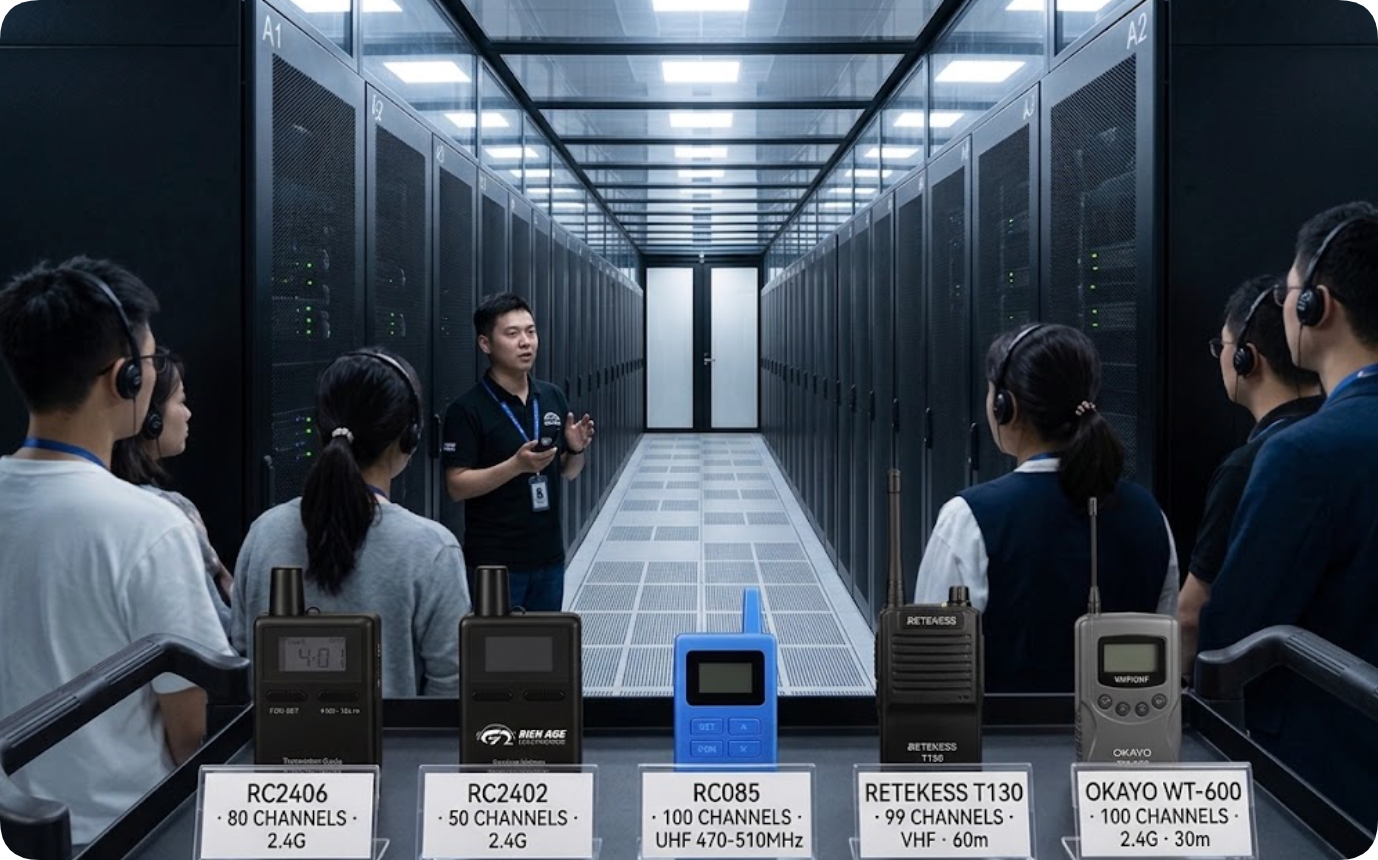
The procurement sequence that survives contact with a real cave runs in three questions. First, count the parallel groups at peak season, because that number settles the channel budget: up to five concurrent tours fits comfortably in 20 channels, six or more wants 50, and a training operation running many simultaneous groups wants 80. Second, ask the cave administration about humidity data and local spectrum rules, because the first decides how the fleet is stored and the second decides whether a UHF model is even necessary in your region.

Third, weigh the route against the ear. A staircase-heavy route with long single-file sections rewards the lightest receiver, which is the RC2468 at 18 g; a flat, wide chamber route with big groups rewards the 20-hour receivers; a region with congested 2.4 GHz traffic points at the 860-870 MHz band. To see how these three kits behave on other kinds of terrain, compare them across our city tour deployments, or browse the full wireless tour guide system range before drawing a shortlist.

Frequently Asked Questions

Do wireless tour guide systems actually work inside a cave?

Yes, with one caveat about distance claims. All three models in this article are specified at 1 to 200 m in open conditions, and a 40 m chamber sits well inside that envelope even with reflections. What limestone changes is not whether the signal arrives but how much power it needs to arrive cleanly, so the practical advice is to walk the route with a demo kit at your own group spacing — usually 10 to 15 m between the guide and the last visitor on a staircase — before buying a fleet.

How many receivers should one guide carry in a show cave?

Operators typically outfit 20 to 30 visitors per guide, which all three models support in channel terms — the constraint is stewardship, not radio capacity. On a staircase, a single guide cannot supervise 30 people moving single-file over wet steps, so caves commonly split into sub-groups of 12 to 15 with one transmitter per sub-group. That practice, not the hardware, is why five parallel groups at peak season is a realistic planning number.

How do I protect the equipment from cave humidity?

Start by acknowledging that the manufacturers publish no humidity or IP figures for these models, so protection is on the operator. The working routine used by cave operators is: wipe receivers at the end of each session, let them air-dry in the charging case for at least an hour before closing the lid, keep silica-gel packs in the transport case, and replace any ear-hook foam that has absorbed water. Ask the supplier for written condensation guidance as part of the purchase contract, and treat a device left overnight in the cave as suspect until it has dried and been tested.

Is UHF really better than 2.4 GHz for cave tours?

There is no published side-by-side measurement for caves, so treat any absolute claim with suspicion. What can be said from the specifications: 860 to 870 MHz is licence-free in most of Europe and sits away from the crowded 2.4 GHz band that every visitor's phone occupies, while 2.4 GHz is licence-free nearly everywhere and needs no regional variant. If your cave sits in a tourist town where dozens of phone hotspots cluster at the entrance, the UHF option is worth a trial; if you operate across borders and want one fleet everywhere, 2.4 GHz keeps logistics simple.
2026年10月23日 17:04
ꄘ click: 42

Get the spec sheet, MOQ and a factory-direct quote

Tell us the venue, the group size and how many languages you need. An engineer at our Shenzhen factory replies within one business day with the matching model, a written quote, lead time and the CE / RoHS / ISO 9001 documents.

Talk to an engineer WhatsApp +86 189 2287 9583

Prefer email? tiger.wang@richitek.com  |  OEM / ODM, custom tooling and neutral packaging available  |  send the enquiry through our contact page

Shenzhen Rich Age Electronics Co., Ltd. (Richitek) - manufacturing wireless tour guide systems, church translation headsets and museum audio guide equipment since 2007.

no data
Home > VS

A Cave Is the Worst Room for a Guide's Voice

time: 2026年10月23日 click:42

Most tour venues are acoustically forgiving. A museum gallery has carpet and fabric, a city square disperses sound into open air, a bus has a roof that keeps your voice contained. A show cave does none of this. Limestone walls are hard, damp and angled in every direction, so every syllable a guide speaks bounces around the chamber for two or three seconds before it dies. Add dripping water, an underground stream, and forty other visitors, and the room itself becomes the loudest thing in it.

That physics is why cave operators end up testing three completely different sound paths. A voice can travel through open air on a loudspeaker, point to point on a professional wireless link, or one-to-many on a dedicated guide system. This article walks each path through the same cave — a typical show cave with a 40-metre main chamber, a staircase of about eighty wet steps, and five groups running in parallel at peak season — and puts the RC2468, RC2408 and RC8860 on the third path.

Loudspeakers Lose to Limestone

The first path is the one most operators already own: a portable voice amplifier clipped to a belt. The AISOMEX K20 is a typical specimen of this breed. It outputs about 3 watts through a small full-range driver, charges over Type-C, pairs with a wireless ear microphone over Bluetooth 5.2, and the vendor claims a full week of use on one charge for the main unit with roughly eight to ten hours on the ear microphone battery. Retail listings put it around 170 to 199 yuan, which is a rounding error next to any professional system.

In a classroom this works, because a classroom absorbs sound. In a limestone chamber the same 3 watts becomes a problem. Every hard surface returns the voice as a delayed copy, and the reverb tail of one sentence smears directly into the first word of the next. Speech intelligibility collapses long before loudness does — the visitors can hear that the guide is talking, but the consonants that carry meaning are buried under their own echoes. Water dripping at one to two second intervals lands in almost the same frequency range as consonants, which makes the masking worse.

There is also a courtesy problem. Air is a broadcast medium with no admission control. Your narration reaches the group behind you in the queue, the group resting at the viewpoint, and anyone standing near the entrance. In a corridor-style cave where groups pass each other on the stairs, two amplified guides produce an interference pattern no visitor paid to hear. The loudspeaker path is cheap, and in a cave it is exactly as cheap as it sounds.

🗺️ Borrowing a Film Crew Kit for a Walking Tour

The second path appears when a tourism operator borrows gear from the video world. The Saramonic UwMic9 is the common choice, and on paper its numbers embarrass most dedicated guide equipment. It is a UHF system working across 514 to 596 MHz with 96 selectable frequency groups, PLL synthesis, under 10 mW of output, a receiver sensitivity of -95 dBm, about 12 ms of latency, and a frequency response of 20 Hz to 18 kHz. Two AA batteries power each unit, and spare AAs are sold at every convenience store on the planet.

The catch is architectural, not electrical. The UwMic9 is a point-to-point system: one transmitter sends to one receiver, and that receiver feeds a camera input or a monitoring headphone. It has no concept of a group. You cannot hand thirty visitors their own receivers and let them all listen to the same transmission, because the system was designed to deliver one clean channel to one recording device. A film crew kit in a cave gives you one perfectly recorded guide and thirty people straining to hear the playback later.

Its carrying weight tells the same story. The transmitter weighs about 211.4 g and the receiver about 218 g without batteries — roughly the mass of an entire four-receiver guide kit in each hand. There is one more procurement detail: 514 to 596 MHz sits in spectrum that many countries allocate to licensed professional audio, so a cave operator importing such a kit needs to check local rules before the first tour, not after.

Eighteen Grams on a Wet Staircase

The third path is a dedicated guide system, and the cave version of the decision starts at the ear. On the descent, visitors hold the handrail with one hand and steady themselves with the other; the receiver has to disappear onto the ear and stay there. The RC2468 is built around exactly this constraint. Its receiver weighs 18 g in an ear-hook form — the lightest wearing experience in this entire product family — and carries a 3.7 V 300 mAh cell that delivers roughly 8 hours of reception. The transmitter side weighs 59 g with a 3.7 V 1500 mAh battery running about 10 hours, and the whole kit charges over USB.

That 300 mAh figure is the honest trade on this model. Eight hours covers a morning and an afternoon session, but not both plus an evening lantern tour, so an operator running the device all day builds a midday charging rotation into the schedule. Against a wet staircase, though, the arithmetic favours lightness: an 18 g ear-hook is never taken off, never stuffed in a pocket, and never swung on a lanyard against the rock face while a visitor climbs. The transmitter ships in several colours while receivers stay black, which keeps the visitor-facing side uniform in photos.

QQ_1792744349315_1792746061

Peak Season Means Five Groups in One Cave

Capacity planning inside a cave is a channel-count problem. A typical show cave in high season runs a group in the entrance gallery, another in the main chamber, a third on the staircase, a fourth at the underground river viewpoint, and a fifth waiting at the exit lounge — all inside the same 40 metres of rock. Every group needs its own channel, plus one or two spare frequencies for the maintenance staff. Under 20 channels that math gets tight fast; with headroom it becomes routine.

The RC2408 is the capacity answer in the current line-up. It provides 80 channels on the 2403-2483 MHz band at 10 mW output with a working range of 1 to 200 m, frequency response of 50 Hz to 12 kHz on reception, a 59 g transmitter paired with 50 g receivers, and DC-port charging for the charging-case workflow. Where the RC2468 wins by disappearing onto the ear, the RC2408 wins by letting the fifth and sixth group join the rotation without anyone re-planning frequencies at the ticket desk.

QQ_1792744358772_1792746064

The UHF Case for Damp Rock

The same product family keeps one UHF model around, and a cave is the environment that justifies it. The RC8860 transmits on 860 to 870 MHz — a licence-free band across most of Europe — at 10 mW with 20 channels, a 59 g transmitter, 50 g receivers, about 10 hours of transmitter runtime and 20 hours on the receiver, charged over a DC port. The band choice matters where the air is wet: the 2.4 GHz band is shared with every visitor's phone hotspot gathered at the cave entrance, while 860 to 870 MHz sits in a quieter neighbourhood of the spectrum.

Twenty channels sounds like a downgrade until you count the deployment. A single-operator cave running two or three concurrent tours uses maybe five channels including spares, and the RC8860's six colours — black, iron grey, silver grey, red, orange and blue — let a two-guide operation colour-code its fleets so receivers return to the right charging slot. This model is the family's argument that band selection, not channel count, is sometimes the procurement question, and it is why the line-up deliberately keeps both answers on the shelf.

QQ_1792744365658_1792746066

What the Three Kits Put on Paper

DimensionRC8860RC2468RC2408
Number of channels205080
Receiver weight50g18g ear-hook50g
Receiver battery life20h8h approx.20h
Receiver battery3.7V 1000mAh3.7V 300mAh3.7V 1000mAh
Charging portDC PortUSBDC Port

Read the table as a set of trade-offs inside one family rather than a ranking. All three transmitters weigh 59 g and share the same transmitter cell and roughly 10 hours of transmitter runtime, so the differences concentrate on the visitor's ear: 18 g against 50 g, 8 hours against 20, and 50 channels against 80 against 20 across two different bands. The RC2468 and RC2408 both live on 2.4 GHz; the RC8860 is the family's UHF outlier.

What the Spec Sheets Leave Out

None of the three Richitek models publishes an IP rating, a humidity rating or a storage-temperature spec, and a show cave runs at 90 percent-plus humidity year-round at around 14 degrees Celsius. That is a genuine gap, not a formality: condensation forms on devices moving between the cool chamber and the warm surface building, and operators should ask the manufacturer for written moisture-handling guidance before committing a fleet. Until such numbers exist, the practical mitigation is operational — dry the kits in the charging case before storage and inspect ear-hooks weekly for mineral deposits from the drip zones.

Fairness requires conceding what the alternatives do better. The Saramonic UwMic9 offers 96 frequency groups, -95 dBm sensitivity, 12 ms latency and an audio bandwidth reaching 18 kHz — every one of those numbers is better than any guide system in this article, because it was engineered for recording rather than group delivery. And the AISOMEX K20 costs roughly what a single replacement receiver does; an operator with a tiny budget and a dry, quiet surface venue loses nothing by choosing it. The cave is what disqualifies each of them, not the spec sheet.

Matching Hardware to the Route

The procurement sequence that survives contact with a real cave runs in three questions. First, count the parallel groups at peak season, because that number settles the channel budget: up to five concurrent tours fits comfortably in 20 channels, six or more wants 50, and a training operation running many simultaneous groups wants 80. Second, ask the cave administration about humidity data and local spectrum rules, because the first decides how the fleet is stored and the second decides whether a UHF model is even necessary in your region.

Third, weigh the route against the ear. A staircase-heavy route with long single-file sections rewards the lightest receiver, which is the RC2468 at 18 g; a flat, wide chamber route with big groups rewards the 20-hour receivers; a region with congested 2.4 GHz traffic points at the 860-870 MHz band. To see how these three kits behave on other kinds of terrain, compare them across our city tour deployments, or browse the full wireless tour guide system range before drawing a shortlist.

Frequently Asked Questions

Do wireless tour guide systems actually work inside a cave?

Yes, with one caveat about distance claims. All three models in this article are specified at 1 to 200 m in open conditions, and a 40 m chamber sits well inside that envelope even with reflections. What limestone changes is not whether the signal arrives but how much power it needs to arrive cleanly, so the practical advice is to walk the route with a demo kit at your own group spacing — usually 10 to 15 m between the guide and the last visitor on a staircase — before buying a fleet.

How many receivers should one guide carry in a show cave?

Operators typically outfit 20 to 30 visitors per guide, which all three models support in channel terms — the constraint is stewardship, not radio capacity. On a staircase, a single guide cannot supervise 30 people moving single-file over wet steps, so caves commonly split into sub-groups of 12 to 15 with one transmitter per sub-group. That practice, not the hardware, is why five parallel groups at peak season is a realistic planning number.

How do I protect the equipment from cave humidity?

Start by acknowledging that the manufacturers publish no humidity or IP figures for these models, so protection is on the operator. The working routine used by cave operators is: wipe receivers at the end of each session, let them air-dry in the charging case for at least an hour before closing the lid, keep silica-gel packs in the transport case, and replace any ear-hook foam that has absorbed water. Ask the supplier for written condensation guidance as part of the purchase contract, and treat a device left overnight in the cave as suspect until it has dried and been tested.

Is UHF really better than 2.4 GHz for cave tours?

There is no published side-by-side measurement for caves, so treat any absolute claim with suspicion. What can be said from the specifications: 860 to 870 MHz is licence-free in most of Europe and sits away from the crowded 2.4 GHz band that every visitor's phone occupies, while 2.4 GHz is licence-free nearly everywhere and needs no regional variant. If your cave sits in a tourist town where dozens of phone hotspots cluster at the entrance, the UHF option is worth a trial; if you operate across borders and want one fleet everywhere, 2.4 GHz keeps logistics simple.
Get the spec sheet, MOQ and a factory-direct quote

Tell us the venue, the group size and how many languages you need. An engineer at our Shenzhen factory replies within one business day with the matching model, a written quote, lead time and the CE / RoHS / ISO 9001 documents.

Talk to an engineer WhatsApp +86 189 2287 9583

Prefer email? tiger.wang@richitek.com  |  OEM / ODM, custom tooling and neutral packaging available  |  send the enquiry through our contact page

Shenzhen Rich Age Electronics Co., Ltd. (Richitek) - manufacturing wireless tour guide systems, church translation headsets and museum audio guide equipment since 2007.

no data
×

Contact us

email:
name:
subject:
content: