
A leading China factory specializing in Wireless Tour Guide Systems, Church Audio Guides, and Translation Headphones with premium OEM/ODM solutions.

Tel:+86 18922879583

Email:tiger.wang@richitek.com

Lanterns on the Old Walls: An Ancient Town Case Study with RC2401, RC2468 and RC8860

The harbour town of Bodrum leans on a wall that has been standing since antiquity, and every summer the operators who walk visitors along it face the same puzzle: the best hour to show the Golden Gate is after sundown, exactly when written notes, hand signals and raised voices stop working. This case follows one licensed operator who rebuilt its evening schedule around three devices — the RC2401, the RC2468 and the RC8860 — and moved its briefing, its pairing routine and its charging rhythm to fit a route that only truly begins when nightfall comes.

What makes the case worth recording is not the hardware list but the sequence. The team runs a daylight meeting point by the water, then a lantern-lit circuit through the old bastion quarter, and the two halves of the evening make different demands on the equipment. A transmitter clipped to a lanyard at the quay has to survive heat, spray and small talk; a receiver passed along a stone rampart in the dark has to be found, worn and understood without a single page of printed instructions.

💡 Why the Walk Starts When Nightfall Comes

The southern wall of the old town catches furnace heat until early evening, and visitors who start at noon cut the route in half. By moving the departure to the hour when the bastions turn amber, the operator can run the full outer circuit in roughly ninety minutes. Nightfall also changes what visitors expect from the guide: the group spreads out along the parapet, faces are no longer visible, and a voice that carries two hundred metres becomes the only thread holding the walk together. Families with children, who dominate the summer schedule, are the first to drift — which is why the lightest receiver in the fleet matters more after dark than it does at noon. The operator books the route through its city walking programme, and the sunset slot now sells out weeks ahead of the midday one.

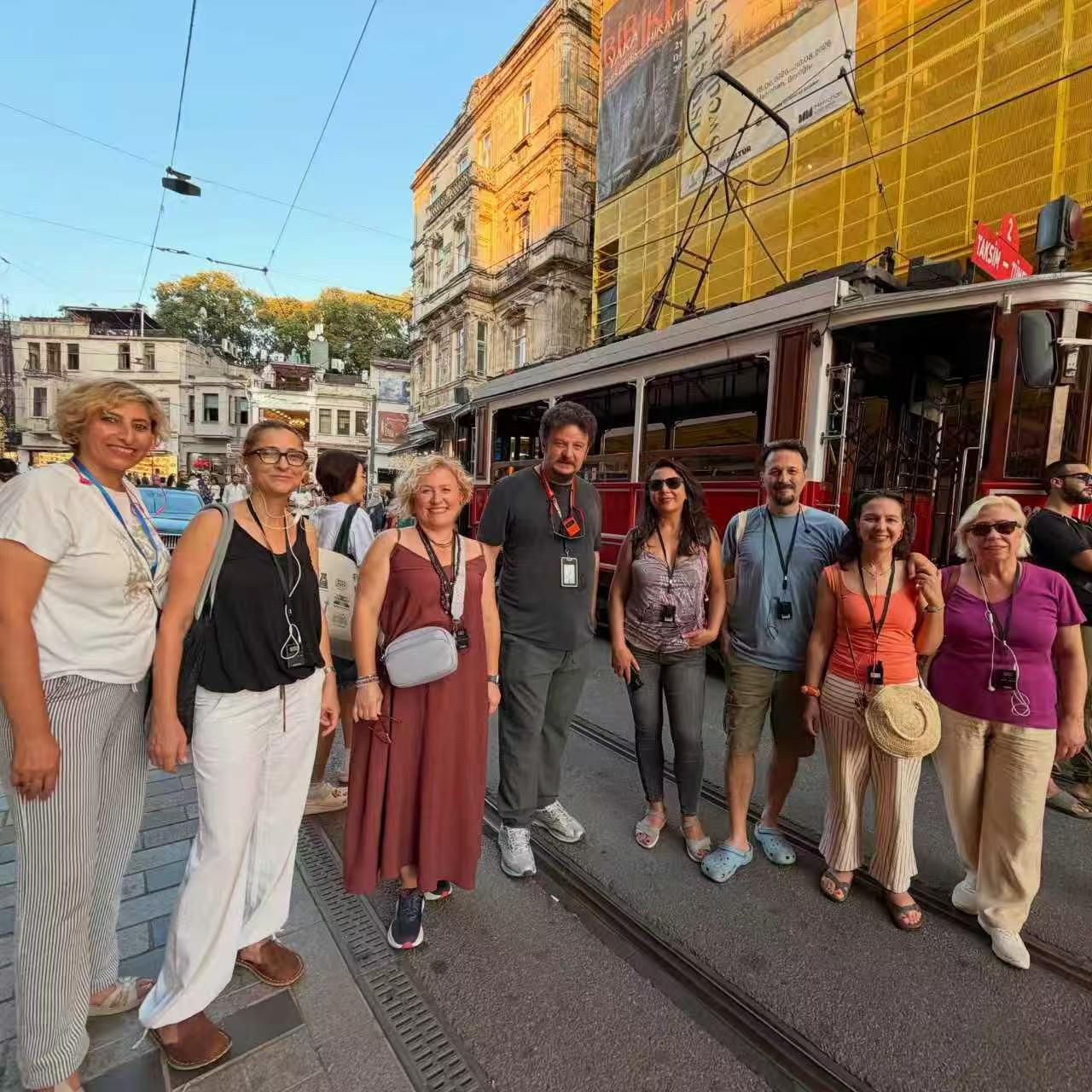
A guide with a red-lanyard transmitter briefing visitors by the harbour

🎯 By the Waterline, the Guide Sets the Rules

Every evening begins on the quay, twenty minutes before the first coach doors open. The guide wears a transmitter on a red lanyard and walks the line of waiting visitors, holding up a receiver and demonstrating three gestures: how to clip it, how to raise the volume with the left arrow, and how to hold it so the speaker faces the ear. The rules are simple because they have to survive being shouted over harbour noise. Nobody switches channels. Nobody pockets the unit — it lives on the lanyard, which is why so few have gone over the railing. The guide carries a laminated card listing each departing group and its channel, and the operator credits this card, not memory, with the fact that no group has boarded the wrong circuit since spring.

What CH 4 and CH 9 Showed at the Equipment Table

At the equipment table behind the kiosk, a routine check caught something worth repeating to every crew that runs multiple departures a night. A transmitter set for channel 4 was paired with a receiver still showing channel 9 — a unit that had come back from an afternoon food-tour group and never been reset. On the bench the mismatch takes ten seconds to spot and ten seconds to fix; on the rampart it would have taken a visitor walking back down the stair to report silence. The orange pair in the kit photo below shows exactly what the crew saw: transmitter and receiver from the same fleet, screens disagreeing. Operators running the RC2401 wireless audio guide system at volume should treat the screen check as a fixed step, not a habit that varies by who is packing the crate.
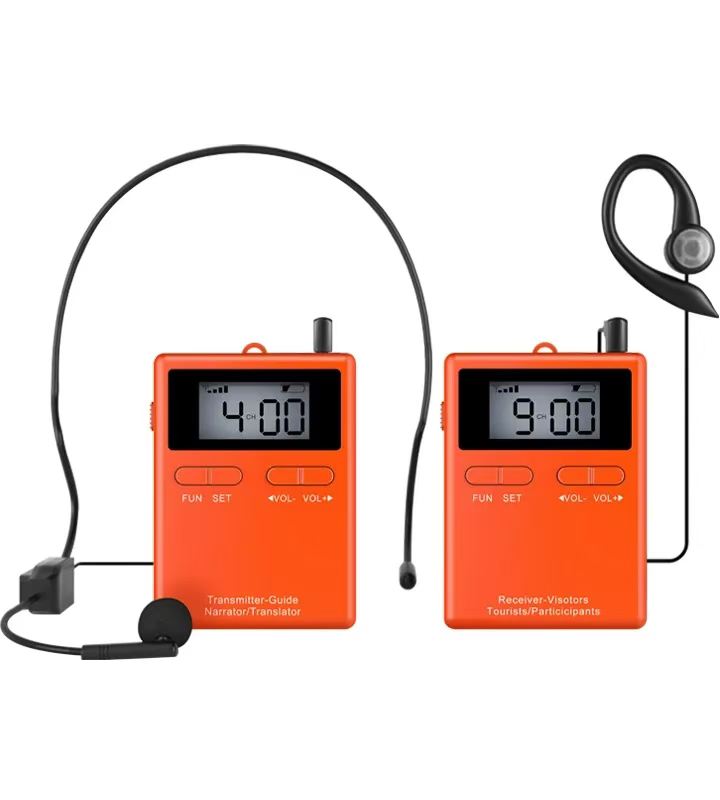
An orange transmitter showing CH 4 beside a receiver showing CH 9

Inside the Bastion Circuit, Torch by Torch

The night circuit climbs from the marina gate to the bastion platform, where volunteers set candle lanterns along the parapet and the group follows a guide whose voice arrives through each visitor's earpiece. Roughly two-thirds of the walk happens without overhead lighting, and the operator counts on the torch bearers — hired locals carrying shielded flame lanterns — to mark the turns. Visitors keep their receivers on the whole time; the channel stays locked from the quay to the far gate. The photograph below was taken at the mid-point halt, where the group gathers inside the oldest span of the wall and the guide answers questions for a fixed five minutes before the line moves on. The full tour guide range the operator carries was chosen so that every unit on a given night shares one channel plan, whatever the model.
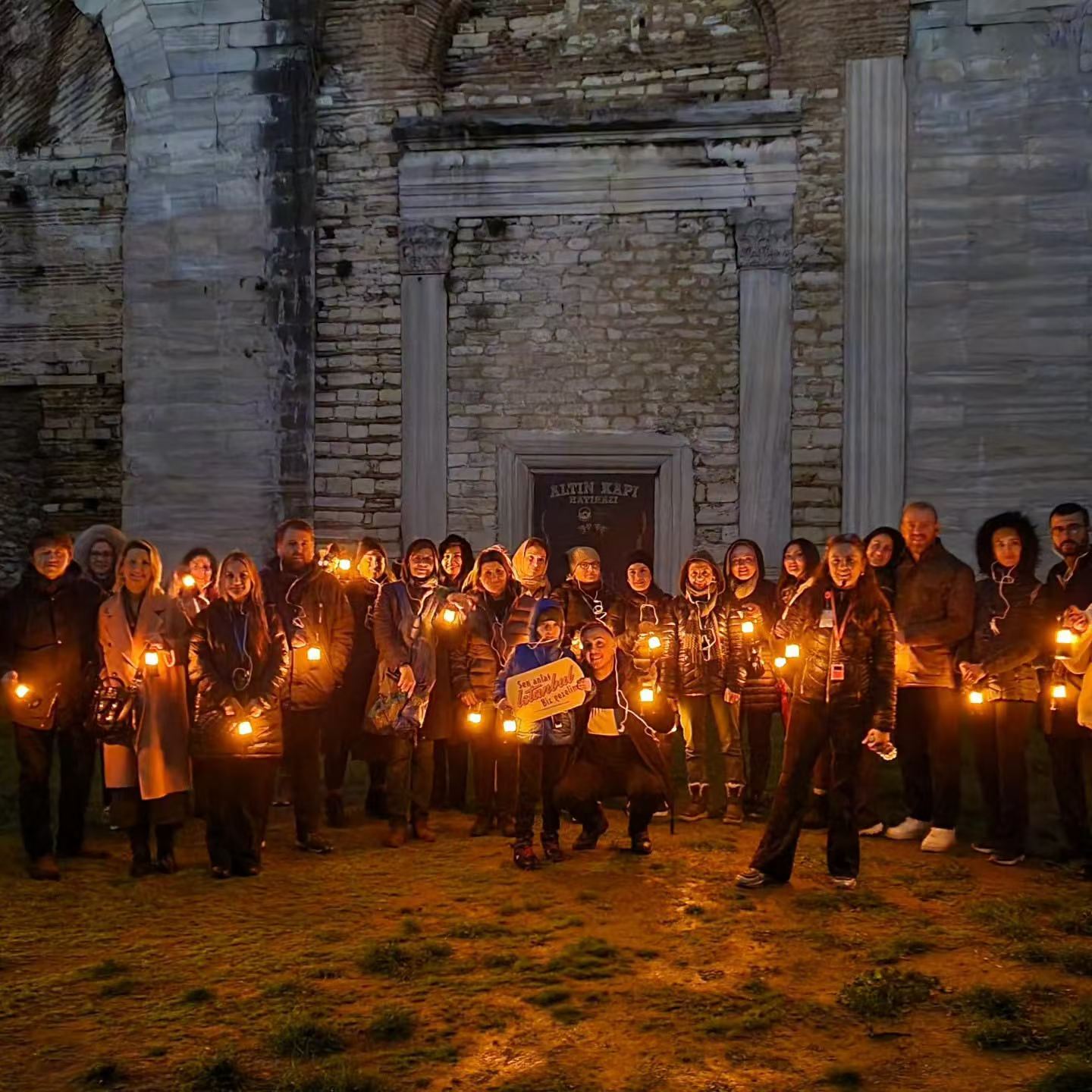
Visitors with lanterns gathered inside the old bastion walls at night

A Receiver You Forget Until the Walk Ends

The children on the evening tour receive the RC2468 ultra-light 2.4G tour guide system, whose ear-hook receiver weighs 18 grams. That number decides more than comfort. On a ninety-minute walk with stone stairs, a heavier belt-clip unit gets handed to a parent within half an hour; the ear-hook stays on. The crew also reports fewer units dangling from railings at the mid-point halt, because a child leaning over the parapet does not feel the hook slip. Battery life is the trade the operator accepts: the RC2468 receiver runs about eight hours per charge, which covers two evening circuits with margin, and the crew tops the fleet at the same kiosk bench where the pairing check happens.

UHF Range Across the Outer Wall

The outer section of the circuit runs past a modern marina that lights up with radio noise on regatta nights. On those evenings the guide switches the long leg to the RC8860 tour guide transmitter, whose 860-870 MHz UHF band sits far away from the 2.4 GHz crowd that fills the harbour on event nights. Twenty channels is fewer than the 2.4 GHz units offer, but the operator only ever needs one clean channel per departing group, and the frequency plan is written on the laminated card. The crew's record so far is three groups walking the outer wall simultaneously without a single complaint of crosstalk — all three on UHF units, staggered ten minutes apart.

DimensionRC2401RC2468RC8860
Frequency band and channels2403-2483 MHz, 50 channels2403-2483 MHz, 50 channels860-870 MHz, 20 channels
Transmitter battery3.7V 1500mAh, 10h3.7V 1500mAh, 10h3.7V 1500mAh, 10h
Receiver battery3.7V 1000mAh, 20h3.7V 300mAh, 8h approx.3.7V 1000mAh, 20h
Receiver weight50g18g, ear-hook type50g
Charging portDC PortUSBDC Port

🛒 Two DC Ports and One USB at the Counter

The charging shelf behind the kiosk has become the quiet bottleneck of the operation, and the port mix on the table decides the order of the evening. The RC2401 and RC8860 units charge from DC ports on two shared power boards; the RC2468 receivers top up over USB at a third board reserved for them. The crew's rule is that everything goes on charge the moment a crate comes back, because the gap between the last circuit ending and the first morning food-tour is under seven hours in high summer. A full receiver charge takes about two hours, so the real constraint is outlet count, not charge speed — which is why the shelf grew from one board to three over a single season.

🔮 What the Operator Puts Aside for Next Summer

Asked what changes after one season of night circuits, the operator lists three things. First, a second screen check has been added at the bastion gate, halfway up, because one silent receiver discovered at the far gate costs fifteen minutes of walking. Second, the fleet split is shifting: more ear-hook units for family departures, and the UHF sets reserved for regatta nights and the outer wall. Third, the laminated card is being replaced by a printed tag wired to each crate, because handwriting faded under lantern light. None of these changes touches the radios themselves; all of them exist because the route now ends in the dark, at a gate two hundred metres from where it started, and the equipment has to be as predictable as the tide. Tour operators weighing a similar move can explore our solutions for evening routes built on mixed fleets.

Frequently Asked Questions

1. How do you stop visitors losing receivers on an unlit rampart?

The lanyard rule does most of the work: every unit stays around the neck from the quay to the far gate, and the crew counted two dropped receivers across the whole season, both recovered at the mid-point halt where the torch bearers stand. The kiosk also holds a small deposit slip per group, which gives visitors a reason to hand units back rather than pocket them.

2. The transmitter showed CH 4 and the receiver showed CH 9 — why was that worth a checklist step?

Because the mismatch came from an afternoon group and would have walked up the stairs in silence. A receiver that has not been reset holds the previous channel indefinitely; the screen check at the equipment table catches it in seconds, and the same check is now repeated at the bastion gate before the unlit section begins.

3. Does the UHF unit interfere with the 2.4 GHz fleet on the same walk?

No. The RC8860 transmits at 860-870 MHz, a band physically separated from the 2403-2483 MHz range the RC2401 and RC2468 use, so the two fleets can run on the same night without any channel coordination between them. The crew keeps them on separate crate shelves anyway, purely so the regatta-night kit is packed first.

4. How are the three models divided among a mixed group of adults and children?

Adults receive belt-clip receivers from the RC2401 fleet, children receive the 18-gram RC2468 ear-hook units, and guides walking the outer wall or regatta-night departures carry the RC8860 transmitter with matching receivers. The split is written on each crate tag, so a volunteer refilling a crate cannot hand a child's unit to an adult line by mistake.


2026年10月22日 14:18
ꄘ click: 14

Get the spec sheet, MOQ and a factory-direct quote

Tell us the venue, the group size and how many languages you need. An engineer at our Shenzhen factory replies within one business day with the matching model, a written quote, lead time and the CE / RoHS / ISO 9001 documents.

Talk to an engineer WhatsApp +86 189 2287 9583

Prefer email? tiger.wang@richitek.com  |  OEM / ODM, custom tooling and neutral packaging available  |  send the enquiry through our contact page

Shenzhen Rich Age Electronics Co., Ltd. (Richitek) - manufacturing wireless tour guide systems, church translation headsets and museum audio guide equipment since 2007.

no data

Lanterns on the Old Walls: An Ancient Town Case Study with RC2401, RC2468 and RC8860

time: 2026年10月22日 click:14

The harbour town of Bodrum leans on a wall that has been standing since antiquity, and every summer the operators who walk visitors along it face the same puzzle: the best hour to show the Golden Gate is after sundown, exactly when written notes, hand signals and raised voices stop working. This case follows one licensed operator who rebuilt its evening schedule around three devices — the RC2401, the RC2468 and the RC8860 — and moved its briefing, its pairing routine and its charging rhythm to fit a route that only truly begins when nightfall comes.

What makes the case worth recording is not the hardware list but the sequence. The team runs a daylight meeting point by the water, then a lantern-lit circuit through the old bastion quarter, and the two halves of the evening make different demands on the equipment. A transmitter clipped to a lanyard at the quay has to survive heat, spray and small talk; a receiver passed along a stone rampart in the dark has to be found, worn and understood without a single page of printed instructions.

💡 Why the Walk Starts When Nightfall Comes

The southern wall of the old town catches furnace heat until early evening, and visitors who start at noon cut the route in half. By moving the departure to the hour when the bastions turn amber, the operator can run the full outer circuit in roughly ninety minutes. Nightfall also changes what visitors expect from the guide: the group spreads out along the parapet, faces are no longer visible, and a voice that carries two hundred metres becomes the only thread holding the walk together. Families with children, who dominate the summer schedule, are the first to drift — which is why the lightest receiver in the fleet matters more after dark than it does at noon. The operator books the route through its city walking programme, and the sunset slot now sells out weeks ahead of the midday one.

A guide with a red-lanyard transmitter briefing visitors by the harbour

🎯 By the Waterline, the Guide Sets the Rules

Every evening begins on the quay, twenty minutes before the first coach doors open. The guide wears a transmitter on a red lanyard and walks the line of waiting visitors, holding up a receiver and demonstrating three gestures: how to clip it, how to raise the volume with the left arrow, and how to hold it so the speaker faces the ear. The rules are simple because they have to survive being shouted over harbour noise. Nobody switches channels. Nobody pockets the unit — it lives on the lanyard, which is why so few have gone over the railing. The guide carries a laminated card listing each departing group and its channel, and the operator credits this card, not memory, with the fact that no group has boarded the wrong circuit since spring.

What CH 4 and CH 9 Showed at the Equipment Table

At the equipment table behind the kiosk, a routine check caught something worth repeating to every crew that runs multiple departures a night. A transmitter set for channel 4 was paired with a receiver still showing channel 9 — a unit that had come back from an afternoon food-tour group and never been reset. On the bench the mismatch takes ten seconds to spot and ten seconds to fix; on the rampart it would have taken a visitor walking back down the stair to report silence. The orange pair in the kit photo below shows exactly what the crew saw: transmitter and receiver from the same fleet, screens disagreeing. Operators running the RC2401 wireless audio guide system at volume should treat the screen check as a fixed step, not a habit that varies by who is packing the crate.

An orange transmitter showing CH 4 beside a receiver showing CH 9

Inside the Bastion Circuit, Torch by Torch

The night circuit climbs from the marina gate to the bastion platform, where volunteers set candle lanterns along the parapet and the group follows a guide whose voice arrives through each visitor's earpiece. Roughly two-thirds of the walk happens without overhead lighting, and the operator counts on the torch bearers — hired locals carrying shielded flame lanterns — to mark the turns. Visitors keep their receivers on the whole time; the channel stays locked from the quay to the far gate. The photograph below was taken at the mid-point halt, where the group gathers inside the oldest span of the wall and the guide answers questions for a fixed five minutes before the line moves on. The full tour guide range the operator carries was chosen so that every unit on a given night shares one channel plan, whatever the model.

Visitors with lanterns gathered inside the old bastion walls at night

A Receiver You Forget Until the Walk Ends

The children on the evening tour receive the RC2468 ultra-light 2.4G tour guide system, whose ear-hook receiver weighs 18 grams. That number decides more than comfort. On a ninety-minute walk with stone stairs, a heavier belt-clip unit gets handed to a parent within half an hour; the ear-hook stays on. The crew also reports fewer units dangling from railings at the mid-point halt, because a child leaning over the parapet does not feel the hook slip. Battery life is the trade the operator accepts: the RC2468 receiver runs about eight hours per charge, which covers two evening circuits with margin, and the crew tops the fleet at the same kiosk bench where the pairing check happens.

UHF Range Across the Outer Wall

The outer section of the circuit runs past a modern marina that lights up with radio noise on regatta nights. On those evenings the guide switches the long leg to the RC8860 tour guide transmitter, whose 860-870 MHz UHF band sits far away from the 2.4 GHz crowd that fills the harbour on event nights. Twenty channels is fewer than the 2.4 GHz units offer, but the operator only ever needs one clean channel per departing group, and the frequency plan is written on the laminated card. The crew's record so far is three groups walking the outer wall simultaneously without a single complaint of crosstalk — all three on UHF units, staggered ten minutes apart.

DimensionRC2401RC2468RC8860
Frequency band and channels2403-2483 MHz, 50 channels2403-2483 MHz, 50 channels860-870 MHz, 20 channels
Transmitter battery3.7V 1500mAh, 10h3.7V 1500mAh, 10h3.7V 1500mAh, 10h
Receiver battery3.7V 1000mAh, 20h3.7V 300mAh, 8h approx.3.7V 1000mAh, 20h
Receiver weight50g18g, ear-hook type50g
Charging portDC PortUSBDC Port

🛒 Two DC Ports and One USB at the Counter

The charging shelf behind the kiosk has become the quiet bottleneck of the operation, and the port mix on the table decides the order of the evening. The RC2401 and RC8860 units charge from DC ports on two shared power boards; the RC2468 receivers top up over USB at a third board reserved for them. The crew's rule is that everything goes on charge the moment a crate comes back, because the gap between the last circuit ending and the first morning food-tour is under seven hours in high summer. A full receiver charge takes about two hours, so the real constraint is outlet count, not charge speed — which is why the shelf grew from one board to three over a single season.

🔮 What the Operator Puts Aside for Next Summer

Asked what changes after one season of night circuits, the operator lists three things. First, a second screen check has been added at the bastion gate, halfway up, because one silent receiver discovered at the far gate costs fifteen minutes of walking. Second, the fleet split is shifting: more ear-hook units for family departures, and the UHF sets reserved for regatta nights and the outer wall. Third, the laminated card is being replaced by a printed tag wired to each crate, because handwriting faded under lantern light. None of these changes touches the radios themselves; all of them exist because the route now ends in the dark, at a gate two hundred metres from where it started, and the equipment has to be as predictable as the tide. Tour operators weighing a similar move can explore our solutions for evening routes built on mixed fleets.
Frequently Asked Questions

1. How do you stop visitors losing receivers on an unlit rampart?

The lanyard rule does most of the work: every unit stays around the neck from the quay to the far gate, and the crew counted two dropped receivers across the whole season, both recovered at the mid-point halt where the torch bearers stand. The kiosk also holds a small deposit slip per group, which gives visitors a reason to hand units back rather than pocket them.

2. The transmitter showed CH 4 and the receiver showed CH 9 — why was that worth a checklist step?

Because the mismatch came from an afternoon group and would have walked up the stairs in silence. A receiver that has not been reset holds the previous channel indefinitely; the screen check at the equipment table catches it in seconds, and the same check is now repeated at the bastion gate before the unlit section begins.

3. Does the UHF unit interfere with the 2.4 GHz fleet on the same walk?

No. The RC8860 transmits at 860-870 MHz, a band physically separated from the 2403-2483 MHz range the RC2401 and RC2468 use, so the two fleets can run on the same night without any channel coordination between them. The crew keeps them on separate crate shelves anyway, purely so the regatta-night kit is packed first.

4. How are the three models divided among a mixed group of adults and children?

Adults receive belt-clip receivers from the RC2401 fleet, children receive the 18-gram RC2468 ear-hook units, and guides walking the outer wall or regatta-night departures carry the RC8860 transmitter with matching receivers. The split is written on each crate tag, so a volunteer refilling a crate cannot hand a child's unit to an adult line by mistake.


Get the spec sheet, MOQ and a factory-direct quote

Tell us the venue, the group size and how many languages you need. An engineer at our Shenzhen factory replies within one business day with the matching model, a written quote, lead time and the CE / RoHS / ISO 9001 documents.

Talk to an engineer WhatsApp +86 189 2287 9583

Prefer email? tiger.wang@richitek.com  |  OEM / ODM, custom tooling and neutral packaging available  |  send the enquiry through our contact page

Shenzhen Rich Age Electronics Co., Ltd. (Richitek) - manufacturing wireless tour guide systems, church translation headsets and museum audio guide equipment since 2007.

no data
×

Contact us

email:
name:
subject:
content: