.webp)
RC2401: Three Customer Photos From an Istanbul Walking Tour, Read Closely
Most customer photos arrive as proof that a delivery worked. Every so often a set arrives that works better as documentation, because between them the pictures answer questions a specification table never settles: where the receiver actually ends up on a body, what a group looks like from the outside after two hours of walking, and whether the screen can be read in the light a real street provides. A client running walking tours through Istanbul's older quarters sent three such photos back with their RC2401 fleet, and this article reads them one at a time — not as testimonials, but as field notes that happen to be images. Everything the photos show is consistent with what the RC2401's own numbers predict, which is precisely why they are worth the close look.
The Group Photo Is a Wearing-Position Audit
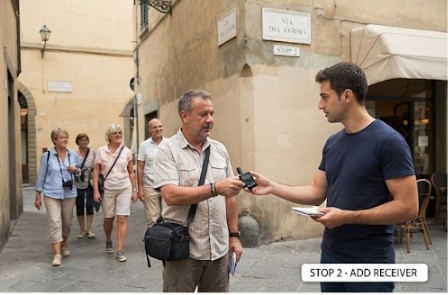
The first photo looks like an ordinary souvenir: five people under the awning of a street café, somebody's phone held up to take the picture. Look instead at where the equipment sits. The blue receiver hangs at chest height on its lanyard, in front of the jacket, not buried in a pocket and not swinging at waist level. That placement is not an accident of fashion. A receiver worn at the chest keeps the earphone cable short and out of the way, keeps the LCD upright and glanceable, and keeps the antenna above the crowd's shoulder line rather than below it. Tour operators who brief their groups on this one habit — receiver in front, lanyard adjusted so the unit sits at the sternum — quietly solve half of the reception and audibility complaints that otherwise get blamed on the hardware. The photo shows the habit in place after a full morning of walking, which is the only test that matters.

The Street Photo Is a Coverage Map Drawn by Hand
The second photo contains no equipment at all: a narrow lane climbing between tall masonry walls, the kind of street the older districts of the city produce in abundance. From a radio point of view this is the demanding frame — high walls on both sides, a vertical canyon that reflects and shadows a signal at the same time. The 2.4G band the RC2401 uses handles this terrain the way its 1-to-200 meter range figure implies: the link holds where line of sight is short, and the places that strain any system are the moments a group strings out around a corner. Guides running routes like this one keep two disciplines that the photo implies. They pause the group at the mouth of a lane rather than letting five listeners trail into it alone, and they treat a steep street the way a stadium treats a tunnel — as the segment where the count of visible receivers matters more than any number on a datasheet. Nothing in the RC2401's specification prevents either discipline; the specification is what lets the disciplines be this simple.
The lane in the picture also explains why city walking routes reward a wider channel count than the group count alone suggests. On a summer afternoon a historic quarter runs several independent operators at once, and every one of them is transmitting in the same crowded 2.4G band within a few hundred meters of pavement. Fifty PLL-controlled channels give this client room to assign a fixed channel per daily route and never touch it again, so groups that cross at a junction simply pass through each other's frequency space without a word of coordination. The alternative — waiting for interference to appear and then re-planning channels mid-season — is the failure mode the channel count exists to prevent, and it is invisible in any photo precisely because it never happened here.

🏭 The Close-Up Is a Readability Test the Factory Cannot Stage
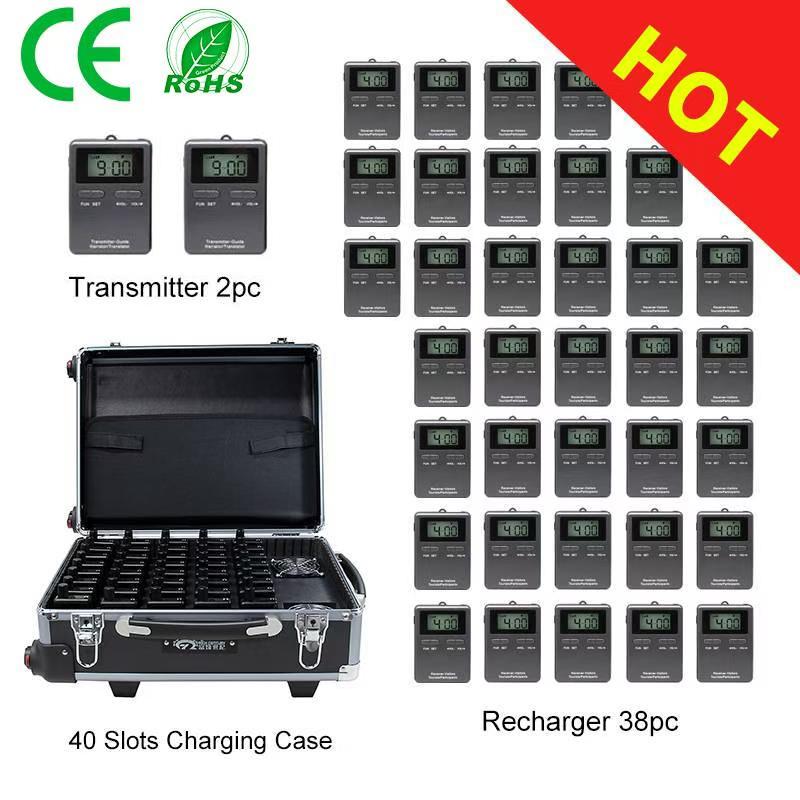
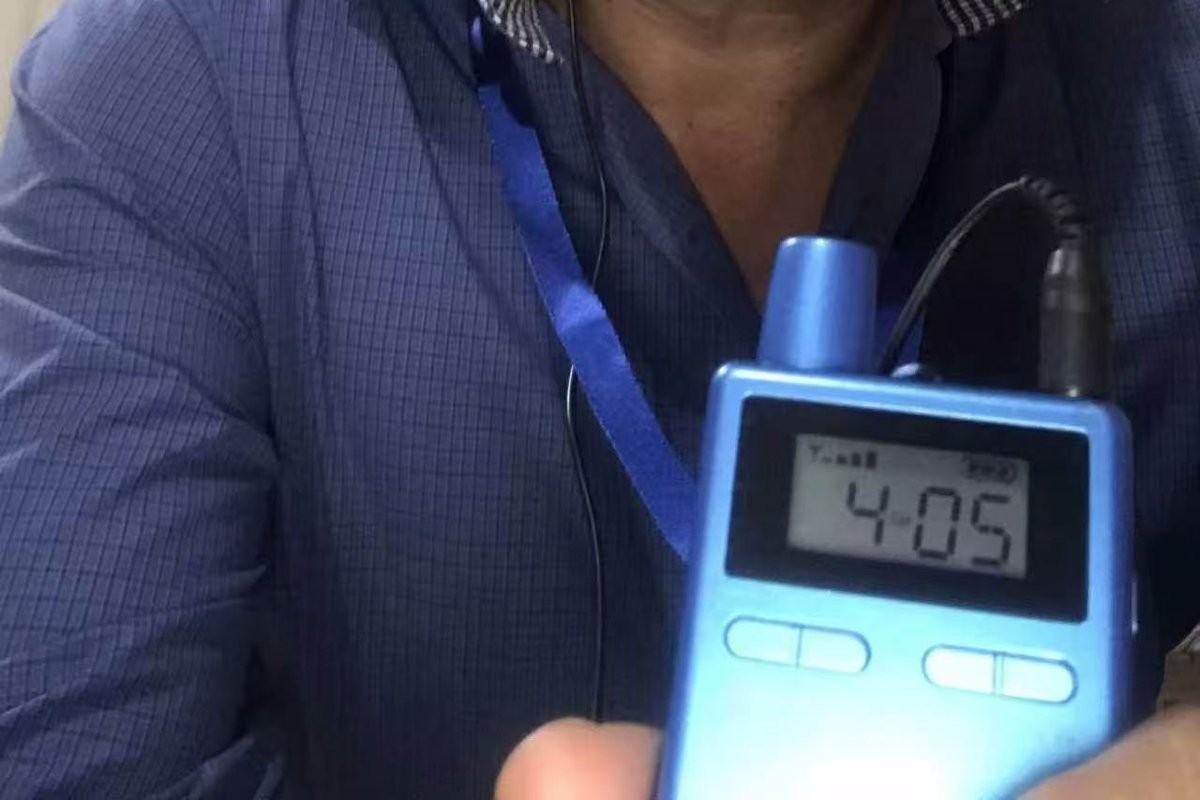
The third photo is the one the client took themselves: a receiver held toward the camera, lanyard and earphone in frame, LCD lit and legible. Two details carry the weight. The display is readable at arm's length in open daylight, which confirms what the segment type and the backlight were chosen for — a channel and volume readout that a guide can verify across a small huddle without asking anyone to remove the unit. And the blue shell, one of the colors the RC2401 ships in for volume orders, has faded none of its saturation after a season of outdoor work, which matters more to operators than it sounds: color is how a fleet gets sorted at the end of a day when three groups return at once. The 3.5mm earphone hanging beside the unit completes the picture — the standard wired earphone is the part guests actually touch, and the one a case of spares quietly solves.
The close-up also settles a question operators rarely think to ask until it costs them an afternoon: what a guest sees when they adjust their own volume. On this receiver the two largest buttons sit below the screen, catchable by thumb without looking, and the readout confirms the change in a glance. Guests with gloves, long nails or shaky hands manage it unaided, which removes the quiet bottleneck where a guide stops mid-sentence to fix someone's listening level. Small ergonomics of this kind never appear in a buying conversation, and then they decide how smoothly six hundred handovers a month actually run.
What the Numbers Said Before the Photos Did
| Specification | RC2401 value | What it meant on this route |
|---|---|---|
| Frequency band | 2.4G (2403-2483 MHz) | Short-range clarity through the old quarter's lanes; no licence to arrange |
| Channels | 50, PLL-controlled | Parallel groups on adjacent routes stay separated without coordination calls |
| Range | 1-200 m | Covers a street segment plus the pause at each corner |
| Output power | 10 mW | Headroom for body shadowing without ear-splitting peaks indoors |
| Transmitter battery | 3.7V 1500 mAh, 10 h | A full walking day on one morning charge |
| Receiver battery | 3.7V 1000 mAh, 20 h | Two tour days per charge in guest hands — nobody charges mid-tour |
| Receiver weight | 50 g | Light enough that the lanyard, not the unit, is what guests notice |
| Colors | Multi-color at volume | The blue shell doubles as fleet sorting at return time |
One honesty note belongs beside the table: the RC2401 is the value tier of the range, and the photos show exactly that tier being used well rather than stretched. A client needing sixty parallel listener groups on one plaza would be steered to the 100-channel RC9150 or RC085 instead; a client whose tours run through RF-noisy exhibition halls would hear about the 80-channel RC2406. This client's brief — walking groups of twenty to forty through narrow streets with a coffee stop in the middle — sat squarely inside the 50-channel baseline, and the three photos are what a correct match looks like after the fact.
The Wearing Habit Is Worth More Than Any Feature on the Box
If the three photos reduce to one operational lesson, it is the lanyard. A receiver worn at the sternum does four jobs at once: the LCD faces up for glances, the earphone cable takes the shortest path, the antenna clears the crowd, and the color of the shell stays visible to the guide doing a head-count. Operators who issue the units in their boxes tend to see receivers migrate into jacket pockets within an hour — pockets shadow the signal, muffle the volume, and hide the color. The fix costs nothing and takes one sentence at the meeting point, and the first photo here is what compliance looks like two hours later. Fleets that care about the detail put a one-line diagram on the charging case lid; the guests never read it twice, but they only need to read it once.
The sentence itself is worth drafting before the season starts, because guides improvise differently under pressure. The versions that stick are physical rather than explanatory: "receiver in front, screen out, cable inside the jacket" covers the habit in nine words a guest can repeat. Some operators demonstrate it on themselves at the meeting point and hand the first unit to the most conspicuous guest, on the reasonable logic that the rest of a group copies what it sees. On routes with a mid-tour café stop — as in the first photo here — the stop doubles as an inspection point, where a guide walking the table line can spot a pocketed receiver and fix it before the afternoon leg. None of this appears on any specification sheet, and none of it requires supervision after the first week.
Reading a Fleet's Health From Souvenir Photos
The client probably intended the pictures as a courtesy. Read as telemetry, they report a fleet in good health. Nobody in the group photo is holding a spare receiver or a dead unit; nobody carries a receiver in hand like a phone, which is the classic sign of a flat battery or a broken clip. The lane photo shows a group bunched at the correct walking distance rather than strung over fifty meters, which means the guide is managing pace and the radio is managing the rest. The close-up shows a unit whose shell and screen survived a season without a scratch worth photographing. None of this can be claimed from a spec sheet, and none of it required a site survey — it is what a correctly sized system looks like in the only review that matters, which is the one guests appear in.
Turning that reading into a routine takes almost no structure. Operators who do this well keep the incoming photos next to the booking they belong to, dated, so a season's worth of images lines up against the season's worth of tours; a receiver that appears scuffed in March and beaten by June is telling a different story from one that looks the same all year. Charging-case returns tell the complementary half — how many earphones went missing, how many lanyards were replaced, whether any unit came back with its belt clip snapped. The client in these photos sent three frames without being asked twice, which itself is a health signal: customers who volunteer pictures are customers whose equipment disappeared into the work rather than into the complaints file. The habit also builds the reference library every operator eventually needs, because the next buyer of a city-walking system will ask for exactly this kind of evidence and the only way to have it is to have kept it.
🏆 When a Customer Photo Beats a Site Survey
Sales engineers ask for floor plans, group sizes and route maps before quoting a system, and they should. But the three photos here carry a kind of information a site visit never captures: how the equipment behaves in the hands of guests who were never briefed by the manufacturer, weeks after the handover, on an ordinary working day. A photo of a group at a coffee stop shows whether the wearing habit held. A photo of the route shows whether the guide trusts the range enough to walk the natural line. A photo taken by the client shows whether the hardware still looks like something they are proud to hand out. Prospective buyers collecting references for a city-walking operation should ask for exactly these three pictures — not the staged handover shot — because they are the cheapest honest audit a purchase can get.
For buyers building a shortlist of their own, the practical sequence runs the other way: start from the operating brief rather than the photo set. Fix the group size, the daily hours and the number of concurrent routes first, because those three numbers eliminate most of the range before a single photo matters. Then ask each shortlisted supplier the question these pictures answer for free: can you show the equipment in a client's hands, unposed, a season after delivery? Suppliers who can produce such photos run fleets that stay in the field; suppliers who can only offer renderings and handover shots are still selling the box. The full hardware range sits on the Richitek tour guide system line, where each model's channel count, battery figures and color options can be lined up against the brief in a single pass.