
A leading China factory specializing in Wireless Tour Guide Systems, Church Audio Guides, and Translation Headphones with premium OEM/ODM solutions.

Tel:+86 18922879583

Email:tiger.wang@richitek.com

A Championship Week at a Links Course: Sizing Three Fleets With RC9150, RC2408 and RC2401

The enquiry arrived in March from a links course on the east coast that had won the right to host its regional open for the next four years. Tournament week, the club's events manager explained, is really three audiences moving across the same ground: spectators who follow the marquee pairing for all eighteen holes, visitors who cluster around the clubhouse and registration tents, and juniors and beginners who rotate through the practice ground in short clinics. One rental fleet had covered all three in previous years, and every year it failed somewhere different. For this championship they split the problem three ways instead, and the three machines they settled on — a deployment pattern we see across outdoor event venues — were the RC9150, the RC2408 and the RC2401. What follows is the week as the club actually ran it, with the numbers that decided each choice.

The scale to hold in mind: four days of competition plus a pro-am, roughly three hundred and forty receivers in circulation at peak, a par-five finishing hole that measures about five hundred and forty metres from the back tee, and a spectator route that keeps walkers outside, in wind, from eight in the morning until the final putt. Nothing about that list is unusual for a professional event, but together it means no single fleet specification can serve every zone without waste somewhere.

Who Listens Where on a Tournament Course

Spectator audio at a golf championship behaves differently from a museum tour or a factory visit, and the difference is distance plus dwell time. The marquee-group followers stay with one pairing for up to five hours, walking hole after hole, so their receivers need range across open ground and stamina for the whole round. The clubhouse crowd listens in bursts — registration questions, draw-board announcements, autograph-stage interviews — so their units need enough channels to coexist with every other radio on site but only moderate endurance. The practice ground rotates audiences every forty-five minutes, all day, which makes it a volume game: the most units, the shortest sessions, the tightest budget. Three zones, three duty profiles, three machines.

The Marquee Loop Follows RC9150 All Day

rc9150-marquee-group-loop

The marquee loop is the flagship listening experience of the week — a capped crowd of about ninety walking with the leading pairing — so it gets the flagship unit. The RC9150 runs a hundred channels, which matters less for the loop itself than for the fact that the loop shares air with an entire championship's radio traffic; its ten-milliwatt output across the 1-200 metre working range keeps the commentary solid from the tee box to the back of a green-side crowd, and the third fairway at this course runs nearly two hundred metres corner to corner without a repeater. Battery figures are the quiet reason it suits the loop: a fifteen-hour transmitter rating on an 1800 mAh pack and thirty-five-plus hours of receiver standby mean the fleet charged on Wednesday evening covers Thursday's pro-am and Friday's first round without a lunchtime swap.

Weight is the second reason. At 97.5 grams for both transmitter and receiver, a spectator who has carried a unit for five hours over dunes hands it back without the shoulder ache that heavier hardware leaves behind, and the course's marshals reported no receiver fatigue complaints all week. Charging runs over Type-C, so the overnight routine used the same multi-port bricks the media centre already owned.

RC2408 Holds the Clubhouse Crush
rc2408-clubhouse-registration-crush

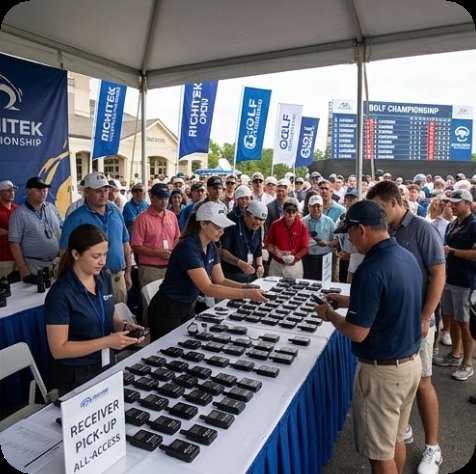
Between the registration tents, the draw board and the autograph stage, the clubhouse zone packed more radio traffic into fewer square metres than anywhere else on site — plus the local two-way radio net, the broadcast compound and every spectator's phone. This is the anti-interference job, and it belongs to the RC2408: eighty channels on the same 2403-2483 MHz band, enough to carve the clubhouse, the halfway hut and the interview stage into separate frequency islands that never touch. Transmitters hold ten hours on a 1500 mAh cell and receivers twenty hours on 1000 mAh, which comfortably outlasts the daily public window; the fifty-nine-gram transmitter clips onto an announcer's lapel for the draw-board briefings and moves to the interview stage without re-pairing. The RC2408's channel specification is what the club's technical lead cited when the local radio club asked how the event would avoid stepping on their net.

⚡ RC2401 Runs the Practice Ground Economics
rc2401-practice-ground-clinic

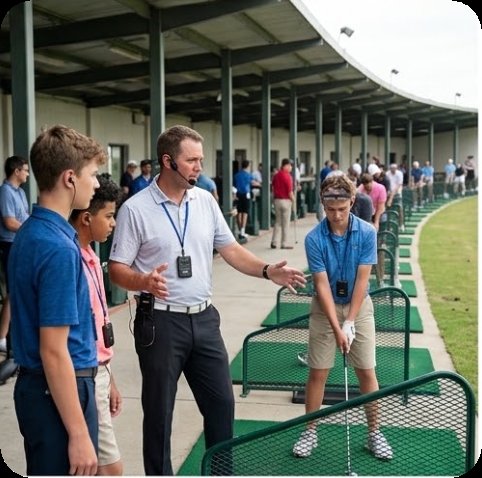
The practice ground hosted eight clinics a day — junior groups, beginner sessions, a short-game masterclass — each lasting forty-five minutes with a fresh batch of listeners. One hundred and sixty of the week's receivers lived here, more than half the fleet, and none of them needed the range or the marathon battery of the marquee loop. The RC2401 is the standard 2.4G unit: fifty channels, ten-milliwatt output, a ten-hour transmitter and twenty-hour receiver, both units in the familiar fifty-to-sixty gram class. The clinics never came close to exhausting its channel bank, and because the units run on DC charging in the same cradles the club already used for its older stock, the practice-ground fleet could rotate between morning and afternoon blocks without a dedicated charging station. The RC2401's standard configuration is also the price point that made the volume zone affordable — which, for a club budgeting its first championship, mattered as much as any radio figure.

🔋 Battery Arithmetic Across a Ten-Hour Day

Gates opened at 7:30 and the course cleared after 18:00, a ten-and-a-half-hour public day. The arithmetic per fleet: the RC9150 loop never saw a charger between Wednesday evening and Friday night, its fifteen-hour transmitter and thirty-five-hour receiver figures absorbing two full rounds. The RC2408 clubhouse fleet topped up transmitters at the lunch lull out of habit rather than necessity, since the public window sits well inside the ten-hour rating. The RC2401 practice fleet ran the hardest charge cycles — eight sessions a day on shared units — and still never approached its ratings, though the club's routine of parking every unit on DC cradles at the 13:00 handover became the template they now apply to every event. The lesson the events manager wrote down: battery spec buys freedom, but only the charging routine makes it repeatable.

What the Rental Ledger Showed by Sunday

By the final round the club's spreadsheet told the story in three rows.

ZoneUnitChannelsTX / RX batteryUnits outCharge port
Marquee loopRC915010015 h / 35+ h standby90 receivers, 3 transmittersType-C
Clubhouse zoneRC24088010 h / 20 h90 receivers, 5 transmittersDC
Practice groundRC24015010 h / 20 h160 receivers, 8 transmittersDC

Ninety-plus-ninety-plus-one-hundred-and-sixty makes the three hundred and forty receivers of the peak day, and the three-channel-bank split never produced a single cross-zone collision all week. Clubs weighing a similar split can read the RC9150's full specification against the other two rows before deciding how many tiers their own calendar justifies.

💡 Handover Habits the Pro Shop Kept

Every unit went out from the pro shop window and came back to it, counted against a laminated sheet that split the fleet by zone. Three habits survived the week. Units were wiped and bagged between sessions, which the practice-ground volunteers managed because the forty-five-minute clinic rhythm built the gap into the schedule anyway. Channel dials stayed locked, so a unit handed to a junior at the range was silent the moment it left its clinic's frequency. And the ledger counted receivers out and in at every session boundary, not just at close of play — the two units that went missing on Saturday were traced to the halfway hut within twenty minutes because the last verified count was tied to a time slot, not to a general impression. None of this is unique to golf; it is simply what a split fleet rewards.

The club has since committed the same three-tier layout for next year's championship, and the courses hosting smaller events in its regional group are copying the pattern in miniature. Venues planning their own tournament calendar can browse the complete tour guide line or pull deployment notes from the solutions library before writing their own three-row ledger.


Frequently Asked Questions

1. Why three fleets instead of one hundred-channel fleet everywhere?

Cost and fit. The practice ground's one hundred and sixty units do their job perfectly on fifty channels and short batteries; speculating them up to the flagship tier would have roughly doubled the volume zone's budget without changing a single listener's experience. The split buys flagship performance where the course actually needs it.

2. How do three channel banks stay out of each other's way?

By band discipline within the same 2.4 GHz block: the loop held its hundred-channel bank, the clubhouse carved eighty, and the practice ground used fifty, with each zone's channels assigned on a written plan locked on the Wednesday before the pro-am. Three banks totalling two hundred and thirty channels never collided on a site with broadcast crews and a radio club on air.

3. What happens in coastal wind and open ground?

Less than most buyers fear. The marquee loop's route crossed two hundred metres of open dune-land, and the RC9150's output held commentary solid at the back of the crowd. Wind noise is a microphone problem, not a transmission problem, which is why the loop's commentators used foam windscreens on the supplied lapel microphones.

4. Can a smaller club copy this with two tiers?

Easily. The natural cut is flagship for the main spectacle and the standard unit for everything else; the mid-tier only earns its place when a venue has a genuinely separate third zone with its own crowd. The club itself ran two tiers before its championship justified the middle row.


2026年10月20日 11:35
ꄘ click: 11

A Championship Week at a Links Course: Sizing Three Fleets With RC9150, RC2408 and RC2401

time: 2026年10月20日 click:11

The enquiry arrived in March from a links course on the east coast that had won the right to host its regional open for the next four years. Tournament week, the club's events manager explained, is really three audiences moving across the same ground: spectators who follow the marquee pairing for all eighteen holes, visitors who cluster around the clubhouse and registration tents, and juniors and beginners who rotate through the practice ground in short clinics. One rental fleet had covered all three in previous years, and every year it failed somewhere different. For this championship they split the problem three ways instead, and the three machines they settled on — a deployment pattern we see across outdoor event venues — were the RC9150, the RC2408 and the RC2401. What follows is the week as the club actually ran it, with the numbers that decided each choice.

The scale to hold in mind: four days of competition plus a pro-am, roughly three hundred and forty receivers in circulation at peak, a par-five finishing hole that measures about five hundred and forty metres from the back tee, and a spectator route that keeps walkers outside, in wind, from eight in the morning until the final putt. Nothing about that list is unusual for a professional event, but together it means no single fleet specification can serve every zone without waste somewhere.

Who Listens Where on a Tournament Course

Spectator audio at a golf championship behaves differently from a museum tour or a factory visit, and the difference is distance plus dwell time. The marquee-group followers stay with one pairing for up to five hours, walking hole after hole, so their receivers need range across open ground and stamina for the whole round. The clubhouse crowd listens in bursts — registration questions, draw-board announcements, autograph-stage interviews — so their units need enough channels to coexist with every other radio on site but only moderate endurance. The practice ground rotates audiences every forty-five minutes, all day, which makes it a volume game: the most units, the shortest sessions, the tightest budget. Three zones, three duty profiles, three machines.

The Marquee Loop Follows RC9150 All Day

rc9150-marquee-group-loop

The marquee loop is the flagship listening experience of the week — a capped crowd of about ninety walking with the leading pairing — so it gets the flagship unit. The RC9150 runs a hundred channels, which matters less for the loop itself than for the fact that the loop shares air with an entire championship's radio traffic; its ten-milliwatt output across the 1-200 metre working range keeps the commentary solid from the tee box to the back of a green-side crowd, and the third fairway at this course runs nearly two hundred metres corner to corner without a repeater. Battery figures are the quiet reason it suits the loop: a fifteen-hour transmitter rating on an 1800 mAh pack and thirty-five-plus hours of receiver standby mean the fleet charged on Wednesday evening covers Thursday's pro-am and Friday's first round without a lunchtime swap.

Weight is the second reason. At 97.5 grams for both transmitter and receiver, a spectator who has carried a unit for five hours over dunes hands it back without the shoulder ache that heavier hardware leaves behind, and the course's marshals reported no receiver fatigue complaints all week. Charging runs over Type-C, so the overnight routine used the same multi-port bricks the media centre already owned.

RC2408 Holds the Clubhouse Crush

rc2408-clubhouse-registration-crush

Between the registration tents, the draw board and the autograph stage, the clubhouse zone packed more radio traffic into fewer square metres than anywhere else on site — plus the local two-way radio net, the broadcast compound and every spectator's phone. This is the anti-interference job, and it belongs to the RC2408: eighty channels on the same 2403-2483 MHz band, enough to carve the clubhouse, the halfway hut and the interview stage into separate frequency islands that never touch. Transmitters hold ten hours on a 1500 mAh cell and receivers twenty hours on 1000 mAh, which comfortably outlasts the daily public window; the fifty-nine-gram transmitter clips onto an announcer's lapel for the draw-board briefings and moves to the interview stage without re-pairing. The RC2408's channel specification is what the club's technical lead cited when the local radio club asked how the event would avoid stepping on their net.

⚡ RC2401 Runs the Practice Ground Economics

rc2401-practice-ground-clinic

The practice ground hosted eight clinics a day — junior groups, beginner sessions, a short-game masterclass — each lasting forty-five minutes with a fresh batch of listeners. One hundred and sixty of the week's receivers lived here, more than half the fleet, and none of them needed the range or the marathon battery of the marquee loop. The RC2401 is the standard 2.4G unit: fifty channels, ten-milliwatt output, a ten-hour transmitter and twenty-hour receiver, both units in the familiar fifty-to-sixty gram class. The clinics never came close to exhausting its channel bank, and because the units run on DC charging in the same cradles the club already used for its older stock, the practice-ground fleet could rotate between morning and afternoon blocks without a dedicated charging station. The RC2401's standard configuration is also the price point that made the volume zone affordable — which, for a club budgeting its first championship, mattered as much as any radio figure.

🔋 Battery Arithmetic Across a Ten-Hour Day

Gates opened at 7:30 and the course cleared after 18:00, a ten-and-a-half-hour public day. The arithmetic per fleet: the RC9150 loop never saw a charger between Wednesday evening and Friday night, its fifteen-hour transmitter and thirty-five-hour receiver figures absorbing two full rounds. The RC2408 clubhouse fleet topped up transmitters at the lunch lull out of habit rather than necessity, since the public window sits well inside the ten-hour rating. The RC2401 practice fleet ran the hardest charge cycles — eight sessions a day on shared units — and still never approached its ratings, though the club's routine of parking every unit on DC cradles at the 13:00 handover became the template they now apply to every event. The lesson the events manager wrote down: battery spec buys freedom, but only the charging routine makes it repeatable.

What the Rental Ledger Showed by Sunday

By the final round the club's spreadsheet told the story in three rows.

ZoneUnitChannelsTX / RX batteryUnits outCharge port
Marquee loopRC915010015 h / 35+ h standby90 receivers, 3 transmittersType-C
Clubhouse zoneRC24088010 h / 20 h90 receivers, 5 transmittersDC
Practice groundRC24015010 h / 20 h160 receivers, 8 transmittersDC

Ninety-plus-ninety-plus-one-hundred-and-sixty makes the three hundred and forty receivers of the peak day, and the three-channel-bank split never produced a single cross-zone collision all week. Clubs weighing a similar split can read the RC9150's full specification against the other two rows before deciding how many tiers their own calendar justifies.

💡 Handover Habits the Pro Shop Kept

Every unit went out from the pro shop window and came back to it, counted against a laminated sheet that split the fleet by zone. Three habits survived the week. Units were wiped and bagged between sessions, which the practice-ground volunteers managed because the forty-five-minute clinic rhythm built the gap into the schedule anyway. Channel dials stayed locked, so a unit handed to a junior at the range was silent the moment it left its clinic's frequency. And the ledger counted receivers out and in at every session boundary, not just at close of play — the two units that went missing on Saturday were traced to the halfway hut within twenty minutes because the last verified count was tied to a time slot, not to a general impression. None of this is unique to golf; it is simply what a split fleet rewards.

The club has since committed the same three-tier layout for next year's championship, and the courses hosting smaller events in its regional group are copying the pattern in miniature. Venues planning their own tournament calendar can browse the complete tour guide line or pull deployment notes from the solutions library before writing their own three-row ledger.
Frequently Asked Questions

1. Why three fleets instead of one hundred-channel fleet everywhere?

Cost and fit. The practice ground's one hundred and sixty units do their job perfectly on fifty channels and short batteries; speculating them up to the flagship tier would have roughly doubled the volume zone's budget without changing a single listener's experience. The split buys flagship performance where the course actually needs it.

2. How do three channel banks stay out of each other's way?

By band discipline within the same 2.4 GHz block: the loop held its hundred-channel bank, the clubhouse carved eighty, and the practice ground used fifty, with each zone's channels assigned on a written plan locked on the Wednesday before the pro-am. Three banks totalling two hundred and thirty channels never collided on a site with broadcast crews and a radio club on air.

3. What happens in coastal wind and open ground?

Less than most buyers fear. The marquee loop's route crossed two hundred metres of open dune-land, and the RC9150's output held commentary solid at the back of the crowd. Wind noise is a microphone problem, not a transmission problem, which is why the loop's commentators used foam windscreens on the supplied lapel microphones.

4. Can a smaller club copy this with two tiers?

Easily. The natural cut is flagship for the main spectacle and the standard unit for everything else; the mid-tier only earns its place when a venue has a genuinely separate third zone with its own crowd. The club itself ran two tiers before its championship justified the middle row.


×

Contact us

email:
name:
subject:
content: