The winter intake at a welding and fitting school outside Lyon used to run on lungs. Three instructors, six sessions a day, and a fleet of handheld megaphones that died by Thursday. When the January cohort list came back at 104 names against 48 the previous winter, the training office did not buy more megaphones. It bought a channel plan, three racks of equipment, and a written handover sheet that now lives in a binder by the charging cabinet. This is what the first term with the new kit actually looked like, read from the office's own session logs rather than from a brochure. The full deployment runs on two wireless lines and one keypad player, and the wiring between them — the training-room audio setup guide covers the same pattern — matters more than any single spec.
💡 When the Winter Intake Doubled
The school runs three buildings: a welding bay with sixteen booths, a fitting hall with two rows of lathes and mills, and a smaller assessment wing where examiners watch candidates work against the clock. Under 48 trainees, one instructor could shout over booth fans and be understood roughly seven times out of ten, by the office's own count. At 104 trainees across overlapping morning and afternoon blocks, that math stopped working. Two classes now share the welding bay in the same slot, and a third group rotates through the fitting hall. The megaphone also had a scheduling problem nobody had named out loud: when two instructors used them in the same bay, the louder voice won, and neither class heard the safety step that mattered.
The office set three requirements before ordering. Each class must hear its own instructor only, even with another class three meters away. The kit must survive a full 09:00–16:30 session day without a lunchtime charge. And the assessment wing needs a way for examiners and auditors to walk the twelve stations without a guide at all. Those three requirements mapped onto three different devices, which is why the purchase order has three lines instead of one.
The intake itself explains the squeeze. Of the 104 names, 61 are apprenticeship-contract students whose employers pay per completed module, so the school cannot run them in smaller groups without invoicing delays. The remaining 43 split between a regional retraining programme and the school's own evening track, which overlaps the afternoon block by design. The office also knows the March intake will add a bilingual group, because two employers in the same industrial park signed on within a week. Every projection since October has pointed the same direction: more people, same buildings, tighter slots.
🔊 Channel 12 Runs the Welding Bay
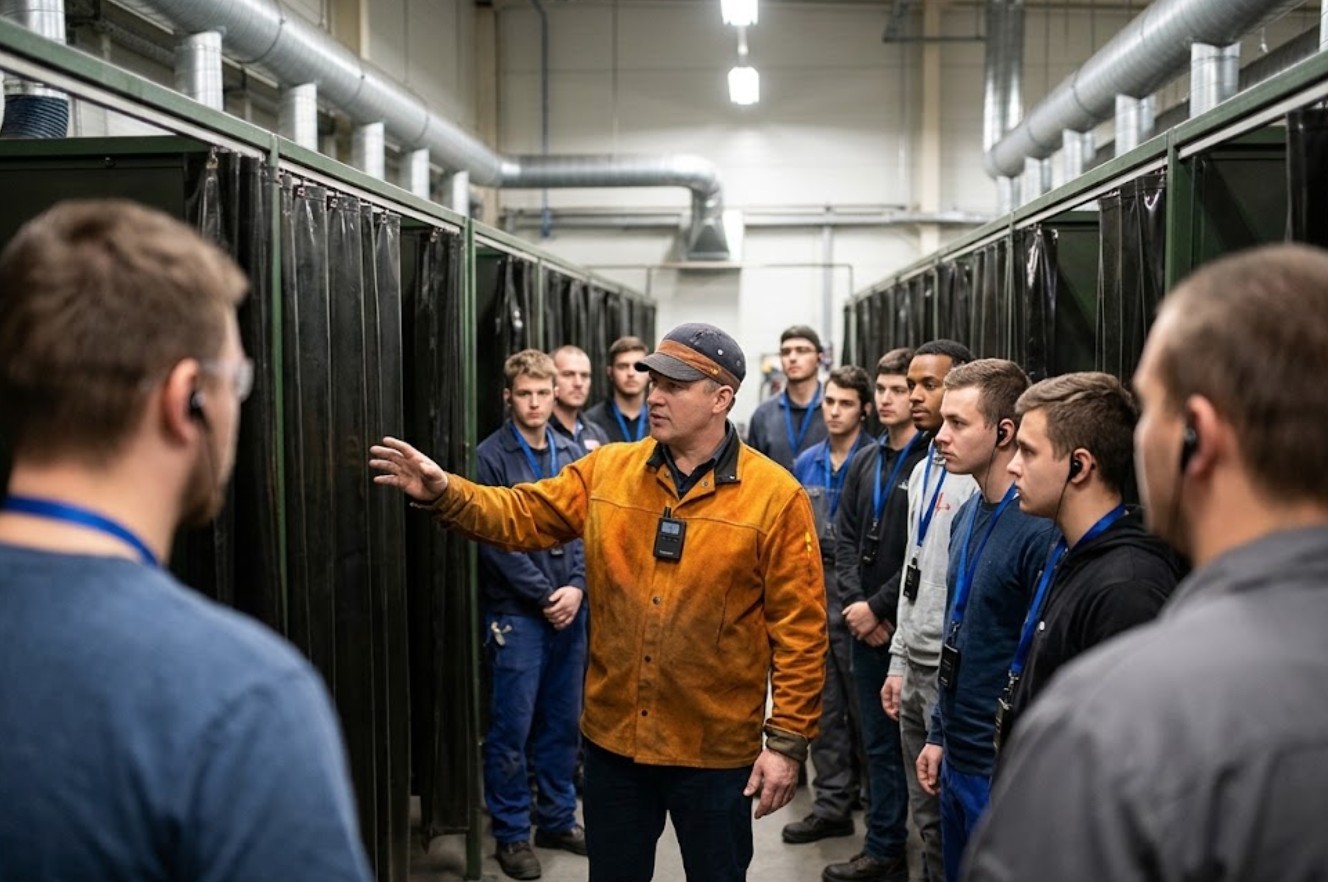
The main bay went to the RC2406 80-channel 2.4G tour guide system. The head instructor keeps transmitter channel 12; the second class in the same slot takes channel 24. Eighty channels sounds like overkill for two classes until you count the whole building: sixteen booths, a grinding corner, and a storage mezzanine where the safety officer records voice notes for the noticeboard. The band sits at 2403-2483 MHz, and the transmitter is rated for 10 hours, which covers the 09:00 start and the 16:30 teardown with margin. Trainees wear the 50 g receivers on a lanyard under the welding jacket collar, where the flame-resistant fabric does not press the earpiece out.
Range was the quiet worry. The bay is 62 meters corner to corner, and the instructor walks the booths during tack-weld demonstrations. The specification allows 1-200 meters, and in practice the signal holds through two rows of steel cabinets at about 40 meters. What convinced the safety officer was not the distance but the isolation: channel 24's class, three meters from channel 12's, reports zero bleed-through during simultaneous demonstrations. That single fact ended a month of argument about splitting the bay into morning and afternoon halves.
Training the instructors took one session, not a project. The supplier's fifteen-minute walkthrough covered pairing a transmitter to a channel, fitting a lanyard so the earpiece sits under the collar, and the mute gesture the two bay instructors agreed on for simultaneous demonstrations. The oldest instructor on staff, twenty-two years in the trade, ran his first channelled session the next morning and filed one note: the transmitter clips to the flame-resistant jacket the same way his old lapel mic did. The office took that as the real acceptance test. Equipment that needs a behaviour change fails in a workshop; equipment that behaves like the old tool succeeds.
🎧 A Second Class Shares the Same Hall
The fitting hall uses the RICH AGE RC2401 wireless audio guide system, the 50-channel sibling on the same 2.4 GHz band. Why not a second RC2406? The office's answer is in the channel ledger: the fitting hall hosts one class at a time plus a visiting group, so 50 channels is already four times more than the building will ever use at once. The transmitter again runs 10 hours; the receivers again manage 20 hours, which means a Monday-morning charge survives Monday and Tuesday both. The two halls charge their crates overnight on the same shelf, and the office stopped writing charge reminders on the whiteboard in week three because nobody had missed one.
The two halls run at the same hours, so the office fixed a rule that needs no enforcement: welding keeps channels in the teens, fitting keeps channels in the twenties and thirties. The 2403-2483 MHz band handles this the way a well-run toolbox handles sockets — the numbers exist so that nobody has to negotiate. When a class from the fitting hall walks through the welding bay on a tour, the instructors mute rather than switch, because the channel separation already did the work. The office also numbered the storage bays 01 through 12, so a trainee with a dead receiver knows exactly which bay to swap at without asking; the sign-out count on the bay doors has matched the crate inventory at every Friday check since.

⌨️ The Assessment Wing Answers by Keypad
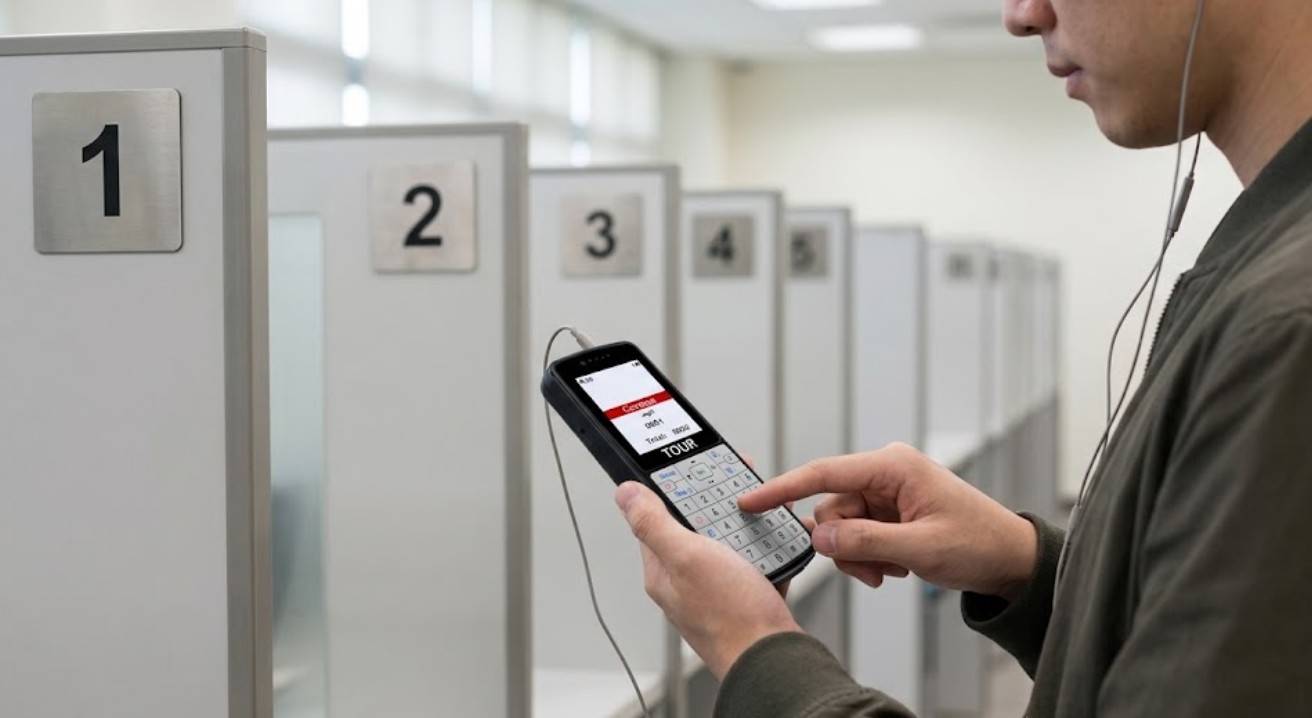
The assessment wing was the odd requirement. Twelve stations, each with a laminated number, and a stream of examiners, auditors, and visiting employers who walk them alone. Hiring a guide for each visitor was never in the budget. The school bought a run of the 2.8-Inch Semi-Auto Digital Audio Guide, a keypad player rather than a wireless system: the visitor types the station number on the 0-9 keypad, and the station's audio plays through the included earphone. Play, pause, and volume have their own buttons, which mattered after the first audit, when two visitors over-rotated a dial-style player and asked for a reset.
The numbers on this device decide the assessment day by themselves. The 2.8-inch screen shows the entered number large enough to confirm from arm's length. Storage is 2 GB internal, holding the school's current library of 96 station tracks with room for the 9999 files the specification allows. Audio is stored and played as MP3, so the office re-records a track the same afternoon the assessment rubric changes — the bilingual safety briefing for station 7 was rewritten twice last term, and both versions went live before the next morning's candidates arrived. A full charge runs up to 18 hours, and the Micro USB port means the office charges the players on the same phone chargers it already keeps at the front desk. Sixteen languages are supported in the file plan, which the school uses for its March intake of French, Portuguese, and Arabic speakers.
The visitor flow runs itself now, on paper. A visiting employer signs in, takes a player from the drawer, and the sign-in sheet lists the station numbers in walking order — 3, 7, 11 for the milling rubric, 1 through 6 for the welding sequence. The office timed eighteen walks in November before writing the sheet: median 22 minutes, longest 31, and nobody needed an escort after the first three visits. The drawer holds nine players against the twelve stations because the office watched the peak: never more than seven walkers at once, and the ratio survived every audit since.
For a wider view of where a keypad player fits against a live transmitter system, the solutions overview covers the same trade-off from the visitor side. The short version the office gives visitors: live systems carry a living instructor, keypad players carry a library. The two lines in the purchase order were never competitors.
🔋 Batteries Measured Against the Timetable
The office printed one page and pinned it inside the charging cabinet. It reads the timetable against the batteries, nothing else. A teaching day runs 09:00 to 16:30 with a 90-minute midday break, so a transmitter rated at 10 hours finishes the day with roughly two hours in hand. Receivers rated at 20 hours are issued on Monday and returned on Wednesday without a midweek charge, which is how the office handles the two cohorts whose schedules overlap on alternating days. The keypad players are charged Friday afternoon; at 18 hours per full charge, a player that walks the assessment wing three times in a week still ends Friday above half.
The honest failures are written down too. One receiver came back with a cracked lanyard clip in week five — a replacement, not a repair. One keypad player was left on a windowsill and its screen went unreadable in the afternoon sun until it cooled; the office now stores them in the drawer under the sign-in sheet. Neither failure involved a battery, a channel, or the band, which is the summary the office gave the director in the December review.
| Deployment Line | Welding Bay | Fitting Hall | Assessment Wing |
|---|---|---|---|
| Device | RC2406 | RC2401 | 2.8-Inch Semi-Auto Digital Audio Guide |
| Band / Type | 2403-2483 MHz wireless | 2403-2483 MHz wireless | MP3 keypad player |
| Channels / Library | 80 channels (CH 12, CH 24 in use) | 50 channels (teens vs 20s-30s blocks) | 2 GB, up to 9999 files, 16 languages |
| Battery Reality | TX 10h / RX 20h | TX 10h / RX 20h | Up to 18h, Micro USB charge |
| Carried By | 50 g receiver under jacket collar | 50 g receiver on lanyard | Visitor at station, earphone included |
| Covers | 2 classes, 16 booths, 09:00-16:30 | 1 class + visiting group | 12 self-guided stations, no guide hour |
📊 What the Cohort Log Showed by Week Twelve
The December numbers, from the office's own log: comprehension complaints fell from seven per week under the megaphones to zero across the term's 312 sessions. The safety step that used to be repeated per class — booth shutdown order — is now repeated once per class, and the instructors estimate it saves about six minutes per session, which across six sessions a day is most of a teaching period returned. The assessment wing processed 41 external visitor walks in the term without a single dedicated guide hour. And the two-classes-in-one-bay arrangement, the one nobody believed would work, ran 48 times without a channel complaint.
The log also settled the equipment question the office started with: 80 channels in the welding bay and 50 in the fitting hall are not redundant purchases, they are one decision applied twice at different sizes. The channel ledger still has entire decades of numbers unassigned, and the office intends to keep it that way.
🧰 What the Office Reorders Each Quarter
Quarterly restock, from the same log: foam earpiece covers, ordered by the hundred, because trainees keep them. Two spare lanyards per class. One keypad player per twelve stations is the ratio that held, so a thirteenth station means a thirteenth player and a re-record, not a schedule change. The office keeps one transmitter per hall as a hot spare after week five's clip incident, and the batteries behind the spare units get a supervised full discharge and recharge each quarter so the shelf stock stays honest. Nothing else has been added to the order since November, which the office reads as the sign the channel plan finally matches the buildings.
The quarter-end audit takes twenty minutes now. Count the covers, test each spare transmitter against its hall channel block, discharge and recharge the shelf batteries, and read the channel ledger against the timetable for the next term. December's audit produced one change: the evening track gets the fitting hall's channel twenties on Thursdays, because the ledger showed the evening instructor re-keying channel 21 from memory and guessing right only twice out of three tries. The printed card in the transmitter crate fixed the guessing. Small, boring, written down — the same three words the office uses for every procedure that survived the term.
FAQ: Questions the Office Answered Directly
1. Can two classes really run in the same welding bay without hearing each other?
Yes. Channel 12 and channel 24 ran side by side 48 times in the term with zero reported bleed-through. The 2403-2483 MHz band carries both at once; the discipline is keeping each building inside its assigned channel blocks.2. What happens when a transmitter battery dies mid-session?
It has not happened in the term — the 10-hour rating covers a 7.5-hour day with margin. The hot spare in each hall's cabinet is charged and logged, and swapping it is a two-minute change recorded in the session log.3. Why a keypad player instead of a second wireless system for the assessment wing?
Because the wing has no live instructor. Visitors walk twelve numbered stations alone, type the station number, and hear that station's track. A wireless system would need a transmitter person on every walk, which is the cost the wing was built to avoid.4. How does the office update the audio when an assessment rubric changes?
The players read MP3 files from 2 GB of internal storage, so the office re-records the changed track, renames it to the station number, and loads it over Micro USB the same day. Station 7's briefing was replaced twice last term with no downtime.5. What does the charging routine actually look like?
Transmitters and receivers charge overnight in their hall's crate; receivers rated 20 hours skip midweek charges entirely. The keypad players charge Friday afternoon on the front-desk phone chargers over Micro USB. The pinned sheet inside the cabinet is the whole procedure.🏭 🛒 Get the Spec Sheet, MOQ and a Factory-Direct Quote
The channel plan in this article is one school's, but the method transfers: count the rooms that run at once, assign channel blocks, and measure every battery against the printed timetable. For the hardware, the wireless tour guide system range covers both halls, and the museum-audio page covers the keypad player line. Factory-direct quotes include the same one-by-one pre-shipment testing this school's log quietly depends on.