
A leading China factory specializing in Wireless Tour Guide Systems, Church Audio Guides, and Translation Headphones with premium OEM/ODM solutions.

Tel:+86 18922879583

Email:tiger.wang@richitek.com

RC2401, RC2402 and RC2500: What a Corporate Training Team Told Us After One Full Quarter

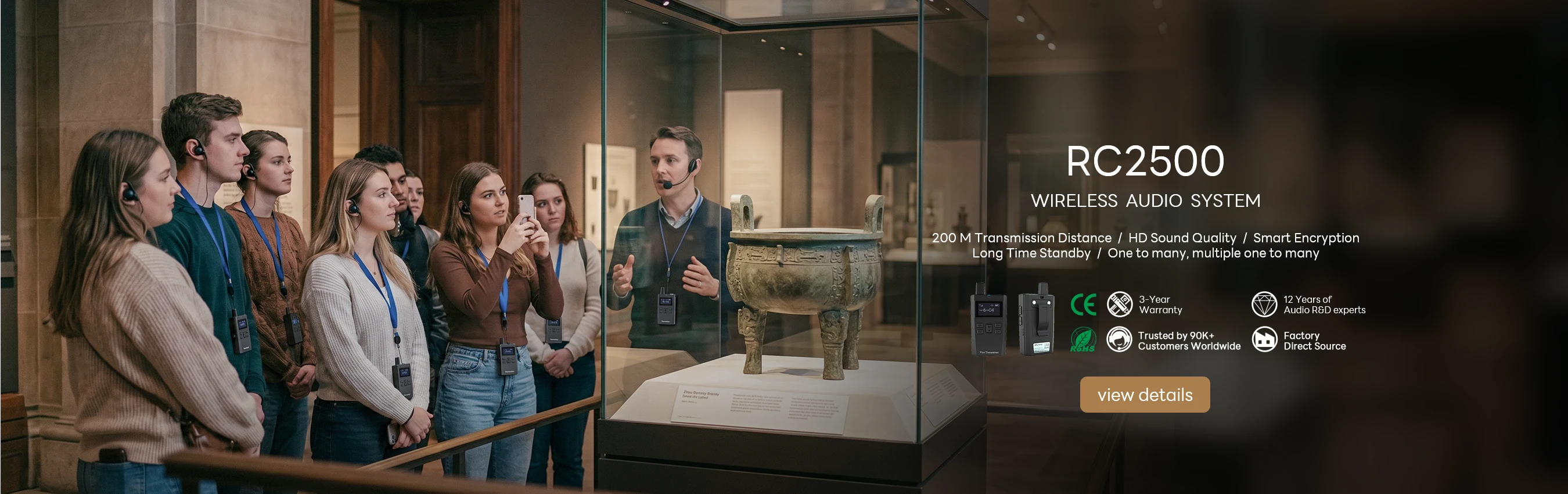
Corporate training departments rarely write love letters or complaint letters about audio equipment; they simply renew or replace. So when a manufacturing client running monthly onboarding cohorts and a quarterly supervisor program agreed to a structured debrief after one full quarter on our systems, we treated the session as an audit of our own hardware. The client runs three stations in every training cycle: a conference-table session for the classroom day, a walk-through on the production floor, and an AV rack where every unit is charged and reset between cohorts. Each station carries a different model — the RC2401 at the conference table, the RC2402 on the floor, and the RC2500 at the AV rack — and each one came out of the debrief with a different verdict.

The debrief was organized around three questions: what the trainers praised, what the trainees noticed, and what the equipment room changed in its own procedures. Their facility manager kept notes for all twelve weeks, which made the session unusually concrete — every remark traced back to a dated log entry rather than a vague impression. This article walks through the feedback station by station, then lists the published figures the client's procurement committee asked to see before signing the renewal.

⚙️ The Setup: Three Stations a Corporate Trainer Actually Runs

Most corporate training content describes one classroom and one product. A real training operation is closer to a small broadcast facility that packs up every evening. On induction days, the whole cohort sits in the conference room for compliance content in the morning and moves to the production floor after lunch. Supervisor courses run the reverse pattern twice a quarter. Between cohorts, every transmitter and receiver returns to the AV rack for charging, firmware sanity checks and kit counts. A system that ignores any one of the three stations fails in a way the other two cannot compensate for — a lesson the client learned years ago with a single-model fleet, and the reason this deployment mixes three.

Trainer wearing the RC2401 headset microphone addresses an onboarding cohort at a conference table

RC2401 at the Conference Table: What the Trainers Praised

The conference-room verdict was the most positive of the three stations, and the trainers' reasons were specific. The RC2401's 50 channels meant three parallel rooms could run simultaneously during the quarter's busiest onboarding week without anyone scanning for a clear frequency — the facility manager logged zero cross-talk incidents across all cohorts. The transmitter's 3.7V 1500mAh battery running 10 hours covered a full training day with margin, and its 59g weight was light enough that trainers forgot they were wearing it during two-hour sessions. Trainers also singled out the receiver's 20-hour battery life: with 3.7V 1000mAh cells, the AV room could rotate receivers every second cohort instead of every cohort, which halved the midday charging queue that plagued their previous fleet.

The criticism was equally concrete. One trainer wanted a brighter channel indicator for the back row of the room; another asked why the DC charging port required the dedicated adapters rather than a shared cable. Neither remark stopped the renewal — the first is a habit the trainers adjusted to, and the second was solved at the AV rack, where the RC2500 units already charge over Type-C. The practical takeaway the client recorded was that RC2401 is the right main-room unit exactly because it is the standard 2.4G workhorse: nothing exotic to explain to a rotating cast of internal trainers, at a price point that lets the department issue one to every classroom it runs. The full specification sits on the RC2401 system page.

RC2402 on the Floor: What the Walk-Through Changed

The production-floor station got the most discussion. The RC2402 shares the RC2401's core platform — 2.4G transmission on 50 channels from 2403 to 2483 MHz, a 1-200m range, 10mW output, and the same 10-hour transmitter and 20-hour receiver endurance — but the floor walk-through stresses a different part of the specification. Trainers lead fifteen people past running machinery for forty minutes at a time, and the feedback that mattered was about hearing, not logistics. Trainees reported that the 50Hz-12kHz receiver response carried speech clearly over the ambient machinery noise on all but the loudest line, and the PLL control mode held the channel without drift when the group crossed between halls.

The change the client made after the debrief concerned pairing discipline, not hardware. Floor sessions overlap between departments, so the equipment room now assigns floor kits to fixed channel blocks written on the case lids — the same fixed-block habit the parallel conference rooms use — instead of letting trainers pick channels ad hoc. The facility manager's log showed the single near-miss of the quarter came from an ad hoc pick during an unplanned joint session, and the fixed-block rule closed it. On the praise side, the 59g transmitter and 50g receivers survived the quarter with no physical failures, which the client attributed to lanyard discipline rather than luck. One suggested improvement — a belt clip option for receivers worn under harnesses — went onto the next order as a custom colorway and lanyard variant request. The RC2402 system page carries the same figures for procurement review.

Trainer leading a production floor walk-through with the RC2402 while trainees wear receivers

RC2500 at the AV Rack: The Complaint That Became a Compliment

The AV rack station produced the debrief's most useful exchange. The client's original complaint, logged in week two, was about bulk: at 104g for both transmitter and receiver, the RC2500 is the heaviest unit in the fleet, and the equipment room questioned why the flagship should sit at a charging rack instead of in a trainer's hand. The answer emerged over the following weeks. The RC2500's one-key sync, one-key power-off and one-key mute functions turned nightly reset from a twenty-minute routine into a two-minute routine — the equipment room reset forty-eight units by pressing each one's button and docking it, no menu navigation, no channel rescans. Its 3.7V 1800mAh batteries run 15 hours on the transmitter and over 35 hours on the receiver, so the units docked overnight are always the fullest in the fleet, ready to substitute anywhere a morning cohort starts early. Charging runs over Type-C, which ended the dedicated-adapter problem the trainers raised about the DC-port units.

By the debrief, the facility manager had reversed the week-two complaint in writing: the heavy, dockable flagship became the fleet's reset anchor and its spare-parts pool simultaneously. When a conference-room transmitter came back with a cracked lanyard lug in week nine, an RC2500 substitute taught the session the same morning without re-pairing the room. The client's procurement committee did raise one more question — why the RC2500's 50Hz-8kHz response is narrower than the RC2401/RC2402 pair — and accepted the answer that the dock-and-dispatch role values battery life and one-key control over the last octave of audio fidelity. The RC2500 flagship page documents the one-key functions in full.
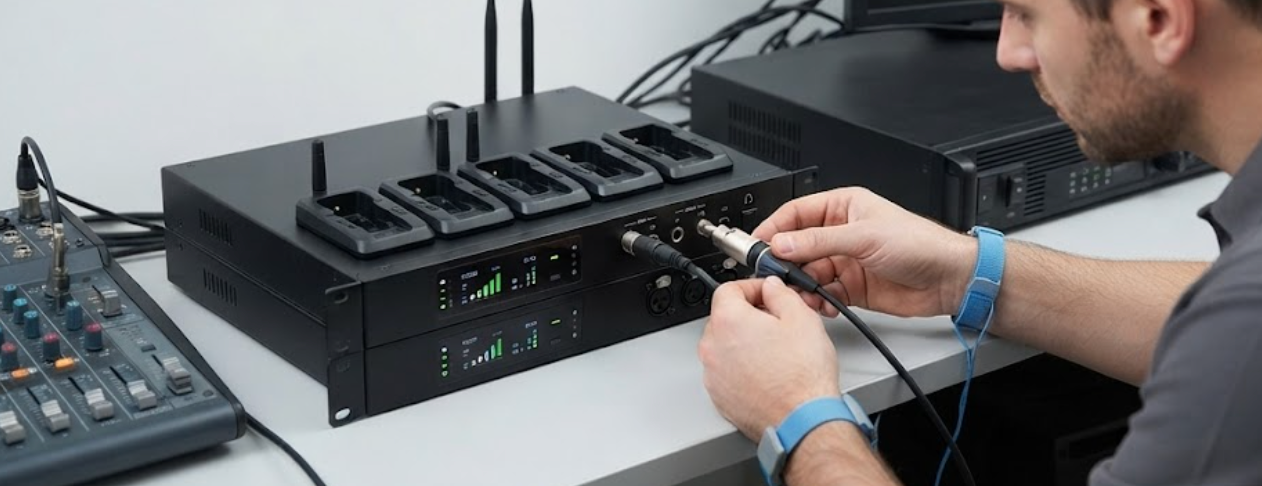
Technician docking RC2500 units in a multi-bay charging rack beside an audio mixer

The Figures the Renewal Committee Asked to See

The client's committee reviews renewals against a one-page technical annex. The table below collects the published figures for the three models as they appear in the current specification sheet.

Published ItemRC2401RC2402RC2500
Band2403-2483 MHz (2.4G)2403-2483 MHz (2.4G)2403-2483 MHz (2.4G)
Channels505050
Range1-200m1-200m1-200m
Output power10mW10mW10mW
TX / RX endurance10h / 20h10h / 20h15h / 35+h
TX / RX battery3.7V 1500mAh / 3.7V 1000mAh3.7V 1500mAh / 3.7V 1000mAh3.7V 1800mAh / 3.7V 1800mAh
TX / RX weight59g / 50g59g / 50g104g / 104g
Charging portDC PortDC PortType-C
Standout controlsPLL; standard 2.4G platformPLL; standard 2.4G platformOne-key sync / power-off / mute
Color optionsMulti-color (customizable)Multi-color (customizable)Black only (customizable)

One figure in the annex is a frequency response note rather than a number: the RC2401 and RC2402 publish transmitter response to 200kHz and receiver response to 12kHz, while the RC2500 publishes 50Hz-8kHz across the unit. The committee accepted the difference as the design split between classroom fidelity and rack endurance, and it is the only specification row where the three models are not directly comparable.

What We Changed in the Kit After the Feedback

Feedback only pays when it reaches the next shipment. Four changes went into the renewal order. First, the fixed channel-block cards described above are now printed and laminated into every case lid as standard, in the client's wording rather than ours. Second, the RC2500 share of the fleet rises by four units, funded by trimming one RC2402 floor kit that usage logs showed idle for nine of twelve weeks — the one-key reset made a smaller rack fleet viable. Third, the receiver lanyard variant the floor trainers requested goes in as a custom option, since both RC2401 and RC2402 ship in customizable colorways and the client wanted a harness-compatible length. Fourth, the spare-adapter drawer is gone: Type-C charging on the RC2500 rack units covers every fast-top-up need, and the DC-port adapters now live attached to their cases.

The Second-Quarter Numbers After the Adjustments

The client agreed to share three operational counts from the following quarter, measured the same way as the debrief logs. Cross-talk incidents across parallel rooms and floor groups stayed at zero under the fixed channel blocks. Midday charging queue time at the AV rack fell from the twelve-minute peak logged in week five to under four minutes, driven by the RC2500's overnight-dock habit and the receiver rotation change. And the equipment room's nightly reset time, the metric behind the week-two complaint, settled at the two-to-three minute range the one-key routine promised. The client's one-line verdict for the renewal file — the systems stopped being noticed — is the outcome a training audio fleet should aim for, and the three-station split is what got them there.

The deployment pattern also fits the wider conference and training solutions notes, and the full tour guide system catalogue lists the adjacent models for larger venues.

Case histories from other deployments, including factories, museums and city tours, are collected in the audio guide case library.


FAQ

1. Why mix three models instead of standardizing on one?

Because each station stresses a different part of the specification. The conference room values multi-color, lightweight transmitters that internal trainers forget they are wearing; the floor values reliable PLL stability and clear speech reproduction while walking; the AV rack values one-key reset, long standby and Type-C docking. A single model that optimizes all three would be heavier and more expensive at every station.

2. Is the RC2500's heavier 104g body a problem for trainers?

At the rack, no — the weight is irrelevant to its reset-and-reserve role, and the 3.7V 1800mAh batteries behind it are what keep the fleet's fullest units ready for early cohorts. Trainers who carry a unit all day were issued the 59g RC2401 or RC2402 transmitters instead, which is exactly how the client's fleet is split.

3. How do the DC Port and Type-C charging differences work in practice?

The DC-port units charge on their dedicated adapters at fixed charging positions, which is workable at a supervised rack. The RC2500's Type-C port matters when a unit needs a fast top-up away from the rack, since a shared cable works anywhere in the facility. The client kept the adapters attached to each case to remove the only friction the trainers reported.

4. What does the fixed channel-block rule actually prevent?

It prevents ad hoc channel picks during overlapping sessions, which was the only near-miss the client logged all quarter. With conference rooms and floor groups assigned to written channel blocks on 50-channel units, three parallel sessions ran with zero cross-talk incidents for the entire deployment, and the rule now ships printed into every case lid.


2026年10月27日 12:11
ꄘ click: 12

Get the spec sheet, MOQ and a factory-direct quote

Tell us the venue, the group size and how many languages you need. An engineer at our Shenzhen factory replies within one business day with the matching model, a written quote, lead time and the CE / RoHS / ISO 9001 documents.

Talk to an engineer WhatsApp +86 189 2287 9583

Prefer email? tiger.wang@richitek.com  |  OEM / ODM, custom tooling and neutral packaging available  |  send the enquiry through our contact page

Shenzhen Rich Age Electronics Co., Ltd. (Richitek) - manufacturing wireless tour guide systems, church translation headsets and museum audio guide equipment since 2007.

no data

RC2401, RC2402 and RC2500: What a Corporate Training Team Told Us After One Full Quarter

time: 2026年10月27日 click:12

Corporate training departments rarely write love letters or complaint letters about audio equipment; they simply renew or replace. So when a manufacturing client running monthly onboarding cohorts and a quarterly supervisor program agreed to a structured debrief after one full quarter on our systems, we treated the session as an audit of our own hardware. The client runs three stations in every training cycle: a conference-table session for the classroom day, a walk-through on the production floor, and an AV rack where every unit is charged and reset between cohorts. Each station carries a different model — the RC2401 at the conference table, the RC2402 on the floor, and the RC2500 at the AV rack — and each one came out of the debrief with a different verdict.

The debrief was organized around three questions: what the trainers praised, what the trainees noticed, and what the equipment room changed in its own procedures. Their facility manager kept notes for all twelve weeks, which made the session unusually concrete — every remark traced back to a dated log entry rather than a vague impression. This article walks through the feedback station by station, then lists the published figures the client's procurement committee asked to see before signing the renewal.

⚙️ The Setup: Three Stations a Corporate Trainer Actually Runs

Most corporate training content describes one classroom and one product. A real training operation is closer to a small broadcast facility that packs up every evening. On induction days, the whole cohort sits in the conference room for compliance content in the morning and moves to the production floor after lunch. Supervisor courses run the reverse pattern twice a quarter. Between cohorts, every transmitter and receiver returns to the AV rack for charging, firmware sanity checks and kit counts. A system that ignores any one of the three stations fails in a way the other two cannot compensate for — a lesson the client learned years ago with a single-model fleet, and the reason this deployment mixes three.

Trainer wearing the RC2401 headset microphone addresses an onboarding cohort at a conference table

RC2401 at the Conference Table: What the Trainers Praised

The conference-room verdict was the most positive of the three stations, and the trainers' reasons were specific. The RC2401's 50 channels meant three parallel rooms could run simultaneously during the quarter's busiest onboarding week without anyone scanning for a clear frequency — the facility manager logged zero cross-talk incidents across all cohorts. The transmitter's 3.7V 1500mAh battery running 10 hours covered a full training day with margin, and its 59g weight was light enough that trainers forgot they were wearing it during two-hour sessions. Trainers also singled out the receiver's 20-hour battery life: with 3.7V 1000mAh cells, the AV room could rotate receivers every second cohort instead of every cohort, which halved the midday charging queue that plagued their previous fleet.

The criticism was equally concrete. One trainer wanted a brighter channel indicator for the back row of the room; another asked why the DC charging port required the dedicated adapters rather than a shared cable. Neither remark stopped the renewal — the first is a habit the trainers adjusted to, and the second was solved at the AV rack, where the RC2500 units already charge over Type-C. The practical takeaway the client recorded was that RC2401 is the right main-room unit exactly because it is the standard 2.4G workhorse: nothing exotic to explain to a rotating cast of internal trainers, at a price point that lets the department issue one to every classroom it runs. The full specification sits on the RC2401 system page.

RC2402 on the Floor: What the Walk-Through Changed

The production-floor station got the most discussion. The RC2402 shares the RC2401's core platform — 2.4G transmission on 50 channels from 2403 to 2483 MHz, a 1-200m range, 10mW output, and the same 10-hour transmitter and 20-hour receiver endurance — but the floor walk-through stresses a different part of the specification. Trainers lead fifteen people past running machinery for forty minutes at a time, and the feedback that mattered was about hearing, not logistics. Trainees reported that the 50Hz-12kHz receiver response carried speech clearly over the ambient machinery noise on all but the loudest line, and the PLL control mode held the channel without drift when the group crossed between halls.

The change the client made after the debrief concerned pairing discipline, not hardware. Floor sessions overlap between departments, so the equipment room now assigns floor kits to fixed channel blocks written on the case lids — the same fixed-block habit the parallel conference rooms use — instead of letting trainers pick channels ad hoc. The facility manager's log showed the single near-miss of the quarter came from an ad hoc pick during an unplanned joint session, and the fixed-block rule closed it. On the praise side, the 59g transmitter and 50g receivers survived the quarter with no physical failures, which the client attributed to lanyard discipline rather than luck. One suggested improvement — a belt clip option for receivers worn under harnesses — went onto the next order as a custom colorway and lanyard variant request. The RC2402 system page carries the same figures for procurement review.

Trainer leading a production floor walk-through with the RC2402 while trainees wear receivers

RC2500 at the AV Rack: The Complaint That Became a Compliment

The AV rack station produced the debrief's most useful exchange. The client's original complaint, logged in week two, was about bulk: at 104g for both transmitter and receiver, the RC2500 is the heaviest unit in the fleet, and the equipment room questioned why the flagship should sit at a charging rack instead of in a trainer's hand. The answer emerged over the following weeks. The RC2500's one-key sync, one-key power-off and one-key mute functions turned nightly reset from a twenty-minute routine into a two-minute routine — the equipment room reset forty-eight units by pressing each one's button and docking it, no menu navigation, no channel rescans. Its 3.7V 1800mAh batteries run 15 hours on the transmitter and over 35 hours on the receiver, so the units docked overnight are always the fullest in the fleet, ready to substitute anywhere a morning cohort starts early. Charging runs over Type-C, which ended the dedicated-adapter problem the trainers raised about the DC-port units.

By the debrief, the facility manager had reversed the week-two complaint in writing: the heavy, dockable flagship became the fleet's reset anchor and its spare-parts pool simultaneously. When a conference-room transmitter came back with a cracked lanyard lug in week nine, an RC2500 substitute taught the session the same morning without re-pairing the room. The client's procurement committee did raise one more question — why the RC2500's 50Hz-8kHz response is narrower than the RC2401/RC2402 pair — and accepted the answer that the dock-and-dispatch role values battery life and one-key control over the last octave of audio fidelity. The RC2500 flagship page documents the one-key functions in full.

Technician docking RC2500 units in a multi-bay charging rack beside an audio mixer

The Figures the Renewal Committee Asked to See

The client's committee reviews renewals against a one-page technical annex. The table below collects the published figures for the three models as they appear in the current specification sheet.

Published ItemRC2401RC2402RC2500
Band2403-2483 MHz (2.4G)2403-2483 MHz (2.4G)2403-2483 MHz (2.4G)
Channels505050
Range1-200m1-200m1-200m
Output power10mW10mW10mW
TX / RX endurance10h / 20h10h / 20h15h / 35+h
TX / RX battery3.7V 1500mAh / 3.7V 1000mAh3.7V 1500mAh / 3.7V 1000mAh3.7V 1800mAh / 3.7V 1800mAh
TX / RX weight59g / 50g59g / 50g104g / 104g
Charging portDC PortDC PortType-C
Standout controlsPLL; standard 2.4G platformPLL; standard 2.4G platformOne-key sync / power-off / mute
Color optionsMulti-color (customizable)Multi-color (customizable)Black only (customizable)

One figure in the annex is a frequency response note rather than a number: the RC2401 and RC2402 publish transmitter response to 200kHz and receiver response to 12kHz, while the RC2500 publishes 50Hz-8kHz across the unit. The committee accepted the difference as the design split between classroom fidelity and rack endurance, and it is the only specification row where the three models are not directly comparable.

What We Changed in the Kit After the Feedback

Feedback only pays when it reaches the next shipment. Four changes went into the renewal order. First, the fixed channel-block cards described above are now printed and laminated into every case lid as standard, in the client's wording rather than ours. Second, the RC2500 share of the fleet rises by four units, funded by trimming one RC2402 floor kit that usage logs showed idle for nine of twelve weeks — the one-key reset made a smaller rack fleet viable. Third, the receiver lanyard variant the floor trainers requested goes in as a custom option, since both RC2401 and RC2402 ship in customizable colorways and the client wanted a harness-compatible length. Fourth, the spare-adapter drawer is gone: Type-C charging on the RC2500 rack units covers every fast-top-up need, and the DC-port adapters now live attached to their cases.

The Second-Quarter Numbers After the Adjustments

The client agreed to share three operational counts from the following quarter, measured the same way as the debrief logs. Cross-talk incidents across parallel rooms and floor groups stayed at zero under the fixed channel blocks. Midday charging queue time at the AV rack fell from the twelve-minute peak logged in week five to under four minutes, driven by the RC2500's overnight-dock habit and the receiver rotation change. And the equipment room's nightly reset time, the metric behind the week-two complaint, settled at the two-to-three minute range the one-key routine promised. The client's one-line verdict for the renewal file — the systems stopped being noticed — is the outcome a training audio fleet should aim for, and the three-station split is what got them there.

The deployment pattern also fits the wider conference and training solutions notes, and the full tour guide system catalogue lists the adjacent models for larger venues.

Case histories from other deployments, including factories, museums and city tours, are collected in the audio guide case library.

FAQ

1. Why mix three models instead of standardizing on one?

Because each station stresses a different part of the specification. The conference room values multi-color, lightweight transmitters that internal trainers forget they are wearing; the floor values reliable PLL stability and clear speech reproduction while walking; the AV rack values one-key reset, long standby and Type-C docking. A single model that optimizes all three would be heavier and more expensive at every station.

2. Is the RC2500's heavier 104g body a problem for trainers?

At the rack, no — the weight is irrelevant to its reset-and-reserve role, and the 3.7V 1800mAh batteries behind it are what keep the fleet's fullest units ready for early cohorts. Trainers who carry a unit all day were issued the 59g RC2401 or RC2402 transmitters instead, which is exactly how the client's fleet is split.

3. How do the DC Port and Type-C charging differences work in practice?

The DC-port units charge on their dedicated adapters at fixed charging positions, which is workable at a supervised rack. The RC2500's Type-C port matters when a unit needs a fast top-up away from the rack, since a shared cable works anywhere in the facility. The client kept the adapters attached to each case to remove the only friction the trainers reported.

4. What does the fixed channel-block rule actually prevent?

It prevents ad hoc channel picks during overlapping sessions, which was the only near-miss the client logged all quarter. With conference rooms and floor groups assigned to written channel blocks on 50-channel units, three parallel sessions ran with zero cross-talk incidents for the entire deployment, and the rule now ships printed into every case lid.


Get the spec sheet, MOQ and a factory-direct quote

Tell us the venue, the group size and how many languages you need. An engineer at our Shenzhen factory replies within one business day with the matching model, a written quote, lead time and the CE / RoHS / ISO 9001 documents.

Talk to an engineer WhatsApp +86 189 2287 9583

Prefer email? tiger.wang@richitek.com  |  OEM / ODM, custom tooling and neutral packaging available  |  send the enquiry through our contact page

Shenzhen Rich Age Electronics Co., Ltd. (Richitek) - manufacturing wireless tour guide systems, church translation headsets and museum audio guide equipment since 2007.

no data
×

Contact us

email:
name:
subject:
content: