A leading China factory specializing in Wireless Tour Guide Systems, Church Audio Guides, and Translation Headphones with premium OEM/ODM solutions.

Tel:+86 18922879583

Email:tiger.wang@richitek.com

RC085 and the Slovenian Pilgrims: A Microphone Kept Changing Hands

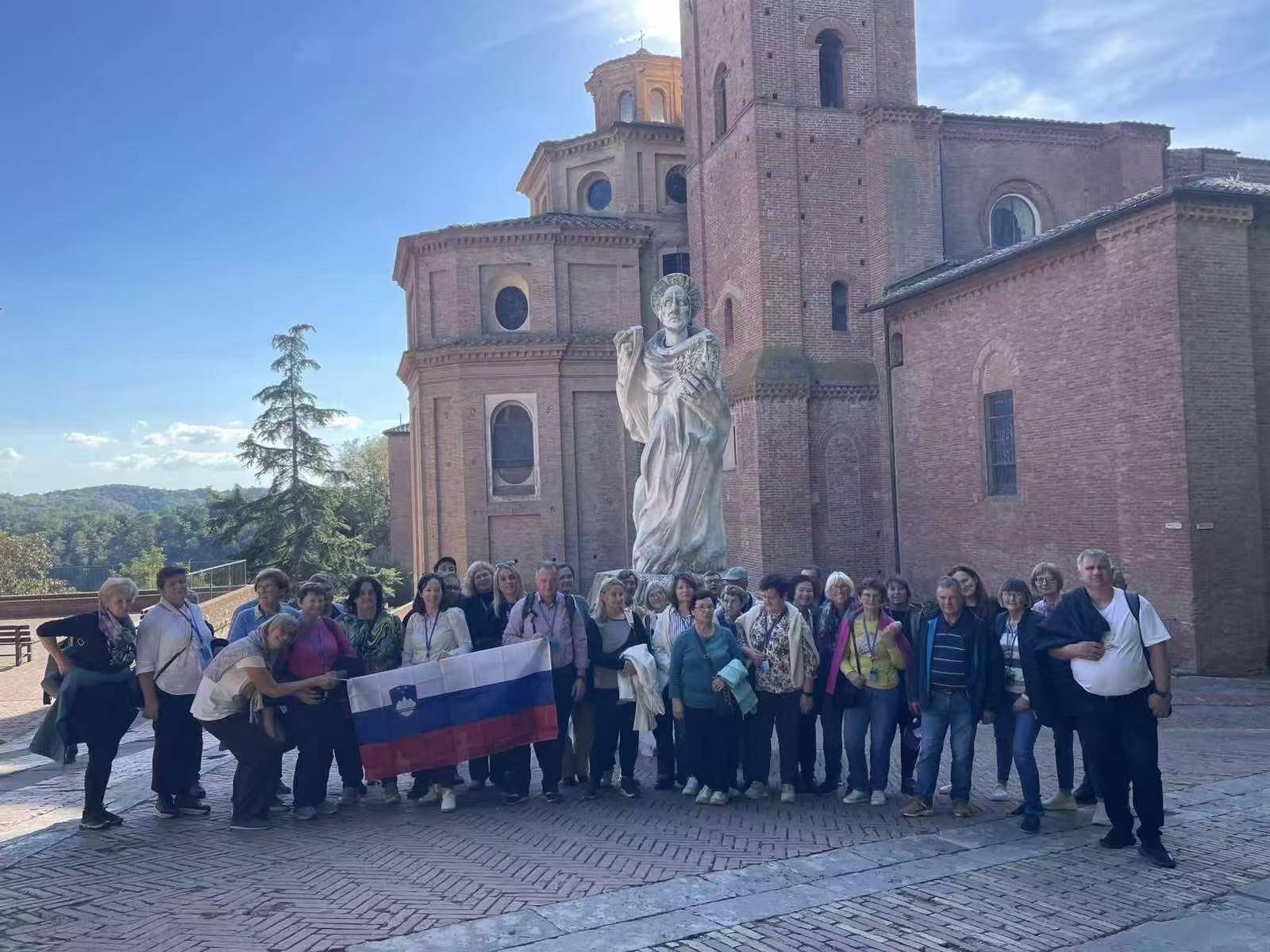
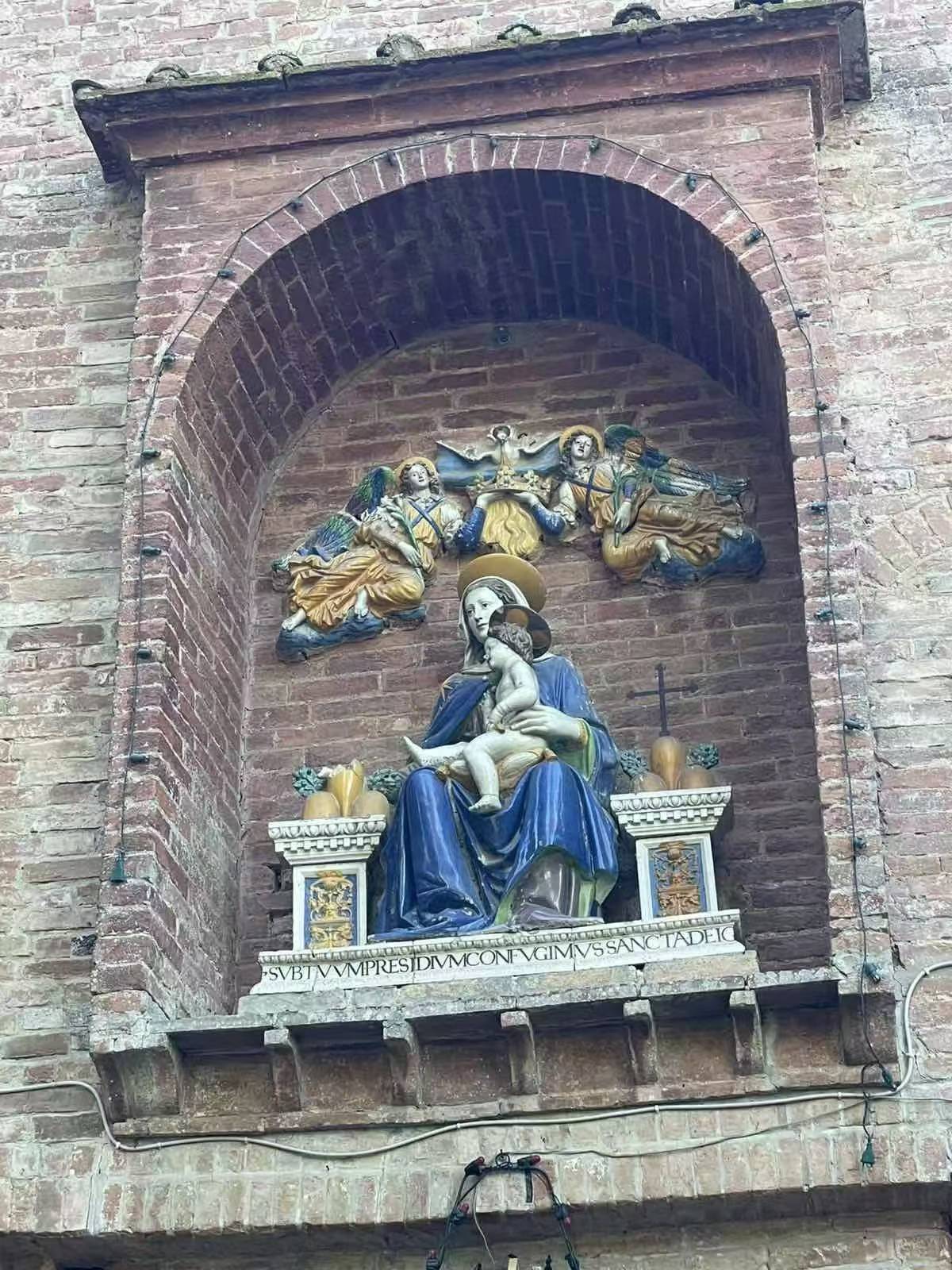
The three photographs arrived without a caption. In the first, a group of about two dozen people stands in two rows on a paved terrace in front of a red brick basilica, holding a Slovenian flag stretched between two of them. A white marble statue rises behind the group, and a square brick bell tower with round arched openings fills the upper half of the frame. Several people wear lanyards. Nobody is holding a loudspeaker, and there is no portable amplifier on the ground. The second photograph is a tall, narrow shot of a glazed terracotta niche set into the same kind of brickwork: a seated Madonna with the child, two small altarpieces, three angels above, and a carved band of Latin letters along the base. The third looks straight up at a pale stone facade with a rose window, a green door, a separate clock tower on the left, two bell openings, and a monumental saint with one arm extended over a plinth bearing a carved dedication. Taken together the three frames describe one visit, not three products.

Customer photographs are usually treated as decoration, but for a case study they are closer to a witness statement: they show where the group actually stood, which surfaces surrounded them, and which moments were considered worth recording. Here the evidence points to a pilgrimage rather than a sightseeing circuit. A national flag in a group portrait is not a prop handed out by a tour operator; it is something a parish or a diocesan group brings from home. The niche and the facade were photographed alone, with no people in them, which suggests the organiser wanted to document the stops themselves rather than the travellers. We have kept that distinction in this write-up. What follows is built around the parts of the morning that the pictures can support, plus the specifications the manufacturer publishes for the kit the organiser named. For broader context on how churches handle spoken commentary, see our church wireless audio solutions page.

What the Flag at the Front of the Group Tells You

The organiser identified the kit used that morning as the RC085 digital tour guide system. That is a statement from the customer, not something the photographs prove: at this distance the receivers are small dark shapes on lanyards and no model marking can be read. We say that plainly because a case study loses its value the moment a picture is asked to certify a part number. What the picture does show is the shape of the group. Roughly two dozen adults are arranged in two rows, with the flag held low across the front row and a few people crouching to keep the fabric flat. The flag is at the front, which means the people who matter most for timing are at the back: they are the ones furthest from whoever is speaking, and they are the ones who will start walking a few seconds after everyone else.
Slovenian-pilgrims-group-photo-pilgrimage_group_tour

A group that stops for a photograph creates a specific audio problem. The guide stops talking, the group spreads sideways, and the people at either end of the back row are now several metres away from the person who will say when to move again. Nothing about that interval requires more volume. It requires that the same receivers come back to the same channel without anyone being re-paired or re-counted. The photograph was taken in bright sun on an open terrace, so there is no shelter and no wall to reflect sound; the only thing holding the group together at that moment is the fact that everybody is still listening to the same person. When the shutter is done, the person at the front with the flag starts walking, and the instruction to follow has to reach the back row first time. A receiver that has dropped out during the pause does not announce itself. It simply leaves one person standing still while the rest of the row moves.

The Inscription Nobody Wanted to Read Aloud

The second frame is the one most tour operators would leave out. It is a close view of a niche above eye level, with a band of capital letters cut into the stone along its base. The spelling is classical: V does the work that a modern reader expects U to do, so a line that begins SVB TVVM PRESIDIVM cannot simply be read out as ordinary Latin by someone who has not seen it before. A guide who is confident with architecture can still stumble over an inscription, and stumbling in front of a pilgrimage group is worse than saying nothing. This is the kind of stop where commentary changes hands. For teams that plan church translation headphones around a fixed script, the niche is an awkward object: it is not a translation task, it is a reading task, and the person qualified to do it may not be the person holding the transmitter.
Marian-niche-latin-inscription-pilgrimage_group_tour

What the photograph records, then, is a place where one voice was not enough. The organiser's account of the morning describes the local clergy taking the inscription while the guide handled the building; we have no audio recording, so we are not going to claim a word-for-word transcript or a duration for that exchange. The useful observation is structural. At the terrace, the group needed one person to be heard by everyone. At the niche, the group needed another person to be heard by everyone, immediately after the first, without a pause long enough for the row to drift apart. A system designed only for one-way broadcast makes that change a small ceremony: stop, unclip, pass the transmitter, check that the new speaker is close enough to the microphone, start again. A system with a reply position turns it into a sentence. The distinction matters because the niche is set back into a wall and the group has to stand slightly off to one side to see it, which puts the person at the far end of the row behind a brick corner.

When the Bell Takes the Turn

The third photograph looks up at a facade with a rose window and two separate towers. One tower carries a clock face, another carries a visible bell, and a stone saint stands on a plinth to the right with an arm extended over the square. The bells in a building like this do not run on the visitor's schedule. They mark offices, masses and the hour, and a group standing in front of the facade has no authority over any of them. That is a different kind of interruption from a photograph. A photograph is planned by the group; a bell is not, and the guide may not know how long it will last. Comparisons such as RC085 vs RC8860 spend most of their space on range and channel counts, but on a church square the more practical question is what the equipment does during an unplanned silence.
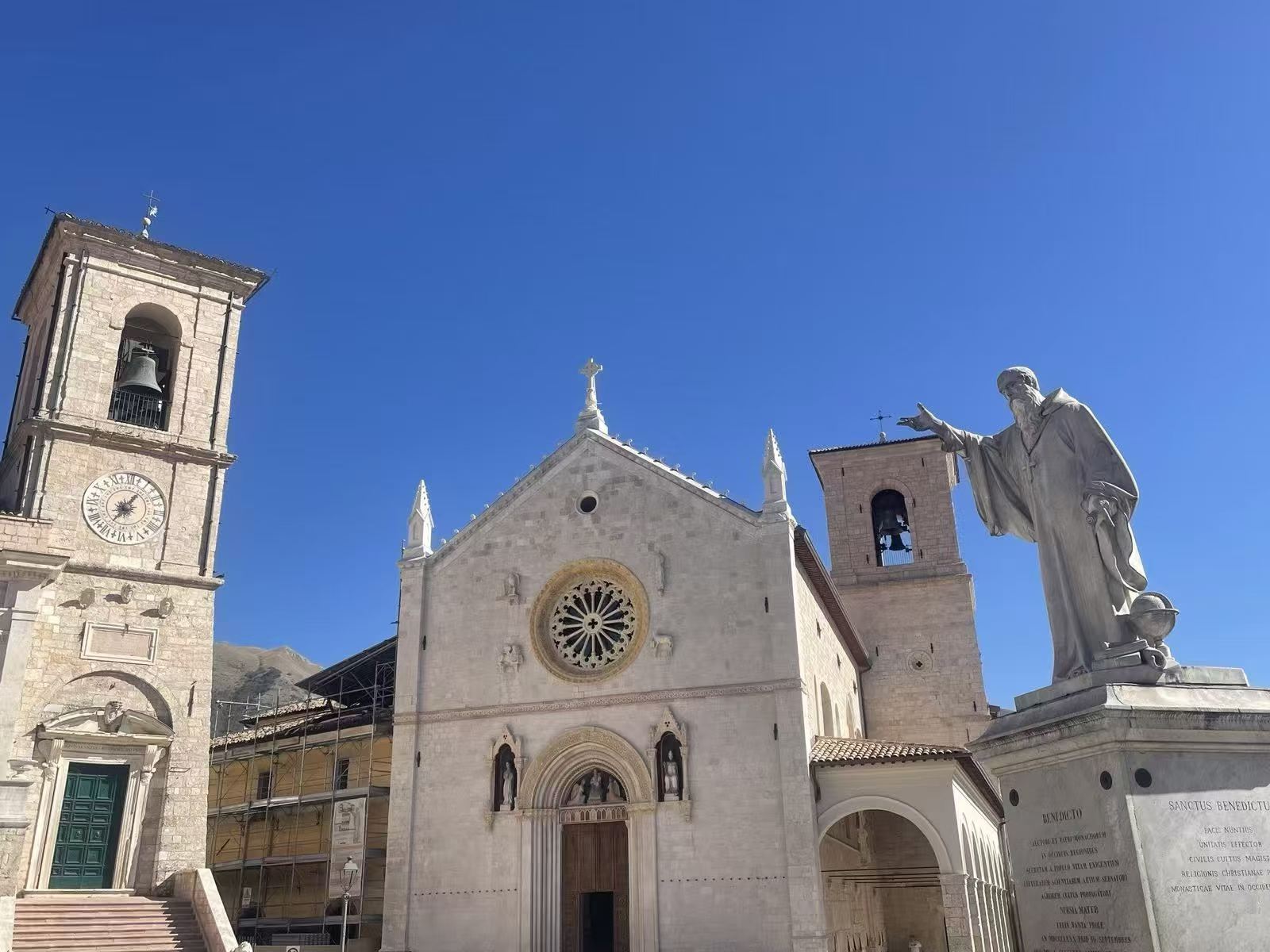
Basilica-facade-bell-tower-pilgrimage_group_tour

There are two honest answers. The first is procedural: the guide stops, waits, and resumes at the same point, because the group has not moved and the receivers have not been touched. The second is in the published feature list. The RC085 page lists auto sleep and wake-up as part of its power management, which is a way of saying that a pause does not have to become a restart. We are not claiming a measured battery saving from this visit; no meter reading was supplied with the photographs. What we can say is that a morning built around a service timetable contains silences that nobody schedules, and equipment that treats silence as an idle state rather than a shutdown is easier to run on that kind of day. The bell, in other words, takes the turn without taking the kit away. Nobody in the third photograph is looking at a screen, which is exactly the point: the interruption is handled without asking twenty-odd people to do anything at all.

Broadcast and Reply on the Same Kit

The product page describes two communication modes for the RC085, F1 and F2. F1 is a one-way broadcast: a single transmitter talks and any number of receivers listen. F2 is a two-way arrangement with a main speaker and a reply position, intended for sessions where somebody in the group needs to answer or ask. Both are listed on the same unit, which matters more here than the raw channel count. A pilgrimage group is not a lecture audience. The person leading the flag may need to say that the coach is waiting, and a member of the clergy may need to correct a reading before it is repeated by twenty people. Our wireless tour guide system range includes one-way-only units, and for a museum gallery that is usually the right answer. It is a poorer fit for a morning with several different speakers.

Mode Who is heard What the rest of the group does Moment in these photographs
F1 one-way One transmitter, unlimited receivers Listens only Terrace commentary before the group portrait
F2 two-way A main speaker and one reply position Can answer or ask without leaving the row The carved band beneath the Marian niche
Idle between turns Nobody Receivers stay paired on the same channel The bell over the facade

The third row is not a mode in the manual; it is a description of what happens between the other two, and we include it because it is where a case study usually goes wrong. Specifications are written for continuous use, while a church visit is a sequence of short bursts separated by silence, a photograph, a prayer, or a bell. If the equipment treats every gap as the end of a session, the guide spends the day restarting it. The published auto sleep and wake-up behaviour is the closest thing the specification sheet offers to a description of that gap. We would rather name the gap than pretend the morning ran as one uninterrupted talk. It also explains why nobody in these three frames is holding a spare handset: the working assumption is that the same receivers stay with the same people from the first terrace to the last doorway.

Why 470-510 MHz Matters Behind Brick

The RC085 is a UHF unit. The current model specification table used for this site lists a core band of 470-510 MHz, 100 channels, a working distance of 1-200 m, and an output power of 8-10 mW; the product page states the same frequency range as 470-510MHz and describes the distance as up to 200 meters. The product page was written for factories. It argues that UHF penetrates steel structures and heavy machinery better than 2.4 GHz equipment, and that it avoids the crowded Wi-Fi and Bluetooth part of the spectrum. None of the three photographs shows a factory. They show brick: a brick apse, a brick bell tower, a brick niche recessed into a wall, and a stone facade with thick masonry around a rose window. The physics the page describes does not stop being relevant because the wall is older, and readers who want the wider picture can explore our solutions by application.

We want to be careful about what that sentence does and does not claim. No signal measurement was taken during this visit, and we are not going to invent one. What the manufacturer publishes is a penetration advantage for UHF in obstructed environments and a band that does not share spectrum with the Wi-Fi routers a busy parish site may well have installed. What the photographs show is an obstructed environment of a particular kind: the group is outside, the niche is set back into a wall, and the facade has multiple towers and deep openings. A guide who walks from the terrace to the niche changes the geometry between the transmitter and the receivers several times in a few minutes. Choosing a band for that walk is a planning decision made before the coach arrives, not something to troubleshoot while two dozen people wait on the steps. It is also a decision that has nothing to do with how loudly the guide speaks, which is why a photograph of a quiet square is not evidence against it.

Numbers a Spec Sheet Actually Publishes

A single-product case study has a trap that a three-model comparison does not: with nothing to compare against, it is tempting to fill a table with estimates. We have not done that. The table below contains only values that appear either in the current model specification table or on the live RC085 product page. Where the two sources phrase a value differently we give both phrasings rather than pick one. Where a field is not published at all, it is absent from the table rather than shown as a blank. Dimensions, operating temperature and ingress rating are the three obvious omissions; neither the specification table nor the product page gives a figure for them, and we are not going to infer a rating for a device from a photograph of a sunny square. The same rule applies to the number of people in the group: about two dozen is a description of the first frame, not a headcount supplied by the organiser.

Field Published value Source
Core frequency band 470-510 MHz Model table
Number of channels 100 Model table
Transmission distance 1-200 m; up to 200 meters Both
Output power 8-10 mW Model table
Transmitter battery life 12 h Model table
Receiver battery life 20 h Model table
Transmitter battery 3.7 V 1200 mAh Model table
Receiver battery 3.7 V 1000 mAh Model table
Transmitter weight 65 g Model table
Receiver weight 60 g Model table
Frequency response 50 Hz - 12 kHz Model table
Control mode PLL Model table
Receiver sensitivity about -102 dBm Model table
Charging port USB Model table
Communication modes F1 one-way / F2 two-way Product page
Display LCD smart screen Product page
Power management Auto sleep / wake-up Product page
Certification CE; RED; RoHS Product page
Warranty 3 years; mainboard only; headset, microphone and battery excluded Product page

Two of these rows deserve a note because they are easy to misread. The 100-channel figure is often quoted as though it means a hundred simultaneous tours; the product page itself only says multi-channel group operation, and the model table gives the number. On a church square the useful reading is narrower: the organiser does not have to find out how many other groups are on site that morning before assigning a channel. We did not count other groups and the customer did not report a count. The second row is battery life: 12 h for the transmitter and 20 h for the receiver. Both comfortably exceed a day's visiting, which is why nobody in these photographs is carrying a charger. That is an inference from published figures, not a logged runtime. The weights tell a similar story from the other direction: 65 g at the speaker's end and 60 g on each lanyard are small enough that the first photograph shows no visible strain on anyone's neck, but we would not turn that observation into a comfort claim without asking the group.

What the Organiser Would Order Again

Customer case studies on this site go back a long way, including an account of a European Catholic pilgrimage that dealt with five languages and a group of senior travellers over nearly two weeks. That report is about scale: more languages, more days, more people who need the same sentence at the same moment. This one is smaller and more specific. Three photographs, one morning, one kit, and a set of interruptions that nobody could schedule in advance. The difference is worth keeping, because a buyer reading a large pilgrimage report may conclude that the hard part is capacity, while the organiser of a single parish outing usually struggles with the opposite problem: too few minutes, too many small pauses, and several people who each need to say one sentence. Capacity planning and turn-taking are different jobs, and a specification sheet only describes the first one well.

What we would take from this visit is a short list. Keep the receivers on one channel for the whole morning, because a group that reforms after a photograph should not have to be re-paired. Decide before leaving who will read anything carved into a wall, and make sure that person can be heard without borrowing the guide's place in the row. Treat the bell as part of the plan rather than an accident. Choose the band for the walls and the other radio traffic on site, not for the open square. And when a customer sends three photographs, describe what is actually in them: a flag, a line of Latin letters, and a tower with a bell. The equipment is the part the photographs cannot prove, which is why we have named it only where the organiser named it, and quoted only the numbers the manufacturer publishes. Everything else in these frames belongs to the group, and it is their morning rather than our product story.

Frequently Asked Questions

1. Does a group that stops for a photograph need a second transmitter?

No. In the terrace frame the group spreads sideways for a few seconds and then reforms; the requirement at that moment is that every receiver returns to the same channel, not that another speaker is added. Re-pairing twenty-odd receivers on a paved square would take longer than the pause itself, and the people at the back of the second row are the ones who would be missed.

2. Who should read an inscription carved in classical spelling?

Whoever has seen that particular line before. The band under the niche in the second photograph uses V where a modern reader expects U, and a guide who guesses at it in front of a parish group will be corrected by somebody in the row. A reply position lets that correction happen once, quietly, instead of being repeated down the line while the group stands off to one side of a brick corner.

3. What should the guide do when a bell starts during commentary?

Stop and resume at the same sentence. The bell belongs to the building's timetable, not the visit's, and its length is not knowable in advance. The RC085 page lists auto sleep and wake-up under power management; we quote that as a published behaviour, not as a measured result from this morning. Nobody in the third photograph is checking a screen, which is the outcome a guide actually wants.

4. Did the organiser use all 100 channels?

No count was reported, and we did not invent one. The value of a published 100-channel figure on a shared church site is that the organiser can assign a channel without first asking how many other groups arrived that day. That is a planning benefit, not a claim about occupancy, and it is the sort of detail a photograph of an empty square can never settle.
2026-11-06 15:01
ꄘ click: 11

Get the spec sheet, MOQ and a factory-direct quote

Tell us the venue, the group size and how many languages you need. An engineer at our Shenzhen factory replies within one business day with the matching model, a written quote, lead time and the CE / RoHS / ISO 9001 documents.

Talk to an engineer WhatsApp +86 189 2287 9583

Prefer email? tiger.wang@richitek.com  |  OEM / ODM, custom tooling and neutral packaging available  |  send the enquiry through our contact page

Shenzhen Rich Age Electronics Co., Ltd. (Richitek) - manufacturing wireless tour guide systems, church translation headsets and museum audio guide equipment since 2007.

no data

RC085 and the Slovenian Pilgrims: A Microphone Kept Changing Hands

time: 2026年11月06日 click:11

The three photographs arrived without a caption. In the first, a group of about two dozen people stands in two rows on a paved terrace in front of a red brick basilica, holding a Slovenian flag stretched between two of them. A white marble statue rises behind the group, and a square brick bell tower with round arched openings fills the upper half of the frame. Several people wear lanyards. Nobody is holding a loudspeaker, and there is no portable amplifier on the ground. The second photograph is a tall, narrow shot of a glazed terracotta niche set into the same kind of brickwork: a seated Madonna with the child, two small altarpieces, three angels above, and a carved band of Latin letters along the base. The third looks straight up at a pale stone facade with a rose window, a green door, a separate clock tower on the left, two bell openings, and a monumental saint with one arm extended over a plinth bearing a carved dedication. Taken together the three frames describe one visit, not three products.

Customer photographs are usually treated as decoration, but for a case study they are closer to a witness statement: they show where the group actually stood, which surfaces surrounded them, and which moments were considered worth recording. Here the evidence points to a pilgrimage rather than a sightseeing circuit. A national flag in a group portrait is not a prop handed out by a tour operator; it is something a parish or a diocesan group brings from home. The niche and the facade were photographed alone, with no people in them, which suggests the organiser wanted to document the stops themselves rather than the travellers. We have kept that distinction in this write-up. What follows is built around the parts of the morning that the pictures can support, plus the specifications the manufacturer publishes for the kit the organiser named. For broader context on how churches handle spoken commentary, see our church wireless audio solutions page.

What the Flag at the Front of the Group Tells You

The organiser identified the kit used that morning as the RC085 digital tour guide system. That is a statement from the customer, not something the photographs prove: at this distance the receivers are small dark shapes on lanyards and no model marking can be read. We say that plainly because a case study loses its value the moment a picture is asked to certify a part number. What the picture does show is the shape of the group. Roughly two dozen adults are arranged in two rows, with the flag held low across the front row and a few people crouching to keep the fabric flat. The flag is at the front, which means the people who matter most for timing are at the back: they are the ones furthest from whoever is speaking, and they are the ones who will start walking a few seconds after everyone else.

Slovenian-pilgrims-group-photo-pilgrimage_group_tour

A group that stops for a photograph creates a specific audio problem. The guide stops talking, the group spreads sideways, and the people at either end of the back row are now several metres away from the person who will say when to move again. Nothing about that interval requires more volume. It requires that the same receivers come back to the same channel without anyone being re-paired or re-counted. The photograph was taken in bright sun on an open terrace, so there is no shelter and no wall to reflect sound; the only thing holding the group together at that moment is the fact that everybody is still listening to the same person. When the shutter is done, the person at the front with the flag starts walking, and the instruction to follow has to reach the back row first time. A receiver that has dropped out during the pause does not announce itself. It simply leaves one person standing still while the rest of the row moves.

The Inscription Nobody Wanted to Read Aloud

The second frame is the one most tour operators would leave out. It is a close view of a niche above eye level, with a band of capital letters cut into the stone along its base. The spelling is classical: V does the work that a modern reader expects U to do, so a line that begins SVB TVVM PRESIDIVM cannot simply be read out as ordinary Latin by someone who has not seen it before. A guide who is confident with architecture can still stumble over an inscription, and stumbling in front of a pilgrimage group is worse than saying nothing. This is the kind of stop where commentary changes hands. For teams that plan church translation headphones around a fixed script, the niche is an awkward object: it is not a translation task, it is a reading task, and the person qualified to do it may not be the person holding the transmitter.

Marian-niche-latin-inscription-pilgrimage_group_tour

What the photograph records, then, is a place where one voice was not enough. The organiser's account of the morning describes the local clergy taking the inscription while the guide handled the building; we have no audio recording, so we are not going to claim a word-for-word transcript or a duration for that exchange. The useful observation is structural. At the terrace, the group needed one person to be heard by everyone. At the niche, the group needed another person to be heard by everyone, immediately after the first, without a pause long enough for the row to drift apart. A system designed only for one-way broadcast makes that change a small ceremony: stop, unclip, pass the transmitter, check that the new speaker is close enough to the microphone, start again. A system with a reply position turns it into a sentence. The distinction matters because the niche is set back into a wall and the group has to stand slightly off to one side to see it, which puts the person at the far end of the row behind a brick corner.

When the Bell Takes the Turn

The third photograph looks up at a facade with a rose window and two separate towers. One tower carries a clock face, another carries a visible bell, and a stone saint stands on a plinth to the right with an arm extended over the square. The bells in a building like this do not run on the visitor's schedule. They mark offices, masses and the hour, and a group standing in front of the facade has no authority over any of them. That is a different kind of interruption from a photograph. A photograph is planned by the group; a bell is not, and the guide may not know how long it will last. Comparisons such as RC085 vs RC8860 spend most of their space on range and channel counts, but on a church square the more practical question is what the equipment does during an unplanned silence.

Basilica-facade-bell-tower-pilgrimage_group_tour

There are two honest answers. The first is procedural: the guide stops, waits, and resumes at the same point, because the group has not moved and the receivers have not been touched. The second is in the published feature list. The RC085 page lists auto sleep and wake-up as part of its power management, which is a way of saying that a pause does not have to become a restart. We are not claiming a measured battery saving from this visit; no meter reading was supplied with the photographs. What we can say is that a morning built around a service timetable contains silences that nobody schedules, and equipment that treats silence as an idle state rather than a shutdown is easier to run on that kind of day. The bell, in other words, takes the turn without taking the kit away. Nobody in the third photograph is looking at a screen, which is exactly the point: the interruption is handled without asking twenty-odd people to do anything at all.

Broadcast and Reply on the Same Kit

The product page describes two communication modes for the RC085, F1 and F2. F1 is a one-way broadcast: a single transmitter talks and any number of receivers listen. F2 is a two-way arrangement with a main speaker and a reply position, intended for sessions where somebody in the group needs to answer or ask. Both are listed on the same unit, which matters more here than the raw channel count. A pilgrimage group is not a lecture audience. The person leading the flag may need to say that the coach is waiting, and a member of the clergy may need to correct a reading before it is repeated by twenty people. Our wireless tour guide system range includes one-way-only units, and for a museum gallery that is usually the right answer. It is a poorer fit for a morning with several different speakers.

Mode Who is heard What the rest of the group does Moment in these photographs
F1 one-way One transmitter, unlimited receivers Listens only Terrace commentary before the group portrait
F2 two-way A main speaker and one reply position Can answer or ask without leaving the row The carved band beneath the Marian niche
Idle between turns Nobody Receivers stay paired on the same channel The bell over the facade

The third row is not a mode in the manual; it is a description of what happens between the other two, and we include it because it is where a case study usually goes wrong. Specifications are written for continuous use, while a church visit is a sequence of short bursts separated by silence, a photograph, a prayer, or a bell. If the equipment treats every gap as the end of a session, the guide spends the day restarting it. The published auto sleep and wake-up behaviour is the closest thing the specification sheet offers to a description of that gap. We would rather name the gap than pretend the morning ran as one uninterrupted talk. It also explains why nobody in these three frames is holding a spare handset: the working assumption is that the same receivers stay with the same people from the first terrace to the last doorway.

Why 470-510 MHz Matters Behind Brick

The RC085 is a UHF unit. The current model specification table used for this site lists a core band of 470-510 MHz, 100 channels, a working distance of 1-200 m, and an output power of 8-10 mW; the product page states the same frequency range as 470-510MHz and describes the distance as up to 200 meters. The product page was written for factories. It argues that UHF penetrates steel structures and heavy machinery better than 2.4 GHz equipment, and that it avoids the crowded Wi-Fi and Bluetooth part of the spectrum. None of the three photographs shows a factory. They show brick: a brick apse, a brick bell tower, a brick niche recessed into a wall, and a stone facade with thick masonry around a rose window. The physics the page describes does not stop being relevant because the wall is older, and readers who want the wider picture can explore our solutions by application.

We want to be careful about what that sentence does and does not claim. No signal measurement was taken during this visit, and we are not going to invent one. What the manufacturer publishes is a penetration advantage for UHF in obstructed environments and a band that does not share spectrum with the Wi-Fi routers a busy parish site may well have installed. What the photographs show is an obstructed environment of a particular kind: the group is outside, the niche is set back into a wall, and the facade has multiple towers and deep openings. A guide who walks from the terrace to the niche changes the geometry between the transmitter and the receivers several times in a few minutes. Choosing a band for that walk is a planning decision made before the coach arrives, not something to troubleshoot while two dozen people wait on the steps. It is also a decision that has nothing to do with how loudly the guide speaks, which is why a photograph of a quiet square is not evidence against it.

Numbers a Spec Sheet Actually Publishes

A single-product case study has a trap that a three-model comparison does not: with nothing to compare against, it is tempting to fill a table with estimates. We have not done that. The table below contains only values that appear either in the current model specification table or on the live RC085 product page. Where the two sources phrase a value differently we give both phrasings rather than pick one. Where a field is not published at all, it is absent from the table rather than shown as a blank. Dimensions, operating temperature and ingress rating are the three obvious omissions; neither the specification table nor the product page gives a figure for them, and we are not going to infer a rating for a device from a photograph of a sunny square. The same rule applies to the number of people in the group: about two dozen is a description of the first frame, not a headcount supplied by the organiser.

Field Published value Source
Core frequency band 470-510 MHz Model table
Number of channels 100 Model table
Transmission distance 1-200 m; up to 200 meters Both
Output power 8-10 mW Model table
Transmitter battery life 12 h Model table
Receiver battery life 20 h Model table
Transmitter battery 3.7 V 1200 mAh Model table
Receiver battery 3.7 V 1000 mAh Model table
Transmitter weight 65 g Model table
Receiver weight 60 g Model table
Frequency response 50 Hz - 12 kHz Model table
Control mode PLL Model table
Receiver sensitivity about -102 dBm Model table
Charging port USB Model table
Communication modes F1 one-way / F2 two-way Product page
Display LCD smart screen Product page
Power management Auto sleep / wake-up Product page
Certification CE; RED; RoHS Product page
Warranty 3 years; mainboard only; headset, microphone and battery excluded Product page

Two of these rows deserve a note because they are easy to misread. The 100-channel figure is often quoted as though it means a hundred simultaneous tours; the product page itself only says multi-channel group operation, and the model table gives the number. On a church square the useful reading is narrower: the organiser does not have to find out how many other groups are on site that morning before assigning a channel. We did not count other groups and the customer did not report a count. The second row is battery life: 12 h for the transmitter and 20 h for the receiver. Both comfortably exceed a day's visiting, which is why nobody in these photographs is carrying a charger. That is an inference from published figures, not a logged runtime. The weights tell a similar story from the other direction: 65 g at the speaker's end and 60 g on each lanyard are small enough that the first photograph shows no visible strain on anyone's neck, but we would not turn that observation into a comfort claim without asking the group.

What the Organiser Would Order Again

Customer case studies on this site go back a long way, including an account of a European Catholic pilgrimage that dealt with five languages and a group of senior travellers over nearly two weeks. That report is about scale: more languages, more days, more people who need the same sentence at the same moment. This one is smaller and more specific. Three photographs, one morning, one kit, and a set of interruptions that nobody could schedule in advance. The difference is worth keeping, because a buyer reading a large pilgrimage report may conclude that the hard part is capacity, while the organiser of a single parish outing usually struggles with the opposite problem: too few minutes, too many small pauses, and several people who each need to say one sentence. Capacity planning and turn-taking are different jobs, and a specification sheet only describes the first one well.

What we would take from this visit is a short list. Keep the receivers on one channel for the whole morning, because a group that reforms after a photograph should not have to be re-paired. Decide before leaving who will read anything carved into a wall, and make sure that person can be heard without borrowing the guide's place in the row. Treat the bell as part of the plan rather than an accident. Choose the band for the walls and the other radio traffic on site, not for the open square. And when a customer sends three photographs, describe what is actually in them: a flag, a line of Latin letters, and a tower with a bell. The equipment is the part the photographs cannot prove, which is why we have named it only where the organiser named it, and quoted only the numbers the manufacturer publishes. Everything else in these frames belongs to the group, and it is their morning rather than our product story.

Frequently Asked Questions

1. Does a group that stops for a photograph need a second transmitter?

No. In the terrace frame the group spreads sideways for a few seconds and then reforms; the requirement at that moment is that every receiver returns to the same channel, not that another speaker is added. Re-pairing twenty-odd receivers on a paved square would take longer than the pause itself, and the people at the back of the second row are the ones who would be missed.

2. Who should read an inscription carved in classical spelling?

Whoever has seen that particular line before. The band under the niche in the second photograph uses V where a modern reader expects U, and a guide who guesses at it in front of a parish group will be corrected by somebody in the row. A reply position lets that correction happen once, quietly, instead of being repeated down the line while the group stands off to one side of a brick corner.

3. What should the guide do when a bell starts during commentary?

Stop and resume at the same sentence. The bell belongs to the building's timetable, not the visit's, and its length is not knowable in advance. The RC085 page lists auto sleep and wake-up under power management; we quote that as a published behaviour, not as a measured result from this morning. Nobody in the third photograph is checking a screen, which is the outcome a guide actually wants.

4. Did the organiser use all 100 channels?

No count was reported, and we did not invent one. The value of a published 100-channel figure on a shared church site is that the organiser can assign a channel without first asking how many other groups arrived that day. That is a planning benefit, not a claim about occupancy, and it is the sort of detail a photograph of an empty square can never settle.


Get the spec sheet, MOQ and a factory-direct quote

Tell us the venue, the group size and how many languages you need. An engineer at our Shenzhen factory replies within one business day with the matching model, a written quote, lead time and the CE / RoHS / ISO 9001 documents.

Talk to an engineer WhatsApp +86 189 2287 9583

Prefer email? tiger.wang@richitek.com  |  OEM / ODM, custom tooling and neutral packaging available  |  send the enquiry through our contact page

Shenzhen Rich Age Electronics Co., Ltd. (Richitek) - manufacturing wireless tour guide systems, church translation headsets and museum audio guide equipment since 2007.

no data
×

Contact us

email:
name:
subject:
content: