
.webp)
An order sheet for a riding centre is a grid of numbers: model code, quantity, frequency band, channel count, battery capacity, talk time. Every cell is filled in at a desk and can be checked against a specification before the deposit is paid. One row almost never appears on the form, and it decides whether the equipment is used at all once it arrives: what a hand can do while it is inside a riding glove, on a rider wearing a hat, holding a rein.
That gap belongs to this setting. A visitor on a museum floor carries nothing else and can stand still to work a control. On a wireless horse instruction system for equestrian training, the receiver wearer is dressed for weather, seated on a moving animal, with one hand occupied. The three systems below differ in exactly the places that missing row covers.
A List With Every Number Except One
Procurement paperwork exists to compare suppliers, so it is built from values that compare cleanly: 860-870 MHz against 2403-2483 MHz, twenty channels against eighty, ten hours of transmitter talk time against fifteen. None of it is wrong. It is simply not what a coach thinks about at the end of the last period of the day, when a set comes back and somebody decides whether it goes out again.
What a coach notices is whether the receiver lasted an hour of instruction untouched, and whether the two times it did need touching were possible without letting go of anything. That is not a specification value, which is why it has no column.
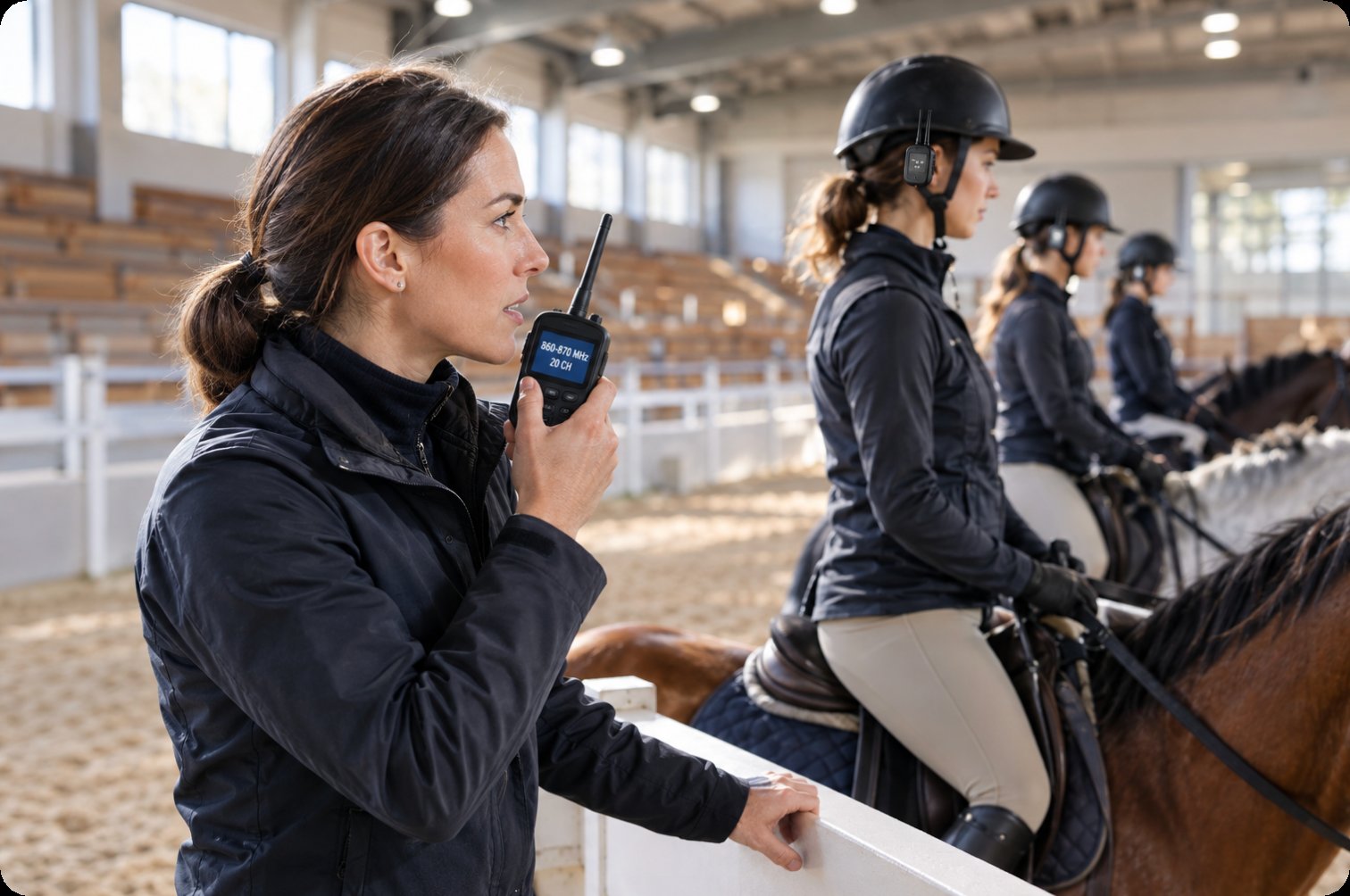
🐴 Where the Receiver Sits Under a Riding Hat
A riding hat covers the ear, and the band around it is already occupied. Anything the rider wears has to coexist with that band, in one of three places: at the ear, against the collarbone, or on a belt. The choice decides which hand reaches the set and what happens when the horse moves faster than a walk.
RC8860 and RC2408 put the receiver at 50g, light enough to sit against the chest unnoticed. RC2500 uses a 104g receiver, matching its own transmitter, and that extra mass makes a neck position feel different: it hangs rather than rests. Over one class period this is unremarkable. Across a teaching day of six or seven, the first thing a rider mentions is usually whether the set stays on the head or has to be lifted back into place.
Two Fingers and One Gloved Thumb
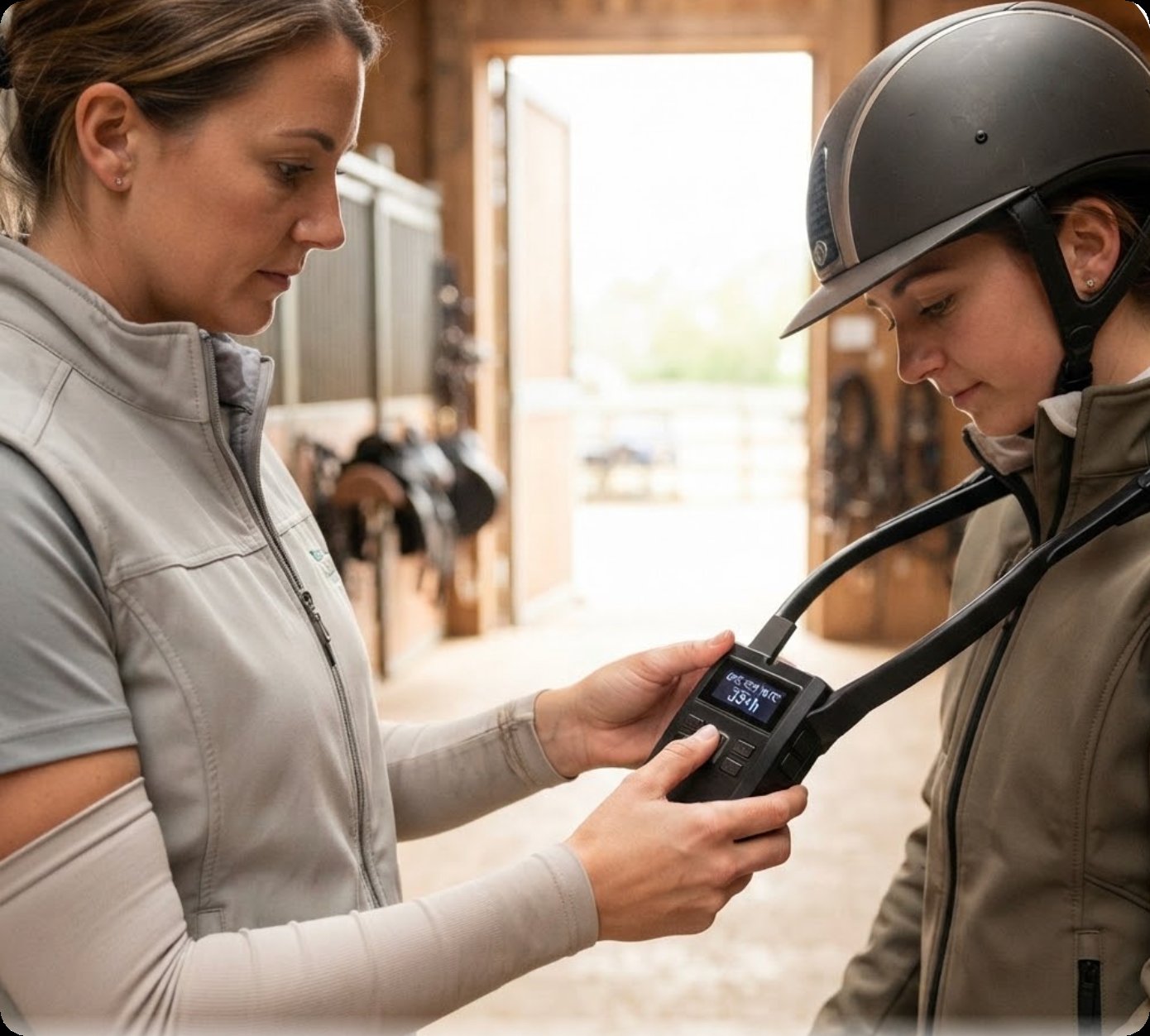
Riding gloves protect a hand from a rein, not let it feel a small control. They are cut thick across the palm and the thumb, and the thumb tip is the least sensitive part of the hand. A control that assumes a bare fingertip is optimistic. What works is a control large enough to be found by the two fingers that are free and worked by the gloved thumb without looking down.
This is where the three diverge. RC2500 carries a single-key combination for sync, power and mute — the only model in the range with it — so a mute is one press rather than a sequence across separate switches. RC8860 and RC2408 keep those functions apart, which is not a defect but more hand movement at the moment the rider would rather be holding the rein. On a RC2500 the whole interaction finishes inside one motion of the thumb.
A Setting You Cannot Change From the Saddle
Volume is set before instruction begins and then has to hold. An indoor school is quiet; once the group moves outside, wind and hooves change the balance and the rider needs a step up or down. The hand that holds the rein cannot do it, which leaves the opposite side of the body, and whatever lives there has to be findable without sight.
Channel planning interacts with this. RC8860 works on a single UHF band in the 860-870 MHz range with twenty channels, plenty for one arena and one instructor but leaving less room for splitting a yard into several simultaneous groups. RC2408 offers eighty channels on 2.4 GHz, so regrouping is a menu decision rather than a hardware limit. An RC8860 UHF transmitter and an eighty-channel receiver are two readings of the same yard.
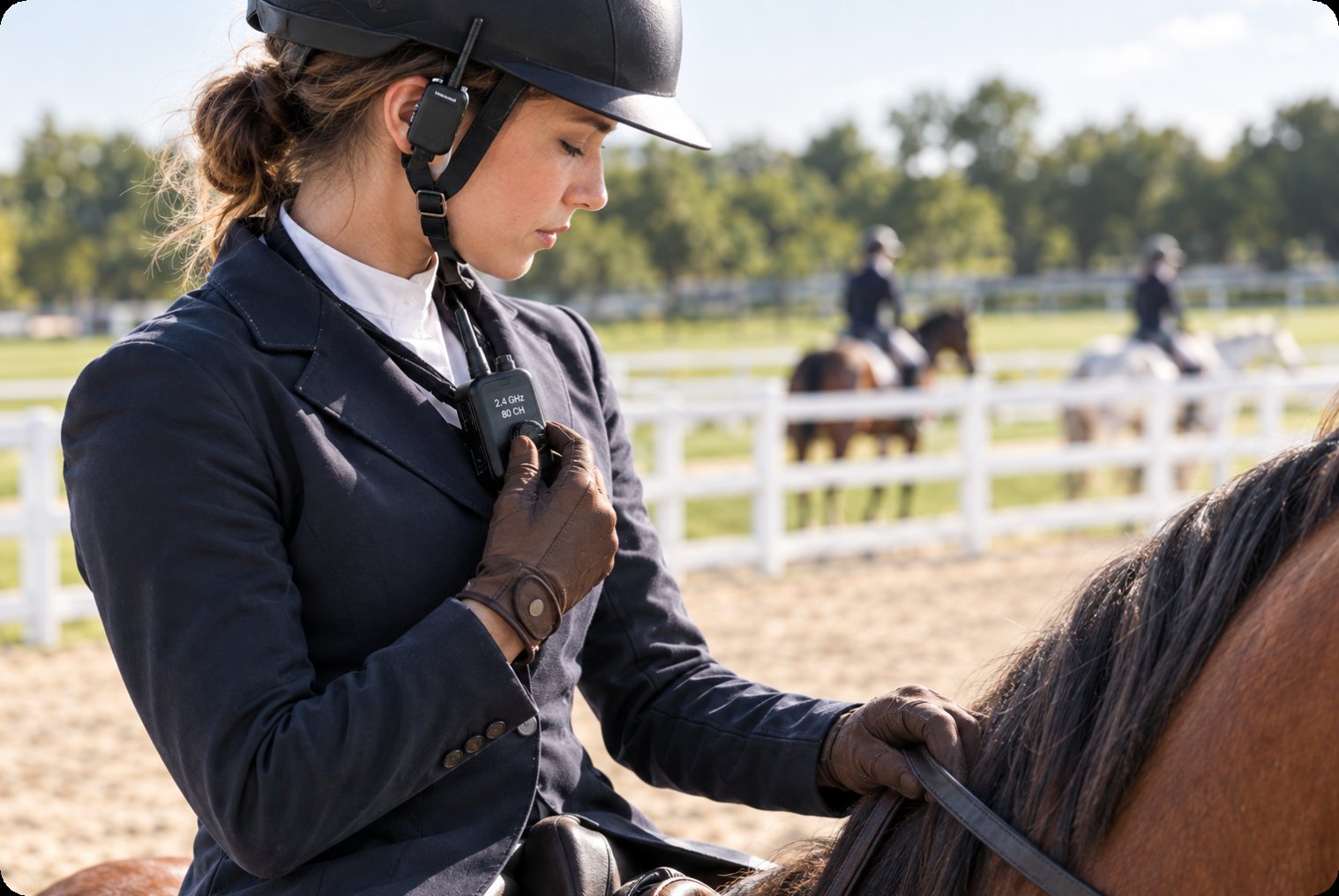
🔮 Passing the Set to the Next Rider
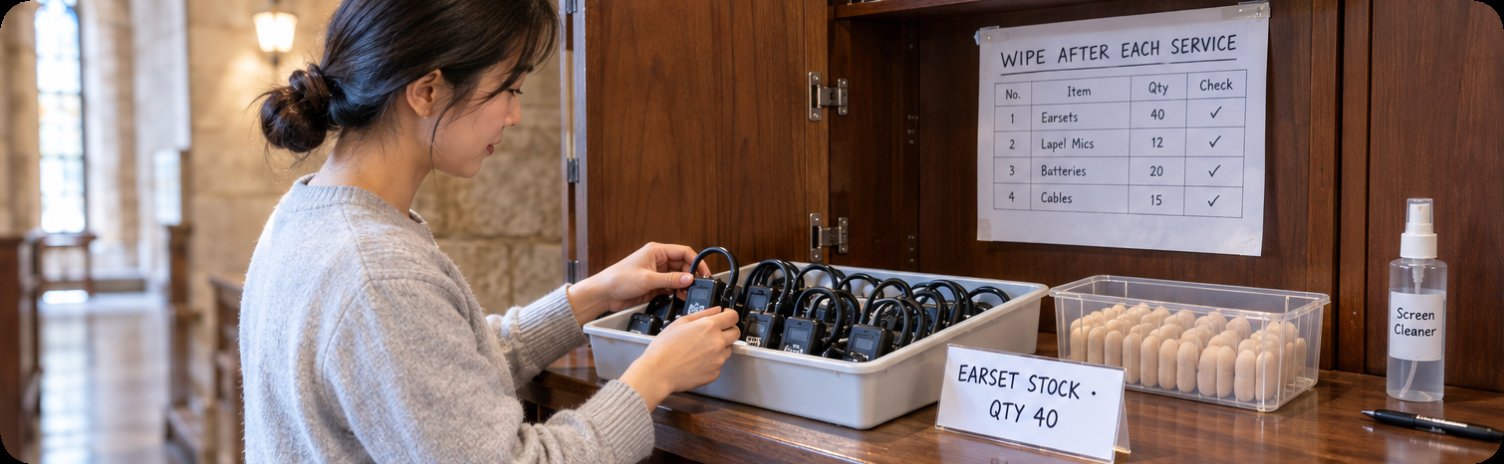
A set does not belong to one person. It goes out, comes back and goes out again several times a day, and each handover is a small piece of work: take it off, switch it off, wipe it, switch it on, hand it over. Every step that can be removed shortens the changeover, and the step that saves most is the one where the receiver never leaves the neck at all.
Muting without taking it off is only possible when the mute is a single deliberate action rather than a menu. Where it is, the set can stay put between two groups and the only task left is the ear piece. Where it is not, the whole set comes off and the changeover doubles.
Settling the Volume in One Motion
A volume reset needs the rider to look, judge and correct, which is three separate acts. What works instead is a volume setting with a fixed position — a detent, a stop, or an edge the thumb can locate through leather — so the movement becomes one push in a known direction.
On a RC2408 wireless tour guide system the adjustment is separate from power, so the hand that finds one has not disturbed the other. On the RC2500 the same movement shares a key with mute, which shortens the search but means the rider must know which function is active. In front of a group, the version matching how the instructor already moves is the one that gets used.
🔋 The Battery Row Against a Full Lesson Block
Battery figures are the ones procurement reads most carefully, and usually as a single number. The published figures for these three differ: RC8860 runs ten hours on the transmitter and twenty on the receiver, RC2408 runs the same ten and twenty, and RC2500 runs fifteen and thirty-five plus. Behind those numbers sit 1500mAh and 1000mAh cells in the first two, and 1800mAh on both sides in the third.
What the sheet does not say is what a day asks of them. A lesson block is measured in periods, not hours, and the receiver rarely gets switched off between two groups. Ten hours of transmitter talk time is comfortable for a full teaching day; twenty hours on the receiver is enough, provided the set is powered down at the end of it. The figure that matters most is the idle one, and the third system publishes thirty-five hours or better of standby, alongside a Type-C port instead of the DC socket the other two use.
| Half a glance | RC8860 | RC2408 | RC2500 |
|---|---|---|---|
| Frequency band | 860-870 MHz (UHF) | 2403-2483 MHz (2.4 GHz) | 2403-2483 MHz (2.4 GHz) |
| Channels | 20 | 80 | 50 |
| Output power | 10mW | 10mW | 10mW |
| Transmitter talk time | 10h | 10h | 15h |
| Receiver run time | 20h | 20h | 35+h |
| Transmitter weight | 59g | 59g | 104g |
| Receiver weight | 50g | 50g | 104g |
| Single-key sync, power and mute | No | No | Yes |
| Charging port | DC Port | DC Port | Type-C |
Putting the Missing Column Back Into the Order
The row does not need to be complicated. Three questions turn it into something a supplier can answer in writing. Can the mute, the power and the sync be reached with one thumb, without looking, through a glove? Where does the receiver sit relative to a riding hat, and what does it weigh there? How long does it last switched on and idle between groups?
A fourth belongs on the same page and is easy to forget in a dry climate: weather. RC8860 carries an IPX4 rating against splashes, which matters in a yard where a set is worn outside and the weather does not check the timetable. Asked this way, the answers fit in a paragraph of a quotation, and the deliverable becomes something comparable between suppliers rather than something discovered in week two.
Everything else on the sheet is still worth reading — band, channels, capacity, talk time — and choosing a wireless tour guide system on those columns alone is not a mistake, only an incomplete one. Buyers wanting the wider picture can explore our solutions before the order is written.