
A leading China factory specializing in Wireless Tour Guide Systems, Church Audio Guides, and Translation Headphones with premium OEM/ODM solutions.

Tel:+86 18922879583

Email:tiger.wang@richitek.com

2.8-Inch Digital Audio Guide, RC085 and RC2468: Priced by the Station or by the Ear

What the Budget Line Is Counted In

A museum seldom buys audio as a single object. It buys a way for one visitor to hear something at one moment, and the invoice that follows can be written in two completely different units. One unit is a place: a plinth, a case, a numbered stop along a fixed route. The other is a person: a pair of ears coming through the door with a ticket. The three devices discussed here sit on opposite sides of that line, and the side a museum chooses sets the shape of the whole season budget before a single price is quoted.

Fix the counting unit first and the specification sheet becomes far easier to read. A budget counted per position behaves nothing like a budget counted per listener, even when both are sold under the same two words, museum guide system. Most museum audio guide programmes mix both approaches eventually, but almost none of them start by naming the unit out loud.

A Player Fixed to the Plinth, Woken by a Number Key

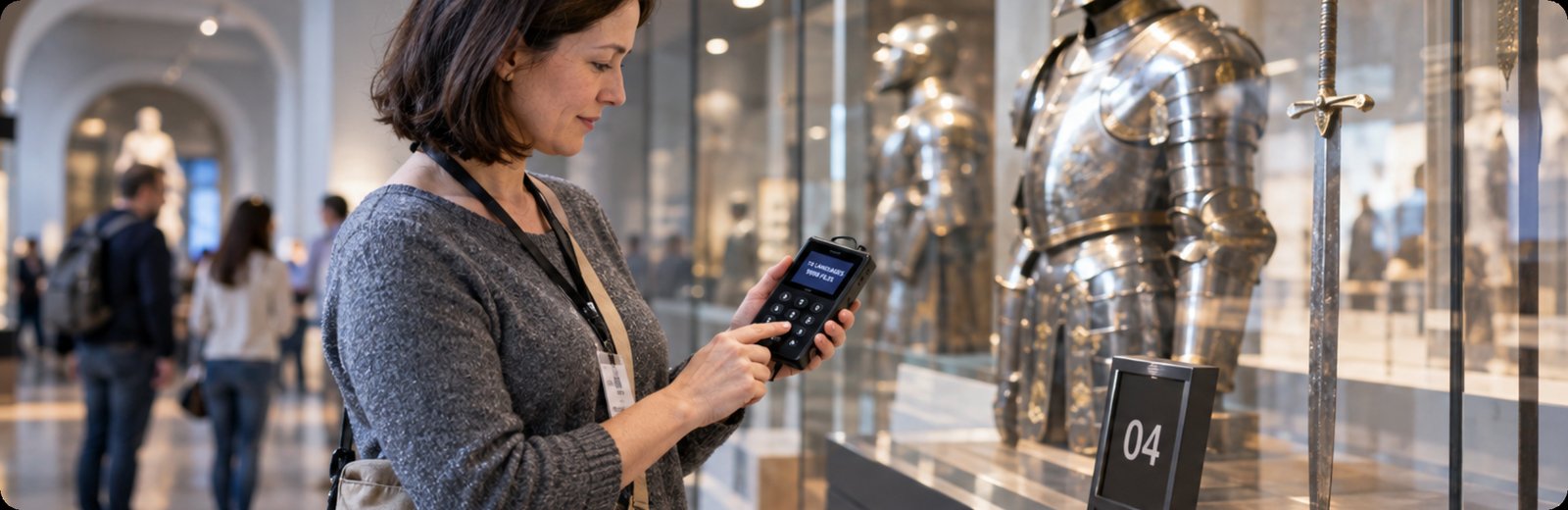
The 2.8-Inch Semi-Auto Digital Audio Guide belongs to the first unit, and the manufacturer describes it in exactly those terms: a point player with buttons. A visitor types a number from 0 to 9 and the unit plays the matching track on the spot, with separate keys for play, pause and volume. There is no radio link anywhere inside the device. Nothing is transmitted, nothing is received, and no member of staff has to speak at all.

What it carries instead is storage. Two gigabytes of built-in memory hold up to 9,999 audio files across 16 languages, and one full charge runs about 18 hours, long enough for an entire opening day on a single top-up through the Micro USB port. Earphones are included in the box, the stated defect rate sits under one percent, and the factory takes OEM/ODM work on the shell, the packaging and the button layout. The 2.8-inch digital audio guide is a fixed asset bolted to a position on the floor plan, and its service life is measured in years of unchanged facts.
2.8-Inch-Audio-Guide-museum_multilingual

📡 A Radio in the Hand, Woken by a Voice

The second unit works the other way round. RC085 and RC2468 are both one-transmitter, many-receiver sets. A guide speaks into a handset and every listener in range hears that voice through a small receiver on a lanyard or an ear-hook. No track has been recorded and none needs to be. Nothing is stored on the visitor side, so nothing has to be filed or re-edited when the facts change, and the count on the order sheet is a count of people rather than a count of places.

That difference decides which department owns the budget. A point-player order is signed by whoever maintains the building and its interpretation panels. A receiver order is signed by whoever runs the front desk and the guiding roster, because a handset only earns its keep while somebody is walking and talking.

16 Languages Stored Against One Voice That Speaks Six

A point player's sixteen-language capacity is a recording commitment, not just a specification. Every language is a separate file, every file is a session in a booth, and every one of them is attached to one position on the route. Correcting a single date on a single panel, in sixteen languages, means sixteen new recordings to re-load and re-check across the fleet.

A live system stores none of that. Its language count is the language count of the person holding the transmitter. One guide who speaks six languages delivers six languages in the same walk, and a sentence that changes is simply said differently at the next group. A recorded asset is paid for once and then reused for years; a spoken commentary is never a capital item and never stops costing staff time.

📡 470-510 MHz and 100 Channels: What a Frequency Plan Costs

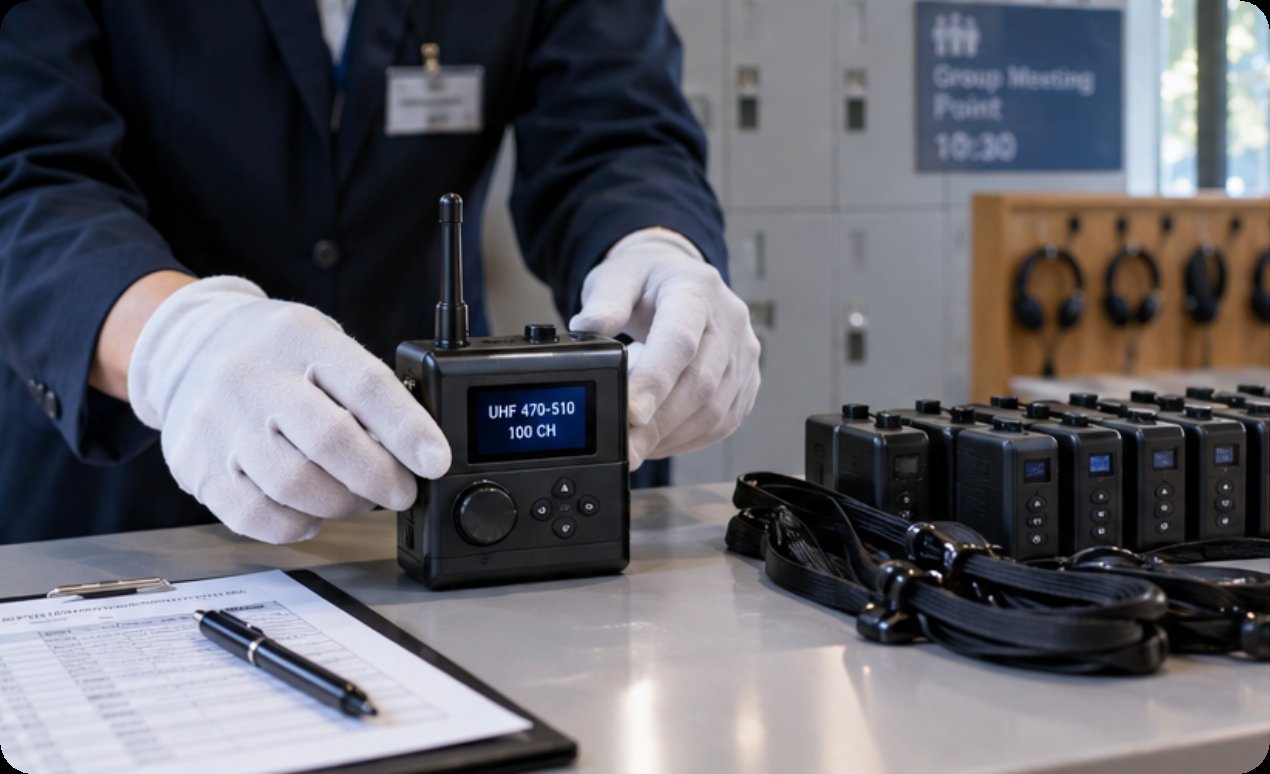
Where the two radios differ from each other is the band they occupy. RC085 runs on UHF at 470-510 MHz with 100 channels, a group-operation design with an LCD screen, one-way F1 and two-way F2 modes, automatic sleep and wake, and CE, RED and RoHS markings. RC2468 runs on the licence-free 2.4 GHz ISM band between 2403 and 2483 MHz with 50 channels under PLL synthesis, usable through walls and obstacles, with CE, EMC, LVD, RED and RoHS certification. The RC085 digital tour guide system and the RC2468 ultra-light 2.4G system are two answers to the same question about where a group may speak.

A licence-free band crosses borders without a filing, which matters to a museum that lends its kit to a sister site abroad. A UHF block buys more separation between simultaneous groups and a longer reaching distance of up to 200 metres, but it raises the question of who is permitted to use those frequencies where the museum sits.
RC085-museum_multilingual

Eighteen Grams Against Sixty: The Weight That Decides the Return Rate

Both receivers go out on a lanyard in the morning and both have to come back at closing, so weight quietly turns into a return rate. RC2468's receiver weighs 18 grams and hangs on the ear as an ear-hook type, while its transmitter is 59 grams. RC085's receiver weighs 60 grams and its transmitter 65 grams. Over a two-hour route the gap is barely noticeable.

Over a school group that arrives at nine and leaves at three, the same gap decides whether a receiver is still being worn at the last case of the afternoon or has quietly been taken off and left on a bench. Every set that fails to come back is a replacement order, a stock count that no longer matches, and a spare carried to cover the shortfall. A lighter receiver is a smaller recurring line in the annual replacement budget.

RC2468-museum_multilingual

🔋 Battery Rows as a Staffing Number

Battery figures look like engineering, but on a museum floor they read as a staffing figure. RC085 offers 12 hours of transmitter talk time from a 3.7 V 1,200 mAh cell and 20 hours of receiver use from a 1,000 mAh cell, charged through a USB port. RC2468 runs roughly 10 hours from a 1,500 mAh transmitter cell and around 8 hours from its 300 mAh receiver cell, charged over Micro USB. Read against a nine-hour opening day and a second shift, those rows answer one question: can a set clear the day without a mid-route swap?

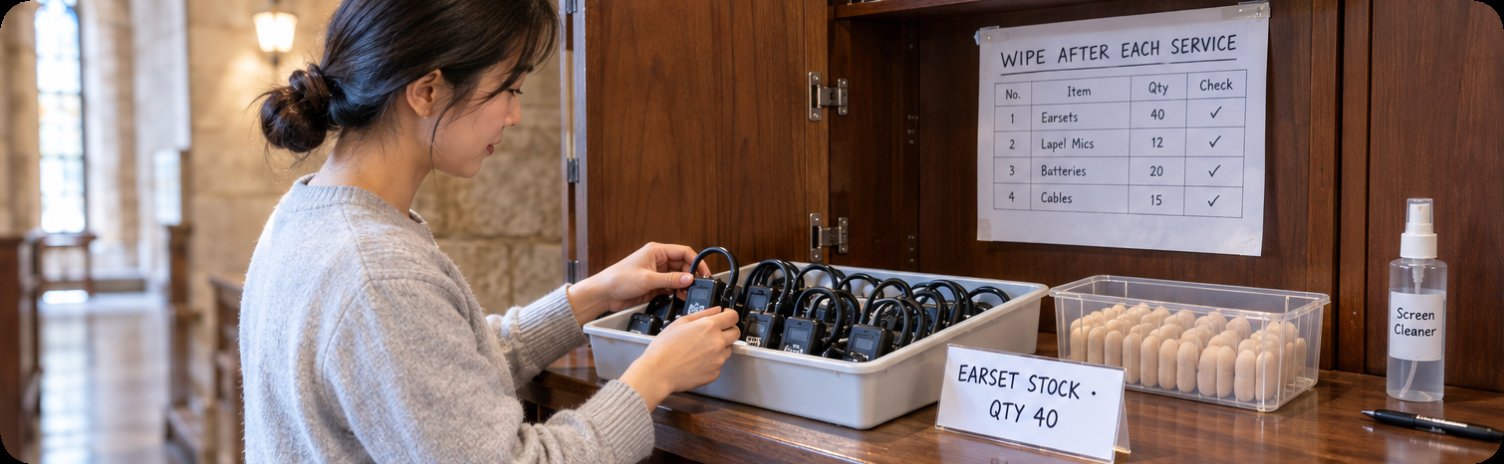
Every set that cannot adds a job to the weekend rota. Somebody has to collect the units, put them on charge, check the indicator and re-issue the ones that are ready while setting aside the rest. On a large site that job has its own name and its own hours; on a small one it is the last twenty minutes of whoever opened the desk, which is the version budgets forget.

Dimension2.8-Inch Point PlayerRC085RC2468
How a visitor starts itTypes 0-9 on the unitA guide speaksA guide speaks
Radio linkNone - self-containedUHF 470-510 MHz2.4 GHz 2403-2483 MHz
ChannelsNot applicable10050
Languages16 stored, 9,999 filesWhatever the guide speaksWhatever the guide speaks
Transmitter battery lifeAbout 18 hours12 hoursRoughly 10 hours
Receiver battery lifeNot applicable20 hoursAround 8 hours
Receiver weightNot applicable60 g18 g ear-hook
Where the spend repeatsEvery re-recordingStaff time per tourStaff time per tour

Writing the Line Item Before the Season Opens

Three counting habits are on the table. Count by position when the commentary is fixed and the same words will still be true in five years. Count by ear when the commentary is a person, the route changes, or the language mix is not known until the coach pulls in. Count by recorded language only after asking how often the script moves, because that side is paid for again every time a fact changes, in every language, at every station.

Whichever row a museum writes, it helps to see the whole range on one page before the meeting that decides it. Start with the wireless tour guide system lineup for the radio side, then look at the recorded side and at the options for every kind of site before the units are fixed.

2026年09月26日 20:32
ꄘ click: 12

2.8-Inch Digital Audio Guide, RC085 and RC2468: Priced by the Station or by the Ear

time: 2026年09月26日 click:12

What the Budget Line Is Counted In

A museum seldom buys audio as a single object. It buys a way for one visitor to hear something at one moment, and the invoice that follows can be written in two completely different units. One unit is a place: a plinth, a case, a numbered stop along a fixed route. The other is a person: a pair of ears coming through the door with a ticket. The three devices discussed here sit on opposite sides of that line, and the side a museum chooses sets the shape of the whole season budget before a single price is quoted.

Fix the counting unit first and the specification sheet becomes far easier to read. A budget counted per position behaves nothing like a budget counted per listener, even when both are sold under the same two words, museum guide system. Most museum audio guide programmes mix both approaches eventually, but almost none of them start by naming the unit out loud.

A Player Fixed to the Plinth, Woken by a Number Key

The 2.8-Inch Semi-Auto Digital Audio Guide belongs to the first unit, and the manufacturer describes it in exactly those terms: a point player with buttons. A visitor types a number from 0 to 9 and the unit plays the matching track on the spot, with separate keys for play, pause and volume. There is no radio link anywhere inside the device. Nothing is transmitted, nothing is received, and no member of staff has to speak at all.

What it carries instead is storage. Two gigabytes of built-in memory hold up to 9,999 audio files across 16 languages, and one full charge runs about 18 hours, long enough for an entire opening day on a single top-up through the Micro USB port. Earphones are included in the box, the stated defect rate sits under one percent, and the factory takes OEM/ODM work on the shell, the packaging and the button layout. The 2.8-inch digital audio guide is a fixed asset bolted to a position on the floor plan, and its service life is measured in years of unchanged facts.

2.8-Inch-Audio-Guide-museum_multilingual

📡 A Radio in the Hand, Woken by a Voice

The second unit works the other way round. RC085 and RC2468 are both one-transmitter, many-receiver sets. A guide speaks into a handset and every listener in range hears that voice through a small receiver on a lanyard or an ear-hook. No track has been recorded and none needs to be. Nothing is stored on the visitor side, so nothing has to be filed or re-edited when the facts change, and the count on the order sheet is a count of people rather than a count of places.

That difference decides which department owns the budget. A point-player order is signed by whoever maintains the building and its interpretation panels. A receiver order is signed by whoever runs the front desk and the guiding roster, because a handset only earns its keep while somebody is walking and talking.

16 Languages Stored Against One Voice That Speaks Six

A point player's sixteen-language capacity is a recording commitment, not just a specification. Every language is a separate file, every file is a session in a booth, and every one of them is attached to one position on the route. Correcting a single date on a single panel, in sixteen languages, means sixteen new recordings to re-load and re-check across the fleet.

A live system stores none of that. Its language count is the language count of the person holding the transmitter. One guide who speaks six languages delivers six languages in the same walk, and a sentence that changes is simply said differently at the next group. A recorded asset is paid for once and then reused for years; a spoken commentary is never a capital item and never stops costing staff time.

📡 470-510 MHz and 100 Channels: What a Frequency Plan Costs

Where the two radios differ from each other is the band they occupy. RC085 runs on UHF at 470-510 MHz with 100 channels, a group-operation design with an LCD screen, one-way F1 and two-way F2 modes, automatic sleep and wake, and CE, RED and RoHS markings. RC2468 runs on the licence-free 2.4 GHz ISM band between 2403 and 2483 MHz with 50 channels under PLL synthesis, usable through walls and obstacles, with CE, EMC, LVD, RED and RoHS certification. The RC085 digital tour guide system and the RC2468 ultra-light 2.4G system are two answers to the same question about where a group may speak.

A licence-free band crosses borders without a filing, which matters to a museum that lends its kit to a sister site abroad. A UHF block buys more separation between simultaneous groups and a longer reaching distance of up to 200 metres, but it raises the question of who is permitted to use those frequencies where the museum sits.

RC085-museum_multilingual

Eighteen Grams Against Sixty: The Weight That Decides the Return Rate

Both receivers go out on a lanyard in the morning and both have to come back at closing, so weight quietly turns into a return rate. RC2468's receiver weighs 18 grams and hangs on the ear as an ear-hook type, while its transmitter is 59 grams. RC085's receiver weighs 60 grams and its transmitter 65 grams. Over a two-hour route the gap is barely noticeable.

Over a school group that arrives at nine and leaves at three, the same gap decides whether a receiver is still being worn at the last case of the afternoon or has quietly been taken off and left on a bench. Every set that fails to come back is a replacement order, a stock count that no longer matches, and a spare carried to cover the shortfall. A lighter receiver is a smaller recurring line in the annual replacement budget.

RC2468-museum_multilingual

🔋 Battery Rows as a Staffing Number

Battery figures look like engineering, but on a museum floor they read as a staffing figure. RC085 offers 12 hours of transmitter talk time from a 3.7 V 1,200 mAh cell and 20 hours of receiver use from a 1,000 mAh cell, charged through a USB port. RC2468 runs roughly 10 hours from a 1,500 mAh transmitter cell and around 8 hours from its 300 mAh receiver cell, charged over Micro USB. Read against a nine-hour opening day and a second shift, those rows answer one question: can a set clear the day without a mid-route swap?

Every set that cannot adds a job to the weekend rota. Somebody has to collect the units, put them on charge, check the indicator and re-issue the ones that are ready while setting aside the rest. On a large site that job has its own name and its own hours; on a small one it is the last twenty minutes of whoever opened the desk, which is the version budgets forget.

Dimension2.8-Inch Point PlayerRC085RC2468
How a visitor starts itTypes 0-9 on the unitA guide speaksA guide speaks
Radio linkNone - self-containedUHF 470-510 MHz2.4 GHz 2403-2483 MHz
ChannelsNot applicable10050
Languages16 stored, 9,999 filesWhatever the guide speaksWhatever the guide speaks
Transmitter battery lifeAbout 18 hours12 hoursRoughly 10 hours
Receiver battery lifeNot applicable20 hoursAround 8 hours
Receiver weightNot applicable60 g18 g ear-hook
Where the spend repeatsEvery re-recordingStaff time per tourStaff time per tour

Writing the Line Item Before the Season Opens

Three counting habits are on the table. Count by position when the commentary is fixed and the same words will still be true in five years. Count by ear when the commentary is a person, the route changes, or the language mix is not known until the coach pulls in. Count by recorded language only after asking how often the script moves, because that side is paid for again every time a fact changes, in every language, at every station.

Whichever row a museum writes, it helps to see the whole range on one page before the meeting that decides it. Start with the wireless tour guide system lineup for the radio side, then look at the recorded side and at the options for every kind of site before the units are fixed.

×

Contact us

email:
name:
subject:
content: