
A leading China factory specializing in Wireless Tour Guide Systems, Church Audio Guides, and Translation Headphones with premium OEM/ODM solutions.

Tel:+86 18922879583

Email:tiger.wang@richitek.com

RC2402, RC2501 and RC2500: The Accessible Route Decides Where the Hardware Goes

I have been on the first morning of an accessible tour where every line on the installation sheet was already ticked: coverage tested corridor by corridor, batteries charged overnight, every receiver checked against its own transmitter. Then a visitor in a wheelchair reached the side hall entrance and stopped, not because the opening was narrow, but because getting through it meant turning the chair slightly, and a charging case had been parked in the only place that turn could happen. The tour went ahead. It went ahead with the commentary no longer reaching the back of it.

Nothing there would be called a mistake. The case was left where the floor plan had room for it, on a route nobody had measured for anything except signal. A walking group can be sent a different way on the morning; an accessible group very often cannot. The three units here — the RC2402, the RC2501 and the RC2500 — are all systems built for museum and gallery tours, and what separates them on a route like this is not their range.

💡 Why the Route Line Is Drawn Before the Device List

On a standard tour the order is comfortable. The guide's path is chosen from several that work, devices are placed to suit it, and coverage is tested at the end. Any point that turns out awkward can be walked around.

An accessible route does not offer that freedom. Retrofits almost always produce one compliant line from entrance to exit. The line cannot be moved to suit a transmitter, because moving it means rebuilding the building. So the drawing that governs everything is the route line, and every device position is subtracted from what it leaves behind. Devices go where the margin is largest, not where the signal is most convenient.

How Much Room Is Left Once the Chair Has Passed

The measurement that matters is not the width of the doorway. Nearly every accessible entrance passes that test, and it says nothing about the twenty minutes after it. What matters is the narrowest point on the line, measured with the chair in it, and then the second narrowest — a route fails where its worst segment is, and the rest only describe how often.

An afternoon with a tape and a chair produces this. Walk the line, stop wherever the remaining gap is visibly smaller than the segment before it, and write the figure down. A route through a museum wing usually gives three or four of these points, and two of them tend to sit where a restored room meets a modern extension, at thresholds reconciled decades before anyone installed hardware.

The rule that follows is narrow and absolute: no device position may fall on any of those points, and none may create a new one.
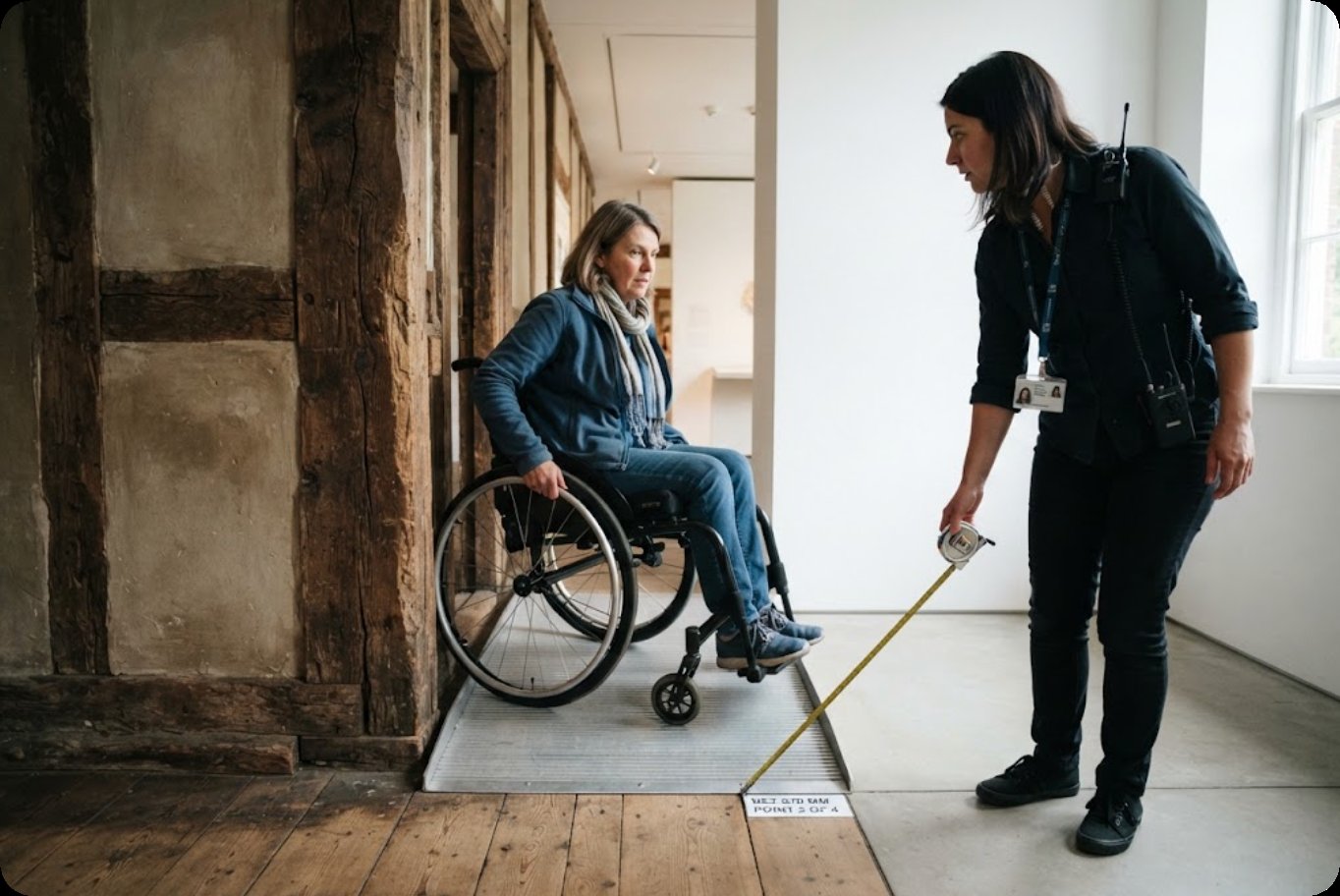
RC2402-accessible_tour

🎯 The Guide Standing in the Middle Is a Fixed Object

Every survey I have watched treats the furniture as fixed and the people as fluid. On an accessible tour the people are the harder constraint. A guide who stops to explain something tends to stop in the middle of the opening they just walked through, which is where the group behind them is about to pass.

That is not solved by a reminder, because the instinct to face the group is what makes a guide worth listening to. It is a drawing problem. The route sheet should carry a standing point at each stop, marked off the narrowest segments, so that turning to face the group does not close the route behind it.

Where Receivers Cannot Be Left for Collection

Handing receivers out from a table near the entrance is the default on almost every tour, and it is one of the first things to go here. A table is furniture, it arrives with a queue of people standing at it, and both occupy segments the route cannot spare.

Two alternatives work, and both change collection rather than hardware. Issue from seating: if the meeting point has space beside the accessible seats, units can be handed to people already positioned, out of the line of travel. Or carry the units in and issue them at the stop, which keeps the entrance clear and spreads the handover across the tour. The second only works if the units are light enough for one person to carry a set without a trolley, which puts the question back onto the hardware.

Which Unit Stays in the Room and Which One Walks In

Weight decides deployment more than any other figure, because it decides whether a device can be carried to where it is needed or has to live where it can be plugged in. The RC2501 is the lightest of the three at 47 g on both the transmitter and the receiver, light enough that a guide can carry a set in a coat pocket and issue it at the first stop.

The RC2402 sits in the middle at 59 g and 50 g, which still travels but shows up once one person is carrying a dozen of them up a staircase. The RC2500 is a different class of object at 104 g on each side, and it belongs where a group already gathers: a desk, a reception point, a fixed interpretive position.
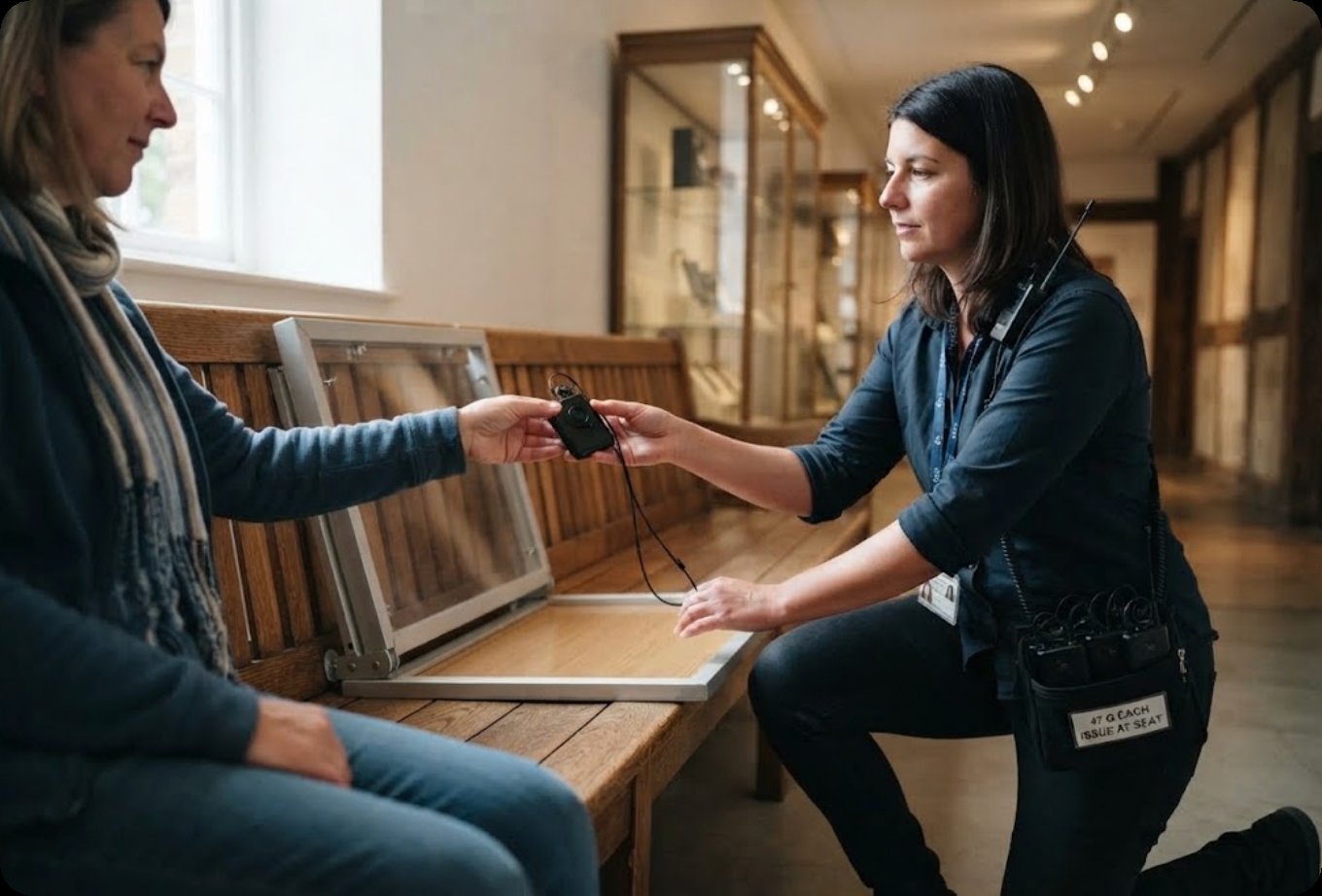
RC2501-accessible_tour

Charging Cradles Are Furniture, Not Accessories

A charger is treated as an accessory in most plans, which is why it ends up on a corridor floor. In use it is a fixed object with a cable, occupying space exactly like a bench. On an accessible route the charging position belongs on the installation drawing, decided in advance and marked.

The charging port decides how much freedom that position has. The RC2402 uses a DC port, so the unit returns to its own cradle and its working life is anchored to that spot. The RC2500 and the RC2501 both charge over Type-C, so a unit can be topped up from a power bank wherever the group happens to be, and the cradle stops being the only place it can recover.

That distinction matters more on a route with a single compliant line than anywhere else, because it decides which pieces of equipment need permanent floor space and which can simply travel.
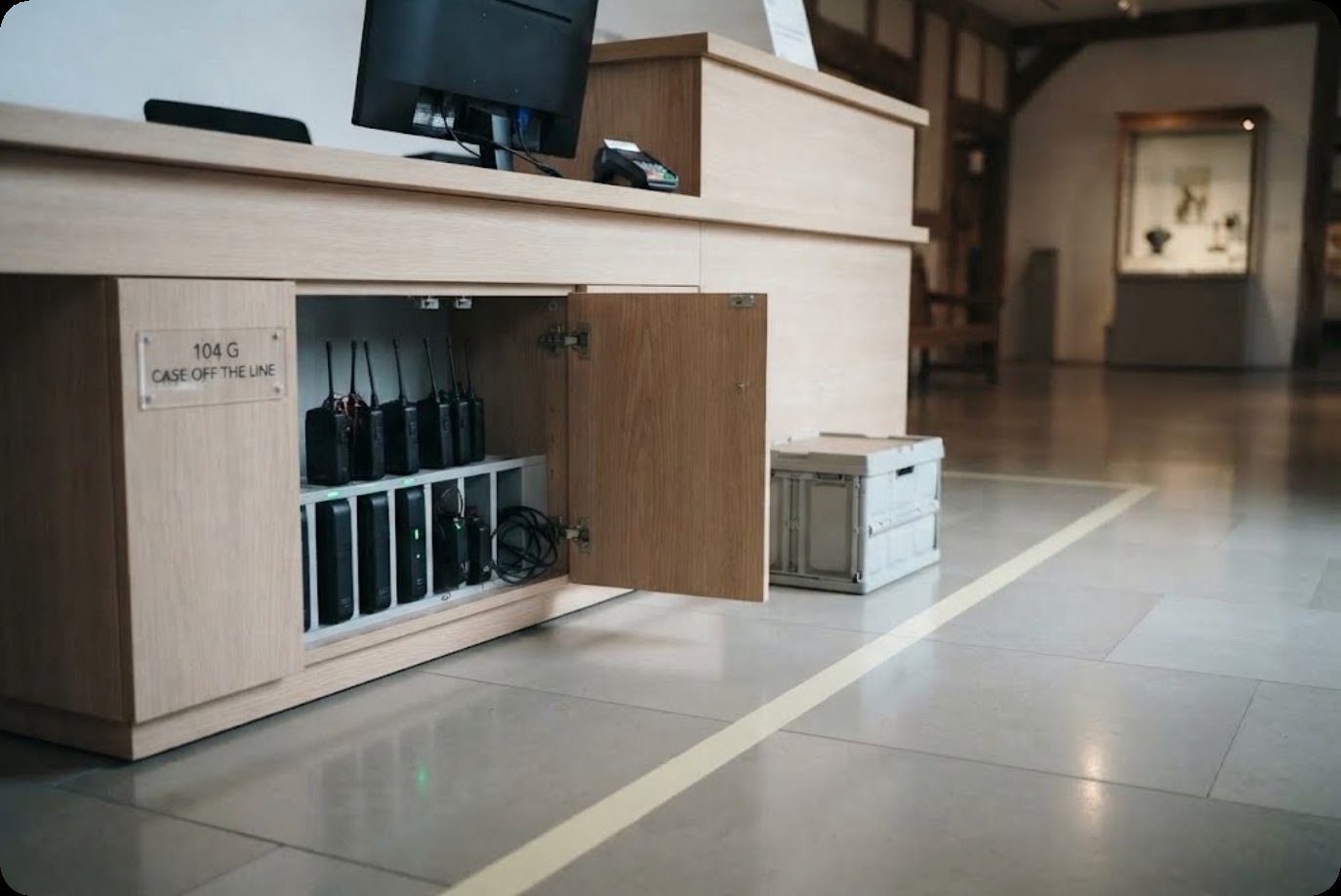
RC2500-accessible_tour

💾 Storage After the Last Group Is Part of the Plan

The drawing is usually considered finished when the last group has been walked through, and the last decision of the day is where everything goes overnight. On an accessible route that is not housekeeping. A case left on the line is an obstruction from the moment it is set down, and the first task of the following morning becomes moving it before anyone can be brought through.

The fix is a marked overnight position that sits off the route entirely, within reach of the charging point so that the same trip does both jobs. Where the room has no such corner, a locked cabinet in an adjacent space is a better answer than a floor position that is simply out of the way most of the time.

Push a Chair Through It Before Anyone Listens

The acceptance test for a general tour is a listening test. Someone walks the route with a receiver on, checks that the voice arrives at each point, and signs the sheet. On an accessible route that proves less than half of what it needs to, because a receiver on a walking person works in places a chair cannot go.

Push a chair the length of the line instead, with no audio running, and note every point where it has to slow, turn or wait. Those are the unfinished parts of the installation, and they are consistent enough to be predicted: the turn into a side room, the transition between floor levels, and the waiting position at any stop where the group gathers.

The rest follows the same line. A route that cannot host a table needs units light enough to be carried in; a route whose units return to a cradle needs that cradle on the drawing; a route with one compliant path needs every position checked against its narrowest point. The wireless tour guide system range is specified this way for venues of every kind, and the solutions filed by venue show the same three decisions repeating in a factory, a gallery or a cathedral.

ModelChannelsTransmitter working timeReceiver working timeTransmitter weightReceiver weightCharging port
RC24025010 hours20 hours59 g50 gDC port
RC25015015 hours35+ hours47 g47 gType-C
RC25005015 hours35+ hours104 g104 gType-C
2026年09月27日 10:42
ꄘ click: 21

RC2402, RC2501 and RC2500: The Accessible Route Decides Where the Hardware Goes

time: 2026年09月27日 click:21

I have been on the first morning of an accessible tour where every line on the installation sheet was already ticked: coverage tested corridor by corridor, batteries charged overnight, every receiver checked against its own transmitter. Then a visitor in a wheelchair reached the side hall entrance and stopped, not because the opening was narrow, but because getting through it meant turning the chair slightly, and a charging case had been parked in the only place that turn could happen. The tour went ahead. It went ahead with the commentary no longer reaching the back of it.

Nothing there would be called a mistake. The case was left where the floor plan had room for it, on a route nobody had measured for anything except signal. A walking group can be sent a different way on the morning; an accessible group very often cannot. The three units here — the RC2402, the RC2501 and the RC2500 — are all systems built for museum and gallery tours, and what separates them on a route like this is not their range.

💡 Why the Route Line Is Drawn Before the Device List

On a standard tour the order is comfortable. The guide's path is chosen from several that work, devices are placed to suit it, and coverage is tested at the end. Any point that turns out awkward can be walked around.

An accessible route does not offer that freedom. Retrofits almost always produce one compliant line from entrance to exit. The line cannot be moved to suit a transmitter, because moving it means rebuilding the building. So the drawing that governs everything is the route line, and every device position is subtracted from what it leaves behind. Devices go where the margin is largest, not where the signal is most convenient.

How Much Room Is Left Once the Chair Has Passed

The measurement that matters is not the width of the doorway. Nearly every accessible entrance passes that test, and it says nothing about the twenty minutes after it. What matters is the narrowest point on the line, measured with the chair in it, and then the second narrowest — a route fails where its worst segment is, and the rest only describe how often.

An afternoon with a tape and a chair produces this. Walk the line, stop wherever the remaining gap is visibly smaller than the segment before it, and write the figure down. A route through a museum wing usually gives three or four of these points, and two of them tend to sit where a restored room meets a modern extension, at thresholds reconciled decades before anyone installed hardware.

The rule that follows is narrow and absolute: no device position may fall on any of those points, and none may create a new one.

RC2402-accessible_tour

🎯 The Guide Standing in the Middle Is a Fixed Object

Every survey I have watched treats the furniture as fixed and the people as fluid. On an accessible tour the people are the harder constraint. A guide who stops to explain something tends to stop in the middle of the opening they just walked through, which is where the group behind them is about to pass.

That is not solved by a reminder, because the instinct to face the group is what makes a guide worth listening to. It is a drawing problem. The route sheet should carry a standing point at each stop, marked off the narrowest segments, so that turning to face the group does not close the route behind it.

Where Receivers Cannot Be Left for Collection

Handing receivers out from a table near the entrance is the default on almost every tour, and it is one of the first things to go here. A table is furniture, it arrives with a queue of people standing at it, and both occupy segments the route cannot spare.

Two alternatives work, and both change collection rather than hardware. Issue from seating: if the meeting point has space beside the accessible seats, units can be handed to people already positioned, out of the line of travel. Or carry the units in and issue them at the stop, which keeps the entrance clear and spreads the handover across the tour. The second only works if the units are light enough for one person to carry a set without a trolley, which puts the question back onto the hardware.

Which Unit Stays in the Room and Which One Walks In

Weight decides deployment more than any other figure, because it decides whether a device can be carried to where it is needed or has to live where it can be plugged in. The RC2501 is the lightest of the three at 47 g on both the transmitter and the receiver, light enough that a guide can carry a set in a coat pocket and issue it at the first stop.

The RC2402 sits in the middle at 59 g and 50 g, which still travels but shows up once one person is carrying a dozen of them up a staircase. The RC2500 is a different class of object at 104 g on each side, and it belongs where a group already gathers: a desk, a reception point, a fixed interpretive position.

RC2501-accessible_tour

Charging Cradles Are Furniture, Not Accessories

A charger is treated as an accessory in most plans, which is why it ends up on a corridor floor. In use it is a fixed object with a cable, occupying space exactly like a bench. On an accessible route the charging position belongs on the installation drawing, decided in advance and marked.

The charging port decides how much freedom that position has. The RC2402 uses a DC port, so the unit returns to its own cradle and its working life is anchored to that spot. The RC2500 and the RC2501 both charge over Type-C, so a unit can be topped up from a power bank wherever the group happens to be, and the cradle stops being the only place it can recover.

That distinction matters more on a route with a single compliant line than anywhere else, because it decides which pieces of equipment need permanent floor space and which can simply travel.

RC2500-accessible_tour

💾 Storage After the Last Group Is Part of the Plan

The drawing is usually considered finished when the last group has been walked through, and the last decision of the day is where everything goes overnight. On an accessible route that is not housekeeping. A case left on the line is an obstruction from the moment it is set down, and the first task of the following morning becomes moving it before anyone can be brought through.

The fix is a marked overnight position that sits off the route entirely, within reach of the charging point so that the same trip does both jobs. Where the room has no such corner, a locked cabinet in an adjacent space is a better answer than a floor position that is simply out of the way most of the time.

Push a Chair Through It Before Anyone Listens

The acceptance test for a general tour is a listening test. Someone walks the route with a receiver on, checks that the voice arrives at each point, and signs the sheet. On an accessible route that proves less than half of what it needs to, because a receiver on a walking person works in places a chair cannot go.

Push a chair the length of the line instead, with no audio running, and note every point where it has to slow, turn or wait. Those are the unfinished parts of the installation, and they are consistent enough to be predicted: the turn into a side room, the transition between floor levels, and the waiting position at any stop where the group gathers.

The rest follows the same line. A route that cannot host a table needs units light enough to be carried in; a route whose units return to a cradle needs that cradle on the drawing; a route with one compliant path needs every position checked against its narrowest point. The wireless tour guide system range is specified this way for venues of every kind, and the solutions filed by venue show the same three decisions repeating in a factory, a gallery or a cathedral.

ModelChannelsTransmitter working timeReceiver working timeTransmitter weightReceiver weightCharging port
RC24025010 hours20 hours59 g50 gDC port
RC25015015 hours35+ hours47 g47 gType-C
RC25005015 hours35+ hours104 g104 gType-C
×

Contact us

email:
name:
subject:
content: