
A leading China factory specializing in Wireless Tour Guide Systems, Church Audio Guides, and Translation Headphones with premium OEM/ODM solutions.

Tel:+86 18922879583

Email:tiger.wang@richitek.com

RC2402, RC085 and RC2408: A Compliance Checklist for Museum Multilingual Tours

RC2402, RC085 and RC2408: A Compliance Checklist for Museum Multilingual Tours

When a museum commits to multilingual guided tours, the equipment decision quietly becomes a compliance decision. A wireless tour guide system is a radio transmitter operating inside a protected heritage building, and the questions a curator should ask are not only about sound quality but about legality, interference and documentation: is the frequency legal in this country, can the signal leak into a neighboring gallery, how loud can the earpiece get, and which certificates exist if an inspector asks. The RC2402, the RC085 and the RC2408 answer these questions in three different ways, and walking through them as a four-part checklist — spectrum, separation, sound and paperwork — turns a product comparison into an audit a museum can actually file. This article works through each check in turn, because a tour that fails any one of them can be shut down regardless of how good it sounds.
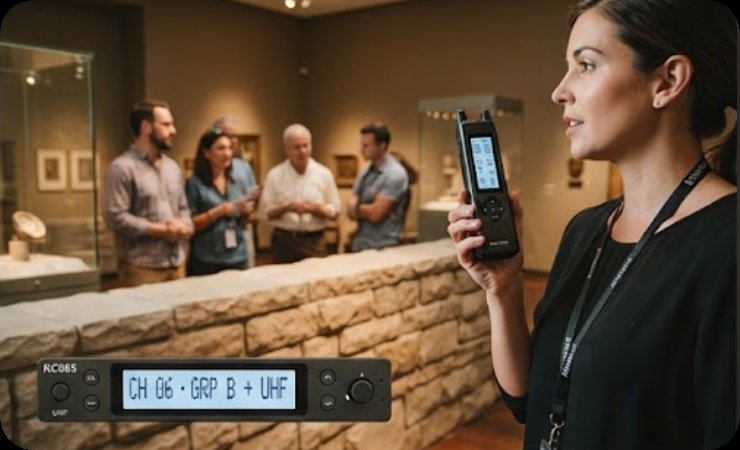
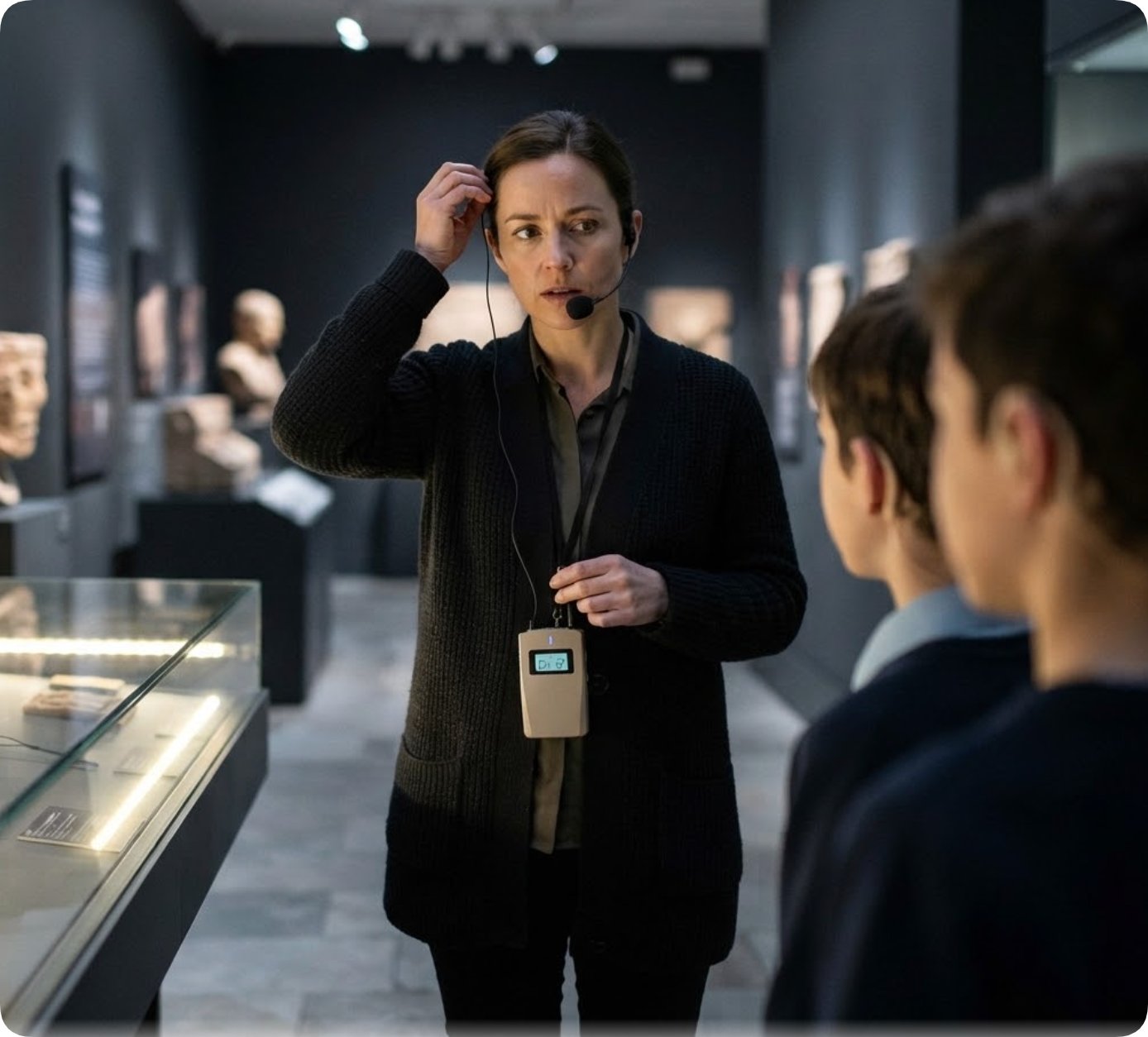
RC2402 receivers handed out at a museum reception desk with GRP A2 synced

🗺️ Four Checks Before the First Tour

The checklist has four parts, and each one maps to a physical property of the system rather than a marketing claim. First, spectrum: the radio frequencies the system uses must be legal for commercial audio transmission in the country where the museum operates. Second, separation: the channels must keep simultaneous language groups from bleeding into each other, which is both an experience failure and, in some venues, a breach of the house rules on noise. Third, sound: the earpiece output must be controllable enough to protect both the listener's hearing and the acoustic environment around the artwork. Fourth, paperwork: the certifications and test reports behind the device must exist in a form a museum can hand to a safety officer. The three systems under review clear all four checks, but they clear them differently, and those differences are what make one unit better suited to a particular gallery than another. What the checklist also does is separate the decisions that can be made once, on paper, from the ones that must be verified in the building: spectrum and certification are desk work that a procurement officer settles before the purchase order, while separation and sound are floor work that a visitor services team tunes during the first supervised week. Mixing the two — buying on audio demos alone, or discovering a licensing question after delivery — is how equipment ends up shelved in a museum storeroom.

The Spectrum Question: License-Free or Registered

The first check splits the three systems down the middle. The RC2402 and the RC2408 both operate on the 2403–2483MHz 2.4GHz ISM band, which is license-free worldwide — a museum can deploy them in any country without registering frequencies or applying for a commercial radio license. The RC085 instead uses the 470–510MHz UHF platform, a band whose licensing rules vary by region; UHF systems deliver excellent range and penetration, but a multinational museum group or a traveling exhibition may need to verify local frequency regulations before switching the transmitters on. For a permanent single-country installation the UHF path is perfectly workable, and the RC085's stronger anti-interference performance in metal-heavy environments — display cases, elevator shafts, reinforced walls — can outweigh the extra regulatory step. But where the compliance priority is "switch on and be legal everywhere," the two 2.4GHz units hold a structural advantage that no amount of audio quality can replace. There is a practical wrinkle worth naming: 2.4GHz is the busiest of the license-free bands, shared with Wi-Fi access points, and a museum with heavy guest Wi-Fi should still walk its galleries with a transmitter during opening hours before finalizing channel assignments. License-free does not mean interference-free; it means the regulatory question disappears and the engineering question moves indoors, where the RC085's UHF band, sitting far below the Wi-Fi traffic, simply does not have the same neighbors.
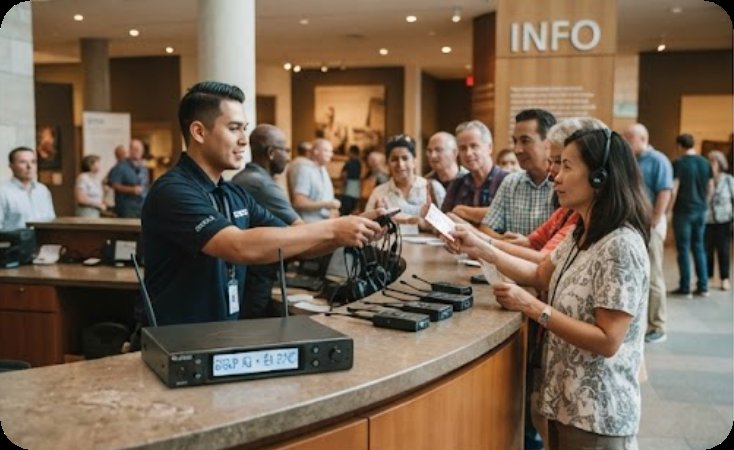
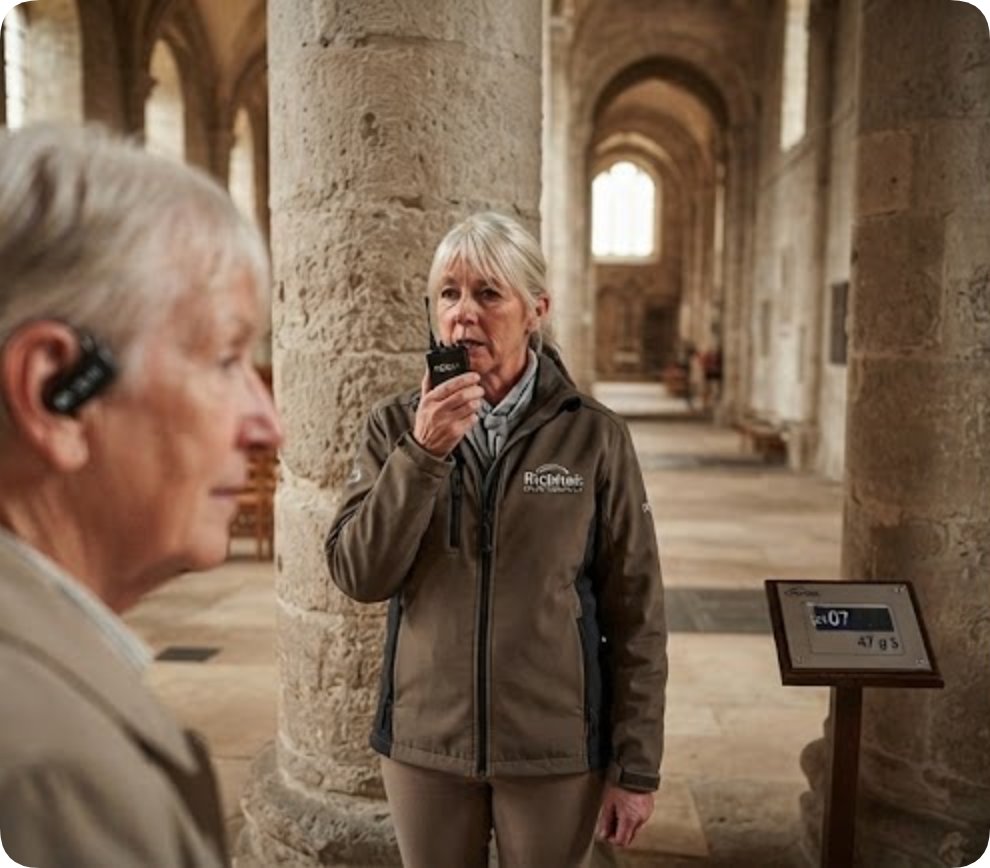
RC085 transmitter with LCD screen showing CH 06 GRP B on the UHF band

🎨 Channel Separation and the Quiet Gallery

The second check concerns what happens when three tours run at once in one building. The RC2408 provides 80 channels, enough to run many simultaneous groups with wide margins between assignments, and its one-key synchronization lets staff re-align an entire fleet between morning and afternoon sessions without a technician. The RC2402 pairs its 2.4GHz band with intelligent encryption that prevents crosstalk between groups — the relevant property when two tours pause on opposite sides of a thin partition wall and neither audience should hear the other language. The RC085 operates multiple channel groups simultaneously and adds a structural trick the others lack: a physical LCD smart screen on the transmitter that shows the active channel and battery state, which turns channel discipline from a remembered procedure into a visible one. For compliance purposes, separation failures are usually reported as "we heard another group," and any of the three systems, properly assigned, keeps that sentence out of the visitor book.

Sound Levels and Listening Safety

The third check is the one museums most often skip until someone complains. Multilingual earpieces sit directly in the ear canal for ninety minutes at a time, and a compliance-minded house sets a maximum output level rather than trusting each guide's instinct. All three systems give the receiver volume controls to the visitor rather than the guide, which is the correct default: a visitor compensating for their own hearing adjusts downward or upward without announcing it. The lightweight design of the RC2402's earpieces, and the light receiver weights across the 2.4GHz units — the RC2408 receiver is 50 grams — reduce the fatigue that causes visitors to crank volume in the first place. The RC085's two-way communication mode adds a supervisory dimension: a guide can hear questions from anywhere in the group, which lowers the shouted repetitions that otherwise push ambient noise up in a small gallery. No manufacturer publishes a hearing-safety curve for these devices, so the museum's own policy — a ceiling volume, a note in the training manual — completes this check. The policy costs nothing to write and settles disputes quickly: when a visitor reports an earpiece as too loud, the question becomes whether the device was within its calibrated range, not whether the exhibition was negligent, because the limit and the person who set it are both on record.
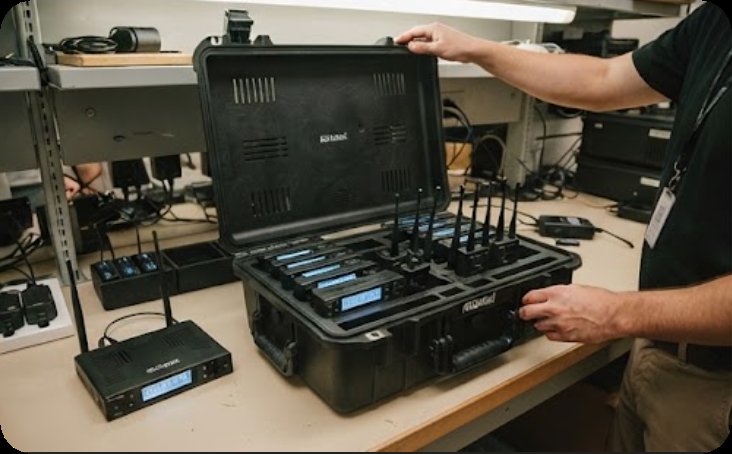
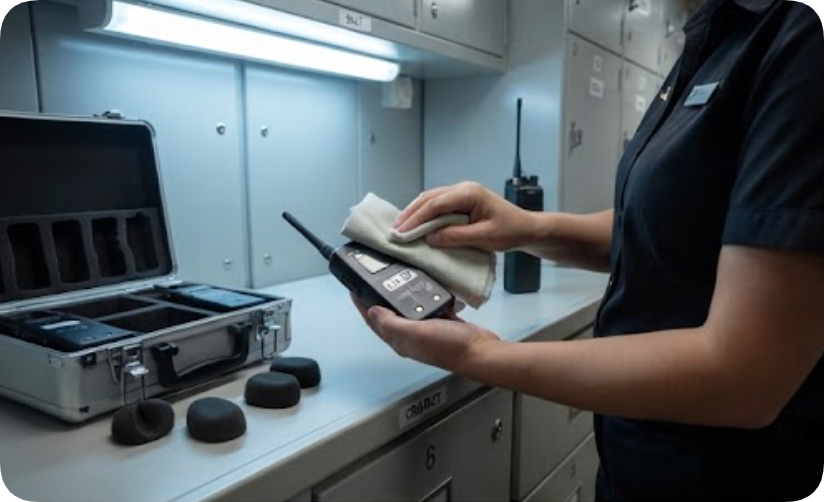
RC2408 receiver fleet in a charging case prepared for the next museum group

✅ Paperwork: Certifications on File

The fourth check is administrative, and it is where equipment choices become auditable. The RC2402 carries CE, EMC, LVD, RED and RoHS certification — the RED radio equipment directive being the specific one an inspector will look for on a transmitting device in Europe. The RC2408 lists CE and RoHS, and the RC085 carries CE with its UHF platform's regional conformity. All three are export-oriented products documented for commercial use, which is what distinguishes them from consumer wireless headphones that have no place in an institutional radio deployment. A museum should also read the warranty terms as part of the compliance file: all three carry a 3-year warranty covering the mainboard, with vulnerable parts — headset, microphone, battery — excluded. That exclusion is standard in the industry, but knowing it in advance shapes the spare-parts budget and prevents a dispute at the point of service. A compliance file should therefore hold three folders, not one: the radio certificates for the transmitting side, the environmental declarations for hardware disposal at end of life, and the warranty terms annotated with which parts the museum stocks itself. Inspectors rarely ask beyond the first folder, but insurers and auditors occasionally ask for the third.

Which System Clears Which Check First

Collapsing the four checks back onto the three products produces a clean allocation. A museum running international exhibitions, or one that simply cannot afford a licensing review, takes the RC2402 for its license-free band plus encryption — the lowest-friction compliance profile of the three. A large museum with many simultaneous language groups and metal-dense architecture takes the RC085, accepting the UHF regional step in exchange for penetration and the visible channel management of its LCD screen. A museum whose compliance priority is capacity and turnaround — dozens of receivers, daily fleet re-synchronization, 80 channels of headroom — takes the RC2408. The three are not ranked alternatives; they are three different answers to the same four questions, and the checklist tells the buyer which question their building actually asks loudest.

The Checklist in One Table

The summary table collects the published figures for the three units, using the current product pages and the verified comparison sheet:

CheckRC2402RC085RC2408
Spectrum2.4GHz ISM, license-free worldwideUHF 470–510MHz, region-dependent2.4GHz ISM, license-free worldwide
Channels / separationMulti-channel + anti-crosstalk encryptionMulti-group, LCD smart screen80 channels, one-key sync
RangeUp to 200mUp to 200mUp to 200m
BatteryTX 10h / RX 20hAuto sleep / wake-upTX 10h / RX 20h
Two-way talk—F1 one-way / F2 two-waySupported
CertificationCE, EMC, LVD, RED, RoHSCECE, RoHS
Warranty3 years, mainboard covered (headset/mic/battery excluded)

A compliance file assembled around these four checks — spectrum approval, channel assignment, sound policy, and certification copies — survives an inspection far better than a folder of brochures. Specifications above reflect the published product pages for the RC2402, RC085 and RC2408.

Museums planning a multilingual program can review the museum solutions page, the RC2402 wireless tour guide system, RC085 digital tour guide system and RC2408 wireless tour guide system product pages, the full tour guide system range, and other application solutions.

2026年10月05日 09:36
ꄘ click: 12

RC2402, RC085 and RC2408: A Compliance Checklist for Museum Multilingual Tours

time: 2026年10月05日 click:12

RC2402, RC085 and RC2408: A Compliance Checklist for Museum Multilingual Tours

When a museum commits to multilingual guided tours, the equipment decision quietly becomes a compliance decision. A wireless tour guide system is a radio transmitter operating inside a protected heritage building, and the questions a curator should ask are not only about sound quality but about legality, interference and documentation: is the frequency legal in this country, can the signal leak into a neighboring gallery, how loud can the earpiece get, and which certificates exist if an inspector asks. The RC2402, the RC085 and the RC2408 answer these questions in three different ways, and walking through them as a four-part checklist — spectrum, separation, sound and paperwork — turns a product comparison into an audit a museum can actually file. This article works through each check in turn, because a tour that fails any one of them can be shut down regardless of how good it sounds.

RC2402 receivers handed out at a museum reception desk with GRP A2 synced

🗺️ Four Checks Before the First Tour

The checklist has four parts, and each one maps to a physical property of the system rather than a marketing claim. First, spectrum: the radio frequencies the system uses must be legal for commercial audio transmission in the country where the museum operates. Second, separation: the channels must keep simultaneous language groups from bleeding into each other, which is both an experience failure and, in some venues, a breach of the house rules on noise. Third, sound: the earpiece output must be controllable enough to protect both the listener's hearing and the acoustic environment around the artwork. Fourth, paperwork: the certifications and test reports behind the device must exist in a form a museum can hand to a safety officer. The three systems under review clear all four checks, but they clear them differently, and those differences are what make one unit better suited to a particular gallery than another. What the checklist also does is separate the decisions that can be made once, on paper, from the ones that must be verified in the building: spectrum and certification are desk work that a procurement officer settles before the purchase order, while separation and sound are floor work that a visitor services team tunes during the first supervised week. Mixing the two — buying on audio demos alone, or discovering a licensing question after delivery — is how equipment ends up shelved in a museum storeroom.

The Spectrum Question: License-Free or Registered

The first check splits the three systems down the middle. The RC2402 and the RC2408 both operate on the 2403–2483MHz 2.4GHz ISM band, which is license-free worldwide — a museum can deploy them in any country without registering frequencies or applying for a commercial radio license. The RC085 instead uses the 470–510MHz UHF platform, a band whose licensing rules vary by region; UHF systems deliver excellent range and penetration, but a multinational museum group or a traveling exhibition may need to verify local frequency regulations before switching the transmitters on. For a permanent single-country installation the UHF path is perfectly workable, and the RC085's stronger anti-interference performance in metal-heavy environments — display cases, elevator shafts, reinforced walls — can outweigh the extra regulatory step. But where the compliance priority is "switch on and be legal everywhere," the two 2.4GHz units hold a structural advantage that no amount of audio quality can replace. There is a practical wrinkle worth naming: 2.4GHz is the busiest of the license-free bands, shared with Wi-Fi access points, and a museum with heavy guest Wi-Fi should still walk its galleries with a transmitter during opening hours before finalizing channel assignments. License-free does not mean interference-free; it means the regulatory question disappears and the engineering question moves indoors, where the RC085's UHF band, sitting far below the Wi-Fi traffic, simply does not have the same neighbors.

RC085 transmitter with LCD screen showing CH 06 GRP B on the UHF band

🎨 Channel Separation and the Quiet Gallery

The second check concerns what happens when three tours run at once in one building. The RC2408 provides 80 channels, enough to run many simultaneous groups with wide margins between assignments, and its one-key synchronization lets staff re-align an entire fleet between morning and afternoon sessions without a technician. The RC2402 pairs its 2.4GHz band with intelligent encryption that prevents crosstalk between groups — the relevant property when two tours pause on opposite sides of a thin partition wall and neither audience should hear the other language. The RC085 operates multiple channel groups simultaneously and adds a structural trick the others lack: a physical LCD smart screen on the transmitter that shows the active channel and battery state, which turns channel discipline from a remembered procedure into a visible one. For compliance purposes, separation failures are usually reported as "we heard another group," and any of the three systems, properly assigned, keeps that sentence out of the visitor book.

Sound Levels and Listening Safety

The third check is the one museums most often skip until someone complains. Multilingual earpieces sit directly in the ear canal for ninety minutes at a time, and a compliance-minded house sets a maximum output level rather than trusting each guide's instinct. All three systems give the receiver volume controls to the visitor rather than the guide, which is the correct default: a visitor compensating for their own hearing adjusts downward or upward without announcing it. The lightweight design of the RC2402's earpieces, and the light receiver weights across the 2.4GHz units — the RC2408 receiver is 50 grams — reduce the fatigue that causes visitors to crank volume in the first place. The RC085's two-way communication mode adds a supervisory dimension: a guide can hear questions from anywhere in the group, which lowers the shouted repetitions that otherwise push ambient noise up in a small gallery. No manufacturer publishes a hearing-safety curve for these devices, so the museum's own policy — a ceiling volume, a note in the training manual — completes this check. The policy costs nothing to write and settles disputes quickly: when a visitor reports an earpiece as too loud, the question becomes whether the device was within its calibrated range, not whether the exhibition was negligent, because the limit and the person who set it are both on record.

RC2408 receiver fleet in a charging case prepared for the next museum group

✅ Paperwork: Certifications on File

The fourth check is administrative, and it is where equipment choices become auditable. The RC2402 carries CE, EMC, LVD, RED and RoHS certification — the RED radio equipment directive being the specific one an inspector will look for on a transmitting device in Europe. The RC2408 lists CE and RoHS, and the RC085 carries CE with its UHF platform's regional conformity. All three are export-oriented products documented for commercial use, which is what distinguishes them from consumer wireless headphones that have no place in an institutional radio deployment. A museum should also read the warranty terms as part of the compliance file: all three carry a 3-year warranty covering the mainboard, with vulnerable parts — headset, microphone, battery — excluded. That exclusion is standard in the industry, but knowing it in advance shapes the spare-parts budget and prevents a dispute at the point of service. A compliance file should therefore hold three folders, not one: the radio certificates for the transmitting side, the environmental declarations for hardware disposal at end of life, and the warranty terms annotated with which parts the museum stocks itself. Inspectors rarely ask beyond the first folder, but insurers and auditors occasionally ask for the third.

Which System Clears Which Check First

Collapsing the four checks back onto the three products produces a clean allocation. A museum running international exhibitions, or one that simply cannot afford a licensing review, takes the RC2402 for its license-free band plus encryption — the lowest-friction compliance profile of the three. A large museum with many simultaneous language groups and metal-dense architecture takes the RC085, accepting the UHF regional step in exchange for penetration and the visible channel management of its LCD screen. A museum whose compliance priority is capacity and turnaround — dozens of receivers, daily fleet re-synchronization, 80 channels of headroom — takes the RC2408. The three are not ranked alternatives; they are three different answers to the same four questions, and the checklist tells the buyer which question their building actually asks loudest.

The Checklist in One Table

The summary table collects the published figures for the three units, using the current product pages and the verified comparison sheet:

CheckRC2402RC085RC2408
Spectrum2.4GHz ISM, license-free worldwideUHF 470–510MHz, region-dependent2.4GHz ISM, license-free worldwide
Channels / separationMulti-channel + anti-crosstalk encryptionMulti-group, LCD smart screen80 channels, one-key sync
RangeUp to 200mUp to 200mUp to 200m
BatteryTX 10h / RX 20hAuto sleep / wake-upTX 10h / RX 20h
Two-way talk—F1 one-way / F2 two-waySupported
CertificationCE, EMC, LVD, RED, RoHSCECE, RoHS
Warranty3 years, mainboard covered (headset/mic/battery excluded)

A compliance file assembled around these four checks — spectrum approval, channel assignment, sound policy, and certification copies — survives an inspection far better than a folder of brochures. Specifications above reflect the published product pages for the RC2402, RC085 and RC2408.

Museums planning a multilingual program can review the museum solutions page, the RC2402 wireless tour guide system, RC085 digital tour guide system and RC2408 wireless tour guide system product pages, the full tour guide system range, and other application solutions.

×

Contact us

email:
name:
subject:
content: