A leading China factory specializing in Wireless Tour Guide Systems, Church Audio Guides, and Translation Headphones with premium OEM/ODM solutions.

Tel:+86 18922879583

Email:tiger.wang@richitek.com

RC085, RC2401 and RC2501: A Training Centre Runs on Three Kinds of Voices

A vocational training centre rarely hires one kind of speaker. The assessor who signs off a student's competence moves bench to bench with a clipboard and cannot stay long at any one of them. The workshop technician who demonstrates a machine talks for most of the day without ever putting down the tools that prove the point. And the students themselves, once trained, take the mic in short shifts to present their own work to visiting groups. Each of these speakers stands somewhere different, holds something different in their hands, and needs a different wireless tour guide system to be heard clearly across the same building.

Planning the kit around the job, rather than issuing identical units to everyone, is what keeps a term running without audio complaints. The three voices below cover most of what happens between an intake in September and the assessment week in June.

The Assessor Moves and Everyone Follows

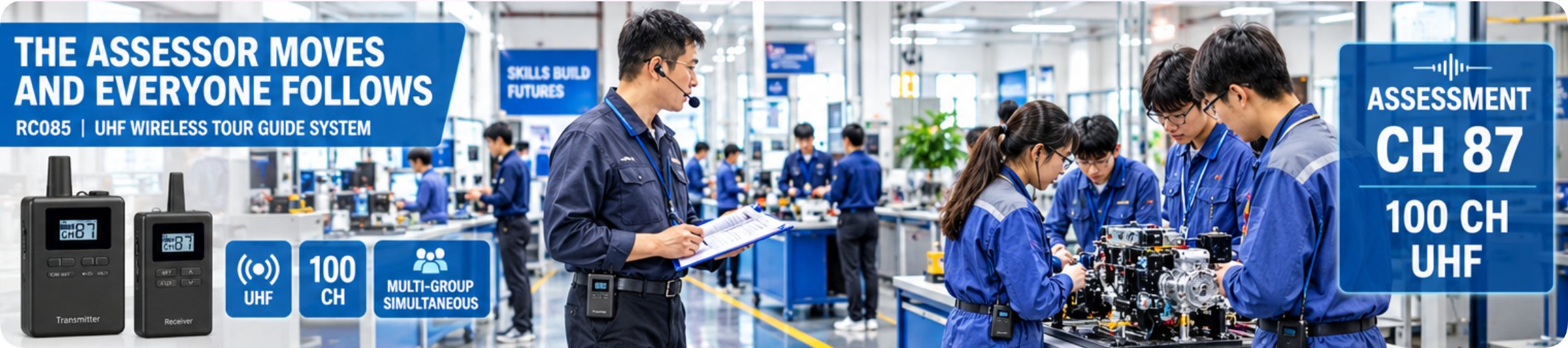
An assessor's day is built around walking. One hour the evaluation happens at the welding bays, the next at the electronics lab, and the assessor carries the standard, not the room. A body-worn transmitter with a headset microphone leaves both hands free for the checklist and the sample workpieces, and the signal has to follow the walk without a technician retuning anything. This is where the RC085 digital tour guide system earns its slot: it broadcasts on the 470-510 MHz UHF band, a range that stays calm while the 2.4G band fills with laptops, projectors and phones around a busy campus. One hundred channels matter too, because three assessors can run three separate evaluations in the same building, each on its own frequency, without a word of cross-talk.
RC085-vocational_training

The receiver side suits the flow of an assessment as well. Learners gather around a bench for ten minutes, then disperse, so the 60g pocket receiver with its 20-hour battery simply rides along in a lab coat until the assessor speaks again. Charging runs over USB, a plug type most school equipment rooms already stock.

The Demonstration Bench Talks for Hours

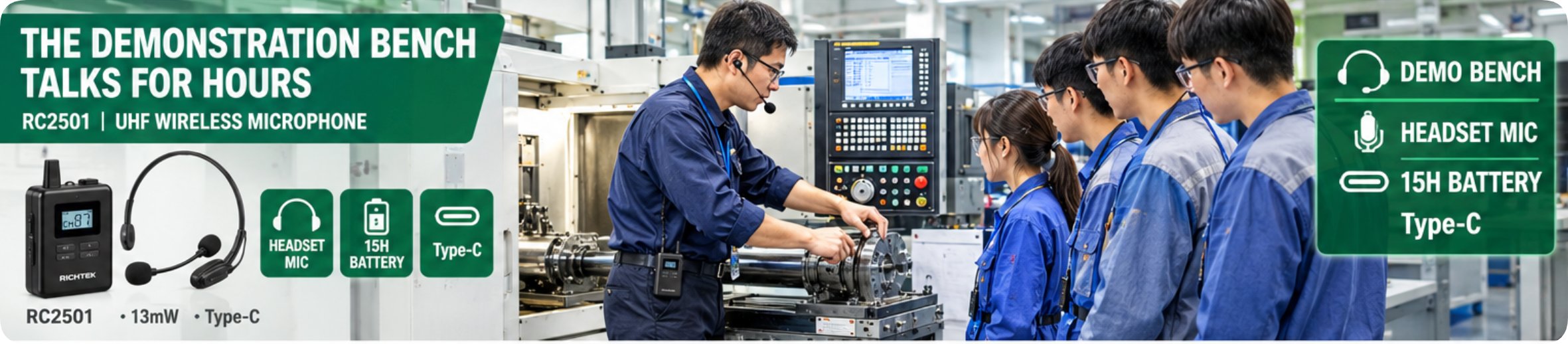
The technician at the demonstration bench has the opposite schedule. The walk is small, the talk is long, and the hands are busy. Explaining a lathe or a CNC cell means pointing, adjusting and holding the part while describing it, so a handheld transmitter is the first thing that gets put down and forgotten. The RC2501 wireless tour guide system was designed for exactly this posture: the transmitter accepts an optional head-worn or lapel microphone, the 13mW output is the strongest in the fleet, and the transmitter runs 15 hours on a charge, which covers the longest practical teaching day with room to spare. At 47g on both the transmitter and the receiver, it is also the lightest pairing in the range, which matters when a technician wears the unit from a morning set-up through an afternoon open-house.
RC2501-vocational_training

Type-C charging rounds out the fit, since a prep room can top the unit up with the same cables used by the rest of the modern AV stock. The 35+h receiver standby means a set of student units issued on Monday morning is still ready on Friday afternoon without a mid-week charging cart.

🎓 The Student Voice Takes the Mic in Short Shifts

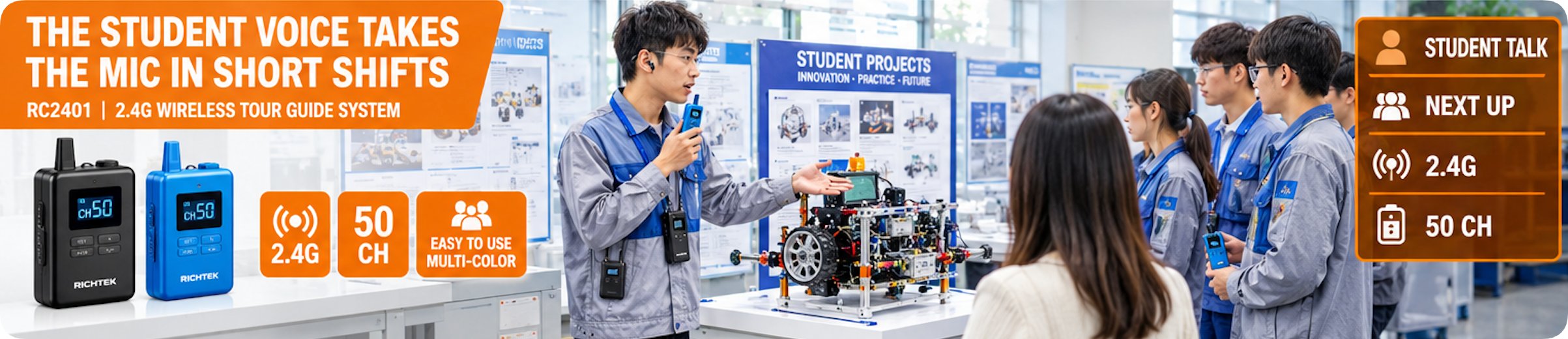
The third voice belongs to the learners themselves. Presentation practice is now a graded part of most vocational programmes, and on open days the students guide visitors through their own projects. Here the priorities invert: the speaker changes every twenty-minute turn, the unit gets handled by dozens of inexperienced users, and the budget covers a whole class rather than one specialist. The RC2401 wireless audio guide system is the baseline 2.4G unit in the fleet for this reason. Fifty PLL channels are ample for one class rotating through a floor, the controls stay simple enough that a new speaker needs no briefing, and the DC-port charging keeps the cost per unit down across a set of thirty.
RC2401-vocational_training

A 59g transmitter that swaps between speakers without adjusting anything, and a 50g receiver that survives a coat pocket, make the handover between turns a five-second affair. When a school buys one fleet for student use, the RC2401 is the unit that can be issued, dropped, returned and reissued without ceremony.

One Table for Three Voices

DimensionRC085RC2501RC2401
Core frequency band470-510 MHz (UHF)2403-2483 MHz (2.4G)2403-2483 MHz (2.4G)
Channels1005050
Output power8-10mW13mW10mW
Transmitter battery life12h15h10h
Receiver battery life20h35+h20h
Transmitter weight65g47g59g
Optional head-worn or lapel micYes (sensitivity approx. -102dBm)Yes (sensitivity approx. -38dBm)No
Charging portUSBType-CDC Port

Where the Exam Week Reshapes the List

Most of the term, the three voices work in separate rooms and the allocation above runs itself. Assessment week bends the rules. Assessors arrive from outside, several run at once, and every channel the RC085 fleet can hold gets used, because two external verifiers plus one internal one in the same building is a normal Tuesday in June. Technician demonstrations move to a fixed showcase schedule, which is when the RC2501's long transmitter day earns its keep again. Student presentations cluster into panels, and a labelled drawer of RC2401 units becomes the most visited spot in the building. Planning the week means deciding which fleet moves where, not buying more of everything.

What the Three Jobs Share After Hours

For all their differences, the three postings agree on the maintenance story. Every transmitter goes back to the same prep room shelf, every receiver returns to its numbered slot, and the whole inventory gets one weekly charge cycle regardless of who used it. The school's own tour guide system line then behaves as one estate rather than three unrelated purchases: spare parts are common, the charging racks are labelled by fleet, and a substitute unit can cover any posting in an emergency. A single inventory sheet listing all three fleets, with the serial ranges grouped by posting, is worth more than any amount of good intentions.

Choosing equipment this way also respects the calendar. Kits sit unused during holidays, so batteries that hold their charge over a quiet fortnight, like the 35+h standby units, reduce the September scramble. Departments that share the prep room should initial the sheet when they borrow a fleet, which keeps the assessor's UHF set from drifting into a student presentation by accident.

📦 One Inventory Sheet for Three Fleets

The sheet itself deserves a sentence of its own, because a paper list outlives every coordinator who wrote it. Each fleet gets one block on the page: the RC085 block carries the UHF frequency plan and the note that assessors sign units out first, the RC2501 block lists which demonstration benches have a Type-C charger within reach, and the RC2401 block records the class set count against the current intake size. Serial ranges sit beside each block, so a unit found in a corridor on Friday afternoon goes home to the right fleet without a guess. A laminated copy hangs by the charging rack, and every September one coordinator reads it aloud to the new staff before the first intake walks in.

Signing the Roster Before the Term Starts

The habit that makes all of this work is writing the voice roster down before the first intake arrives, not after the first complaint. Assign the RC085 fleet to the assessment office, the RC2501 units to the workshop demonstration schedule, and the RC2401 class set to the student presentation cupboard, then print the list and tape it inside the prep room door. When a new term brings a new demonstration bench or an extra external verifier, the roster absorbs the change in minutes. Schools that want to compare fleet options against other teaching environments can browse the education audio guide system range and the wider venue solutions pages, then match the three voices above to the units they already own.
2026年10月12日 10:24
ꄘ click: 12

RC085, RC2401 and RC2501: A Training Centre Runs on Three Kinds of Voices

time: 2026年10月12日 click:12

A vocational training centre rarely hires one kind of speaker. The assessor who signs off a student's competence moves bench to bench with a clipboard and cannot stay long at any one of them. The workshop technician who demonstrates a machine talks for most of the day without ever putting down the tools that prove the point. And the students themselves, once trained, take the mic in short shifts to present their own work to visiting groups. Each of these speakers stands somewhere different, holds something different in their hands, and needs a different wireless tour guide system to be heard clearly across the same building.

Planning the kit around the job, rather than issuing identical units to everyone, is what keeps a term running without audio complaints. The three voices below cover most of what happens between an intake in September and the assessment week in June.

The Assessor Moves and Everyone Follows

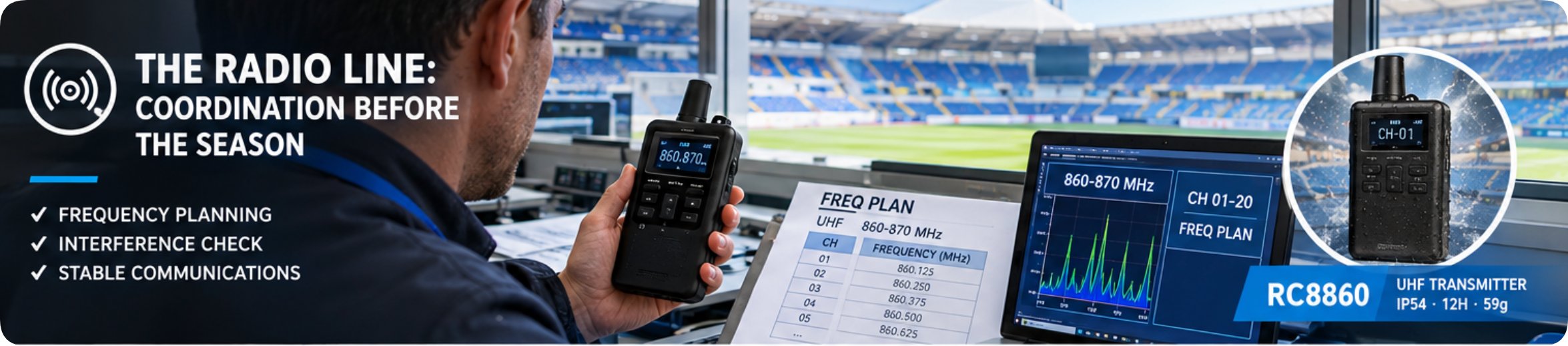
An assessor's day is built around walking. One hour the evaluation happens at the welding bays, the next at the electronics lab, and the assessor carries the standard, not the room. A body-worn transmitter with a headset microphone leaves both hands free for the checklist and the sample workpieces, and the signal has to follow the walk without a technician retuning anything. This is where the RC085 digital tour guide system earns its slot: it broadcasts on the 470-510 MHz UHF band, a range that stays calm while the 2.4G band fills with laptops, projectors and phones around a busy campus. One hundred channels matter too, because three assessors can run three separate evaluations in the same building, each on its own frequency, without a word of cross-talk.

RC085-vocational_training

The receiver side suits the flow of an assessment as well. Learners gather around a bench for ten minutes, then disperse, so the 60g pocket receiver with its 20-hour battery simply rides along in a lab coat until the assessor speaks again. Charging runs over USB, a plug type most school equipment rooms already stock.

The Demonstration Bench Talks for Hours

The technician at the demonstration bench has the opposite schedule. The walk is small, the talk is long, and the hands are busy. Explaining a lathe or a CNC cell means pointing, adjusting and holding the part while describing it, so a handheld transmitter is the first thing that gets put down and forgotten. The RC2501 wireless tour guide system was designed for exactly this posture: the transmitter accepts an optional head-worn or lapel microphone, the 13mW output is the strongest in the fleet, and the transmitter runs 15 hours on a charge, which covers the longest practical teaching day with room to spare. At 47g on both the transmitter and the receiver, it is also the lightest pairing in the range, which matters when a technician wears the unit from a morning set-up through an afternoon open-house.

RC2501-vocational_training

Type-C charging rounds out the fit, since a prep room can top the unit up with the same cables used by the rest of the modern AV stock. The 35+h receiver standby means a set of student units issued on Monday morning is still ready on Friday afternoon without a mid-week charging cart.

🎓 The Student Voice Takes the Mic in Short Shifts

The third voice belongs to the learners themselves. Presentation practice is now a graded part of most vocational programmes, and on open days the students guide visitors through their own projects. Here the priorities invert: the speaker changes every twenty-minute turn, the unit gets handled by dozens of inexperienced users, and the budget covers a whole class rather than one specialist. The RC2401 wireless audio guide system is the baseline 2.4G unit in the fleet for this reason. Fifty PLL channels are ample for one class rotating through a floor, the controls stay simple enough that a new speaker needs no briefing, and the DC-port charging keeps the cost per unit down across a set of thirty.

RC2401-vocational_training

A 59g transmitter that swaps between speakers without adjusting anything, and a 50g receiver that survives a coat pocket, make the handover between turns a five-second affair. When a school buys one fleet for student use, the RC2401 is the unit that can be issued, dropped, returned and reissued without ceremony.

One Table for Three Voices

DimensionRC085RC2501RC2401
Core frequency band470-510 MHz (UHF)2403-2483 MHz (2.4G)2403-2483 MHz (2.4G)
Channels1005050
Output power8-10mW13mW10mW
Transmitter battery life12h15h10h
Receiver battery life20h35+h20h
Transmitter weight65g47g59g
Optional head-worn or lapel micYes (sensitivity approx. -102dBm)Yes (sensitivity approx. -38dBm)No
Charging portUSBType-CDC Port

Where the Exam Week Reshapes the List

Most of the term, the three voices work in separate rooms and the allocation above runs itself. Assessment week bends the rules. Assessors arrive from outside, several run at once, and every channel the RC085 fleet can hold gets used, because two external verifiers plus one internal one in the same building is a normal Tuesday in June. Technician demonstrations move to a fixed showcase schedule, which is when the RC2501's long transmitter day earns its keep again. Student presentations cluster into panels, and a labelled drawer of RC2401 units becomes the most visited spot in the building. Planning the week means deciding which fleet moves where, not buying more of everything.

What the Three Jobs Share After Hours

For all their differences, the three postings agree on the maintenance story. Every transmitter goes back to the same prep room shelf, every receiver returns to its numbered slot, and the whole inventory gets one weekly charge cycle regardless of who used it. The school's own tour guide system line then behaves as one estate rather than three unrelated purchases: spare parts are common, the charging racks are labelled by fleet, and a substitute unit can cover any posting in an emergency. A single inventory sheet listing all three fleets, with the serial ranges grouped by posting, is worth more than any amount of good intentions.

Choosing equipment this way also respects the calendar. Kits sit unused during holidays, so batteries that hold their charge over a quiet fortnight, like the 35+h standby units, reduce the September scramble. Departments that share the prep room should initial the sheet when they borrow a fleet, which keeps the assessor's UHF set from drifting into a student presentation by accident.

📦 One Inventory Sheet for Three Fleets

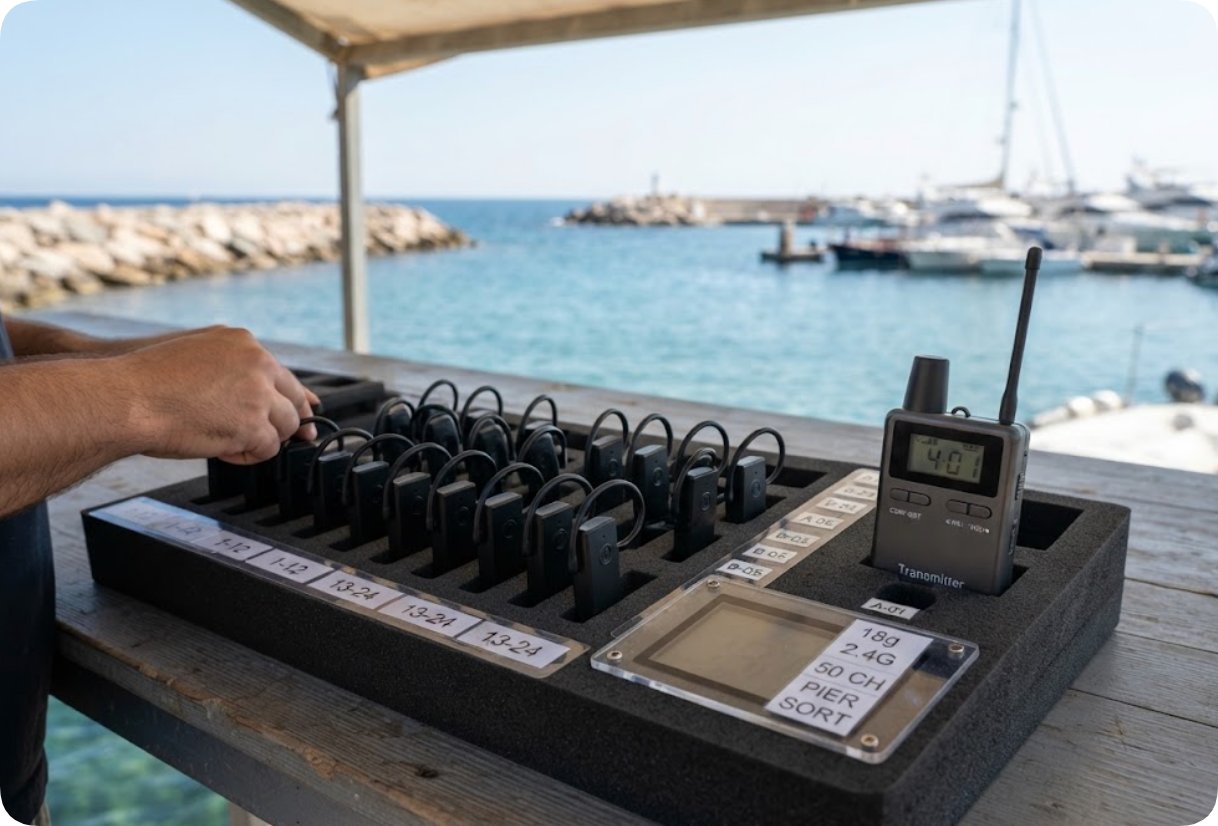
The sheet itself deserves a sentence of its own, because a paper list outlives every coordinator who wrote it. Each fleet gets one block on the page: the RC085 block carries the UHF frequency plan and the note that assessors sign units out first, the RC2501 block lists which demonstration benches have a Type-C charger within reach, and the RC2401 block records the class set count against the current intake size. Serial ranges sit beside each block, so a unit found in a corridor on Friday afternoon goes home to the right fleet without a guess. A laminated copy hangs by the charging rack, and every September one coordinator reads it aloud to the new staff before the first intake walks in.

Signing the Roster Before the Term Starts

The habit that makes all of this work is writing the voice roster down before the first intake arrives, not after the first complaint. Assign the RC085 fleet to the assessment office, the RC2501 units to the workshop demonstration schedule, and the RC2401 class set to the student presentation cupboard, then print the list and tape it inside the prep room door. When a new term brings a new demonstration bench or an extra external verifier, the roster absorbs the change in minutes. Schools that want to compare fleet options against other teaching environments can browse the education audio guide system range and the wider venue solutions pages, then match the three voices above to the units they already own.
×

Contact us

email:
name:
subject:
content: