.webp)
Island operators write a purchase order for wireless tour guide systems the way they write a fuel order: by the week it will run. A lagoon route works three seasons and stalls in the wet one. A ferry pier works all year but loses forty minutes of every sailing to condensation. The same two lines carry both seasons. This is how one coastal order splits into two acceptance columns, why the eighteen-gram receiver and the eighty-channel bench unit land on different lines, and what each proves before a guide carries a device onto a breakwater.
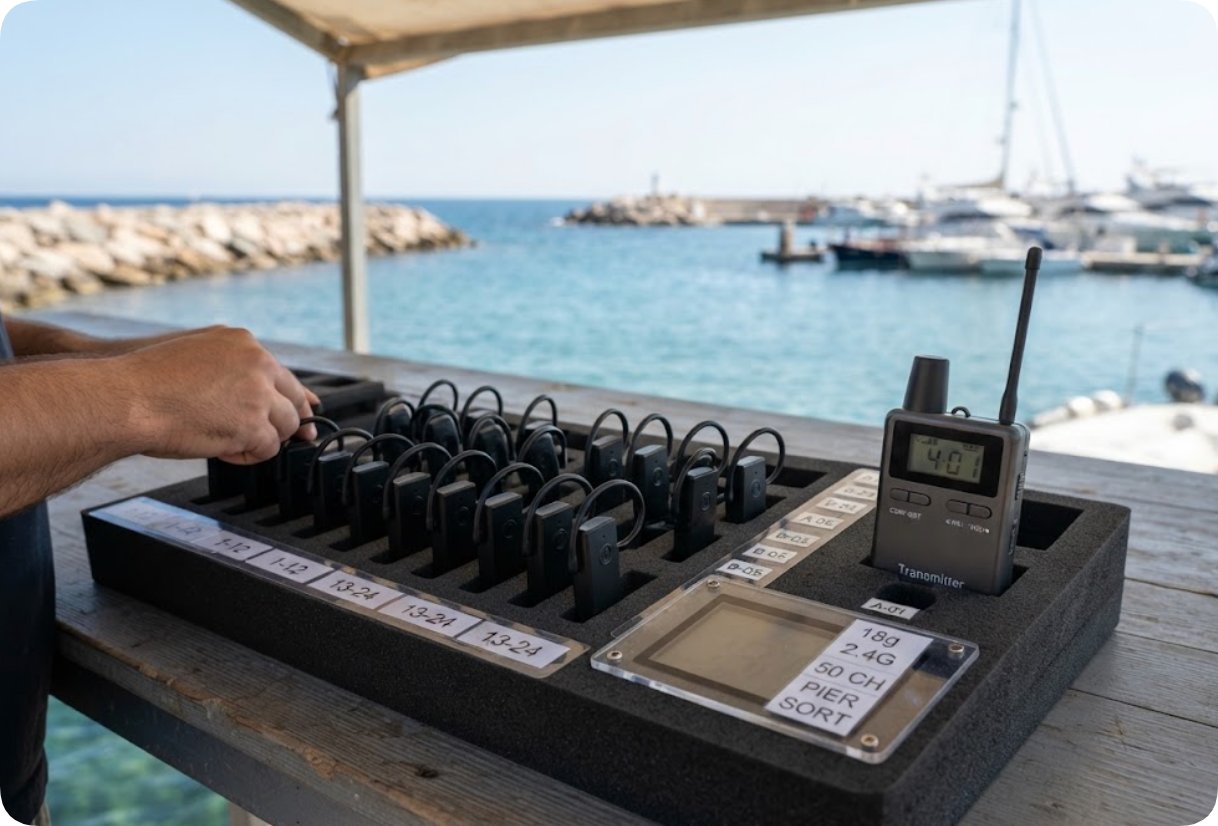
Two product lines sit behind the columns. The RC2468 Ultra-Light 2.4G Tour Guide System is the one guests wear, with a receiver that weighs eighteen grams. The RC2406 80-Channel 2.4G Tour Guide System stays at the basecamp table and carries the channels.
The Order Is Written in Seasons, Not in Specs
A museum purchase order is written against a floor plan: two rooms, a fixed route, a known group ceiling. A coastal order is written against weather. The dry season gives long walking routes and afternoon departures; the wet season shortens every route to the sheltered boardwalk and doubles the group rotation. One supplier reading the same sheet can produce two defensible systems, and both can pass inspection in the season they were built for.
So the first column on an acceptance sheet is not the specification column. It is the season column. Before anyone measures a channel count, the sheet should carry the season the kit was accepted in, because every line below inherits that assumption. A forty-channel system accepted in the dry season may fail the wet one, not because the radio is weaker but because the route grew shorter while the group rotation stayed the same. That assumption is why coastal and island deployment planning belongs at the top of the file.
Column One: The Pocket Line and What Eighteen Grams Buys
The RC2468 line is written for a guest who walks for ninety minutes in wind. Its receiver weighs eighteen grams and its transmitter fifty-nine, so a guest forgets it is there somewhere around the fourth stop. That forgetfulness is the actual test. A device a visitor can feel is one that gets handed to a child, dropped on a wet rail, or pocketed again after a stop without a word.
Its specification block supports the column. Fifty channels with PLL synthesis, one to two hundred meters of effective range in open areas, a figure the manufacturer states as usable through walls and obstacles, and a frequency band of 2403 to 2483 megahertz on the licence-free ISM band accepted worldwide. The receiver runs a three-hundred-milliamp-hour cell for ten hours; the transmitter runs fifteen hundred milliamp-hours for twelve hours of talk. Output is ten milliwatts at the receiver, and frequency response covers fifty hertz to two hundred kilohertz.
That battery line is worth arguing about. Ten hours sounds generous against a ninety-minute route, but the wet-season route is a boardwalk loop repeated four times a day with the group rotating between stops, and the receiver goes to whoever walks last. Weight and hours are the same argument here. Colour enters too: the transmitter comes in six finishes and the receiver in black, removing one sorting decision at a pier entrance.
Column Two: The Basecamp Line and What Eighty Channels Are For
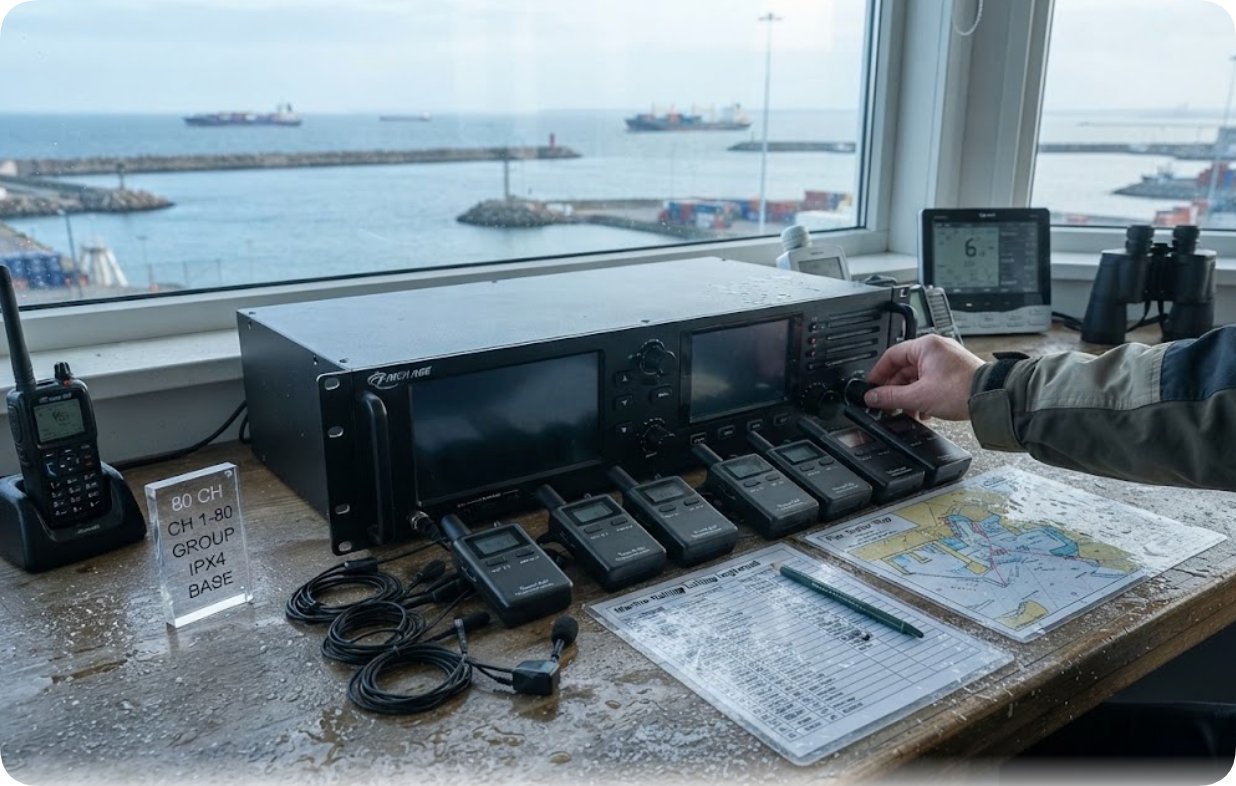
The RC2406 line answers a different question: how many groups can one operator run without crossing into each other. Its specification block lists eighty channels with PLL anti-interference technology, the same 2403 to 2483 megahertz licence-free band, and a range of up to two hundred meters in open areas. Battery is fifteen hundred milliamp-hours for full-day use, weight is fifty grams, and the enclosure is rated IPX4 splash resistant.
Splash resistant is not waterproof, and on a pier order that distinction is the whole argument. A pier accumulates spray at head height on a bad afternoon; a boardwalk collects water at ankle height all season. An operator buying for a pier should read the IPX4 line as a rating for drizzle and handling, not as permission to leave a bench unit on an open jetty.
Eighty channels is also a ceiling coastal operators tend to over-buy. Four groups in parallel need twelve channels and have them to spare; a site running seven languages across two departure points is the one that pushes past fifty.
Both lines also carry the same three-year warranty covering the mainboard and excluding headsets, microphones and batteries, and that exclusion deserves its own acceptance line: on a coastal site the headset is the part that meets wind, spray and sand, and it is the part the warranty explicitly does not hold.
One Table for Two Different Proofs
The two lines are not competing versions of the same column. They are different columns, and a coastal order keeps both because they are verified by different evidence. The table below sets the two specification blocks side by side along the axes that matter when the acceptance test is written.
| Acceptance axis | Pocket line (RC2468) | Basecamp line (RC2406) |
|---|---|---|
| Frequency band | 2403-2483MHz, licence-free 2.4GHz ISM | 2403-2483MHz, licence-free 2.4GHz ISM |
| Channels | 50 with PLL synthesis | 80 with PLL anti-interference |
| Stated range | 1-200m open area, usable through walls | Up to 200m open area |
| Receiver cell | 300mAh, 10 hours continuous | Not itemised separately |
| Transmitter cell | 1500mAh, 12 hours talk time | 1500mAh, full-day use |
| Weight | Transmitter 59g / receiver 18g | 50g lightweight design |
| Liquid rating | Not published on the product page | IPX4 splash resistant |
| Frequency response | 50Hz-200kHz, 10mW receiver output | Clear voice optimized for guided talk |
| Certification listed | CE, EMC, LVD, RED and environmental compliance marks | RoHS |
| Warranty | 3 years, mainboard only | 3 years, mainboard only |
Read the empty cells before the filled ones. The pocket line publishes no liquid rating, so a route that depends on splash tolerance has no figure to test against, and the sheet needs a substitute written by the operator. The basecamp line publishes a rating but itemises no receiver cell, so a channel-count argument there cannot become a shift-length argument without asking the supplier.
Where a Coastal Order Actually Fails Late
Three failures recur on coastal purchase orders, and none appear in the specification block. The first is the tidal window: a route whose departure depends on a ferry timetable cannot be tested on a Thursday morning and accepted for a weekend sailing. The second is the salt-and-sand line, where a headset that works in a showroom fails at the sandline and the warranty excludes exactly that part. The third is the channel ceiling, where a two-departure-point operation quietly runs over a fifty-channel system because nobody counted the concurrent groups.
Each has a remedy that costs nothing on the order and everything in the acceptance column: accept on the day the kit will actually run, put spare headsets on the same line as the radios rather than on a later consumable order, and count concurrent groups on the busiest sailing instead of total daily visitors. They require the sheet to state what was proven, in which season, against which sailing.
What to Put on the Sheet Before Anyone Signs
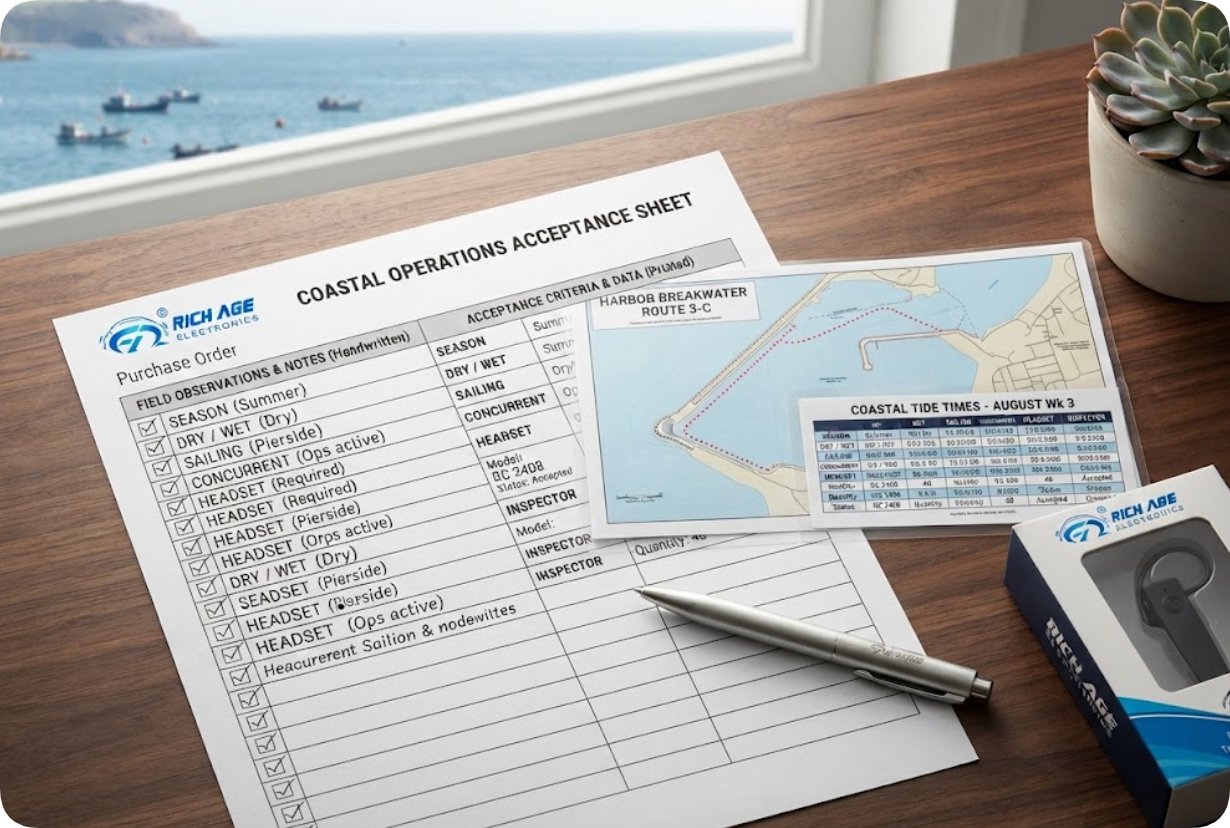
Write the season column first, then the two proof columns, then the consumables line. Four entries do most of the work: the season the kit was accepted in, the concurrent group count measured on the busiest sailing, the headset quantity outside the warranty, and the liquid rating for whichever line faces spray.
For the pocket line, verify weight and hours together, because on a repeated loop they are one argument. For the basecamp line, verify channel headroom against the two departure points rather than the daily headcount, and read the IPX4 line as splash tolerance rather than submersion. Both systems sit inside the same licence-free 2.4 gigahertz band, so a coastal order needs no separate frequency licensing for either line. That is the one entry nobody negotiates. The rest is counting.
Where to Read the Range of the Full Line
Once the two acceptance columns are written, the rest of the range is worth one pass. Browse our solutions for harbour and island deployments, step through our wireless tour guide system range when a route needs more channels, and compare architectures in the tour guide system comparison guide before the order is cut. A coastal order fails in the acceptance column far more often than in the specification column.