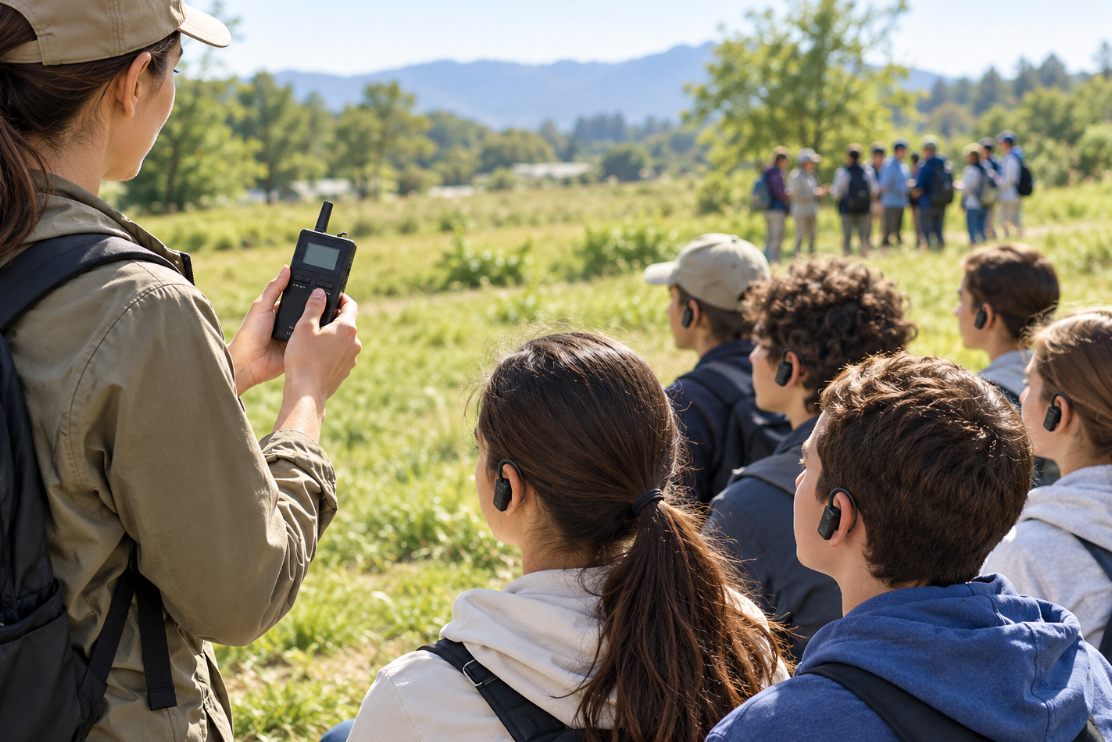
An outdoor lesson lives or dies on the weakest link in the audio chain. When a class of thirty students spreads across a meadow, a wooded slope, or an open-air heritage site, the teacher cannot repeat a sentence four times or gather everyone around a single speaker. Wireless tour guide systems solve the distance problem, but they introduce their own failure modes, and the three most common ones look identical from the back of the group: sudden silence. Diagnosing which failure you are facing takes minutes if you know the pattern, and the right hardware choices make two of the three failures impossible in the first place. This article walks through a full troubleshooting session from an actual outdoor teaching day, using the RC2406, the RC8860, and the RC2500 as the three instruments of the diagnosis.
When Two Classes Land on One Channel
The classic mid-morning failure is not a broken unit at all. Two school groups arrive at the same nature reserve, both guides power on, and suddenly half of your students hear a stranger explaining bird migration. Both systems shipped on factory-default frequencies, and in crowded venues those defaults collide. The fix is re-channeling, and the depth of your channel bank decides how often you will ever face this fault again. The RC2406 was built precisely for this situation: it carries 80 independent channels managed by PLL frequency synthesis on the 2.4GHz global ISM band (2403-2483MHz), so a coordinator can move each group to its own lane and still leave dozens of lanes free for visiting classes. Its 80-channel anti-interference design turns channel collision from a showstopper into a thirty-second adjustment. During the field session, the affected class moved from the default lane to channel 57, and the crosstalk vanished before the guide finished her sentence.
Channel discipline is also a scheduling matter. When a site hosts four concurrent groups, the lead teacher assigns blocks: channels 1-20 for the morning rotation, 21-50 for the midday batch, and the upper range reserved for special events. Writing the plan on a laminated card taped inside the transmitter case prevents the most common human error, which is two coordinators independently picking "a free channel" that is not free.
Where 200 Meters Ends in Wooded Terrain
The second failure shows up at the far edge of the trail. A group rounds a stand of mature trees, the path curves downhill, and the audio starts to stutter before it fades entirely. Every unit in this comparison is rated for up to 200 meters in open ground, but foliage and terrain absorb 2.4GHz energy noticeably faster than open air. This is where band selection matters more than channel count. The RC8860 transmits on the 860-870MHz UHF band instead, and that lower frequency wraps around tree trunks and bends over terrain far better than 2.4GHz alternatives. Its UHF transmission design is the reason the wooded leg of the route kept a stable signal while a 2.4GHz unit tested side by side lost syllables at roughly the same distance. The trade-off is a narrower bank of 20 PLL-locked channels, which is why the UHF unit works best as the dedicated woods-and-terrain instrument while higher-channel 2.4G units cover open plazas.
A practical range discipline also helps. Guides on woodland routes learn to hold a sightline back to the group at the boundary of the covered stretch, and the transmitter wearer keeps the antenna side of the unit clear of the body. A transmitter pressed flat against a backpack strap loses several meters of effective range before the physics of the forest even enters the picture.

🔋 The Afternoon Battery Cliff
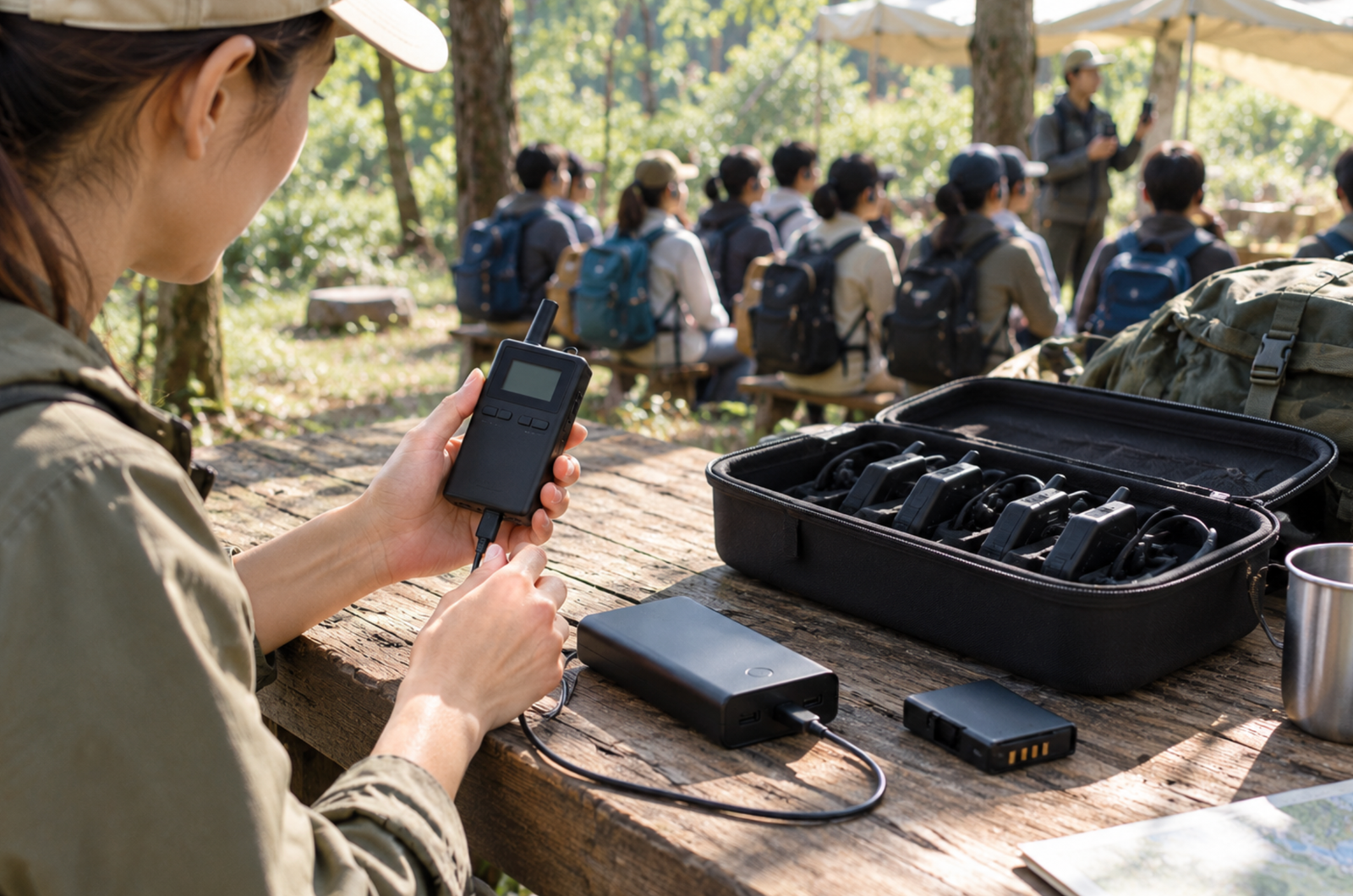
The third failure arrives on schedule: around 14:30, after a 09:00 departure, a receiver dies mid-explanation. The arithmetic was never checked at the depot. A transmitter rated at 10 hours and a receiver rated at 20 hours will comfortably survive a single field day, but units that left the charger at 60 percent the night before, after three consecutive tour days without a top-up, do not. Battery planning starts with knowing each unit's real consumption. The RC2406 and the RC8860 both run 10-hour transmitters on 1500mAh cells and 20-hour receivers on 1000mAh cells, which covers the longest teaching day with margin if every unit starts full. The RC2500 plays a different role: its 1800mAh cells carry the transmitter for 15 hours and the receiver beyond 35 hours, and it charges over Type-C, so the unit that forgot its charging cradle can borrow a phone-class cable from any teacher in the building. Its long-standby receiver design is what makes it the natural instrument for multi-day camps where nightly charging is unreliable.
Re-Sync in One Button Before the Group Walks On
Occasionally the fault is neither channel nor battery but a receiver that has wandered off its assigned lane, or a unit that someone muted and forgot. Legacy systems turn this into a menu-diving exercise while thirty students wait. The RC2500 compresses the whole recovery into a single press: one-key sync re-pairs the fleet, one-key mute silences a stray receiver, and one-key power-off closes the day. During the field session, a receiver that had been moved to another lane earlier in the morning was re-joined to the group in the time it took the guide to ask a question. That recovery speed is invisible until the moment you need it, and then it is the feature the whole session depends on.
A Swap Test That Locates the Fault in Ninety Seconds
When silence strikes and the cause is unclear, a structured swap test beats guesswork. Hand the suspect receiver to a neighbor who still hears audio, and hand the healthy unit to the reporter. If the problem follows the student, the earpiece is the culprit; if it stays with the unit, the receiver is. Repeat once with the transmitter: power the group on a spare lane and speak. If audio returns, the original lane was the problem, which points back to channel collision. If it does not, the transmitter battery or the antenna position deserves suspicion. Ninety seconds of structured swapping separates a dead earpiece foam from a frequency collision from a dying cell, and each of those three has a different remedy already covered above.
Specification Reference for the Field Kit
| Specification | RC2406 | RC8860 | RC2500 |
|---|---|---|---|
| Frequency band | 2.4GHz ISM (2403-2483 MHz) | UHF (860-870 MHz) | 2.4GHz ISM (2403-2483 MHz) |
| Channels | 80 with PLL synthesis | 20 with PLL synthesis | 50 with PLL synthesis |
| Transmission range | Up to 200m open area | Up to 200m open area | Up to 200m open area |
| Transmitter battery | 3.7V 1500mAh, 10 hours | 3.7V 1500mAh, same 10-hour window | 3.7V 1800mAh, 15 hours |
| Receiver battery | 3.7V 1000mAh, 20 hours | 3.7V 1000mAh, 20-hour receiver | 3.7V 1800mAh, 35+h with standby |
| Weight (TX / RX) | 59g / 50g | Same 59g / 50g pair | 104g each side |
| Frequency response | TX 50Hz-200kHz; RX 50Hz-12kHz | RX and TX both 50Hz-12kHz | 50Hz-8kHz |
| Charging port | DC port | DC port charger | Type-C |
Read as a set, the three units divide the troubleshooting space cleanly. The RC2406 owns the frequency-collision problem with its 80-lane bank. The RC8860 owns terrain, where UHF keeps teaching through foliage that starves 2.4GHz. The RC2500 owns time, with the longest endurance in the kit and the fastest recovery path when a unit needs re-pairing. A coordinator who assigns each unit to the failure it eliminates spends the field day teaching, not diagnosing.
Packing Spares and Charging Math at the Depot
The last habit that prevents repeat failures is depot discipline. A fleet card lists each unit's last charge date and its role for the coming day. Units destined for wooded routes go out with the UHF transmitter; plaza routes take the 80-lane units; the long-endurance Type-C pair covers anything overnight. Chargers stay labeled by port type, because the kit mixes DC cradles with a Type-C cable, and the ten minutes saved by not hunting for the right cable at 07:30 is the same ten minutes that used to produce half-charged units by 09:00. One spare receiver per twenty students covers the statistical reality of earphone wear, and earpieces get inspected at pack-up, not at hand-out.
🔮 What Each Model Should Carry on the Next Outing
Hardware does not remove field failures by being powerful; it removes them by being assigned correctly. Put the 80-channel unit wherever several groups share one site, because its education-focused channel plan was designed for exactly that congestion. Put the UHF unit on any route where trees, walls, or terrain stand between the guide and the last row. Put the long-endurance unit on multi-day programs and on any day when the charging routine cannot be guaranteed. The brand behind all three keeps the full transmitter and receiver lineup on a single product family page, and the deployment notes by venue type are worth reading before the next route is finalized. A kit built on this division of labor turns the three classic silences into three solved adjustments, and the students at the back of the group never learn that anything went wrong.