
A public service hall runs on counters. Residents queue for a number, sit down when the screen calls them, and leave twenty minutes later. Most of them will never speak to the same clerk twice, and almost none of them would notice, let alone report, a tour guide receiver that sounds faint, sits on the wrong channel, or dies halfway through an appointment. That is the structural difference between a hall deployment and a guided tour: on a tour, the group and the guide share the problem. Here, the equipment is loaned to strangers who have no stake in its health.
So the troubleshooting question changes shape. In a museum the fault is found by a guide who walks the route every day. In a hall, the fault has to be caught by the counter process itself — at the moment a unit is handed out, while it is in a resident's hands, when it comes back across the counter, or later that night on the charging shelf. We install three kits across different counters — the RC2402, the RC2406 and the RC9150 — the kind of counter setup described in the conference room deployment playbook — and this article walks through what each one is good at catching, and where in the daily cycle a failure actually surfaces.
🛒 A Counter That Loans Out Its Sound
The layout matters. One transmitter sits behind the consultation window and never moves; its receiver pile sits in a tray on the counter and goes out and comes back dozens of times a day. A second window handles the noisiest counter in the hall — the one beside the entrance, next to the queue screen and the rolling shutters. A third window rarely issues audio at all, but when it does, the resident keeps the unit for a full day: document handover for residents with hearing difficulties, where the clerk's voice has to reach them through a full morning of appointments, not one conversation.
None of the three windows has a technician. The clerks rotate weekly. Whatever catches a fault has to be built into the handout, the return and the overnight charging — three moments that already exist in the daily routine, with no extra labor attached.
RC2402: The Basic Window Kit That Fails Early and Cheaply
The consultation window runs the RC2402 Wireless Tour Guide System, the entry-level 2.4G kit with fifty channels. At a counter this is the right trade: the transmitter never leaves the building, the distance to the farthest seat is under forty meters, and fifty channels are far more than a single transmitter needs. What the window actually relies on is the handout moment. The clerk switches the receiver on, hears the voice for two seconds, and hands it across. Thirty seconds of checking at handout catches the units that came back the previous evening with a depleted battery or a channel somebody nudged with a pocket.

When something does slip through, the RC2402 fails in ways the counter can see. A drained receiver battery announces itself as silence within the twenty-minute appointment. A channel conflict is rarer here than on a factory floor — the hall's 2.4G traffic is the queue screen and the payment terminals, not a wall of industrial radios — and when it happens, the symptom is a rhythmic stutter rather than a dead channel, which the resident will usually tolerate in silence. That tolerance is precisely why the handout check, not the resident, is this kit's first line of defense.
🛒 RC2406: Eighty Channels for the Busiest Counter
The entrance window borrows nothing from the consultation setup. Its counter sits beside the entrance doors, the roller shutters and the LED queue display — the noisiest corner of the hall by radio standards, even though none of that equipment is deliberate interference. The RC2406 80-Channel 2.4G Tour Guide System earns its place here on channel count: eighty channels against the RC2402's fifty means the window keeps a permanently clear spare and can absorb a second transmitter when the hall runs a temporary desk for a seasonal campaign.

The fault that shows up at this counter is interference-shaped: crackle that comes and goes with the shutter motor, or a thin layer of hash whenever the display refreshes. Eighty channels make the fix trivial — step two channels over and the noise is gone — but the process point is the interesting one. The clerk who hears crackle at 09:40 cannot leave the counter to debug it. So the standing rule is written on the window card: change channel first, note the number on the log sheet, report at shift end. The RC2406's headroom turns a debugging session into a one-step workaround, and the log turns a one-step workaround into a pattern the facilities team can read across weeks.
RC9150: The Receiver That Stays Out All Day
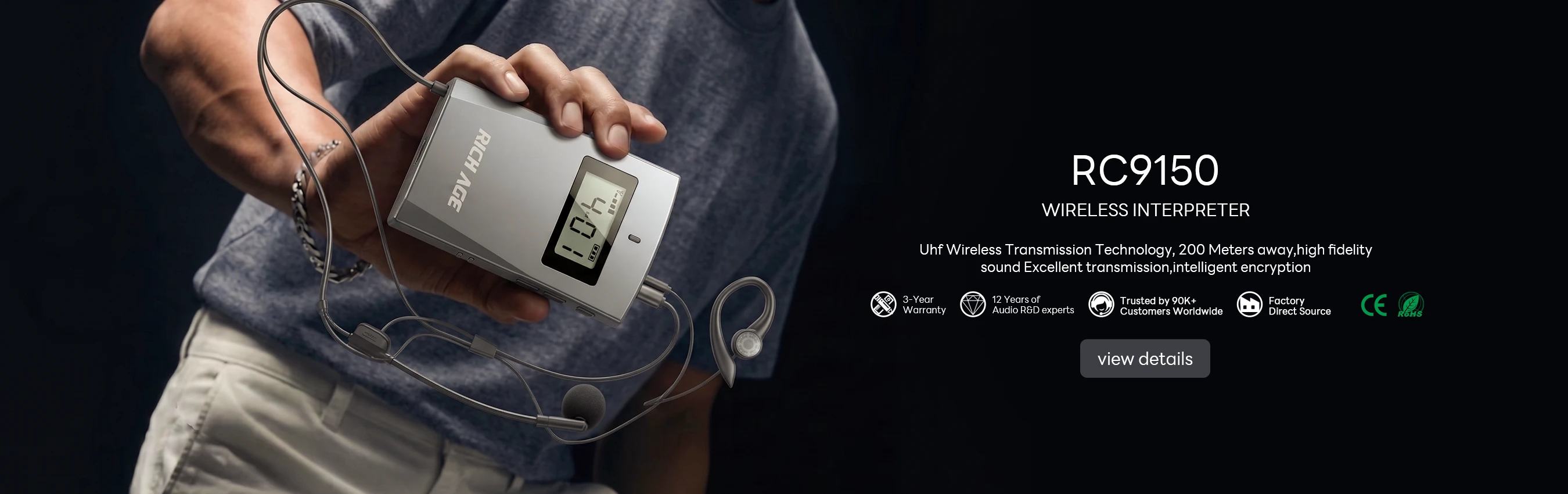
The document-handover window is a different borrowing model. Its RC9150 2.4G Wireless Audio Guide System units go out at 08:30 with the first appointment and come back at closing — and the residents wearing them have no obligation to manage battery life on the hall's behalf. This is where the RC9150's specification does the real work: thirty-five-plus hours of receiver standby against the twenty hours of the two cheaper kits, and a transmitter that holds fifteen hours instead of ten. A unit borrowed at opening is still alive at the end of a full hall day, with margin for the resident who wanders off to a second building before returning it.

Its failure mode is correspondingly quieter. Nothing dies mid-appointment; instead, a unit that went out with a half-charged battery comes back flat, and if the counter misses that, it goes out again the next morning and dies at 14:00. That is why this window's counter process leans on the overnight side — the charging shelf is checked slot by slot against a board, and any unit whose indicator has not settled by morning does not go out that day. The Type-C charging port is a small thing at purchase time, but at the shelf it means a broken cable is a five-minute swap instead of a spare-parts request.
What the Side-by-Side Table Shows
The three kits look similar on a brochure page. Counted through the borrowing cycle, they answer three different counter questions:
| Comparison dimension | RC2402 | RC2406 | RC9150 |
|---|---|---|---|
| Channels | 50 | 80 | 100 |
| Core frequency band | 2403-2483 MHz | 2403-2483 MHz | 2403-2483 MHz |
| Transmitter battery life | 10h | 10h | 15h |
| Receiver battery life | 20h | 20h | 35+h |
| Receiver weight | 50g | 50g | 97.5g |
| Charging port | DC Port | DC Port | Type-C |
Read as a loan decision: the RC2402 handles short appointments where the handout check does the work; the RC2406 buys interference headroom for the loudest corner; the RC9150 buys a whole day of untended battery, at the price of a heavier receiver and a shelf that needs a morning check. The receiver weight difference is worth noting for a hall with elderly residents — fifty grams disappears on a lanyard, ninety-seven does not — which is one more reason the long-day kit is issued at the window where a clerk hands it over personally rather than leaving it in a self-serve tray.
The Four Points Where a Fault Surfaces
Across the three windows, every fault we have logged in a year surfaces at one of four moments. Handout: two seconds of listening catches dead batteries and wrong channels before a resident ever hears them. In use: interference symptoms belong to the RC2406's corner, and the standing rule converts them to a channel step plus a log line. Return: the tray is counted, not glimpsed — one unit short means a name on the day sheet gets a phone call before closing, because a unit sitting in a resident's bag overnight is a unit nobody can charge. Overnight: the shelf is the real inspection, because a receiver that fails to charge will always announce itself there, quietly, twelve hours before it would have failed in someone's ear.
What none of the four points requires is radio knowledge. Each is a count, a listen or a glance at an indicator, written into the routine of a desk that rotates staff weekly. That is the actual engineering deliverable in a hall deployment: not a sturdier device, but a borrowing cycle in which a failing unit has nowhere to hide.
Charging Night Is the Real Inspection
The overnight shelf deserves its own paragraph, because it is where the three kits behave most differently. The RC2402 and RC2406 receivers charge through DC ports in a multi-unit dock, and their twenty-hour receiver life means a unit that reaches the shelf with even a quarter left is safe for the next morning — the shelf's job is simple replenishment. The RC9150 shelf works harder: thirty-five-plus hours of standby means a unit can skip a night and still run a day, but the counter treats that slack as a trap rather than a feature, because the skipped night is invisible until the following afternoon. So its board records charge completion per slot, and the unlit slot is the morning's first action item.
Transmitters, by contrast, barely participate in the cycle. The RC2402's and RC2406's transmitters hold ten hours — one hall day plus margin — and the RC9150's fifteen hours means it can miss a night entirely. The desk plugs them in with the receivers and forgets them; the specification that matters at the counter is the receiver side, because that is the unit that walks out the door.
Writing the Loan Rules Down
None of this survives a paper filing cabinet. The log sheet that matters is the one taped beside the tray: which window, how many units out, how many back, which slot did not light. The facilities team reads it monthly, and two patterns have driven every purchase since — the entrance corner's crackle reports justified the RC2406's eighty channels, and the long-day complaints from the document window justified paying the RC9150 premium over a third basic kit. Both purchases went through the same review cycle we describe in our deployment solutions notes.
The closing observation is the one we give every hall buyer: in a loaned-equipment deployment, the fault report is not the resident's job, and pretending otherwise is how a kit slowly dies in a drawer. Choose the kit for the moment in the cycle where it must be caught — the cheap kit for a counter that checks at handout, the wide-channel kit for the noisy corner, the long-standby kit for the unit that stays out all day — and the counter catches its own faults. Hall operators weighing a first deployment can start from the conference-room deployments on the manufacturer's solutions page, and the full tour guide system lineup behind all three kits is built around exactly this kind of fixed-window use.