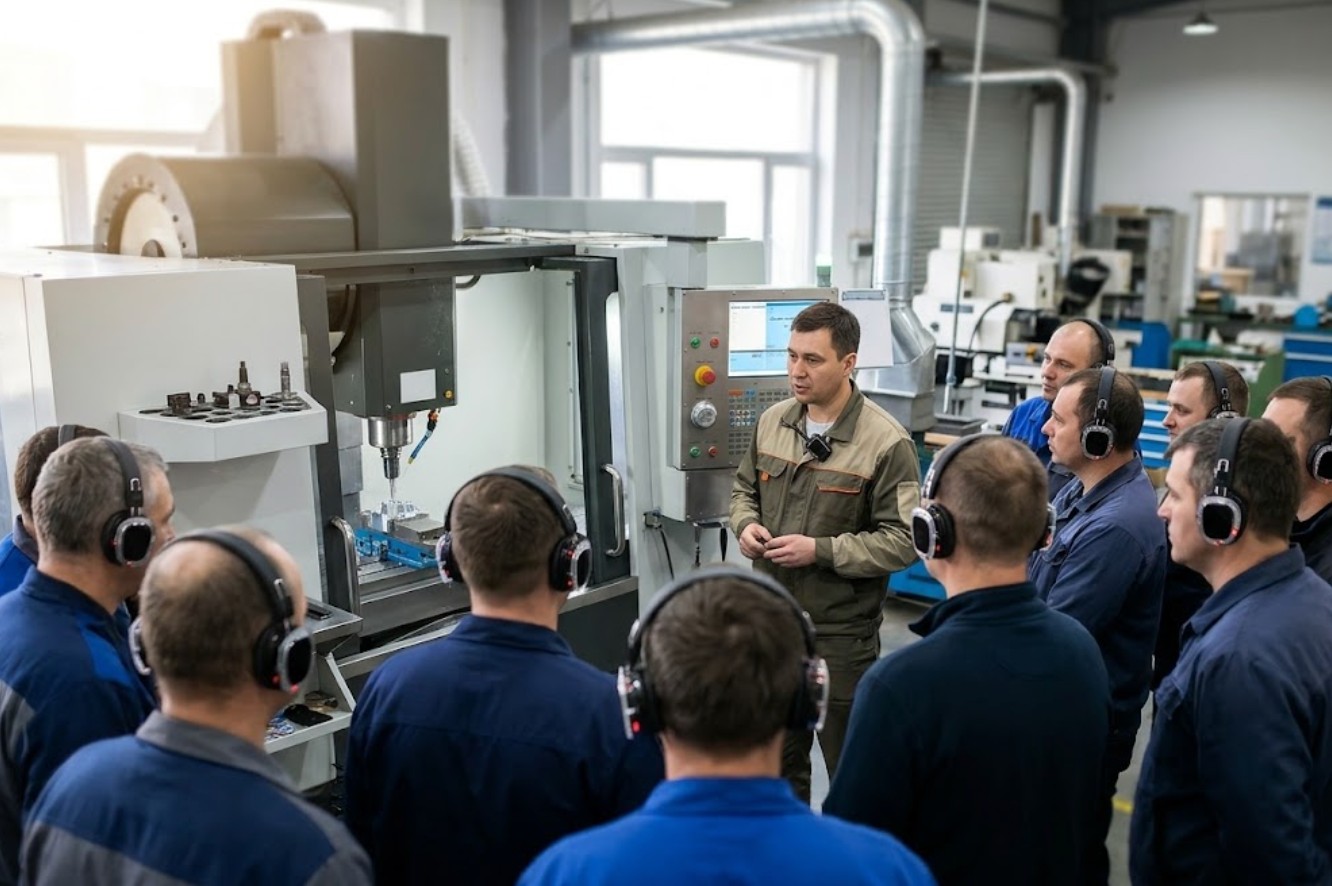
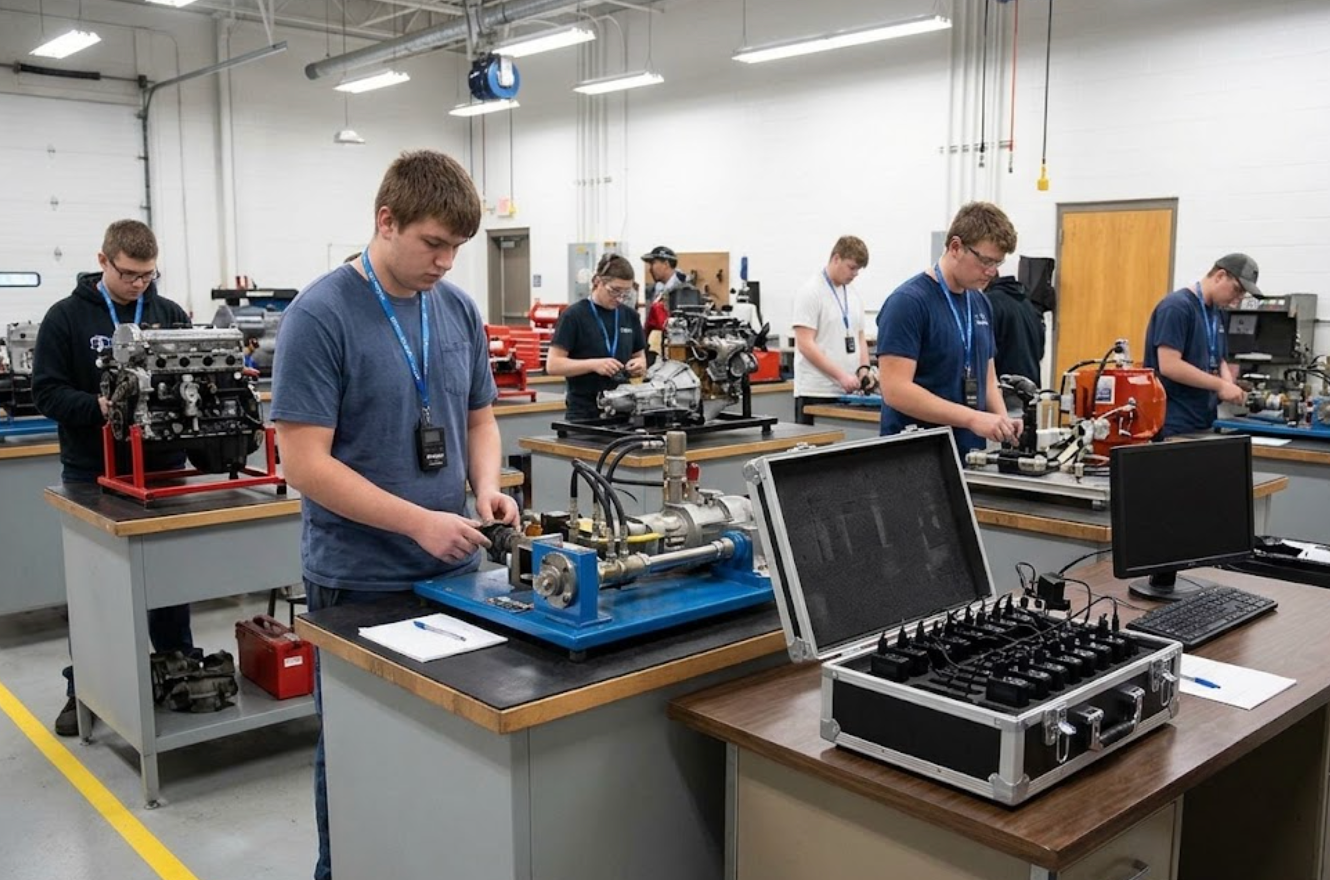
A vocational training workshop buys audio equipment for an audience that changes completely every September. Unlike a museum, where visitors arrive and leave the same day, a training cohort borrows, drops, misplaces and graduates away from the same kit for an entire academic year. The specification that decides whether that equipment survives is not printed on any datasheet — it is the replacement rhythm. Buy every unit as if a student will lose it, and the budget doubles. Buy everything as if it will last a decade, and September's intake finds half the pool missing.
The middle path splits the fleet by exposure. The RC2500 stays with instructors and the equipment office, where units are signed in and out daily. The RC2401 is the mass-issue receiver handed to students, chosen because a class set costs less to replace than to police. The SG28 player carries the pre-recorded part of the curriculum, so revision sessions run without an instructor at all. The sections below walk through each tier, compare the published figures, and finish with the counting discipline that makes the split work between semesters.
🎓 Student Turnover Is the Real Specification
Every purchasing conversation in a training workshop starts from the same arithmetic. A cohort of thirty students shares twenty receivers during practical periods; across a four-year programme, more than a thousand different students will handle the same class set. Handles get dropped, units migrate into backpacks, and the odd receiver leaves campus entirely. Equipment that assumes careful adult hands — museum-grade, single-owner devices — ages badly in that environment. What survives is hardware chosen for its loss tolerance: cheap enough to replace individually, light enough that students actually wear it, and simple enough that a substitute unit can be swapped in mid-lesson without retraining anyone.
RC2500 Stays With the Instructor, Not the Cohort
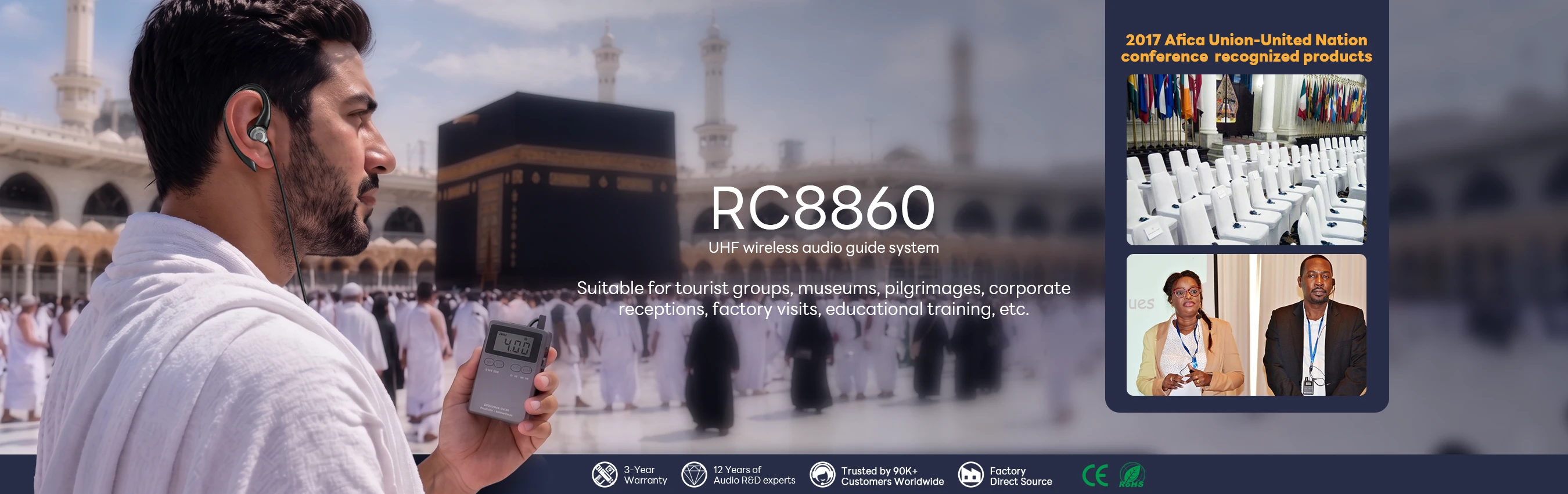
The instructor tier carries the teaching load, so it earns the flagship specification. The RC2500 transmitter weighs 104 g and runs 15 hours on its 1800 mAh cell, which covers the longest workshop day on one morning charge; its receiver side holds more than 35 hours of standby, so a unit signed out on Monday is still ready on Friday without a top-up between practical periods. Charging runs over Type-C, one standard shared with every laptop trolley the workshop already owns, and the one-key sync function re-pairs a full class set in seconds before the instructor speaks.
Because this tier never leaves the equipment office unaccompanied, the loss exposure is near zero and the specification budget is spent where students benefit: audio clarity. The 50 Hz-8 kHz frequency response is tuned for speech instruction rather than music, and fifty channels mean two adjacent workshops can run simultaneously without the demonstration bench bleeding into the welding bay commentary.
One-Key Sync Before a Class of Thirty Settles
The least glamorous feature on the RC2500 is the one that saves the most teaching minutes. A class set that pairs at the press of one button means the first five minutes of a practical period go to the exercise, not to channel hunting. When a substitute instructor covers a session, the same button removes the need for a handover briefing: power on, sync, teach. Workshops that run back-to-back cohorts through the same room rely on that simplicity twice an hour, and it is the reason the instructor tier justifies a flagship price while the student tier deliberately does not.
RC2401 Is Priced Like It Will Be Misplaced
The student tier inverts the logic. Here the specification that matters most is the price per unit, because a class set of twenty-five receivers is a consumable in academic terms. The RC2401 is the entry model in the range: the same 2.4 GHz band as the flagship, the same fifty-channel count, at a hardware cost built for volume purchase orders. Receivers weigh 50 g and transmitters 59 g, light enough that a first-year student wears one through a four-hour practical without noticing, and the entry price means a lost unit is an invoice line, not an incident report.
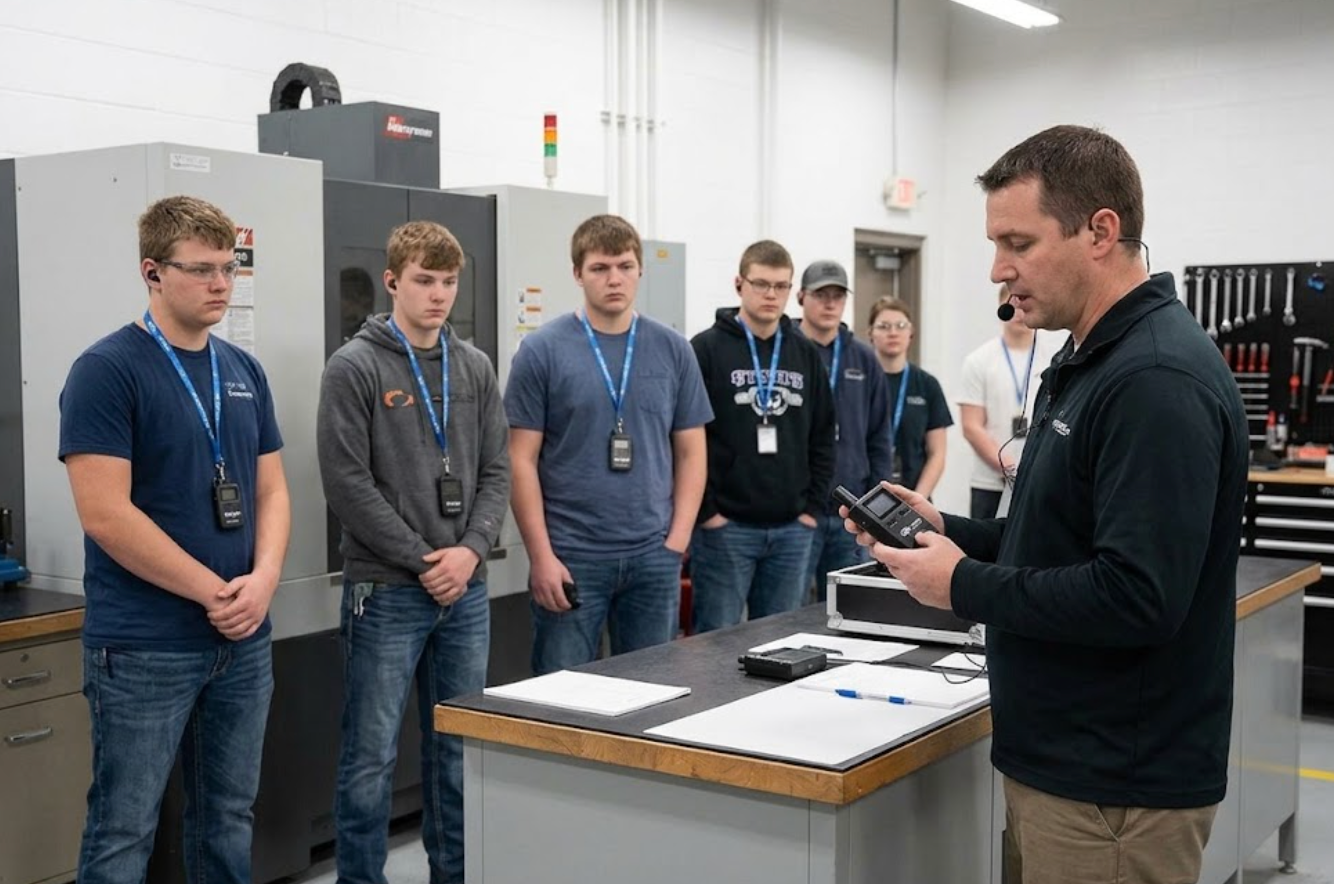
The published battery figures hold up to a teaching timetable too. A transmitter rated at 10 hours and a receiver at 20 hours of use cover any single practical day, and the 1500 mAh transmitter cell recharges between periods. Charging runs over a DC port rather than Type-C, which is the one compromise the price buys — the workshop simply keeps the dedicated adapters in the same crate as the class set, and the crate travels with the timetable.
Light Receivers Survive a Full Timetable
Weight is a wear specification disguised as a comfort one. A 50 g receiver on a lanyard survives a dropped lanyard, a stuffed backpack and a bench top; heavier units crack housings at the clip points within two semesters of the same handling. Across a thousand-hand academic year, the entry model's 50 g build is not a luxury line on the datasheet — it is the reason the pool returns from each cohort roughly complete. The 50 Hz-12 kHz receiver response covers spoken instruction cleanly, and students who miss a live demonstration hear the same content from the SG28 tier without borrowing the instructor's kit.
The SG28 Player Covers the Revision Gap
The third tier carries the recorded curriculum. The SG28 player is a 2.8-inch digital voice player with a numeric keypad: students key in an exhibit number or exercise code, and the corresponding track plays. Two gigabytes of memory hold up to 9999 audio files across 16 languages, which is enough for an entire semester of recorded safety briefings, machine walkthroughs and assessment criteria in every language the intake needs. Playback is semi-automatic by design — the student chooses when to listen, which makes it the revision tool for students who missed a live session.
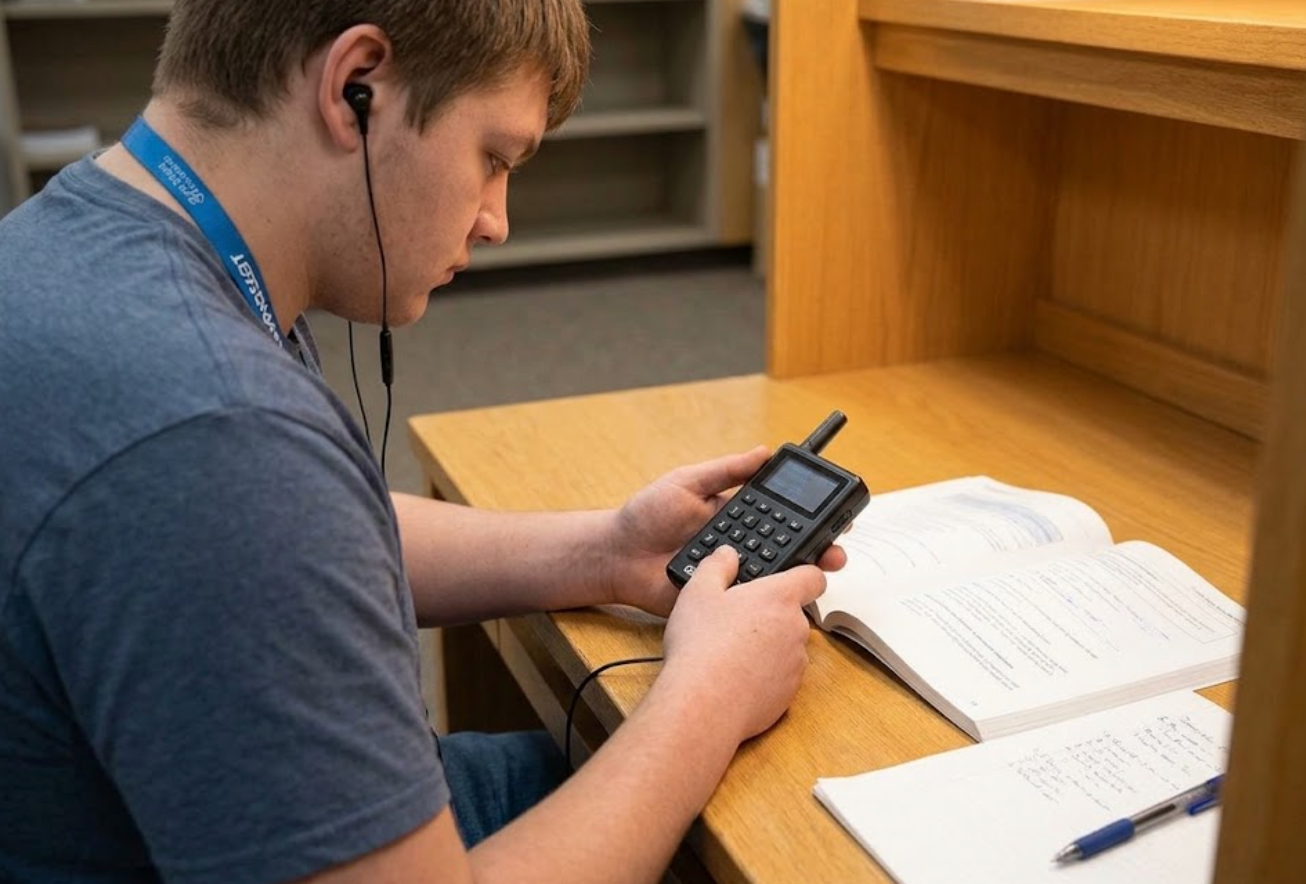
Operationally the SG28 is the most autonomous unit in the fleet: 18 hours of continuous playback on a full charge over Micro USB covers a full assessment week without a recharge, each unit ships with its own earphones, and the one-year warranty matches the reality that this tier travels furthest from supervision. Because the content lives in files rather than a live voice, updating the curriculum is a file copy, and a damaged player never takes a live lesson down with it.
💰 What Three Kits Cost Across a School Year
| Spec | RC2500 | RC2401 | SG28 player |
|---|---|---|---|
| Channels / content | 50 channels | 50 channels | 9999 files, 16 languages |
| Operating time | TX 15h / RX 35+h standby | TX 10h / RX 20h | About 18h playback |
| Weight | 104g each unit | TX 59g / RX 50g | Not published |
| Charging | Type-C | DC port | Micro USB |
| Warranty | 3 years | 3 years | 1 year |
The player's weight is not published on its product page, so that cell stays empty rather than estimated. The warranty split is deliberate on the manufacturer's side: three years on the tour guide kits matches instructor-grade duty cycles, while the one-year term on the SG28 reflects its unsupervised student handling. A workshop that assigns tiers this way replaces units at their true rate instead of averaging the fleet into one misleading budget line.
⚖️ Charging and Counting Between Semesters
The discipline that makes the three tiers work runs in the gap between cohorts. Every unit is charged, counted against the crate list, and inspected before storage; discrepancies are written off in June, when replacing them is a routine purchase, not in September, when they cost a teaching week. Spare batteries follow the same calendar: the instructor tier's cells are topped up monthly during the long break, and the student crates ship to the next intake sealed with their count sheet. Workshops that run this rhythm start each year with a complete fleet, and the published figures above — standby hours, file counts, warranty terms — become planning inputs instead of marketing claims.
Teams comparing tiers across a whole programme can start from the education audio guide range, and the tour guide system catalogue shows where each model sits in the wider line-up.
The solutions notes cover seasonal planning patterns for the rest of the year, and the same split-fleet logic transfers directly to other high-turnover environments beyond the workshop floor.