
A leading China factory specializing in Wireless Tour Guide Systems, Church Audio Guides, and Translation Headphones with premium OEM/ODM solutions.

Tel:+86 18922879583

Email:tiger.wang@richitek.com

RC2468, RC2408 and RC085: Where a Red Education Season Budget Actually Goes

A red education base does not buy audio guides the way a museum does. A museum buys once and amortizes against a steady daily flow of visitors; a study-travel site that hosts school groups on a red-education curriculum buys for a season that arrives in two or three concentrated waves — the spring semester rush in April and May, the summer camp stretch in July, and the pre-National Day intake in September. Between waves, the equipment sits in a charging cabinet and quietly depreciates. That rhythm changes which costs dominate the ledger, and it changes which receiver belongs to which job. This article splits a season's spending into its real lines — purchase, power and handling, breakage, and content — and follows three devices through a base that runs roughly 60,000 student visits a year, built on the same hardware families that power every education audio guide system deployment.

The Ledger Every Memorial Site Splits Into

Before any model number appears on a purchase requisition, the site accountant already keeps four lines. The first is hardware: transmitters, receivers, and charging cases, bought in waves that match the biggest single-day group the base has ever hosted, plus about fifteen percent for breakdown cover. The second is power and handling — the person who racks forty receivers at 16:30, spots the one that did not seat properly, and starts the charge cycle again. The third is breakage and repair, which on a student-heavy site is not a rounding error: headsets, earpieces, and batteries wear out an order of magnitude faster than mainboards. The fourth is content — the recorded narration that turns a memorial hall walk into a curriculum, re-recorded whenever the exhibit text is revised.

What makes a study season different from ordinary tourism is that the second and third lines are driven almost entirely by the age of the listener and the density of the calendar. Nine-year-olds on a spring red-story route treat an earpiece very differently than a trade delegation does, and a base that takes eight school groups in one morning has a fundamentally different channel problem than one that takes two. The three devices below were chosen against those two pressures, and each one carries its own slice of the budget.

The Workhorse That Holds the Warranty Line

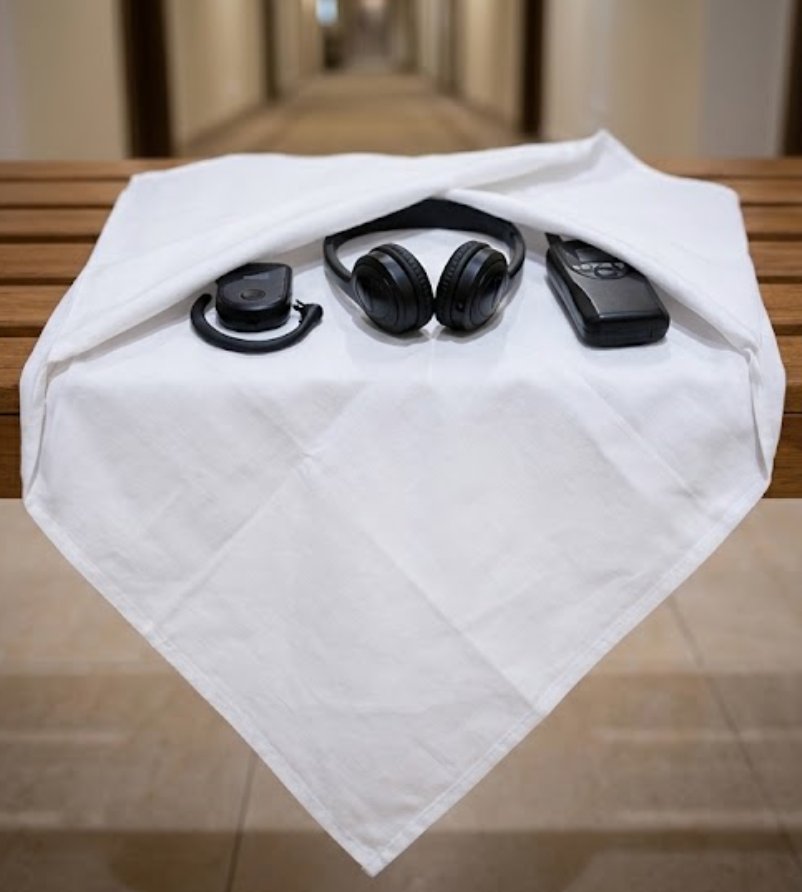
The fleet that lives at the base year-round is built around the RC085 Digital Tour Guide System, and the reason is written into its warranty card: three years of coverage with the mainboard included, explicitly excluding only the vulnerable parts — headset, microphone, and battery. On a budget ledger, that clause moves repair risk from the site to the manufacturer for the one component that is expensive to replace, while the parts that students actually break stay cheap and user-serviceable. It is the closest thing a purchase order can get to insuring the season itself.

rc085-red_education_base-memorial-hall

The engineering behind that confidence fits the building, too. The RC085 transmits on the UHF 470–510 MHz band, which penetrates the thick brick and concrete walls of a memorial hall or a restored revolutionary-site dwelling far better than 2.4 GHz systems do, and it sits well below the Wi-Fi and Bluetooth congestion that a busload of phones brings through the door. It offers two communication modes — F1 one-way broadcast for the standard guided route, and F2 two-way communication for the interactive seminar rooms where a teacher stops the group and takes questions. An LCD smart screen on the unit shows channel and status at a glance, auto sleep and wake-up conserve the charge between groups, and the unit operates multi-channel for groups running in parallel. Transmission reaches up to 200 meters, and the platform carries CE, RED, and RoHS certifications — the paperwork a school district procurement office asks for before the first invoice is signed.

Crowd Days and the Channels to Absorb Them

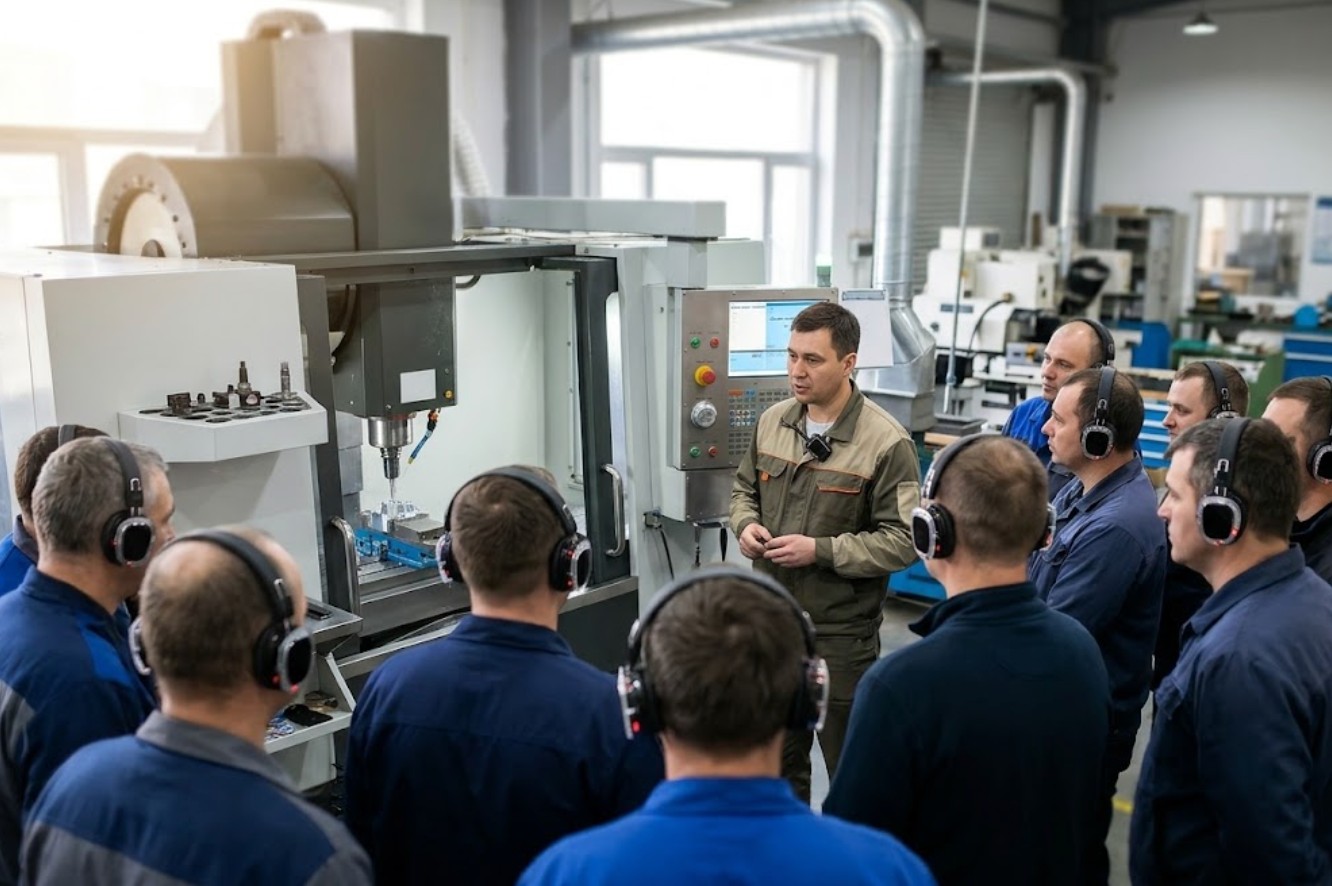
Twice a year the base hits its designed maximum: eight to ten school groups moving through the exhibition halls at staggered starts, each with its own guide, all inside one frequency-dense building. This is the day the fleet either works or generates refund phone calls, and it is why the surge kit is built on the RC2408. Its eighty independent channels on the global 2.4 GHz ISM band (2403–2483 MHz) with one-key channel synchronization let ten guide-transmitter pairs run side by side without crosstalk — a fifty-channel fleet would fit eight groups with nothing to spare, and the ninth morning bus is exactly when a shared channel starts bleeding audio into the wrong tour.

rc2408-red_education_base-crowd-day

The surge day also stresses batteries differently, because the groups do not pause: a receiver issued at 08:30 has to still be loud at 16:00 when the last delegation reaches the memorial wall. The RC2408's receiver is published at up to 20 hours on a full charge, with the transmitter at 10 hours — comfortably a double shift, which means the charging desk only runs one full cycle even on the longest program day. Weight stays non-trivial for a full-day wear: the receiver is 50 g and the transmitter 59 g, light enough that the fourth-hour complaint queue at the front desk never materializes. At 200 meters of open-area reach across the same 2.4 GHz band, the outer courtyard station no longer drops when the group rounds the statue garden.

📱 Small Ears, Lighter Kits, Fewer Breaks

The third slice of the budget belongs to the youngest visitors, and it is measured in a different currency: what survives a nine-year-old. The primary-school routes are equipped with the RC2468, whose receiver weighs just 18 grams — light enough that the lanyard, not the ear, carries it, and few enough grams that a day of wear does not end in the unit being pulled off and pocketed. The transmitter stays at 59 g, so the young volunteer guides the partner school sends lose nothing to hand fatigue. Fifty independent channels with PLL frequency synthesis hold a clean frequency for the smaller groups these routes run, and the same 2.4 GHz band reaches the full 200 meters across the outdoor parade ground.

rc2468-red_education_base-student-group

The battery split on this model matches its duty cycle: the transmitter runs 12 hours on its 1500 mAh cell, while the receiver delivers 10 hours from a compact 300 mAh pack. A primary-school program rarely exceeds five contact hours, so a morning charge covers the day with margin, and the smaller cell keeps replacement cost — the budget's ugliest recurring line on a children's route — as low as the component class allows. When a student does snap a unit, the arithmetic of an 18 g receiver versus a 50 g one shows up in the annual breakage line, because the lightest devices are also the ones that hit the floor with the least force.

What the Three Kits Put on the Table

Pulled together, the published figures behind the three posts look like this — every number below is taken from the manufacturer's own product pages, and rows a model does not publish stay out of the table:

RowRC085RC2408RC2468
BandUHF 470–510 MHz2.4 GHz ISM (2403–2483 MHz)2.4 GHz ISM (2403–2483 MHz)
ChannelsMulti-channel group operation80 independent, one-key sync50 independent, PLL synthesis
ModesF1 one-way / F2 two-wayOne-way broadcastOne-way broadcast
ReachUp to 200 m200 m open area200 m open area
Battery lifeAuto sleep / wake-up (hours not published)RX up to 20 h, TX 10 hTX 12 h (1500 mAh), RX 10 h (300 mAh)
WeightNot publishedRX 50 g, TX 59 gRX 18 g, TX 59 g
Display / certificationLCD smart screen; CE, RED, RoHS——
Warranty3 years, mainboard covered——

The dashes are deliberate. A cell left blank invites a procurement officer to assume the best number, so anything the product page does not state is left unstated here as well. The full transmitter-and-receiver families these three draw from are listed under Richitek's tour guide system range, where a site can match fleet size to its own peak-day count.

The Charging Desk and Who Staffs It

The second line of the ledger — power and handling — is where most sites underestimate a study season. Forty to eighty receivers returning at 16:30 need to be racked, seated, and verified before the building closes, and one receiver that missed its contact does not announce itself until the next morning's first group is already at the gate. The published auto sleep / wake-up power management on the RC085 fleet reduces the overnight draw, but no specification eliminates the human check. Bases that run this volume settle on a single part-time charging-desk shift whose entire job is the 16:30 rack-down and the 08:00 issue-out, and the labor line stabilizes once the routine does. The alternative — making guides responsible for their own group's rack-down — reliably fails on the days it matters most, because the surge days are precisely the days the guides leave exhausted.

What Repeat Use Does to the per-Visit Number

The reason a red education site can afford this equipment at all is the visit calendar it serves. Sixty thousand student visits spread across a season turns the entire four-line ledger into a few cents per listening hour, but the same fleet sitting through a quiet autumn costs the same depreciation against a tenth of the traffic. The practical consequence is fleet sizing: buy for the surge day, not for the annual average, and let the RC085 workhorses carry the shoulder-season school visits while the RC2408 surge kits and the RC2468 primary-school kits sit charged and counted. Sites that buy to the average end the season short-handed in May; sites that buy to the surge and fill the quiet months with community and weekend programs end the year with a per-visit figure that survives the district's budget review. For sites comparing this build-out against other venue types, Richitek keeps a set of deployment references under explore our solutions that map fleet sizes to visitor volumes.

Content is the last line, and the cheapest per use: the recorded narration that carries a red-story curriculum costs the same whether thirty students hear it or thirty thousand, which is why the sites with the lowest per-visit figures are the ones that stopped re-speaking the script live and let the recorded track carry the halls. The hardware's job is to make sure every one of those recorded words arrives intact at 470 MHz or 2.4 GHz, through brick, crowd, and a busload of phones.


Frequently Asked Questions

1. Why choose UHF 470–510 MHz for a memorial hall instead of 2.4 GHz?

The RC085's product page frames it directly: the 470–510 MHz UHF band provides stronger penetration through the brick, concrete, and steel common in memorial and heritage buildings, and it sits away from the Wi-Fi and Bluetooth congestion that visitor phones carry. For a red education base whose route passes through thick-walled restored buildings, that penetration difference is the difference between a continuous narration and one that drops at every doorway.

2. How many school groups can run at the same time on one system?

It depends on which fleet covers the day. The RC2408 publishes eighty independent channels with one-key synchronization on the 2.4 GHz band, which absorbs the eight-to-ten-group surge days with headroom; the RC2468's fifty PLL-synthesized channels serve the smaller parallel groups on primary-school routes. A base that expects more simultaneous groups than its channel count should plan the surge kit around the eighty-channel unit.

3. What exactly does the RC085's three-year warranty cover?

The published warranty covers the mainboard for three years and explicitly excludes the vulnerable parts: headset, microphone, and battery. For budgeting purposes that is the useful split — the expensive component is insured, and the wear items that students actually damage remain inexpensive, user-replaceable consumables.

4. Can the RC2468 receivers really last a full school day without a midday charge?

The published figure is 10 hours for the receiver from a 300 mAh cell and 12 hours for the transmitter from 1500 mAh. A primary-school red-education program typically runs five contact hours or fewer, so a morning charge covers the day with margin. Programs that genuinely run longer than the published window should schedule a midday swap rather than assume unpublished endurance.


2026年10月26日 12:32
ꄘ click: 41

Get the spec sheet, MOQ and a factory-direct quote

Tell us the venue, the group size and how many languages you need. An engineer at our Shenzhen factory replies within one business day with the matching model, a written quote, lead time and the CE / RoHS / ISO 9001 documents.

Talk to an engineer WhatsApp +86 189 2287 9583

Prefer email? tiger.wang@richitek.com  |  OEM / ODM, custom tooling and neutral packaging available  |  send the enquiry through our contact page

Shenzhen Rich Age Electronics Co., Ltd. (Richitek) - manufacturing wireless tour guide systems, church translation headsets and museum audio guide equipment since 2007.

no data

RC2468, RC2408 and RC085: Where a Red Education Season Budget Actually Goes

time: 2026年10月26日 click:41

A red education base does not buy audio guides the way a museum does. A museum buys once and amortizes against a steady daily flow of visitors; a study-travel site that hosts school groups on a red-education curriculum buys for a season that arrives in two or three concentrated waves — the spring semester rush in April and May, the summer camp stretch in July, and the pre-National Day intake in September. Between waves, the equipment sits in a charging cabinet and quietly depreciates. That rhythm changes which costs dominate the ledger, and it changes which receiver belongs to which job. This article splits a season's spending into its real lines — purchase, power and handling, breakage, and content — and follows three devices through a base that runs roughly 60,000 student visits a year, built on the same hardware families that power every education audio guide system deployment.

The Ledger Every Memorial Site Splits Into

Before any model number appears on a purchase requisition, the site accountant already keeps four lines. The first is hardware: transmitters, receivers, and charging cases, bought in waves that match the biggest single-day group the base has ever hosted, plus about fifteen percent for breakdown cover. The second is power and handling — the person who racks forty receivers at 16:30, spots the one that did not seat properly, and starts the charge cycle again. The third is breakage and repair, which on a student-heavy site is not a rounding error: headsets, earpieces, and batteries wear out an order of magnitude faster than mainboards. The fourth is content — the recorded narration that turns a memorial hall walk into a curriculum, re-recorded whenever the exhibit text is revised.

What makes a study season different from ordinary tourism is that the second and third lines are driven almost entirely by the age of the listener and the density of the calendar. Nine-year-olds on a spring red-story route treat an earpiece very differently than a trade delegation does, and a base that takes eight school groups in one morning has a fundamentally different channel problem than one that takes two. The three devices below were chosen against those two pressures, and each one carries its own slice of the budget.

The Workhorse That Holds the Warranty Line

The fleet that lives at the base year-round is built around the RC085 Digital Tour Guide System, and the reason is written into its warranty card: three years of coverage with the mainboard included, explicitly excluding only the vulnerable parts — headset, microphone, and battery. On a budget ledger, that clause moves repair risk from the site to the manufacturer for the one component that is expensive to replace, while the parts that students actually break stay cheap and user-serviceable. It is the closest thing a purchase order can get to insuring the season itself.

rc085-red_education_base-memorial-hall

The engineering behind that confidence fits the building, too. The RC085 transmits on the UHF 470–510 MHz band, which penetrates the thick brick and concrete walls of a memorial hall or a restored revolutionary-site dwelling far better than 2.4 GHz systems do, and it sits well below the Wi-Fi and Bluetooth congestion that a busload of phones brings through the door. It offers two communication modes — F1 one-way broadcast for the standard guided route, and F2 two-way communication for the interactive seminar rooms where a teacher stops the group and takes questions. An LCD smart screen on the unit shows channel and status at a glance, auto sleep and wake-up conserve the charge between groups, and the unit operates multi-channel for groups running in parallel. Transmission reaches up to 200 meters, and the platform carries CE, RED, and RoHS certifications — the paperwork a school district procurement office asks for before the first invoice is signed.

Crowd Days and the Channels to Absorb Them

Twice a year the base hits its designed maximum: eight to ten school groups moving through the exhibition halls at staggered starts, each with its own guide, all inside one frequency-dense building. This is the day the fleet either works or generates refund phone calls, and it is why the surge kit is built on the RC2408. Its eighty independent channels on the global 2.4 GHz ISM band (2403–2483 MHz) with one-key channel synchronization let ten guide-transmitter pairs run side by side without crosstalk — a fifty-channel fleet would fit eight groups with nothing to spare, and the ninth morning bus is exactly when a shared channel starts bleeding audio into the wrong tour.

rc2408-red_education_base-crowd-day

The surge day also stresses batteries differently, because the groups do not pause: a receiver issued at 08:30 has to still be loud at 16:00 when the last delegation reaches the memorial wall. The RC2408's receiver is published at up to 20 hours on a full charge, with the transmitter at 10 hours — comfortably a double shift, which means the charging desk only runs one full cycle even on the longest program day. Weight stays non-trivial for a full-day wear: the receiver is 50 g and the transmitter 59 g, light enough that the fourth-hour complaint queue at the front desk never materializes. At 200 meters of open-area reach across the same 2.4 GHz band, the outer courtyard station no longer drops when the group rounds the statue garden.

📱 Small Ears, Lighter Kits, Fewer Breaks

The third slice of the budget belongs to the youngest visitors, and it is measured in a different currency: what survives a nine-year-old. The primary-school routes are equipped with the RC2468, whose receiver weighs just 18 grams — light enough that the lanyard, not the ear, carries it, and few enough grams that a day of wear does not end in the unit being pulled off and pocketed. The transmitter stays at 59 g, so the young volunteer guides the partner school sends lose nothing to hand fatigue. Fifty independent channels with PLL frequency synthesis hold a clean frequency for the smaller groups these routes run, and the same 2.4 GHz band reaches the full 200 meters across the outdoor parade ground.

rc2468-red_education_base-student-group

The battery split on this model matches its duty cycle: the transmitter runs 12 hours on its 1500 mAh cell, while the receiver delivers 10 hours from a compact 300 mAh pack. A primary-school program rarely exceeds five contact hours, so a morning charge covers the day with margin, and the smaller cell keeps replacement cost — the budget's ugliest recurring line on a children's route — as low as the component class allows. When a student does snap a unit, the arithmetic of an 18 g receiver versus a 50 g one shows up in the annual breakage line, because the lightest devices are also the ones that hit the floor with the least force.

What the Three Kits Put on the Table

Pulled together, the published figures behind the three posts look like this — every number below is taken from the manufacturer's own product pages, and rows a model does not publish stay out of the table:

RowRC085RC2408RC2468
BandUHF 470–510 MHz2.4 GHz ISM (2403–2483 MHz)2.4 GHz ISM (2403–2483 MHz)
ChannelsMulti-channel group operation80 independent, one-key sync50 independent, PLL synthesis
ModesF1 one-way / F2 two-wayOne-way broadcastOne-way broadcast
ReachUp to 200 m200 m open area200 m open area
Battery lifeAuto sleep / wake-up (hours not published)RX up to 20 h, TX 10 hTX 12 h (1500 mAh), RX 10 h (300 mAh)
WeightNot publishedRX 50 g, TX 59 gRX 18 g, TX 59 g
Display / certificationLCD smart screen; CE, RED, RoHS——
Warranty3 years, mainboard covered——

The dashes are deliberate. A cell left blank invites a procurement officer to assume the best number, so anything the product page does not state is left unstated here as well. The full transmitter-and-receiver families these three draw from are listed under Richitek's tour guide system range, where a site can match fleet size to its own peak-day count.

The Charging Desk and Who Staffs It

The second line of the ledger — power and handling — is where most sites underestimate a study season. Forty to eighty receivers returning at 16:30 need to be racked, seated, and verified before the building closes, and one receiver that missed its contact does not announce itself until the next morning's first group is already at the gate. The published auto sleep / wake-up power management on the RC085 fleet reduces the overnight draw, but no specification eliminates the human check. Bases that run this volume settle on a single part-time charging-desk shift whose entire job is the 16:30 rack-down and the 08:00 issue-out, and the labor line stabilizes once the routine does. The alternative — making guides responsible for their own group's rack-down — reliably fails on the days it matters most, because the surge days are precisely the days the guides leave exhausted.

What Repeat Use Does to the per-Visit Number

The reason a red education site can afford this equipment at all is the visit calendar it serves. Sixty thousand student visits spread across a season turns the entire four-line ledger into a few cents per listening hour, but the same fleet sitting through a quiet autumn costs the same depreciation against a tenth of the traffic. The practical consequence is fleet sizing: buy for the surge day, not for the annual average, and let the RC085 workhorses carry the shoulder-season school visits while the RC2408 surge kits and the RC2468 primary-school kits sit charged and counted. Sites that buy to the average end the season short-handed in May; sites that buy to the surge and fill the quiet months with community and weekend programs end the year with a per-visit figure that survives the district's budget review. For sites comparing this build-out against other venue types, Richitek keeps a set of deployment references under explore our solutions that map fleet sizes to visitor volumes.

Content is the last line, and the cheapest per use: the recorded narration that carries a red-story curriculum costs the same whether thirty students hear it or thirty thousand, which is why the sites with the lowest per-visit figures are the ones that stopped re-speaking the script live and let the recorded track carry the halls. The hardware's job is to make sure every one of those recorded words arrives intact at 470 MHz or 2.4 GHz, through brick, crowd, and a busload of phones.
Frequently Asked Questions

1. Why choose UHF 470–510 MHz for a memorial hall instead of 2.4 GHz?

The RC085's product page frames it directly: the 470–510 MHz UHF band provides stronger penetration through the brick, concrete, and steel common in memorial and heritage buildings, and it sits away from the Wi-Fi and Bluetooth congestion that visitor phones carry. For a red education base whose route passes through thick-walled restored buildings, that penetration difference is the difference between a continuous narration and one that drops at every doorway.

2. How many school groups can run at the same time on one system?

It depends on which fleet covers the day. The RC2408 publishes eighty independent channels with one-key synchronization on the 2.4 GHz band, which absorbs the eight-to-ten-group surge days with headroom; the RC2468's fifty PLL-synthesized channels serve the smaller parallel groups on primary-school routes. A base that expects more simultaneous groups than its channel count should plan the surge kit around the eighty-channel unit.

3. What exactly does the RC085's three-year warranty cover?

The published warranty covers the mainboard for three years and explicitly excludes the vulnerable parts: headset, microphone, and battery. For budgeting purposes that is the useful split — the expensive component is insured, and the wear items that students actually damage remain inexpensive, user-replaceable consumables.

4. Can the RC2468 receivers really last a full school day without a midday charge?

The published figure is 10 hours for the receiver from a 300 mAh cell and 12 hours for the transmitter from 1500 mAh. A primary-school red-education program typically runs five contact hours or fewer, so a morning charge covers the day with margin. Programs that genuinely run longer than the published window should schedule a midday swap rather than assume unpublished endurance.


Get the spec sheet, MOQ and a factory-direct quote

Tell us the venue, the group size and how many languages you need. An engineer at our Shenzhen factory replies within one business day with the matching model, a written quote, lead time and the CE / RoHS / ISO 9001 documents.

Talk to an engineer WhatsApp +86 189 2287 9583

Prefer email? tiger.wang@richitek.com  |  OEM / ODM, custom tooling and neutral packaging available  |  send the enquiry through our contact page

Shenzhen Rich Age Electronics Co., Ltd. (Richitek) - manufacturing wireless tour guide systems, church translation headsets and museum audio guide equipment since 2007.

no data
×

Contact us

email:
name:
subject:
content: