
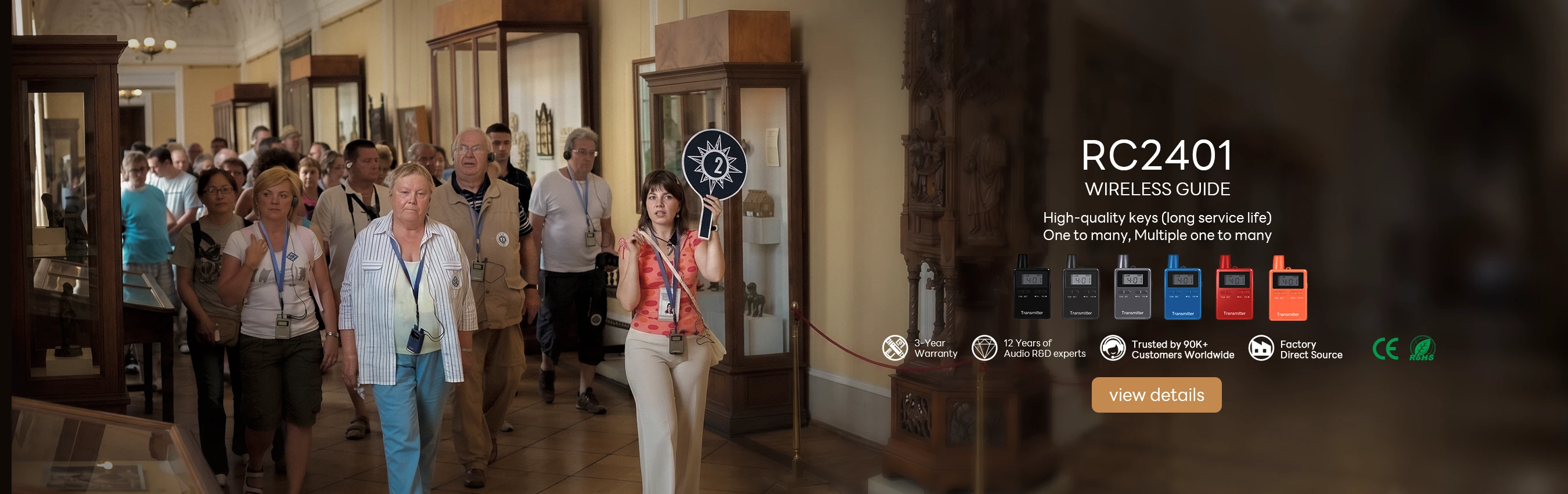
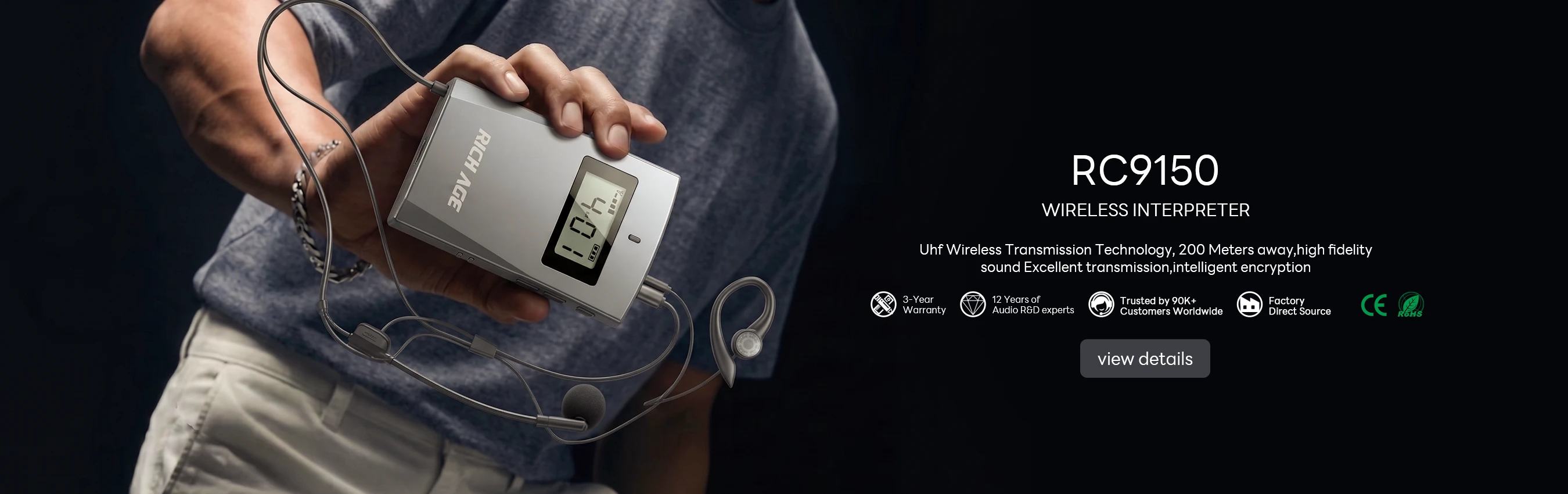
Every major motor show runs as two separate events wearing one badge. The press and media days at the start are small, dense and hungry for detail: hundreds of journalists, each with a recording device, moving between reveal stages and technical briefings on a fixed schedule. The public days that follow are the opposite shape — tens of thousands of visitors, most of whom will spend four minutes at a stand and never join a guided tour. Treating those two crowds as one audience is where visitor audio budgets fail, because the equipment that flatters a journalist annoys a casual visitor, and the kit that survives a public gate queue wastes a reporter's time.
Planning the season ahead of the show calendar means deciding, before the floor plan is even final, which units serve which crowd. This article works through that split with three systems: the RC085 with its UHF band and lavalier option, the RC9150 with the longest standby figures in the range, and the Silent Disco headphone kit that lets a launch stage run in near silence. The goal is a channel plan, a charging plan and a booking plan that hold across both phases without doubling the inventory.
Press Briefings Reward Detail, Not Loudness
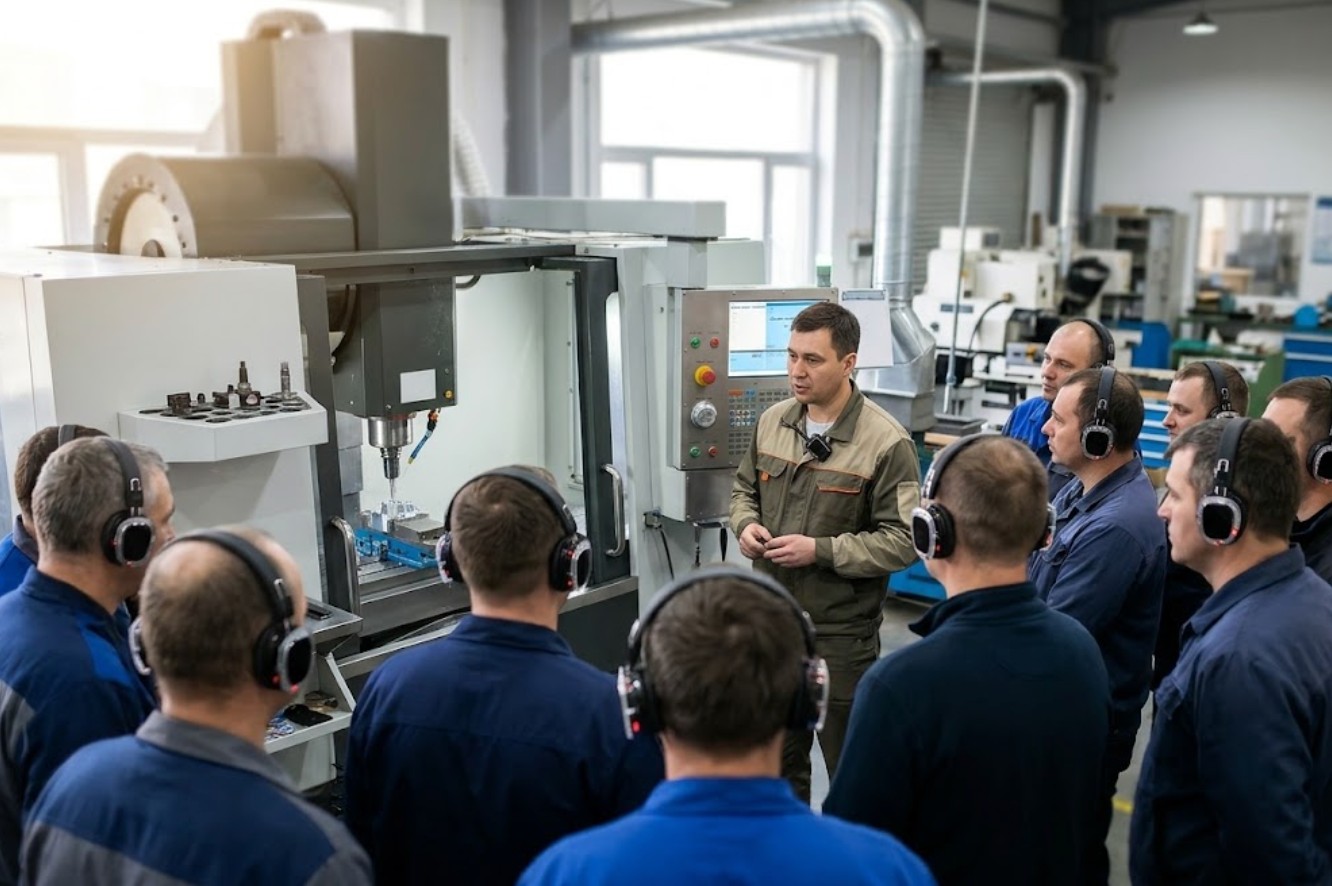
A journalist at a technical briefing is not there to be entertained; they are there to quote torque figures and battery chemistry accurately. What serves them is a closed, low-noise audio loop: one presenter, a small circle of listeners, and a transmitter that can take a proper microphone feed. This is where the RC085 earns its slot in the media phase. Its optional headset and lavalier microphone inputs mean a presenter can clip a proper broadcast-grade mic rather than shouting over a console, and the published receiver sensitivity of about -102 dBm keeps the link stable when fifty recorders, phones and camera hops crowd the same air.
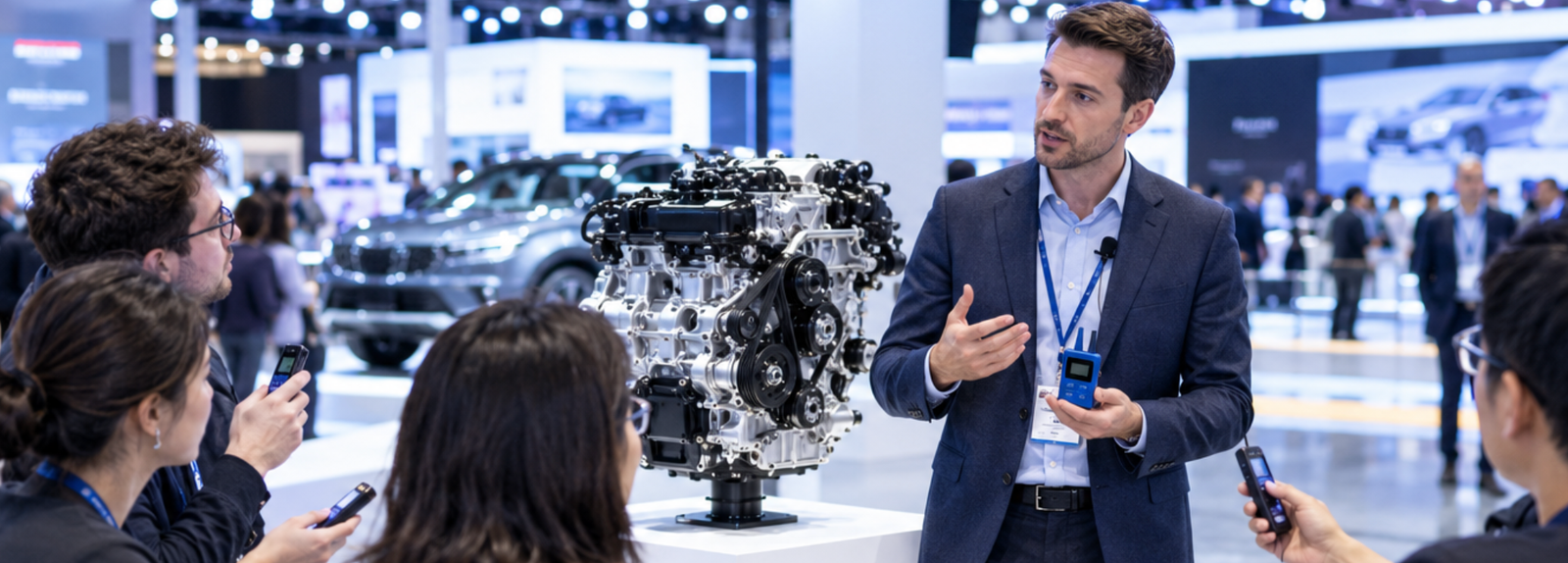
There is also a volume arithmetic that works in favour of reserving the RC085 pool for press duty. Media groups at a launch briefing rarely exceed thirty people, so a single transmitter with a hundred available channels covers the group with headroom for several parallel briefings from other exhibitors. On our last show cycle we held twenty channels as a fixed reservation for press loops, which sounds generous until three competing launches run at once and every clean frequency is taken — the limit is not the hardware table, it is the shared convention space.
💡 Why UHF Holds Up Inside a Hall Full of Transmitters
A motor show floor is one of the dirtiest radio environments an audio guide will ever work in. Two-way radios, wireless cameras, HDMI extenders and intercom systems all compete for spectrum, and most of them cluster in the 2.4 GHz band because it is licence-free worldwide. The RC085 sidesteps that congestion entirely: its 470-510 MHz UHF range is a band the exhibition industry barely touches, which is precisely why the certification list (CE, RED and RoHS on the current unit) matters less on paper than it does in practice — the band itself is the advantage.
The same logic argues against putting a 2.4 GHz system on press duty. A 2.4 GHz transmitter can work perfectly at a quiet heritage site and then drop packets every few seconds in a hall where eight live streams run simultaneously. Frequency response of 50 Hz-12 kHz on the RC085 link is ample for speech, and speech is what a briefing transmits. The lesson from previous seasons is blunt: assign by band environment first, by feature list second. Units certified for the region and carrying a three-year motherboard warranty also reduce the downside of handing expensive kits to subcontracted hostesses who will drop them.
🚀 Gate Queues Reward Speed, and the RC9150 Is Built for Volume
Public days invert every assumption of the press phase. Visitors arrive in family groups, spend minutes rather than hours, and hand equipment back with no ceremony. The bottleneck is not audio quality — it is throughput at the handout desk. Here the RC9150 carries the load: transmitters and receivers both weigh 97.5 g, light enough that a queue of two hundred visitors can be served without staff fatigue becoming its own problem, and both ends charge over Type-C, one cable standard for every charging brick on the desk.
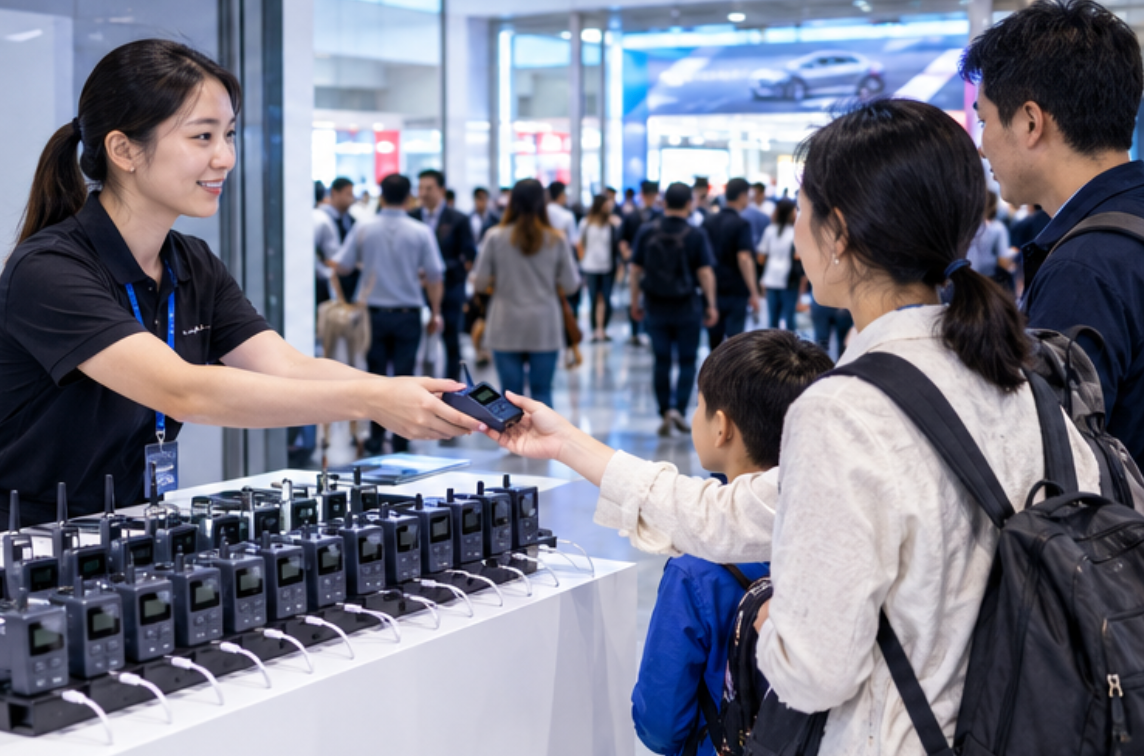
The battery figures are the quiet argument. A transmitter rated at 15 hours and a receiver at more than 35 hours of standby mean a kit issued at gate opening at 09:00 does not need a mid-day swap even if the show runs late sessions. On a public weekend we plan for one charge cycle per day rather than two, which halves the number of charged spares that must sit ready at the desk. Each unit carries a 3.7 V 1800 mAh cell, and the 100-channel count means several guide groups can coexist without a visitor wandering into the wrong commentary.
What a Ten-Hour Window Covers on the Busiest Day
It is worth converting the standby figures into show-floor time. Doors open at 09:00 and the last crowd push ends around 19:00 on peak days — a ten-hour serving window. A receiver with more than 35 hours of standby and roughly 20 hours of active use is never the reason a tour stops. The 35-plus figure also absorbs the standby drain from units issued in the morning but claimed slowly, which happens constantly at a public gate: visitors collect, wander, and only switch on when a guide gathers them. Cheap receivers die in that gap; long-standby units do not.
Launch Stages Need Silence, Not Another Speaker Stack
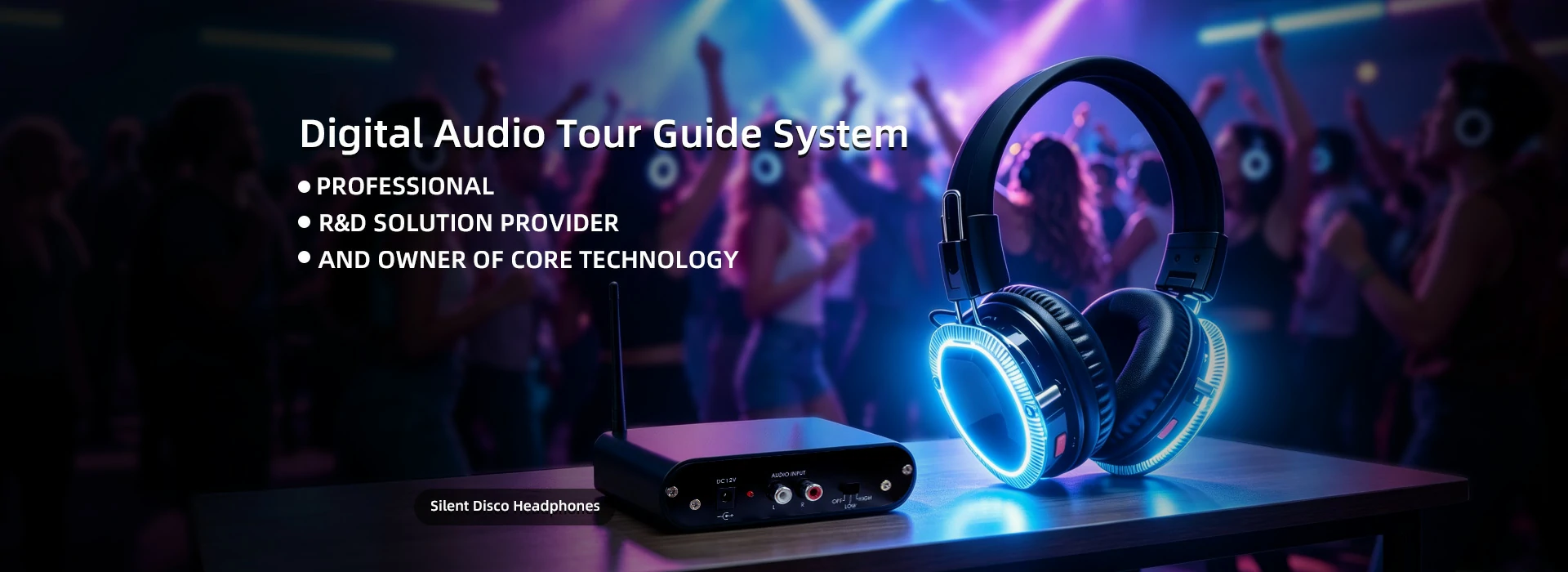
The third crowd is the one standing in front of a roped-off concept car while the PA system thunders elsewhere in the hall. Explaining engineering to that visitor through more loudspeaker power is hopeless; the answer is to remove the shared air entirely. The Silent Disco headphone kit does exactly that: visitors put on closed headphones, the presenter speaks into the RC-409 transmitter, and the RC-50RF receivers deliver audio regardless of the hall noise. Ten channels let one stage run several language tracks at once, and the five-colour LED ring shows staff at a glance which language a visitor is wearing.
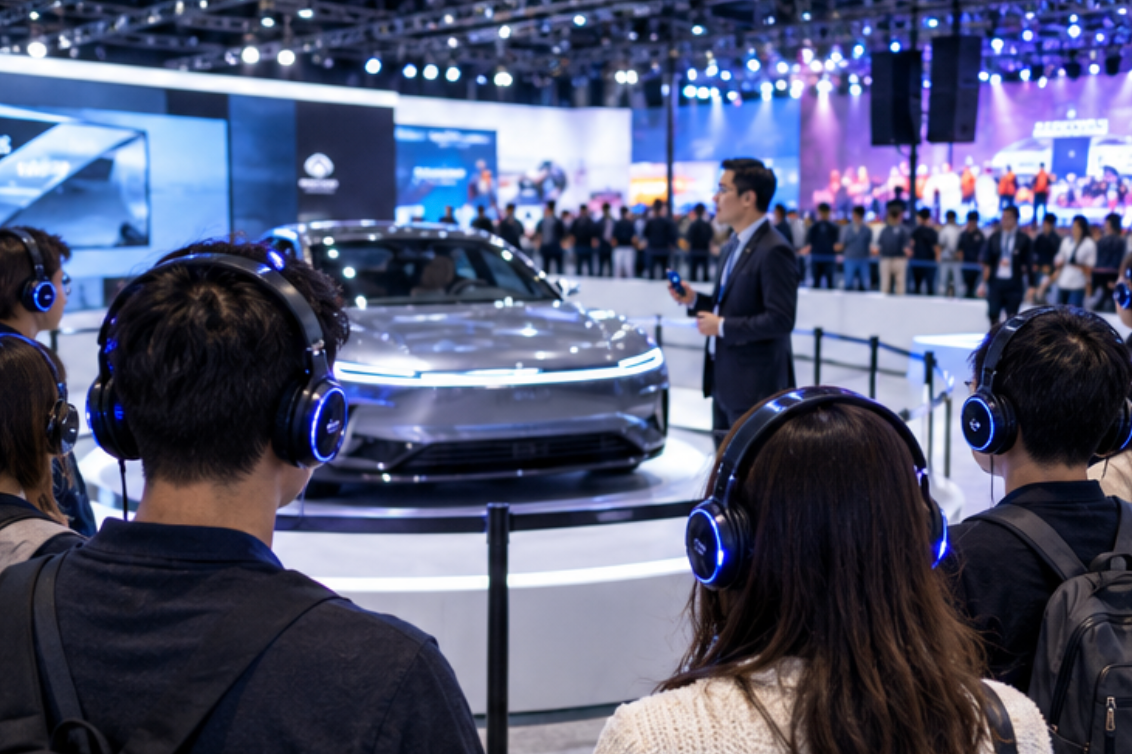
Operationally the kit is friendlier than its exotic reputation suggests. Working range of 200 to 500 m covers an entire hall from one transmitter position, the 500 mAh battery runs about 10 hours, and a full recharge takes roughly 3 hours over Micro USB, so an overnight cycle restores everything even after the longest public day. Because the headphones are collected at the stage exit rather than the main gate, losses stay local: one staff member, one crate, one count. That simplicity is why the launch stage, not the gate queue, is where silent systems pay back first.
One Table, Both Crowds
| Spec | RC085 | RC9150 | Silent Disco kit |
|---|---|---|---|
| Channels | 100 | 100 | 10 |
| Operating time | TX 12h / RX 20h | TX 15h / RX 35+h standby | About 10h |
| Working range | 1-200m | 1-200m | 200-500m |
| Charging port | USB | Type-C | Micro USB, about 3h full |
| Weight | TX 65g / RX 60g | 97.5g each unit | Not published |
The manufacturer does not publish a frequency band for the headphone kit, so that row is left out rather than guessed; the two guide systems are documented at 470-510 MHz UHF and 2403-2483 MHz respectively. Weight for the headphone set is likewise absent from the product page. Where a figure exists it comes straight from the specification sheet, and where it does not, the plan simply routes that system to the role that does not depend on it — which is the whole method of splitting a show by crowd type.
Booking Both Phases Without Counting Units Twice
The final discipline is inventory arithmetic. A fleet that serves press days and public days with the same pool must budget for the handover night in between: kits return from media duty late, need a charge cycle, and must be recounted before the gates open to the public. The safe rule from recent seasons is to hold twenty percent of each pool as phase-change spares rather than treating the fleet as one number. Channel plans should also be written per phase — a channel reserved for a press loop on Tuesday is free for a public tour on Saturday, but only if someone actually rewrites the sheet.
Teams that want to see how a full visitor-audio programme fits together across a year of exhibitions can review the conference and event solutions overview, and the tour guide system range page summarises which frequencies and form factors sit where in the catalogue. Neither replaces the exercise above; both shorten the first planning call.
What to Lock Before the Show Contract Is Signed
Exhibition organisers confirm stand space many months ahead, but audio decisions lag until the final month, by which point rental stock across the industry is thin. The working order that has held up across several show seasons is: fix the band decision first (UHF for press loops, 2.4 GHz for volume duty, silent headphones for stages), then the channel reservations, then charging infrastructure, and only last the colour and branding extras. A buyer who follows the published solution notes for seasonal planning will recognise this order — it is the sequence that avoids re-negotiation, because every step upstream makes the next one cheaper.
Getting the split right also changes what happens after the show. Units reserved for press duty come back with lavalier cables to inspect; public-duty receivers come back needing a wipe and a count; headphone crates come back needing a charge. Three return conditions, three inspection checklists, one fleet. That is the real meaning of serving two crowds at once: not buying more equipment, but assigning the equipment so that each crowd gets the specification it actually stresses.