
A leading China factory specializing in Wireless Tour Guide Systems, Church Audio Guides, and Translation Headphones with premium OEM/ODM solutions.

Tel:+86 18922879583

Email:tiger.wang@richitek.com

RC2468, RC9150 and RC2408: Three Numbers Redefining the Concert Season

A concert season is a stress test that no museum floor or factory line can imitate. The crowd arrives in a single wave, waits through the support act wearing whatever the venue handed it, and stays through an encore that nobody can schedule. Every season the expectations creep up: listeners judge the hardware on their ears as much as the show in front of them, and operators quietly rewrite what they order.

That rewrite shows up in the specifications. Three numbers from the current Richitek line trace the shift precisely: an 18-gram ear-hook receiver, an 80-channel buffer against a crowded radio environment, and a 15-hour transmitter shift with more than 35 hours of receiver standby. This article walks through what each number means for concert and large-venue work, and where the RC2468, the RC9150 and the RC2408 each fit.

📡 What a Concert Day Asks of a Wireless System

The working day is longer than the show. Rigging and soundcheck happen in the afternoon, doors open two hours before the first note, and the crew is still collecting receivers while the load-out trucks are being packed. A system that was specced for a two-hour museum circuit meets a very different clock here, and the difference is measurable in battery figures rather than marketing language.

The radio environment is the second pressure. A concert hall on show night carries wireless microphones, in-ear monitors, lighting control links and thousands of phones, all sharing spectrum with the venue's own explanation or commentary system. A tour guide system that works flawlessly in an empty hall can become a different machine in a full one, which is why channel count and interference handling have moved from footnote to headline. The sections below take the three numbers in turn and match them to the models that carry them.

The collection routine is the third pressure, and the least glamorous. Hundreds of receivers come back at once, in the dark, from guests who have already stopped listening; anything that runs out mid-show generates a complaint, and anything that needs a charging cycle between a matinee and an evening show simply cannot keep the schedule. Battery and standby figures therefore read differently here than in a daytime touring context, and the models that survive concert work are the ones whose numbers were set with a full day, not a single session, in mind.

The 18-Gram Receiver: Wearability Became a Specification

The first number sits on the listener. Concert audiences wear a receiver for the whole evening: queueing, support act, main show, encore. A few grams stop mattering in the first ten minutes and start mattering in the third hour, and operators now read receiver weight the way they read sound quality.
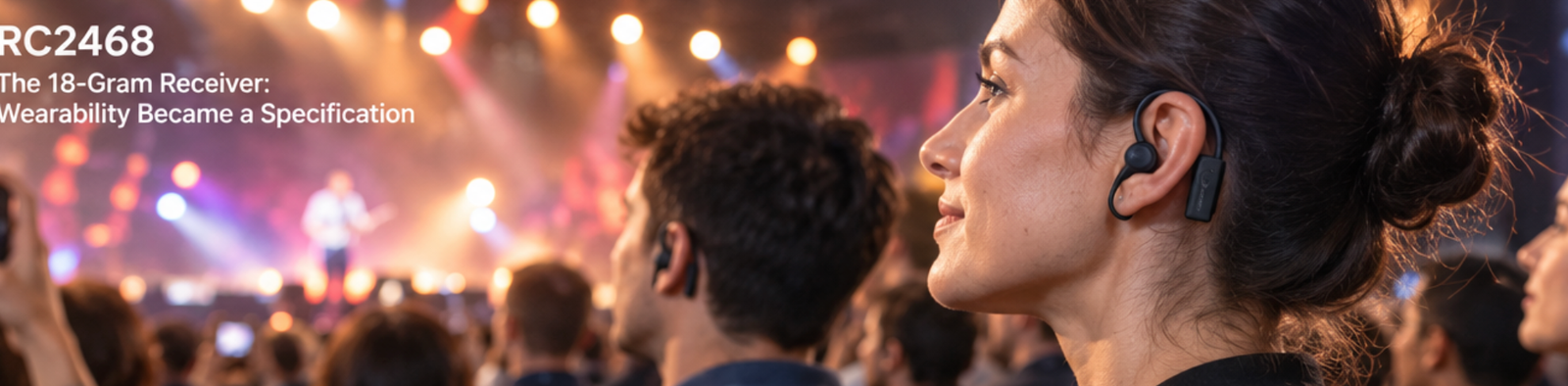
RC2468-concert_venue-earhook-lightness

The RC2468 Ultra-Light 2.4G Tour Guide System is the line's answer to that expectation. Its ear-hook receiver weighs 18 grams, against 50 grams for the standard pocket-style receivers in the same family, and the transmitter stays at 59 grams. The penalty for the light build is a small 3.7V 300mAh receiver battery, rated at roughly eight hours per charge, which covers an evening comfortably but is not a multi-day unit. The transmitter runs ten hours on its 1500mAh pack. For a venue that hands receivers to paying guests and wants them forgotten rather than noticed, the 18-gram figure is the whole argument.

The 80-Channel Buffer: Sharing the Air With the Show

The second number is about coexistence. A large production rarely needs one group; it needs a VIP group, a press group, a foreign-language group and a backstage group, all listening at once, in a hall where the show's own wireless fleet is already dense. Every additional channel is an additional group that can run simultaneously without colliding.
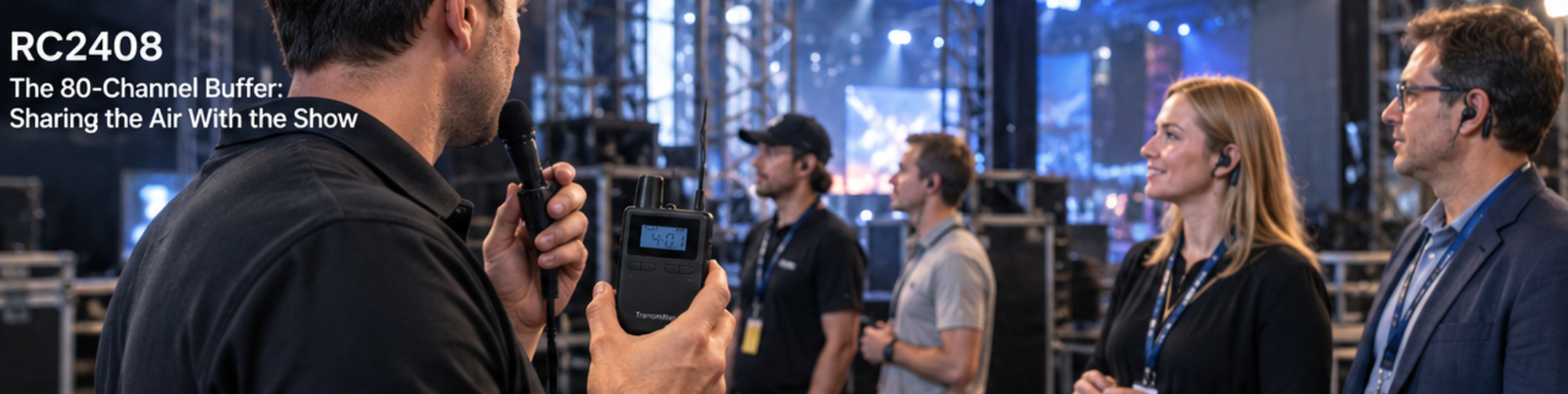
RC2408-concert_venue-channel-buffer

The RC2408 Wireless Tour Guide System carries 80 channels on the 2.4G band (2403-2483 MHz) with PLL frequency synthesis and 10mW output. Its receiver runs twenty hours on a 1000mAh pack and the transmitter ten hours on 1500mAh, so a full show day passes without a mid-event swap. Receivers weigh 50 grams, transmitters 59 grams, and charging runs through a DC port. Against the 50-channel standard configuration, the extra thirty channels are exactly the headroom a multi-group concert operation keeps reaching for as its season grows.

The 15-Hour Shift: From Doors Open to Load-Out

The third number belongs to the biggest rooms. Stadium-scale operations hand out hundreds of receivers, run multiple shows back to back, and cannot afford a charging cycle in the middle of a weekend. There the talk shifts from per-show battery life to per-day battery life, and to standby figures that decide whether the kit is still ready on the second morning.
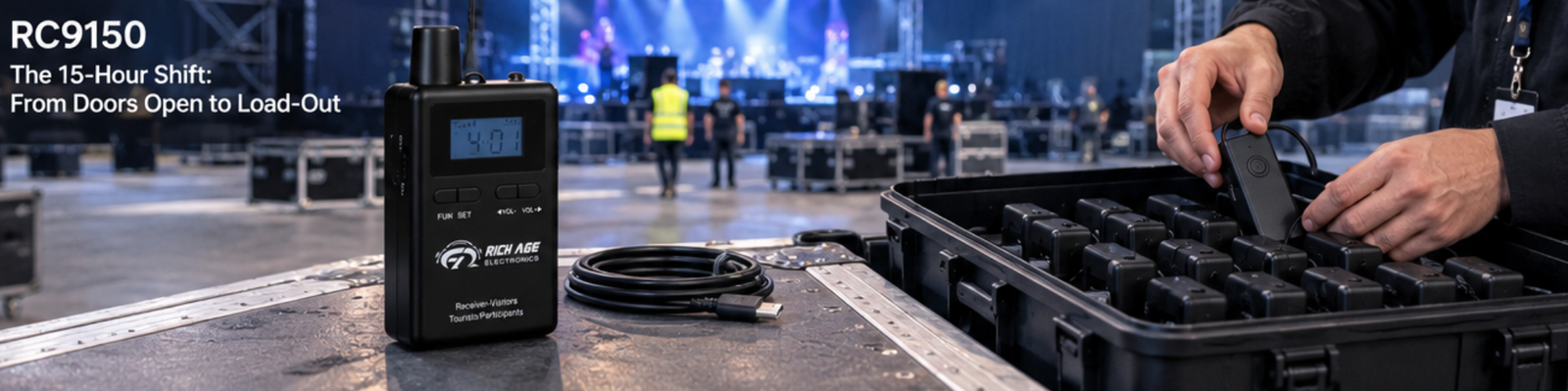
RC9150-concert_venue-long-shift

The RC9150 2.4G Wireless Audio Guide System is built around that arithmetic. The transmitter runs fifteen hours on its 1800mAh pack and the receiver is rated at more than 35 hours, with matching standby figures of 15 hours and 35-plus hours. It carries the widest channel count of the three at 100, weighs 97.5 grams on both ends, and is the only one of the trio charged over Type-C. The frequency response spans 20Hz to 8kHz, the widest of the three at the low end. For a season of consecutive show nights, the 35-hour figure is the difference between charging every night and charging every few days.

The Figures, Line by Line

The table collects the comparable figures from the manufacturer's current specification sheet.

ColumnRC2468RC2408RC9150
Channels5080100
Band2.4G (2403-2483 MHz)2.4G (2403-2483 MHz)2.4G (2403-2483 MHz)
Output power10mW10mW10mW
Tx battery life10h (1500mAh)10h (1500mAh)15h (1800mAh)
Rx battery life8h approx. (300mAh)20h (1000mAh)35+h (1800mAh)
Weight (Tx / Rx)59g / 18g ear-hook59g / 50g97.5g / 97.5g
Charging portUSBDC PortType-C

What These Numbers Do Not Cover

Frequency response is quoted in three different shapes across the three pages. The RC9150 lists a single 20Hz-8kHz range; the RC2468 and the RC2408 both split the figure, quoting 50Hz-200kHz on the transmitter and 50Hz-12kHz on the receiver. The receiver numbers are the ones a listener actually hears through, and on those the three sit within a comparable band, with the RC9150 reaching half an octave lower at the bottom. The split quoting is worth knowing before a buyer compares sheets from different manufacturers and reads the two formats as contradictory.

The battery chemistry also deserves a note. All three run 3.7V lithium packs, and the receiver figures scale directly with capacity: 300mAh yields the eight-hour class of service on the RC2468, 1000mAh yields twenty hours on the RC2408, and 1800mAh yields the 35-plus class on the RC9150. That linearity is useful when a venue plans spare batteries: one spare 1000mAh receiver pack doubles the RC2408's effective service window far more cheaply than any other upgrade on the sheet.

On the transmitter side the same arithmetic holds. The RC2468 and the RC2408 share the same 1500mAh transmitter pack and the same ten-hour rating, so a fleet that mixes the two models only needs one transmitter spare profile, while the RC9150's 1800mAh pack remains its own line item on the inventory sheet. Color options follow a similar operational logic: the RC2468's transmitters ship in multiple colors, which rental desks use to mark language groups visually from across a lobby, while the RC2408 and the RC9150 keep a darker standard finish. None of these rows change radio performance, but all of them surface in the season's running cost.

🔮 Where the Trend Points Next

Read together, the three numbers describe where venue audio is heading. Listeners now expect to forget they are wearing hardware, which pushes receiver weight down toward the 18-gram class. Productions keep adding simultaneous language and crew groups, which pushes channel counts from the 50-class toward 80 and 100. And the working day keeps stretching, which pushes the battery conversation from hours per show to hours per season-week. Operations planning a multi-group venue rollout can see how these roles map onto the wider conference and event solutions before committing to a fleet mix.

The practical summary is that the three models are complements rather than substitutes: the RC2468 for guest-facing comfort, the RC2408 for multi-group coexistence, and the RC9150 for marathon operations. Full specifications for the wireless tour guide system range sit on the product pages, and the solutions library collects deployment notes from tours, exhibitions and conference floors for teams still sizing their first fleet.

Frequently Asked Questions

1. Which of the three suits a venue that runs different show types every week?

The RC2408 is the flexible middle case: 80 channels cover several simultaneous groups, the 20-hour receiver and 10-hour transmitter cover a full event day, and the 50-gram receivers suit short-term handouts. Choose the RC9150 when the calendar stacks consecutive stadium nights and the 35-hour receiver class pays for itself; choose the RC2468 when the audience wears the receiver for the entire evening and weight is the deciding complaint.

2. Can all three units share one charging cart between shows?

Not directly, because the charging ports differ: the RC9150 charges over Type-C, the RC2468 over USB (its page specifies Micro USB 5V/1A), and the RC2408 over a DC port. A mixed fleet needs either separate carts or a crate of adapter cables, and the charging plan should be written into the inventory before the first multi-model show night rather than improvised backstage.

3. Will these systems interfere with the show's own wireless microphones?

All three transmit at 10mW on the 2.4G band (2403-2483 MHz), a low power over a short range, and concert wireless microphone fleets usually live in the UHF television bands, so direct overlap is uncommon. The realistic risk is congestion from phones and Wi-Fi in the same 2.4G space, which is exactly what the higher channel counts and PLL synthesis are for. A short channel-coordination check with the production's RF engineer before doors is still the professional habit.

4. How many separate listener groups can each system run at once?

The channel count is the ceiling: 50 simultaneous groups on the RC2468, 80 on the RC2408, and 100 on the RC9150. In practice a concert operation uses far fewer, reserving one channel per language or crew function and keeping the rest clear as fallback. The larger counts matter most when several departments of the same venue run independent groups on the same night.


2026年10月28日 11:40
ꄘ click: 12

Get the spec sheet, MOQ and a factory-direct quote

Tell us the venue, the group size and how many languages you need. An engineer at our Shenzhen factory replies within one business day with the matching model, a written quote, lead time and the CE / RoHS / ISO 9001 documents.

Talk to an engineer WhatsApp +86 189 2287 9583

Prefer email? tiger.wang@richitek.com  |  OEM / ODM, custom tooling and neutral packaging available  |  send the enquiry through our contact page

Shenzhen Rich Age Electronics Co., Ltd. (Richitek) - manufacturing wireless tour guide systems, church translation headsets and museum audio guide equipment since 2007.

no data

RC2468, RC9150 and RC2408: Three Numbers Redefining the Concert Season

time: 2026年10月28日 click:12

A concert season is a stress test that no museum floor or factory line can imitate. The crowd arrives in a single wave, waits through the support act wearing whatever the venue handed it, and stays through an encore that nobody can schedule. Every season the expectations creep up: listeners judge the hardware on their ears as much as the show in front of them, and operators quietly rewrite what they order.

That rewrite shows up in the specifications. Three numbers from the current Richitek line trace the shift precisely: an 18-gram ear-hook receiver, an 80-channel buffer against a crowded radio environment, and a 15-hour transmitter shift with more than 35 hours of receiver standby. This article walks through what each number means for concert and large-venue work, and where the RC2468, the RC9150 and the RC2408 each fit.

📡 What a Concert Day Asks of a Wireless System

The working day is longer than the show. Rigging and soundcheck happen in the afternoon, doors open two hours before the first note, and the crew is still collecting receivers while the load-out trucks are being packed. A system that was specced for a two-hour museum circuit meets a very different clock here, and the difference is measurable in battery figures rather than marketing language.

The radio environment is the second pressure. A concert hall on show night carries wireless microphones, in-ear monitors, lighting control links and thousands of phones, all sharing spectrum with the venue's own explanation or commentary system. A tour guide system that works flawlessly in an empty hall can become a different machine in a full one, which is why channel count and interference handling have moved from footnote to headline. The sections below take the three numbers in turn and match them to the models that carry them.

The collection routine is the third pressure, and the least glamorous. Hundreds of receivers come back at once, in the dark, from guests who have already stopped listening; anything that runs out mid-show generates a complaint, and anything that needs a charging cycle between a matinee and an evening show simply cannot keep the schedule. Battery and standby figures therefore read differently here than in a daytime touring context, and the models that survive concert work are the ones whose numbers were set with a full day, not a single session, in mind.

The 18-Gram Receiver: Wearability Became a Specification

The first number sits on the listener. Concert audiences wear a receiver for the whole evening: queueing, support act, main show, encore. A few grams stop mattering in the first ten minutes and start mattering in the third hour, and operators now read receiver weight the way they read sound quality.

RC2468-concert_venue-earhook-lightness

The RC2468 Ultra-Light 2.4G Tour Guide System is the line's answer to that expectation. Its ear-hook receiver weighs 18 grams, against 50 grams for the standard pocket-style receivers in the same family, and the transmitter stays at 59 grams. The penalty for the light build is a small 3.7V 300mAh receiver battery, rated at roughly eight hours per charge, which covers an evening comfortably but is not a multi-day unit. The transmitter runs ten hours on its 1500mAh pack. For a venue that hands receivers to paying guests and wants them forgotten rather than noticed, the 18-gram figure is the whole argument.

The 80-Channel Buffer: Sharing the Air With the Show

The second number is about coexistence. A large production rarely needs one group; it needs a VIP group, a press group, a foreign-language group and a backstage group, all listening at once, in a hall where the show's own wireless fleet is already dense. Every additional channel is an additional group that can run simultaneously without colliding.

RC2408-concert_venue-channel-buffer

The RC2408 Wireless Tour Guide System carries 80 channels on the 2.4G band (2403-2483 MHz) with PLL frequency synthesis and 10mW output. Its receiver runs twenty hours on a 1000mAh pack and the transmitter ten hours on 1500mAh, so a full show day passes without a mid-event swap. Receivers weigh 50 grams, transmitters 59 grams, and charging runs through a DC port. Against the 50-channel standard configuration, the extra thirty channels are exactly the headroom a multi-group concert operation keeps reaching for as its season grows.

The 15-Hour Shift: From Doors Open to Load-Out

The third number belongs to the biggest rooms. Stadium-scale operations hand out hundreds of receivers, run multiple shows back to back, and cannot afford a charging cycle in the middle of a weekend. There the talk shifts from per-show battery life to per-day battery life, and to standby figures that decide whether the kit is still ready on the second morning.

RC9150-concert_venue-long-shift

The RC9150 2.4G Wireless Audio Guide System is built around that arithmetic. The transmitter runs fifteen hours on its 1800mAh pack and the receiver is rated at more than 35 hours, with matching standby figures of 15 hours and 35-plus hours. It carries the widest channel count of the three at 100, weighs 97.5 grams on both ends, and is the only one of the trio charged over Type-C. The frequency response spans 20Hz to 8kHz, the widest of the three at the low end. For a season of consecutive show nights, the 35-hour figure is the difference between charging every night and charging every few days.

The Figures, Line by Line

The table collects the comparable figures from the manufacturer's current specification sheet.

ColumnRC2468RC2408RC9150
Channels5080100
Band2.4G (2403-2483 MHz)2.4G (2403-2483 MHz)2.4G (2403-2483 MHz)
Output power10mW10mW10mW
Tx battery life10h (1500mAh)10h (1500mAh)15h (1800mAh)
Rx battery life8h approx. (300mAh)20h (1000mAh)35+h (1800mAh)
Weight (Tx / Rx)59g / 18g ear-hook59g / 50g97.5g / 97.5g
Charging portUSBDC PortType-C

What These Numbers Do Not Cover

Frequency response is quoted in three different shapes across the three pages. The RC9150 lists a single 20Hz-8kHz range; the RC2468 and the RC2408 both split the figure, quoting 50Hz-200kHz on the transmitter and 50Hz-12kHz on the receiver. The receiver numbers are the ones a listener actually hears through, and on those the three sit within a comparable band, with the RC9150 reaching half an octave lower at the bottom. The split quoting is worth knowing before a buyer compares sheets from different manufacturers and reads the two formats as contradictory.

The battery chemistry also deserves a note. All three run 3.7V lithium packs, and the receiver figures scale directly with capacity: 300mAh yields the eight-hour class of service on the RC2468, 1000mAh yields twenty hours on the RC2408, and 1800mAh yields the 35-plus class on the RC9150. That linearity is useful when a venue plans spare batteries: one spare 1000mAh receiver pack doubles the RC2408's effective service window far more cheaply than any other upgrade on the sheet.

On the transmitter side the same arithmetic holds. The RC2468 and the RC2408 share the same 1500mAh transmitter pack and the same ten-hour rating, so a fleet that mixes the two models only needs one transmitter spare profile, while the RC9150's 1800mAh pack remains its own line item on the inventory sheet. Color options follow a similar operational logic: the RC2468's transmitters ship in multiple colors, which rental desks use to mark language groups visually from across a lobby, while the RC2408 and the RC9150 keep a darker standard finish. None of these rows change radio performance, but all of them surface in the season's running cost.

🔮 Where the Trend Points Next

Read together, the three numbers describe where venue audio is heading. Listeners now expect to forget they are wearing hardware, which pushes receiver weight down toward the 18-gram class. Productions keep adding simultaneous language and crew groups, which pushes channel counts from the 50-class toward 80 and 100. And the working day keeps stretching, which pushes the battery conversation from hours per show to hours per season-week. Operations planning a multi-group venue rollout can see how these roles map onto the wider conference and event solutions before committing to a fleet mix.

The practical summary is that the three models are complements rather than substitutes: the RC2468 for guest-facing comfort, the RC2408 for multi-group coexistence, and the RC9150 for marathon operations. Full specifications for the wireless tour guide system range sit on the product pages, and the solutions library collects deployment notes from tours, exhibitions and conference floors for teams still sizing their first fleet.
Frequently Asked Questions

1. Which of the three suits a venue that runs different show types every week?

The RC2408 is the flexible middle case: 80 channels cover several simultaneous groups, the 20-hour receiver and 10-hour transmitter cover a full event day, and the 50-gram receivers suit short-term handouts. Choose the RC9150 when the calendar stacks consecutive stadium nights and the 35-hour receiver class pays for itself; choose the RC2468 when the audience wears the receiver for the entire evening and weight is the deciding complaint.

2. Can all three units share one charging cart between shows?

Not directly, because the charging ports differ: the RC9150 charges over Type-C, the RC2468 over USB (its page specifies Micro USB 5V/1A), and the RC2408 over a DC port. A mixed fleet needs either separate carts or a crate of adapter cables, and the charging plan should be written into the inventory before the first multi-model show night rather than improvised backstage.

3. Will these systems interfere with the show's own wireless microphones?

All three transmit at 10mW on the 2.4G band (2403-2483 MHz), a low power over a short range, and concert wireless microphone fleets usually live in the UHF television bands, so direct overlap is uncommon. The realistic risk is congestion from phones and Wi-Fi in the same 2.4G space, which is exactly what the higher channel counts and PLL synthesis are for. A short channel-coordination check with the production's RF engineer before doors is still the professional habit.

4. How many separate listener groups can each system run at once?

The channel count is the ceiling: 50 simultaneous groups on the RC2468, 80 on the RC2408, and 100 on the RC9150. In practice a concert operation uses far fewer, reserving one channel per language or crew function and keeping the rest clear as fallback. The larger counts matter most when several departments of the same venue run independent groups on the same night.


Get the spec sheet, MOQ and a factory-direct quote

Tell us the venue, the group size and how many languages you need. An engineer at our Shenzhen factory replies within one business day with the matching model, a written quote, lead time and the CE / RoHS / ISO 9001 documents.

Talk to an engineer WhatsApp +86 189 2287 9583

Prefer email? tiger.wang@richitek.com  |  OEM / ODM, custom tooling and neutral packaging available  |  send the enquiry through our contact page

Shenzhen Rich Age Electronics Co., Ltd. (Richitek) - manufacturing wireless tour guide systems, church translation headsets and museum audio guide equipment since 2007.

no data
×

Contact us

email:
name:
subject:
content: