An industrial heritage park is three venues wearing one fence. A turbine hall with a steel roof truss span, a brick warehouse block cut into rented studios, and an open yard built around a preserved gantry crane each treat a radio signal differently, and a single tour kit rarely survives all three. This article walks the park zone by zone and asks which of three Richitek transmitters and receivers belongs where: the RC2406 with its eighty PLL channels for the crowded hall, the RC2468 with its 18-gram ear-hook receiver for the all-day brick maze, and the RC085 running UHF 470-510 MHz for the open yard. All three are license-free systems with a 200-meter working range, so the decision is not about distance on paper — it is about how steel, brick and open air treat each band, and about the practical details of batteries, weight and charging when a guiding day runs from the first school bus to the last evening slot. The numbers below come from the current product pages and specification sheets, and where a figure is not published we say so instead of guessing.
🎯 Why Industrial Heritage Parks Stress a Guide System
A purpose-built convention hall has one acoustic profile and one crowd pattern. A converted industrial site has neither. The original structures were built to move goods, not speech: turbine halls echo, brick partitions block, and steel gantries reflect. Add the crowd mix a heritage park actually receives — school cohorts in the morning, tour groups at midday, corporate events in the afternoon — and the guiding problem changes by the hour. The failure modes are familiar to any operator: two groups on neighboring routes cross-talk, a receiver dies before the afternoon slot, or a visitor removes an uncomfortable earpiece and misses the commentary that explains why the building matters. Planning the radio plan the way the site plans its fire exits — zone by zone, with a named device for each — prevents all three. The rest of this article takes the three zones in the order a visitor usually meets them and matches each to the system whose strengths line up with that structure's behavior.
The Turbine Hall: One Vast Room, Many Concurrent Groups
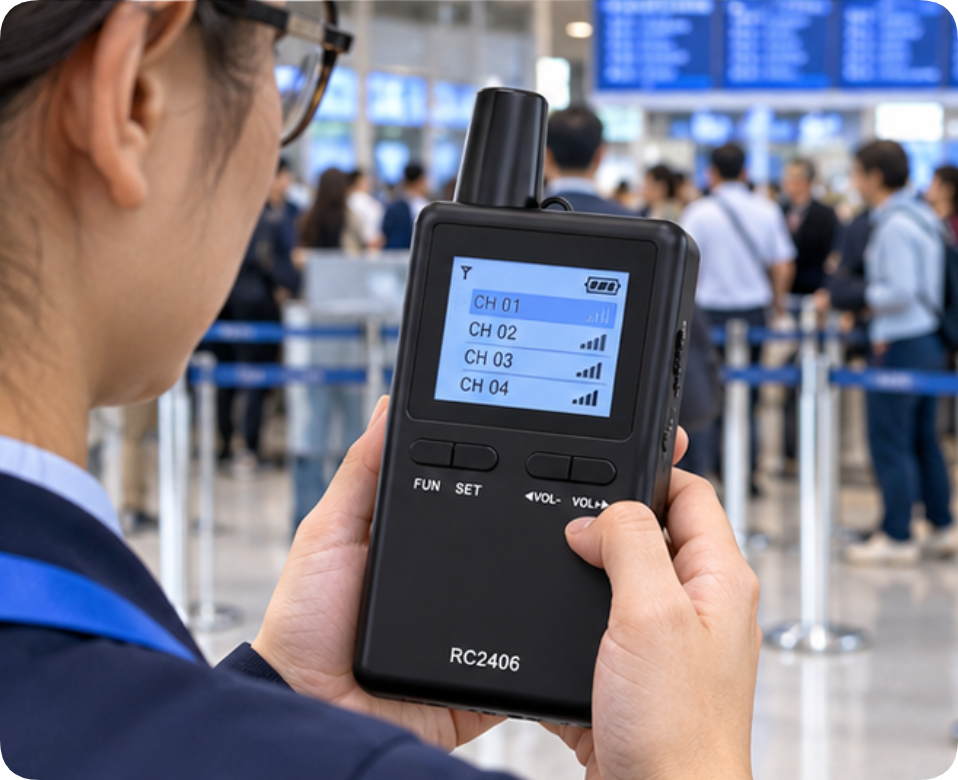
The turbine hall is the park's centerpiece: a single volume under a steel truss roof, hard surfaces everywhere, and the highest concentration of simultaneous groups. Here the RC2406 earns its place. Its eighty channels use PLL frequency synthesis for anti-interference, which is what lets several school groups, a private tour and a staff walkthrough share the same hall without hearing each other; fifty-channel kits start to feel tight on a peak day. The system runs on the license-free 2403-2483 MHz 2.4 GHz ISM band with one-click pairing, and output is 10 mW with a 200-meter range, comfortably covering the hall from a fixed position. The transmitter carries a 1500 mAh battery rated at 10 hours and the receiver runs 20 hours on its 1000 mAh cell, so a full operating day fits on one charge with margin for the evening slot. The product page also lists an IPX4 splash-resistance rating on the receiver and a 50-gram receiver weight, both relevant in a hall where visitors handle equipment while moving between exhibits. Multiple kits can be staged at the hall entrance and paired in sequence between slots, which is how the hall absorbs a midday peak without a technician walking the floor. Details and current configurations are on the RC2406 80-Channel 2.4G Tour Guide System page.

Brick Partitions and the Case for an 18-Gram Ear-Hook
The converted warehouse block is the opposite problem: not one big room but many small ones, brick walls between studios, and a route that climbs mezzanine stairs. Visitors wear a receiver here for two to three continuous hours, and comfort decides whether the commentary actually reaches them. The RC2468 exists for exactly this zone. Its receiver weighs 18 grams in an ear-hook format — the lightest in the current range — and visitors stop noticing it after the first staircase, which matters when the route keeps moving. The transmitter weighs 59 grams with a 1500 mAh battery and runs 12 hours on a charge, while the 300 mAh receiver delivers 10 hours, both charging over Micro USB at 5V/1A; for a park opening at nine and closing the last tour at six, a lunchtime top-up keeps every unit alive. Fifty PLL channels are enough for the brick zone because the walls themselves separate cohorts — the building does part of the isolation work, and the group count per floor is naturally limited by fire code. The radio side is the same license-free 2.4 GHz band at 10 mW with a 200-meter range, and the transmitter offers black, iron grey, silver grey and other color options for parks that color-code routes. Specifications live on the RC2468 Ultra-Light 2.4G Tour Guide System page.

The Yard: UHF 470-510 MHz Across the Gantry Crane Plaza
The outdoor yard is where the preserved gantry crane sits, groups form in the open, and visitors drift — and it is the zone where the RC085 pulls ahead. It transmits on UHF 470-510 MHz, a band that behaves better than 2.4 GHz across open ground and around steel structures, at 8-10 mW output with the same 200-meter working range. One hundred channels give the yard the deepest pool in the range, useful when the plaza hosts a market day with several operators working at once. The hardware is built for the way yards are actually guided: an LCD smart screen on the transmitter, selectable F1 one-way and F2 two-way communication modes so a foreman-led safety briefing can take questions, and auto sleep and wake-up power management that survives the pause-and-resume rhythm of an outdoor route. The transmitter runs 12 hours on a 1200 mAh cell and the receiver 20 hours on 1000 mAh, charging over USB; transmitter weight is 65 grams and receiver 60 grams. Certification is CE, RED and RoHS with a three-year warranty on the mainboard. For open-air commentary across a crane plaza, the RC085 Digital Tour Guide System page carries the current configuration.

Three Kits Side by Side
The table condenses the zone logic into one comparison. Figures come from the current product pages; where the page publishes no value, the cell says so.
| Comparison Dimension | RC2406 | RC2468 | RC085 |
|---|---|---|---|
| Best-fit zone | Turbine hall, many groups | Brick studios, long wear | Open yard, gantry plaza |
| Frequency band | 2403-2483 MHz (2.4G ISM) | 2403-2483 MHz (2.4G ISM) | 470-510 MHz (UHF) |
| Channels | 80 (PLL anti-interference) | 50 (PLL) | 100 |
| Range / Output | 200 m / 10 mW | 200 m / 10 mW | 200 m / 8-10 mW |
| Transmitter battery | 10 h / 1500 mAh | 12 h / 1500 mAh | 12 h / 1200 mAh |
| Receiver battery | 20 h / 1000 mAh | 10 h / 300 mAh | 20 h / 1000 mAh |
| Transmitter / receiver weight | 59 g / 50 g | 59 g / 18 g ear-hook | 65 g / 60 g |
| Charging port | DC port | Micro USB 5V/1A | USB |
| Notable extras | IPX4 receiver, one-click pairing | Lightest receiver in range | LCD screen, F1/F2 modes, 3-year mainboard warranty |
🗺️ Splitting a Visitor Day Across the Three Bands
A practical deployment assigns each system to its zone and lets the route do the switching. School cohorts start in the turbine hall with RC2406 kits, where the eighty channels absorb the ten-o'clock peak; the same visitors move into the warehouse block on RC2468 ear-hooks collected at the brick-zone desk, a swap that takes less time than the restroom break; and afternoon slots finish in the yard on RC085 units signed out at the plaza kiosk. Charging follows the same map: the hall kit on its DC dock overnight, the brick-zone Micro USB units topped up at lunch, the yard's USB units on the kiosk shelf between slots. Parks that operate one mixed fleet instead should still keep the assignment, because a receiver's worst day is the wrong zone — an 18-gram ear-hook is pleasant indoors but easy to lose in plaza wind, and a 60-gram yard receiver is a burden by the third staircase. Publishing the equipment plan with the route map also shortens staff training: guides learn one device per zone, and the swap points become routine.
Operators mapping their own routes can compare the zone logic with other site types under explore our solutions, where factory, city and museum deployments are collected in one place. The full hardware range behind this article, including the accessories that travel with each kit, sits on the Richitek tour guide systems catalog.
Frequently Asked Questions
1. Can one kit cover all three zones if the budget allows only one system?
Yes, with a compromise. The RC2406 is the most flexible single purchase: eighty channels handle hall concurrency, the 20-hour receiver survives a full day, and the 200-meter range covers the yard. What it gives up is the RC2468's 18-gram wear comfort on long indoor routes and the RC085's UHF behavior across open ground around steel.2. Do the three systems interfere with each other when zones overlap?
The RC2406 and RC2468 share the 2403-2483 MHz band, so their channel plans should be kept apart — with eighty and fifty PLL channels respectively, coordinators can assign non-overlapping channel blocks per zone. The RC085 runs on UHF 470-510 MHz, a different band entirely, and does not contend with the 2.4 GHz kits.3. What happens on a peak day when more groups arrive than channels?
Peak-day pressure lands mostly in the turbine hall, which is why the eighty-channel RC2406 is assigned there. In the brick zone the partitions physically isolate cohorts, so the fifty-channel RC2468 rarely fills; in the yard, the RC085's hundred channels plus the open-air group spacing keep the plaza workable even on market days.4. How should the three charging standards be handled at the equipment desk?
Each zone keeps its own dock: DC for the hall kit, Micro USB at the brick-zone desk, USB at the plaza kiosk. Labeling shelves by zone rather than by model keeps volunteers from cross-docking, and the lunchtime top-up for the 300 mAh RC2468 receivers is the one habit worth scheduling, since that cell is the smallest in the range.The three structures of an industrial heritage park ask three different questions of a radio system, and answering each with a matched kit turns a difficult venue into a routine one: the RC2406 absorbs the hall's concurrency, the RC2468 makes the brick maze comfortable to wear for hours, and the RC085 holds the yard across steel and open air. All three belong to the same Richitek tour guide systems family, so chargers, spare ear-hooks and replacement parts stay common across zones. Parks planning a seasonal retrofit can start from the zone map above, verify current specifications on each product page, and pilot the swap points on a school day before committing to a full fleet.