
.webp)
One Cable, Four Sailings
A river cruise boat rarely sells the same trip twice in a day. The morning slot is a city loop for walk-up tourists, noon belongs to a sightseeing run with a pre-booked group, the afternoon is chartered by a company or an inbound agency, and the evening turns the same deck into a social sailing. One audio fleet serves all four, and the only maintenance window is the quarter hour between berthing and the next boarding call. So a wireless tour guide system for city and sightseeing routes on water is judged less by its spec sheet than by its charging behaviour, its handout speed and its reset routine. This comparison runs the Richitek RC9150, RC2500 and RC2501 against two challengers built on very different economics, the BIXITE 7103R receiver and the HZY H061T kit, through one full operating day on the water.

RC9150: One Hundred Channels for Parallel Sailing Parties
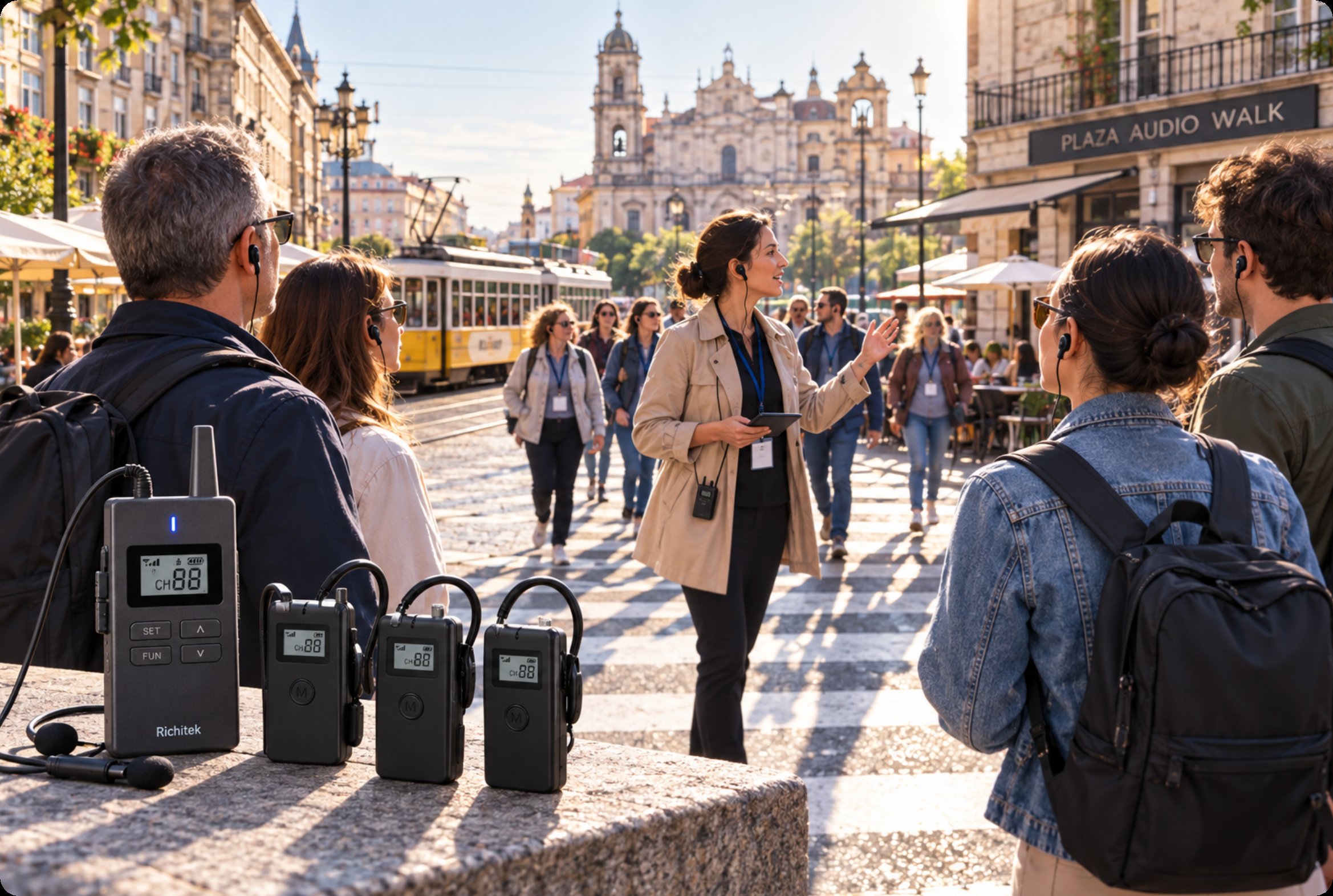
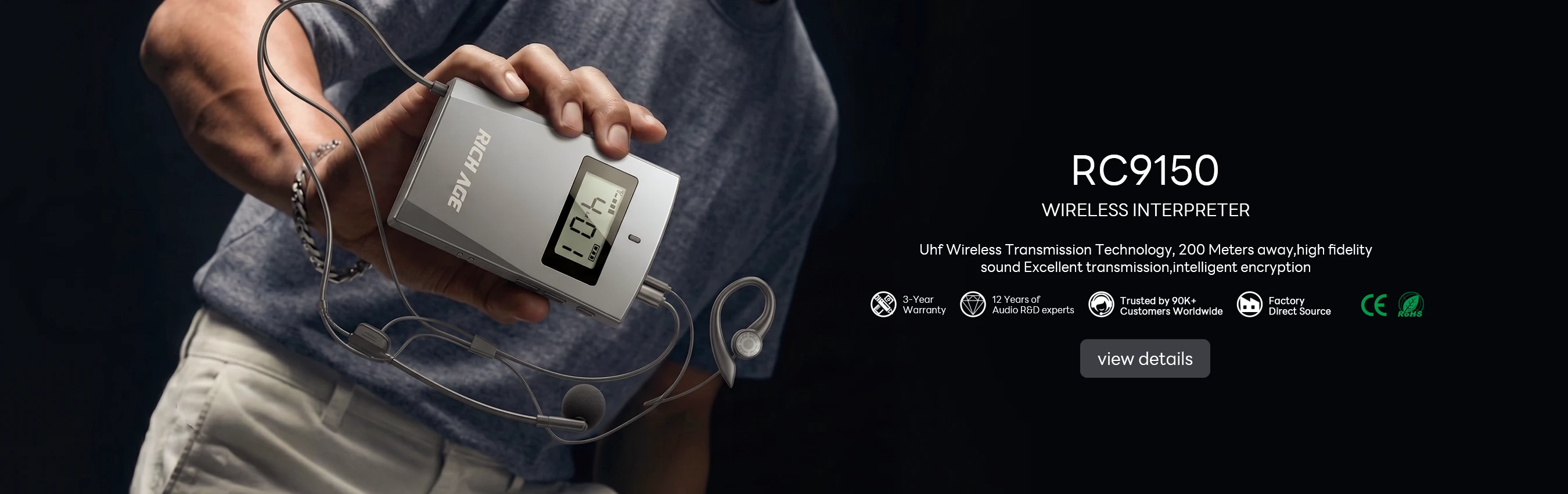
The first constraint on a busy quay is not range but separation: an inbound charter and a public city loop may depart the same pontoon minutes apart, two commentators speaking to two crowds a few metres from each other. The RC9150 wireless tour guide system carries one hundred PLL channels in the 2403-2483 MHz band, so the two parties sit on well-spaced frequencies instead of negotiating over one. Its transmitter holds a 3.7V 1800 mAh cell rated at fifteen hours, and receivers stand by for thirty-five hours and more, so a unit that skips its overnight charge still opens the morning loop usable. At 97.5 grams on both transmitter and receiver, the fleet packs into a single crew bag. The 20 Hz-8 kHz response keeps consonants intact over engine hum, and the Type-C port matches the cable the rest of the boat already uses.
RC2500: The Dockside Reset Machine
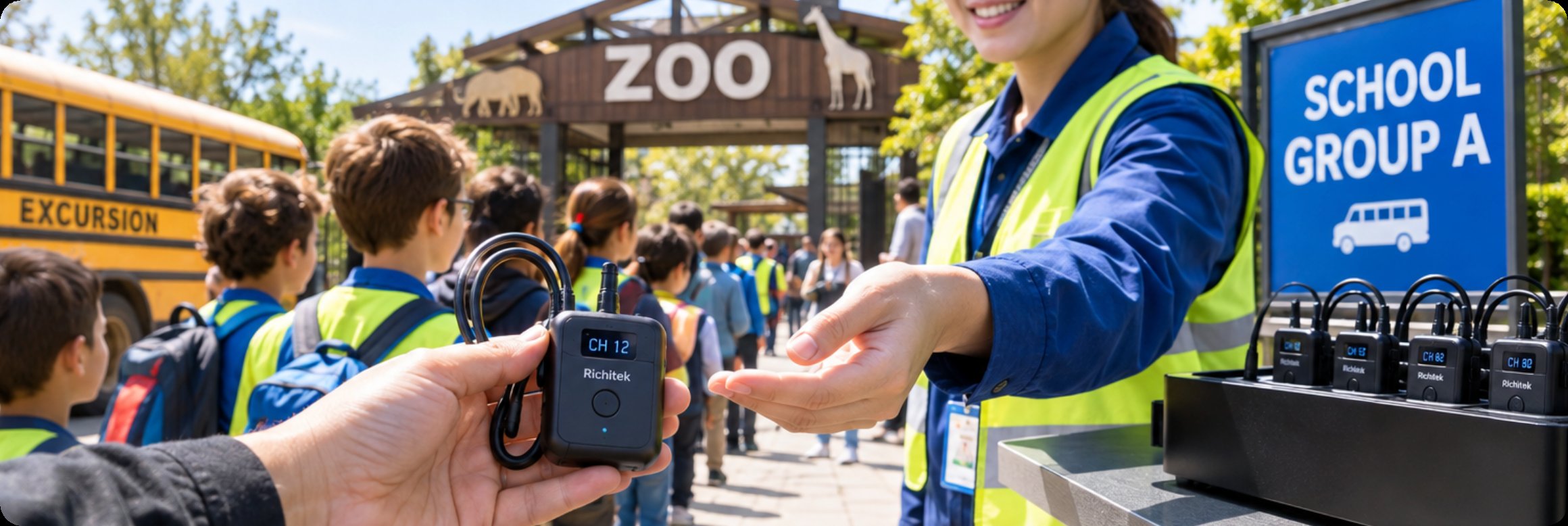
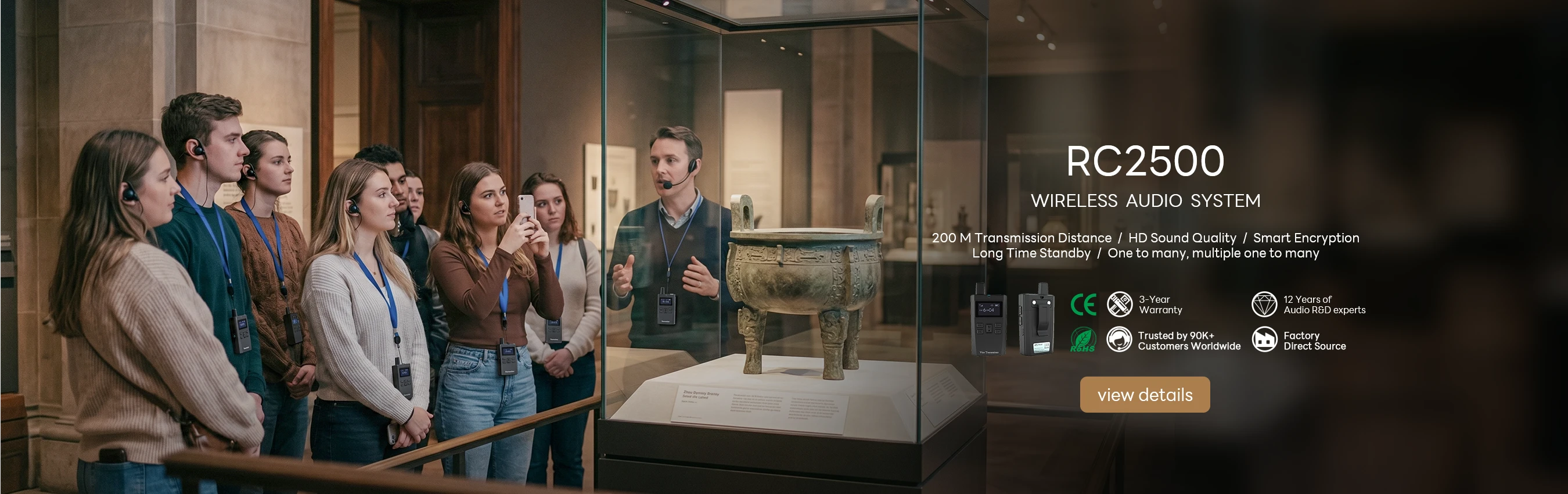
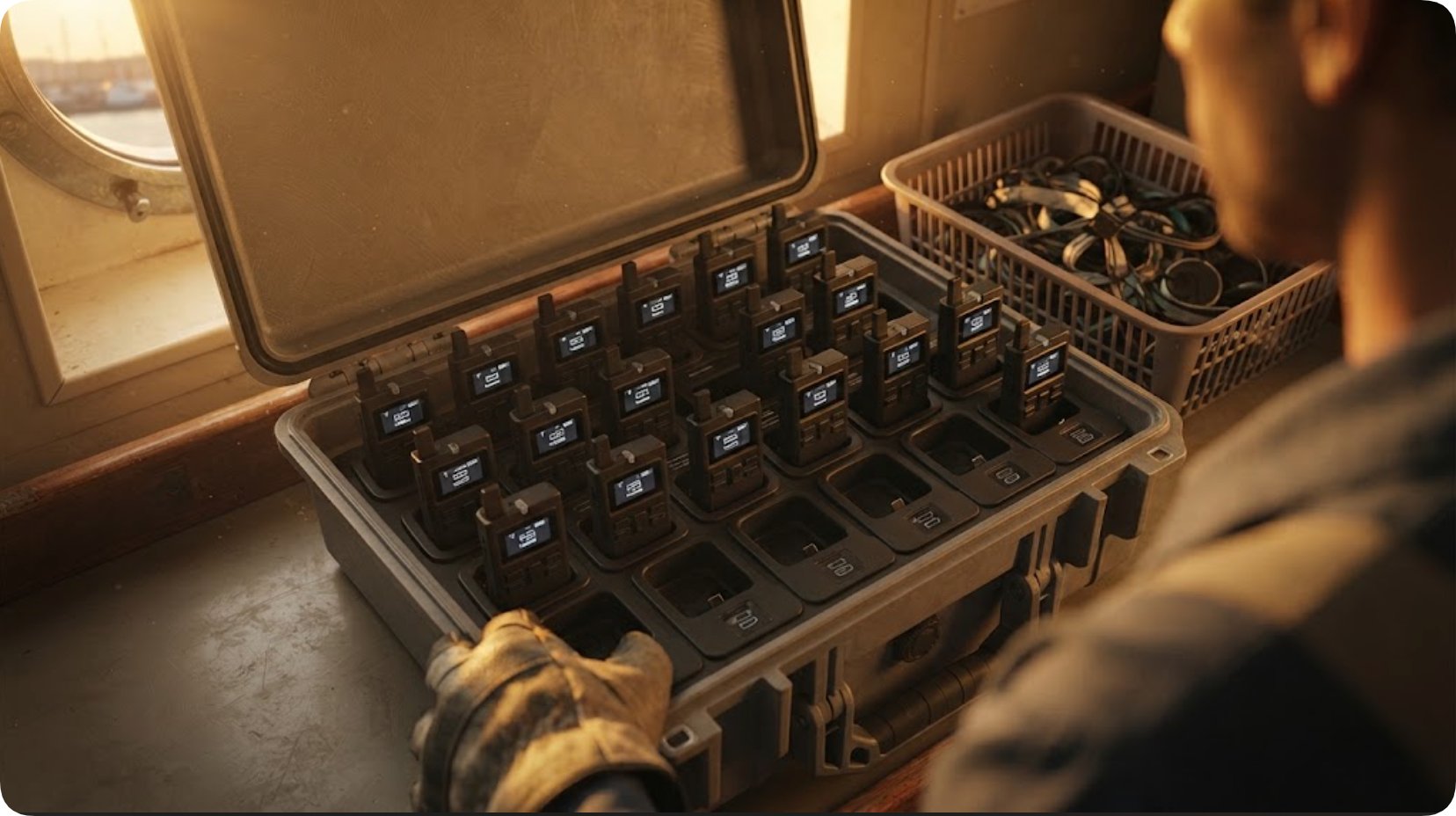
The quiet cost of a multi-sailing day is what happens at the gangway after disembarkation. Sixty receivers come back in pockets, cupholders and tote bags, with perhaps ten minutes to ready every unit for the next boarding line. The RC2500 flagship tour guide system is built around that moment: synchronise, mute and power-off are each a single press, so the host silences the returned rack and shuts the whole fleet down without inspecting sixty power switches. Underneath sit the same flagship internals as the RC9150 — a fifteen-hour transmitter cell, thirty-five-hour-plus receiver standby, fifty channels at 10 mW — with a 50 Hz-8 kHz voice band tuned for intelligibility over hull noise. The trade-off is carry weight: at 104 grams, transmitter and receiver are the heaviest pair here, which is why the RC2500 earns its place on the charging shelf rather than in a walking guide's pocket.
RC2501: A Second Voice Without a Second Budget
The lunch sightseeing run exposes a different need. A captain wants to announce the lock timing; the guide wants to keep narrating the skyline. Buying two full systems for one boat is where most budgets break. The RC2501 professional tour guide system accepts an optional headset or lapel microphone, so one transmitter passes from handheld briefing to clipped-on narration without swapping hardware, and the second voice joins on another channel of the same fifty. At 47 grams for transmitter and receiver alike, it is the lightest unit Richitek fields, and the 13 mW output with a 20 Hz-200 kHz response gives narration more air than the speech-tuned RC2500. Sensitivity is specified at approximately -38 dBm, and its fifteen-hour transmitter and thirty-five-hour receiver figures match the flagships on one Type-C cable.

The Challengers: Thirty-Hour Batteries and Kit Pricing
BIXITE approaches the same pier from the wearing side. Its 7103R receiver, a 2026 release, uses a non-in-ear bud and claims a thirty-hour battery, marketed to guides who would rather skip daily charging; domestic listings price it between CNY 75 and CNY 500, with the 721RS receiver at CNY 165 for government and corporate reception duty. The honest reading is that thirty hours is a genuine figure: on a two-sailing day a BIXITE fleet never visits the charger. What the listing omits is band, channel count, transmit power and charging port — all of which matter when two boats raft together at a pier. HZY attacks from pricing instead. The H061T handheld transmitter lists at CNY 339, receivers such as the H909R ear-hook at CNY 199 each, and bundles at CNY 3,900 for one transmitter with ten receivers or CNY 7,599 for thirty, with the H730T second transmitter sold separately. The bundle maths is real for a single-language boat; the published spec sheet stops at those numbers, leaving band, channels and battery ratings unstated.
Specification Comparison
| Dimension | RC9150 | RC2500 | RC2501 | BIXITE 7103R | HZY H061T / H909R |
|---|---|---|---|---|---|
| Frequency band | 2403-2483 MHz | 2403-2483 MHz | 2403-2483 MHz | Not published | Not published |
| Channels | 100 | 50 | 50 | Not published | Not published |
| Output power | 10 mW | 10 mW | 13 mW | Not published | Not published |
| Transmitter battery | 15 h, 3.7V 1800 mAh | 15 h, 3.7V 1800 mAh | 15 h, 3.7V 1500 mAh | Not published | Not published |
| Receiver battery / standby | 35+ h, 3.7V 1800 mAh | 35+ h standby, 3.7V 1800 mAh | 35+ h, 3.7V 1000 mAh | 30 h claimed | Not published |
| Transmitter weight | 97.5 g | 104 g | 47 g | Not published | Not published |
| Receiver weight | 97.5 g | 104 g | 47 g | Not published | Not published |
| Frequency response | 20 Hz-8 kHz | 50 Hz-8 kHz | 20 Hz-200 kHz | Not published | Not published |
| Charging port | Type-C | Type-C | Type-C | Not published | Not published |
| Signature feature | 15 h TX / 35+ h RX standby | One-key sync, mute, power-off | Optional headset or lapel mic, ≈ -38 dBm | Non-in-ear bud, long-life cell | 1T10 / 1T30 kits, H730T second transmitter |
What Remains Unresolved
Two gaps cut both ways and deserve plain language. First, none of the three Richitek units publishes an ingress-protection rating, so a spray-soaked aft deck still calls for a pouch; buyers needing a stated IP figure should get it in writing. Second, both challengers keep their cost advantage partly by omitting what a pier-side engineer would ask: without a stated band and channel plan, an operator cannot predict how two concurrent sailings, a dockside PA and a nearby vessel will share the air. A thirty-hour receiver is convenient until two charter groups land on the same frequency, and kit pricing is a bargain only if interference never needs diagnosing. Neither challenger is a poor product; both are priced for deployments where those questions stay unasked.
Matching the Fleet to the Sailing Schedule
Choose by how the day actually divides. If the pontoon hosts several parties at once, the RC9150's hundred channels and fifteen-hour transmitter are the cheapest separation money can buy. If the bottleneck is the ten minutes between disembarkation and boarding, the RC2500's one-press mute and power-off return that time to the crew. If a captain and a guide must alternate on the same sailing, the RC2501's optional microphone and 47-gram frame carry the second voice for the price of one system. Single-language, single-boat budgets should still price the HZY kit honestly, and operators who never want to see a charging shelf may accept the BIXITE's unpublished band plan as the cost of thirty silent hours. For the rest, one cable that charges every unit in the fleet is what keeps four sailings on schedule; browse the wireless tour guide systems line to plan the fleet, or compare more deployments in our cross-brand comparison guides.