
.webp)
A stadium is the most hostile radio environment a tour guide system will ever work in, and it fails hardware in three specific ways. First, the concrete bowl itself: tiered seating and service tunnels scatter and absorb radio energy in ways an open plaza never does. Second, the crowd: fifty thousand phones, each a Wi-Fi client and a Bluetooth host, push the 2.4 GHz band to saturation on every matchday. Third, the logistics: stadium audio is not issued to the same eight visitors every morning — it is handed by the hundreds to strangers at a gate and collected by night. This comparison walks those three failures through five systems: the RC8860, built for the concrete problem; the RC2500, built for the channel-count problem; and the RC2402, built for the hand-out problem. Across the table sit the OKAYO WT-500, a regional-UHF veteran with a one-battery workday, and the ANLEON S2, a stage monitor that many venues reach for because it is already in the equipment room.
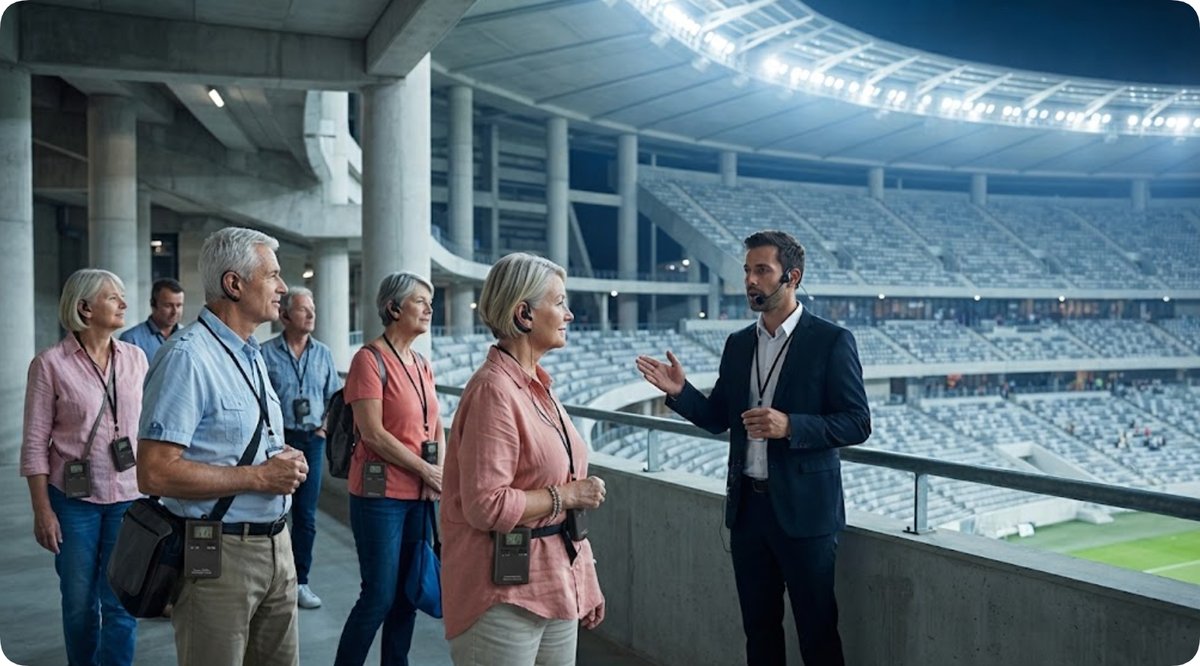
📡 Concrete Eats Radio: Why the Band Matters Indoors
The RC8860 transmits on 860-870 MHz UHF, a band whose physics favour exactly the building this scenario describes: lower-frequency signals scatter less off concrete stanchions and carry further through service corridors than 2.4 GHz can. Twenty PLL-locked channels keep neighbouring groups separate, the transmitter runs ten hours on its 1,500 mAh cell, and both units stay splash-resistant at IPX4 — relevant when beer and rain share a schedule. Its 200-metre open-area reach shrinks inside a bowl, but it shrinks less than the alternatives. The OKAYO WT-500 also works UHF, and works it well: 40 to 80 channels depending on region, PLL synthesis, and a fin antenna that holds 100 metres of line-of-sight. Two honest caveats matter at procurement scale. Its 584-870 MHz range is region-dependent, so a fleet bought for one country may need re-banding for another, where the RC8860's 860-870 allocation travels. And its audio response is specified at 150 Hz to 4 kHz — crisp enough for speech, but noticeably thinner than the RC8860's wideband reproduction when the tour pauses and the venue's own sound system bleeds in. Wearability splits the same way: the RC8860 receiver weighs 50 grams as an all-in-one earpiece, while the WT-500's 70-gram belted unit adds a lanyard and a cable to the same visitor, a small difference that compounds across a hundred-handed distribution.
Fifty Groups, One Venue, Zero Crosstalk
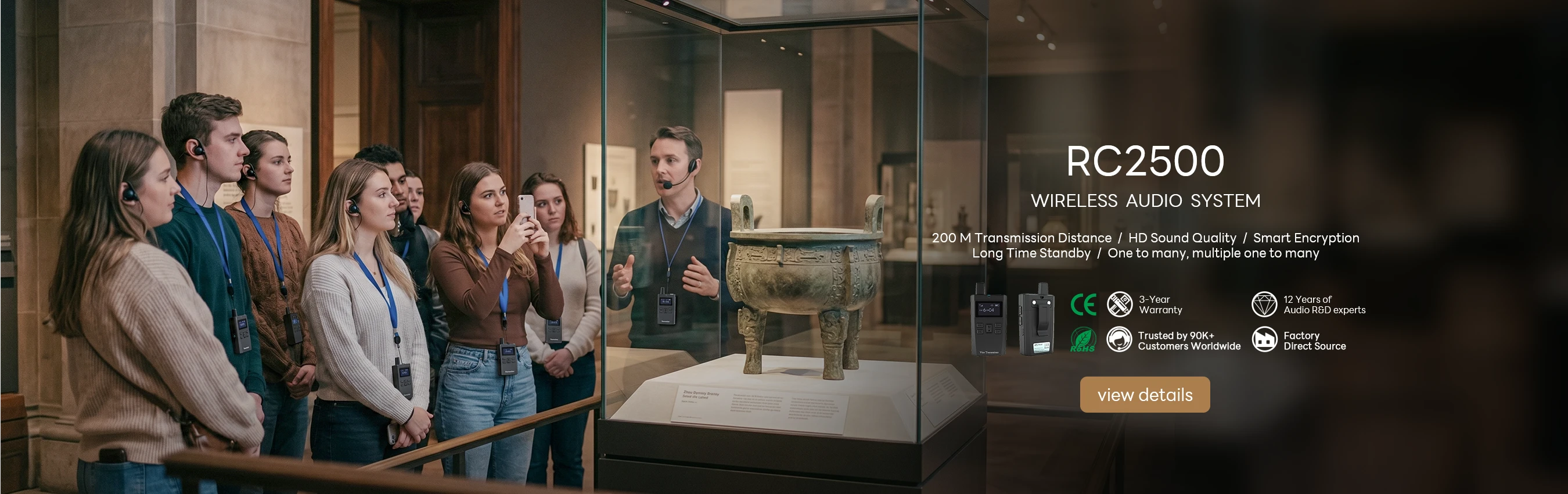
On a matchday the building hosts more than one audience: a sponsors' walkabout, a media loop, an away-fans heritage tour and a juniors' clinic may all run at once. The RC2500 was designed for exactly this arithmetic — 2.4 GHz with a 20 mW output that pushes through crowd density better than standard-power units, and fifty PLL channels so parallel groups never hear each other. Its receiver endurance is the quiet superpower here: forty hours per charge means a fleet issued on Friday survives a full weekend without a single charging session, and the -15 to 50 °C tolerance covers unheated concourses in January. The OKAYO counters with a different endurance philosophy: one AA battery per unit, twelve to fifteen hours in the receiver, nine to ten in the transmitter — and a fresh cell swaps in thirty seconds when a chargeroom is not available. Both approaches work; only one of them survives a volunteer who forgets to plug anything in. Venue operators running back-to-back rentals should also weigh the charging floor: forty-hour receivers mean one overnight dock cycle per weekend, while AA-based kits need a counted battery inventory before every single event.
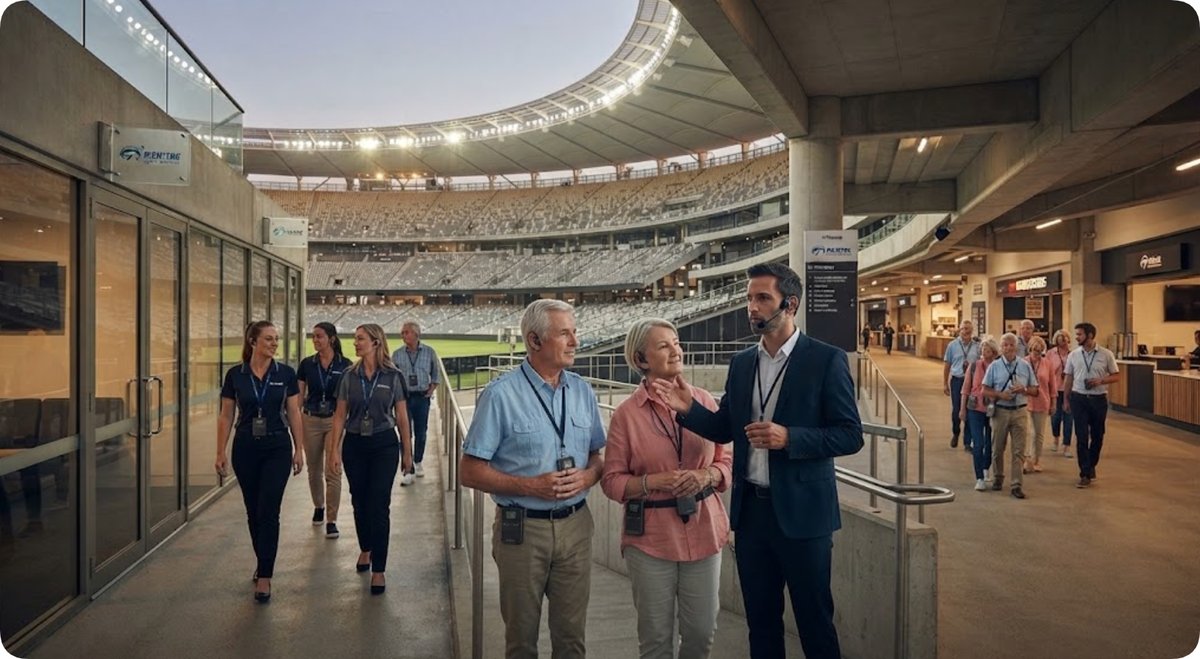
Handing Receivers to Strangers
The third failure is human, not technical. Matchday staff are often volunteers, and a system they cannot operate becomes a bin of dead hardware by kickoff. The RC2402 attacks this with one-click frequency synchronisation — a supervisor pairs every receiver to the transmitter in seconds, no menus — plus intelligent encryption that stops crosstalk when two groups drift close in a tunnel. Ten hours of transmitter time and twenty per receiver cover the longest event day, and because pairing is stored, a receiver that powers off mid-tour rejoins silently rather than re-entering a setup menu a stranger has never seen. Compare the ANLEON S2, and the mismatch is structural. It is a stage in-ear monitor: dual XLR inputs, stereo or mono mixing, an 80 dB signal-to-noise ratio that flatters a drummer but means nothing to a stadium narrator. Its receiver is a belt pack wired to earphones — two pieces to hand out, two to collect, and cables that catch on lanyards in a moving crowd. Its six-channel capacity cannot host parallel groups, and its 670-680 MHz variant is region-locked like any UHF band. As a music tool it is excellent; as stadium fleet hardware it answers questions nobody at the gate asked.
The Numbers Behind the Noise
| System | Band / Channels | Range | Battery | Wear & Build |
|---|---|---|---|---|
| Richitek RC8860 | UHF 860-870 MHz; 20 PLL | 200 m open area | Tx 10 h / Rx 20 h | 59 g Tx, 50 g Rx; IPX4 |
| Richitek RC2500 | 2.4 GHz ISM; 50 PLL; 20 mW | 200 m open area | Tx 12 h / Rx 40 h | -15 to 50 °C operation |
| Richitek RC2402 | 2.4 GHz ISM; one-click sync + encryption | 200 m open area | Tx 10 h / Rx 20 h | Lightweight earpiece build |
| OKAYO WT-500 | UHF 584-870 MHz regional; 40-80 ch | 100 m line of sight | 1×AA: Tx 9-10 h / Rx 12-15 h | 70 g with battery; 150 Hz-4 kHz audio |
| ANLEON S2 | UHF regional (670-680 etc.); 6 ch | 50 m indoor / 100 m+ outdoor | 2×AA: Rx up to 12 h | Belt pack + wired earphones; 80 dB S/N |

What OKAYO and ANLEON Do Better
Credit where the challengers earn it. The WT-500's single-AA economy is the cheapest fleet logistics in this comparison: no charging racks, no worn USB ports, and a battery inventory any supermarket can refill — for venues that already run AA-based kits, that continuity is worth real money. Its 40-to-80-channel ceiling also exceeds the RC8860's twenty, which matters if your calendar really does stack that many groups. The ANLEON S2 wins every audio-fidelity figure in the table, takes standard AA cells, and its stereo mix function genuinely helps when the feed is a concert rather than a voice. What neither system bundles is the specific stadium stack: a globally consistent UHF allocation, forty-plus hours of untethered receiver time, and a pairing gesture simple enough for a first-day volunteer.
Choosing by the Shape of Your Event Day
If your venue's problem is the building itself — concrete tiers, tunnels, steel in every sightline — the RC8860's band physics are the reason to lead with it. If the problem is arithmetic, a calendar stacking group upon group with no charging window between, the RC2500's fifty channels and forty-hour receiver carry the weekend. If the problem is people — hundreds of receivers passing through untrained hands twice a day — the RC2402's one-click pairing and encryption turn fleet management into a one-supervisor job. Buy the WT-500 if your region's UHF allocation matches its band plan and your storeroom already thinks in AA batteries; audition the S2 only when the event is a concert and the audio engineer owns the checklist. The rest of the wireless tour guide systems line maps onto the other jobs a large venue invents, our conference audio solutions page covers the indoor event side in depth, and the cross-brand comparison guides test the same hardware against museums, factories and pilgrimages.