

Ferry Terminal Guide Systems: Metal Hulls and the UHF Case
A ferry terminal is two environments separated by a ramp. On the landside there is a ticket hall, a queue, a shop and a departure board — an ordinary guide system problem, solvable with whatever band is convenient. On the vessel there is a steel box that moves through salt water, and almost every radio decision changes at the point where a passenger steps across that ramp. Nothing about the acoustic environment is negotiable once the hull is closed, and the choice that seemed academic in the terminal becomes the only choice that matters on board.
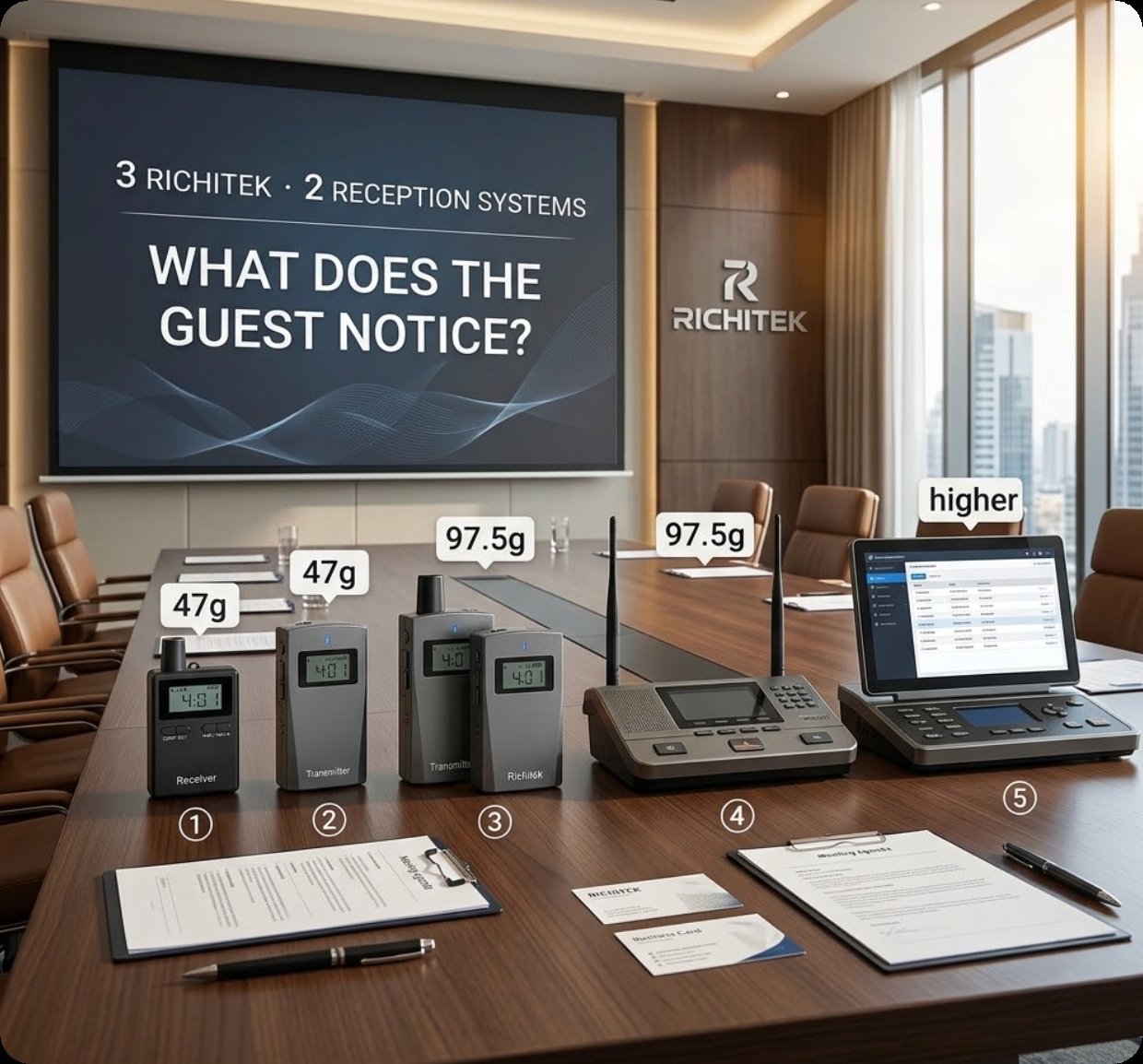
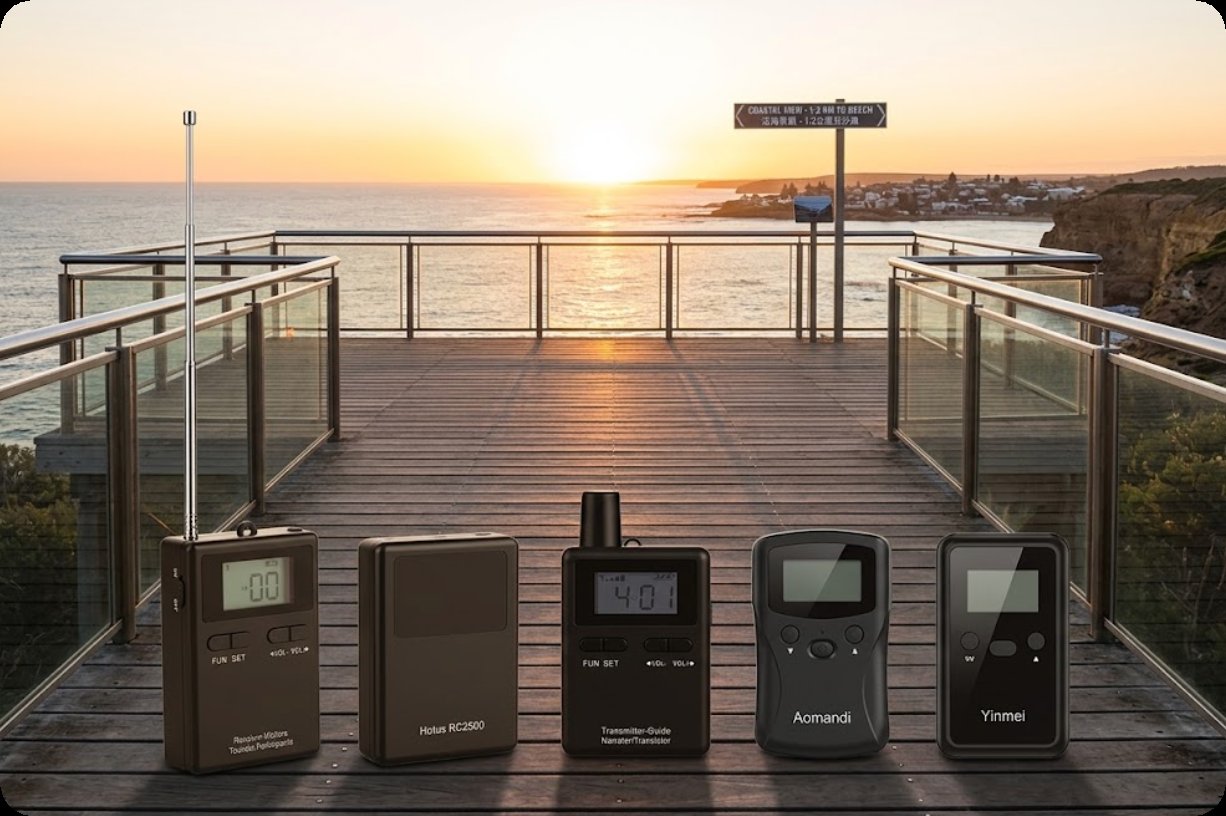
Three Richitek units are compared here against two systems that answer the onboard problem differently. The RC085 is the only UHF unit in the group at 470 to 510MHz, and it does so with a hundred channels, a receiver sensitivity quoted at approximately -102dBm and an output figure of 8 to 10 milliwatts. The RC2408 is an 80-channel 2.4GHz unit whose documented special feature is interference resistance, with a transmit audio response reaching 200kHz. The RC2401 is the baseline: fifty channels on 2.4GHz, documented as a high value-for-money standard version that is easy to use. Facing them are Asaimei K20, which abandons the headset and amplifies the guide directly for outdoor deck commentary, and Beijing Dongfang Songbo, which removes the guide entirely and runs on QR code and NFC triggers with a cloud content platform.
Two things this comparison cannot pretend to cover. On the two competitor systems the published material is a feature list rather than a specification set, so any parallel arithmetic on channels, range or battery life would be invention. And all three Richitek units are commentary systems: they carry a guide's voice to listeners, which is not the same thing as a public-address system, a safety announcement chain or a position-based automatic trigger. Where a vessel's requirement is one of those, the right answer is a different category of equipment altogether.
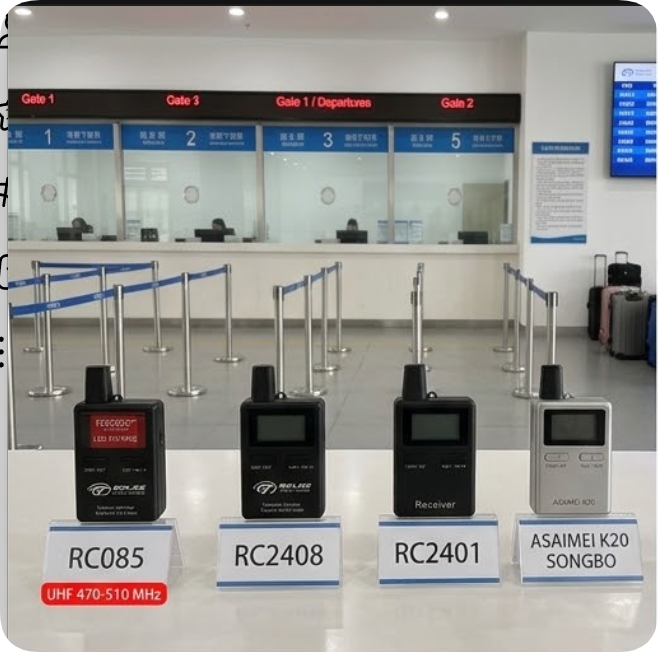
📡 What a Steel Hull Does to a Radio Signal
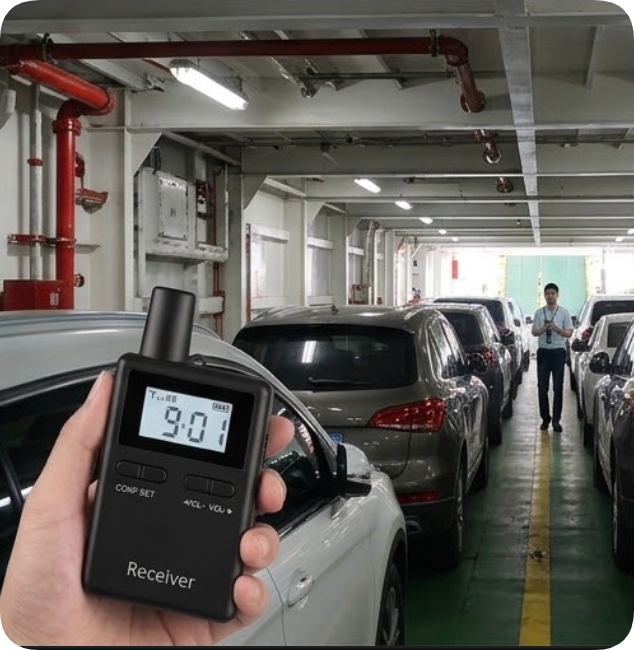
The physics here is unglamorous and it decides the purchase. A steel hull is a conductive enclosure. Radio energy that reaches it is partly reflected, partly absorbed, and partly converted to heat in the plate. The worse case is not distance — it is a passenger standing on the vehicle deck two bulkheads away from a guide on the promenade deck. A quarter of a kilometre of open water barely touches a signal; one steel bulkhead can remove a large fraction of it, and five decks of parked vehicles on a car ferry is a wall of metal and glass between the guide and the people who need to hear.
Wavelength is what distinguishes the two bands. A 2.4GHz signal has a wavelength of about 125 millimetres; a 470MHz signal is roughly 640 millimetres. The longer wavelength diffracts around obstacles far more readily, and it penetrates thin material with less loss — which is why broadcast radio, marine VHF and many industrial low-band systems have settled where they have. This is not a marketing claim about one band being better. It is the reason a receiver quoted at -102dBm on the UHF unit exists as a specification worth quoting at all, and the reason the 8 to 10 milliwatts on that same unit is not a weakness.
The consequence is worth stating plainly, because it inverts the usual instinct. On a landside tour a stronger transmitter buys reach. On a vessel it buys very little, because the limiting factor is what the signal has to pass through. A low-band unit at ten milliwatts will often deliver a usable signal inside a steel saloon where a 2.4GHz unit at the same power does not, and the reason is the wavelength rather than the wattage. Anyone specifying for a ferry by output power alone is reading the wrong line of the table.
There is a second metal problem, and it is quieter. Hull plating, handrails, stair frames and lift shafts are all conductive, and passengers wearing metal-framed spectacles or carrying phones and cameras add more. A body-worn receiver close to a metal rail picks up a different multipath pattern from one tucked under a jacket, and the setting that works on an open promenade may not be the setting that works at a rail. This is not a specification item; it is a reason to test in the space rather than on a bench.
RC085: The Hundred-Channel UHF Unit
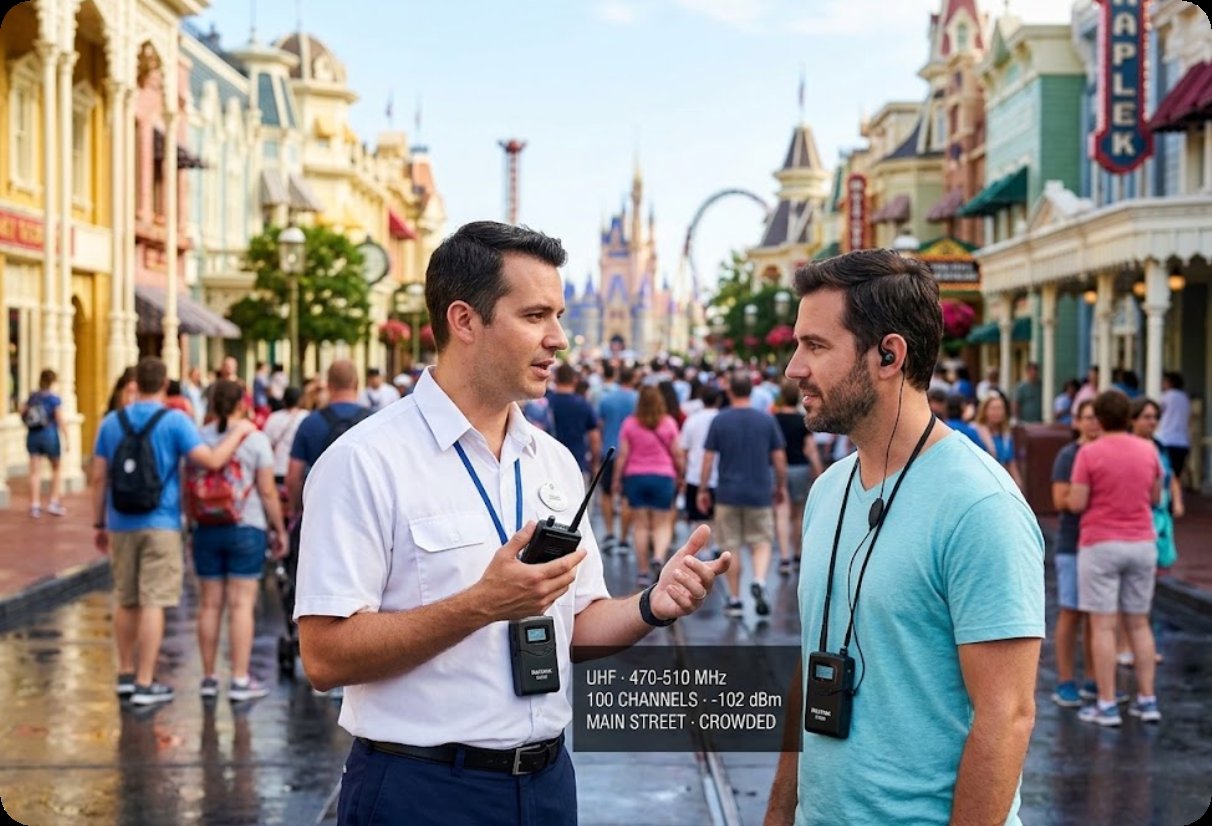
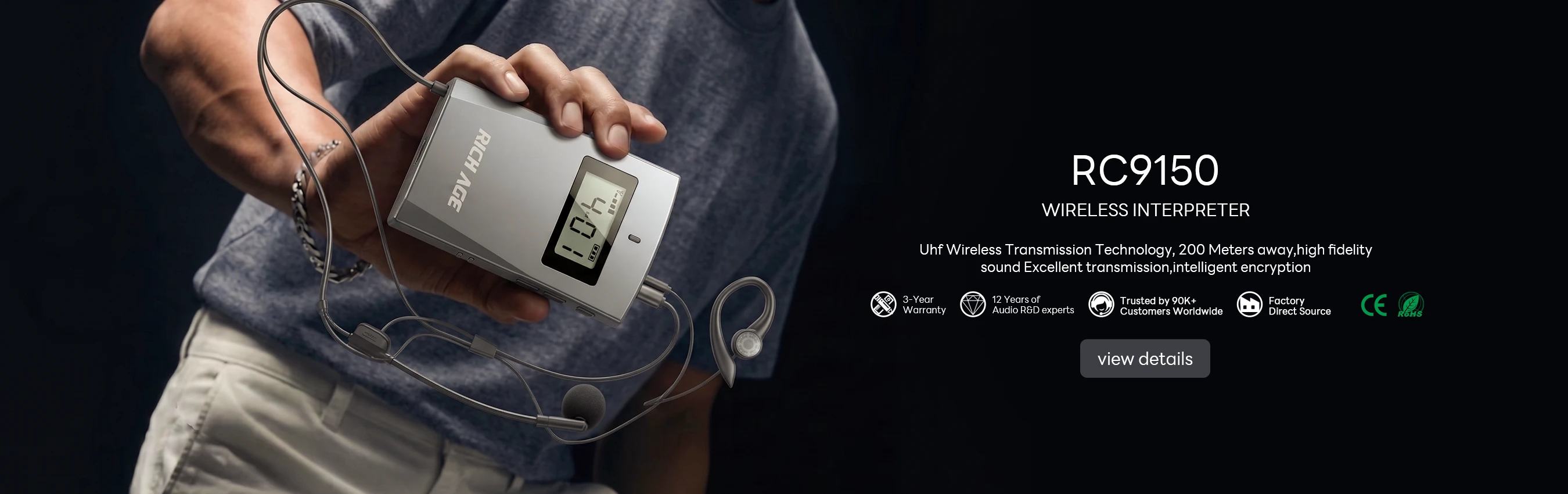
The RC085 UHF Wireless Tour Guide System is the only band choice that matches the problem, and its specification sheet reads differently from the others for exactly that reason. Core frequency is 470 to 510MHz with a hundred channels, quoted transmission distance of one to two hundred metres, and an output of 8 to 10 milliwatts — a low figure that reflects a licence-exempt allocation rather than an engineering shortfall.
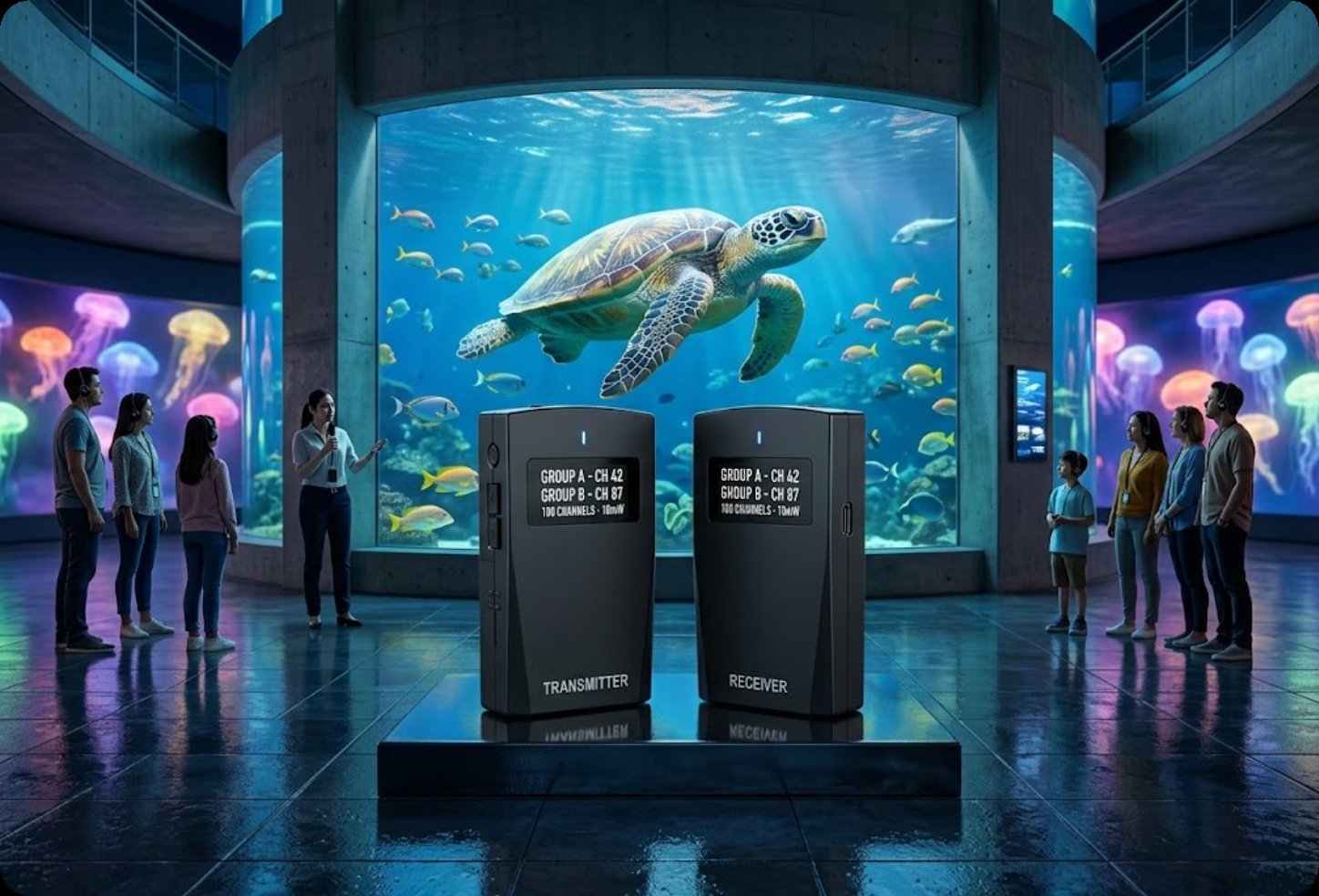
Carrying a hundred channels on a vessel is more useful than it sounds. The passenger decks of a large ferry are wide and there is more than one place a guide might want to speak from, and a hundred channels means the operator can run several groups independently without first solving an interference problem. Sensitivity of approximately -102dBm is quoted on this unit and not on the other two, which is the figure that matters when a listener is on the far side of a car deck.
The cost of the band shows up in the physical specification. A 3.7V 1200mAh transmitter cell gives twelve hours and a 3.7V 1000mAh receiver cell twenty, with USB charging rather than a DC port. The two halves weigh 65 and 60 grams, the heaviest pair in this comparison, and audio bandwidth runs 50Hz to 12kHz with PLL control. Documented extras are an optional head-worn or lapel microphone and a professional microphone option, and three finishes are listed for volume orders — black, iron grey and blue.
The honest observation about a hundred channels on a ferry is that most operators will use a fraction of it. A vessel with three passenger decks, two vehicle decks and a crew-only area has room for a dozen simultaneous groups in principle, and a typical sailing uses two or three. Paying for the ceiling is defensible on a ship that runs seasonal shore tours with six groups, and it is over-specification on a commuter run that carries forty vehicles and one commentary channel. That judgement is a scheduling decision rather than a technical one, which is why it belongs to the operator.
What this unit does not offer is any marine-specific certification. Salt fog, standing water and constant vibration are not addressed in the published specification, and no IP rating is recorded for it in the source data. For a promenade deck in fair weather that is a reasonable position; for a wheelhouse, an open bow in a swell or any equipment mounted permanently on a steel bulkhead, it is not, and the honest answer is that this comparison cannot substitute for a vendor who will state a salt-spray figure in writing.

RC2408: The Eighty-Channel 2.4GHz Unit
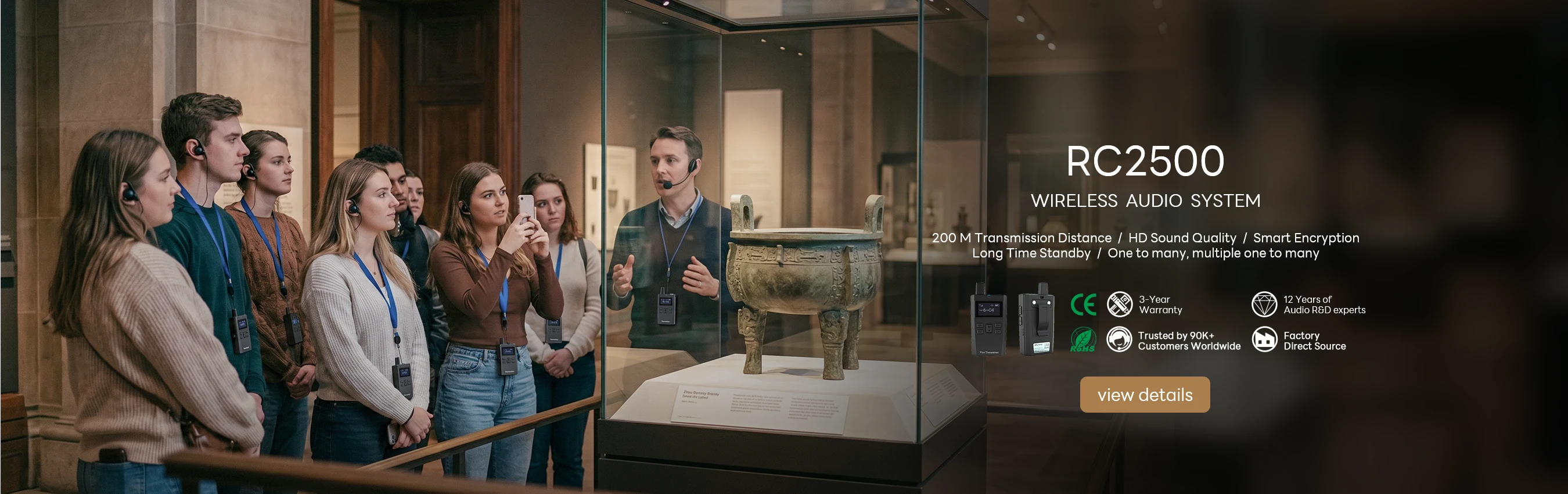
The RC2408 Wireless Tour Guide System is the middle answer and the one most likely to be quoted for a landside terminal. Eighty channels on 2403 to 2483MHz over a quoted one to two hundred metres at 10 milliwatts, with the documented special design note reading 80-channel interference resistance and the core advantages listed as 80 channels, strong interference resistance and stable performance. Ten hours on the transmitter and twenty on the receiver come from 3.7V 1500mAh and 3.7V 1000mAh cells, charging over a DC port.
Two specifications here are worth more than the channel count. Transmit audio response reaches 50Hz to 200kHz against a receive figure of 50Hz to 12kHz, which is a wide path on the transmit side and means this is the unit to specify if the same channel has to carry recorded material as well as a live voice. And multiple colours are available at volume, which for a terminal issuing eighty handsets from a kiosk is the difference between a queue that moves and a queue that stops while staff look for the right box.
Where it sits physically is 59 grams on the transmitter and 50 on the receiver, 236 by 144 by 17.4 millimetres, with PLL control. Against the RC085 it gives up the UHF band and about forty channels, and it gains 15 to 20kHz of transmit bandwidth, half an amp-hour of transmitter capacity, three grams and one colour option fewer on the heaviest side.
The honest limitation is the one the band imposes. At 2.4GHz this unit is at its best in the terminal hall and on an open deck, and it degrades faster than the UHF unit as steel is introduced between guide and listener. It is not a failure mode — a 2.4GHz system works inside many steel saloons at short range — but it is a shorter margin, and the margin shrinks deck by deck as the passenger moves further from the guide.
Two operational details decide whether it works in practice. A hands-free microphone option matters on a moving vessel because the guide is holding a railing, a child's hand or a cane, and a handheld transmitter frees one hand for the microphone clip. And twenty hours of receiver standby means a handset issued at boarding is still working at the far terminal, which removes the charging trolley from the vehicle deck entirely — on a short crossing that trolley is often the only thing between an operator and a queue at the gangway.
RC2401: The Baseline Fifty-Channel Unit
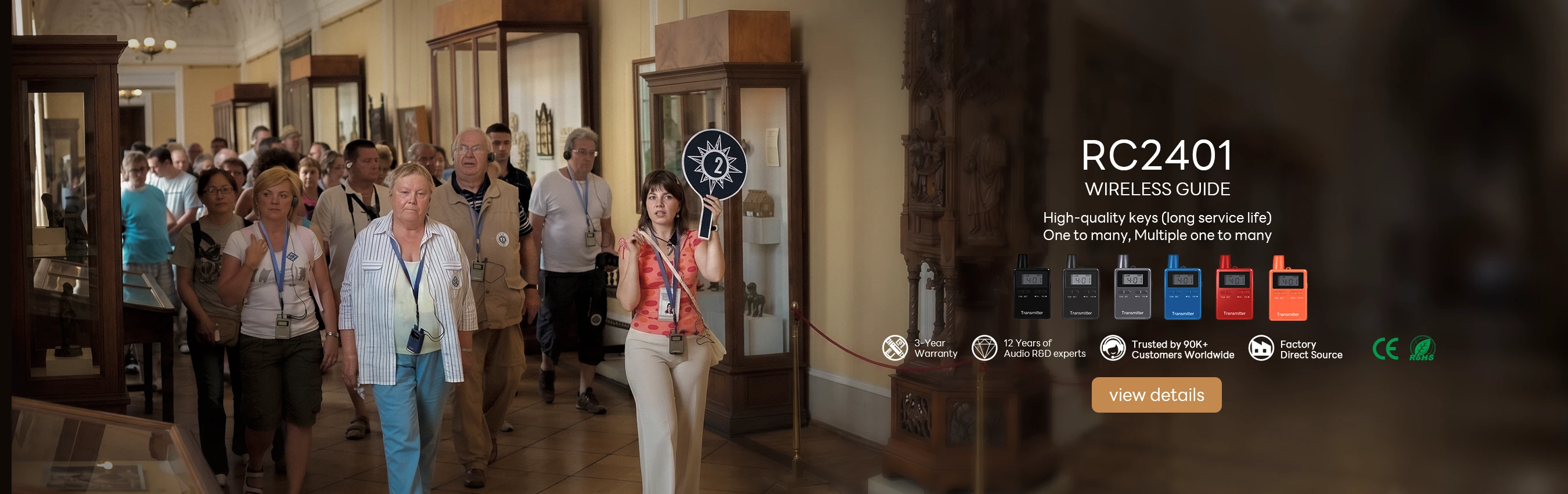
The RC2401 Wireless Audio Guide System is the entry in the group and the one most likely to be the right answer on a small vessel. Fifty channels on the same 2403 to 2483MHz band over a quoted one to two hundred metres at 10 milliwatts, with the documented description reading basic 2.4GHz standard version, easy to use and high in value. Ten hours of transmitter and twenty of receiver run from 1500mAh and 1000mAh cells, and the 59 and 50 gram pair is identical to the RC2408's.
What changes is the ceiling and the audio path. Fifty channels is two thirds of the RC2408's eighty, and the transmit figure of 50Hz to 200kHz with receive at 50Hz to 12kHz is the same in both, so this unit is not the cheaper option on audio — it is the smaller one on scale. Multiple colours are available at volume, which for a small operator running two or three groups is genuinely sufficient and removes the reason to buy the larger model.
The special design note on this model reads basic 2.4GHz standard version, which is a plain way of saying it has no documented special feature. No microphone option is recorded, no sensitivity figure is quoted, and no marine or ingress specification appears. Against a fifty-channel ceiling, a ferry running four simultaneous groups has room to spare; one running nine does not, and at that point the RC085's hundred channels stop being a luxury.
The battery figures are the quiet advantage here. Twenty hours of receiver standby means a handset issued at the gangway at nine in the morning is still working on an afternoon sailing, and for a rental fleet that has to be counted back in at the end of each crossing it removes a charging pool rather than shrinking one. Charging is over a DC port on both halves, which means one cable type across the fleet rather than two.
The trade is worth stating in a sentence: this unit and the RC2408 differ by thirty channels and a documented interference feature, and for a small vessel running fewer than four groups that difference is rarely the reason a passenger cannot hear the guide. The reason is more often the band, and if the crossing includes an enclosed deck that puts the RC085 back in the conversation regardless of channel count.
Asaimei K20: The Amplifier Route for an Open Deck
The Asaimei K20 wireless amplifier is listed in the economy tier for teachers, guides and amplified commentary, and its documented characteristics are original-voice output, strong volume, an 1800mAh battery described as one charge per week of use, a small light body and Bluetooth connectivity.
On an open promenade this is a genuinely better answer than a headset, and the reason is physical. A ferry's top deck has no bulkheads, no cabin corridors and no steel between the guide and the passenger — the same open-air geometry that makes a viewpoint easy. A single amplifier covering that area means no handsets to issue, no charging, no count at the gangway and no receiver dropped overboard, which on a vessel is a real and specific risk rather than a general one.
The limits are structural rather than a matter of quality. An amplifier serves one group: everyone within earshot hears the same commentary, and a second guide talking over it is not separated by anything. It also does nothing for passengers in a cabin, a vehicle deck or an indoor lounge, so it complements a commentary system on a large vessel rather than replacing it, and on a small vessel it is a reasonable substitute. The 1800mAh cell described as one charge per week suits a short duty cycle; a twelve-hour crossing with a guide commenting throughout is a different pattern of use entirely.
🎯 Beijing Dongfang Songbo: Removing the Guide Entirely
The Beijing Dongfang Songbo digital guide system is listed at multi-band in the mid-to-high tier and is documented across a very different axis: QR code and NFC triggering, a cloud content platform for content management, a broader smart cultural tourism solution, and visitor behaviour analysis. Its recorded applications are chain museums, large cultural tourism groups and smart guiding rather than any single vessel.
This is the category that a ferry route can sometimes use better than a guided system. A terminal operator running a route with historical narration along the shoreline has content that does not change during the crossing and does not need a human being to deliver it. Passengers scan at the gangway, content plays to them on their own handset, and the crew's job stays what it is on any ferry, which is safety. Nobody has to count eighty handsets back in at the far end because there are no handsets.
What it does not solve is anything live. There is no guide, which means no unscripted commentary, no response to a question, no narration timed to a specific point in the crossing and nothing for a group that splits up on a long route. The documented visitor behaviour analysis is an operational asset for a museum or a group running many sites, and for a single vessel it is a feature that produces data nobody has a process to read.
The two competitor approaches therefore frame the Richitek range rather than competing with it. One keeps the handsets off the passenger and gives up group separation. The other keeps the handsets off the passenger and gives up the guide. The three Richitek units are the ones that keep a guide talking to separated groups inside a steel box, and that is the combination neither alternative offers.
🪧 Choosing for a Vessel Rather Than for a Terminal
The table below maps each unit to the part of the operation it fits, because a ferry runs three environments that do not want the same equipment: a landside hall, an open deck, and an enclosed steel saloon. Buying one model for all three is how an operator ends up with a unit that is excellent in two of them.
One practical note belongs with any of these units. On a moving vessel the setting a passenger actually uses is established in the first five minutes, and it is usually lower than the maximum — a listener who sets the volume high enough on the promenade will find it uncomfortable three decks later. Whatever the sensitivity figure says, the useful measure is the coverage achieved at a comfortable setting, and that has to be walked on the actual sailing with the actual hull configuration.
🎯 Specification Summary and Selection Matrix
| Richitek RC085 | 470-510MHz, 100 channels, 8-10mW, 1-200m | 3.7V 1200mAh transmitter 12h; 3.7V 1000mAh receiver 20h | 65g transmitter, 60g receiver | 50Hz-12kHz | USB; black, iron grey, blue at volume | Optional head-worn or lapel and professional microphone; sensitivity approx. -102dBm |
| Richitek RC2408 | 2403-2483MHz, 80 channels, 10mW, 1-200m | 3.7V 1500mAh transmitter 10h; 3.7V 1000mAh receiver 20h | 59g transmitter, 50g receiver | Transmit 50Hz-200kHz, receive 50Hz-12kHz | DC port; multiple colours at volume | Documented 80-channel interference resistance; hands-free microphone option |
| Richitek RC2401 | 2403-2483MHz, 50 channels, 10mW, 1-200m | 3.7V 1500mAh transmitter 10h; 3.7V 1000mAh receiver 20h | 59g transmitter, 50g receiver | Transmit 50Hz-200kHz, receive 50Hz-12kHz | DC port; multiple colours at volume | Documented as basic 2.4GHz standard version, easy to use, high value |
| Asaimei K20 | No channel system published; direct amplification | 1800mAh, described as one charge per week | Described as small and light; weight not published | Original-voice output; bandwidth not published | Bluetooth connectivity | Economy tier; price not listed |
| Beijing Dongfang Songbo | Multi-band system with QR code and NFC triggering | Device batteries not published; cloud content platform | Not published | Not published | Not published | Mid-to-high tier; visitor behaviour analysis; museum and cultural tourism focus |
| Enclosed steel saloon or vehicle deck where the guide and listener are separated by bulkheads | RC085 | The only UHF unit; long wavelength diffracts around structure, and -102dBm sensitivity is the figure that matters at range |
| Terminal hall, kiosk issue and an open deck with several simultaneous groups | RC2408 | Eighty channels, zone colours at volume, 200kHz transmit bandwidth for recorded content and twenty hours of receiver standby |
| Small vessel running fewer than four groups, budget-driven, nothing enclosed | RC2401 | Fifty channels is sufficient, the audio path matches the RC2408, twenty hours of standby and colour options at volume |
| Open promenade deck where no handsets should be issued at all | Asaimei K20 | No issue, no charging, no count at the gangway, and no receivers lost overboard |
| Route with recorded shoreline narration and no live guide required | Dongfang Songbo | QR and NFC triggering removes the handset fleet entirely; crew stay on safety duties |
An operator running a conventional passenger ferry with commentary on enclosed decks is looking at the RC085, and one that has not yet decided whether commentary belongs on the vessel at all is looking at the amplifier or the self-service route first. The three Richitek units answer the question the two alternatives leave open, which is how a guide keeps talking to separated groups inside a steel box — and that question is settled by wavelength and channel count, not by output power.
Terminals running heritage routes with ticketed commentary packages can review the museum audio guide equipment overview for lighter indoor chassis, and multi-stop industrial itineraries share the same multi-guide constraints covered in the industrial tour headset page. To weigh capacity classes across the whole range before specifying, begin with the tour guide system comparison index.